

Follow-Up Email Examples That Actually Get Replies After No Response
You've sent three follow-ups to a prospect this week. Zero replies. Your sequence tool shows "opened" but you're starting to suspect that metric is lying to you. It probably is.
Here's the thing: the problem isn't always your copy. A Belkins study of 16.5M cold emails found that the highest reply rate tops out at 8.4% from just one email, and performance steadily declines with each follow-up. Meanwhile, a HubSpot email marketing report found that 40% of recipients have 50+ unread emails sitting in their inbox right now. Your carefully crafted message is competing with a wall of unread noise.
The follow-up email examples after no response below are built on data, not guesswork. Let's get into it.
Three Rules Before You Touch a Template
Before you scroll to the templates, internalize these - they matter more than any subject line hack:
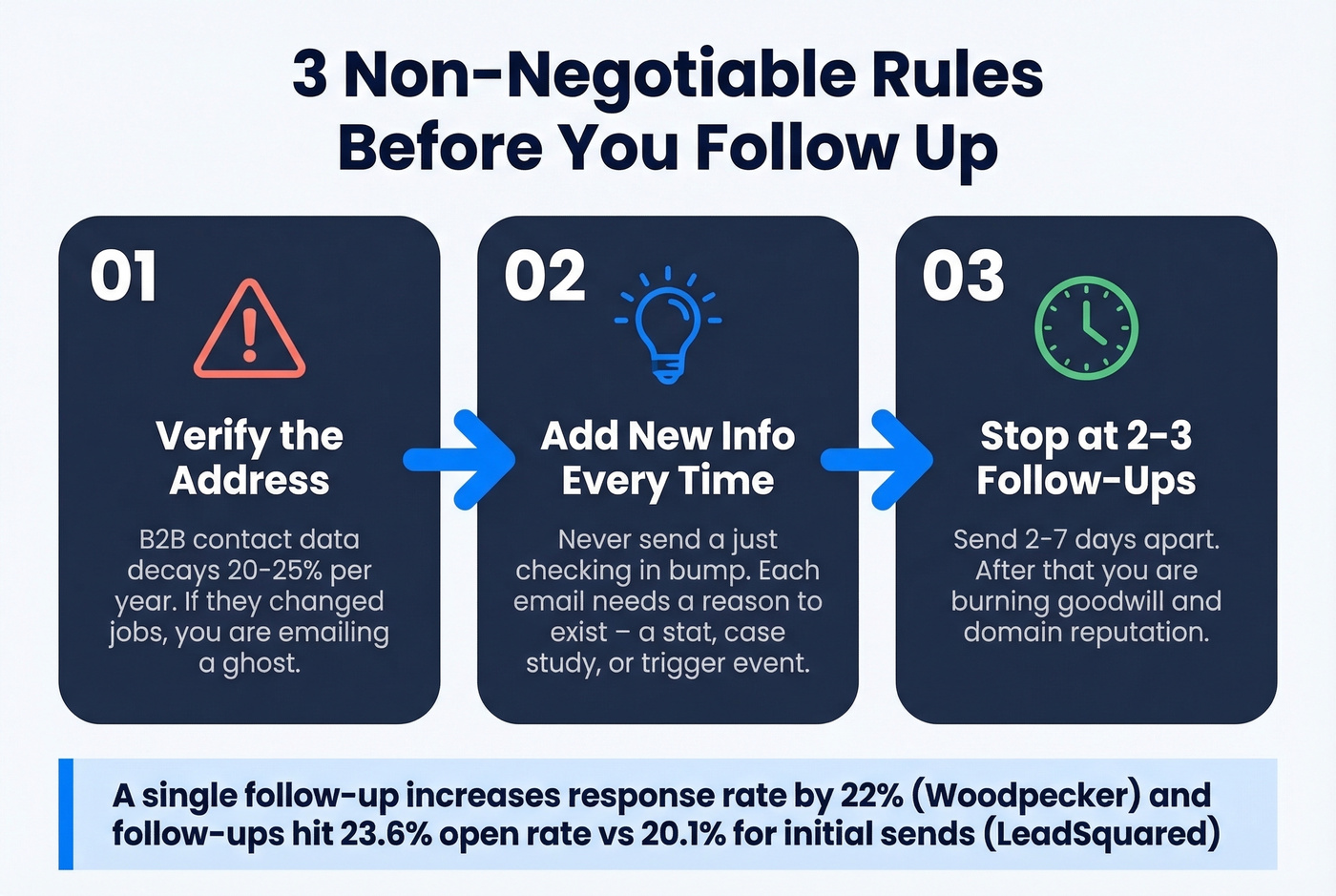
- Verify you're emailing a real, active address. Industry estimates put B2B contact data decay at roughly 20-25% per year. If your prospect changed jobs six months ago, you're following up with a ghost.
- Add new information in every follow-up. Never send a "just checking in" bump. Each email needs a reason to exist - a new stat, a relevant case study, a trigger event.
- Send 2-3 follow-ups, typically 2-7 days apart. After that, you're burning goodwill and domain reputation.
Woodpecker research found a single follow-up increases response rate by 22%. LeadSquared's own campaign data showed follow-up emails hitting a 23.6% open rate versus 20.1% for the initial send. Follow-ups work - but only when they're done right.
Subject Lines That Get Replies
Your subject line determines whether the email gets opened or buried. A Belkins/Reply.io dataset of 5.5M cold emails produced hard numbers on what actually works:
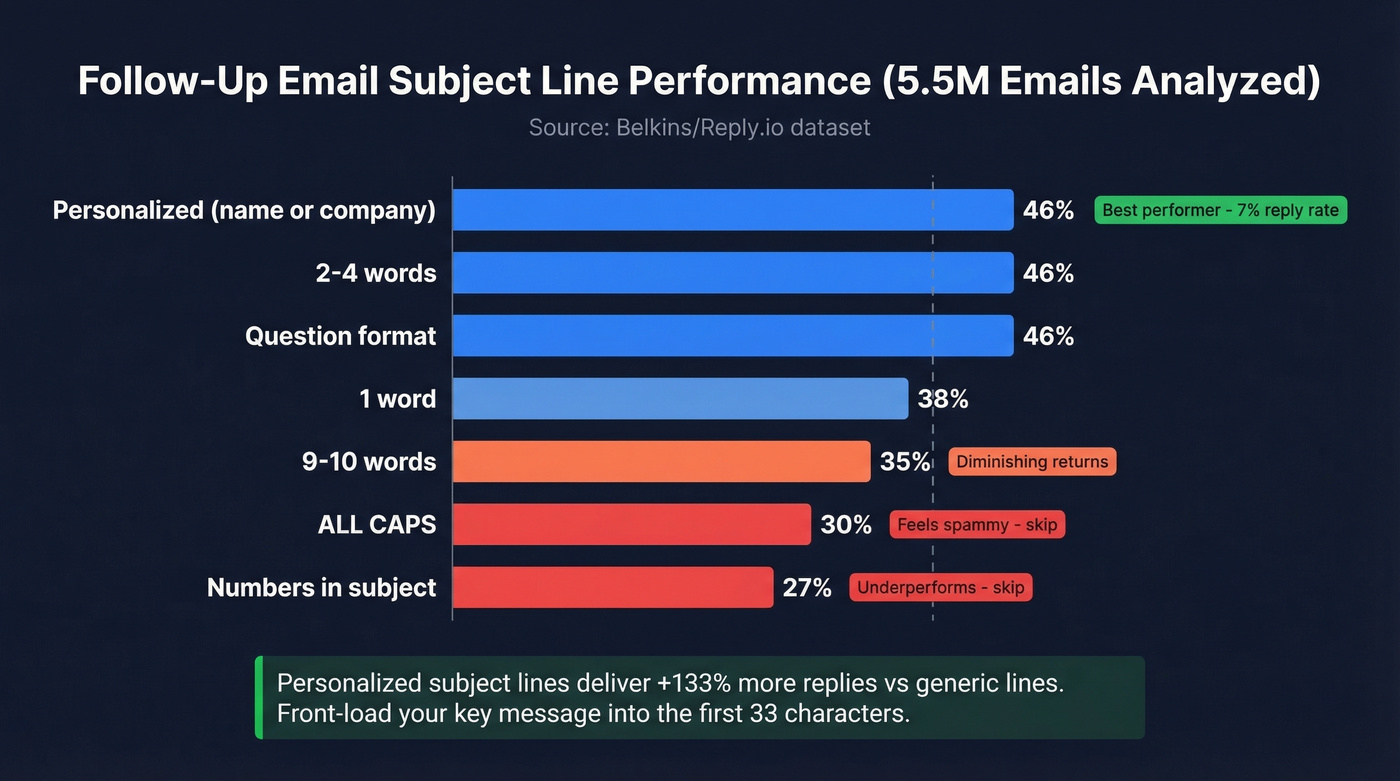
| Subject Line Type | Open Rate | Reply Rate | Verdict |
|---|---|---|---|
| Personalized (name/company) | 46% | 7% | Best performer - use this |
| 2-4 words | 46% | - | Length sweet spot |
| Question format | 46% | - | Strong opener |
| 1 word | 38% | - | Use sparingly |
| 9-10 words | 34-35% | - | Diminishing returns |
| ALL CAPS | 30% | - | Feels spammy - skip |
| Numbers in subject | 27% | - | Underperforms - skip |
Personalized subject lines - ones that include the recipient's name, company, or a specific reference - deliver 46% opens and 7% replies. That's +133% on replies versus generic lines. Front-load your key message into the first 33 characters, because that's all most mobile clients display. We've broken down the full data in our separate guide on subject lines for follow-up emails.
Phrases to retire permanently: "Quick question," "Following up," "Just checking in," fake "Re:" prefixes, and anything with "ASAP" or "Urgent." In the same dataset, urgency words pushed opens below 36%. They feel manipulative, and recipients have been trained to ignore them.
One caveat on open rates worth knowing: Apple Mail Privacy Protection pre-loads tracking pixels, inflating open rates by roughly 18 points. Apple Mail accounts for about 46% of email clients. Belkins stopped tracking open rates in 2024 because of pixel impact - if the company that analyzed 16.5M cold emails doesn't trust opens, neither should you. Track reply rate instead. It's the only metric that can't be faked.
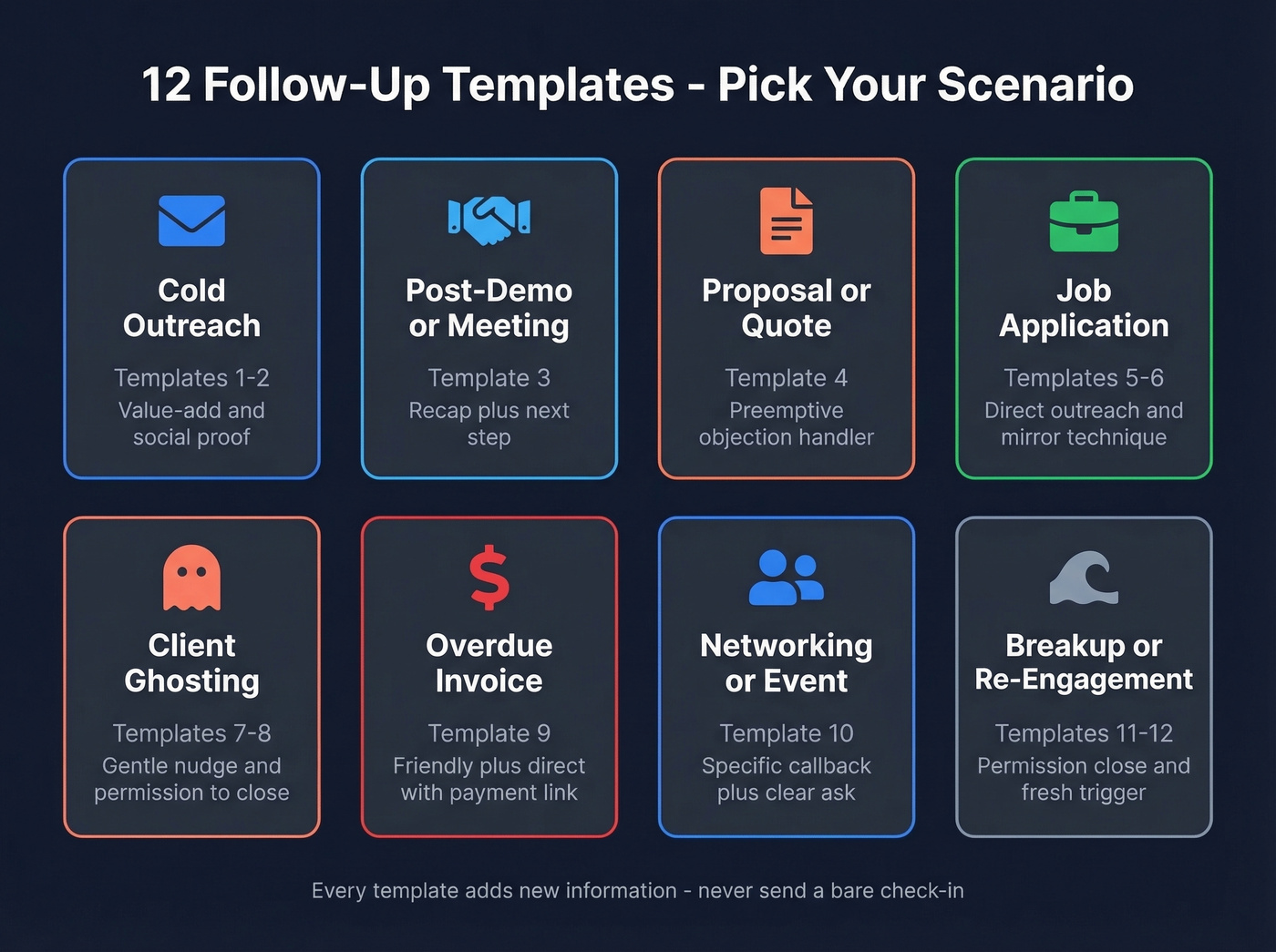
12 Templates for Every No-Response Scenario
Every template below includes a one-line rationale explaining why it works. Copy the structure, swap in your details, and send.
Cold Outreach Follow-Up
Template 1 - Value-Add with New Proof Point
Subject: [First name], quick data point on [their pain]
Hi [First name],
Since my last note, [Company X] published data showing [specific stat relevant to their industry]. It reminded me of what your team is likely dealing with on [specific challenge].
We helped [similar company] cut [metric] by [result] in [timeframe]. Happy to share the playbook if it's useful.
Worth 15 minutes this week?
Each follow-up introduces new information - a fresh stat, a new proof point. The recipient gets value even if they don't reply.
Template 2 - Social Proof with Case Study Snippet
Subject: How [similar company] solved [pain point]
Hi [First name],
[Similar company in their space] was dealing with [same problem]. They [specific action] and saw [specific result] within [timeframe].
I think there's a direct parallel to what [their company] is working on. Want me to send the full breakdown?
Social proof from a peer company is the strongest persuasion lever in B2B. Naming a specific company and result makes it concrete, not hand-wavy.
Post-Demo / Post-Meeting
Template 3 - Recap + Next Step + Deadline
Subject: Next steps from our call
Hi [First name],
Great speaking Thursday. To recap: you mentioned [specific pain they described] and wanting to [goal they stated]. I'm sending over [resource/proposal/recording] as promised.
Can we lock in a follow-up by [specific date] to walk through the next steps with [other stakeholder they mentioned]?
Mirroring their own words back shows you listened. The specific date creates gentle urgency without "ASAP" energy.
Proposal or Quote Follow-Up
Template 4 - Preemptive Objection Handler
Subject: One thing I should've addressed
Hi [First name],
I realized I didn't fully address [likely objection - budget, timeline, implementation]. Most teams we work with had the same concern. Here's how [client] handled it: [one-sentence solution].
Does that change the picture? Happy to jump on a quick call to work through the details.
Silence after a proposal usually means an unspoken objection. Naming it proactively shows confidence and removes the friction of them having to bring it up.
Job Application Follow-Up
Template 5 - Post-Apply Outreach to Hiring Manager
Subject: Applied for [role] - quick note
Hi [Hiring manager name],
I just applied for the [role title] position. Rather than let my resume sit in the ATS, I wanted to reach out directly.
I noticed [specific detail about team/company - recent product launch, hiring trend, public challenge]. In my last role at [company], I [specific accomplishment that maps to their need].
Would love to chat about how I could contribute. Available anytime this week.
A hiring manager with 1,000+ interviews says direct outreach - not the ATS - is the single highest-leverage move.
Template 6 - Post-Interview Thank-You (Mirror Technique)
Subject: Loved hearing about [specific thing they mentioned]
Hi [Interviewer name],
Thank you for the conversation today. When you mentioned that [key attribute for success in the role] and [biggest challenge the team faces], it clicked immediately.
At [previous company], I [specific experience that directly maps to their stated success criteria]. I'd be excited to bring that same approach to [their team's primary goal they mentioned].
Looking forward to next steps.
Ask about success criteria during the interview, then mirror those exact priorities back. It shows you're already thinking like someone on the team.
Client Ghosting Follow-Up
Template 7 - Gentle Nudge with Value Reminder
Subject: Still on your radar?
Hi [First name],
I know things get busy. Just wanted to flag that [specific deliverable/deadline/opportunity] is coming up on [date], and I want to make sure we're set on your end.
Is there anything blocking us from moving forward? Happy to adjust the scope if priorities have shifted.
Acknowledges their silence without guilt-tripping. The "adjust the scope" line gives them an easy out that keeps the conversation alive.
Template 8 - Permission to Close the File
Subject: Should I close your file?
Hi [First name],
I haven't heard back, so I want to respect your time. If this project is no longer a priority, totally understood - I'll close out your file on my end.
If timing has just shifted, let me know and we'll pick it back up when you're ready.
Loss aversion drives this one. Nobody wants their file "closed." This template consistently generates replies because it gives the recipient a concrete thing to lose.
Overdue Invoice
Template 9 - Friendly + Direct with Payment Link
Subject: Invoice #[number] - quick reminder
Hi [First name],
Just a heads-up that invoice #[number] for [amount] was due on [date]. I've attached it again for easy reference. You can pay directly here: [payment link]
If there's an issue with the invoice or payment terms, let me know and we'll sort it out.
The payment link removes friction. Most overdue invoices aren't malicious - they're just buried. Making payment one click away solves the actual problem.
Networking / Event Follow-Up
Template 10 - Specific Callback + Clear Ask
Subject: From [event name] - [topic you discussed]
Hi [First name],
Great meeting you at [event]. Our conversation about [specific topic - not just "your work"] stuck with me, especially [specific detail they shared].
I'd love to continue that thread. Would you be open to a 20-minute call next week? I think there's a real overlap between [your thing] and [their thing].
Specificity proves you were paying attention. "Great meeting you" alone is forgettable. "Our conversation about migrating off Marketo" isn't.
Breakup Email
Template 11 - Permission-Based Close
Subject: Not the right time?
Hi [First name],
I've reached out a few times and haven't heard back - totally fine if now isn't the right time.
I'll stop following up, but if [pain point] becomes a priority again, my door's open. Just reply to this thread and we'll pick up where we left off.
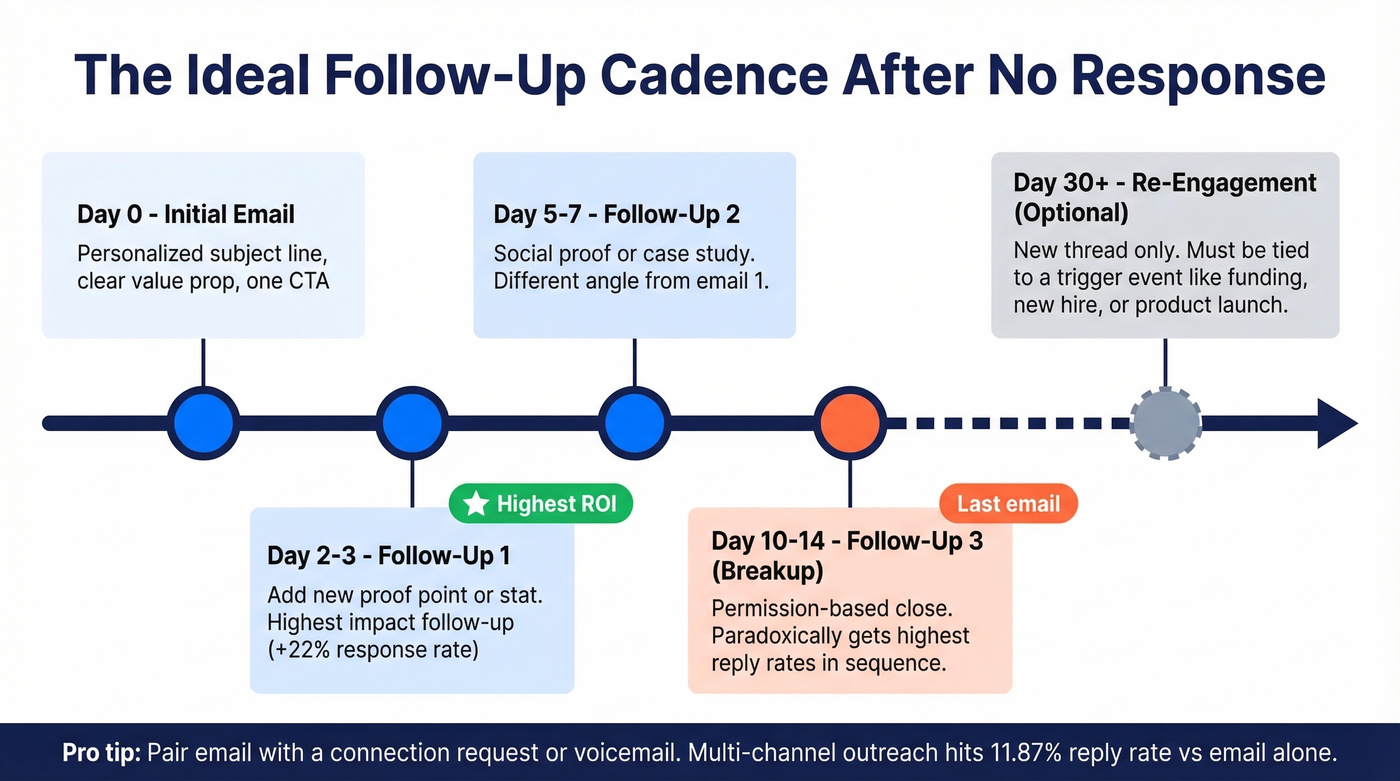
Paradoxically, breakup emails often get the highest reply rates in a sequence because they eliminate the obligation to commit. Removing pressure creates space for a genuine response.
Re-Engagement After 30+ Days
Template 12 - Fresh Thread, New Angle
Subject: [Trigger event - funding round, new hire, product launch]
Hi [First name],
Saw that [their company] just [trigger event]. Congrats - that usually means [implication relevant to your product/service].
We've been working with [similar company] on exactly this, and the results have been [specific outcome]. Figured it was worth a fresh note.
Open to a quick conversation?
After 30+ days, your old thread is dead. A new subject line tied to a real trigger event gives you a legitimate reason to re-engage without feeling like you're pestering.
Pro tip: Pair email follow-ups with a connection request or a brief voicemail. The 16.5M-email dataset found that a message + visit combo on a professional network hit an 11.87% reply rate - outperforming email follow-ups alone. Don't limit yourself to one channel.

You read it above: B2B contact data decays 20-25% per year. Every follow-up to a dead address burns your domain reputation and wastes a sequence slot. Prospeo's 7-day data refresh and 98% email accuracy mean your follow-ups actually land in real inboxes.
Stop following up with ghosts. Start with verified data.
The SPBC Sequence Framework
Templates are useless without a cadence. Here's the framework we've seen work consistently across outbound teams - think of it as the engine that turns individual templates into a coordinated system.
SPBC stands for Spark, Proof, Bridge, Close. Each phase has a job, and each email in your sequence maps to one:
| Email # | Day | Gap | SPBC Phase | Job |
|---|---|---|---|---|
| 1 (Initial) | Day 1 | - | Spark | Introduce pain point |
| 2 | Day 3 | 2 days | Spark | New angle on pain |
| 3 | Day 7 | 4 days | Proof | Case study / social proof |
| 4 | Day 14 | 7 days | Proof | Specific result / stat |
| 5 | Day 21 | 7 days | Bridge | New resource / trigger event |
| 6 | Day 30 | 9 days | Bridge | Different angle entirely |
| 7 | Day 45 | 15 days | Close | Breakup - permission to close |
The gaps widen deliberately. Early follow-ups (Day 3, Day 7) keep you top of mind while the pain is fresh. Later emails (Day 21-45) space out to avoid fatigue. Best send windows: Tuesday through Thursday, 10am-12pm in the recipient's local time zone.
Most teams don't need all seven emails. Roughly 79% of all replies arrive by the fifth email - everything after that is diminishing returns. The reply rates by company size tell an even clearer story:
| Company Size | Initial Reply | After 1 Follow-Up | After 4 Emails |
|---|---|---|---|
| Small business (2-50) | 9.2% | 8.0% | - |
| Founders | 6.64% | 6.66% | 3.01% (steep drop) |
If you're selling to founders, four emails is your absolute ceiling. After that, replies crater to 3%. I've watched teams burn entire domains chasing that fifth and sixth touch - it's painful to see. For small businesses, the curve is flatter and you've got more room. Adjust your sequence length to your audience, not to some universal "send 7 emails" rule.
When email isn't getting traction by email 3 or 4, escalate channels. A well-timed phone call after a breakup email is one of the highest-converting touches in outbound - the prospect feels the pressure is off, and a voice conversation resets the dynamic entirely. A/B test your subject lines and angles across the sequence too. Small changes in the Spark phase compound through every email that follows.
5 Mistakes Killing Your Replies
1. Bumping with No New Info
"Just wanted to make sure you saw my last email" adds zero value. As one r/coldemail poster put it, after 3 follow-ups (4 total emails), returns are "basically zero" if you're not bringing something new each time. Compare:
- Bad: "Hi Sarah, just bumping this to the top of your inbox."
- Good: "Hi Sarah, since my last note, we helped [company] generate 10-15 warm leads in January using the approach I mentioned. Thought you'd want to see the numbers."
The second email gives Sarah something new to evaluate. The first one just reminds her she's been ignoring you.
2. Ignoring the Real Objection
Silence means one of five things: no need, cost concerns, no urgency, they don't want it, or they don't trust you. Your follow-up should address the most likely objection head-on, not pretend it doesn't exist. If you sent a proposal and heard nothing, the objection is almost certainly price or timing. Name it.
3. HTML-Heavy Formatting
Fancy templates with headers, images, and styled buttons scream "marketing email." Your follow-ups should look like a real person typed them - plain text, short paragraphs, reply-thread style. The goal is to land in the primary inbox, not the promotions tab. Every template in this guide uses plain-text formatting for exactly this reason.
4. Wrong Frequency, No Stop Rule
Sending four emails in eight days is aggressive. Sending four emails in four days is harassment. The 16.5M-email dataset shows that 4+ emails in a sequence more than triples your unsubscribe and spam complaint rates. Set a stop rule: we use 3 follow-ups for cold outreach, 2 for warm leads, and 1 for post-meeting.
5. Not Verifying Contact Data
Look - a common reason for silence isn't that your email was bad. It's that it never arrived. B2B contact data decays at roughly 20-25% per year. People change jobs, companies switch domains, and catch-all servers silently swallow your emails without bouncing them.
We've seen teams at Prospeo catch 30%+ dead addresses in lists they thought were clean, using a 5-step verification process that handles catch-all domains, spam traps, and honeypot filtering - delivering 98% email accuracy on a 7-day refresh cycle. The free tier gives you 75 verifications per month, enough to audit your most important sequences before you hit send.
Verify Your Data Before Following Up
Let's be honest about a scenario we see constantly: you've crafted three thoughtful follow-ups to a VP of Marketing, each one adds new value, follows the SPBC framework, and lands on the right day. Zero replies. You assume they're not interested. In reality, that VP left the company four months ago and you've been emailing a dead address the entire time.
Skip this step if you're only emailing a handful of people you know personally. But for any list over 50 contacts, verification isn't optional - it's the difference between a 2% reply rate and a 6% one.
If you want a deeper deliverability checklist, start with our email deliverability guide and then audit your sender reputation.
The best follow-up template in the world won't save you if you're emailing someone who changed jobs six months ago. Prospeo tracks job changes across 300M+ profiles so your sequences reach the right person at the right company - for about $0.01 per email.
Fix your contact data before you fix your copy.
FAQ
How long should I wait before following up?
For cold outreach, wait 2-3 business days before your first follow-up. After a job interview, send a thank-you the same day. For proposals, 3-5 business days is the sweet spot - long enough to avoid seeming desperate, short enough to stay relevant. The SPBC cadence table above maps exact timing email by email.
How many follow-ups is too many?
Two to three follow-ups works for most scenarios. The 16.5M-email study found that 4+ emails in a sequence more than triples spam complaints. For founders specifically, reply rates drop from 6.66% to 3.01% by the fourth email. More isn't better - it's just noisier.
Should I keep the same thread or start fresh?
Keep the same thread for your first one or two follow-ups - it provides context and feels like a natural conversation. After day 14, or if you suspect they never opened, start a fresh thread with a new subject line tied to a different angle or trigger event. Template 12 above is built for exactly this scenario.
What if I still get no response after all follow-ups?
Send the breakup email (Template 11), then move the contact to a nurture track in your CRM. Consider channel escalation - a phone call is harder to ignore, and a professional-network message + profile visit combo pulls an 11.87% reply rate. Some of the best-converting touches come from a well-timed call after a breakup email, when the prospect feels the pressure is off.
How do I know my emails are actually being delivered?
Verify addresses before sending. Catch-all domains, role-based addresses, and job changes all create silent delivery failures that look like "no response" but are really "never arrived." Prospeo's free tier lets you verify 75 emails per month - enough to audit your active sequences and catch dead addresses before they hurt your sender reputation.