

Follow-Up Email Generators Don't Work - Here's What Does
A RevOps lead we work with tested a popular follow-up email generator against a custom ChatGPT prompt she'd spent ten minutes writing. The ChatGPT version got noticeably better replies. The difference wasn't the AI - it was the specificity of the input. Most generators ask for a name and a topic. That's not enough context to write anything worth reading.
Follow-ups generate 42% of all campaign replies, yet 48% of reps never send a second email. The problem isn't laziness - writing good follow-ups is genuinely hard, and the tools promising to automate it mostly produce garbage. Below: templates you can steal, three copy-paste ChatGPT prompts that outperform any generator, and the timing data to back it all up.
What You Need (Quick Version)
- For quick one-offs: QuillBot's free generator is fine for a fast first draft - just rewrite the parts that don't sound like you.
- For serious outbound: Skip generators entirely. Use the ChatGPT prompts later in this article to write follow-up emails with a 40-60 word format and a soft CTA.
How Many Follow-Ups Should You Send?
Fewer than you think. Belkins analyzed 16.5M cold emails across 93 business domains and found the highest reply rate - 8.4% - came from a single email. Not a five-touch sequence. Not a seven-step cadence. One email.
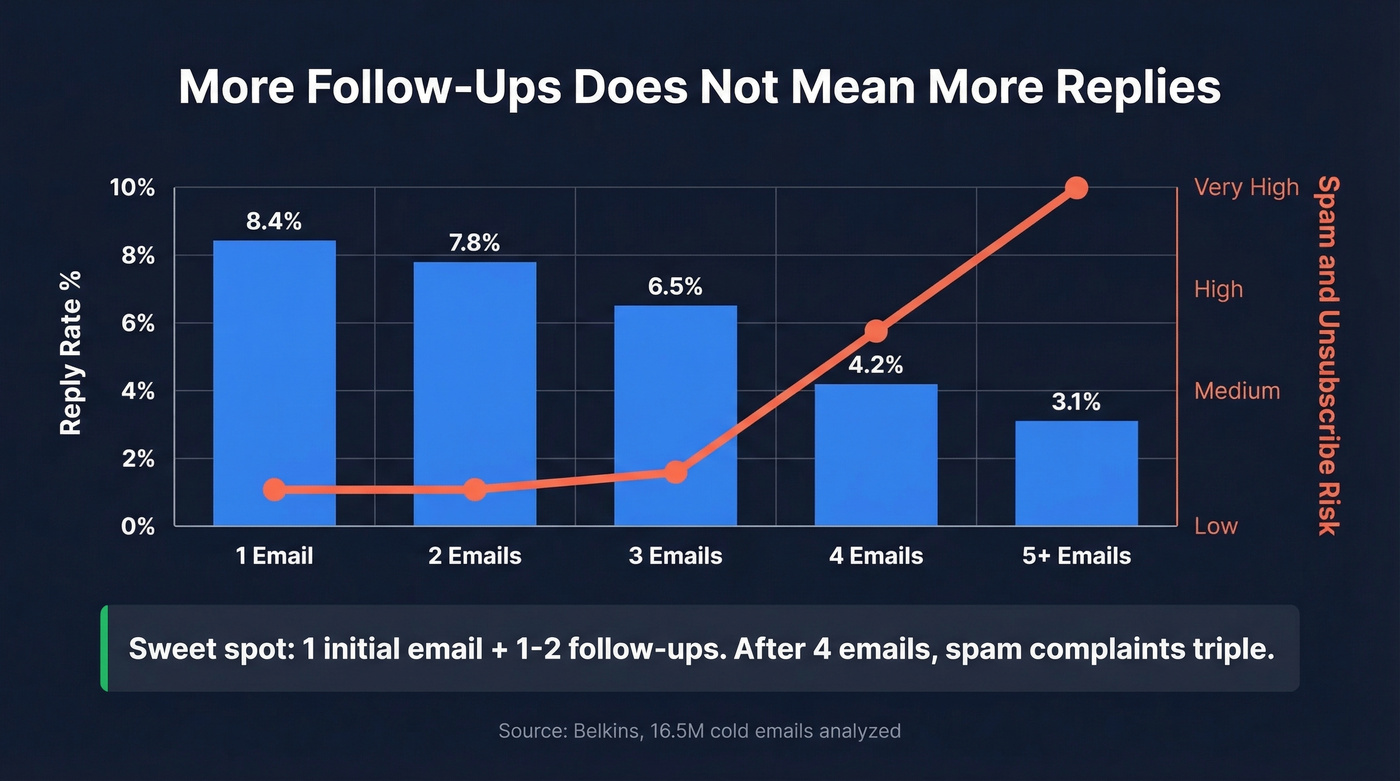
Every additional follow-up showed diminishing returns. At 4+ emails in a sequence, unsubscribe and spam complaint rates more than tripled. That's not persistence - that's domain damage.
Instantly recommends 4-7 emails per sequence to maximize total replies, and Outreach.io cites 5-12 touchpoints before closing. But Belkins' data tells a different story: unsubscribe and spam complaints triple at 4+ emails. The right answer depends on your list quality and sender reputation. Most teams should start conservative with one initial email plus one or two follow-ups, then expand only if their domain health stays clean.
Here's the thing: if you're closing deals under $10k, you almost certainly don't need a seven-step cadence. Two emails and a move-on is the right play. Save the long sequences for enterprise deals where the payoff justifies the domain risk.
Small businesses with 2-50 employees tolerate a second follow-up reasonably well, with reply rates holding around 8%. Founders are touchier - reply rates drop from 6.64% to 3.01% by the fourth touch. Know your audience and stop before you become noise.
Belkins also found that combining a message with a profile visit on professional networking platforms produced an 11.87% reply rate - higher than any email-only sequence. If your first follow-up gets silence, a multi-channel touch might outperform a second email entirely.
When to Send Follow-Ups
35-50% of sales go to the vendor that responds first. Speed matters more than polish.
| Scenario | Send Within |
|---|---|
| No response | 3-5 business days |
| After a demo | 24 hours |
| After a sales call | 2 hours |
| After a proposal | 2-3 days |
| After contract sent | 2-3 days |
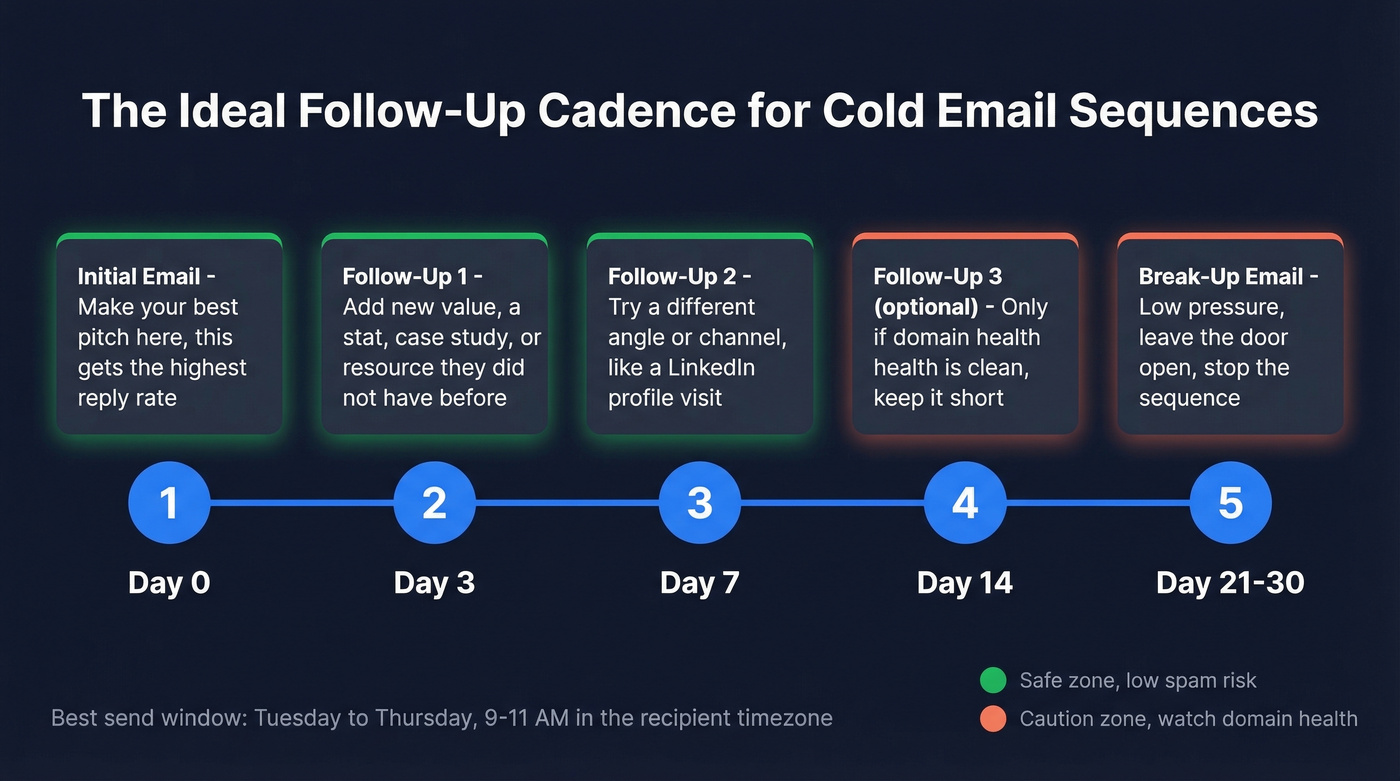
For multi-step sequences, Instantly recommends expanding gaps as the sequence progresses: Day 0, Day 3, Day 7, Day 14, Day 21, Day 30. Early touches can be tighter because the conversation is fresh. Later touches need breathing room.
Best send window: Tuesday through Thursday, 9-11 AM in the recipient's timezone. Not yours - theirs.
Subject Lines That Get Opened
Cold email open rates sat at 27.7% as of the latest benchmarks - down from 36% just two years prior. Your subject line is doing more heavy lifting than ever.
Do this:
- Keep it under 33 characters - that's the mobile truncation cutoff
- Reference something specific from your prior interaction
- Use curiosity gaps or pattern interrupts ("Quick thought on your Q3 pipeline")
- Test by reply rate, not opens - opens are increasingly unreliable with privacy proxies
Don't do this:
- Avoid using the word "follow-up" in the subject line. NetHunt's research flags this as an engagement killer - it signals obligation, not value.
- Skip "Free," "Guarantee," or ALL CAPS - these trip spam filters
- Don't fake a "Re:" when there's no existing thread. Prospects notice, and it erodes trust immediately.
Subject line optimization has a ceiling, though. If the email body is generic, a clever subject line just gets you an open and a delete.

Your follow-up copy doesn't matter if 17% of emails bounce. Prospeo verifies every email through a 5-step process - 98% accuracy, 7-day refresh cycle - so your carefully crafted follow-ups actually reach real inboxes instead of destroying your sender reputation.
Stop writing perfect follow-ups to dead email addresses.
Five Mistakes That Kill Replies
Bumping with no new information
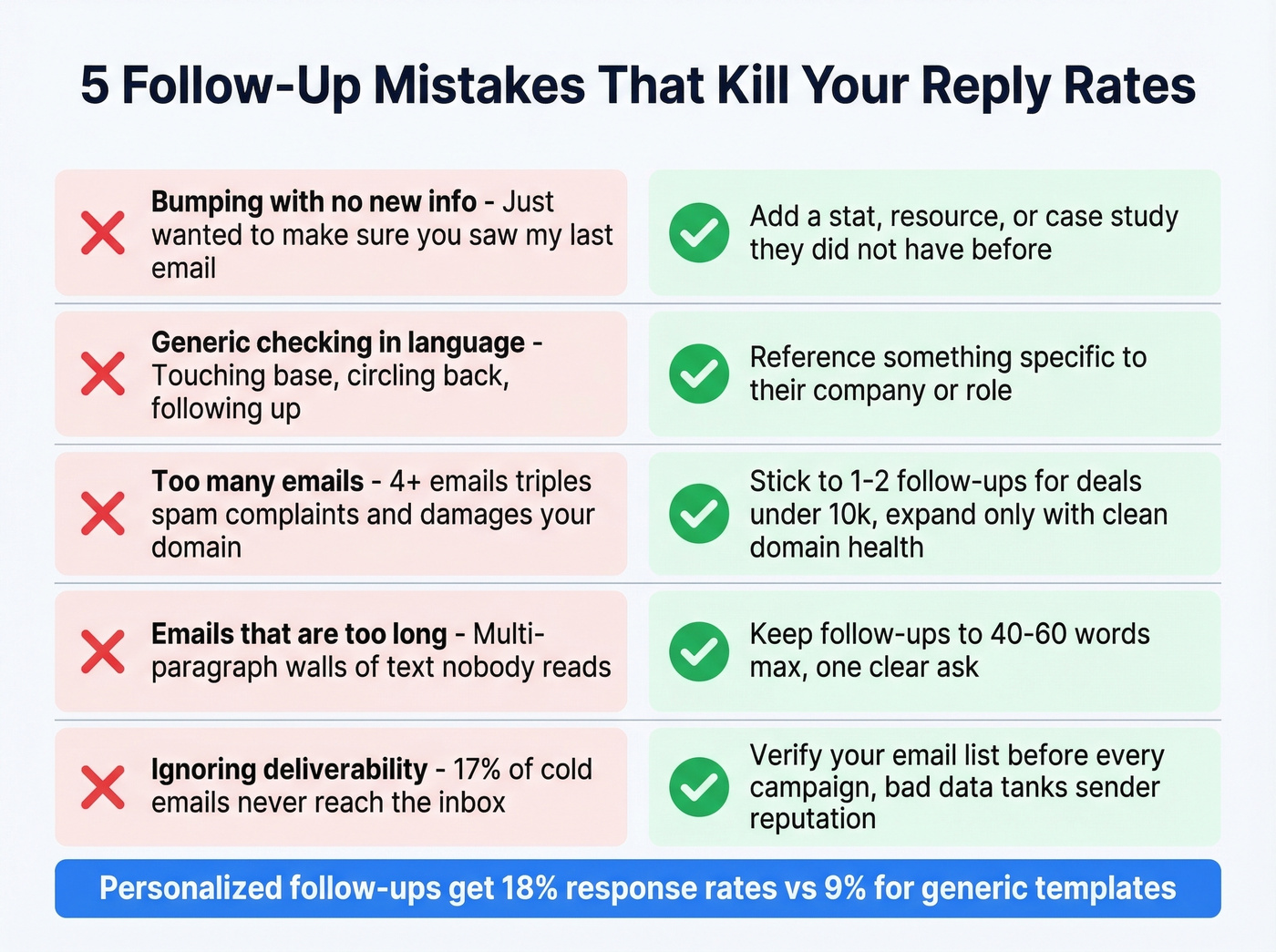
"Just wanted to make sure you saw my last email" adds zero value. Every follow-up needs to bring something the prospect didn't have before - a stat, a resource, a relevant case study. GMass calls this the single most common follow-up mistake, and we've seen the same pattern across our own outbound campaigns.
GMass outlines five core objections behind every non-response: no need, not worth the cost, no urgency, don't want it, or don't trust you. Your follow-up should address at least one of these head-on. If you can't identify which objection you're overcoming, you don't have something new to say - and you shouldn't send the email.
Generic "checking in" language
"Checking in" and "touching base" are the email equivalent of elevator music. They signal that you couldn't think of a reason to write. Replace them with a specific hook tied to the prospect's world.
Too many emails, wrong frequency
4+ emails triples spam complaints. More isn't better. More at the wrong cadence is actively destructive to your sender reputation and domain health.
Emails that are too long
The consensus on r/copywriting is clear: cold emails performing in 2026 are 40-60 words max. One practitioner shared a 47-word email that consistently outperformed longer versions. Your follow-up isn't a whitepaper - it's a conversation starter.
Ignoring deliverability
17% of cold emails never reach the inbox. You could write the perfect follow-up and it won't matter if it lands in spam or bounces. Verify your list before sending - bad data tanks your sender reputation, and recovering from that takes weeks of consistent sending discipline.
Follow-Up Templates That Work
Personalized follow-ups get ~18% response rates versus ~9% for generic templates. That's a 2x difference from the same effort - you just need to swap the generic parts for specific ones.
After No Response (Sales)
Subject: [Specific metric] for [Company]
Hi [Name],
Sent you a note last Tuesday about [specific topic]. Since then, I pulled some data - companies in [their industry] using [your approach] are seeing [specific result].
Attached a one-pager if you're curious. Worth a quick conversation?
[Your name]
52 words. Adds new value with the data point. The CTA is soft - "worth a conversation?" not "let's book 30 minutes."
After a Demo
Don't overthink this one. Hit these four elements within 24 hours and you're ahead of 90% of reps:
- Reference a specific pain point they raised during the call
- Connect that pain point to a specific feature or outcome
- Propose a concrete next step with a date
- Ask if they need anything else before then
Keep it under 100 words. The prospect remembers the demo - you're reinforcing, not re-selling.
After an Interview
80% of hiring managers say thank-you notes affect their decisions, yet fewer than half of candidates send them. This is the easiest competitive advantage in job searching.
Subject: Thanks - loved the [specific topic] discussion
Hi [Name],
Thank you for the conversation today. Your point about [specific thing they said] really resonated - it's exactly the kind of challenge I'd be excited to tackle in this role.
Looking forward to next steps. Happy to provide anything else you need.
Send within 24 hours. Reference something specific. That's it.
Invoice / Payment Reminder
Subject: Invoice #[number] - due [date]
Hi [Name],
Quick reminder that invoice #[number] for $[amount] was due on [date]. I've reattached it here for convenience.
Could you confirm when payment will be processed? Happy to hop on a quick call if there's anything to sort out.
The Break-Up Email
Most reps are afraid to send this one. They shouldn't be.
Before (what most reps send): "Hi [Name], just following up again on my previous emails. Would love to connect when you have a chance."
After (what actually works): "Hi [Name], I've reached out a couple of times about [topic] and haven't heard back - totally understand if the timing isn't right. I'll assume this isn't a priority now and won't follow up again. If things change, I'm here."
Low pressure, leaves the door open, and respects their time. That's the formula.
Skip the Generator - Use These AI Prompts
Writing emails eats up roughly 28% of the average workday - about 11 hours per week. Generators promise to fix this, but they fail because they don't know enough about your situation. A generator that asks for "recipient name" and "topic" can't compete with a prompt that includes your prospect's role, their company's recent funding round, and the specific pain point you're solving.
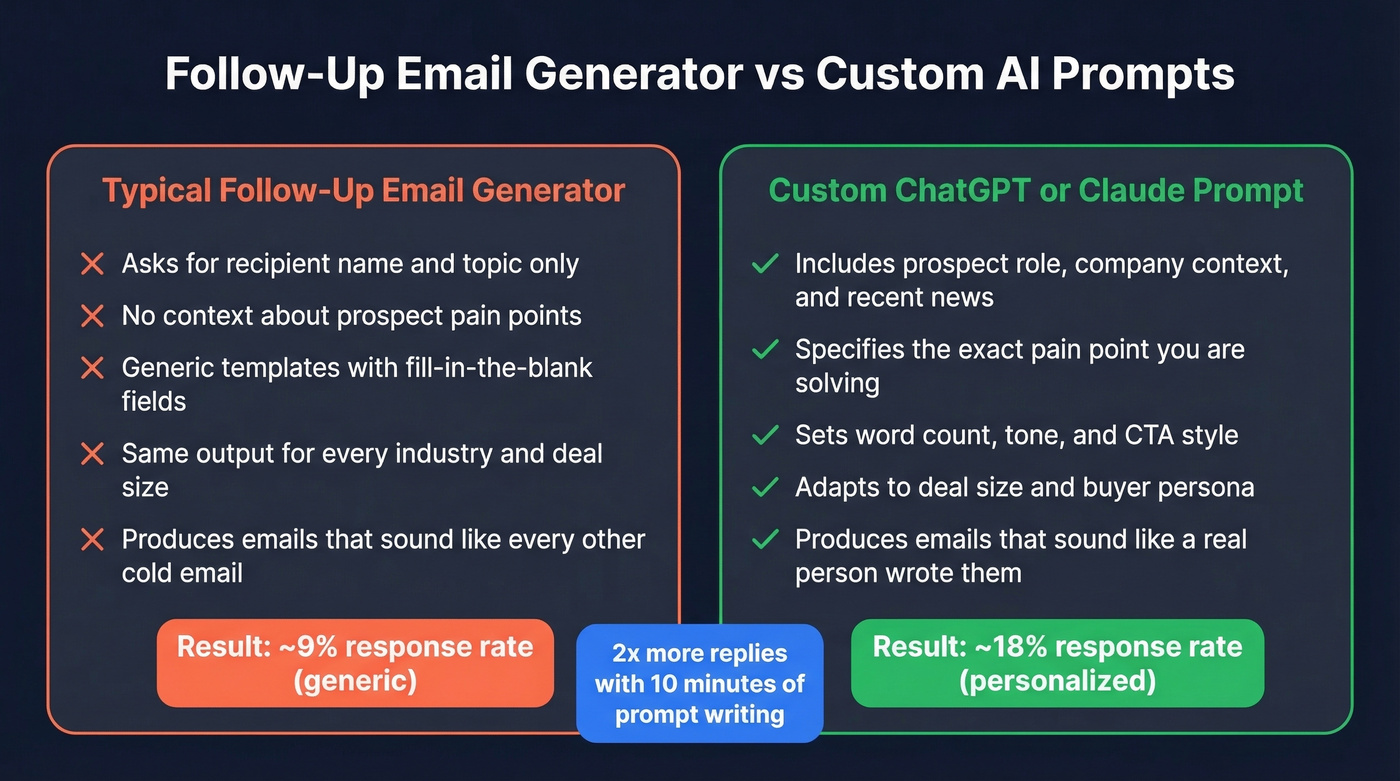
Some generators like Enrich Labs let you toggle between ChatGPT, Claude, and Grok in one interface - but you still get better results writing your own prompts with full context. The model matters less than what you feed it.
Cold Follow-Up Prompt
Write a follow-up email to [Name], [Title] at [Company]. I emailed them
[X days] ago about [specific topic]. They haven't responded. Keep it under
60 words, conversational tone. Include this pain point: [their specific
challenge]. End with a soft CTA like "Worth a conversation?" Do not use
"checking in" or "following up."
Post-Demo Follow-Up Prompt
Write a follow-up email based on these call notes: [paste notes]. Extract
2-3 key features we discussed and the prospect's main pain point. Keep it
200-250 words. Reference specific things they said. End with a clear next
step (proposal by [date] or second call). Tone: professional but warm.
Three-Email Sequence Prompt
Write a 3-email follow-up sequence for [Name] at [Company] who hasn't
responded to my initial outreach about [topic]. Each email should be
100-150 words, spaced 5-7 days apart. Email 1: share a relevant insight.
Email 2: include a brief case study. Email 3: break-up email with a soft
close. Each email must add new value   -   never just "bump" the previous one.
These prompts are adapted from SendTrumpet's framework, which produces consistently usable output. Treat your prompt like a creative brief, not a one-line request.
Best Follow-Up Email Tools in 2026
Let's be honest - most "follow-up email generators" are lead magnets for broader platforms. You land on a free tool page, generate a mediocre email, and get funneled into a paid product. That's fine, just know what you're buying.
| Tool | Free Tier? | Paid From | Best For | Verdict |
|---|---|---|---|---|
| Prospeo | Yes | $0.01/email | Deliverability-first outbound | Best for data accuracy + inbox protection |
| QuillBot | Yes | Premium | Quick one-offs | Best free follow-up draft tool |
| Mailmodo | Yes | $10-$50/mo | Marketers | Good for follow-ups inside an email marketing platform |
| Rytr | Limited | $7.50/mo | General AI writing | Not follow-up-specific |
| Copy.ai | Limited | $24/mo | Marketing copy | Overkill for follow-ups |
| Writesonic | Limited | $39/mo | Content teams | Wrong use case |
| InterviewPal | Yes | Free | Interview follow-ups | Narrow but solid |
QuillBot is a solid free option for a quick follow-up you need in two minutes. Paste in your context, get a draft, then rewrite the parts that don't sound like you. It's the closest thing to a reliable AI follow-up writer that doesn't require a paid subscription.
Mailmodo is worth a look if you're already running campaigns and want follow-up generation inside the same platform you use for everything else.
The rest - Rytr, Copy.ai, Writesonic - are general-purpose AI writing tools that happen to have email templates. They work, but you're paying for capabilities you won't use. ChatGPT with a good prompt is cheaper and better.
InterviewPal deserves a mention for job seekers. Purpose-built for interview follow-ups with scenario-specific templates. Free, narrow, and useful for exactly one thing.
Skip any generator that doesn't let you paste in context about your prospect beyond their name. Tone control, subject line generation, and prospect-specific input fields are the three features that separate useful tools from toy demos.
Verify Your Data Before Sending
None of the templates, prompts, or tools above matter if your emails bounce. Google's spam complaint threshold is 0.3%, and your bounce rate needs to stay under 1%. We've seen teams torch months of domain warmup with a single bad list - it's frustrating to watch, and it's entirely preventable.
Prospeo verifies emails in real time with 98% accuracy and refreshes data every 7 days - so you're not following up with someone who left the company six weeks ago. The free tier covers 75 emails per month plus 100 Chrome extension credits. For teams running higher volume, paid plans start at $0.01 per email with no contracts.
If you're scaling outreach, pair verification with outbound email automation and a deliverability checklist like sender authentication to keep inbox placement stable.
Belkins found that combining email with a profile visit hits 11.87% reply rates. Prospeo gives you verified emails, direct dials, and 50+ data points per contact - everything you need to personalize follow-ups that get the 18% response rate, not the 9%.
Personalized follow-ups start with accurate contact data at $0.01 per email.
FAQ
How many follow-up emails should I send?
One to two follow-ups is the sweet spot. Belkins' 16.5M email study found the highest reply rate (8.4%) comes from a single email, and 4+ emails in a sequence more than triples unsubscribe and spam complaint rates. Stick to one initial email plus one or two follow-ups unless you have strong signals of interest.
When should I send a follow-up email?
After no response, wait 3-5 business days. After a demo, send within 24 hours. After a sales call, follow up within 2 hours while the conversation is fresh. After a proposal or contract, give it 2-3 days.
What should I write in a follow-up subject line?
Keep it under 33 characters for mobile visibility, avoid the word "follow-up," and reference something specific from your prior interaction. Test variants by reply rate rather than open rate - opens are increasingly unreliable due to privacy proxies.
Are follow-up email generators worth using?
For quick one-offs, free tools like QuillBot produce a decent starting draft. For outbound at scale, ChatGPT with a detailed, context-rich prompt outperforms any standalone generator because you control the specificity of the input. Most teams get better results skipping the generator entirely.
How do I make sure my follow-ups actually get delivered?
Verify your email list before sending. Keep bounce rates under 1% and spam complaints under 0.3% - those are the thresholds that determine inbox placement. Real-time verification catches invalid addresses and catch-all domains before they damage your sender reputation.