

How to Follow Up on a Meeting Request That Got Ignored
You sent a meeting request three days ago and heard nothing. Now you're staring at your inbox wondering if following up makes you look desperate. It doesn't. A single follow-up increases reply rates by roughly 22%. Most guides on this topic cover recapping meetings that already happened - this one is about writing a follow up meeting request email that gets you on someone's calendar in the first place.
Why Your Meeting Request Went Unanswered
It's almost never personal. Three things explain most silence:
- They didn't see it. Your email landed during a meeting block or got buried under 40 others.
- They got sidetracked. They opened it, meant to respond, then forgot.
- It's low priority. They're interested but not enough to act without a nudge.
In our experience, the third reason is the most common - and the most fixable. The solution in all three cases is the same: a short, well-timed follow-up that adds something new.
How to Write an Effective Follow-Up
1. Keep it under 125 words. A Boomerang study of 40M+ emails found the 50-125 word range produces response rates above 50%. Anything longer and you're working against yourself.
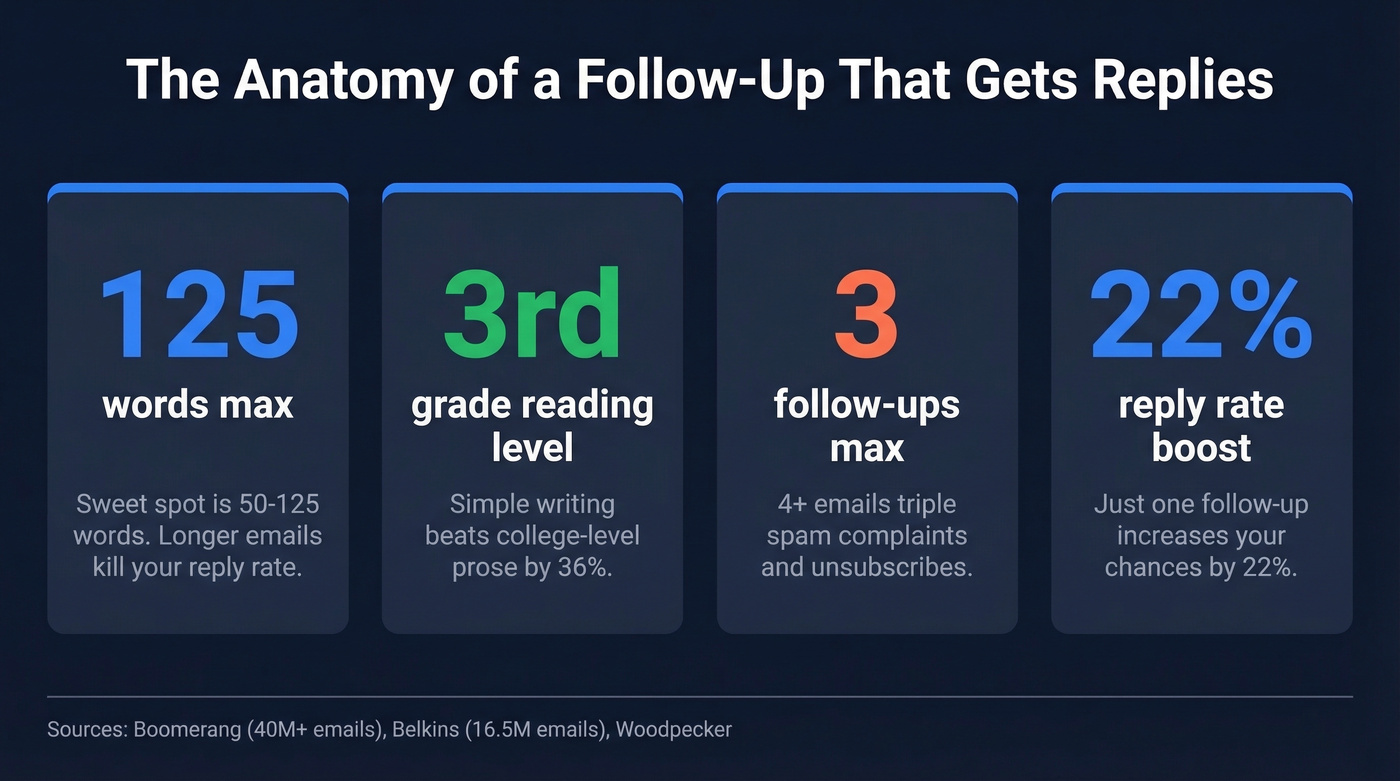
2. Write at a third-grade reading level. That same dataset showed third-grade writing outperforms college-level prose by 36%. Short sentences. Common words. Nobody's impressed by your vocabulary in a follow-up.
3. Add something new each time - and pick a tone. "Just checking in" is dead. Every follow-up needs a fresh angle: a resource, a reframed benefit, a specific time suggestion. The GMass team documented this well - bumping with no new information is one of the most common mistakes people make, and it trains recipients to ignore you.
Here's the thing: don't be beige. Emails with a slightly positive or slightly negative tone get 10-15% more responses than neutral ones. "Excited to show you what we found" beats "Wanted to follow up on my previous email" every time.
4. Cap your sequence at three follow-ups. An analysis of 16.5 million cold emails shows that sending four or more emails triples unsubscribe and spam complaint rates. Three is the ceiling. Emailing enterprise contacts? Keep the sequence even tighter - enterprises ghost fast.
5. Reply in the same thread. Don't start a new email chain. Same-thread follow-ups preserve context so the recipient sees the full conversation history. The only exception: if your original subject line was clearly weak, a fresh thread on the final attempt can work as a pattern interrupt.

Subject Lines That Get Opened
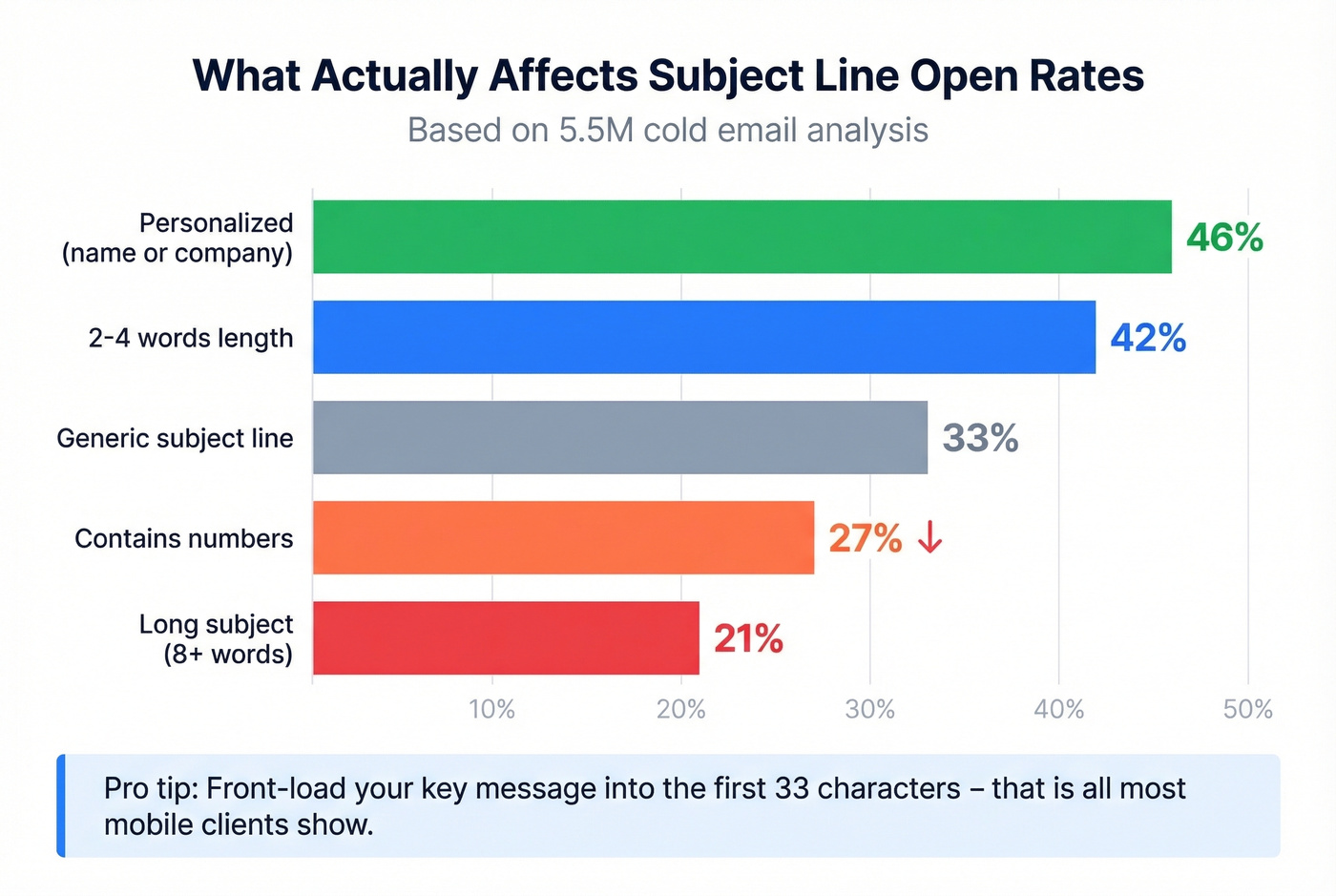
A study of 5.5 million cold emails found personalized subject lines hit a 46% open rate, and lines with two to four words performed best. Front-load your key message into the first 33 characters - that's all most mobile clients display before truncating. Skip numbers in subject lines entirely; they dropped open rates to 27%.
Four subject lines that work:
- Re: Quick chat Thursday?
- Still interested, [First Name]?
- Following up - [specific topic]
- Any Thursday work?
Keep them conversational and short. The subject line's only job is to get the email opened.

Great subject lines don't matter if your email bounces. Prospeo's 98% verified emails and 7-day data refresh mean your follow-up meeting requests actually reach the person you're trying to book - not a dead inbox.
Stop following up with email addresses that don't exist.
When to Send (and When to Stop)
| Follow-Up # | Wait Time | Best Window |
|---|---|---|
| 1st | 2-3 days | Tue-Thu, 8-10 AM |
| 2nd | 5-7 days | Tue-Thu, 8-10 AM |
| 3rd (final) | 7-10 days | Tue-Thu, any morning |
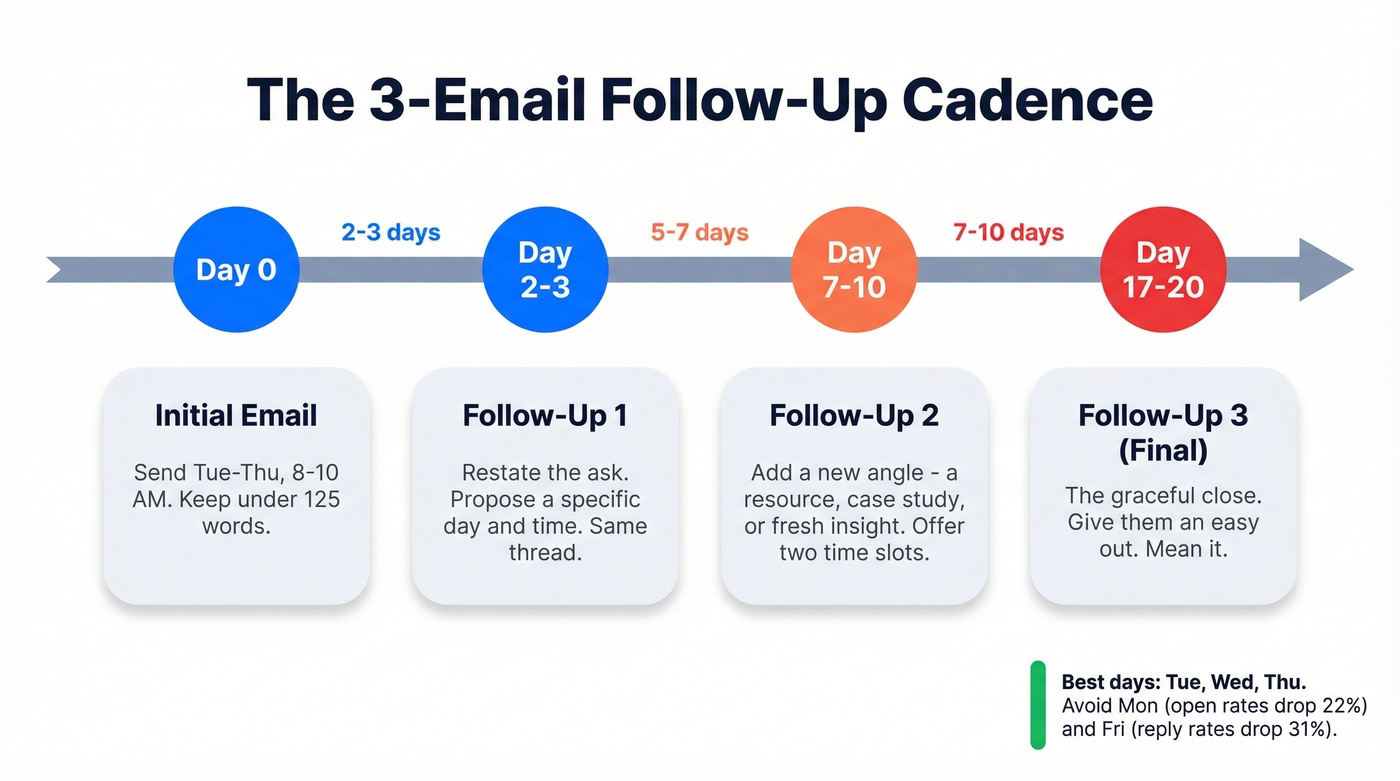
Mailpool's analysis of 10M+ cold email data points puts the Tuesday-through-Thursday morning window at 23-28% higher open rates than afternoon sends. Brevo's data confirms 10 AM and 3:30 PM as peak engagement times. For C-suite, shift earlier - the 6:00-7:30 AM window on Tue-Thu shows 41% higher open rates than midday.
For internal meetings, you can follow up within 24 hours. For cold outreach to prospects, wait the full 2-3 days. Avoid Mondays (open rates drop 22%) and Fridays (reply rates fall 31%).
If three emails get nothing, try a different channel. That same 16.5M-email dataset found a combination of a profile view and a direct message on professional networks hit an 11.87% reply rate - higher than most email sequences manage alone.
Five Copy-Paste Templates
We've tested dozens of follow-up variations over the years. The five below consistently outperform longer, more elaborate alternatives. Swap in your details and send.
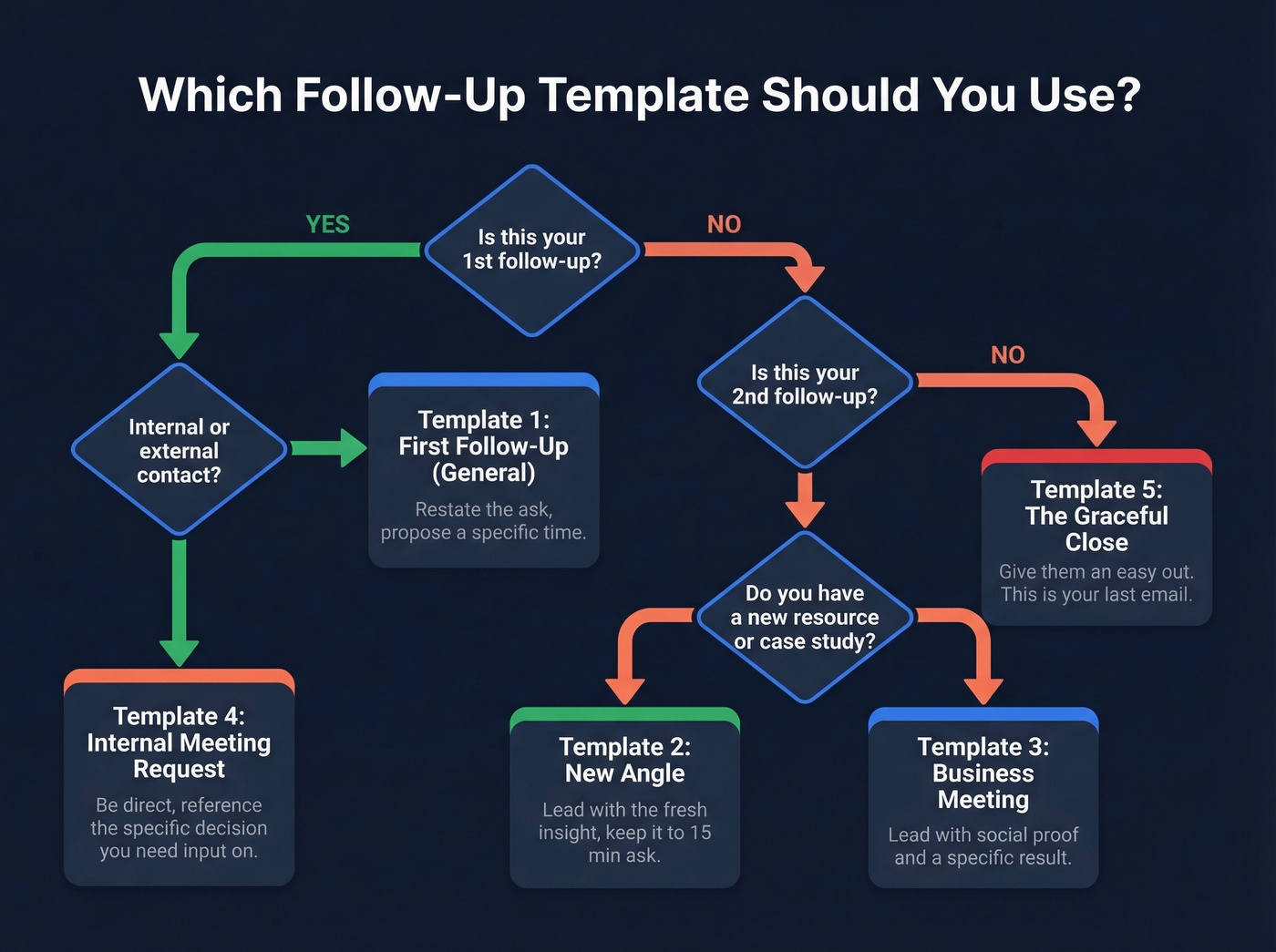
First Follow-Up (General)
Sent a meeting request 2-3 days ago. Radio silence.
Hi [First Name],
I sent a note [day] about [topic/meeting purpose] - wanted to make sure it didn't get buried. Would [specific day] at [time] work for a quick 20-minute call?
Happy to adjust if another time's better. Just let me know.
[Your Name]
Simple. It restates the ask, proposes a specific time, and keeps the door open.
Second Follow-Up (New Angle)
First follow-up ignored. Time to bring a fresh reason to meet.
Hi [First Name],
Circling back on [topic]. I came across [relevant article/insight/case study] that ties directly to [their challenge or initiative] - thought it'd be worth a quick conversation.
Would [day] or [day] work for 15 minutes?
[Your Name]
Follow-Up for a Business Meeting
You emailed someone you don't know well - a prospect or potential partner.
Hi [First Name],
I reached out last week about [specific value prop]. Teams like [similar company] have seen [specific result] from this approach, and I think [their company] could benefit similarly.
Worth a 15-minute call? I'm open [day] afternoon or [day] morning.
[Your Name]
This template doubles as a way to arrange meeting time with busy decision-makers - it leads with proof and offers two concrete windows.
Internal Meeting Request Follow-Up
What if the person ignoring you sits three desks away? Internal follow-ups need a different tone - more direct, less salesy.
Hey [First Name],
Just bumping my note about [project/topic]. I need your input on [specific decision] before we can move forward - shouldn't take more than 15 minutes.
Does [day] at [time] work? I'll send a calendar invite.
[Your Name]
The Graceful Close (Breakup Email)
Third and final follow-up. Give them an easy out - and mean it.
Hi [First Name],
I've reached out a couple of times about [topic] and haven't heard back - totally understand if the timing isn't right.
If this isn't a priority right now, no worries at all. Just let me know and I'll close the loop on my end. Otherwise, I'm still happy to find 15 minutes whenever works.
[Your Name]
The Real Problem Isn't Your Writing
Look, most people who struggle with follow-ups don't have a copywriting problem. They have a targeting problem. If you're following up with the wrong person at the wrong company, no template will save you. I've seen reps burn through entire sequences only to realize the email address was dead or the contact had left the company six months ago. Nail your list first, then worry about the copy.
The consensus on r/sales backs this up - threads about follow-up cadences almost always circle back to "are you even emailing the right person?" before debating word choice. If your bounce rate is above 5%, that's your answer.
If you want a deeper playbook on follow-up strategy, start with follow-ups and then tighten your sequence.
The article ends with the truth: your real problem isn't copywriting - it's targeting. Prospeo gives you 300M+ profiles with 30+ filters so every follow-up hits a real decision-maker. At $0.01 per email, bad data is a choice.
Fix your targeting before you send another follow-up.
FAQ
How many follow-ups should I send for a meeting request?
Three is the sweet spot. A 16.5M-email study shows four or more emails triple spam complaints and unsubscribe rates. Send three follow-ups spaced 3-10 days apart, each with a new angle, then move on.
Should I use the same subject line for every follow-up?
Yes - reply in the same thread to preserve context. The recipient sees the full conversation history, making it easier to respond. Only use a new subject line if your original was weak or you're trying a completely different angle on the final attempt.
What if my follow-ups aren't getting opened at all?
The email address might be outdated or invalid. Before sending another message, verify the address is actually active - a bounced email means none of your carefully written templates are reaching anyone. Bad contact data is the most common invisible reason follow-ups fail, and tools like Prospeo can flag dead addresses before you waste a send.
How long should I wait before following up on a meeting request?
Wait 2-3 business days after your initial email. Sending sooner feels pushy; waiting longer than a week risks the recipient forgetting your original message entirely. For internal colleagues, one business day is fine. For C-suite executives, the full three days gives them time to surface from their calendar.
Can I reuse the same template for every prospect?
You can use the same structure, but always personalize the details - swap in the recipient's name, company, and a specific reason the meeting matters to them. A generic follow-up works far better when it references something unique, whether that's a recent company announcement, a shared connection, or a challenge specific to their industry.