

GMass Email Deliverability: What's Actually Going Wrong (and How to Fix It)
Your open rates just dropped from 45% to 12%. The campaign content hasn't changed. The list is the same one that worked last quarter. Something broke - but the dashboard won't tell you what.
Here's the thing: it's almost always authentication, data quality, or scale. If your emails bounce with cryptic 5.7.x error codes, Google's late-2025 enforcement is rejecting you at the protocol level. If open rates cratered but Spam Solver still says "inbox," bounces are quietly torching your sender reputation. And if you're pushing 400+ emails per day and watching inbox rates slide, you've hit GMass's Gmail-dependent ceiling.
What Good Deliverability Actually Looks Like
The global inbox placement average sits around 84%, but it varies wildly by provider.
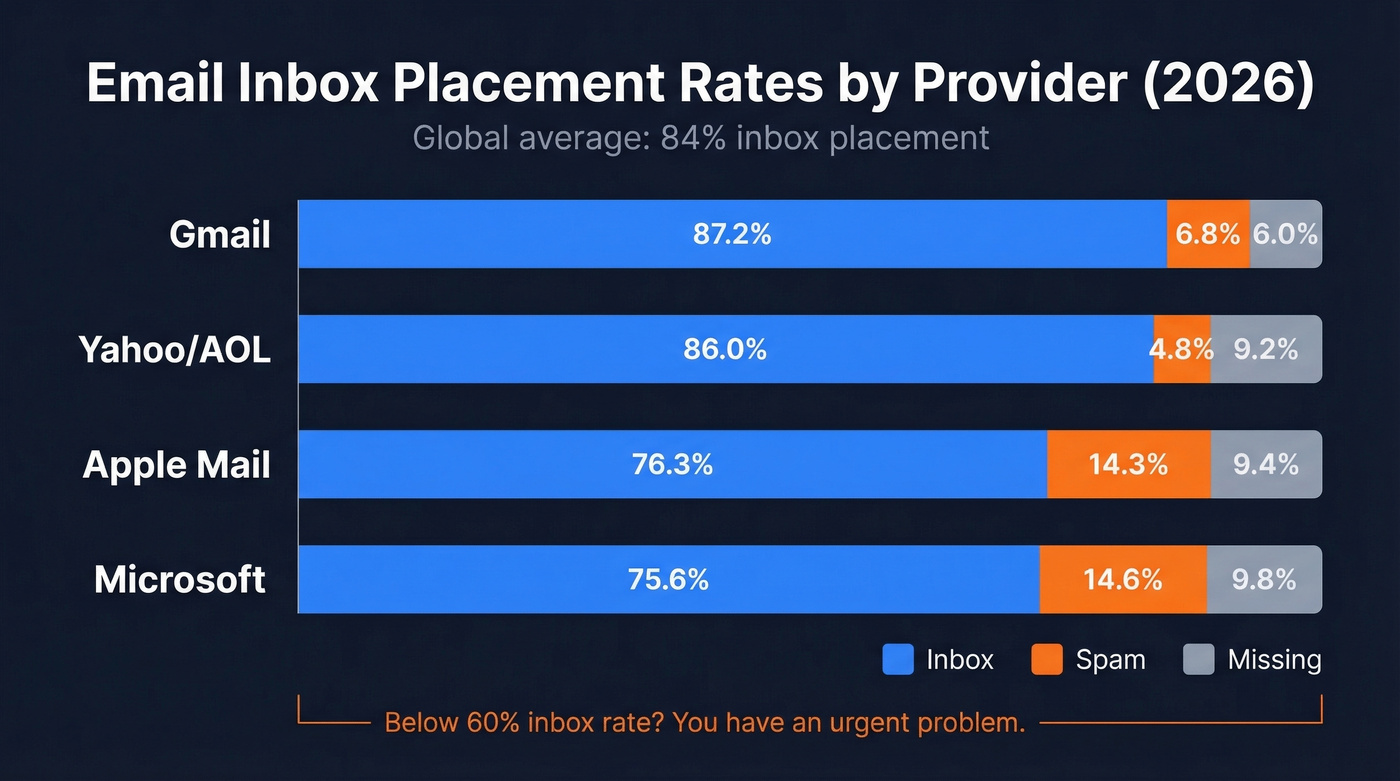
| Provider | Inbox Rate | Spam Rate | Missing |
|---|---|---|---|
| Gmail | 87.2% | 6.8% | 6.0% |
| Microsoft | 75.6% | 14.6% | 9.8% |
| Yahoo/AOL | 86.0% | 4.8% | 9.2% |
| Apple Mail | 76.3% | 14.3% | 9.4% |
If you're consistently below these numbers, you have a problem. Below 60%, you have an urgent one.
Even with perfect inbox placement, cold email reply rates stay modest - around 3.43% on average, with top performers hitting 10.7%+.
Google's Late-2025 Enforcement
This is the shift most GMass users haven't fully absorbed. Google's November 2025 enforcement phase moved from quietly routing non-compliant mail to spam to outright protocol-level rejection. Your emails don't land in spam anymore. They bounce. Google's bulk sender guidelines lay out the full requirements, and they're worth reading end to end if you haven't recently.
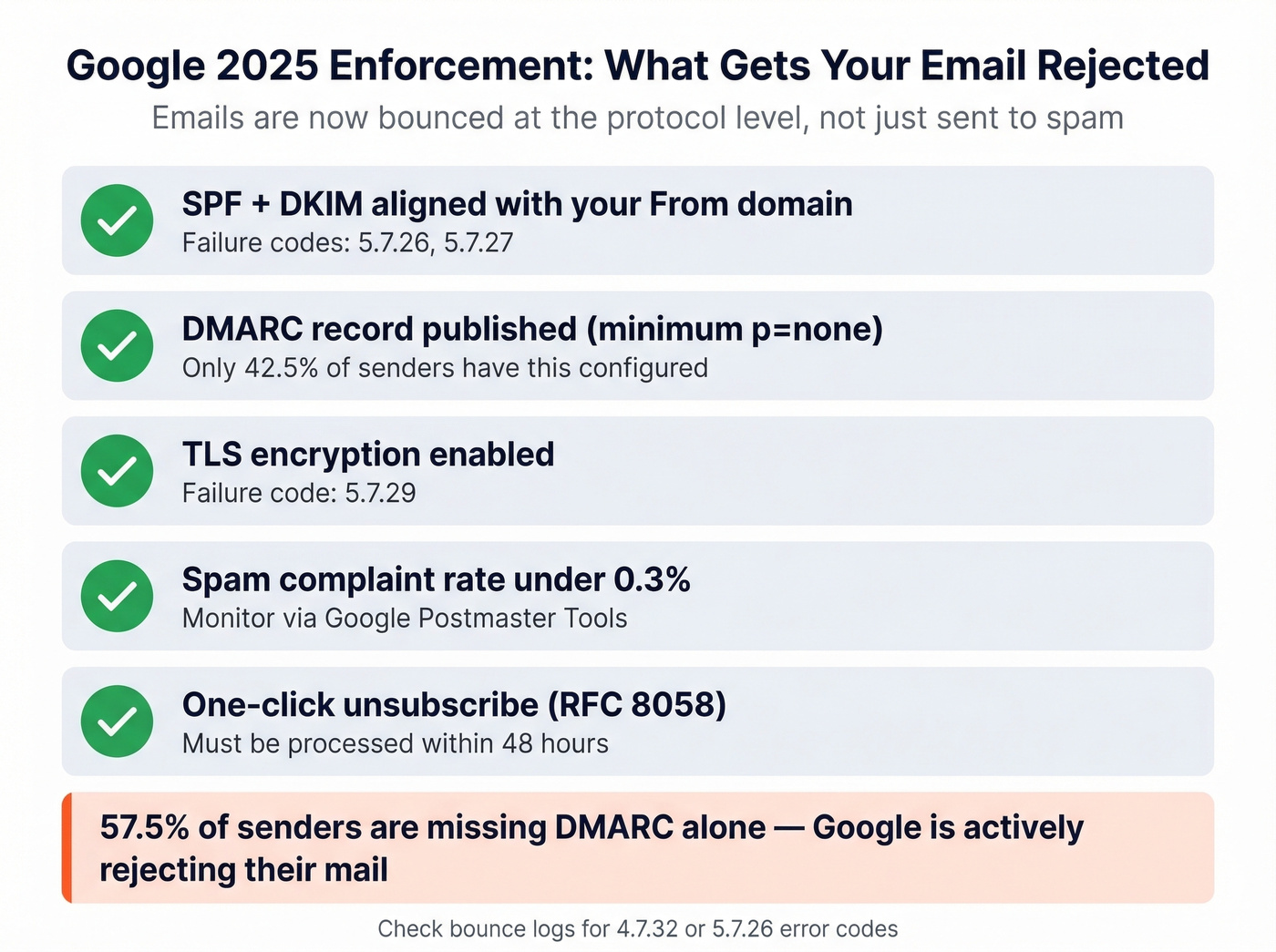
What's now mandatory for reaching any @gmail.com or @googlemail.com address:
- SPF/DKIM alignment with your From domain (failure codes:
5.7.26,5.7.27) - DMARC record present, minimum
p=none(see DMARC alignment) - TLS encryption required (failure code:
5.7.29) - Spam complaint rate below 0.3%
- One-click unsubscribe per RFC 8058, processed within 48 hours
Only 42.5% of senders have DMARC configured. If you're in the other 57.5%, Google is actively rejecting your mail. Check your bounce logs for 4.7.32 or 5.7.26 codes - those are the telltale signs.
GMass's Built-In Tools
GMass gives you a decent toolkit. Let's break down what's worth using and what to skip.
Spam Solver is GMass's best deliverability feature by a wide margin. It sends your draft to 20 Gmail and Google Workspace seed accounts - including accounts with corporate filters from Barracuda, Sophos, and ProofPoint - and reports inbox vs. spam vs. promotions placement. The AI-powered tweak suggestions let you iterate on tracking, images, format, and subject lines before anything goes out to real prospects. Use this before every campaign. We've found it catches issues that would otherwise cost you days of wasted sends.
Custom tracking domain - pay the $50 one-time setup fee. Shared tracking domains create reputation problems when other senders abuse the same domain. This is one of the cheapest deliverability improvements you'll find anywhere (more on tracking domain setup).
Email Analyzer checks blacklist status, DKIM validity, SPF results, and SMTP conversation details. Run it once to confirm authentication is passing (or use this guide on how to verify DKIM is working).
What's missing: GMass doesn't have warmup. It was removed after Google asked GMass to shut it down over API policy concerns, and there's no replacement. No multi-provider seed testing either - it's Gmail/Workspace only. No sender reputation scoring. The Deliverability Wizard lets you compare campaigns over time, but GMass themselves warn that "correlation does not imply causation." For multi-provider seed testing, tools like GlockApps ($59/mo) use a seed list of around 100 mailboxes across providers.
Gmail Sending Limits
GMass runs on Gmail's infrastructure, so Gmail's limits are your limits. No exceptions.
| Account Type | Daily Limit | Notes |
|---|---|---|
| Free Gmail | 500/day | Rolling 24-hour window |
| Paid Workspace | 2,000/day | Rolling 24-hour window |
| Workspace + SMTP relay | 10,000/day | Via smtp-relay.gmail.com |
Exceed these and you'll hit a 429 rateLimitExceeded error. GMass pauses for an hour and resumes with throttling. In some cases it can look like messages were sent, but they won't actually go out until you're unblocked - which is worse because you won't notice unless you check.
If your average deal size is under five figures and you're sending fewer than 500 emails a day, GMass on a Workspace account is probably all you need. The people struggling with inbox placement are almost always the ones pushing it past what Gmail was designed for.
For higher volumes, split sends across multiple domains at roughly 50 emails per domain per day. That's the scaling pattern that actually works on Gmail infrastructure (see email velocity best practices).

Every bounce chips away at your Gmail sender reputation - and GMass can't fix bad data. Prospeo's 5-step verification catches invalid addresses, spam traps, and honeypots before they touch your sending infrastructure. 98% email accuracy. Bounce rates under 3%.
Fix your list before GMass sends a single email.
What Real Users Say
GMass carries a 4.8/5 on G2 with 1,274 reviews, which is strong. But dig into the cons and a pattern emerges: 16 separate mentions flag spam placement and account blocking risk for bulk sends.
The consensus on r/coldemail isn't much rosier. One user running ~400 emails per day from Workspace with spintax, send delays, and Spam Solver checks estimated only 30-40% inbox placement based on out-of-office responses - down significantly from a year earlier. Google forced GMass to disable warmup, and that gap hasn't been filled. There's also recurring community speculation about Gmail restricting third-party sending tools further, which is worth monitoring if GMass is your only outbound infrastructure.
The Fix Most Senders Skip
Spam Solver and authentication are table stakes. The highest-leverage deliverability fix is one GMass can't provide: cleaning your data before you send.
Bounces above ~2-3% actively damage your sender reputation. Every invalid address that hard-bounces tells Gmail your list hygiene is poor, and Gmail responds by routing more of your mail to spam - even the mail going to valid addresses. This compounds fast. We've seen lists with 10%+ invalid addresses tank sender reputation within two campaigns, and recovery takes weeks of careful sending to rebuild trust with Google's systems.
This happens upstream of GMass. By the time you're composing a campaign, the damage is already baked into your list.
Prospeo's 5-step verification - catch-all handling, spam-trap removal, honeypot filtering, 98% email accuracy - catches bad addresses before they touch your sending infrastructure. Stack Optimize built to $1M ARR by running client campaigns through verified lists, maintaining deliverability above 94% and bounce rates under 3% across all clients. Meritt cut their bounce rate from 35% to under 4%.

If you're spending $30-60/month on GMass and your list is 10% invalid, you're burning your domain reputation with every campaign. Verifying that list costs a fraction of what domain recovery takes (see email bounce rate benchmarks and what to do when you’re over them).
GMass users pushing 400+ emails/day are watching inbox rates collapse - not because of GMass settings, but because 10%+ of their list is garbage. Meritt cut bounce rates from 35% to under 4% with Prospeo-verified data. Stack Optimize maintained 94%+ deliverability across every client campaign.
Clean data is the deliverability fix Spam Solver can't give you.
GMass vs. Instantly
Skip this section if you're happy with GMass and sending under 500/day with clean lists. But if you're hitting walls, here's how the two stack up:
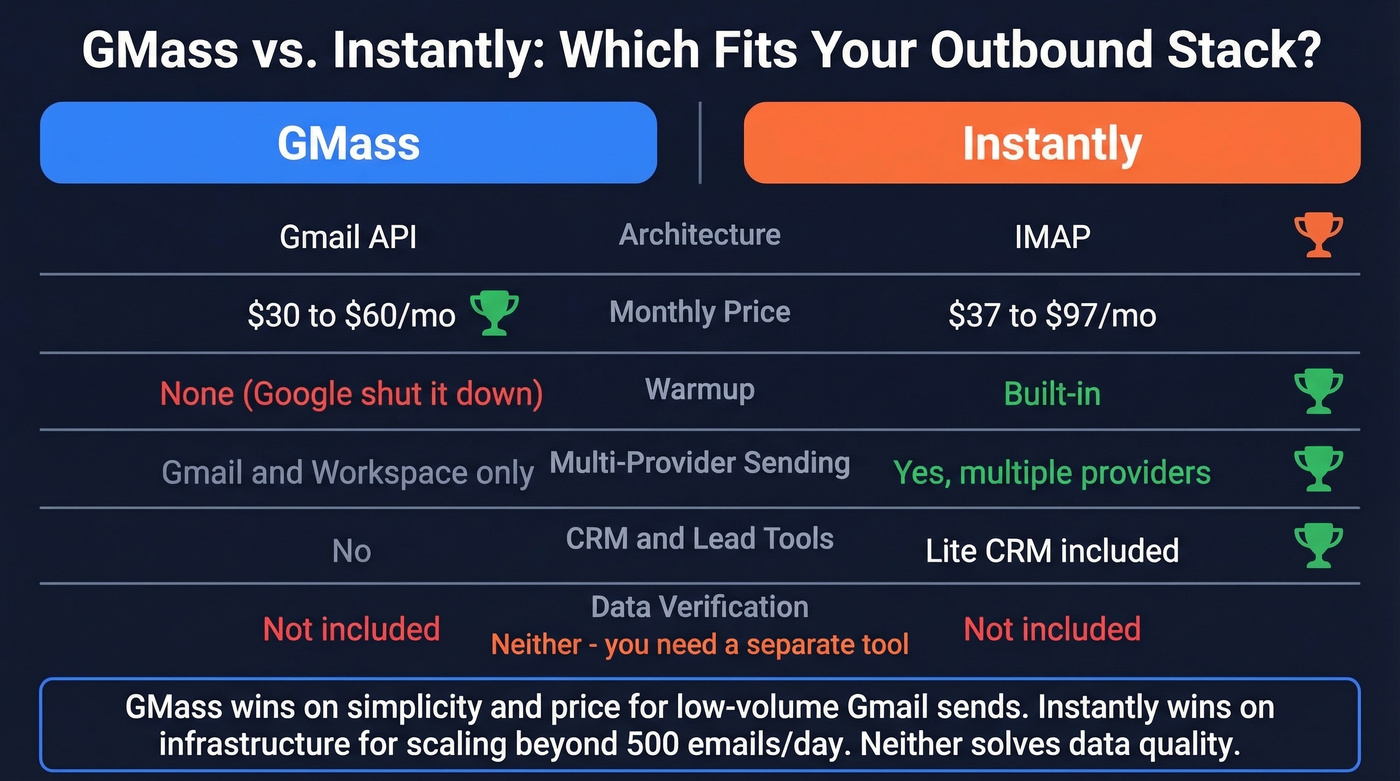
| Factor | GMass | Instantly | Winner |
|---|---|---|---|
| Architecture | Gmail API | IMAP | Instantly |
| Pricing | ~$30-$60/mo | $37-$97/mo | GMass |
| Warmup | None (removed) | Built-in | Instantly |
| Multi-provider | Gmail/Workspace only | Yes | Instantly |
| CRM/lead tools | No | Lite CRM | Instantly |
GMass is simpler and cheaper for low-volume sends with verified lists. If you need warmup, multi-provider sending, or you're scaling beyond Gmail's limits, Instantly is better infrastructure. Neither solves the data quality problem - that's a separate layer entirely (see the email deliverability guide for the full system).
Deliverability Checklist for 2026
Before your next GMass campaign:
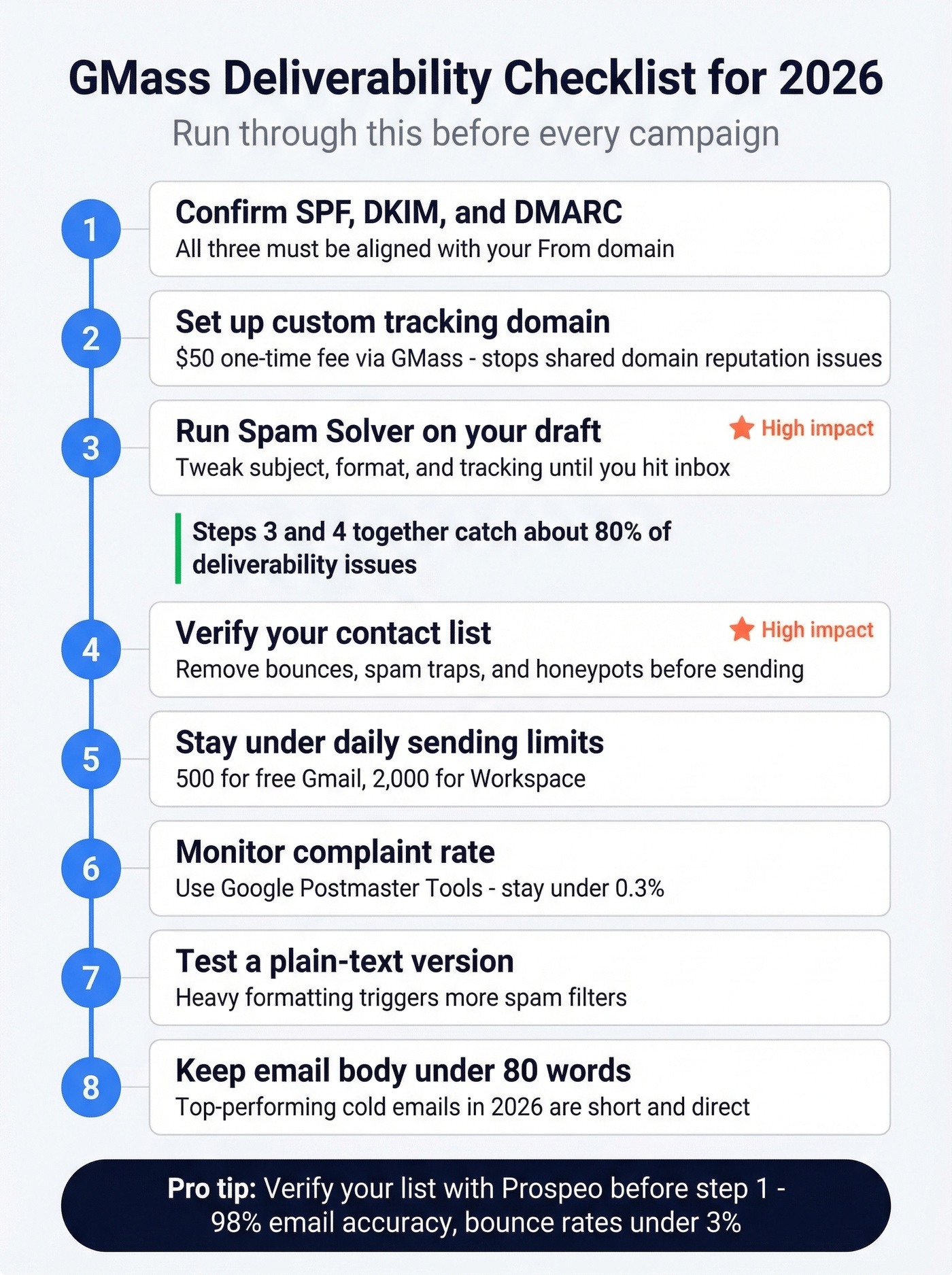
- Confirm SPF, DKIM, and DMARC are configured and aligned
- Set up a custom tracking domain ($50 one-time via GMass)
- Run Spam Solver on your draft - tweak until you hit inbox
- Verify your contact list to eliminate bounces, spam traps, and honeypots (see spam trap removal)
- Stay under your daily sending limit (500 free, 2,000 Workspace)
- Monitor complaint rate via Google Postmaster Tools
- Test a plain-text version - formatting-heavy emails trigger more filters
- Keep email body under 80 words - top-performing cold emails are short
In our experience, steps 3 and 4 together catch about 80% of deliverability issues before they become sender reputation problems.
FAQ
Does GMass have a warmup feature?
No. Google asked GMass to disable warmup due to API policy concerns, and it hasn't been replaced. Use a standalone tool like Warmbox ($19/mo) or switch to a platform like Instantly that bundles warmup natively.
What's the maximum emails GMass can send per day?
Free Gmail caps at 500/day. Paid Workspace allows 2,000/day. Workspace users can push 10,000/day using smtp-relay.gmail.com with additional configuration. Exceeding limits triggers a 429 rateLimitExceeded error and a one-hour pause.
Why are my GMass emails going to spam?
Google's November 2025 enforcement now rejects emails at the protocol level if they lack proper SPF/DKIM alignment, a DMARC record, and TLS encryption. Check bounce logs for 5.7.26 or 5.7.27 error codes - those confirm authentication failure.
How do I reduce bounces in GMass?
Keep your bounce rate under 2-3% by verifying every address before sending. Prospeo's verification catches invalid contacts upstream with 98% accuracy, including spam-trap and honeypot removal. Teams like Meritt dropped from 35% to under 4% bounce rate after switching to verified lists.