

The Formula for Sales Revenue: Every Version You Actually Need
A 10-person sales team generating $2M in gross bookings sounds great - until you realize $340K evaporated to returns, discounts, and allowances before it ever hit the income statement. The formula for sales revenue isn't complicated, but using the wrong version will distort every downstream metric you care about: gross margin, CAC payback, days sales outstanding, customer lifetime value. All of it.
Here's every formula you need, with worked examples and the mistakes that trip up even experienced finance teams.
What Is Sales Revenue?
Sales revenue is the income your business generates from selling its core goods or services over a specific period. It's the top line of your income statement - the number everything else flows from.
The distinction that trips people up: sales revenue isn't the same as total revenue. A company might generate $10M in sales revenue from its products but report $12M in total revenue because $2M came from non-operating sources like investment income, asset sales, or licensing fees. When someone says "revenue" without qualifying it, they usually mean sales revenue.
What doesn't count as sales revenue:
- Interest and dividend income
- Proceeds from selling assets
- Referral fees and partnership commissions
- Unrealized gains on investments
Under ASC 606, the current revenue recognition standard, you can only recognize revenue when you've actually delivered on your performance obligations. Signing a contract isn't enough.
The Quick Version
Three formulas cover 90% of use cases:
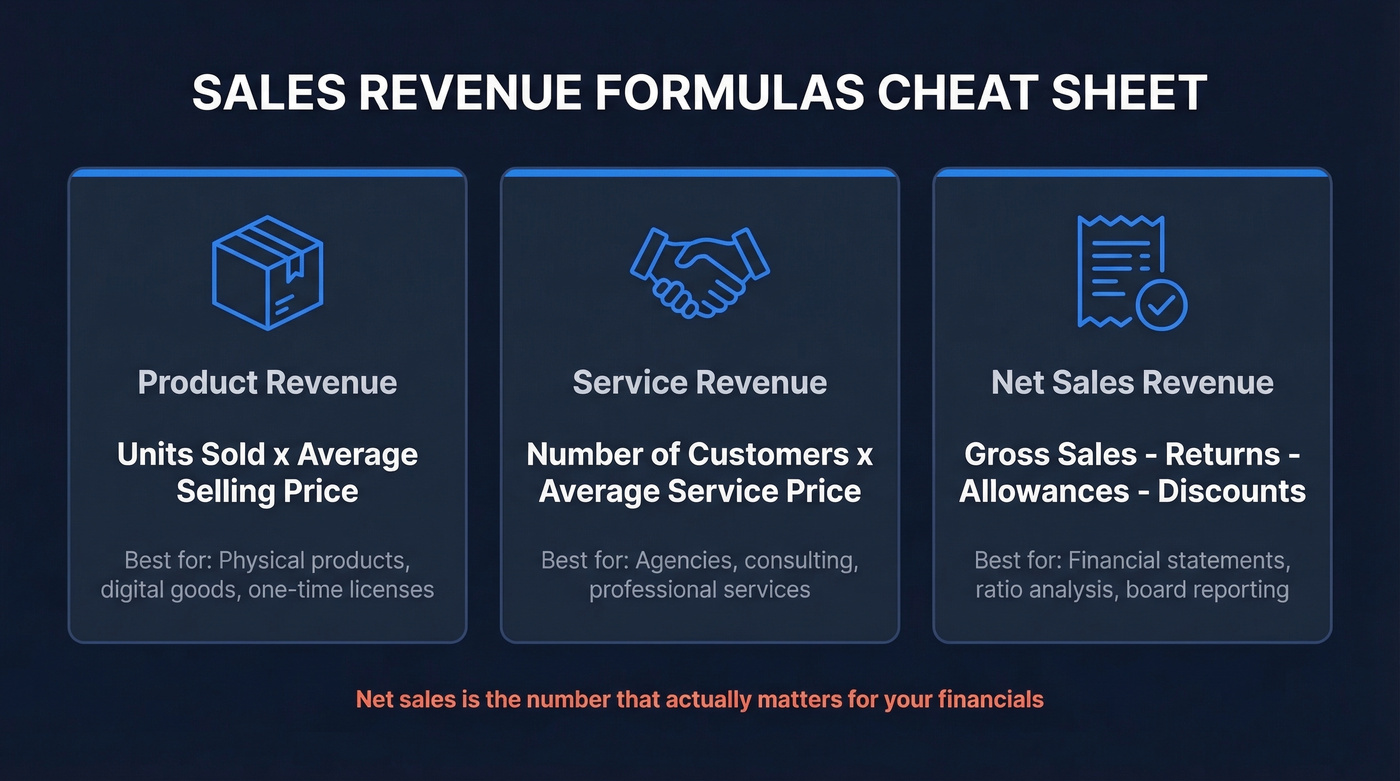
Product Revenue:
Units Sold x Average Selling Price
Service Revenue:
Number of Customers x Average Service Price
Net Sales Revenue:
Gross Sales - Returns - Allowances - Discounts
Net sales is the number that actually matters for your financials. Gross sales is your unadjusted total; net sales is what's left after the deductions. If you run a subscription business, skip ahead to the MRR/ARR section - "units x price" doesn't capture your reality.
Core Sales Revenue Formulas
Product-Based Revenue
If you sell physical or digital products at a defined price point, start here:
Product Revenue = Units Sold x Average Selling Price
Worked example: Your team sells 5,000 units of a SaaS license at $45 per unit.
5,000 x $45 = $225,000 in product revenue
The "average selling price" part matters more than people realize. If you offer volume discounts or tiered pricing, you need the blended average - not your list price. Using list price inflates your revenue calculation and creates a gap between what your formula says and what your bank account shows. We've seen teams overstate quarterly revenue by 15% or more just from this one mistake, which then cascades into bad forecasts and confused board decks.
Service Revenue
For consulting firms, agencies, and professional services businesses, the formula shifts from units to clients:
Service Revenue = Number of Customers x Average Service Price
Worked example: Your agency serves 120 clients at an average monthly retainer of $2,500.
120 x $2,500 = $300,000 in monthly service revenue
The real challenge comes before the math: defining "average service price" when your engagements vary wildly. A $500/month client and a $15,000/month client produce very different averages. Segment by tier if you want this number to be useful for forecasting.
Net Sales Revenue
This is the formula that typically shows up as the top-line figure on financial statements, often labeled "Revenue," "Net revenue," or "Total revenue."
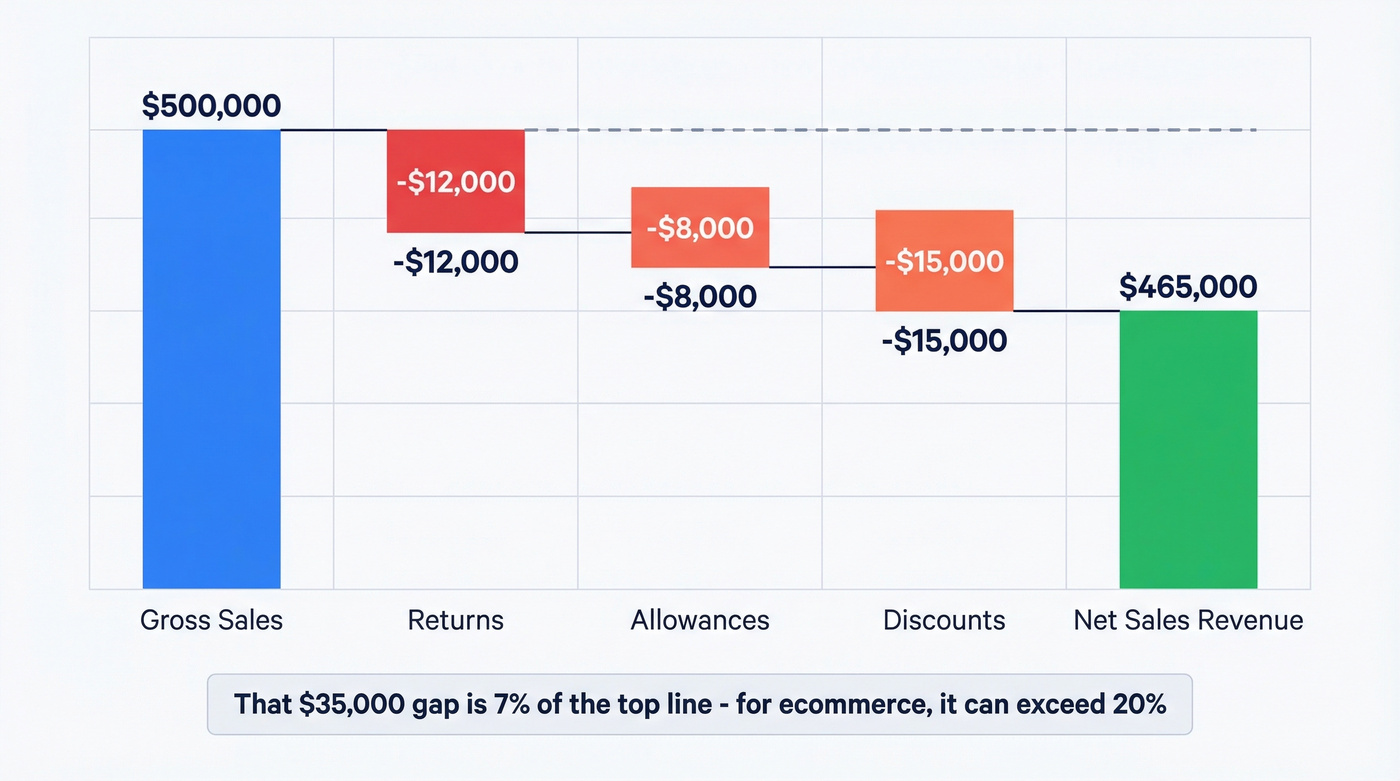
Here's how it works, step by step:
- Start with gross sales: $500,000
- Subtract returns: -$12,000
- Subtract allowances: -$8,000
- Subtract discounts: -$15,000
- Net sales revenue: $465,000
That $35,000 gap is 7% of the top line. For ecommerce businesses with high return rates - apparel is notorious here - the gap gets much wider, sometimes exceeding 20%.
Subscription and SaaS Revenue Formulas
MRR and ARR
If you sell subscriptions, "units x price" is the wrong lens. This is the exact issue that trips people up on r/SaaS and accounting forums - they try to force subscription revenue into a units-times-price model and the numbers never reconcile. You need Monthly Recurring Revenue and Annual Recurring Revenue.
MRR = Sum of all active monthly subscription values
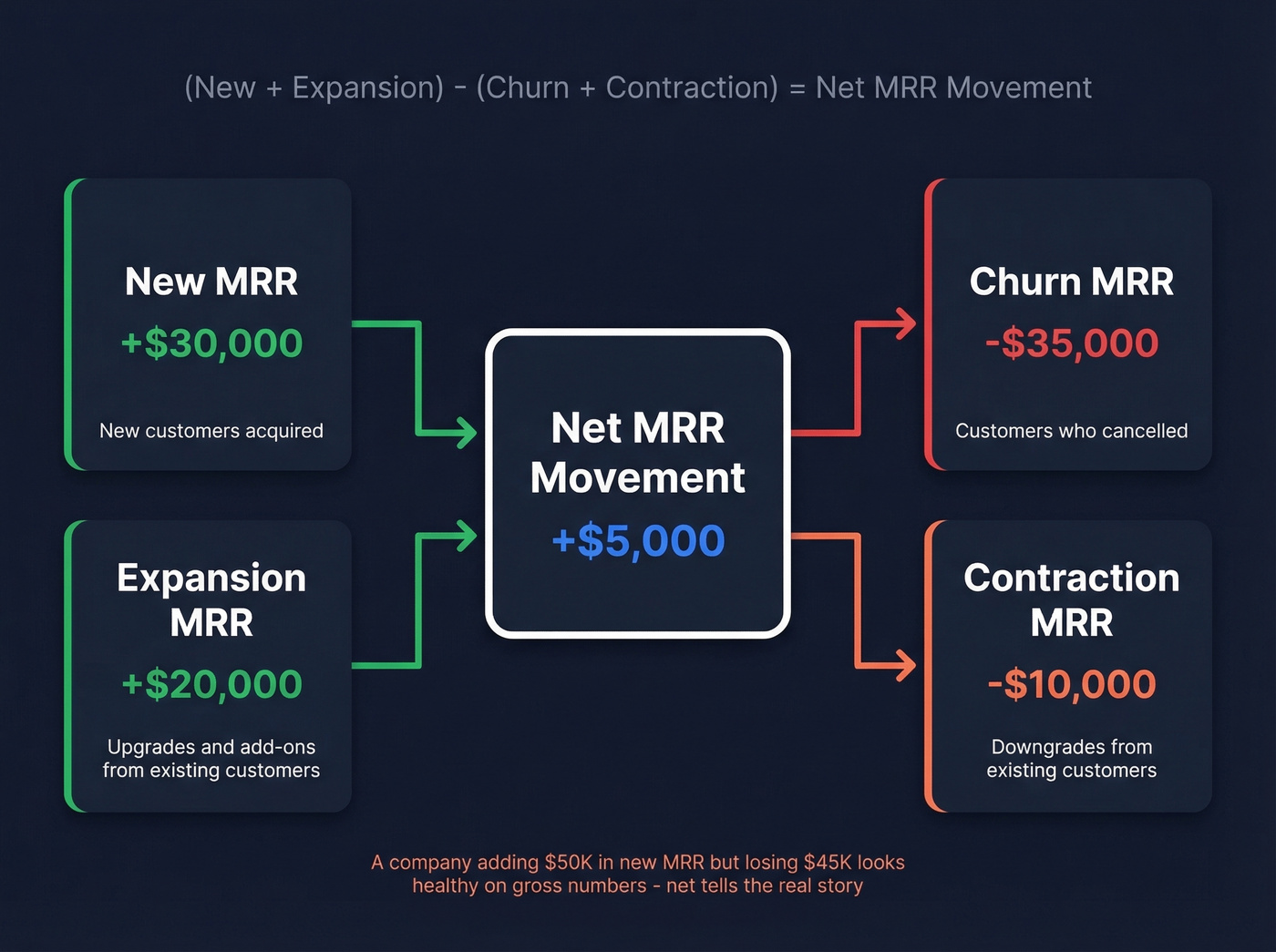
But the raw number isn't enough. What matters is how MRR moves month to month:
Net MRR Movement = (New MRR + Expansion MRR) - (Churn MRR + Contraction MRR)
A company adding $50K in new MRR but losing $45K to churn and downgrades has a net movement of just $5K. The gross number looks healthy; the net number tells the real story. Maxio's breakdown of MRR components is worth reading if you want to go deeper on expansion vs. contraction dynamics.
Why ARR Definitions Vary
There's no single standard for calculating ARR. A review of 160+ SEC filings from public tech companies reveals at least four distinct approaches: pure subscription, subscription plus variable usage, subscription plus managed services, and pure variable consumption. Rubrik annualizes active subscription contracts assuming renewal. MongoDB annualizes the prior 90 days of usage. UiPath annualizes invoiced amounts by term. Same metric name, three completely different calculations.
Know which version your board expects before you present it.
Gross vs. Net Sales Revenue
| Gross Sales | Net Sales | |
|---|---|---|
| Definition | Total unadjusted sales | Gross minus deductions |
| Includes | All sales before adjustments | After returns, allowances, discounts |
| Where it appears | Sometimes in notes | Income statement top line |
| When to use | Sizing total demand | Financial analysis, ratios |
Gross sales is vanity; net sales is sanity. Your gross number tells you how much demand you generated. Your net number tells you how much revenue you actually retained.
Most financial ratios - gross margin, operating margin, revenue per employee, DSO, and many LTV:CAC models - start with net sales as the denominator. Get the formula wrong and every downstream KPI inherits the error. One common mistake we see: using gross sales when calculating gross margin. Gross margin uses net sales as the denominator, and gross profit starts from net sales minus COGS.

Every sales revenue formula starts with the same input: customers. Prospeo gives you 300M+ verified contacts with 98% email accuracy so your pipeline feeds real revenue, not inflated forecasts that evaporate like those $340K in returns.
Fix the top of the funnel and the top line fixes itself.
Where Revenue Lives on the Income Statement
Revenue flows through your income statement in a specific chain:
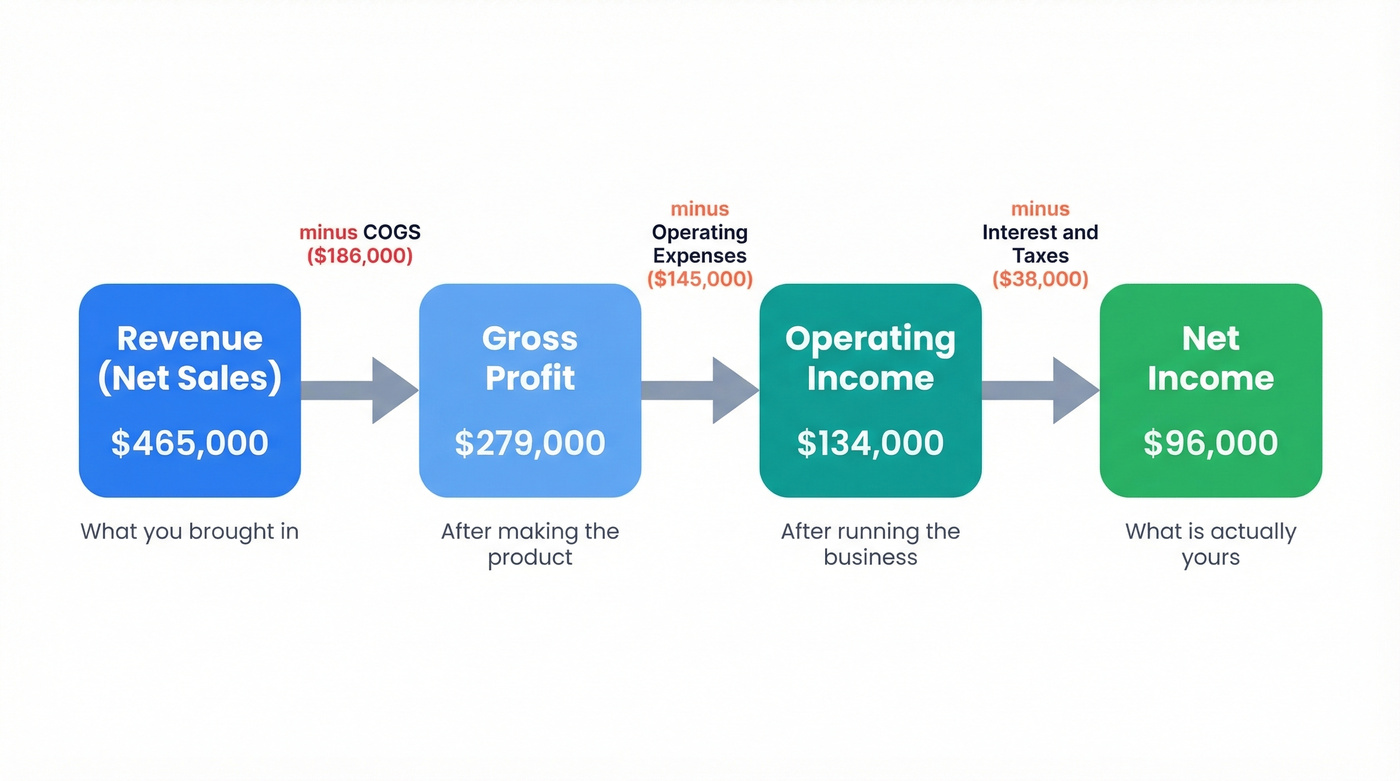
Revenue (Net Sales) -> minus COGS -> Gross Profit -> minus Operating Expenses -> Operating Income -> minus Interest & Taxes -> Net Income
Each step strips away a different layer of cost. Revenue is what you brought in. Gross profit is what's left after making the product. Operating income is what's left after running the business. Net income is what's actually yours.
When you pull up a real 10-K filing, you won't always find a line item called "net sales." Some companies label it "Total revenue," others use "Net revenue," and some just say "Revenue." The label varies, but the concept is the same - it's revenue after returns, allowances, and discounts.
Revenue Recognition Under ASC 606
ASC 606 governs when you can count revenue as revenue. It's principle-based, requiring judgment rather than a rigid checklist. The five steps:
- Identify the contract - both parties have agreed to terms and are committed.
- Identify performance obligations - each distinct promise you've made.
- Determine the transaction price - what you expect to collect, including variable elements.
- Allocate the price - split the total across obligations based on standalone selling prices.
- Recognize revenue - book it when you satisfy each obligation.
These steps sound straightforward until your business model introduces complexity. BDO's analysis of ASC 606 highlights the biggest headaches: variable consideration like volume discounts and rebates, principal vs. agent determinations where you need to decide whether to report gross or just your commission, contract modifications, and license arrangements where timing depends on whether the IP is functional or symbolic. If your business bundles products with services, don't try to figure this out on a spreadsheet - you need an accountant who understands 606.
Seven Revenue Calculation Mistakes
In our experience, the Stripe net-deposit mistake is the single most common error in early-stage SaaS companies. But it's far from the only one.
Booking net deposits as revenue. Stripe and Shopify pay you the net amount after processing fees. Your revenue is the gross sale - processing fees belong in expenses. Track gross sales, refunds, and fees separately.
Counting sales tax as revenue. Sales tax collected is a liability you owe the government, not income. Record it as sales tax payable.
Recognizing annual subscriptions upfront. A $12,000 annual subscription is $1,000/month recognized over 12 months. Booking it all in month one violates ASC 606.
Using sale date instead of delivery date. ASC 606 ties recognition to when the performance obligation is satisfied - typically delivery, not order placement.
Counting cancelled or unfulfilled orders. Platform dashboards sometimes include orders that were never fulfilled. Filter before pulling revenue numbers.
Using invoice date instead of service date. QuickBooks and Xero default to the invoice date. If you invoice on December 28 for January services, that revenue belongs in January.
Erasing revenue for bad debts. When a customer doesn't pay, don't delete the original revenue entry. The sale happened. Record a bad debt expense instead.
2026 SaaS Revenue Benchmarks
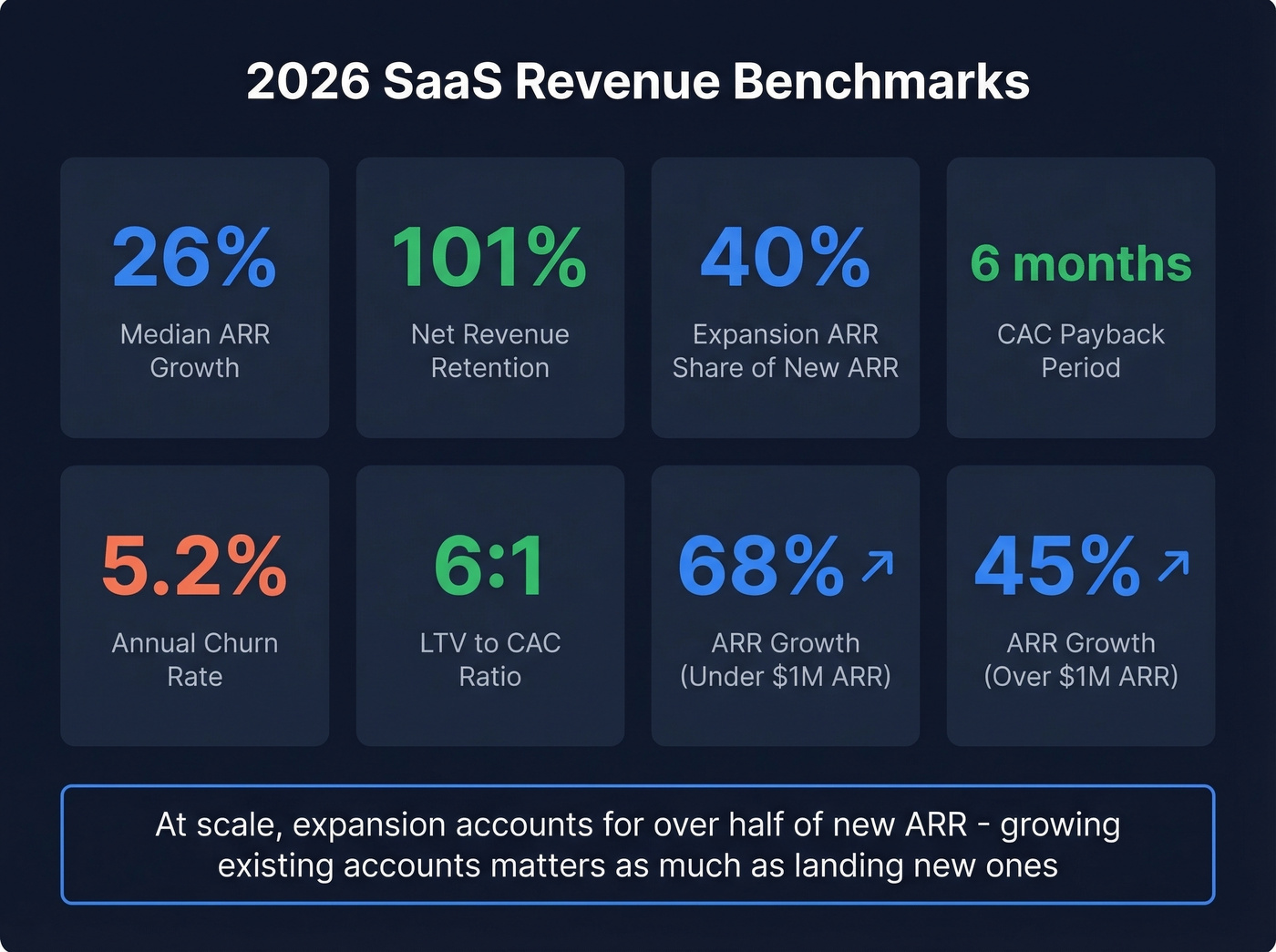
Calculating revenue is step one. Knowing whether your numbers are good is step two. Here's where current SaaS benchmarks land:
| Metric | Benchmark |
|---|---|
| Median ARR growth | 26% |
| Net revenue retention | 101% |
| Expansion ARR share | 40% of new ARR |
| CAC payback | 6 months |
| Annual churn | 5.2% |
| LTV:CAC ratio | 6:1 |
| ARR growth (under $1M) | 68% |
| ARR growth (over $1M) | 45% |
Net revenue retention at 101% means the median SaaS company is barely expanding existing accounts. The gap between early-stage growth at 68% and post-$1M growth at 45% is a reminder that growth rates naturally compress as you scale.
Expansion ARR now represents 40% of total new ARR, up 5 percentage points year over year. For companies above $50M ARR, expansion accounts for over half of new ARR. The takeaway: at scale, growing existing accounts matters as much as landing new ones.
Here's the thing - if your average deal size is under $10K and your net revenue retention sits below 100%, you don't have a revenue formula problem. You have a product-market fit problem. No amount of formula precision fixes a leaky bucket.
How to Calculate Return on Sales
Once you've nailed down your sales revenue, the next question is efficiency. The return on sales ratio measures how much operating profit you generate per dollar of revenue.
Return on Sales = Operating Profit / Net Sales Revenue
If your net sales revenue is $465,000 and your operating profit is $74,400, your return on sales is 16%. Some analysts substitute net income for operating profit depending on context, but the revenue figure you use as the denominator must be the net number - using gross sales inflates the ratio and misrepresents your efficiency.
How to Grow Sales Revenue
Calculating revenue is useful. Growing it is the point.
Optimize pricing. Most companies underprice. A 10% price increase on the same volume drops straight to the top line with zero additional cost. Test annual pricing tiers, reduce unnecessary discounts, and audit whether your "standard" discount has quietly become the default everyone gets.
Increase volume. More customers, more units, more contracts. This is the brute-force lever - expand your addressable market, open new channels, or increase sales capacity. It works, but it's expensive.
Improve retention and expansion. Net revenue retention above 110% means your existing customer base grows even without new logos. For any subscription business, this is the highest-ROI lever you can pull. If you want a tighter way to diagnose churn drivers, run a simple churn analysis before you touch pricing.
Reduce returns and allowances. Every return is revenue you already counted that walks back out the door. Better product descriptions, quality control, and expectation-setting reduce the gap between gross and net sales.
Net sales revenue only grows when you reach the right buyers. Prospeo's 30+ filters - intent data, technographics, funding signals - let you target accounts already in-market. Teams book 26% more meetings and pipelines grow 140%+ with data that actually connects.
Stop calculating revenue you'll never collect. Start generating it.
FAQ
What's the difference between sales revenue and profit?
Sales revenue is total income from selling goods or services before subtracting any expenses. Profit - specifically net income - is what remains after deducting all costs: COGS, operating expenses, interest, and taxes. A company can report $5M in revenue and still post a net loss if expenses exceed that figure.
How do you calculate sales revenue for a subscription business?
Use Monthly Recurring Revenue instead of units times price. MRR equals the sum of all active monthly subscription values; annualize it (MRR x 12) for ARR. Track net MRR movement - new plus expansion minus churn minus contraction - to see real recurring-base changes each month.
Is sales revenue the same as gross revenue?
Not exactly. Gross sales revenue is the unadjusted total before deductions. Most income statements report net sales revenue - gross minus returns, allowances, and discounts. When someone says "sales revenue" without qualifying it, they typically mean the net figure.
What tools help improve sales revenue from outbound?
The biggest outbound revenue leak is bad contact data - bounced emails and wrong numbers waste rep time and suppress pipeline. A platform like Prospeo delivers 98% email accuracy across 143M+ verified addresses with a 7-day refresh cycle, which makes it a strong starting point. Pair it with your preferred sequencing tool to build a pipeline engine that converts.