

The Best Free Email Spam Testers - And What They Can't Tell You
You run the same email through three different spam testers. One says 9.2 out of 10. Another flags your SPF record. The third says you're landing in promotions. Now you're more confused than when you started.
That's the reality of every free email spam tester in 2026. The tools are useful - genuinely - but they're measuring different things, and nobody tells you that upfront. Reddit threads on r/Emailmarketing and r/coldemail are full of practitioners calling results "laughable" and suspecting most checkers are marketing fluff designed to upsell warmup plans. They're not entirely wrong. But some of these tools do real work if you know what you're looking at.
Our Picks (TL;DR)
| Use Case | Tool | Why |
|---|---|---|
| Best overall free test | GlockApps | ~100 seed inboxes, 50+ blacklists, full auth check |
| Best quick spot check | Mail-Tester | No signup, instant score, 30 seconds |
| Best truly free tester | GMass | Unlimited, 15 inboxes incl. enterprise filters |
| Fix the root cause | Prospeo | Verify your list so bounces stop killing your reputation |
Short on time? Test with Mail-Tester for a quick read, then GlockApps for depth. If emails are bouncing, skip straight to list verification - that's where the real damage happens.
Three Types of Spam Testers
The reason results confuse people is that they're comparing tools from completely different categories. For practical purposes, there are three that matter.
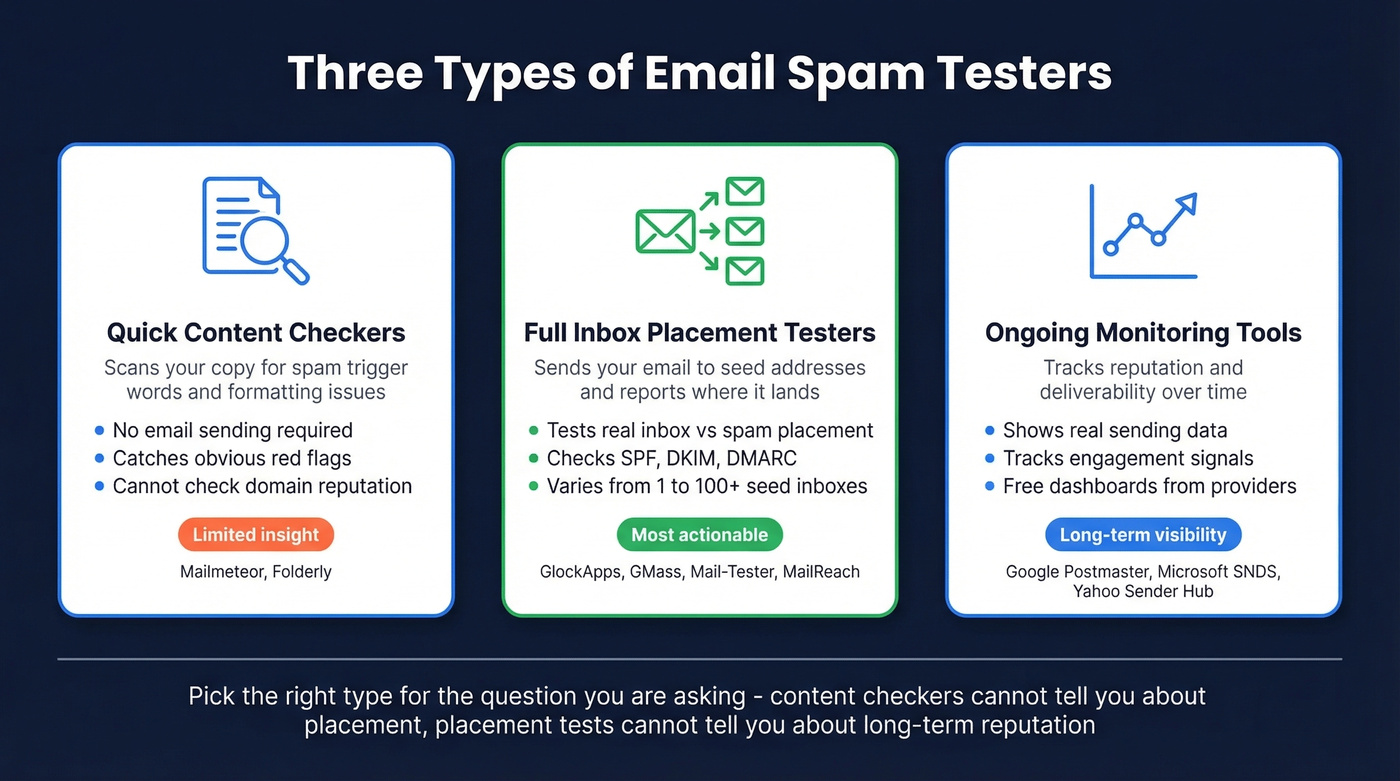
Quick content checkers scan your email copy for spam trigger words, formatting issues, and basic red flags. You paste text in, get a score out. No email sending required. Mailmeteor and Folderly's free checker fall here. Useful for pre-send sanity checks, but they can't tell you anything about domain reputation or authentication.
Full inbox placement testers actually send your email to seed addresses and report where it lands - inbox, spam, promotions, or missing entirely. GlockApps, GMass, Mail-Tester, and MailReach live here. These give you the most actionable data, but they vary wildly in methodology. Some send to one inbox. Others send to 100.
Ongoing monitoring tools track reputation and deliverability over time. Google Postmaster Tools is the gold standard for Gmail. Microsoft SNDS covers Outlook, and Yahoo Sender Hub handles Yahoo/AOL. All three are free. These aren't "testers" - they're dashboards that show what's actually happening to your mail.
Picking the wrong category is why people get confused. A content checker can't tell you about inbox placement. An inbox placement test can't tell you about long-term reputation. Use the right instrument for the question you're asking.
Best Free Spam Checker Tools
GlockApps
Use this if you want the most thorough single-test output available. GlockApps sends your email to roughly 100 seed mailboxes across major providers, checks against 50+ blacklists, runs SPF/DKIM checks, and analyzes your content - all in one report. The dashboard breaks down placement by provider so you can see exactly where you're landing with Gmail vs. Outlook vs. Yahoo.

Skip this if you need ongoing testing on a budget. The free tier gives you exactly 2 spam tests. Total. Not per day, not per month - 2 tests, period. After that, you're looking at $59/mo for Essential, $99/mo for Growth, or $129/mo for Enterprise. Those 2 free tests remain the most comprehensive free output you'll find anywhere, but plan them carefully because once they're gone, they're gone.
GMass Inbox Tester
GMass built something quietly excellent. Their inbox tester is 100% free - no signup, no credit limit, no catch. You send your email to 15 seed addresses and watch results populate in real time.
What makes it stand out: some of those seed accounts run commercial spam filters like Barracuda, Mimecast, and Sophos. That matters because most testers only check consumer email providers. If your prospects sit at mid-market companies running enterprise email security, consumer-only tests miss the filters that actually block you. GMass also provides quick-fix suggestions when emails land in spam - remove images, switch to plain text, check your SPF record. As a completely unlimited deliverability tester, it's the best option for anyone who needs to run repeated checks without worrying about credits.
Mail-Tester
Go to mail-tester.com, send your email to the address they give you, click "check your score." No signup, no account, no friction. You get a 0-10 spam score plus basic technical checks. The interface is clean and the results are easy to read, even for non-technical users. It's the tool we'd recommend to a marketing manager who wants a quick gut check before hitting send.
The catch: it tests against a single inbox. One. That's a tiny sample compared to GlockApps's ~100 or even GMass's 15. You also get a limited number of free tests per day before it cuts you off. Great for catching obvious problems. Not reliable as your only testing tool.
MailReach
MailReach sends to 30+ mailboxes and uses a code snippet to locate your message across inboxes, checking SPF/DKIM/DMARC, blacklists, links, HTML complexity, image-to-text ratio, and spam words. More thorough than Mail-Tester's single-inbox approach, and the multi-provider view gives you a clearer read on where problems actually are.
The downside: there's no pure free tier for spam testing alone. MailReach bundles 20 spam test credits with their warmup plan at $19.50/mailbox/month. You're paying for warmup and getting tests as a bonus.
EXPERTE.com
EXPERTE's online spam checker is free to use. It runs a SpamAssassin-style score and adds something unique: Gmail tab categorization. It tells you whether your email would land in Primary, Social, Promotions, Updates, or Forums - a distinction most testers ignore entirely. For context, 5.0 is the common default SpamAssassin threshold; under 5.0 is generally treated as "not spam." EXPERTE won't replace a full inbox placement test, but it fills a gap nothing else does.
Mailmeteor Spam Checker
Mailmeteor's checker is content-only - paste your text in, get a scan for spam trigger words. No email sending required, completely free, unlimited checks. Think of it as a spell-checker for deliverability. It doesn't check authentication, domain reputation, or inbox placement. Pair it with an inbox placement tester for actual deliverability data.
MailGenius
MailGenius is 100% free and doesn't require an account. It runs a deliverability-style report with authentication and content checks in a simple send-and-score flow. Solid when you want a straightforward report without setting up a full seed test.
MXToolbox
MXToolbox is better known for DNS lookups, but its Delivery Center product monitors inbox placement and blacklists. The free tools cover blacklist checks and DNS diagnostics. Delivery Center starts at $129 and Plus runs $399. Worth bookmarking for troubleshooting, even if it's not a traditional spam testing tool.
Unspam
Unspam includes a deliverability test flow plus checks like blacklists and authentication. It also has an AI eye-tracking heatmap to predict where subscribers look on your email design. Useful as a design supplement, not a primary deliverability tool.
Folderly
Folderly's free offering is limited to an AI spam word checker - paste your copy, get flagged words. The full deliverability platform comes with a 7-day trial, after which you'll need a paid plan.

Every spam tester on this list checks your content, authentication, and inbox placement. None of them check whether the people you're emailing actually exist. Bounces destroy sender reputation faster than any spam word ever will. Prospeo's 5-step email verification catches invalid addresses, spam traps, and honeypots before they torch your domain - at 98% accuracy and $0.01 per email.
Fix the root cause. Verify your list before you test another subject line.
Free Tier Comparison
Let's be honest: calling something "free" when it gives you 2 tests total is a stretch. Here's what "free" actually means for each tool.
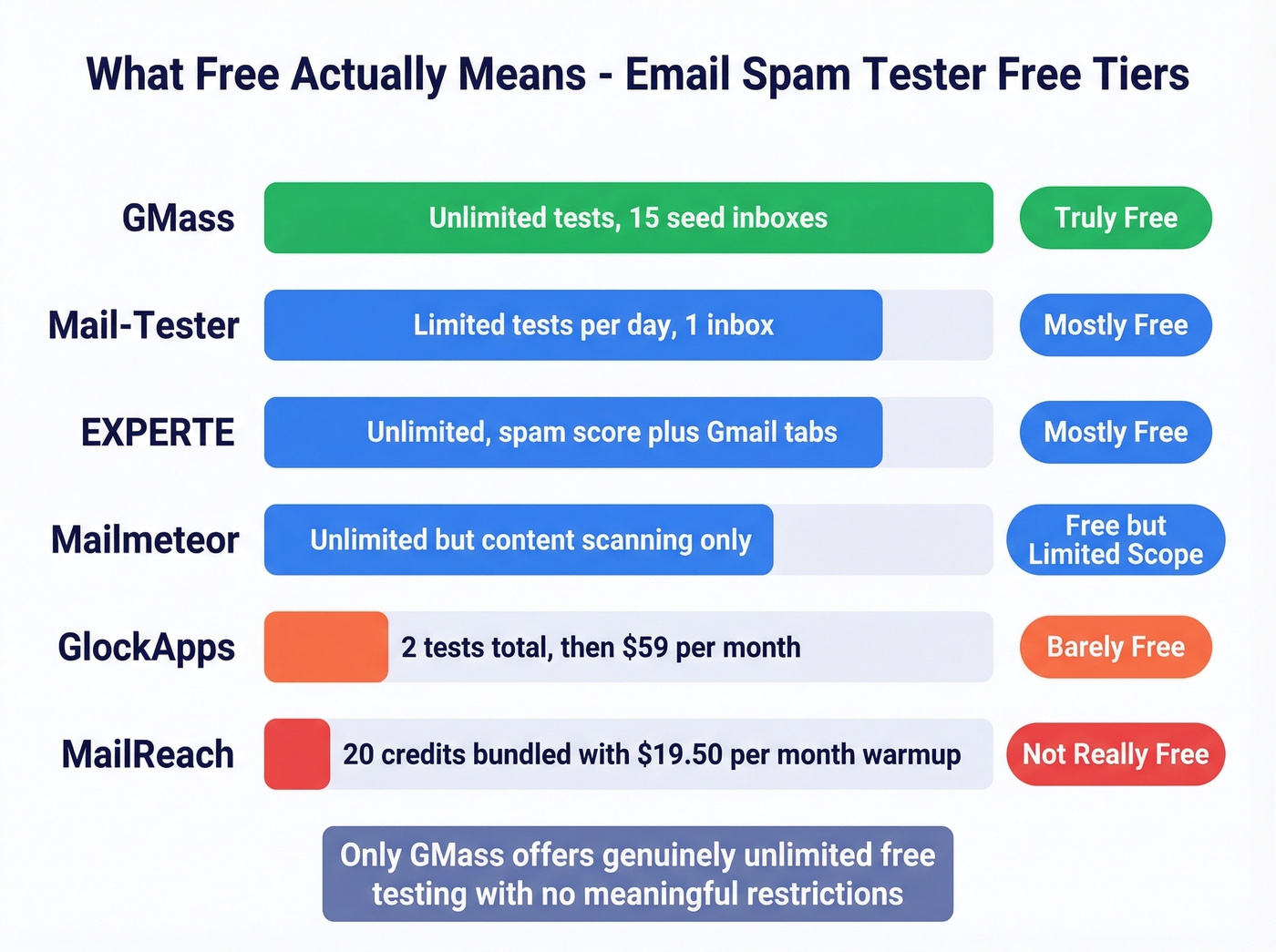
| Tool | What It Tests | Free Limit | Paid From | Best For |
|---|---|---|---|---|
| GlockApps | Full placement + auth | 2 tests total | $59/mo | Deep diagnostics |
| GMass | Seed placement (15) | Unlimited | Free | Commercial filters |
| Mail-Tester | Spam score + basic checks | Limited/day | Free | Quick spot checks |
| MailReach | Multi-inbox (30+) | 20 credits w/ warmup | $19.50/mo | Warmup users |
| EXPERTE | Spam score + tabs | Unlimited | Free | Gmail tab check |
| Mailmeteor | Content only | Unlimited | Free | Pre-send copy review |
| MXToolbox | Blacklists + DNS | Free tools | $129 | DNS troubleshooting |
| MailGenius | Auth + content | Free | Premium available | Basic checks |
| Unspam | Deliverability + design heatmap | Free | Paid plans available | Design feedback |
| Folderly | Spam words only (free) | Unlimited words | Paid after trial | Copy scanning |
GMass is the only tool here that's genuinely free without meaningful restrictions. Mail-Tester's daily limit is workable. Everything else either caps you at a handful of tests or bundles testing into a paid plan.
Why Your Results Don't Match
You tested the same email in three tools and got three different answers. That's expected, not broken.
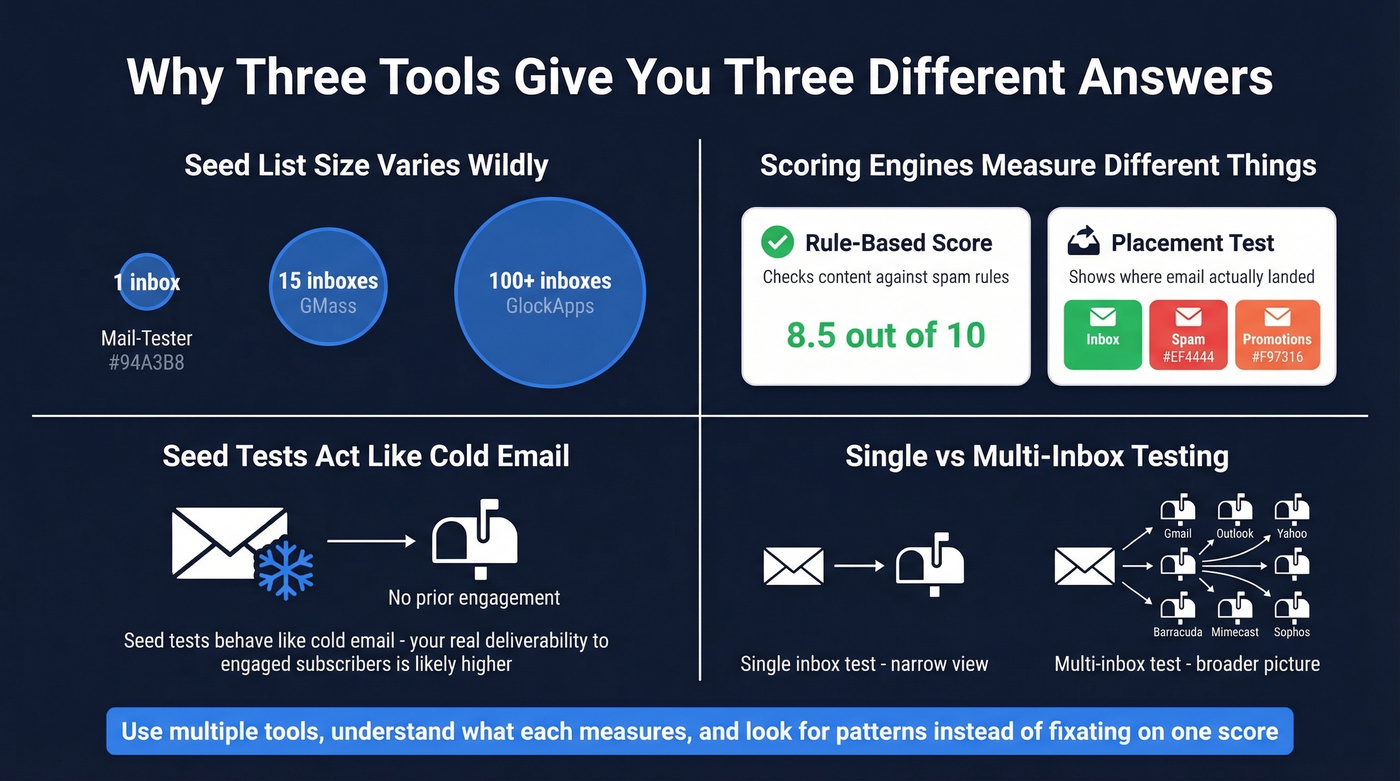
Seed list size varies dramatically. Mail-Tester checks one inbox. GMass checks 15. GlockApps checks roughly 100. MailReach checks 30+. A larger sample gives you more reliable placement data, but even 100 inboxes is a tiny fraction of the email ecosystem.
Scoring engines differ. Some tools focus on a rule-based spam score. Others measure actual inbox placement - where your email physically landed. A rule-based score doesn't guarantee inbox placement, and landing in spam on a seed test doesn't mean you'll hit spam everywhere.
Seed tests behave like cold email. This is the caveat most tools don't mention. Emails sent through these tools are essentially cold emails to addresses that never opted in. Your real deliverability to engaged subscribers will likely be higher.
Single-inbox vs. multi-inbox testing is the biggest methodological gap. Testing against one Gmail inbox tells you almost nothing about Outlook, Yahoo, or enterprise filters. Running a content checker alongside a multi-inbox seed test gives you a much more complete picture.
Use multiple tools, understand what each one measures, and look for patterns rather than fixating on a single score.
What Spam Testers Can't Tell You
Here's the thing most spam tester marketing won't say: Gmail doesn't use SpamAssassin. Neither does Outlook. The major email providers run proprietary machine learning models that weigh domain reputation and engagement signals - opens, replies, spam complaints, unsubscribes - far more heavily than content analysis.
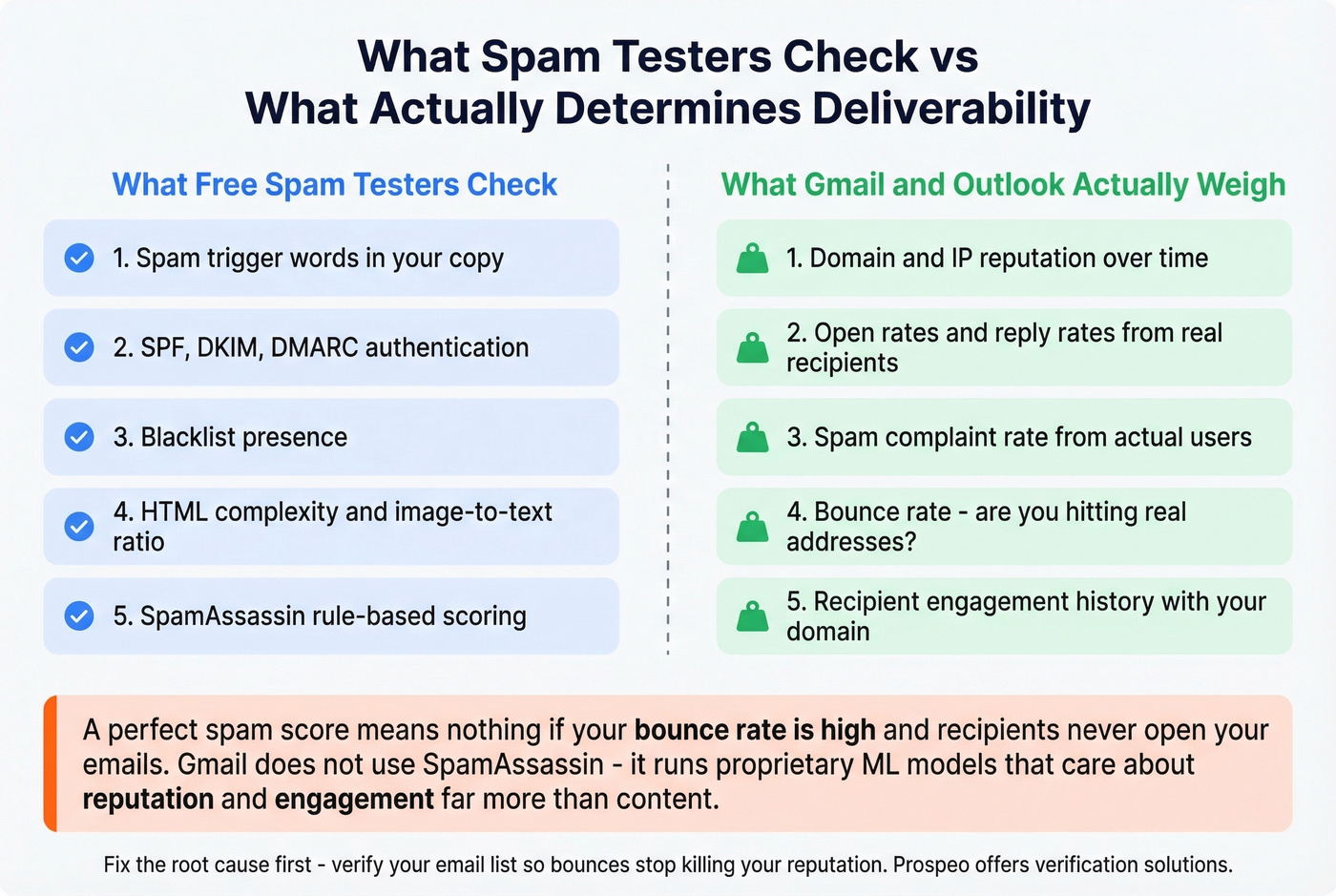
A "perfect" spam score doesn't guarantee inbox placement. We've seen emails score beautifully on every tester and still land in spam because the sending domain had a 40% bounce rate destroying its reputation. Google enforces a 0.3% spam complaint threshold for bulk senders - exceed that and you risk SMTP-level rejection regardless of your content.
If your bounce rate is above 3%, no spam checker - free or paid - matters. You don't have a content problem. You have a data problem. Fix the list first, then worry about your subject line.
For Gmail specifically, domain reputation now matters more than IP reputation. Gmail knows IPs get shared and rotated. Your domain is the persistent signal they track. Google Postmaster Tools is free and shows your actual Gmail domain reputation - if you're not using it alongside Microsoft SNDS and Yahoo Sender Hub, you're only seeing a third of the picture.
What to Do After Your Spam Test
A spam test diagnoses problems. Here's the remediation workflow, in order of impact.
Step 1: Verify your email list. This is the single most impactful thing you can do. Invalid emails cause bounces, and the industry benchmark is to keep total bounces under 2% with hard bounces under 1%. If you're above that, your domain reputation is taking damage with every send. No spam tester can fix a list quality problem - only verification can. Prospeo handles this with a 5-step verification process that includes catch-all domain handling, spam-trap removal, and honeypot filtering, with records refreshing every 7 days compared to the 6-week industry average. Stack Optimize built their agency to $1M ARR using this approach for client list verification, maintaining 94%+ deliverability, under 3% bounce rates, and zero domain flags across all clients.
Step 2: Fix SPF/DKIM/DMARC. Don't stop at p=none. Move to p=quarantine or p=reject. Bulk sender requirements now enforce authentication compliance. If you need a quick reference, start with DMARC alignment and a clean SPF record examples checklist.
Step 3: Separate your email streams. Put transactional and marketing email on different subdomains so a bad campaign doesn't tank your transactional deliverability.
Step 4: Sign up for Google Postmaster Tools. Free. Shows your actual domain reputation with Gmail. There's no reason not to use it.
Step 5: Scale IP infrastructure. For high-volume senders pushing over 2 million emails per day, the rule of thumb is roughly 1 dedicated IP per 2 million daily sends.
Step 6: Consider BIMI. After enforcing DMARC, BIMI displays your brand logo in supported inboxes - a trust signal on top of a clean authentication setup.
Re-test after each fix. Watch for patterns across tools, not single scores. If you want the full system, follow an email deliverability guide and track your email bounce rate as a first-class metric.
Stack Optimize built a million-dollar agency on Prospeo data - 94%+ deliverability, under 3% bounce rate, zero domain flags across every client. Snyk's 50 AEs dropped bounce rates from 35-40% to under 5%. No spam tester fixes a list full of dead addresses. Prospeo's 143M+ verified emails on a 7-day refresh cycle means you start with clean data instead of cleaning up after bad data.
Stop diagnosing deliverability problems. Start with data that doesn't create them.
FAQ
How accurate are free email spam testers?
Directional, not definitive. Seed-based testers can understate real deliverability because test emails behave like cold outreach - the receiving inbox has no engagement history with your domain. Use them to catch authentication errors and obvious content issues, but don't treat any single score as a guarantee of inbox placement.
Why do different spam testers give different results?
They use different methodologies - single-inbox vs. multi-inbox seed lists, rule-based scoring vs. real mailbox placement, and seed list sizes ranging from 1 inbox to 100. The results aren't "wrong." They're measuring different things, which is why testing with multiple tools gives you a more reliable picture.
What's a good spam score?
Most tools use a 0-10 scale where 5.0 is the default spam threshold. Under 5.0 generally passes; aim for under 3.0 for a comfortable margin. But Gmail doesn't use SpamAssassin - your score and your actual inbox placement are separate things entirely.
Can a free spam checker tell me if Gmail will deliver my email?
No. Gmail uses machine learning based on domain reputation and engagement signals, not content rules. A spam tester checks authentication, content, and blacklists, but only Google Postmaster Tools shows your actual Gmail reputation. Use both for a complete picture.
How does email verification improve deliverability?
Invalid emails cause bounces, and high bounce rates destroy sender reputation - the #1 factor in inbox placement. Keeping bounces under 2% protects your domain. Prospeo's verification catches catch-all domains, spam traps, and honeypots with 98% accuracy, refreshing records every 7 days. The free tier includes 75 verifications per month - enough to test the workflow before committing.