

G2 Intent Data: What It Costs, When It Works, and When It Doesn't
Ninety-one percent of B2B marketers say they use intent data to prioritize accounts. Only 24% report exceptional ROI. That gap between adoption and actual results is the story of intent data in 2026 - a $4.49B market growing fast, full of teams buying G2 intent data without a clear picture of what they're getting, what it costs, or how long before it pays for itself. And with 94% of buying groups having already ranked their preferred vendors before talking to sales, the window to act on buyer intent signals is razor-thin. Let's fix that.
The Short Version
G2 Buyer Intent is worth the spend if three things are true: your G2 category is popular, your team can act on signals within hours, and you have a way to turn account-level alerts into actual contacts.
- Price range: $10K-$87K+/year depending on package and add-ons
- Time to ROI: 14 months on average, per G2's own review data
- Signal type: Account-level only - you get company names, not people
- The catch: You need an enrichment tool to find the humans at those accounts
What Is G2 Buyer Intent Data?
G2 Buyer Intent captures behavior happening on G2.com itself. When a company's employees visit your profile, check your pricing page, compare you against a competitor, or browse your category, G2 packages those actions into intent signals and sends them to you.
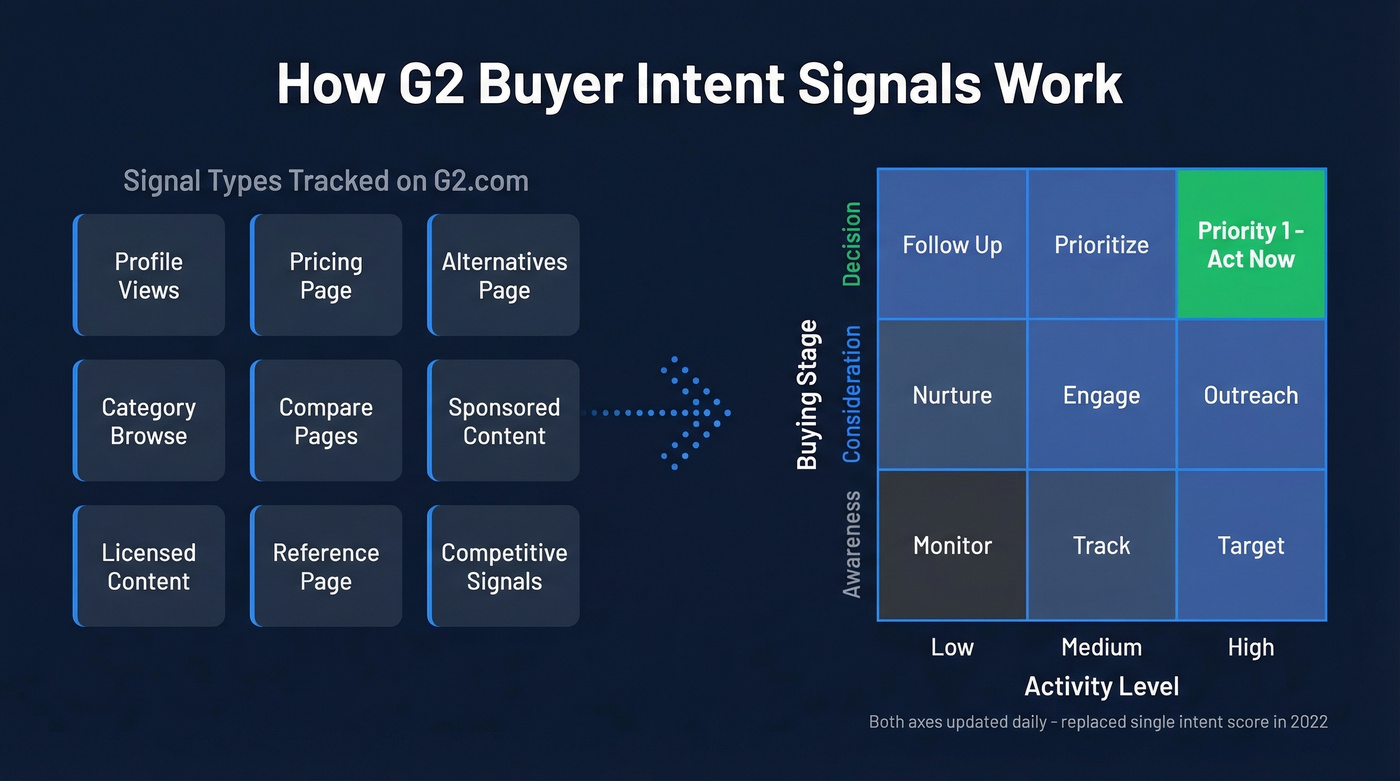
G2 documents signal types including Profile, Pricing, Alternatives, Category, Compare, Sponsored content, Licensed content, Reference page, and Competitive. Each signal carries key account-level fields: the signal URL/type, company name, company website, location, and session time. G2 prioritizes accounts using Buying Stage (Awareness, Consideration, Decision) and Activity Level (Low, Medium, High), both updated daily. Back in June 2022, G2 replaced a single Buyer Intent score with this two-axis model - a meaningful improvement for routing and prioritization.
This is what makes G2 fundamentally different from providers like Bombora or 6sense. Those platforms track topic-level intent across thousands of B2B websites - third-party data. G2 tracks actual behavior on G2.com - first-party data. You're not inferring that someone's researching "project management software" based on content consumption patterns. You're seeing that employees at Acme Corp visited your G2 pricing page three times this week. Because G2 is the largest software review site, this on-site intent carries a specificity that third-party providers can't match.
The product carries a 4.5/5 rating across 1,169 reviews on G2's own platform - which, yes, is a bit like grading your own homework. But the review volume is real and the feedback detailed enough to be useful.
What Does G2 Buyer Intent Cost?
G2 doesn't publish pricing. Buyer Intent is positioned as an add-on to their Brand Packages (Professional and Enterprise tiers), so you can't buy it standalone.
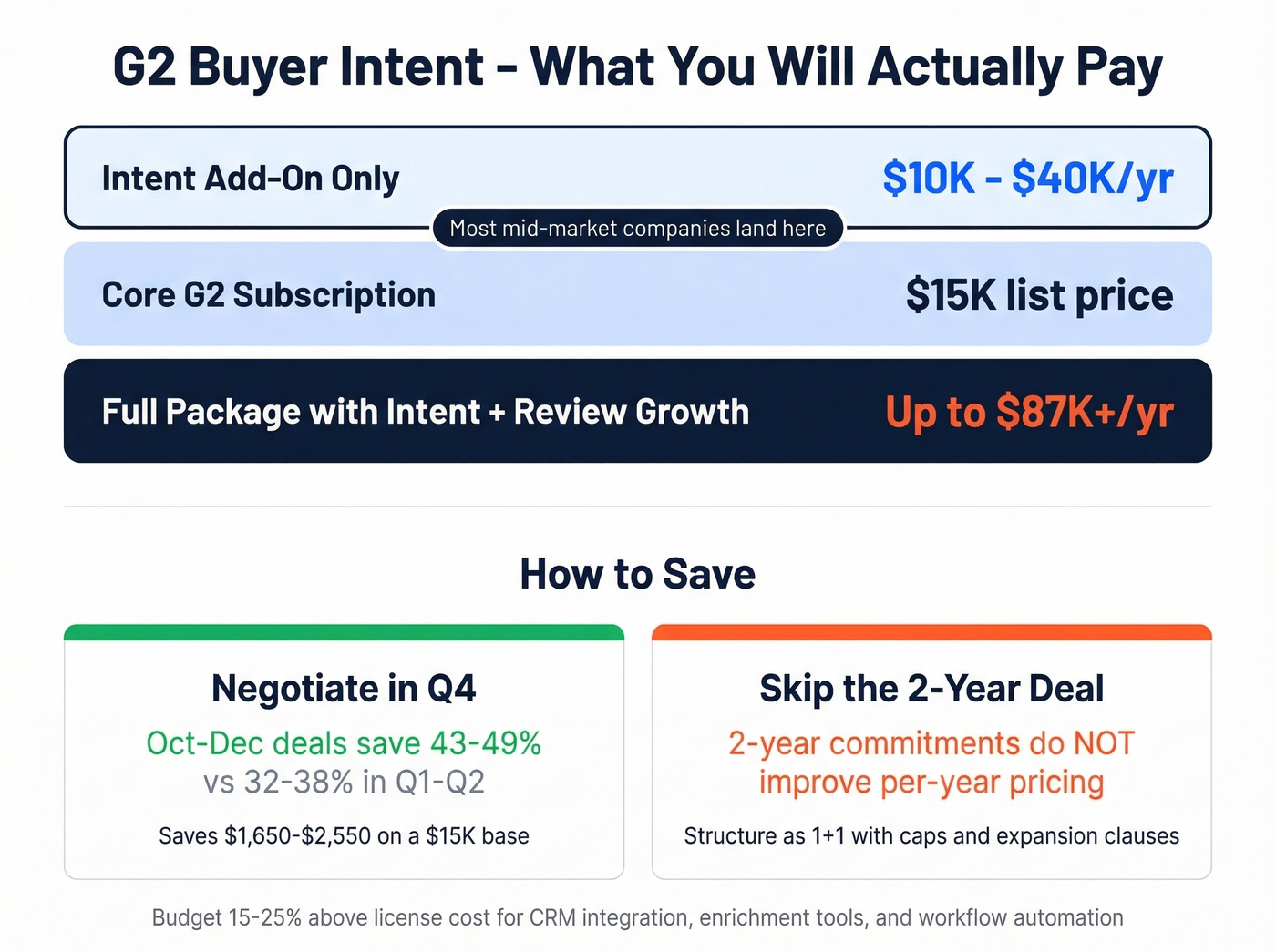
The core G2 subscription carries a $15,000 list price. Layer on Buyer Intent plus Review Growth, and total packages can climb to $87,000/year. Most mid-market companies land in the $10K-$40K range for the intent add-on specifically, depending on category and negotiation leverage.
Negotiate in Q4. October through December negotiations yield 43-49% savings versus 32-38% in Q1-Q2. On a $15K base, that's roughly $1,650-$2,550 in real savings just from timing.
Skip the 2-year deal. Vendr's data shows 2-year commitments don't improve per-year pricing versus 1-year deals. Structure as 1+1 with caps and expansion clauses instead. You keep leverage for year two.
Budget 15-25% above the license cost for implementation overhead - CRM integration, enrichment tooling, workflow automation. The license is just the starting line.
G2's own review data shows a perceived cost rating of "$ $ $ $ $" - the highest tier. Users aren't confused about whether this is expensive. The real question is whether the ROI justifies it.
Does G2 Intent Data Deliver ROI?
It depends entirely on your category, your speed-to-lead, and whether you've built the enrichment workflow to act on signals.
The Demandbase Case Study
The strongest public case study comes from Demandbase's own implementation. They reported $3.5M in pipeline in a single quarter sourced through G2 Buyer Intent integrated with their own platform, surfacing 12 competitive takeout opportunities and 10 additional opportunities from 1:1 display campaigns.
The workflow was tight: intent signals surface accounts viewing product, category, and competitor pages, which flow into Demandbase, get bucketed into journey stages, and trigger a daily report. Sales runs outreach while marketing fires 1:1 ads with personalized landing pages. They also used competitor-page signals for churn prevention - when existing customers started browsing alternatives, the team got alerted.
G2's analysis found that 80% of Demandbase's mid-market opportunities were active on G2 roughly one month before the opportunity opened in CRM. That's a meaningful early-warning signal.
Independent Benchmarks
Based on Dreamdata's 2022 attribution analysis across thousands of deals, 12% of closed-won deals were influenced by G2 signals. Deals with a G2 signal were 2x larger than average deal size, and successful journeys averaged 3 G2 touches.
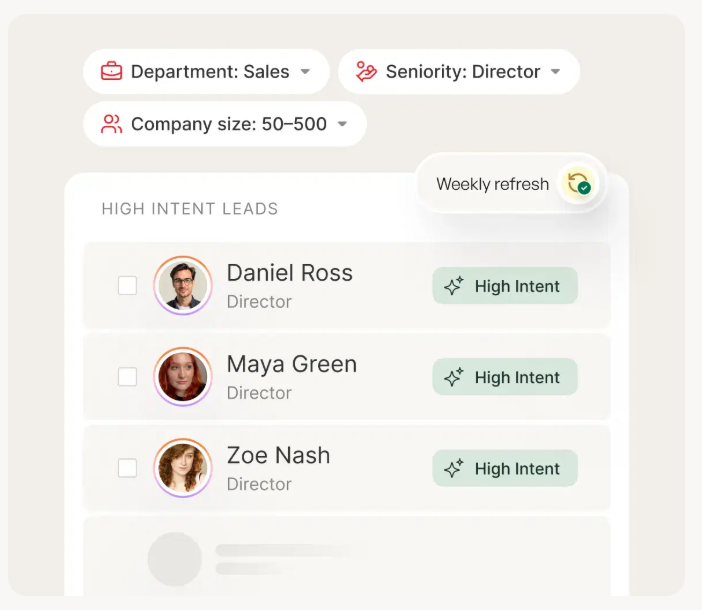
Twelve percent doesn't sound massive. But when those deals are twice the size, the revenue impact compounds fast. For a team closing $500K/quarter, 12% of deals at 2x size means G2-influenced revenue could represent 20%+ of total bookings.
What Users Actually Say
Reviews are polarized. One user said Buyer Intent "helped us be more focused in our outbound acquisition efforts." Another reported they "tried for two years" and "never really saw success," noting "lots of clean up to do" and "account based leads often include leads that aren't a good fit."
On Reddit, the consensus in r/sales threads is that intent data can feel like "smoke and mirrors" and "overpriced lists," with outreach landing on accounts that "have no idea what I'm talking about."
Here's the thing: G2 buyer intent is the best second-party signal you can buy for SaaS. But most teams don't fail because the signal is bad - they fail because they treat account-level data like contact-level data, then blame the vendor when outreach flops.

G2 intent tells you Acme Corp is in-market. Prospeo tells you exactly who to call. Turn account-level signals into 98%-accurate emails and verified mobile numbers with 30+ filters - job title, department, seniority - for $0.01/lead.
Stop paying $87K/yr for company names you can't contact.
Where G2 Intent Falls Short
G2 tells you Acme Corp is researching your category. It doesn't tell you who at Acme Corp. Unless a buyer fills out a gated form, you get company names and intent scores - not contacts, not emails, not phone numbers. This is the single biggest limitation, and it's the one that kills ROI for teams without an enrichment tool layer.
Signal volume is directly tied to how popular your G2 category is. "Project Management Software" has 486 tools and top listings with 10,000+ reviews. "Civil Engineering Design Software" has 90 listings with 100-200 reviews each. If you're in a niche category, you'll get a handful of signals per week - not enough to build a pipeline motion around.
Then there's activation friction. The signals don't do anything on their own. You need to export them, integrate into your CRM, layer enrichment on top, and build routing rules. More subscriptions, more operational overhead, more things that can break.
Picture this: your SDR gets a Slack alert saying "Acme Corp viewed your pricing page." They check the CRM - no contacts from Acme Corp. They spend 20 minutes hunting for the right person's email. By the time they send a message, a competitor's SDR who had enriched contacts ready already booked the meeting. Speed-to-lead is everything in intent-driven outbound, and the account-level limitation creates a bottleneck at the worst possible moment.
How to Use G2 Intent Data for Sales
Most teams that fail with buyer intent don't have a data problem - they have a workflow problem. We've tested this across multiple GTM stacks, and the pattern is always the same: the enrichment step is where 80% of teams stall.
The API-to-CRM Workflow
The Tray.ai automation blueprint lays out the core architecture well. The original blueprint uses Clearbit for enrichment, but any contact data provider works in this slot:
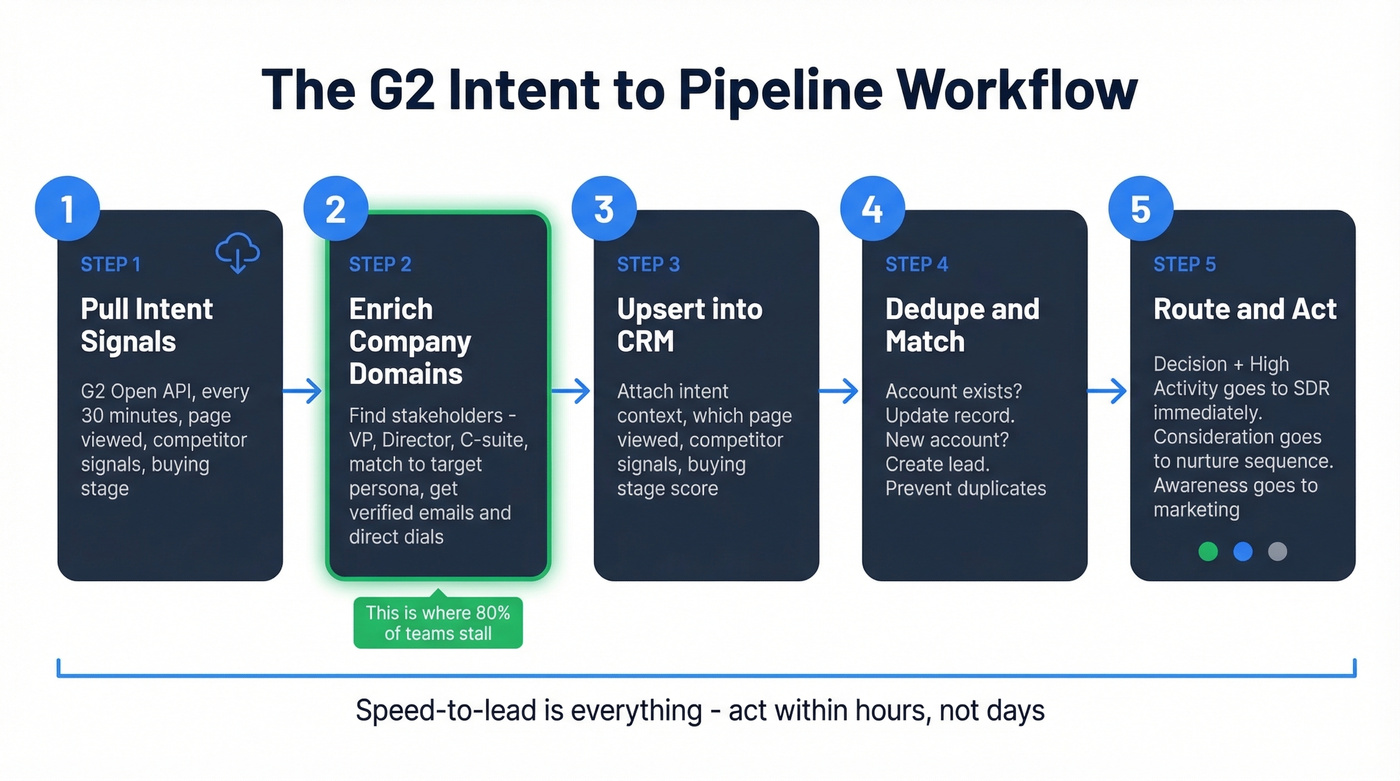
- Pull intent signals via G2's open API every 30 minutes so you can act quickly while minimizing API calls.
- Enrich company domains to find stakeholders - VP, Director, C-suite titles in your target persona.
- Upsert into your CRM with intent context attached: which page they viewed, competitor signals, buying stage.
- Dedupe against existing leads and contacts. If the account already exists, update the record. If not, create a new lead.
- Route based on persona targeting.
Don't over-filter your alerts. Overly specific filters kill signal volume, and then the whole program looks "dead" even when buyers are active.
Closing the Contact-Level Gap
G2 gives you companies, not people. The enrichment step is where this workflow lives or dies.
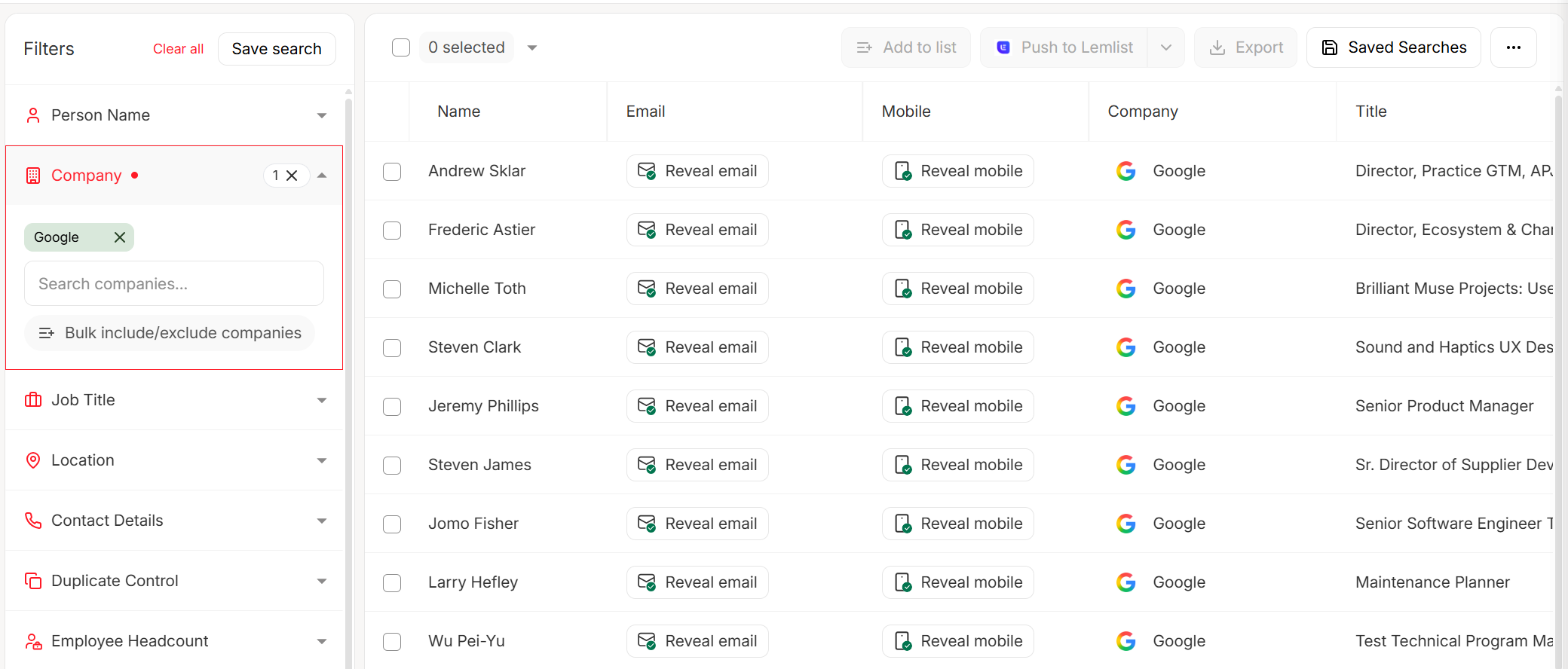
Take the company domains from your intent alerts and run them through Prospeo's B2B database. You'll get verified emails with 98% accuracy and direct dials from 125M+ verified mobiles for decision-makers at those accounts. The 30+ search filters let you narrow by title, department, and seniority - so you're reaching the VP of Marketing who's actually driving the evaluation, not blasting the entire company. Research shows layered intent signals yield 47% better conversion rates and 43% larger deal sizes, which is exactly why pairing G2's on-site signals with verified contacts in one workflow produces outsized results.
G2 Buyer Intent vs. Other Providers
| Provider | Annual Cost | Signal Type | Best For |
|---|---|---|---|
| G2 Buyer Intent | $10K-$87K+ | First-party (G2.com) | SaaS with strong G2 presence |
| Prospeo | From ~$0.01/lead | Bombora 15K topics + contacts | Intent + verified contacts, no contracts |
| Bombora | $25K-$80K | Third-party topic intent | Enterprise ABM, broad coverage |
| ZoomInfo Streaming | $7.2K-$36K | Third-party streaming | Mid-market, intent + contacts |
| 6sense | $35K-$150K+ | Predictive + multi-source | Full-funnel orchestration |
| Demandbase | $40K-$120K | Multi-source account intent | Enterprise account-based GTM |
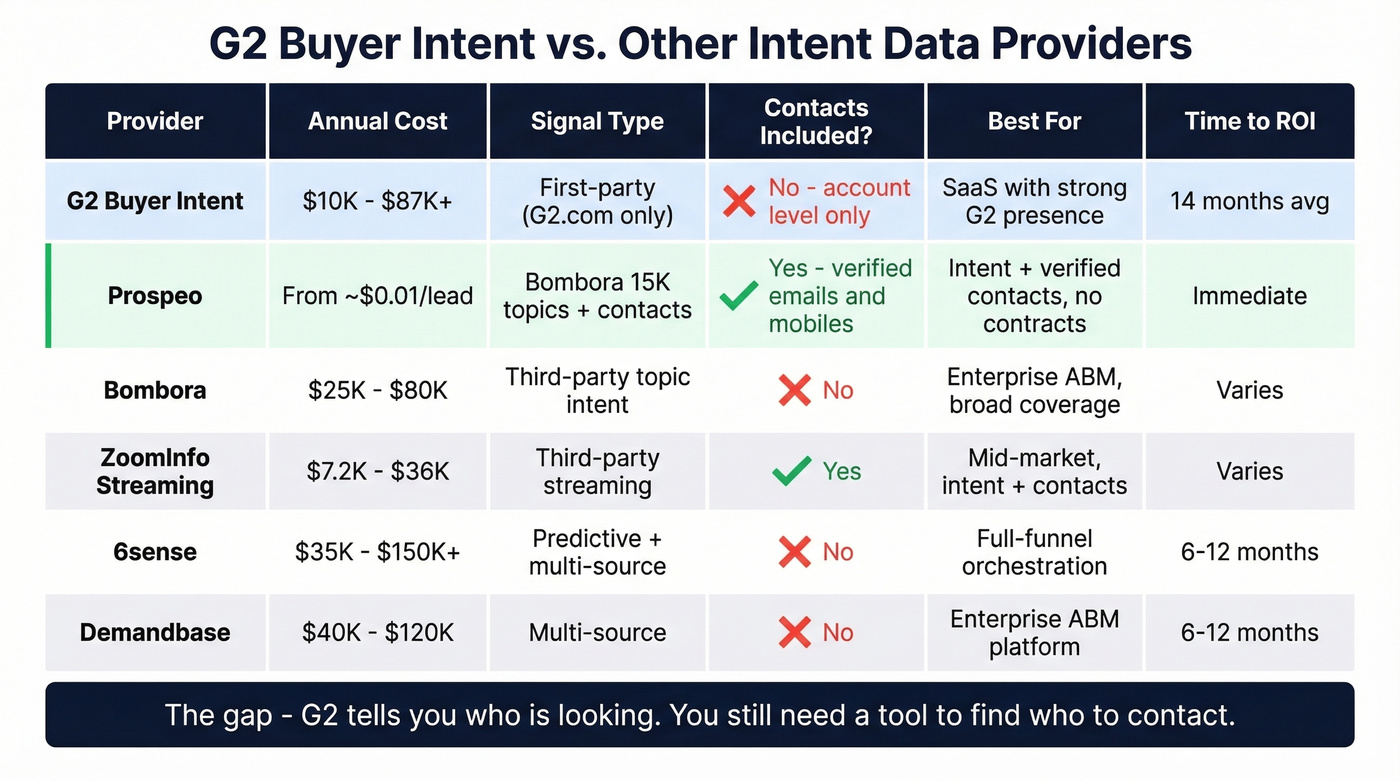
G2's unique advantage is on-site data - you're seeing actual behavior on a platform where buyers go to evaluate software. That's more specific than Bombora's web-wide topic inference or 6sense's predictive modeling. But it's also narrower. If your buyers don't use G2 heavily, the signal volume won't justify the cost.
ZoomInfo Streaming Intent is the middle ground - intent plus contacts in one platform, at $7.2K-$36K/year. We've seen teams get decent results with it, but pricing escalates fast once you add seats and modules.
When It's Worth It (and When to Skip)
Worth it when:
- Your G2 category is large with high review volume
- Your sales team can act on signals within hours, not days
- You already have an enrichment workflow to get from accounts to contacts
- Your deal sizes justify $10K-$40K+ in annual data spend
Skip it when your G2 category is niche - low listing count, low review volume. Skip it when your follow-up cadence is weekly, because signals go stale fast. Skip it when you don't have CRM integration or enrichment tooling in place, and skip it when your average deal size can't absorb five figures in annual data spend.
G2 intent data isn't bad. It's incomplete. The signal quality is genuinely high when your category is active. The problem is that account-level data without a fast enrichment layer creates a gap your competitors will exploit. Close that gap, and G2 buyer intent becomes a real pipeline driver. Leave it open, and you're paying for alerts you can't act on.
The 76% of teams not seeing ROI from intent data share one problem: no enrichment layer. Prospeo's 300M+ profiles and 92% API match rate close the gap between G2's account signals and actual pipeline. Enrich entire account lists in minutes, not days.
Your G2 intent data is only as good as the contacts you extract from it.
FAQ
Is G2 Buyer Intent contact-level or account-level?
Account-level only. You receive company names, buying stages, and signal types - not individual contacts or email addresses. To reach decision-makers, pair it with an enrichment tool that converts domains into actionable contacts with verified emails and direct dials.
How much does G2 Buyer Intent cost per year?
Most mid-market deals land between $10,000-$40,000/year for the intent add-on. Total packages with review growth and content licensing can reach $87,000+. Negotiate in Q4 for 43-49% savings versus Q1 pricing.
How long does it take to see ROI from G2 intent signals?
G2's own review data shows an average of 14 months to ROI. Teams with sub-hour follow-up cadences and automated enrichment workflows see results sooner. Teams without those foundations often report two years of trying with limited success.
Can I use G2 intent for sales without additional tools?
Technically yes, but results will suffer. The signals work best when paired with an enrichment layer that converts account-level alerts into verified contacts your reps can actually reach. Without that step, SDRs waste time manually hunting for the right person while the buying window closes.
What's the difference between G2 intent and Bombora?
G2 captures behavior on G2.com specifically - profile views, pricing page visits, competitor comparisons. That's first-party data. Bombora tracks content consumption across thousands of B2B websites to infer topic-level interest - third-party data. They work best layered together for maximum signal coverage.