

Global Account Management: The 2026 Practitioner Guide
You've just inherited a "global account" - a $4M relationship spread across 11 countries, managed by a CRM full of contacts last updated in 2022. Half the stakeholders have changed roles. The regional teams in APAC and EMEA have their own pricing agreements that contradict what HQ signed. Welcome to global account management.
What You Need (Quick Version)
GAM is an organizational transformation, not a sales tactic. If your CEO isn't sponsoring it, stop here - you'll burn two years and a lot of political capital for nothing. Start with organizational readiness, not account selection.
The three non-negotiable infrastructure layers are a CRM, an account planning platform, and verified contact data for stakeholder mapping. Research on GAM programs found that only about a third of suppliers who adopted GAM were satisfied with the results. The ones who succeeded treated it as a multi-year commitment, not a quarterly initiative.
What Is GAM?
Global account management treats a multinational customer's worldwide operations as one integrated account, with coherent terms for pricing, specifications, and service delivery. That's the HBR definition, and it still holds. The key word is integrated - not "we have salespeople in multiple countries who happen to sell to the same logo."
Think of it this way: a global automotive parts supplier needs GAM because Toyota's procurement in Japan, manufacturing in Thailand, and assembly in the US all need aligned pricing and delivery terms. A regional KAM setup would have three separate reps quoting three different prices to the same customer. That's a fast way to destroy trust.
The confusion usually starts with terminology. GAM, KAM, and SAM get used interchangeably, but they're different animals with different governance requirements.
| GAM | KAM | SAM | |
|---|---|---|---|
| Scope | Cross-border, global | Single region/country | Strategic, often national |
| Governance | HQ + regional + local | Regional/national | National or divisional |
| Typical accounts | 5-20 | 20-50 | 10-30 |
| Coordination | Very high | Moderate | Moderate to high |
KAM manages strategic accounts within one geography. SAM elevates the most important accounts with dedicated resources and executive alignment. GAM does all of that across borders, which introduces currency, compliance, cultural, and organizational complexity that the other two don't face.
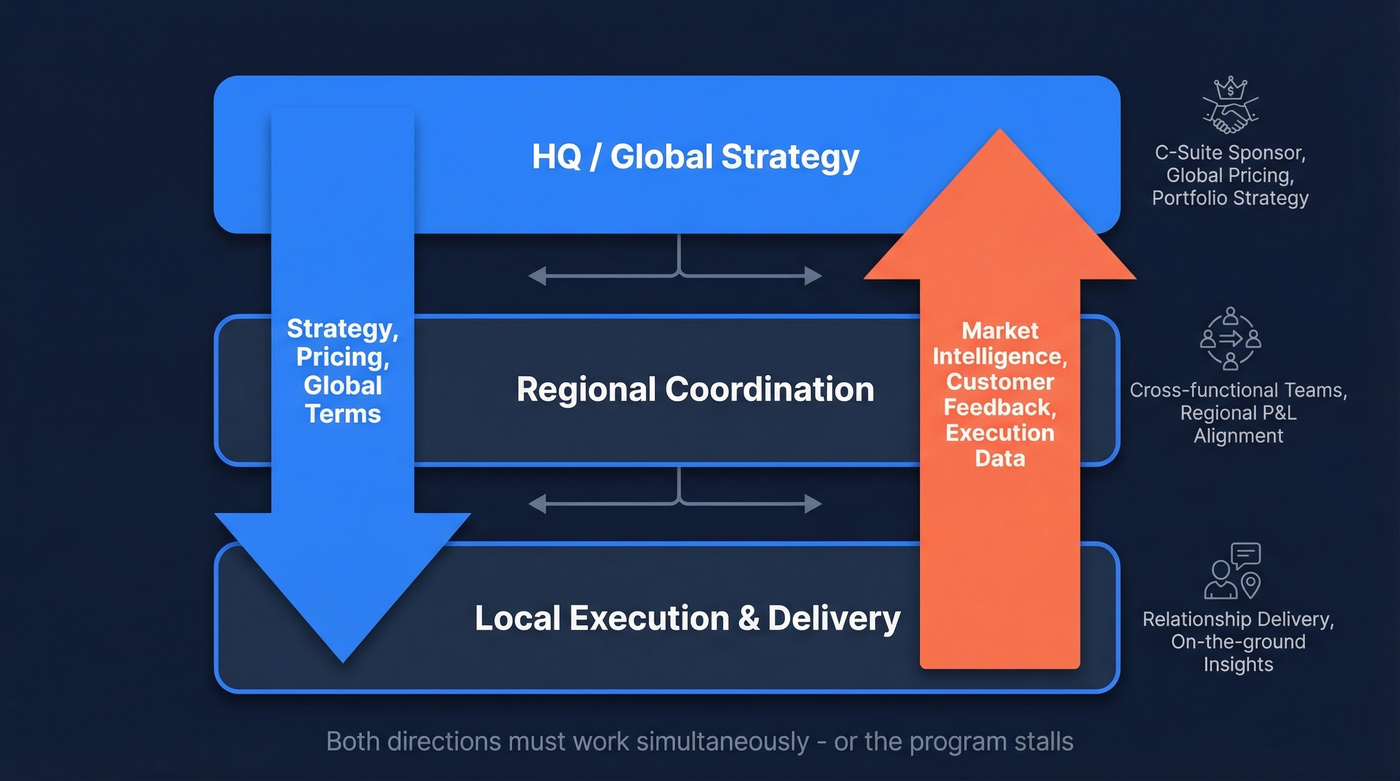
The bidirectional flow is what makes GAM uniquely hard. Strategy flows down from HQ. Execution intelligence flows up from local teams. Both directions need to work simultaneously, and Forbes highlights this bidirectional flow across levels as a core governance challenge.
The Business Case - and Why Most Programs Fail
Let's be honest about the numbers. Early GAM adopters averaged roughly 10 years of trial and error before gains clearly outweighed pains. That's a sobering timeline. But the gains, when they arrive, are real.
A Mercuri International case study involving one of Europe's largest technology conglomerates - operating across 190 countries - found that managed accounts grew at twice the rate of non-managed accounts after rolling out a structured program for 100 global and 4,000 regional account managers. HBR's benchmark suggests that within a few years of introducing a GAM program, companies can expect customer satisfaction to increase by about 20%. B2B customers who are very satisfied with their account management show a 40% full engagement rate, compared to just 13% for unsatisfied customers. That's a 3x difference in engagement, not a marginal gap.
So why do most programs fail? Because companies treat GAM as a selling technique they can bolt onto existing operations. It's a different business model that requires different incentives, different governance, and different measurement. The one-third satisfaction rate isn't because the model doesn't work - it's because most companies don't commit to the organizational change it demands.
Mistakes That Kill GAM Programs
These come from Cranfield's research on KAM failure modes, adapted for global programs. We've seen every one of these play out in real organizations.
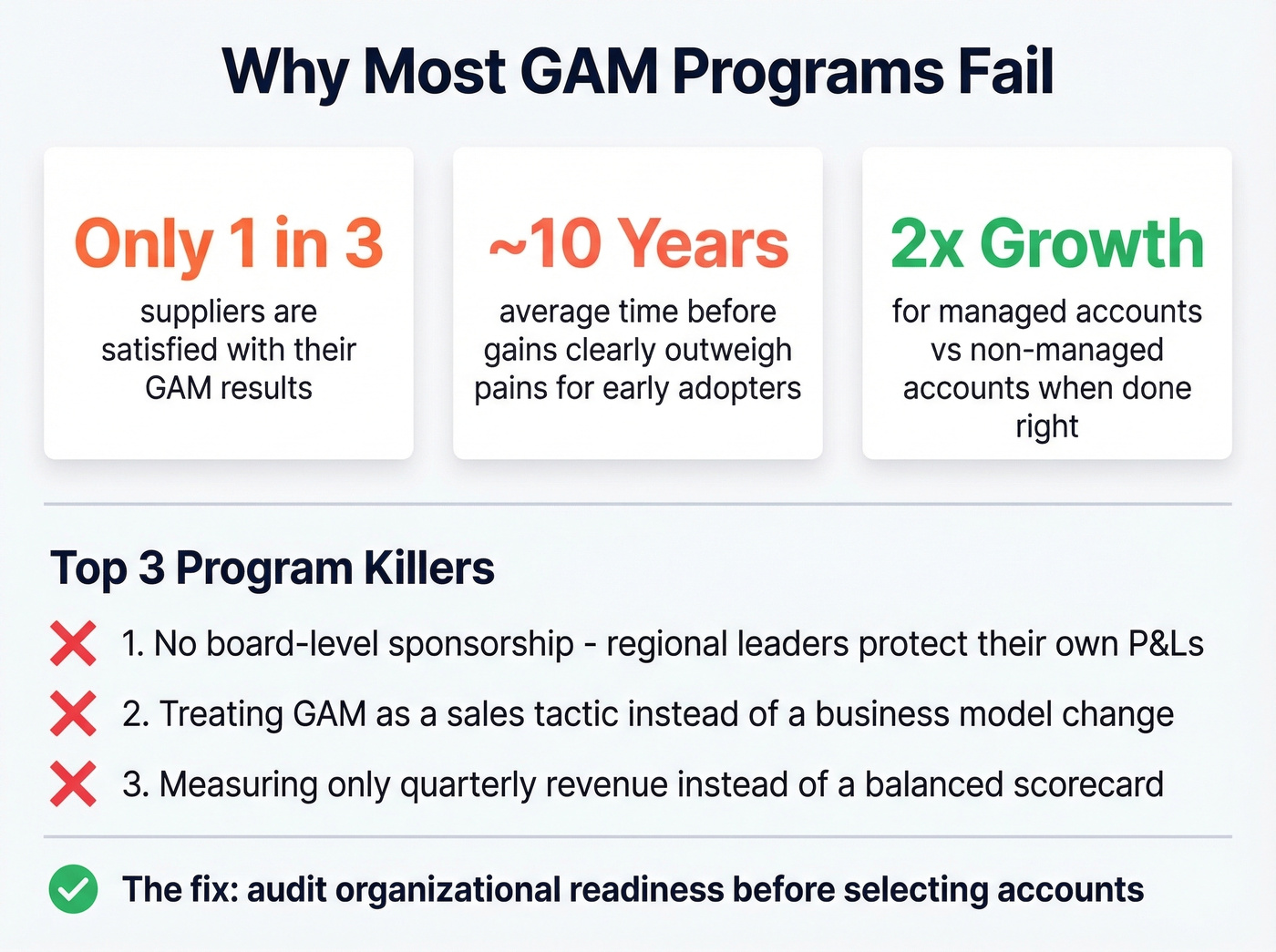
Treating GAM as a selling technique. It's a business model change. If you're just relabeling your enterprise reps as "global account managers," you've changed nothing.
No board-level sponsorship. GAM requires cross-functional coordination that a VP of Sales can't mandate alone. Without C-suite backing, regional leaders will protect their P&Ls and ignore the global strategy.
Weak cross-functional support. The GAM team includes product, marketing, CS, and delivery contributors who don't report to the GAM. Without executive air cover, those contributors prioritize their functional managers every time.
Chasing short-term wins. GAM is a multi-year investment. Measuring it on quarterly bookings is like judging a vineyard by its first harvest.
Buying generic training. Off-the-shelf "strategic selling" courses don't address the specific organizational, cultural, and governance challenges your company faces. Tailor the program or skip it entirely.
No balanced scorecard. If you're only measuring revenue, you're missing cost-to-serve, account health, stakeholder coverage, and share of wallet - the metrics that predict whether revenue will sustain.
Selecting accounts by logo prestige. DemandFarm warns against "Fortune 500 logo" selection. Pick accounts based on revenue potential, cultural fit, product fit, and partnership potential - not brand recognition.
Here's the contrarian move: audit organizational readiness before selecting accounts. Most companies do it backwards. They pick their dream accounts, assign a GAM, and then discover they don't have the governance, incentives, or cross-functional support to serve those accounts globally. Cranfield cites cases where a single focused KAM strategy grew a strategic customer by 70%. Start with the beachhead approach - two or three accounts to generate internal case studies and prove the model before scaling.

Half the stakeholders in your global accounts changed roles since your last CRM update. Prospeo's 7-day data refresh cycle and 300M+ verified profiles mean your stakeholder maps are never stale - across every region, every subsidiary, every buying committee.
Stop managing global accounts with 2022 contact data.
How to Build a GAM Program
Audit Organizational Readiness
Before you pick a single account, answer these:
- Does the CEO or CRO sponsor this program explicitly?
- Are regional P&L incentives aligned, or will country managers fight global pricing?
- Do cross-functional teams have capacity allocated for GAM support?
- Is there budget for a multi-year rollout, not just a pilot quarter?
If you can't check all four, you're not ready. Fix the organizational foundation first. A GAM program without executive sponsorship and incentive alignment is just an expensive title change.
Select Accounts Strategically
Account selection criteria should include revenue potential, cultural fit, product fit, solvency, and partnership potential. Juro's framework recommends executive-level involvement in the selection process - this isn't a decision for frontline managers alone.
Resist the temptation to select accounts by brand recognition. A $200M logo with no co-creation potential is a worse GAM candidate than a $40M partner eager to build together.
What this looks like by industry: in manufacturing, GAM candidates are customers with multi-region supply chains needing coordinated pricing and delivery. In SaaS, they're enterprises deploying your product across geographies with consumption-based expansion potential. For logistics companies, they're shippers with global freight needs who benefit from unified service-level agreements.
Build the Account Plan
xGrowth frames account planning as a continuous cycle - assess, plan, execute, review, repeat. The plan should cover whitespace analysis (where are you engaged today, and where are the expansion opportunities?), voice of the customer through direct conversations, stakeholder mapping across hierarchy and influence networks, and a communication matrix tracking interaction patterns over the last 12 months.
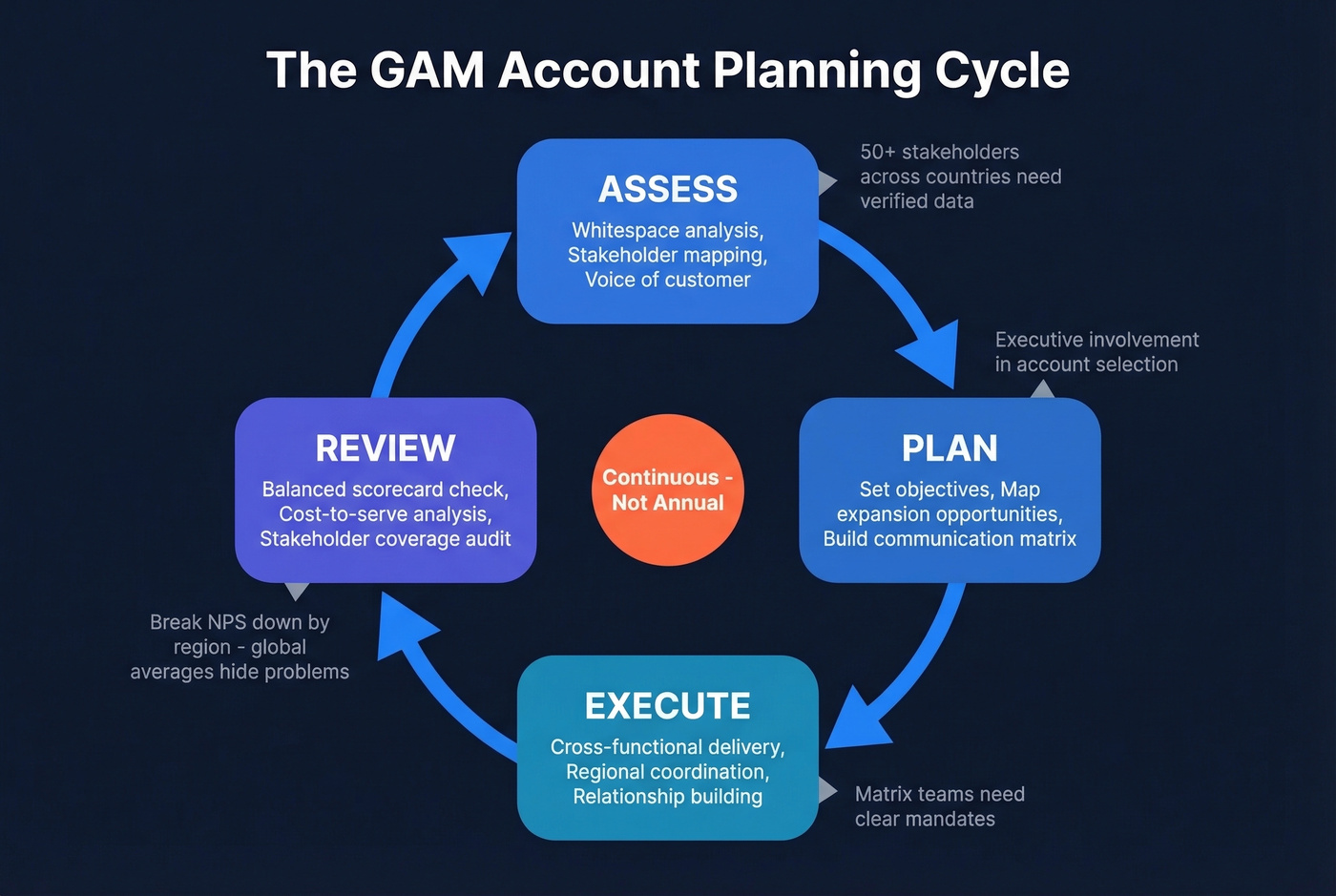
When you're mapping 50+ stakeholders across multiple countries, verified contact data isn't optional. Prospeo offers 98% email accuracy and a 7-day refresh cycle, so your stakeholder map reflects reality rather than a two-year-old CRM snapshot.
Design the Governance Model
In our experience, the governance model is where most GAM programs stall. GAM governance operates across three levels: HQ sets global strategy and pricing, regional teams coordinate execution, and local teams deliver the relationship. The cross-functional team structure is critical - contributors from product, marketing, CS, and delivery participate in the account team but don't report to the GAM. This matrix structure only works with clear executive mandates and shared KPIs. Without them, functional priorities always win.
Define Metrics and KPIs
A balanced scorecard approach prevents the common failure of measuring GAM programs on revenue alone.
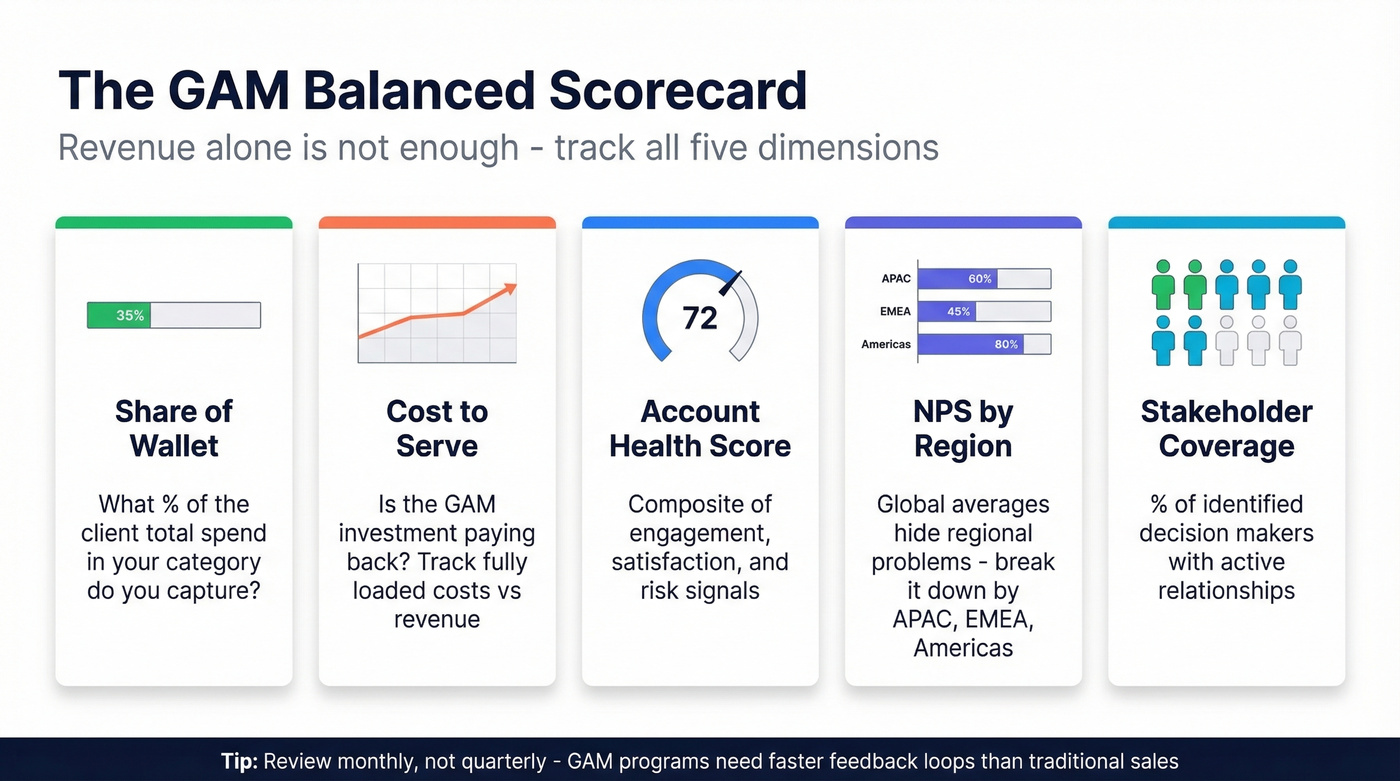
- Share of wallet: What percentage of the client's total spend in your category do you capture?
- Cost-to-serve: GAM programs are expensive. Track whether the investment pays back.
- Account health score: A composite metric covering engagement, satisfaction, and risk signals.
- NPS by region: Global averages hide regional problems. Break it down.
- Stakeholder coverage ratio: Percentage of identified decision-makers with active relationships.
The Modern GAM Operating Model
A 2024 study published in ScienceDirect introduced a dual-dimension framework that captures what makes managing global accounts uniquely complex. GAM units must manage two relationship dimensions simultaneously: intra-organizational (across the supplier's own global divisions) and inter-organizational (with the global client).
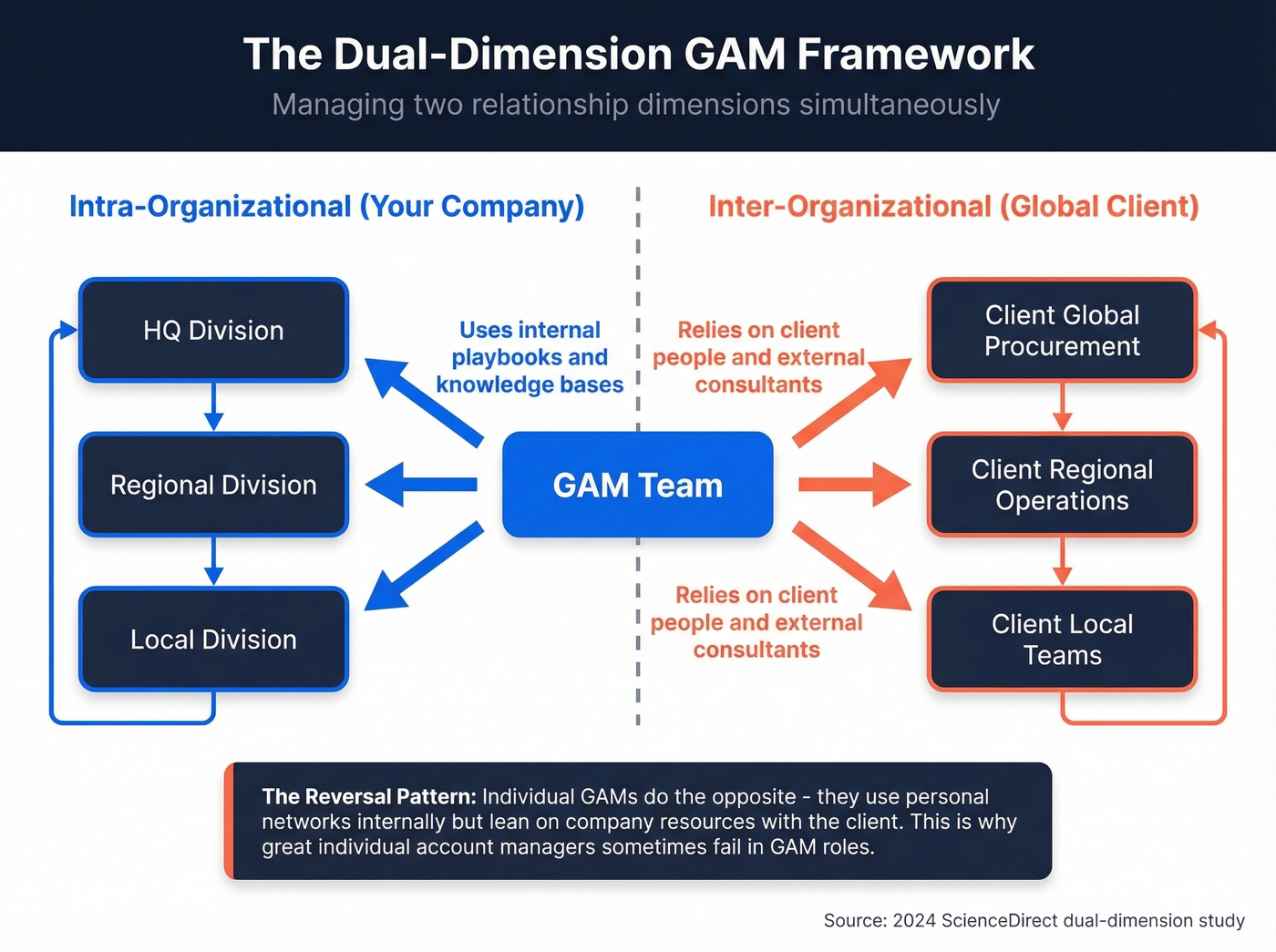
The interesting finding is a reversal pattern. The GAM team uses internal playbooks and knowledge bases to coordinate across its own divisions, but relies on the client's people and external consultants to manage the client relationship. Individual GAMs do the opposite - they tap personal networks to navigate internal politics, but lean on company resources when working directly with the client. This isn't academic trivia. It explains why great individual account managers sometimes fail in GAM roles: the skills that work one-on-one don't automatically scale to organizational coordination.
The Reddit conversation around GAM in SaaS adds a practitioner layer worth noting. In cloud-based businesses, GAM can feel like a secure role with a high floor but a lower ceiling - quota is tied to consumption growth rather than classic new-logo bookings. Renewal-heavy, expansion-focused, with variable comp that doesn't spike the way closing roles can.
Here's the thing: GAM comp plans in SaaS are chronically undervalued relative to the complexity of the work. Managing a $10M relationship across eight countries requires more strategic skill than closing a $500K new logo, but the OTE rarely reflects that. If your company is serious about GAM, fix the comp plan first. Otherwise your best people will stay in closing roles.
Technology Stack for GAM
CRM alone isn't enough for GAM. MarketsandMarkets draws a clear line: CRMs focus on pipeline and new logos, while account management platforms focus on retention and expansion with visual org maps, configurable health models, and whitespace analytics. Poor data quality costs businesses roughly $15 million per year - and in GAM, where a single account relationship can be worth eight figures, stale data is a direct threat to the relationship.
Here's the three-layer stack every GAM program needs:
| Layer | Tool | Starting Price |
|---|---|---|
| Contact Data | Prospeo | Free (75 emails/mo); ~$0.01/email |
| CRM | Salesforce | $25/user/mo |
| CRM | HubSpot | Free; paid Sales Hub ~$20/user/mo |
| CRM | monday CRM | $10/user/mo |
| CRM | Zoho CRM | $14/user/mo |
| Account Planning | DemandFarm | ~$15K-$40K/yr |
| Account Planning | Kapta | ~$12K-$30K/yr |
| Account Planning | Revegy | ~$20K-$60K/yr |
Contact data sits at the foundation because everything else depends on it. A 7-day data refresh cycle matters when stakeholders change roles frequently across global organizations - the industry average of six weeks means your map is already outdated by the time you finish building it. The Chrome extension lets teams enrich contacts directly from company websites, and CRM integrations push verified data straight into Salesforce or HubSpot.

Forbes identifies four criteria for digital GAM optimization: comprehensive account views, knowledge-base-driven decision-making, AI-backed insights to reduce admin time, and retention-focused analytics. Your stack should address all four.
GAM programs fail when reps can't reach decision-makers across borders. Prospeo delivers 98% accurate emails and 125M+ verified mobile numbers globally - so your APAC, EMEA, and Americas teams all connect with the right stakeholders, not dead contacts.
Give every regional team direct access to verified global contacts.
Career Path and Compensation
Let's talk money. Glassdoor data based on 1,500 US salaries puts the median total compensation for a Global Account Manager at $210K/year, with a range of $161K-$279K. Top 10% earn $280K+. PayScale's data from 144 profiles shows an average base salary of $117K, with variable comp adding $16K-$106K depending on performance.
The spread between base and total comp tells you something important: GAM roles have significant variable upside, but it's weighted toward bonuses and account growth metrics rather than pure commission. This is a relationship-and-expansion role, not a hunting role.
Larger accounts: Move from mid-market global accounts to enterprise flagships. A GAM managing a $5M relationship can progress to $50M+ accounts, with comp scaling accordingly. The path leads to VP of Strategic Accounts.
Leadership: Director of Account Management, then VP or CRO. This requires building and managing a team of GAMs, not just running accounts.
Lateral moves: Customer Success leadership, Partnerships, or Sales Engineering. GAMs who enjoy the consultative side often find these adjacent roles more fulfilling than staying on the management track.
The consensus on r/sales reflects a real tension. People drawn to AM work value stability and the consultative side over the adrenaline of closing. That's a legitimate preference, not a weakness. A common concern is whether a "no hunting" GAM role is risky in a weak economy. Usually it's the opposite - retention roles are safer during downturns, not riskier. The risk is company health, not the role itself.
Who should skip GAM entirely? If you need uncapped commission upside, thrive on the hunt, and get bored managing long-term relationships, GAM will feel like a ceiling. It's not for everyone, and that's fine.
FAQ
What's the difference between GAM and KAM?
KAM manages strategic accounts within one region; GAM coordinates across countries with multi-level governance at HQ, regional, and local tiers. GAM requires cross-border alignment on pricing, service delivery, and strategy that KAM doesn't. The coordination complexity - currency, compliance, culture - is significantly higher.
How long until a GAM program shows ROI?
Early adopters averaged roughly 10 years before gains outweighed pains. Modern programs with better tools and frameworks can compress this to two or three years minimum. Programs that demand quarterly ROI proof almost always get killed prematurely.
Is a GAM role risky during a recession?
Usually the opposite. When budgets tighten, companies prioritize retaining and expanding existing accounts, which is exactly what GAMs do. The real risk is whether your company survives the downturn, not whether the GAM function gets cut. Retention-focused roles are among the last to go.
What tools do GAM teams need beyond CRM?
Three layers: CRM for pipeline management, an account planning platform for whitespace analysis and org mapping, and verified contact data for stakeholder mapping. CRM alone can't do visual org mapping or health scoring at the level GAM demands.
How much do Global Account Managers earn?
US median total compensation is $210K/year based on 1,500 Glassdoor salaries, ranging from $161K to $279K. Base salary averages $117K per PayScale, with variable comp adding $16K-$106K. Top 10% earn $280K+, weighted toward bonuses and account growth metrics rather than pure commission.