

Global Business Directories: Which Ones Actually Matter in 2026?
Your agency's quarterly report lands in your inbox. It proudly lists 47 directory submissions. You recognize maybe seven of them. The rest sound like they were generated by a domain name randomizer - and half the links are dead.
You're paying for this.
Fewer than 20 global business directory listings typically move the needle. The rest are noise, link farms, or outright scams. Let's sort the signal from the garbage.
What You Need (Quick Version)
Before we go deep, here's the shortcut based on what you're actually trying to do:
Need local visibility? Google Business Profile + Apple Business Connect + Bing Places. Free, non-negotiable, and they feed major maps and search ecosystems that increasingly show up in AI answers. Everything else is secondary.
Researching B2B suppliers? Kompass, Europages, or Thomas Global Register cover international procurement. D&B is especially useful for US company lookups.
Need verified contact data for outbound sales? Skip directories entirely. You need a sales intelligence platform - traditional directories don't give you emails and direct dials for decision-makers.
Now let's break down why those three paths exist, and which specific directories deserve your time.
What Is a Global Business Directory?
A global business directory is a structured database listing companies by name, address, phone number (NAP), industry category, hours, and sometimes reviews or media. The "digital Yellow Pages" comparison stopped being useful a decade ago. The category has splintered into four distinct types that serve very different purposes, and lumping them together leads to bad decisions about where to invest your time.
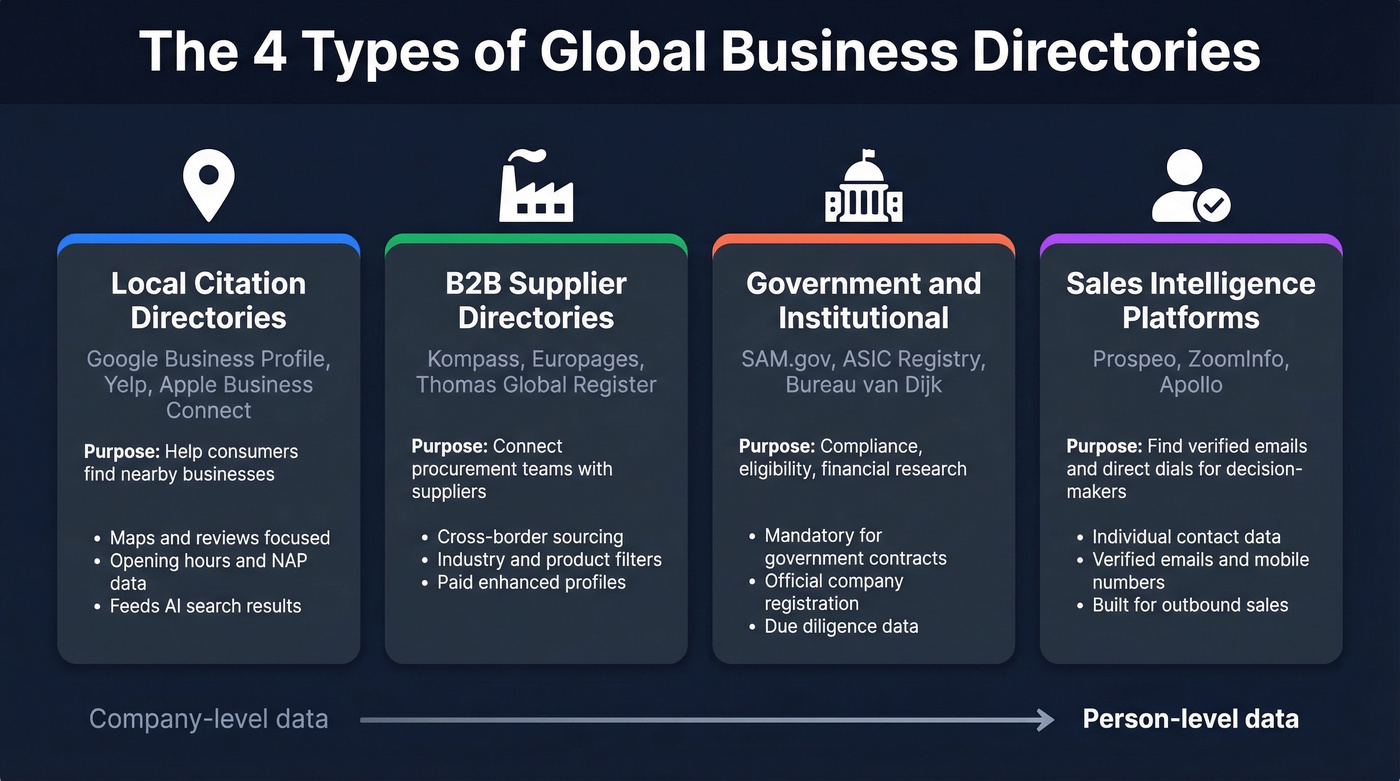
Local citation directories like Google Business Profile and Yelp focus on helping consumers find nearby businesses. They're built around maps, reviews, and opening hours. B2B supplier directories like Kompass and Europages serve procurement teams looking for manufacturers, distributors, and service providers across borders. Government and institutional directories - SAM.gov, ASIC Registry, Bureau van Dijk - exist for compliance, procurement eligibility, and financial research.
Then there's the fourth type: sales intelligence platforms. Instead of listing a company's address and phone number, these platforms provide verified emails, direct mobile numbers, and job titles for individual decision-makers. Different animal entirely. But if you searched for a company directory because you need to reach people at companies, this is probably what you actually need.
Do Directories Still Matter in 2026?
Yes, but only the right ones.
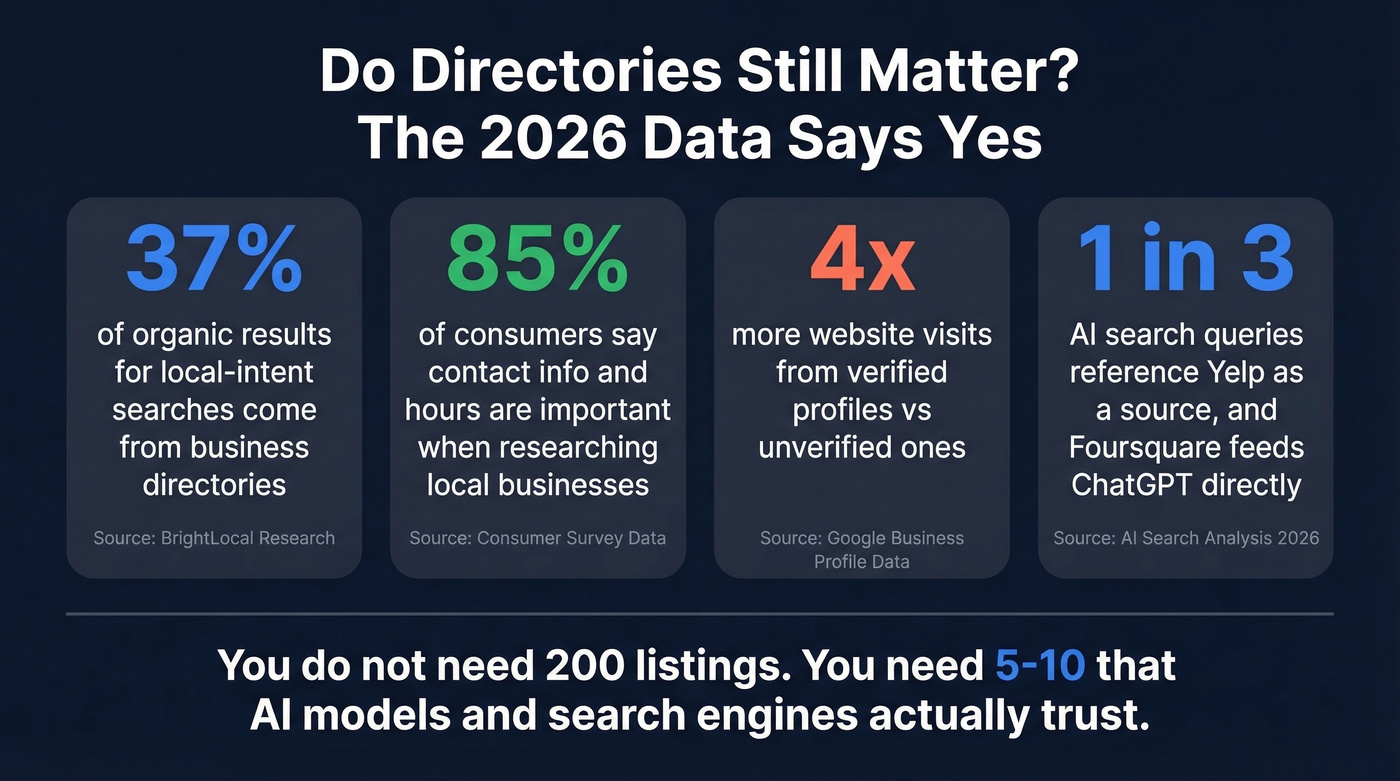
BrightLocal's research puts citations as the 6th most significant ranking factor for local pack visibility and tied for 4th in local organic results. Business directories make up 37% of organic results for informational local-intent terms. That's not a rounding error - it's a third of the page.
The consumer behavior data backs this up too: 85% of consumers consider contact info and opening hours important when researching local businesses, and verified profiles drive up to 4x more website visits than unverified ones.
But the bigger story in 2026 is AI search. Yelp gets used as a source in roughly a third of searches. Foursquare has a data deal with ChatGPT. Google Business Profile is a core source for Google Search and Maps, which influences what Google surfaces in AI-generated results. If your business isn't listed on the platforms that LLMs pull from, you're invisible in the fastest-growing search channel.
Here's the thing, though: this doesn't mean you should submit to 200 directories. It means you should be on the 5-10 that AI models and search engines actually trust. The rest are dead weight - or worse, they can hurt you.
The 3-Tier Company Directory Strategy
A practitioner on r/localseo nailed the modern approach: most citation directories are dead, but a focused three-tier strategy still works.
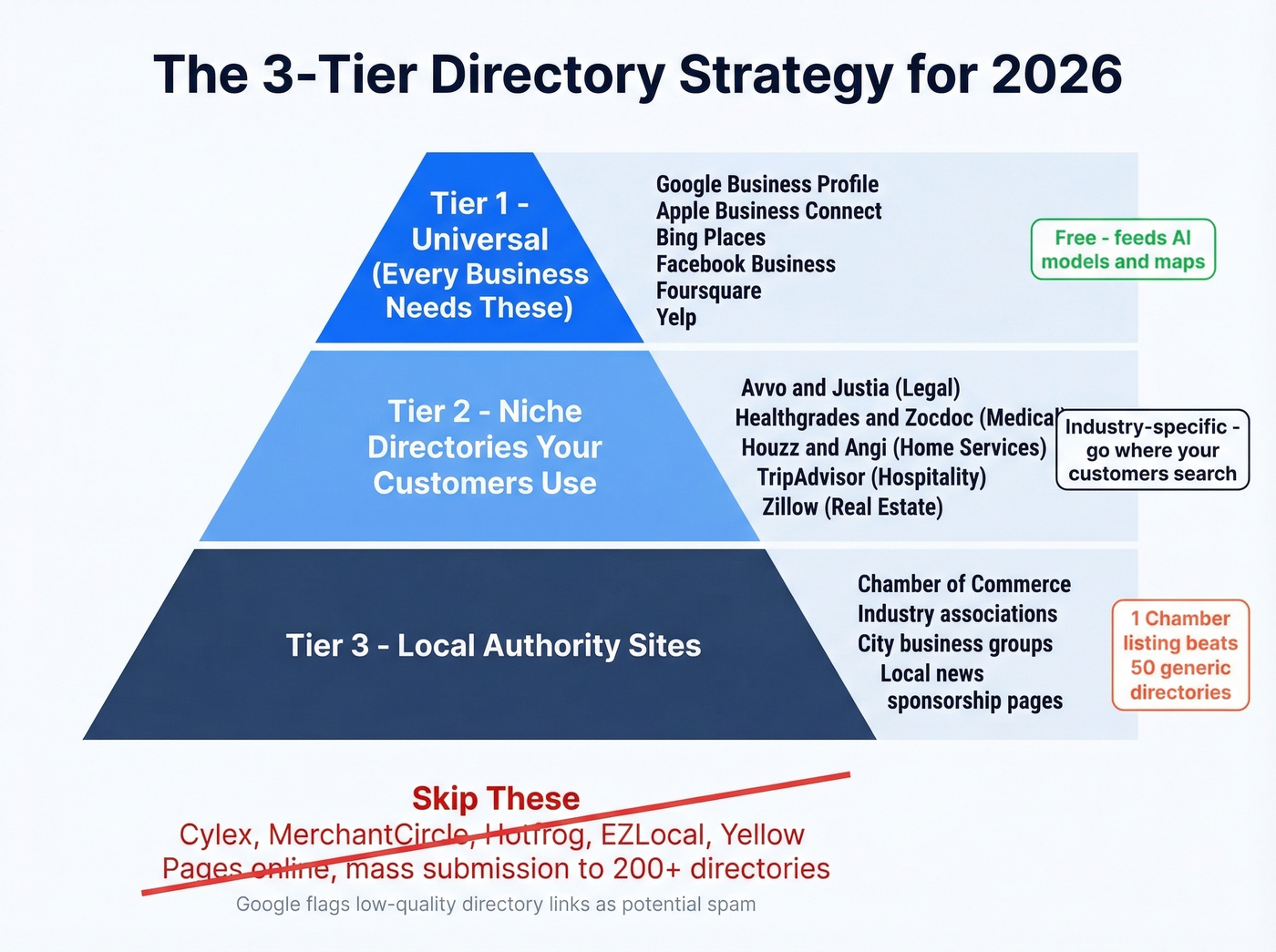
Tier 1 - Universal (every business needs these): Google Business Profile, Apple Business Connect, Bing Places, Facebook Business, Foursquare, and Yelp (industry-dependent). Free, feed AI models, and drive actual traffic. Foursquare deserves special attention - its ChatGPT data partnership makes it increasingly relevant for AI search visibility, and a basic listing costs nothing.
Tier 2 - Niche directories your customers actually use: Avvo and Justia for legal. Healthgrades and Zocdoc for medical. Houzz, Angi, and Thumbtack for home services. TripAdvisor and OpenTable for hospitality. Zillow for real estate. Cars.com for automotive. If your customers search there, be there.
Tier 3 - Local authority sites: Chamber of Commerce listings, industry association member directories, city business groups, local news sponsorship pages. One Chamber of Commerce listing carries more SEO weight than 50 generic directories like Cylex or MerchantCircle.
The old playbook of blasting your NAP across 200 directories isn't just outdated - it's potentially harmful. Google's own guidance flags links from "low-quality directory or bookmark sites" as potential link schemes. Quality over quantity isn't a platitude here. It's the strategy.

Business directories tell you a company exists. They don't give you the VP of Procurement's verified email or direct mobile number. Prospeo has 143M+ verified emails at 98% accuracy and 125M+ mobile numbers across 300M+ professional profiles - refreshed every 7 days, not whenever a directory gets around to it.
Stop searching directories. Start reaching decision-makers directly.
Best Directories by Category
Local and Citation Directories
Google Business Profile - Free. Non-negotiable. It feeds Google Search and Maps, and it influences what Google surfaces in AI results. If you do nothing else, do this.
Apple Business Connect - Free. Growing fast as Apple Maps gains share and Siri integrates business data. Takes five minutes to claim. No reason to skip it.
Bing Places - Free. Lower traffic than Google, but Bing powers Copilot's AI responses. Easy to sync from your Google Business Profile.
Yelp - Free basic listing, ads from ~$5/day. Yelp gets referenced in roughly a third of searches, making it more relevant in 2026 than its declining web traffic suggests. Worth it for consumer-facing businesses.
Facebook Business - Free. Still one of the biggest "default" places people look up local businesses, especially for restaurants, retail, and service providers.
Foursquare - Free. Its data partnership with ChatGPT means your listing can show up in AI-generated responses. Five minutes to claim, and the AI search payoff is growing fast.
Nextdoor - Free business pages with paid options for more reach. Strong for home services, restaurants, and retail in residential neighborhoods.
Skip these: Yellow Pages online is a shadow of its former self - minimal SEO value for most businesses. BBB matters for trust signals in some industries but rarely drives traffic. Cylex, MerchantCircle, Hotfrog, and EZLocal are citation farms with negligible impact. Don't waste your time.
B2B Supplier Directories
Kompass covers nearly 40 million companies with roughly 60 search filters spanning geography, industry, and financials. It's the go-to for international procurement teams, and the filtering is genuinely strong.
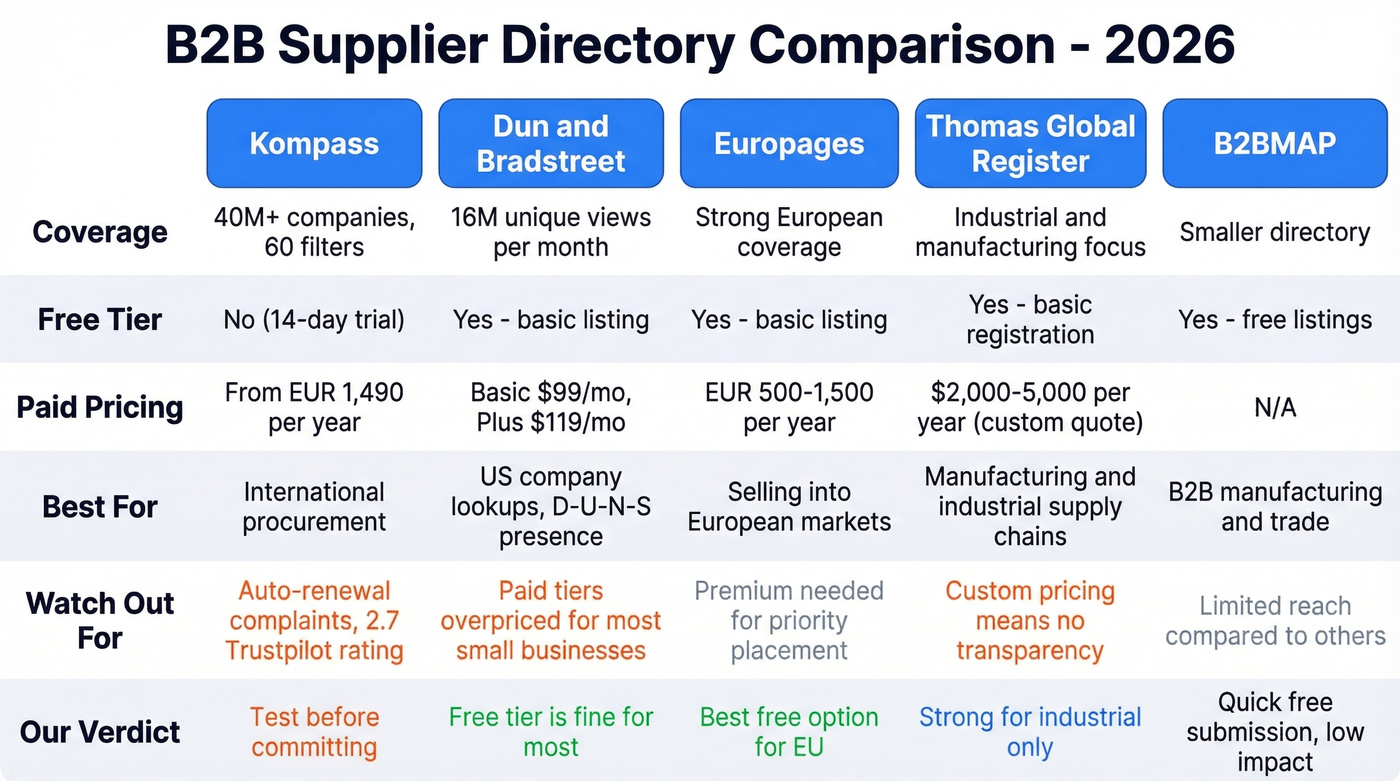
The problem? Pricing starts at EUR1,490/year, the Trustpilot rating sits at 2.7 out of 5, and the auto-renewal complaints are consistent - users report getting invoiced for a second year without clear opt-out communication. There's a 14-day free trial, so test before committing. Read the cancellation terms carefully.
Dun & Bradstreet runs three listing tiers: Free (customize hours, languages, social URLs, payment methods), Basic at $99/month or $999/year (adds description, tagline, logo, 5 photos and 5 videos), and Plus at $119/month or $1,199/year (10 photos and 10 videos plus sync across 80+ sites). The directory pulls 16 million unique views per month.
In our experience, D&B's paid tiers are overpriced for what you get. The free listing is fine for establishing a D-U-N-S presence. The $1,199/year Plus tier only makes sense if the 80-site sync saves you significant manual work - and for most small businesses, it won't.
Europages is the strongest free option for European B2B visibility. The basic listing costs nothing. Premium tiers run around EUR500-1,500/year for enhanced profiles and priority placement. If you're selling into European markets, grab the free listing at minimum.
Thomas Global Register serves procurement professionals looking for industrial suppliers. Free basic registration gets you listed; enhanced profiles require a custom quote, typically in the $2,000-5,000/year range. Strongest for manufacturing and industrial supply chains.
B2BMAP offers free company listings with basic profiles. It's a smaller directory, but zero-cost entry makes it worth a quick submission if you're in B2B manufacturing or trade.
Government and Institutional Directories
These aren't marketing channels - they're credibility infrastructure and compliance requirements.
SAM.gov is mandatory for any company pursuing US government contracts. Registration is free, and approval time varies. Even if you're not bidding on federal work today, having an active SAM registration opens doors.
ASIC Registry (Australia) lists all registered Australian businesses, searchable by organization name or Australian Business Number. Not optional if you operate in Australia.
Austrade Australian Suppliers Directory is a government-compiled listing of Australian companies, products, and services. Free to list, useful for international buyers sourcing Australian suppliers.
Bureau van Dijk / Orbis provides financial data on private European companies. This is a research tool, not a listing service - subscriptions typically run $5,000-20,000+/year depending on access level. Relevant for due diligence and market research, not marketing.
globalEDGE from Michigan State University maintains a curated index of company directories organized by country and region. It's not a directory itself - it's a meta-directory that helps you find the right country-specific registries. Bookmark it.
When You Need Contact Data, Not a Listing
If you searched for a global business directory because you need verified emails and direct dials for decision-makers, you don't need a directory listing at all. You need a sales intelligence platform.

Prospeo is the strongest option for teams that prioritize data accuracy over feature bloat. The database covers 300M+ professional profiles with 143M+ verified emails and 125M+ verified mobile numbers. Email accuracy runs 98%, and the 7-day data refresh cycle is the real differentiator - the industry average is six weeks, which means most platforms serve you stale data by default. With 30+ search filters including buyer intent via Bombora, technographics, job changes, and funding signals, you're finding people at the right moment rather than blasting a static list. Self-serve, no contracts, GDPR compliant. The free tier gives you 75 verified emails and 100 Chrome extension credits per month - enough to test whether the data quality holds up for your ICP before spending a dollar.
Apollo.io is the best entry point for bootstrapped teams. The free tier is genuinely generous, and paid plans start around $49/month per user. You get prospecting, sequencing, and a basic CRM in one tool. The tradeoff: email verification isn't as tight as dedicated platforms, and phone data coverage drops off outside North America. For teams with modest deal sizes who need an all-in-one, Apollo is hard to beat on value.
ZoomInfo remains the enterprise default with 260M+ profiles and the broadest feature set in the category. But a 10-seat contract with intent data and mobile numbers runs $40-60k/year. That's real money, and the annual contract lock-in means you're committed before you've fully evaluated data quality for your specific ICP. We've seen teams overpay for features they never touch - most just need accurate emails and direct dials.
Cognism focuses on EMEA compliance and phone-verified mobile numbers. Their strength is European mobile data, not raw database size. Custom pricing typically runs $1,000-3,000/month for small teams, with annual contracts required. Skip this if your outreach is primarily North American.
| Platform | Database Size | Verified Emails | Pricing | Contracts |
|---|---|---|---|---|
| Prospeo | 300M+ profiles | 143M+ (98% accuracy) | From ~$0.01/email; free tier | No contracts |
| Apollo.io | 275M+ contacts | Included | Free tier; from ~$49/mo | Monthly/annual |
| ZoomInfo | 260M+ profiles | Included | From ~$15K/yr | Annual |
| Cognism | 400M+ profiles | Included | ~$1K-3K/mo | Annual |
If you landed on this article looking for a global business directory to fuel outbound sales, here's the truth: no directory gives you what you actually need. Prospeo's 30+ search filters - buyer intent, technographics, funding, headcount growth - let you find the exact companies and contacts that matter, with emails at $0.01 each and a 92% API match rate.
Replace 47 directory submissions with one platform that books meetings.
Directory Pricing at a Glance
The directories that matter most for local visibility are free. The ones that charge the most aren't necessarily the most valuable.
| Directory | Free Tier | Paid Pricing |
|---|---|---|
| Google Business Profile | Full features | N/A |
| Apple Business Connect | Full features | N/A |
| Bing Places | Full features | N/A |
| Yelp | Basic listing | Ads from ~$5/day |
| Facebook Business | Full features | N/A |
| Foursquare | Full features | N/A |
| D&B | Basic listing | $99-119/mo |
| Kompass | 14-day trial | From EUR1,490/yr |
| Europages | Basic listing | ~EUR500-1,500/yr |
| Thomas Global | Basic listing | ~$2,000-5,000/yr |
Look at that table. Every Tier 1 local directory is completely free. The paid B2B directories offer incremental value, but the ROI math gets shaky fast - especially for D&B's $1,199/year Plus tier, which is essentially paying for profile sync automation you could handle manually in an afternoon.
How to Evaluate Directory Quality
Not all directories are created equal, and submitting to the wrong ones can actively hurt your SEO. Here's the quality checklist we use internally.
Domain Authority baseline: DA 40+ is worth considering. Directories below this rarely pass meaningful link equity. There are exceptions for hyper-niche industry directories with genuine traffic, but they're rare.
Spam score: Keep it under 5%. Anything higher signals the directory has been abused by link builders, and associating your business with it carries risk.
Backlink trust flow: Use Majestic or a similar tool to check whether the directory's backlink profile is clean. A directory with high DA but low trust flow is a red flag - it usually means the authority was built artificially.
Google's own guidance is blunt: "Any links intended to manipulate PageRank... may be considered part of a link scheme," including links from low-quality directories. That's not a suggestion. It's a warning.
Red flags that should make you walk away: the directory name is obviously built for link-building ("best-business-links-directory.com"), there's a link exchange requirement, pages have more ads than content, categorization is weak or nonexistent, and there's no verification process for listings. If a directory will list literally anyone who submits, it's not a directory - it's a link farm.
How to Spot Directory Scams
A post on r/Finland laid out a scam pattern that's been running for years across Europe: someone calls your office to "confirm your business information." The call is short, friendly, and fast. They imply there's an existing relationship. Weeks later, a EUR200+ invoice arrives for an annual directory listing you never consciously agreed to.
This isn't a one-off. It's a systematic operation, and the red flags are consistent:
- The call is framed as "confirming information," not selling anything
- The company name is generic and forgettable
- Their website is vague, with only an info@ contact address
- The invoice references a service you don't remember agreeing to
- They claim the phone call is "legally binding" without any signed documentation
- They refuse to share the call recording when challenged
- The caller actually says "this is not a scam" unprompted - which is, ironically, one of the strongest scam indicators
The broader rule is simple: any directory that contacts you unsolicited and pressures for payment is a red flag. Reputable platforms don't cold-call businesses to "confirm information." If someone's calling you about a listing you didn't initiate, hang up.
FAQ
What's the best free global business directory?
Google Business Profile. It's free, drives more visibility than any other single directory, influences AI search results, and is the only truly non-negotiable listing for any business in 2026. Claim and optimize it before touching anything else.
How many directories should I list on?
Focus on 5-10 that matter for your industry and geography. The three-tier approach - universal platforms like GBP and Apple, niche directories your customers actually use, and local authority sites like your Chamber of Commerce - beats submitting to 200 generic directories every time.
Can directory listings hurt my SEO?
Yes. Submitting to low-quality directories that Google considers link schemes can damage your rankings. Stick to directories with DA 40+, real editorial standards, and no link-exchange requirements. A bad directory is worse than no directory.
What if I need contact data, not a directory listing?
A business directory lists company information - name, address, industry category. Sales intelligence platforms like Prospeo provide verified emails, direct dials, and job titles for individual decision-makers. If you need to reach people at companies, a directory won't cut it.
Is Kompass worth the price?
Kompass offers strong filtering across nearly 40 million companies, but at EUR1,490/year with a 2.7/5 Trustpilot rating and persistent auto-renewal complaints, evaluate carefully. The 14-day free trial is essential before committing. Free alternatives like D&B's basic listing or Europages cover many of the same needs depending on your market.