

Global Database vs SalesQL: Different Tools, Different Jobs
Global Database and SalesQL sit in two different categories. Comparing them like-for-like is where the confusion starts - and where teams buy the wrong thing.
What Is Global Database?
Global Database is a company intelligence platform first and a contact data tool second. The core value is coverage and methodology: 80M+ business profiles across 195 countries and 34 industries, sourced from official registries and public filings - Companies House, stock exchange filings, annual reports, government records - plus web research and an in-house team collecting, organizing, and validating datasets daily. Patented technology keeps entries updated in near real-time.
Email validation runs on a 90-day cadence, which is explicitly slower than real-time verifiers. For KYB, supplier monitoring, and corporate structure work, the company record matters more than whether a VP's inbox still exists. But for outbound sales? That's a real constraint.
Pricing is classic license-based: annual, quote-only, priced by coverage, users, and export volume. Expect mid-four to low-five figures annually with upfront payment. On TrustRadius, Global Database scores 8.8/10, with reviewers highlighting accurate company information and strong global coverage across EMEA and North America. The vendor puts an up to 95% accuracy guarantee on B2B company datasets - the right place to make that promise.
What Is SalesQL?
SalesQL is a browser-based email finder built for fast contact extraction from LinkedIn profiles and search pages. No corporate registry intelligence here. The database covers 127M work emails, 89M personal emails, and 30M phone numbers, and the main workflow is a Chrome extension that pulls data while you browse.
Pricing is self-serve and transparent:
- Free: 100 credits/mo
- Basic: $39/mo (2,000 credits)
- Pro: $79/mo (5,000 credits, 3 seats)
- Org: $119/mo (12,000 credits, 15 seats)
Annual plans include significantly more credits - Basic annual jumps to 24,000 credits/month. One credit covers work email + direct email + phone for a single profile. SalesQL also allocates separate email verifier credits and caps API calls at 600/day on monthly plans.
Here's the thing: reliability is uneven. SalesQL shows 4.5/5 on G2 (166 reviews) but 3.8/5 on Capterra (46 reviews) with Customer Service at 3.3. Capterra reviewers flag billing friction and accuracy issues - including the blunt "works 50% of the time" sentiment. SalesQL's own help docs warn about restriction risk: stay under daily view limits and don't use LinkedIn while a SalesQL automation is running.
Side-by-Side Comparison
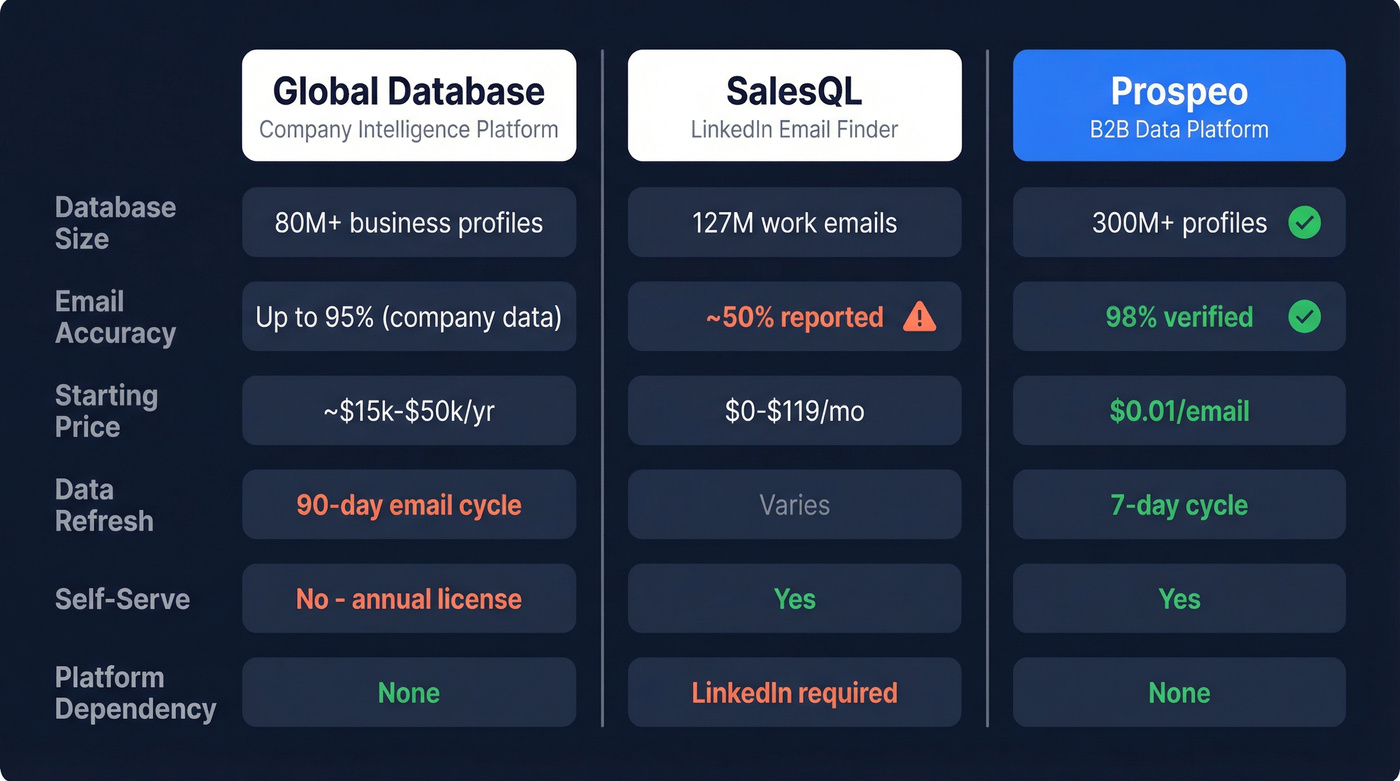
Global Database competes with company intelligence vendors. SalesQL competes with browser-based finders. They barely overlap.
| Attribute | Global Database | SalesQL | Prospeo |
|---|---|---|---|
| Category | Company intel / KYB | Email finder / extension | B2B data platform |
| Database Size | 80M+ business profiles | 127M work emails | 300M+ profiles |
| Data Sources | Registries, filings, web research, in-house validation | LinkedIn workflows + database | Web sources + proprietary verification |
| Pricing Model | Annual license | Monthly/annual credits | Credit-based |
| Starting Price | ~$15k-$50k/yr (est.) | $0-$119/mo | Free; ~$0.01/email |
| Email Accuracy | Up to 95% (company data) | ~50% (per Capterra reviews) | 98% verified emails |
| Data Refresh | Daily (company); 90-day (email) | Ongoing / varies | 7-day cycle |
| Integrations | API + exports | HubSpot, Salesforce, Zapier, Make, API | Salesforce, HubSpot + more |
| Self-Serve Access | No | Yes | Yes |
| Best For | Registry-based verification + global intel | Quick LinkedIn prospecting | Verified outbound at scale |

Global Database locks you into annual contracts for company intel. SalesQL gives you speed but 50% accuracy. Prospeo delivers 300M+ profiles with 98% email accuracy, 7-day data refresh, and no platform dependency - starting at $0.01 per email.
Stop paying twice - once for extraction, once for verification.
Key Differences That Matter
Category fit. Global Database is company intelligence - KYB, supplier monitoring, corporate structure. SalesQL is contact extraction for outbound. Treating them as substitutes is how teams end up buying the wrong thing entirely.
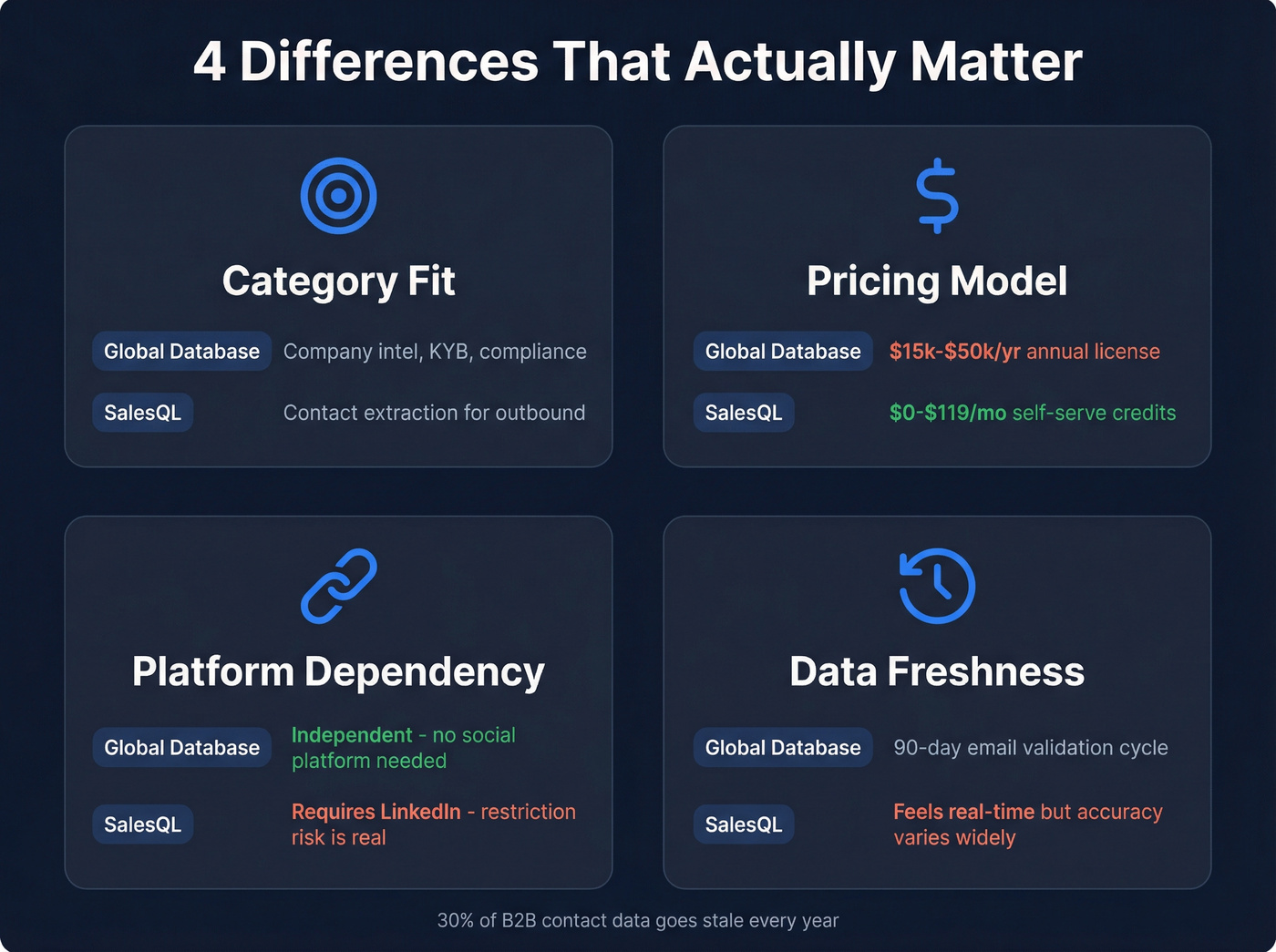
Pricing model. Annual license vs. monthly credits. That alone changes who can buy and how fast you can pilot. A compliance team vetting 500 suppliers across EMEA needs Global Database's registry depth and will tolerate procurement cycles. An SDR team running 200 outbound emails a day needs SalesQL's speed - or better accuracy from a dedicated sales prospecting database.
Platform dependency. SalesQL's core workflow requires heavy LinkedIn usage. Global Database doesn't. One policy change or account restriction and your pipeline stalls. That's not a hypothetical risk - we've seen it happen to teams mid-campaign.
Data freshness. Roughly 30% of B2B contact data goes stale each year. Global Database validates emails every 90 days. SalesQL feels real-time because it pulls during browsing, but underlying accuracy still varies. On Reddit, practitioners report typical email accuracy of 60-70% for tools like Apollo and Lusha, which puts SalesQL's Capterra complaints in context.
When to Choose Each Tool
Choose Global Database if you're doing compliance, KYB, or supplier verification. You need global company records from registries and filings, your stakeholders care about financial and credit context, and you're fine with annual contracts.
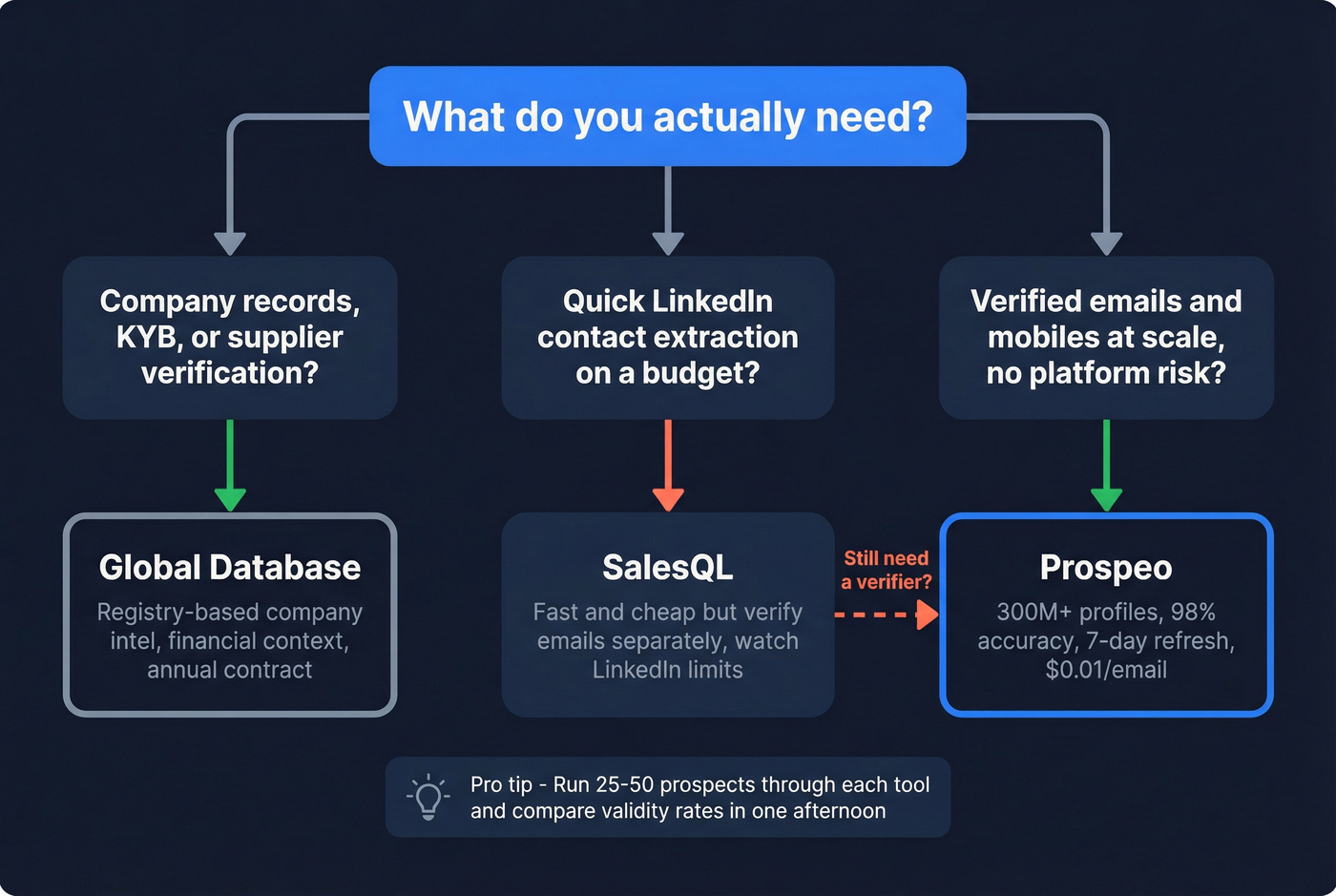
Choose SalesQL if your prospecting is LinkedIn-driven and you want fast extraction. You're a small team that needs self-serve pricing, and you'll verify emails before sending. Skip it if accuracy matters more than speed - you'll end up paying for a verifier on top of SalesQL anyway (see email verification options).
How to test either: Run a 25-50 prospect head-to-head. Pull the same target accounts through both tools and measure email validity rates and data completeness. You'll know within an afternoon which one fits.
Let's be honest: most teams comparing these two tools actually need neither. Global Database's no-pricing-published approach signals enterprise-grade company and verification data - if that's not what you're buying, move on. SalesQL is cheap and fast, but the accuracy complaints are real. And if you're verifying every email anyway, you're paying twice for the same result.
A Third Option Worth Testing
Beyond emails, the platform provides 125M+ verified mobiles with a 30% pickup rate, CRM enrichment returning 50+ data points per contact (see data enrichment services), and intent data tracking 15,000 topics via Bombora. Clean exports without an annual commitment or a workflow that depends on browsing limits.

If your outbound depends on LinkedIn browsing limits or 90-day email validation cycles, your pipeline has a single point of failure. Prospeo refreshes every 7 days, verifies in 5 steps, and adds 125M+ direct dials with a 30% pickup rate - no browser extension required.
Get verified contacts without the platform risk or the annual invoice.
FAQ
Is Global Database vs SalesQL a fair comparison?
Not really. Global Database is a company intelligence and KYB platform built on official registries. SalesQL is a LinkedIn-based email finder. They serve different workflows - compliance and company records vs. quick contact extraction for outbound prospecting.
Is SalesQL safe to use with LinkedIn?
SalesQL's own docs say to stay under roughly 200 daily profile views on basic accounts and avoid using LinkedIn while a SalesQL automation is running. Heavy usage increases restriction risk, so throttle activity and monitor your account standing.
What's the most accurate alternative to both?
Prospeo offers 300M+ profiles with 98% verified email accuracy and a 7-day refresh cycle at roughly $0.01/email. It's self-serve with no annual contract, no social platform dependency, and includes 125M+ verified mobile numbers.