

How to Build a Go-to-Market Campaign That Actually Launches
85% of enterprises consider their GTM strategies "highly effective." Meanwhile, a Bain study of 2,300 global companies found only 9% achieved sustained revenue and profit growth above 5.5% annually. That gap between confidence and results? It lives in execution.
Every go-to-market campaign that hits its number shares one trait: disciplined, time-boxed sprints that turn strategy into pipeline. Not a 40-slide deck. Not a positioning workshop that ends with "let's circle back." A sprint with a start date, an end date, and a launch target.
The confusion starts early. Wrike's own FAQ treats "GTM strategy" and "GTM campaign" as interchangeable, which doesn't help anyone. Here's the thing: a GTM campaign isn't a GTM strategy - it's the execution layer. Pick one GTM motion based on your deal size. Plan 90 days. Master three channels max - outbound, paid search, and one community play.
What Is a Go-to-Market Campaign?
A GTM strategy is the full plan - ICP, positioning, pricing model, channel selection, competitive moat. A go-to-market campaign is the time-boxed execution sprint (typically 8-12 weeks) that operationalizes that strategy around a specific launch date. A marketing strategy is broader still: the long-term brand play that outlives any single product launch.
| GTM Strategy | GTM Campaign | Marketing Strategy | |
|---|---|---|---|
| Scope | Full market entry plan | Time-boxed launch sprint | Long-term brand growth |
| Duration | Ongoing, evolving | 8-12 weeks typical | Multi-year |
| Owns | Cross-functional | Campaign lead / PMM | Marketing team |
Why does the distinction matter? Companies with a defined launch process see 63% launch success rates versus 53% without one, with 35% median revenue growth versus 9%. Process isn't bureaucracy. It's the difference between a launch that generates pipeline and one that generates a blog post nobody reads.
Choose Your GTM Motion
Before you plan a single activity, you need to know which motion you're running. This determines your CAC targets, payback expectations, and which channels even make sense.
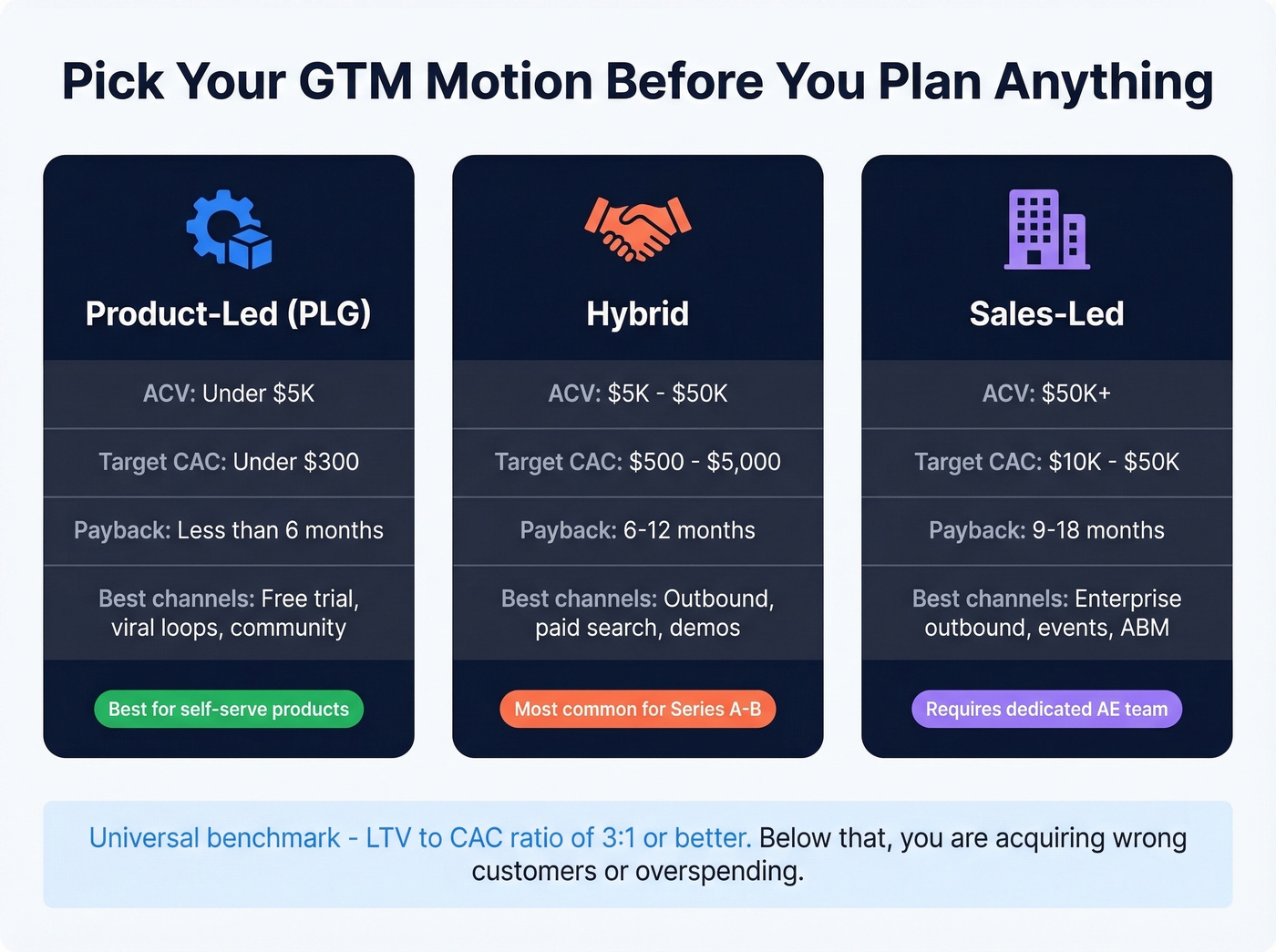
| Motion | ACV Range | Target CAC | Payback Period |
|---|---|---|---|
| Product-led (PLG) | Under $5K | Under $300 | < 6 months |
| Hybrid | $5K-$50K | $500-$5,000 | 6-12 months |
| Sales-led | $50K+ | $10K-$50K | 9-18 months |
The universal benchmark: LTV:CAC of 3:1 or better. Below that, you're either acquiring the wrong customers or spending too much to acquire the right ones.
If your average deal is below $10K, you probably don't need a sales-led motion at all. Most teams default to hiring AEs when they should be investing in product-led acquisition and self-serve onboarding. We've seen this pattern repeatedly - the math rarely works otherwise.
One thing teams get wrong: treating content marketing as a launch channel. Content takes 6-12 months to produce meaningful inbound. For a 90-day sprint, lean on outbound, paid search, and one high-intent community channel.
The 90-Day GTM Campaign Framework
Ninety days sounds generous until you're in week 6 and your prospect list isn't built, your landing page copy hasn't been approved, and sales still doesn't have talk tracks. Here's how to break those 90 days into phases so nothing slips.
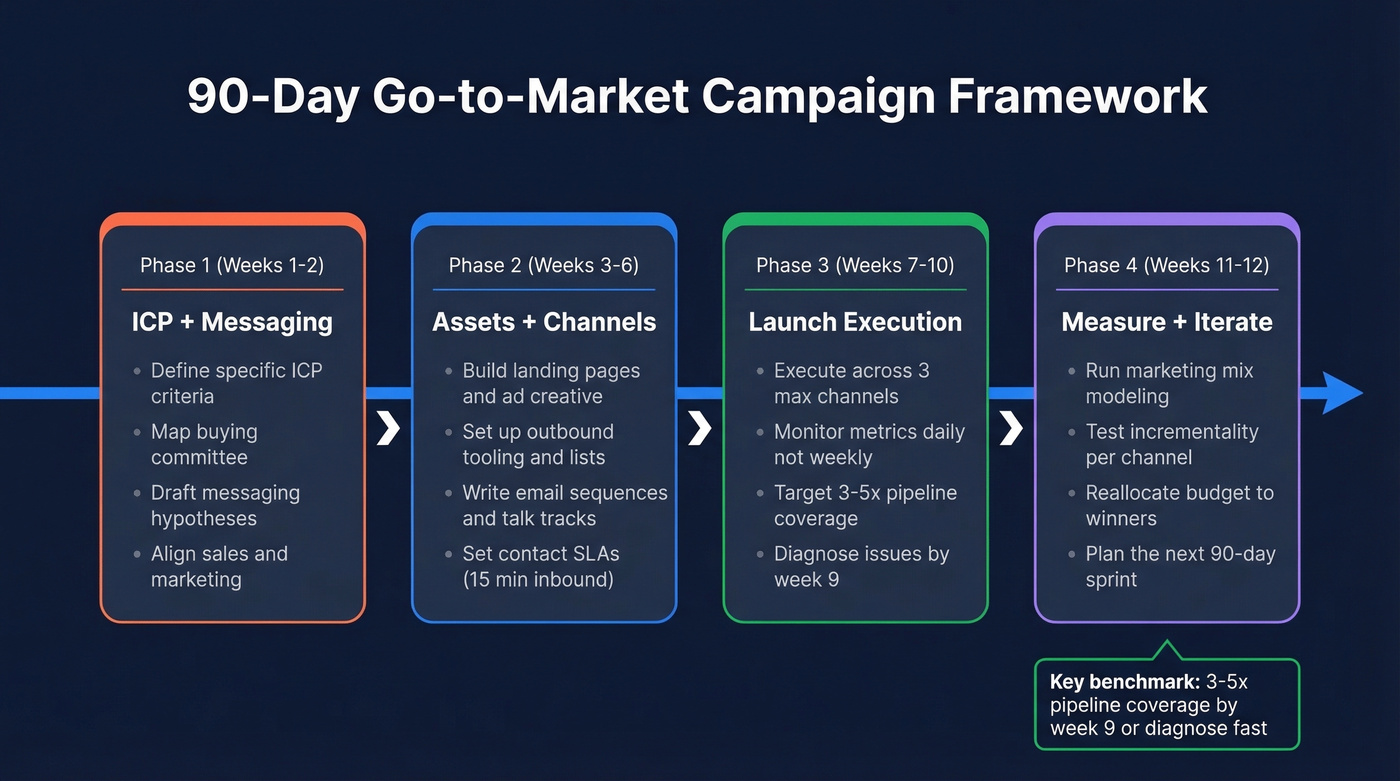
Weeks 1-2: ICP + Messaging
Define your ICP with specificity that's actually useful to reps. "Mid-market SaaS" isn't an ICP - "Series B SaaS companies with 50-200 employees, selling to enterprise, with a VP of Sales who's been in role less than 12 months" is an ICP. PMMs typically launch 10-16 products per year and spend 50+ hours per launch, so two weeks of focused ICP work is the minimum, not a luxury.
Map the buying committee. For larger deals, you're rarely selling to one person. Identify the champion, the economic buyer, and the blocker. Draft messaging hypotheses for each - you'll test these in weeks 7-10. The consensus on r/SaaS echoes this: founders who nail ICP clarity and time-to-value outperform those who launch broadly and hope.
Weeks 3-6: Assets + Channels
Build campaign assets: landing pages, ad creative, email sequences, sales decks, talk tracks. Set up ad accounts, outbound tooling, and community profiles.
This is also when you build your prospect list - and where most campaigns quietly fail. The list you build in week 4 needs to still be accurate in week 8. That means you need a data source with a fast refresh cycle and high verification standards. Prospeo's 7-day data refresh and 98% email accuracy handle this well; you can use 30+ filters across 300M+ professional profiles to match your ICP precisely and keep the list fresh through launch day.

Set SLAs now, not after launch. Inbound demo requests get contacted within 15 minutes. Outbound follow-up runs 5-7 touches over 10 days. Write these down and hold people to them.
Weeks 7-10: Launch Execution
Execute across your chosen channels. Monitor daily - not weekly. The first 72 hours tell you whether your messaging resonates or needs a rewrite.
Your pipeline coverage target: 3-5x quota. If your team needs to close $500K this quarter, you need $1.5M-$2.5M in pipeline. If you're below 3x by week 9, something's broken and you need to diagnose it fast - is it a targeting problem, a messaging problem, or a channel problem?
Weeks 11-12: Measure + Iterate
Use a triangulation approach: marketing mix modeling for channel-level attribution, plus incrementality testing to validate what's actually driving conversions. Companies adapting to privacy-era measurement saw 15-20% better budget efficiency than those clinging to last-click attribution. Review, reallocate, and plan the next sprint.
Budget Allocation for Your Launch
The question everyone asks and nobody wants to answer with real numbers. Let's fix that.
| Company Stage | Marketing Budget (% of Revenue) |
|---|---|
| Startup | 30-50% |
| Growth-stage | 20-30% |
| Established | 10-15% |
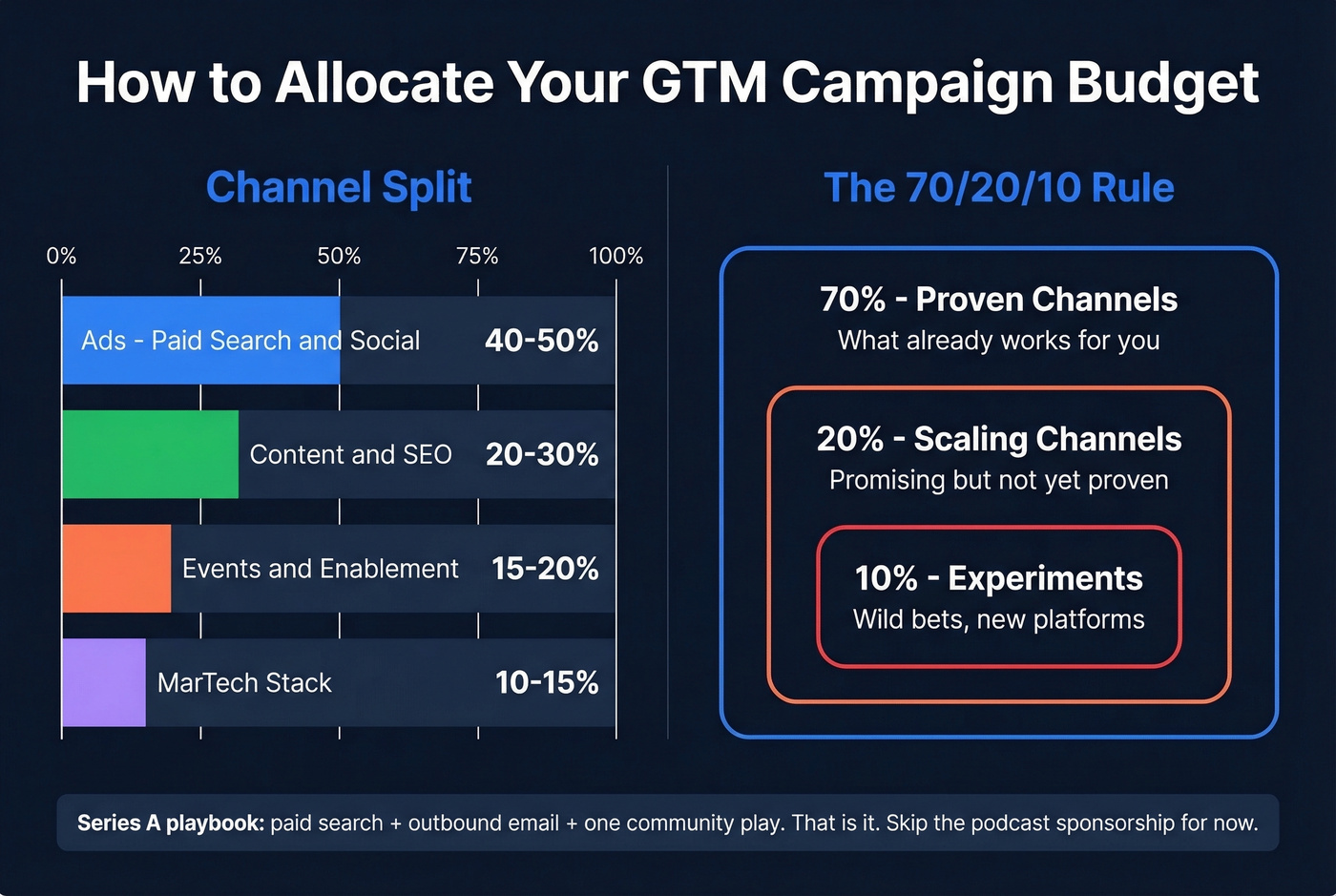
| Channel | % of Budget |
|---|---|
| Ads (paid search, social) | 40-50% |
| Content / SEO | 20-30% |
| Events / Enablement | 15-20% |
| MarTech stack | 10-15% |
Apply the 70/20/10 principle: 70% to proven channels, 20% to channels you're scaling, 10% to experiments. Winning in three channels beats mediocrity in ten. For a Series A company, that means paid search, outbound email, and one community or event play. That's it. Skip the podcast sponsorship for now.

Your GTM campaign lives or dies on list quality. Prospeo gives you 300M+ profiles with 30+ ICP filters - buyer intent, headcount growth, funding, technographics - refreshed every 7 days so your week-4 list still hits in week 10. At $0.01/email with 98% accuracy, your launch budget goes further.
Build your launch prospect list in minutes, not weeks.
KPIs That Actually Matter
Track these mid-market B2B baselines and investigate immediately if you're significantly below them:
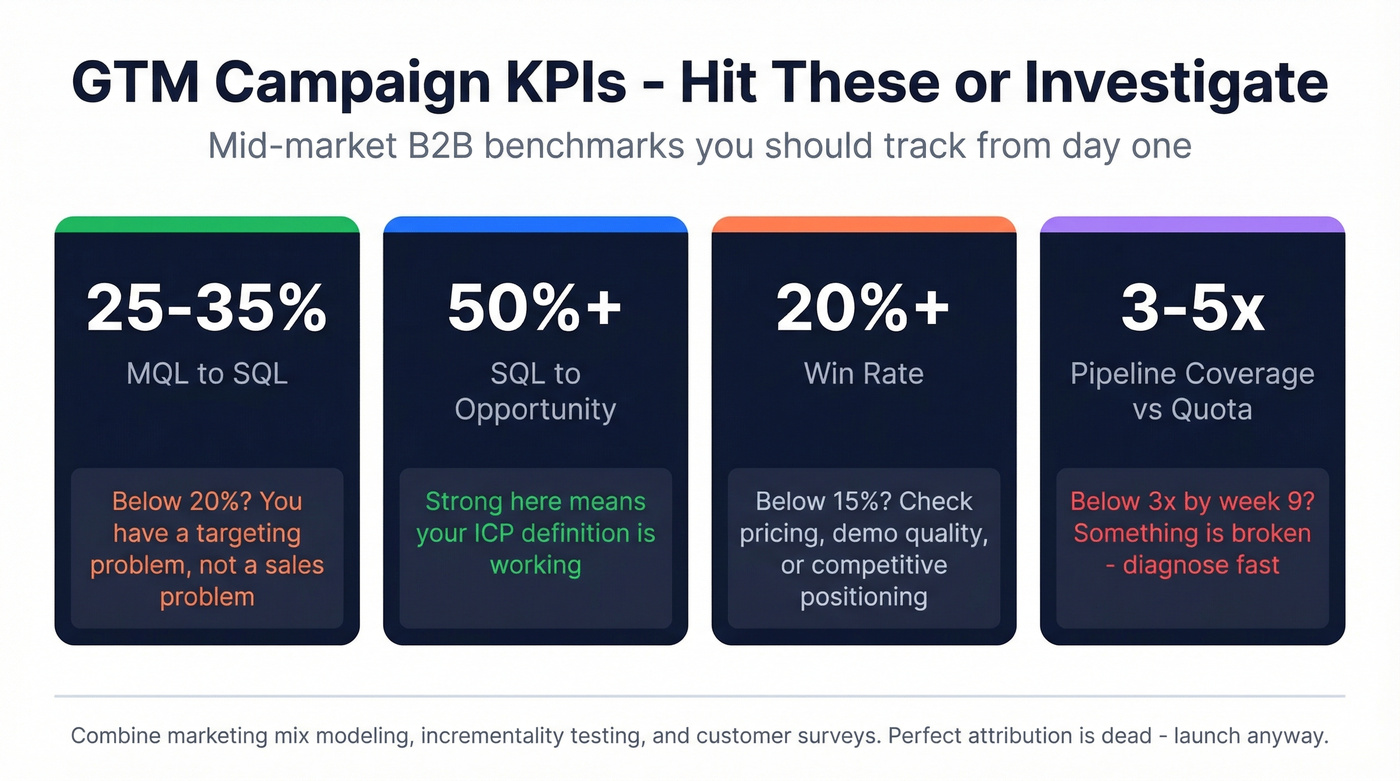
| Metric | Benchmark |
|---|---|
| MQL to SQL | 25-35% |
| SQL to Opportunity | 50%+ |
| Win rate | 20%+ |
| Pipeline coverage | 3-5x quota |
If your MQL-to-SQL conversion is below 20%, you've got a targeting problem, not a sales problem. No amount of sales training fixes leads that were never a fit.
Measurement in 2026 is harder than five years ago. Privacy regulations killed granular user-level attribution. The teams winning now combine MMM, incrementality testing, and good old-fashioned "ask the customer how they found us" surveys. Don't let perfect attribution prevent you from launching.
Mistakes That Kill GTM Campaigns
Confusing GTM with marketing. If only marketing is involved, you don't have a GTM campaign - you have a marketing campaign. Sales, product, and customer success all need skin in the game.
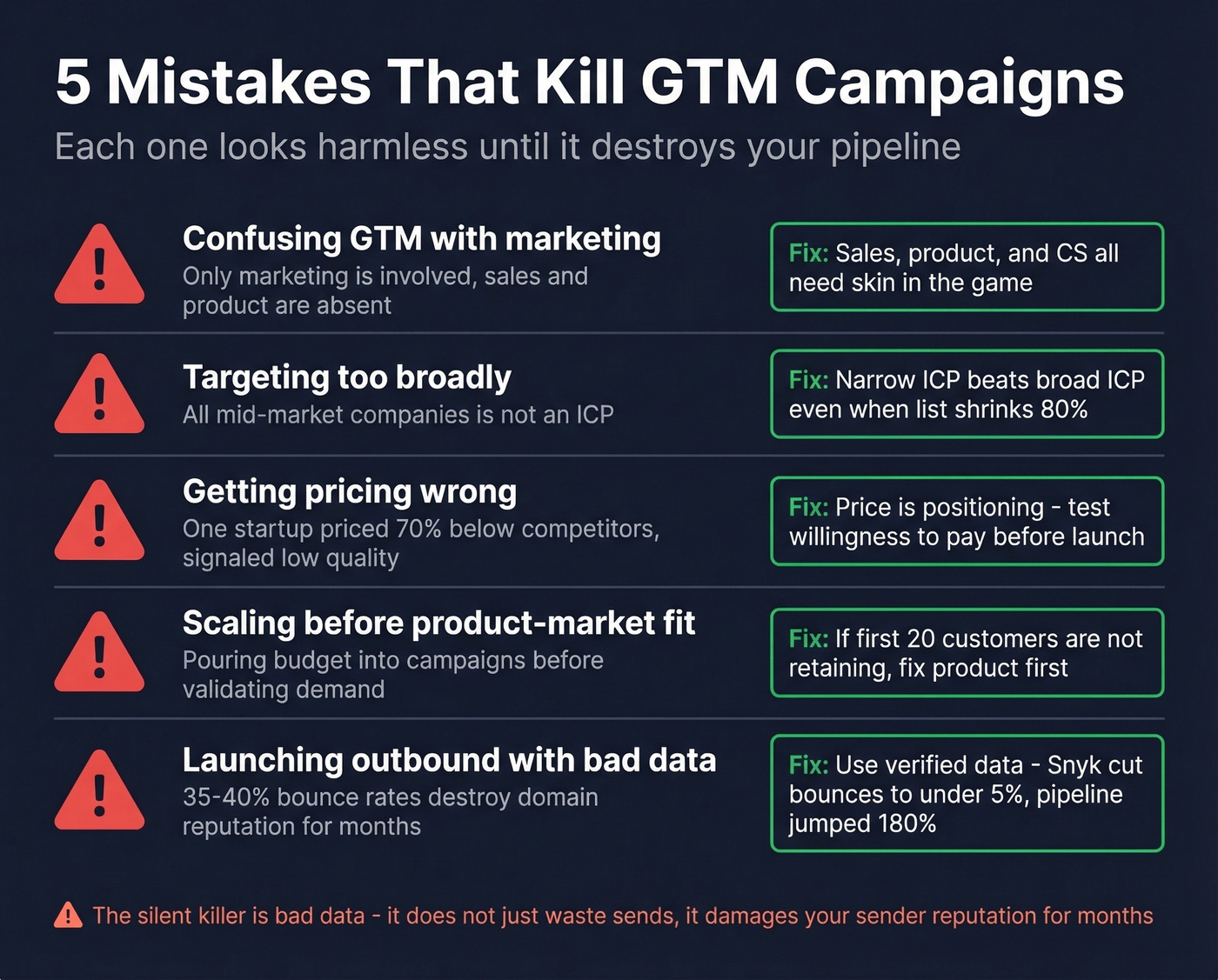
Targeting too broadly. "All mid-market companies" isn't a target. The narrower your ICP, the sharper your messaging, the higher your conversion rates. We've tested this across dozens of campaigns in our own outbound - tight ICP beats broad ICP every single time, even when the total addressable list shrinks by 80%.
Getting pricing wrong. One startup priced 70% below competitors thinking it'd accelerate adoption. Instead, it signaled low quality and made enterprise buyers suspicious. Price is positioning.
Scaling before product-market fit. Pouring budget into a launch campaign before validating demand is the fastest way to burn cash. If your first 20 customers aren't retaining, fix the product before you fix the funnel.
Launching outbound with bad data. This is the silent campaign killer. Snyk's sales team of 50 AEs dealt with 35-40% bounce rates - rates that dropped to under 5% after switching to verified data, with AE-sourced pipeline jumping 180%. Bad email data doesn't just waste sends. It damages your domain reputation for months, which means even your good emails stop landing.
Hitting 3-5x pipeline coverage means reaching the right buyers with verified contact data. Prospeo's 98% email accuracy and 125M+ verified mobiles keep your outbound sequences out of spam and in front of decision-makers - exactly what a 90-day sprint demands.
Stop burning launch weeks on bounced emails and bad numbers.
Go-to-Market Campaign Examples
Slack didn't win by leading with a traditional enterprise sales motion. They leaned hard into product-led growth and memorable campaign creative that made the pain obvious, then let the free product handle adoption and expansion. For PLG companies with ACVs under $5K, this is the playbook: make the product the hero, use the campaign to create the cultural moment.
Lick Paint took the opposite approach. Instead of ad spend, they built an education-led content engine - "How to" guides, an "Ask the Experts" series, and cultural hooks like a "Bridgerton x Lick" guide. They borrowed trust through niche influencer partnerships and built community loops that generated organic demand. Proof that a seven-figure ad budget is optional if your content reduces purchase uncertainty.
The takeaway from both: the best go-to-market campaigns don't try to be everything. They pick one motion, execute it relentlessly, and let the results compound.
Your Launch Checklist
Before you launch, run through this list. Every unchecked box is a risk you're accepting, not a step you're skipping.
Preparation:
- Define measurable goals tied to revenue, not vanity metrics
- Document ICP with specificity reps can actually use
- Map the buyer journey and buying committee
- Complete competitive analysis and positioning
Execution:
- Finalize messaging by persona and buying stage
- Select 3 channels max and set up infrastructure
- Build verified prospect lists and refresh before launch day
- Lock pricing strategy and packaging
Monitoring:
- Track CAC by channel weekly
- Monitor funnel conversion rates against benchmarks
- Measure pipeline coverage (target 3-5x)
- Watch churn signals from early adopters
FAQ
What's the difference between a GTM campaign and a GTM strategy?
A GTM strategy is the full market-entry plan covering ICP, positioning, pricing, and channels. A GTM campaign is the 8-12 week execution sprint that operationalizes that strategy around a specific launch date with its own KPIs and budget.
How long should a go-to-market campaign take?
Plan for 90 days: two weeks for ICP research, four weeks for assets and channels, four weeks for launch execution, and two weeks for measurement. Compressing below 8 weeks usually means skipping research that directly impacts conversion rates.
How do I build an outbound list for a GTM launch?
Start with your ICP criteria - industry, company size, titles, funding stage, tech stack - then use a B2B data platform with real-time verification. Look for 30+ search filters and a fast refresh cycle so the list you build weeks early is still accurate on launch day.
Do I need a separate campaign plan for each product launch?
Yes. Even if your overall GTM strategy stays the same, each launch has unique positioning, timing, and audience nuances. Dedicated KPIs, channel mix, and messaging per launch prevent resource conflicts and give you clean performance data to iterate on.