

Go-to-Market Strategy for Cloud Services That Actually Works
A RevOps Manager lead we know spent six months building a marketplace listing, launched it, and waited. Nothing happened. No co-sell, no private offers, no pipeline. The listing wasn't the strategy - it was a checkbox.
If you're building a go-to-market strategy for cloud services in 2026, the gap between "listed" and "generating pipeline" is enormous. Here's what actually closes it: the right motion, consumption-aligned pricing, co-sell gates cleared early, and a 90-day plan that forces accountability.
Cloud GTM in 30 Seconds
Cloud GTM isn't just messaging and channels. It's a procurement strategy plus a pricing model plus a partner motion. Pick one of three motions (product-led sales, marketplace-first, or channel-first), align pricing to consumption, and activate co-sell within 90 days.
Why Cloud GTM Is Different Now
Two scenarios play out constantly in enterprise sales.
Procurement stalls every deal for 60 days because your buyer can't get a new vendor approved - but they've got $2M in unspent Azure commits sitting there. Or trial signups look healthy but expansion never materializes because your packaging doesn't map to how customers actually consume the product.
Gartner pegged worldwide public cloud spending at $723.4B in 2025, up 21.5% year-over-year, with 90% of organizations adopting hybrid cloud through 2027. Total IT spending is projected at $6.15T in 2026. Cloud isn't a channel anymore. It's the procurement layer for enterprise software.
Pick Your GTM Motion
Not every cloud service should launch the same way. The right motion depends on your buyer, your deal size, and where you are as a company.
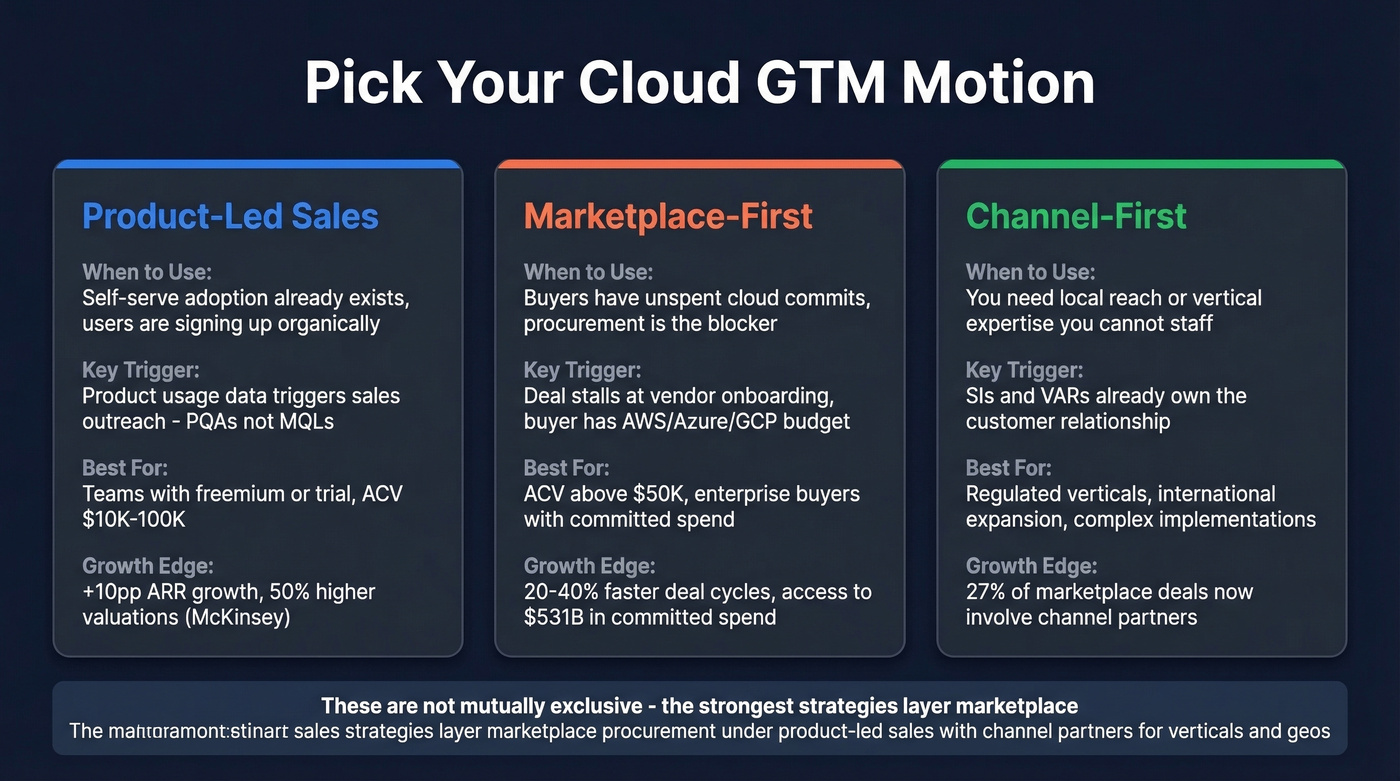
McKinsey's analysis of 107 public B2B SaaS companies found that product-led sales outperformers generate roughly 10 percentage points more ARR growth and achieve about 50% higher valuation ratios than pure sales-led companies. "Product-led" doesn't mean "no sales team." It means product usage data triggers the sales motion - product-qualified accounts, not just MQLs.
AWS's SaaS Journey framework segments ISVs into archetypes based on cloud maturity and scale ambitions: ToeDipper, SurvivorTech, UnicornExpress, New Horizons. It's a useful lens for deciding whether you lead with marketplace procurement or invest in a full platform-native integration first.
| Motion | When to Use | Key Trigger |
|---|---|---|
| Product-led sales | Self-serve adoption exists | Product usage triggers sales |
| Marketplace-first | Buyers have cloud commits | Procurement is the blocker |
| Channel-first | You need local reach | SIs/VARs own the relationship |
These aren't mutually exclusive. The strongest cloud GTM strategies layer marketplace procurement under a product-led sales motion, with channel partners handling verticals or geographies you can't staff directly. Tercera's "third wave" framing gets this right - lead with vertical expertise and business outcomes, not just technical capabilities.
Marketplace as a Procurement Rail
Here's the thing: cloud marketplaces aren't discovery engines. Most of the value comes from procurement acceleration, commit drawdown, and co-sell attachment.
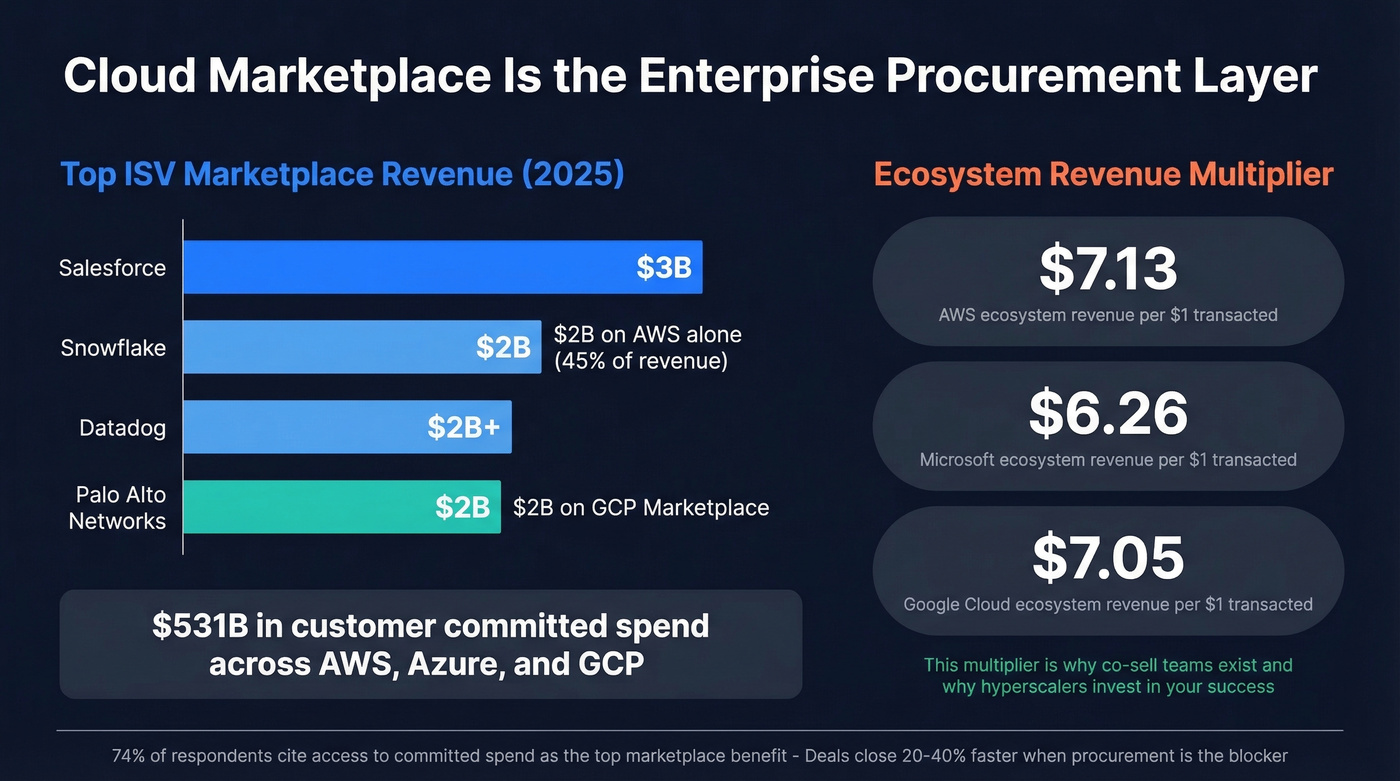
Customer committed spend across AWS, Azure, and Google Cloud crossed $531B, and 74% of respondents cite access to that committed spend as the most significant marketplace benefit. Deals that run through marketplace procurement typically cut cycle time by 20-40% when vendor onboarding is the blocker. Marketplace fees run 10-20% depending on the hyperscaler and program tier.
The numbers at the top end are staggering. Snowflake did $2B on AWS Marketplace in 2025 - roughly 45% of its revenue. Datadog crossed the $2B mark. Salesforce hit $3B. Palo Alto Networks reached $2B on Google Cloud Marketplace. These aren't outliers anymore; they're the playbook. And the hyperscalers are incentivized to help you get there: Microsoft generates $6.26 in ecosystem revenue for every $1 transacted on its marketplace, AWS generates $7.13, and Google Cloud $7.05. That multiplier is why co-sell teams exist.
Channel partners are increasingly part of this motion too - 27% of marketplace transactions now involve a channel partner, expected to reach 37% within the next 12 months. If you have existing channel relationships, route them through marketplace procurement rather than around it.
But the friction is real. 31% of ISVs rate provider engagement extremely challenging, and 46% say getting access to a partner development manager is extremely challenging. You can't just list and wait. You need to earn co-sell attention with pipeline, references, and ACR.

A marketplace listing without pipeline is just a checkbox. To activate co-sell, you need to reach the right partner development managers, cloud alliance leads, and enterprise buyers - fast. Prospeo gives you 300M+ profiles with 30+ filters including technographics and buyer intent, so you can target accounts already consuming AWS, Azure, or GCP.
Build your cloud GTM pipeline in hours, not months.
Co-Sell Activation Checklists
Microsoft Azure IP Co-Sell
To unlock MACC eligibility - where buyers draw down Azure commits on your product - you need Azure IP co-sell status:
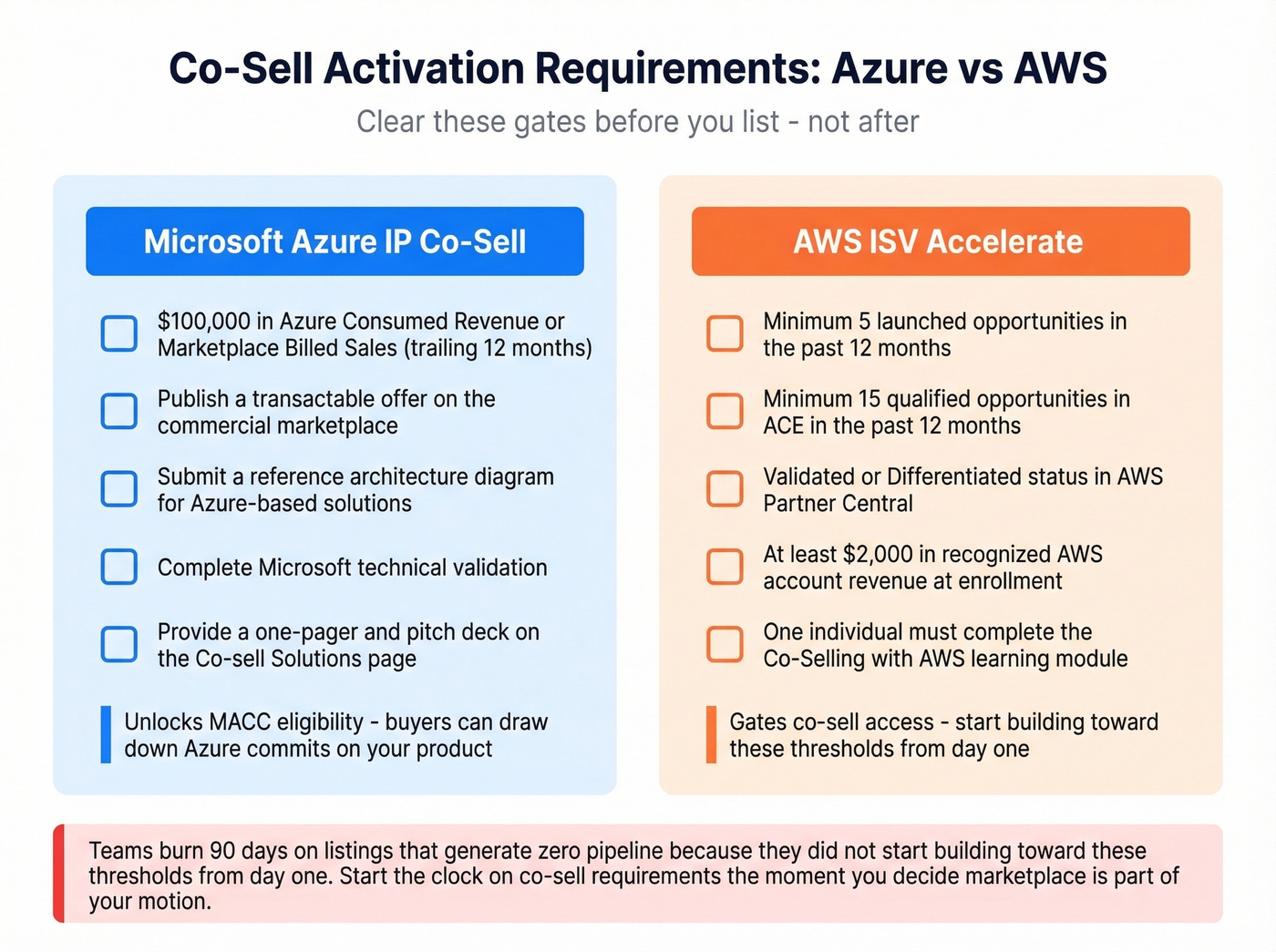
- Generate at least $100,000 in Azure Consumed Revenue or Marketplace Billed Sales over the trailing 12 months
- Publish a transactable offer on the commercial marketplace
- Submit a reference architecture diagram for Azure-based solutions
- Complete Microsoft technical validation
- Provide a one-pager and pitch deck on the Co-sell Solutions page
AWS ISV Accelerate
AWS gates co-sell access through ISV Accelerate, and the requirements are specific:
- Minimum 5 launched opportunities in the past 12 months
- Minimum 15 qualified opportunities in ACE in the past 12 months
- Validated or Differentiated status in AWS Partner Central
- At least $2,000 in recognized AWS account revenue at enrollment
- One individual must complete the "Co-Selling with AWS" learning module
These aren't aspirational targets. They're hard gates. We've seen teams burn 90 days on a listing that generates zero pipeline because they didn't start building toward these thresholds from day one. Start the clock on co-sell requirements the moment you decide marketplace is part of your motion.
Pricing and Packaging
85% of SaaS companies have adopted usage-based pricing, with nearly half making the shift in the last two years. For cloud services, consumption-aligned pricing isn't optional - it's how marketplace private offers and expansion motions work.
A hybrid model works best for most teams: base platform fee plus consumption overages. Buyers get predictability. You preserve expansion economics. Structure private offers around committed usage tiers so buyers can draw down cloud commits while you lock in annual minimums.
Skip marketplace-first if your average deal is under $50K. The 10-20% fee and integration overhead don't pencil out at that deal size. Go direct until procurement friction is the documented reason deals stall - not just because marketplace sounds strategic.
The 90-Day Launch Plan
| Phase | Deliverables |
|---|---|
| Days 1-30 | Define ICP with firmographic and intent filters. Build a verified contact list - tools like Prospeo give you 98% email accuracy across 300M+ profiles on a 7-day refresh cycle, so outbound doesn't torch your domain on stale data. Submit co-sell applications to target hyperscalers. |
| Days 31-60 | Publish transactable marketplace listing. Begin ACE/referral pipeline with hyperscaler field teams. Launch outbound sequences to ICP accounts with cloud commits. |
| Days 61-90 | Close first private offers. Establish KPI baselines. Run first co-sell pipeline review with hyperscaler PDMs. |
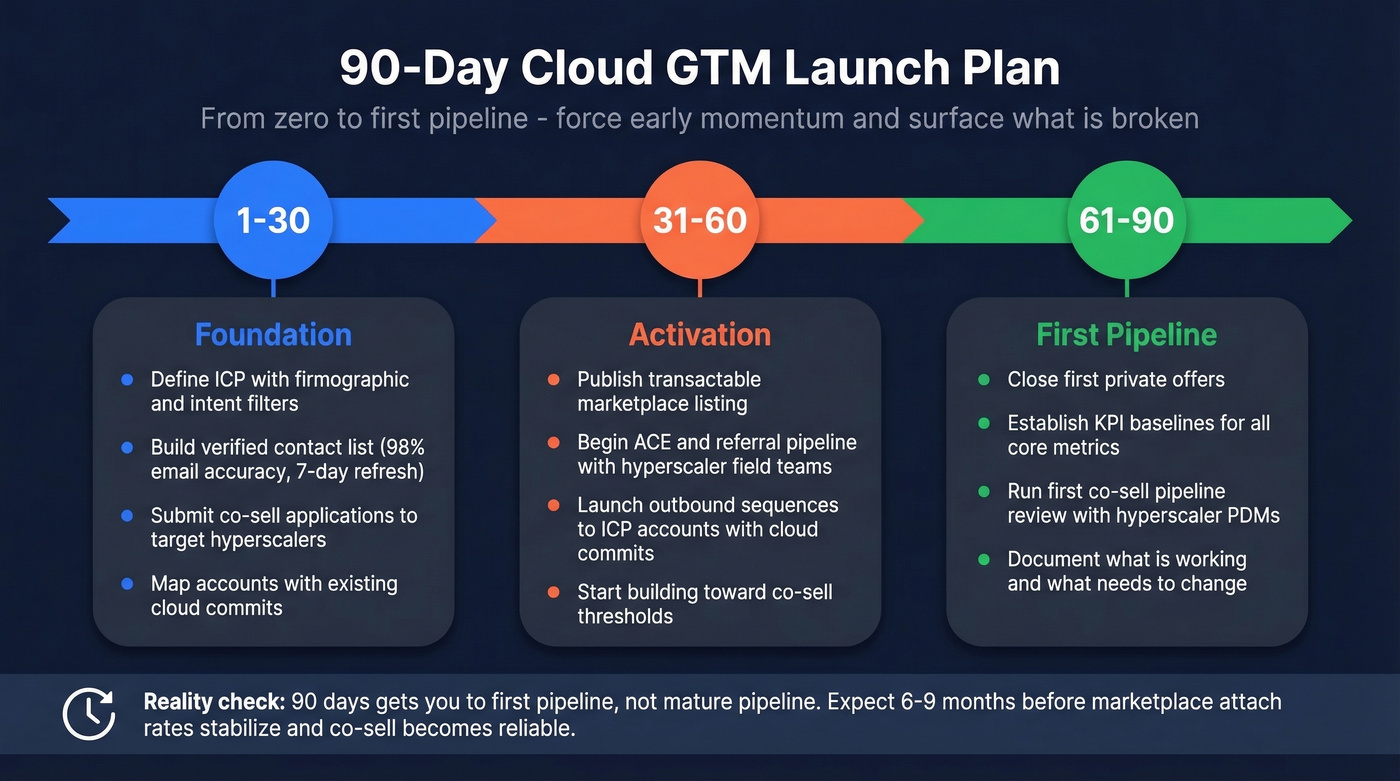
Let's be honest about timelines: 90 days gets you to first pipeline, not mature pipeline. Expect 6-9 months before marketplace attach rates stabilize and co-sell becomes a reliable source of new opportunities. The 90-day plan exists to force early momentum and surface what's broken before you've burned two quarters.
KPIs That Matter
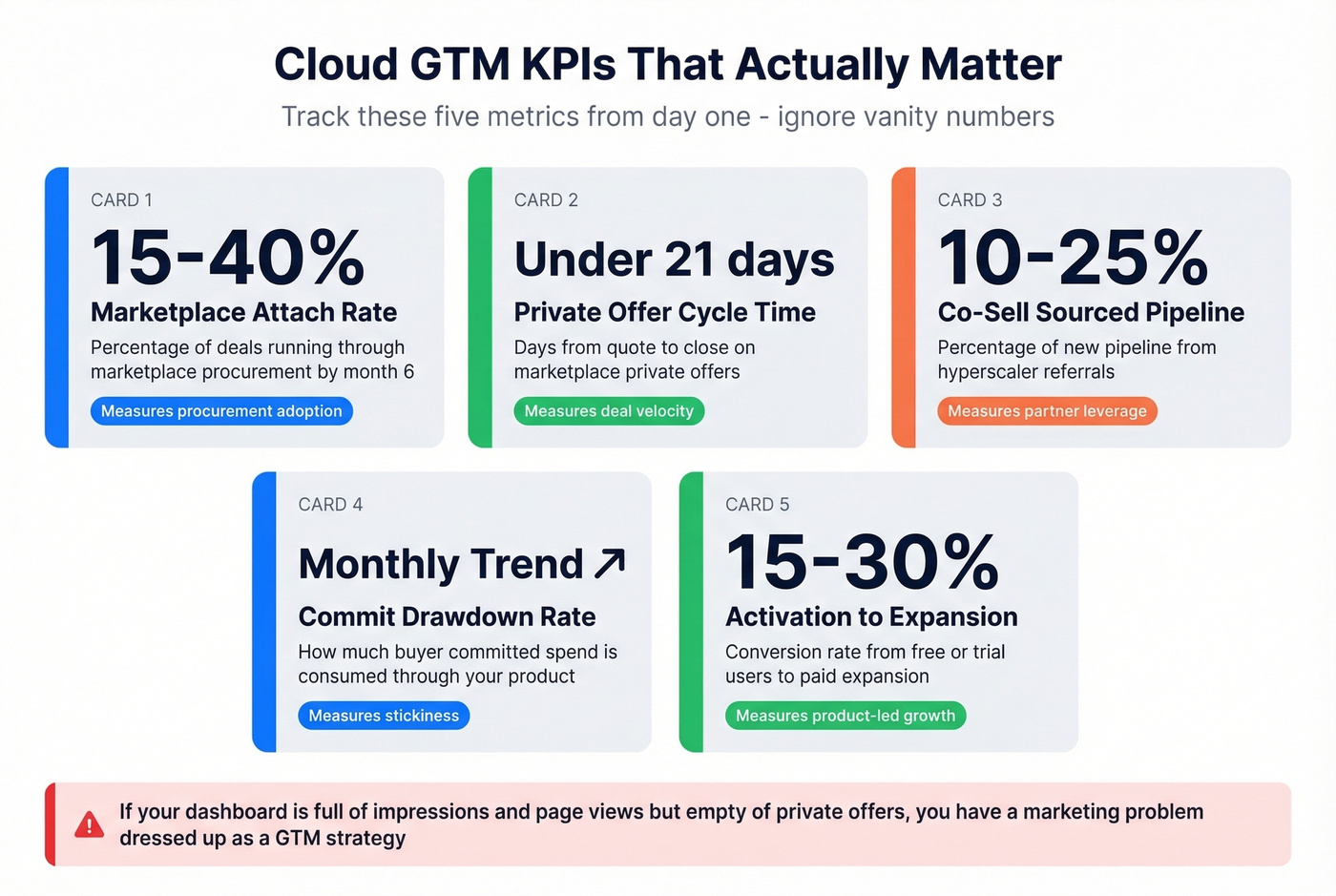
| Metric | What It Measures | Target Range |
|---|---|---|
| Marketplace attach rate | % of deals through MP | 15-40% by month 6 |
| Private offer cycle time | Days from quote to close | Under 21 days |
| Co-sell sourced % | Pipeline from hyperscaler refs | 10-25% of new pipe |
| Commit drawdown % | Buyer commit consumed via you | Track monthly trend |
| Activation-to-expansion | Free/trial to paid expansion | 15-30% |
Common Cloud GTM Mistakes
Building before validating your selling motion. No ICP, no buying trigger, no "why now" - just a product looking for a market. This is the #1 mistake founders call out in r/SaaS threads, and in our experience it's the hardest one to recover from because you've already burned co-sell credibility with the hyperscaler field teams.
Confusing traffic with intent. Marketplace page views and trial signups aren't pipeline. Measure activation and expansion, not vanity metrics. If your dashboard is full of impressions and empty of private offers, you've got a marketing problem dressed up as a GTM strategy.
Treating GTM as a one-time plan. A go-to-market strategy for cloud services is an iterative operating rhythm - quarterly co-sell reviews, pricing experiments, channel partner activation. It doesn't ship and sit. The teams that win revisit their motion every quarter and kill what isn't working.
Cutting marketplace deal cycles by 40% means nothing if your outbound bounces. Teams running cloud GTM motions use Prospeo's 98% verified emails and 125M+ direct dials to reach procurement stakeholders and cloud alliance managers without burning their domain. Data refreshes every 7 days - not 6 weeks - so you're always reaching people in their current roles.
Stop co-sell from stalling because your contact data is stale.
FAQ
Is a marketplace listing enough to launch cloud GTM?
No. A listing is table stakes - the actual strategy is the co-sell operating rhythm, private-offer workflow, and expansion motion you build around it. Without those, you're a catalog entry nobody finds. Plan 90 days minimum to activate co-sell pipeline.
Which GTM motion works best for enterprise cloud services?
Product-led sales, for most mid-market and enterprise plays. Combine self-serve adoption with sales motions triggered by usage signals. McKinsey data shows PLS outperformers generate roughly 10 percentage points more ARR growth than pure sales-led companies.
How do I build a verified prospect list for cloud outbound?
Define your ICP using firmographic and intent filters - cloud commits, tech stack, headcount growth - then pull verified emails through a platform with weekly-refreshed data and catch-all domain handling. Stale data destroys domain reputation fast, and once you're flagged, recovery takes months.