

The Best GTM Agencies in 2026: Pricing, Red Flags, and Who to Actually Hire
A RevOps lead we know spent $180,000 over nine months with a GTM agency that delivered a beautiful slide deck, a revised ICP document, and exactly zero pipeline. The board wasn't impressed. That's not an outlier - it's a common outcome when you pick the wrong go-to-market partner.
Based on one GTM consultant's experience across 40+ startups, roughly 15% have a real, repeatable go-to-market motion. The rest run on founder magic - a few early wins that feel like a system but can't survive the founder stepping back. Then Series A closes, the board wants pipeline in 90 days, and suddenly you're searching for agency help at midnight.
Most agency lists rank the publisher first. We've tried to do something more useful: honest pricing, actual red flags, and a framework for deciding whether you even need outside help at all.
Our Picks
| Category | Pick | Starting Price | Why |
|---|---|---|---|
| Full-service GTM | Kalungi | $45,000/mo | Fractional CMO + execution for Series A-B SaaS |
| Sprint-based GTM | ARISE GTM | ~$9,500/mo | Hands-on implementation, results in 30-90 days |
| Sales methodology | Winning by Design | ~$5K-$15K/mo | Trained 17,000+ GTM pros at Adobe, DocuSign |
| Outbound execution | SalesCaptain | ~$5K-$15K/mo | Multi-channel outbound at scale |
| B2B data accuracy | Prospeo | Free-$99/mo | 98% email accuracy, 125M+ verified mobiles |
What a Go-to-Market Agency Actually Does
A go-to-market agency isn't a marketing agency with a fancier name. Marketing agencies run campaigns and report on impressions, clicks, and MQLs. A GTM agency owns the entire commercial motion - from ICP definition and positioning through outbound execution and sales enablement - and is accountable for pipeline and revenue-stage metrics.
[GrowTech breaks it down](https://www.growtech.co/post/what-is-a-go-to-market-agency - and-do-you-really-need-one) into three phases: strategy and positioning (ICP, messaging, competitive triggers, pricing), execution across channels (outbound sequences, list building, workflows), and enablement at scale (building the in-house system so you can eventually fire the agency). That last phase is the one most agencies conveniently forget to mention during the pitch.
The 2026 trend is what Omniscient Digital calls "Unified Growth Pods" - cross-functional teams combining product, data, creative, and media instead of siloed channel specialists. Some agencies now run podcast-led outbound as an entry point, with one firm generating over $1.1M in pipeline from that motion alone.
Do You Actually Need One?
When to Hire a GTM Agency
- You've got product-market fit but no repeatable sales motion
- There's no marketing team and no budget to build one in the next 90 days
- The board is asking for pipeline numbers and you're still founder-selling every deal
- Your reps can't replicate what the founder does to close - that's the litmus test
When You Don't
Here's the contrarian take: you probably don't need one.
GrowTech's three-criteria test is useful - if you already have a proven sales leader, an SDR team hitting quota, and a clear pipeline and messaging framework, an agency will just add overhead. If you go in-house, your minimum stack is a CRM, a data provider for verified emails and direct dials, and a sending tool. That's around $500/month to start. Test outbound yourself before committing to a retainer.

Which Type Fits Your Stage?
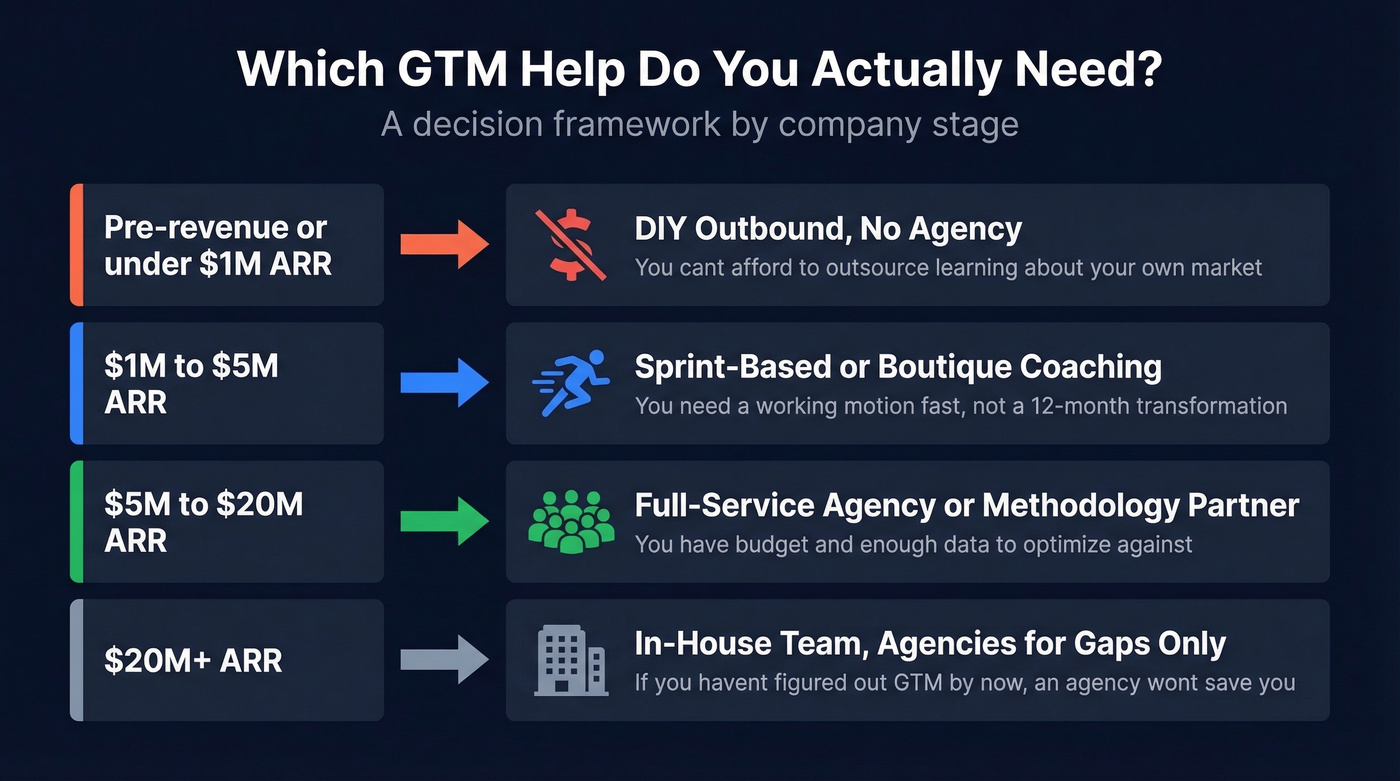
This is the decision framework most agency lists skip. Your ARR band determines what kind of help you actually need:
| Company Stage | Recommended Approach | Why |
|---|---|---|
| Pre-revenue / <$1M ARR | DIY outbound, no agency | You can't afford to outsource learning about your own market |
| $1M-$5M ARR | Sprint-based (ARISE) or boutique coaching | You need a working motion fast, not a 12-month transformation |
| $5M-$20M ARR | Full-service (Kalungi) or methodology (Winning by Design) | You have budget and enough data to optimize against |
| $20M+ ARR | In-house team, agencies for specific gaps only | If you haven't figured out GTM by now, an agency won't save you |
Hot take: If your average deal size is under $10K, you almost certainly don't need a full-service go-to-market agency. At $10K ACV, a $15K/month retainer means you need to close ~1.5 extra deals per month just to break even on the agency fee. Invest in tools and a sharp first SDR instead.
In-House vs. Agency
| Factor | In-House | Agency |
|---|---|---|
| Cost structure | Fixed salaries | Scalable retainer |
| Speed to start | Weeks to months | Immediate bandwidth |
| Expertise range | Limited to hires | Specialist bench |
| Tool access | You buy everything | Agency provides |
| Flexibility | Slow to scale up/down | Scale in weeks, not months |
The Spinutech framework recommends picking a single north-star KPI for the next 6-12 months and letting that guide the decision. If your north star is "build a repeatable outbound engine from scratch in one quarter," an agency gets you there faster. If it's "optimize an existing pipeline that's already producing," you need a hire, not a retainer.
Most Series A companies end up with a hybrid - a small in-house team supplemented by an agency for the first 6-9 months, then a transition to full in-house once the playbook is proven.

The article says it: your minimum in-house GTM stack is a CRM, a data provider, and a sending tool - about $500/month. Prospeo is the data layer. 300M+ profiles, 98% email accuracy, 125M+ verified mobiles, and 30+ filters including buyer intent and technographics. That's enterprise-grade targeting without the enterprise agency retainer.
Build your own GTM motion for less than one agency meeting costs.
How to Evaluate a GTM Agency
Red Flags
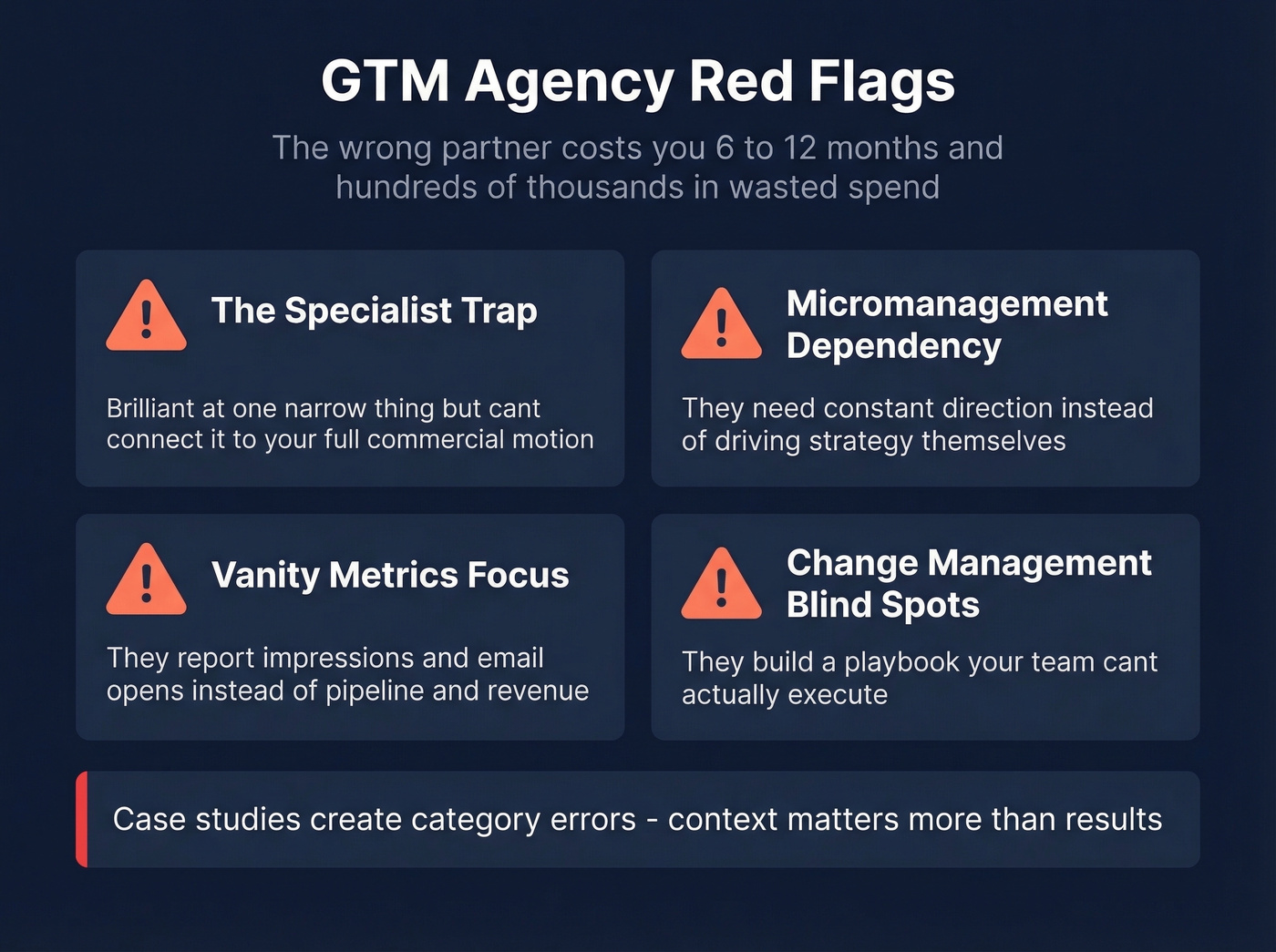
ARISE GTM published a useful breakdown of what goes wrong. The cost of choosing the wrong partner is 6-12 months and hundreds of thousands in wasted spend. Watch for these patterns:
The specialist trap - they're brilliant at one narrow thing but can't connect it to your full commercial motion. Micromanagement dependency - they need constant direction instead of driving strategy themselves. Vanity metrics focus - they report impressions and email opens instead of pipeline and revenue. And the one that kills the most engagements: change management blind spots - they build a playbook your team can't actually execute.
Case studies create category errors. An agency that tripled pipeline for a $50M ARR enterprise SaaS company may be completely wrong for your $2M ARR startup. The context matters more than the result.
A Better Selection Process
Instead of trusting rankings, use a structured process adapted from TrinityP3's methodology:
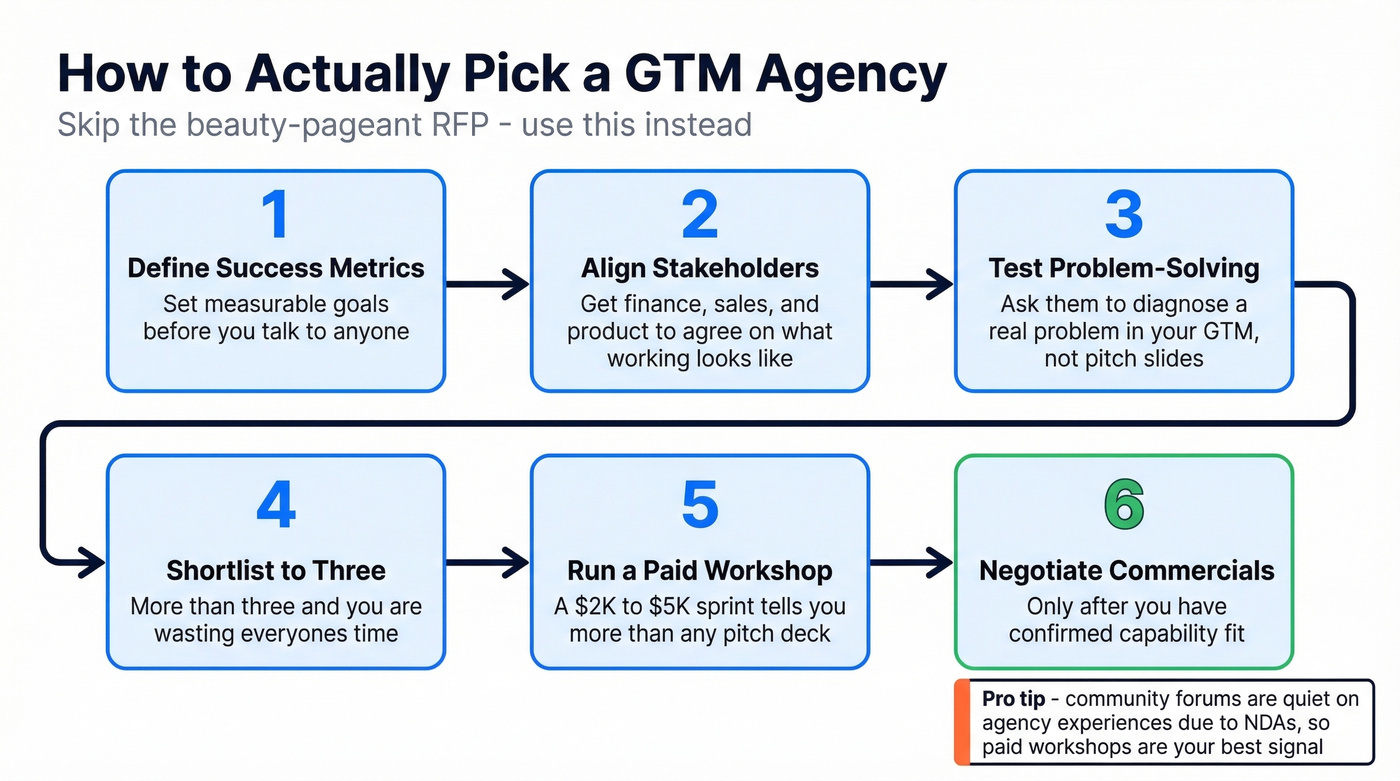
- Define measurable success metrics before you talk to anyone
- Align internal stakeholders - finance, sales leadership, product - on what "working" looks like
- Test problem-solving ability, not pitch decks. Ask them to diagnose a real problem in your go-to-market
- Shortlist to three agencies maximum
- Run a paid workshop with each finalist - a $2,000-$5,000 sprint tells you more than any pitch
- Negotiate commercials after you've confirmed capability fit
Skip the beauty-pageant RFP process. It rewards presentation skills, not execution ability. Community forums are surprisingly quiet on agency experiences - most engagements come with NDAs, so public reviews are rare. That's another reason to run a paid workshop before committing.
The Best GTM Agencies in 2026
Kalungi - Full-Service for B2B SaaS
Founded in 2018 in Seattle, Kalungi provides what most Series A-B SaaS companies actually need: a fractional CMO paired with a full team of specialists who execute, not just advise. They handle everything from positioning and ICP work through demand gen, content, and sales enablement.
Pricing is steep: $45,000/month for the full-service engagement, or $6,500/month for coaching-only if you just need a CMO brain on call. Their Clearwave case study showed a 30% increase in MQLs plus a successful product launch. They've got 26 reviews on HubSpot's App Marketplace but zero on Clutch - a gap worth noting.
Compared to sprint-based agencies like ARISE, Kalungi is a longer-term commitment but covers more ground. Use this if you're a Series A-B SaaS company with no marketing team and budget for a real engagement. Skip this if you're bootstrapped or pre-revenue - $45K/month is overkill before product-market fit.
ARISE GTM - Sprint-Based Implementation
ARISE takes the opposite approach from the 12-month transformation program. Their model is sprint-based: ~$9,500/month with a 6-month minimum, designed to drive results in 30-90 days. You get pre-configured templates and dashboards from day one, not a discovery phase that eats your first quarter.
Where ARISE wins over traditional agencies: speed to value and combined strategy-plus-execution. Most agencies separate the two - one team builds the strategy, another implements it, and the handoff loses half the nuance. ARISE keeps it unified. Use this if you need a working outbound motion in 90 days. Skip this if you're US-only and need deep North American market expertise - they're UK-based and that matters for some verticals.
Winning by Design - Sales Methodology
If your go-to-market motion exists but leaks at every stage, Winning by Design is the fix. They've trained 17,000+ professionals across 1,000+ clients including Adobe, Uber Eats, and DocuSign. They're not an execution agency - they're a methodology company that makes your existing team better. Think of them as the operating system upgrade, not the engine.
Pricing typically runs $5,000-$15,000/month for ongoing engagements, with project-based options for specific workshops. Where they beat generic sales training: they redesign your entire revenue architecture, not just teach cold calling frameworks.
SalesCaptain - Outbound Pipeline
SalesCaptain focuses on what most early-stage companies actually need: meetings on the calendar. They run multi-channel outbound - email, phone, social - at scale, typically $5,000-$15,000/month depending on volume. Best for teams that have a clear ICP but no outbound muscle. If you need strategy work before execution, look elsewhere.
Refine Labs - Demand Generation
Refine Labs built a strong reputation for brand and demand marketing, earning a 4.8/5 on G2 - but from only 4 reviews, and their G2 profile has been inactive for over a year. That's a yellow flag. The reviews that exist praise their depth of market research and willingness to experiment, but the "awareness is hard to measure" caveat keeps coming up. Typically $10,000-$25,000/month. Before engaging, verify their current team composition - the brand-era Refine Labs and the 2026 version may be different animals.
Ironpaper - B2B Lead Gen
Ironpaper made Directive's top-23 GTM agencies list and leans heavily into content-driven pipeline. Typically $8,000-$20,000/month. Here's how to think about them versus SalesCaptain: if your motion is more inbound-heavy than pure outbound, Ironpaper is the better fit. SalesCaptain wins on cold outbound volume; Ironpaper wins on content-to-pipeline conversion.
Six & Flow - The HubSpot Native
HubSpot partner specializing in RevOps implementation and inbound GTM. Typically ~$5,000-$15,000/month. If your entire stack is HubSpot-centric, Six & Flow speaks that ecosystem natively. On Salesforce? They're not your agency.
Single Grain - Growth and Paid Media
Known for content-led growth strategies and paid media execution, typically ~$10,000-$30,000/month. Their sweet spot is companies spending $50K+/month on paid and needing someone to connect that spend to pipeline, not just impressions.
Directive Consulting
Performance marketing for B2B tech, typically ~$10,000-$25,000/month. They literally wrote the top-23 GTM agencies list that half the industry references, which tells you something about their content game.
Sales-Led GTM Agency (Leslie Venetz)
Boutique coaching and advisory, typically ~$3,000-$10,000/month. Best for founders who want to learn go-to-market themselves rather than outsource it. If you're a technical founder who needs someone to teach you outbound, not run it for you, this is the model.
Beacon GTM
Newer entrant focused on strategy, featured in Directive's late-2025 roundup. We haven't tested them deeply enough to recommend confidently, but they're on our radar. Expect boutique-tier rates of $5,000-$15,000/month based on comparable firms.
NinjaPromo
Full-service digital marketing agency with B2B capabilities, typically ~$5,000-$20,000/month. Stronger on the paid social and community-building side than pure outbound. Worth a look if your motion includes heavy social selling.
The Data Layer Most Agencies Ignore
Here's a pattern we see constantly: a company spends $15,000/month on an agency, the agency builds beautiful sequences and a sharp ICP framework, and then execution falls apart because the contact data is garbage. Five hundred emails go out daily, half bounce, domain reputation tanks, and the agency blames "market conditions."
No agency strategy survives bad data. That's the uncomfortable truth nobody on the agency side wants to talk about.

Prospeo solves this specific problem with 300M+ professional profiles, 143M+ verified emails at 98% accuracy, and 125M+ verified mobile numbers - all on a 7-day refresh cycle versus the 6-week industry average. Stack Optimize built from $0 to $1M ARR running client campaigns with sub-3% bounce rates and zero domain flags. Meritt tripled their pipeline from $100K to $300K/week after switching their data layer. Whether you're working with an agency or running outbound in-house, the data layer is the foundation everything else sits on.
Bad data is the silent killer of every GTM motion - agency-led or in-house. When 35% of your emails bounce, no strategy deck saves you. Prospeo's 7-day data refresh and 5-step verification keep bounce rates under 4%, the same result agencies charge $45K/month to deliver. At $0.01 per verified email, the math isn't even close.
Stop paying agency rates for data you can own directly.
Pricing, Timelines, and Engagement Models
Let's save you 3-4 discovery calls.
| Agency Type | Monthly Range | Typical Commitment |
|---|---|---|
| Boutique/specialist | $5K-$15K | 3-6 months |
| Mid-market execution | $10K-$30K | 6-12 months |
| Full-service outsourced | $30K-$75K+ | 6-12 months |
| Training/methodology | $5K-$15K | Project-based |
Three engagement models dominate the market. Sprint-based (ARISE's model) gives you a defined scope, a timeline, and deliverables in 30-90 day chunks. Retainer-based is the traditional model - monthly fee, ongoing execution, typically 6-12 month commitments. Project-based works for specific needs like sales methodology training or a one-time audit.
Be wary of any agency that requires a $50,000 "diagnostic phase" before they'll quote execution work. That's a red flag for scope creep and a sign they don't have a repeatable framework. The best agencies can tell you within two calls what the engagement looks like and what it costs.
FAQ
What does a GTM agency actually do?
A GTM agency designs, launches, and scales your go-to-market motion - ICP definition, messaging, outbound execution, and sales enablement. Unlike a marketing agency, they're accountable for pipeline and revenue, not campaign metrics like impressions or MQLs.
How much does a go-to-market agency cost?
Boutique agencies start around $5,000-$15,000/month; full-service teams with a fractional CMO run $30,000-$75,000+/month. Most require 3-6 month minimums, with sprint-based models like ARISE starting at ~$9,500/month.
When should a startup hire a GTM agency?
Hire one when you've got product-market fit but no repeatable sales motion and board pressure to show pipeline within 90 days. If you already have SDRs hitting quota, invest in tools and training instead - it's far cheaper.
What's the difference between a GTM agency and a marketing agency?
A marketing agency runs campaigns and reports on leads and impressions. A go-to-market agency designs the entire commercial motion - positioning, outbound, enablement - and is accountable for revenue-stage outcomes, not vanity metrics.
Can you run GTM in-house instead of hiring an agency?
Yes. A CRM, a data provider for verified emails and direct dials, and a sending tool cost around $500/month combined. Test outbound yourself before committing to a $10K+/month retainer. Many successful companies never hire an agency at all.