

GTM Motion: How to Choose, Measure & Scale in 2026
Fewer than 33% of companies have a documented GTM playbook. The ones that do see 3x revenue growth. That's not a rounding error - it's the difference between a repeatable GTM motion and a team that reinvents its sales process every quarter.
Most teams overthink this. Pick the wrong go-to-market motion and you waste a quarter. Run three at once and you waste a year. Here's how to pick the right one, measure whether it's working, and know when to layer a second.
What Is a GTM Motion?
A GTM motion is the repeatable mechanism your company uses to acquire and convert customers. It's not a strategy, not a channel, and not a campaign. Strategy is the overarching plan - your ICP, positioning, pricing, competitive angle. A motion is how that strategy turns into pipeline and revenue, week after week.
"We sell to mid-market fintech companies" is strategy. "We run outbound sequences to VP-level buyers using intent signals" is a motion. "We posted on LinkedIn" is a channel tactic. The confusion between these three levels is where most GTM dysfunction starts.
The Two-Question Shortcut
Only two questions matter when picking your first go-to-market motion. Can users get value without talking to a human? If yes, product-led growth is on the table. Is your ACV high enough to justify a sales team? Above $25K, sales-led is the default.
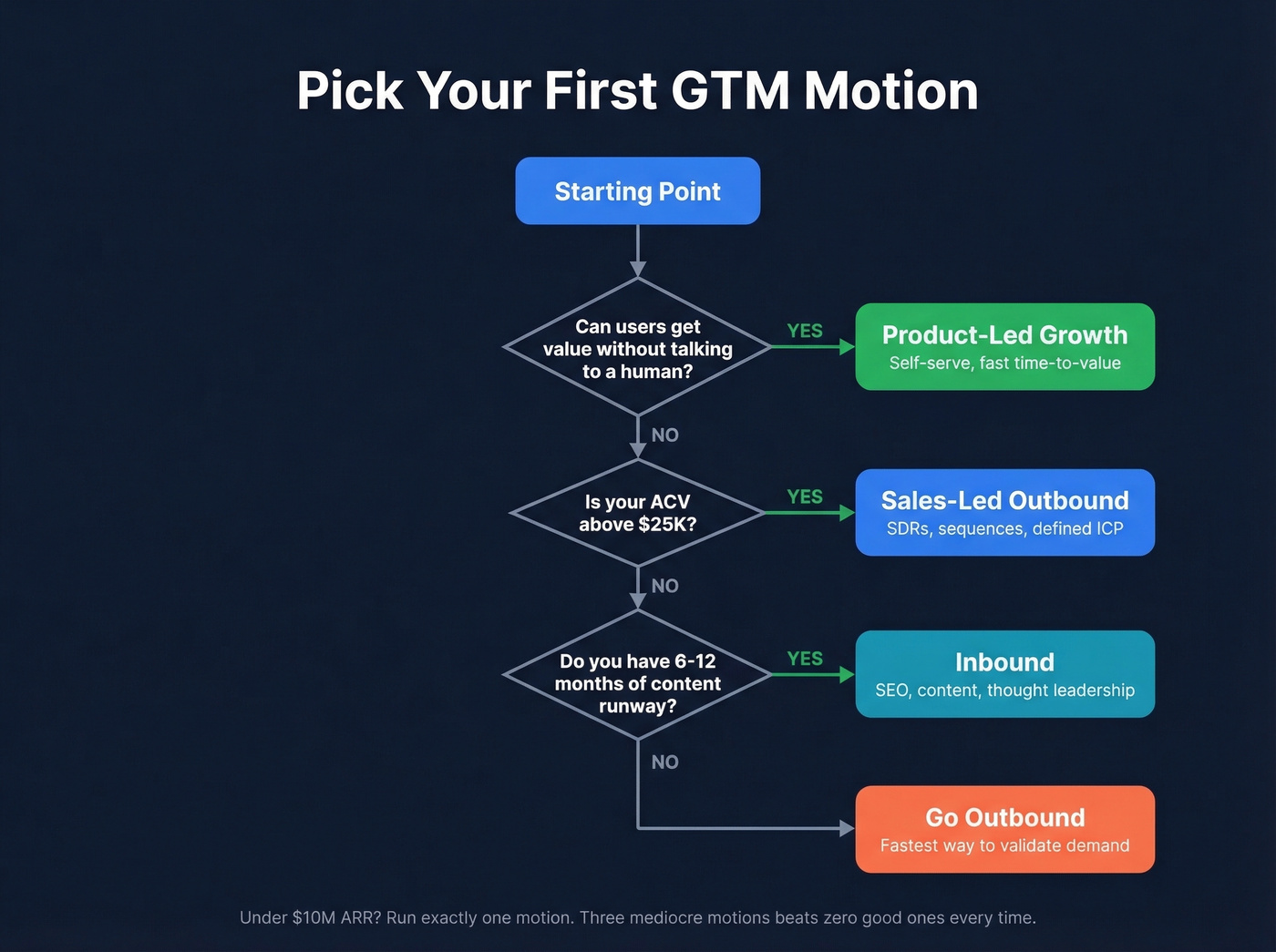
The decision falls out fast. ACV above $25K points to outbound and sales-led. Time-to-value under an hour with no human needed opens the door to PLG. A strong content engine with 6-12 months of runway makes inbound viable. If none of those apply, go outbound - it's the fastest way to validate whether anyone will pay for what you've built.
Here's a take we'll stand behind: most teams under $10M ARR should run exactly one motion. Companies that try three simultaneously almost always end up with three mediocre ones.
The 6 Core GTM Motions
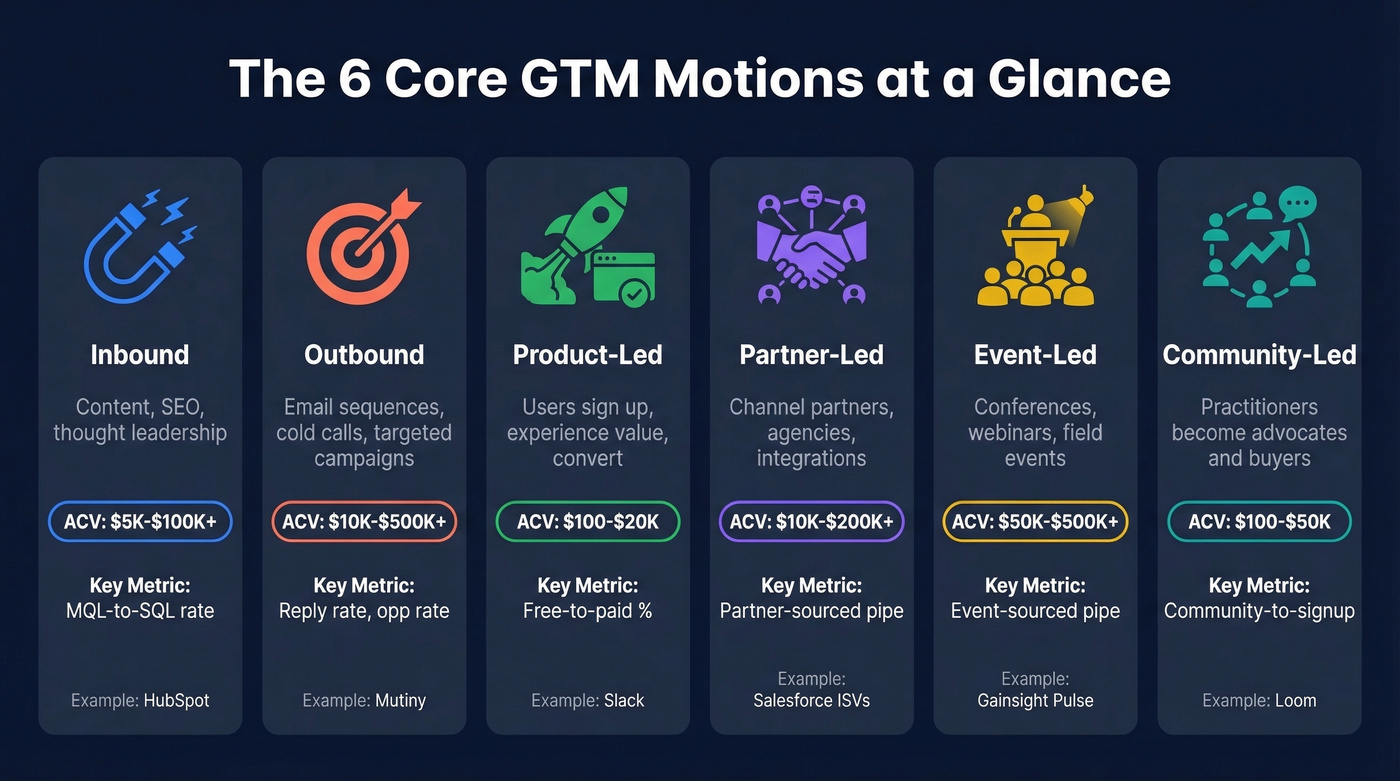
Every B2B company's revenue engine maps to one or more of these six motions. Understanding which ones fit your business is the first step toward predictable growth.
Inbound
HubSpot grew from 8,200 customers in 2012 to 205,000+ by end of 2023 - almost entirely on inbound. The model is simple: create content, SEO, and thought leadership that pulls prospects to you. The risk is patience. Inbound takes 6-12 months to compound, and most teams quit at month four when the pipeline report still looks empty.
Outbound
The workhorse motion for B2B. Your team proactively reaches prospects through email sequences, cold calls, and targeted campaigns. Sales cycles run 30-180 days with 20-40% close rates on qualified opportunities. Outbound works best above $10K ACV where you can define a tight ICP - but it breaks fast when data quality is poor. If 30% of your emails bounce, the motion isn't broken. Your data is.
This is the motion we've spent the most time studying, and the pattern is consistent: teams that fix their data layer first see results in weeks, not months, while teams that optimize sequences on top of bad contact records just optimize their way to faster failure.
Product-Led (PLG)
What if your product could sell itself? That's the PLG bet. Users sign up, experience value, and convert - or signal readiness for a sales conversation. 58% of SaaS companies report having a PLG motion, and 91% plan to increase investment. But average free-to-paid conversion sits around 9%, so the funnel needs volume. PLG works when time-to-value is under an hour. In DevTools specifically, 50% of Series A startups run PLG, but only 34% offer a free plan.
Partner-Led
Channel partners, agencies, and technology integrations source pipeline on your behalf. Best for products that plug into an existing ecosystem - think Salesforce ISVs. The tradeoff is control: partner-sourced deals move on someone else's timeline. Expect 15-30% of pipeline from partners in a mature program.
Event-Led
Conferences, webinars, and field events drive awareness and pipeline. Event CAC runs 2-5x higher than digital channels, which means this motion only pencils out for high-ACV enterprise sales where face-to-face trust matters. Gainsight built Pulse into a flagship event that feeds their enterprise pipeline. It works well as a complement to outbound - rarely as a standalone.
Community-Led
Build an audience of practitioners who become advocates and buyers. Loom and developer-focused tools have made this work. Let's be honest though: community takes years to build and is nearly impossible to attribute directly to revenue. It's a force multiplier, not a primary acquisition engine for most companies.
| Motion | Best For | ACV Range | Key Metric | Example |
|---|---|---|---|---|
| Inbound | Long cycles, content fit | $5K-$100K+ | MQL-to-SQL rate | HubSpot |
| Outbound | Defined ICP, $10K+ ACV | $10K-$500K+ | Reply rate, opp rate | Mutiny |
| PLG | Fast time-to-value | $100-$20K | Free-to-paid % | Slack |
| Partner-Led | Ecosystem products | $10K-$200K+ | Partner-sourced pipe | Salesforce ISVs |
| Event-Led | Enterprise, trust-heavy | $50K-$500K+ | Event-sourced pipe | Gainsight Pulse |
| Community-Led | DevTools, platforms | $100-$50K | Community-to-signup | Loom |
How to Choose Your Motion
ACV drives everything. The math is unforgiving:
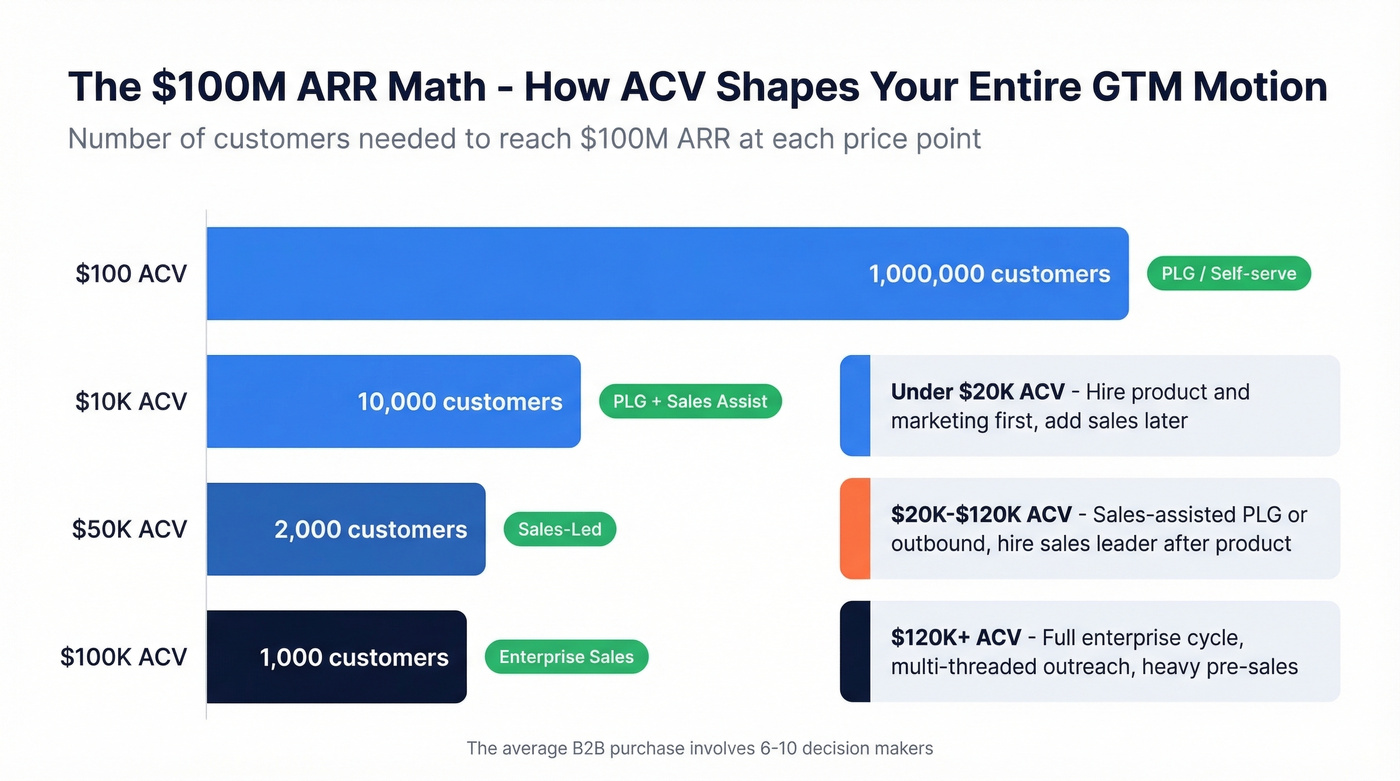
| ACV | Customers to $100M ARR | Typical Motion |
|---|---|---|
| $100 | 1,000,000 | PLG / self-serve |
| $10K | 10,000 | PLG + sales-assist |
| $50K | 2,000 | Sales-led |
| $100K | 1,000 | Enterprise sales |
That customer-count math shapes your entire org - hiring sequence, marketing spend, support model, everything. The typical B2B purchase now involves 6-10 decision-makers, which means your approach needs to be deliberate and cross-functional, not something you improvise in a Monday standup.
ACV bands map to motions like this:
- Under $20K ACV (bottom-up): PLG or self-serve. Hire product and marketing first, add sales later to convert and expand.
- $20K-$120K ACV (middle-out): Sales-assisted PLG or outbound. Hire a sales leader after product, then marketing. Add CS/AM after 5-10 accounts.
- $120K+ ACV (top-down): Full enterprise sales cycle. Multi-threaded outreach, long cycles, heavy pre-sales investment.
A founder on r/Entrepreneur shared a useful diagnostic: they started thinking "pure PLG" and landed on product-led with sales assist after evaluating time-to-value, pricing model, and customer learning curve. That's where most B2B companies end up.
PLG doesn't mean free. Among 474 Series A startups scanned in 2025, only 25% offer a free tier. Stripe, Vercel, and Linear all charge from day one. Self-serve means users can start without talking to sales - it doesn't mean giving the product away.

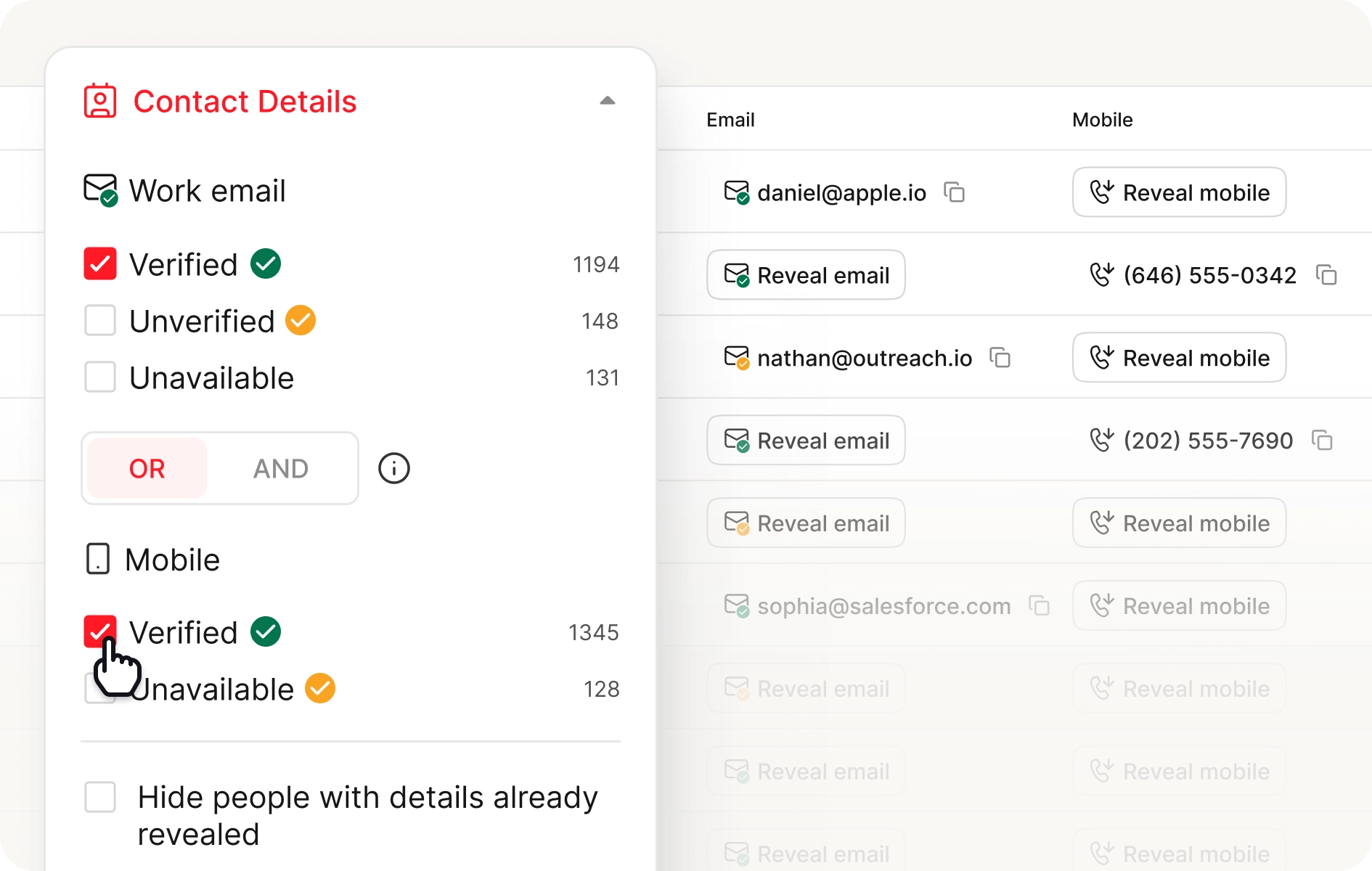
You read it above: outbound breaks fast when data quality is poor. Prospeo's 98% email accuracy, 125M+ verified mobiles, and 7-day refresh cycle give your outbound GTM motion the foundation it needs. Teams using Prospeo book 26% more meetings than ZoomInfo users - at 90% lower cost.
Fix the data layer first. The motion scales itself after that.
Hybrid GTM Motions
Most mature companies run a hybrid. But "hybrid" is a spectrum. MKT1's taxonomy breaks it into three sub-types.
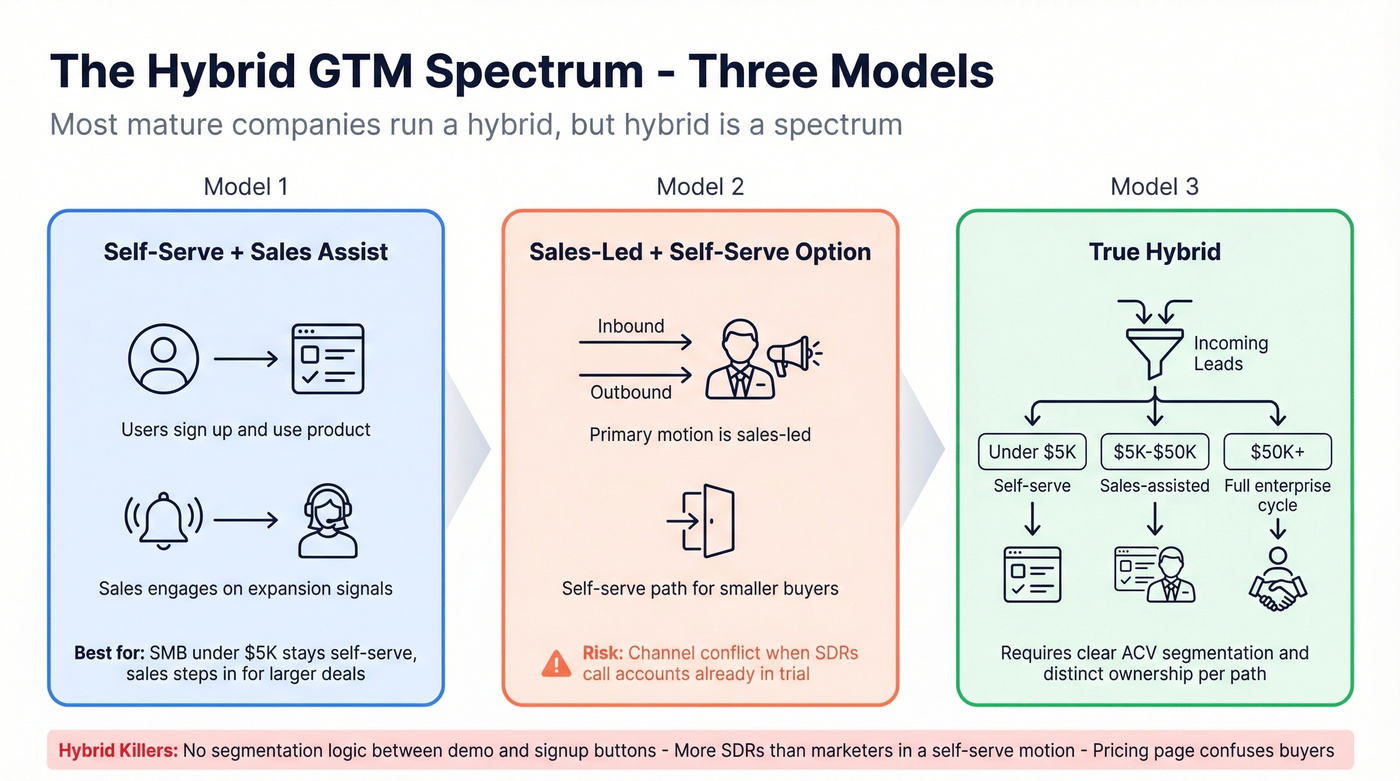
Self-serve + sales assist. Users sign up and use the product. Sales engages when usage signals indicate expansion potential. This works best when you segment cleanly: SMB under $5K stays self-serve, with sales stepping in for larger deals.
Sales-led + self-serve option. The primary motion is outbound or inbound-to-sales, but there's a self-serve path for smaller buyers. This is the "enterprise company that added a free tier" model. The risk is channel conflict - your SDRs are calling the same accounts that just signed up for a trial.
True hybrid. Both self-serve and sales-led operate as first-class acquisition paths, with routing rules determining which accounts go where. This requires clear ACV segmentation: SMB under $5K stays self-serve, mid-market $5K-$50K gets sales-assisted, enterprise $50K+ gets the full cycle. Layering multiple go-to-market motions only works when each one has distinct ownership and a defined segment.
How do you know your hybrid is broken? Three signs: you have both "Request Demo" and "Sign Up" buttons without segmentation logic, you have more SDRs than marketers in what's supposed to be a self-serve motion, or your pricing page confuses buyers because self-serve and enterprise terms don't align. These are hybrid killers - channel conflict, pricing confusion, and misaligned incentives where reps get paid on accounts that would've converted without them.
Benchmarks That Matter
PLG benchmarks from a survey of 600+ SaaS businesses:
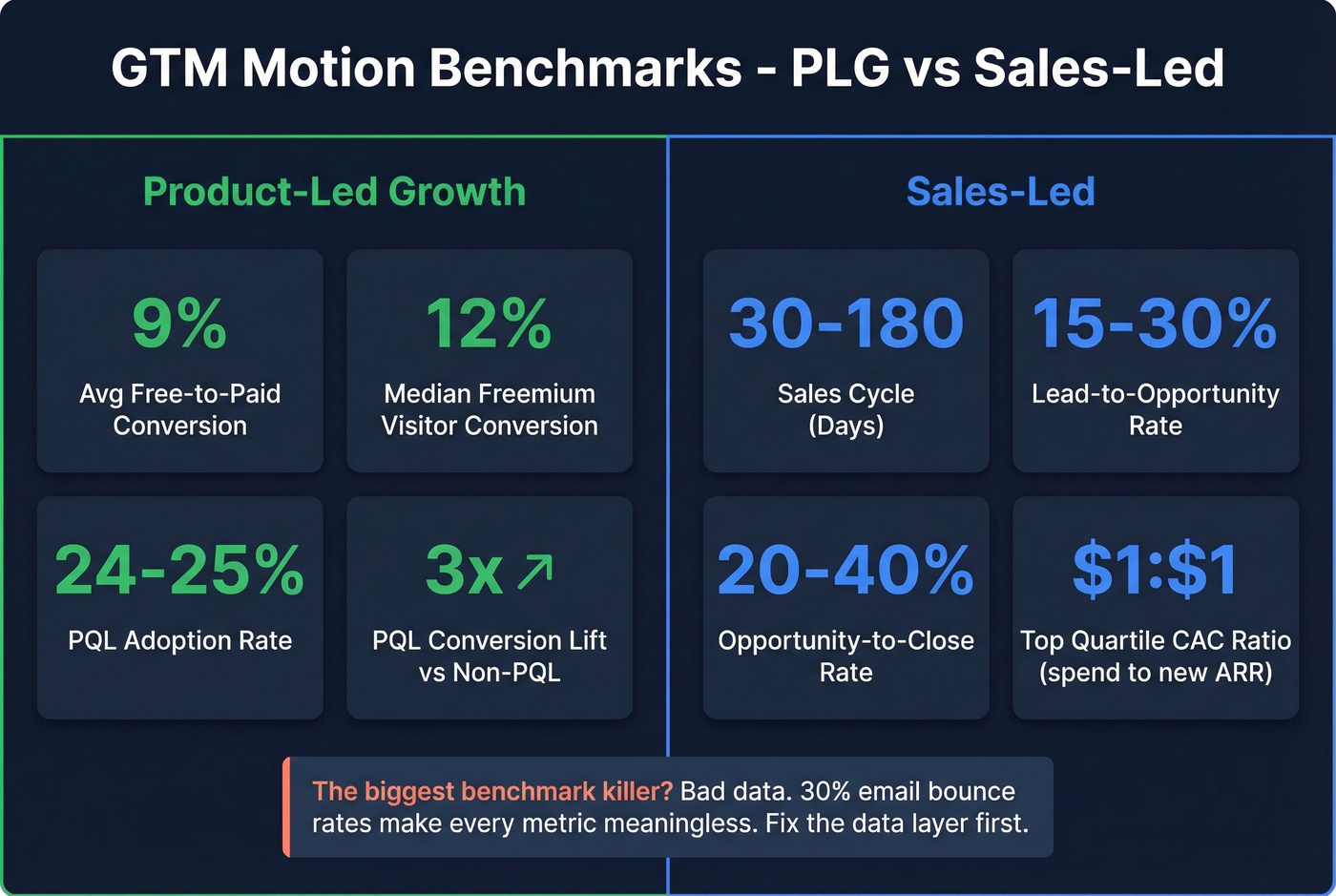
| Metric | Benchmark |
|---|---|
| Free-to-paid conversion | ~9% average |
| Freemium visitor conversion | 12% median |
| PQL adoption rate | 24-25% |
| PQL conversion lift | ~3x vs non-PQL |
Sales-led benchmarks:
| Metric | Benchmark |
|---|---|
| Sales cycle | 30-180 days |
| Lead-to-opportunity | 15-30% |
| Opportunity-to-close | 20-40% |
| CAC payback | Under 12 months |
| CAC ratio (top quartile) | $1 to acquire $1 new ARR |
The surprising number in the PLG table is the PQL conversion lift - 3x over non-PQL leads. That's the entire argument for investing in product-qualified lead scoring rather than treating every signup equally.
Which metrics matter depends on your stage. At problem-market fit, track activity volume and funnel conversion by function. At product-market fit, shift to tracking by account segment - engagement, pipeline coverage, deal velocity. At platform-market fit, it's cohort-level metrics: LTV, NPS, NRR, gross margins.
We've seen teams waste entire quarters diagnosing a "broken motion" when the real problem was 30% email bounce rates. Outbound benchmarks only mean something if the underlying data is clean. You can't diagnose a motion on corrupted inputs - fix the data layer first.
GTM Motions in Practice
Slack went all-in on PLG with a viral loop baked into the product: 8,000 signups in 24 hours at launch, 265,000 active users within a year, eventually 32M daily active users across 750,000 companies. Time-to-value was measured in minutes.
Zoom followed a similar playbook. 400,000 users in month one, 1 million by May 2013, 40 million users two years after launch - and then 300 million daily meeting participants in 2020 when the world went remote. The product's frictionless onboarding made every meeting an acquisition event.
Loom launched on Product Hunt and drove 3,000 new users on day one. Every video shared is a marketing touchpoint, which fueled 1,100% revenue growth in 2020. Classic bottom-up PLG where the product is the distribution channel.
TruckX took the opposite approach. They proved outbound first, scaling from $2M to $16M ARR, then layered inbound and ABM once the core motion was repeatable. This is the sequencing model most B2B companies should follow - nail one motion before adding another.
Mutiny runs a sales-led/ABM motion targeting companies spending $100K+ on paid and content. Their ICP is narrow and their outreach is hyper-personalized. When ACV justifies a full sales cycle, ABM math works.
How to Layer Multiple Motions
The instinct to run three motions simultaneously is strong. Resist it. In our experience, the companies that stall hardest are the ones running three with zero owners.
The framework that works:
- Stage 1: Pick one motion. Prove it's repeatable - consistent pipeline, predictable conversion, documented playbook.
- Stage 2: Add a complementary motion, not a competing one. Outbound + inbound works. Two outbound variants targeting the same ICP doesn't.
- Stage 3: Systematize before adding a third. Every motion needs an exclusive ICP segment, a named owner with dedicated metrics, and a handoff protocol.
Before layering a second motion, make sure your first has clean infrastructure. For outbound, that means verified contact data - not a list you bought six months ago. Tools like Prospeo give you verified emails at 98% accuracy on a 7-day refresh cycle, which means you're testing the motion itself rather than fighting stale records.
The "GTM pendulum" is a useful mental model. Early-stage, bias toward human-led onboarding to learn what works. Mid-stage, productize those learnings into guided self-serve with escape hatches to sales. Later, run a portfolio approach - self-serve for low-complexity segments, sales-assisted for high ACV.
3 Mistakes That Kill Your Motion
1. Building before validating how you'll sell. A thread on r/SaaS nailed this: the most common founder mistake is spending months on product and then asking "how do I get users?" No ICP, no trigger event, no "why now." GTM isn't a launch activity - it's a design constraint that shapes what you build.
2. Confusing traffic with intent. High website traffic and zero conversions means your motion is attracting the wrong audience. Vanity metrics feel good in board decks and mean nothing in pipeline reviews. Skip the celebration when pageviews spike - ask what those visitors did next.
3. Treating GTM as a one-time plan. Your motion needs to evolve as your market, ACV, and team change. Switching from PLG to sales-led has massive downstream impacts - org structure, pricing, incentive design, even your tech stack. Underestimating those impacts is how companies stall for two quarters during a transition.
Running a sales-led or hybrid GTM motion above $10K ACV? Layer Prospeo's intent data across 15,000 topics with 30+ filters - buyer intent, technographics, job changes, headcount growth - so your reps reach the right buyers before competitors do. One team tripled pipeline from $100K to $300K/week.
Stop choosing motions blind. Start with data that actually connects you to buyers.
FAQ
What's the difference between a GTM motion and a GTM strategy?
Strategy is the overall plan - ICP, positioning, pricing, competitive angle. A GTM motion is the repeatable execution mechanism for acquiring customers within that strategy. Think blueprint vs. factory machine. One company can have one strategy and multiple motions serving different segments.
How many GTM motions should a startup run?
One to start. Add a second only after the first is repeatable with a named owner, documented playbook, and clear ICP boundaries. Most companies under $10M ARR shouldn't run more than two - three mediocre motions always lose to one excellent one.
When should I layer a second motion?
When your first motion hits diminishing returns on a specific segment and you have the operational capacity - dedicated owner, budget, routing rules - to run a second without cannibalizing the first. For most teams, that's somewhere between $5M and $15M ARR.
What's the most common go-to-market motion for SaaS?
Outbound and PLG dominate. 58% of SaaS companies report a PLG motion. Outbound is the default above $10K ACV because it produces pipeline fastest. Most mid-market companies end up running a hybrid of both.
What tools support an outbound GTM motion?
You need a verified contact database, a sequencing tool like Outreach or Instantly for cadences, and a CRM to track pipeline. Data quality is the foundation - fix that before optimizing anything else.