

The Complete Handling Objections Training Playbook for 2026
A RevOps lead we work with ran a call audit last quarter and found a painful pattern: a big chunk of "not interested" outcomes weren't objection-handling failures at all. They were targeting failures - wrong title, wrong company size, wrong buying stage. The reps weren't failing at handling objections. They were practicing on the wrong people.
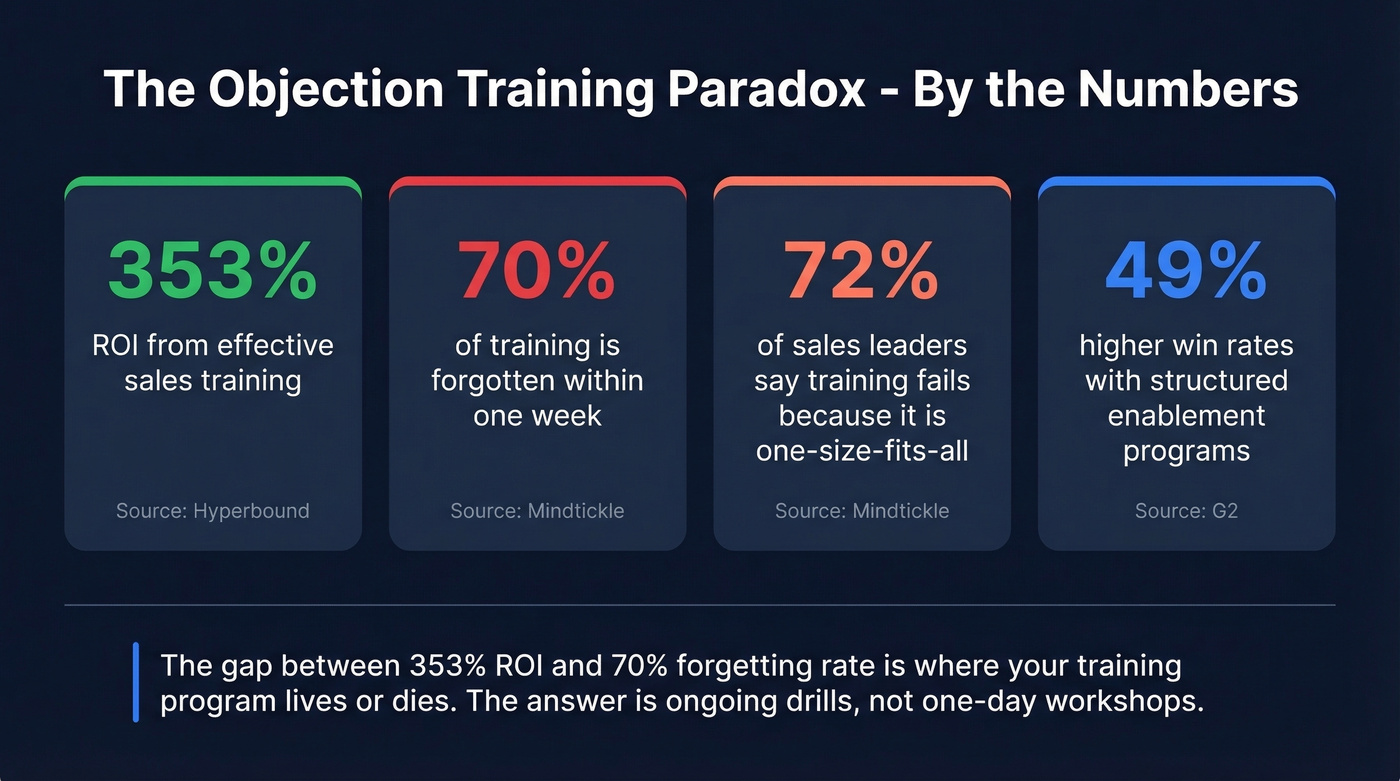
Here's the thing: effective sales training delivers a 353% ROI. But reps forget 70% of what they learn within a week. That means your training program needs to be ongoing, scored, and grounded in real conversations - not a one-day workshop with a binder nobody opens again.
The Short Version
Pick one framework (LAER), drill it weekly for four weeks, and score every roleplay. Train for messy, vague objections - not textbook ones - because that's what reps actually hear on calls. And before you train skills, fix your data: a huge share of "not interested" objections come from calling the wrong people entirely.
Why Most Objection Training Fails
72% of sales leaders say training fails because it's one-size-fits-all. But the deeper problem is structural: most programs teach reps to respond before they've clarified, and they practice on objections that sound nothing like real calls.
An objection is a buying signal. Most training programs get this backwards. A prospect who pushes back is still engaged. Silence - the call that ends with "sure, send me something" and zero follow-up - is far worse. Your training should treat objections as openings, not obstacles.
ASLAN Training identified two failure modes that kill these conversations:
Reps start selling before clarifying. A prospect says "the battery life concerns me" and the rep launches into specs. But "battery life" could mean ten different things - travel use, charging infrastructure, total cost of ownership. Wrong guesses erode trust fast.
Customers brace for the rebuttal. Even when the rep addresses the right objection, the prospect has mentally checked out because they expect a fight, they stop listening, and the conversation dies not because the answer was wrong but because the format felt adversarial.
Then there's the training content itself. A practitioner on r/salestechniques put it bluntly: training over-focuses on "clean" objections like "No budget" or "Not a priority" while real objections sound like "Yeah... not right now," "Let's circle back," or "Just send something over." These vague brush-offs don't map to any framework neatly. Reps freeze.
The Five Objection Categories
Every objection your reps hear falls into one of five buckets - and the real meaning is almost never what's said on the surface.
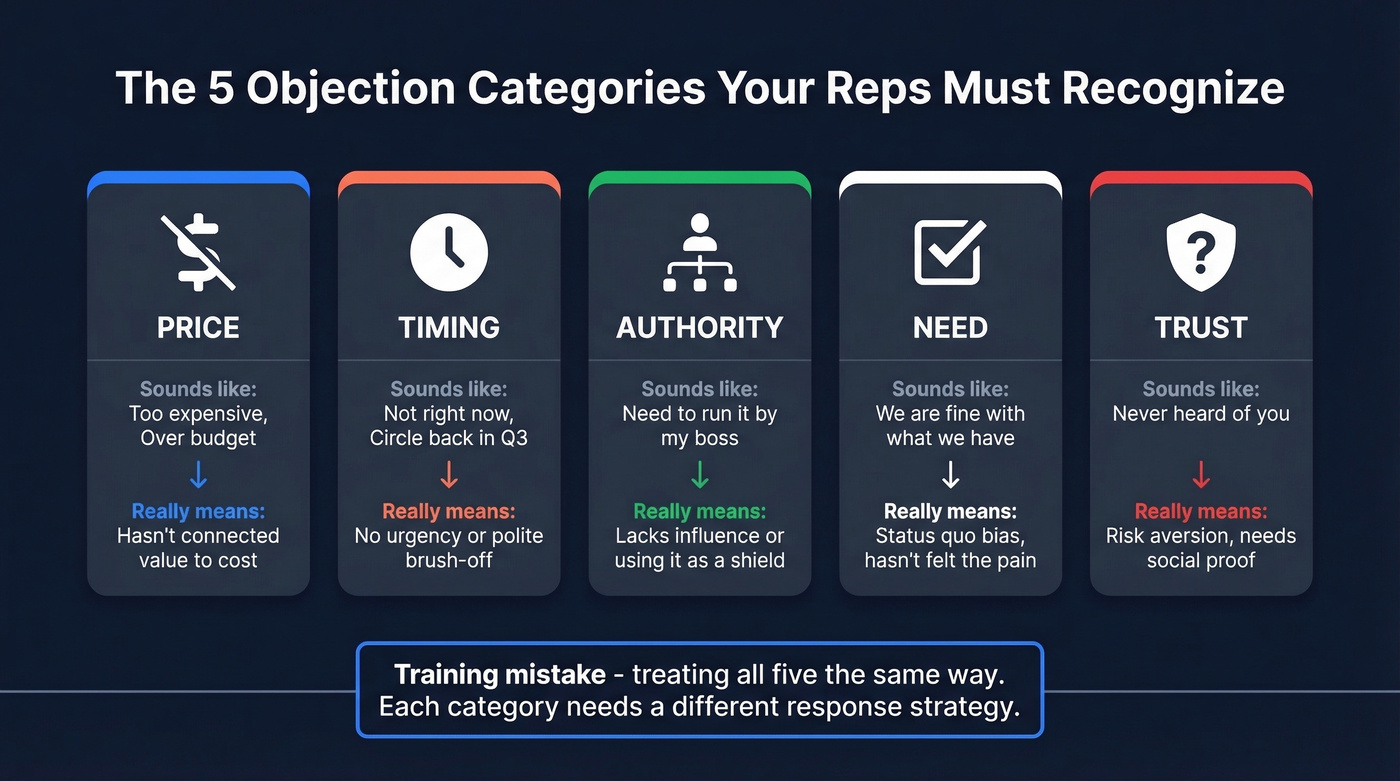
| Category | What It Sounds Like | What It Really Means |
|---|---|---|
| Price | "Too expensive" / "Over budget" | Hasn't connected value to cost; or genuinely wrong fit |
| Timing | "Not right now" / "Circle back in Q3" | No urgency; competing priorities; or polite brush-off |
| Authority | "Need to run it by my boss" | Lacks influence; or using hierarchy as a shield |
| Need | "We're fine with what we have" | Status quo bias; hasn't felt the pain yet |
| Trust | "Never heard of you" / "Seems too good" | Risk aversion; needs proof points and social proof |
The training mistake is treating all five the same way. A price objection requires ROI math. A trust objection requires case studies and patience. Drilling your reps on the difference is half the battle.
Choose Your Framework
There are dozens of objection-handling frameworks. You need one.
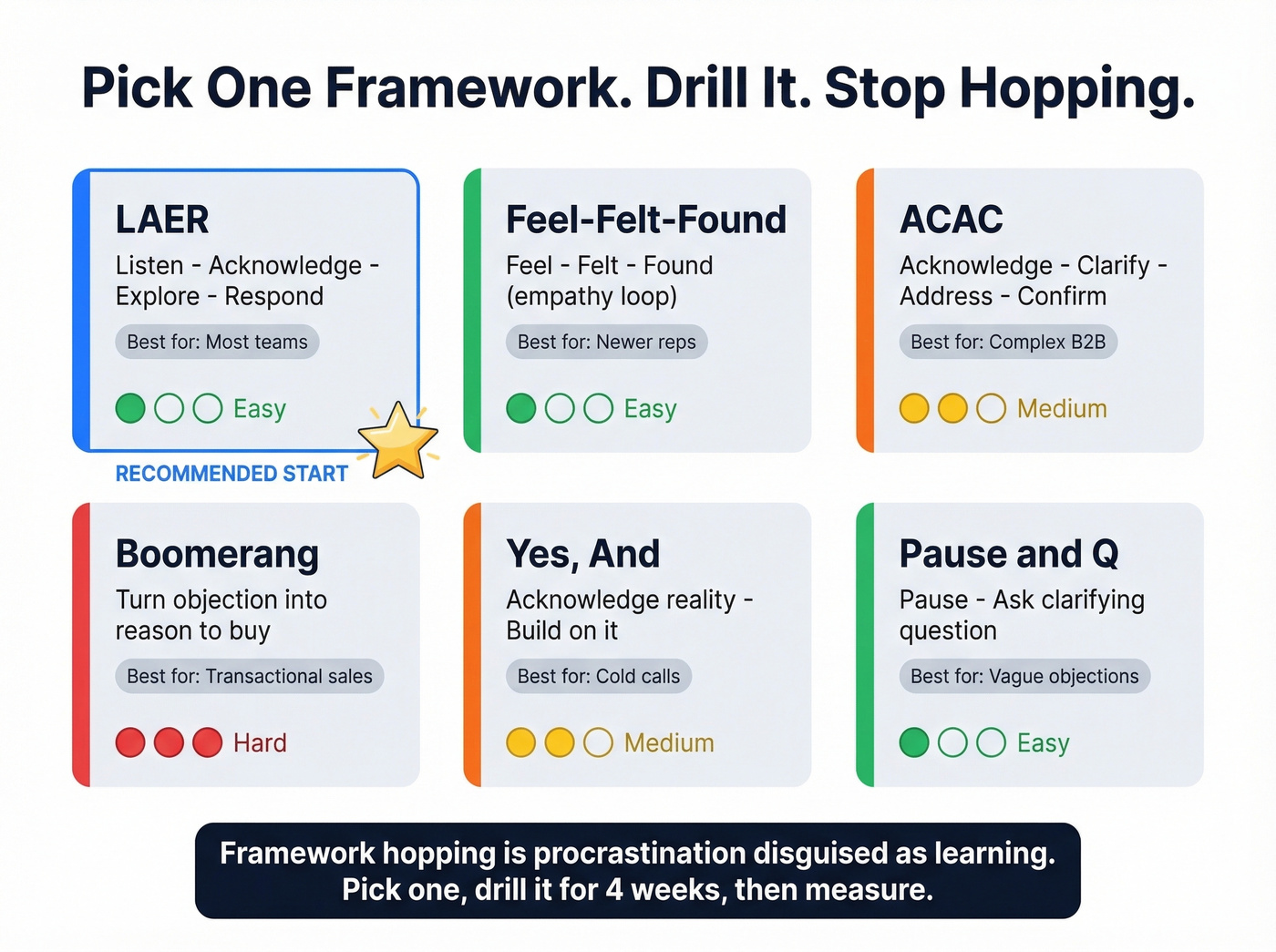
| Framework | Steps | Best For | Difficulty |
|---|---|---|---|
| LAER | Listen → Acknowledge → Explore → Respond | General purpose; most teams | Low |
| Feel-Felt-Found | Feel → Felt → Found (empathy loop) | Empathy-heavy sales; newer reps | Low |
| ACAC | Acknowledge → Clarify → Address → Confirm | Complex B2B; multiple stakeholders | Medium |
| Boomerang | Turn objection into reason to buy | Confident reps; transactional sales | High |
| "Yes, And" | Acknowledge reality → Build on it | Outbound cold calls; relationship-first | Medium |
| Pause & Q | Pause → Ask clarifying question | Vague objections; discovery-heavy | Low |
LAER is the right starting point for most teams. It's structured enough to teach in a single session, flexible enough to handle ambiguity, and it forces reps to explore before responding - which directly addresses the #1 failure mode we covered above.
But the "Yes, And" approach deserves more attention than it gets. A practitioner on Reddit described using improv principles on cold calls. When a prospect says "We already have a vendor," instead of arguing, you acknowledge and build: "Totally makes sense - most companies I call already have someone. Usually they still chat because they want to fix one specific gap, not replace the whole thing. What's the one thing you wish worked better?"
The objection doesn't die. The conversation opens up.
This works across industries. A real estate agent using a similar reframe on interest-rate objections - "Rates are high, but here's what that means for your negotiating position" - turns a blocker into a talking point. The principle is the same: don't fight the objection, redirect its energy.
Stop collecting frameworks. Pick one. Drill it for four weeks. Measure. Then decide if you need another. Framework-hopping is procrastination disguised as learning.
Training for Messy Objections
Your reps won't fail on "Your price is too high." They'll fail on "Hmm, yeah, I dunno, maybe send me something and we'll see."
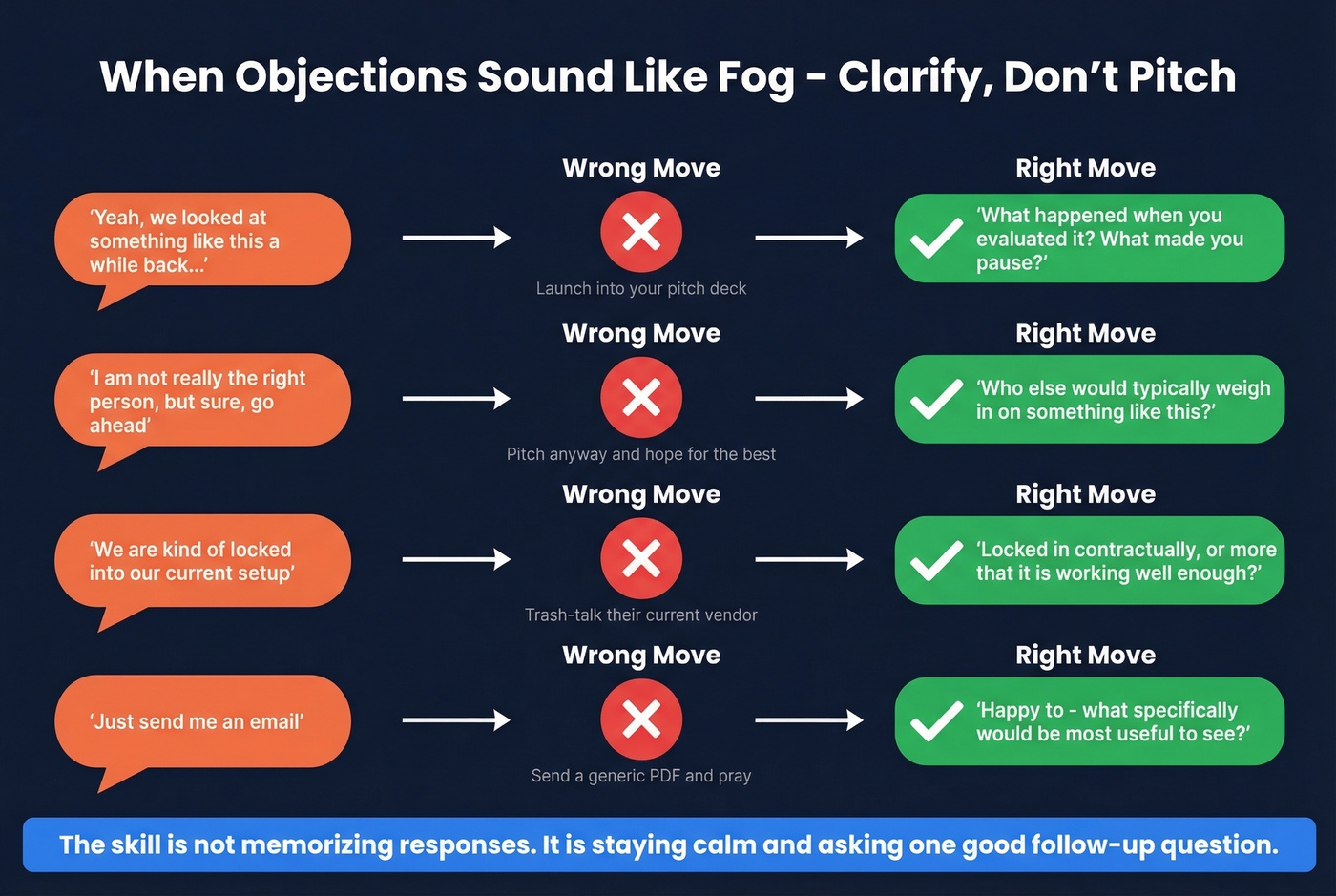
That's not an objection - it's a fog bank. And most training programs don't prepare reps for fog. The core skill isn't memorizing responses. It's staying calm, asking one good follow-up question, and resisting the urge to panic-pitch. One Reddit practitioner described using AI roleplay with deliberately ambiguous prompts - telling the AI to "act distracted," "give unclear reasons," and "change your mind mid-call." The goal isn't winning the roleplay. It's building composure.
Try these messy prompts in your next training session:
- "Yeah, we looked at something like this a while back..." → "What happened when you evaluated it? What made you pause?"
- "I'm not really the right person, but sure, go ahead." → "Who else would typically weigh in on something like this?"
- "We're kind of locked into our current setup." → "Locked in contractually, or more that it's working well enough?"
- "Just send me an email." → "Happy to - what specifically would be most useful to see?"
Each of these forces the rep to clarify instead of pitch. That's the muscle you're building.

Your reps aren't failing at objections - they're practicing on the wrong people. Prospeo's 30+ search filters (buyer intent, job changes, headcount growth) put reps in front of prospects who actually have the problem you solve. Fewer "not interested" brush-offs, more real conversations worth training for.
Eliminate targeting failures before you train objection skills.
Five Drills to Run This Week
Frameworks are theory. Drills are where reps actually get better. Here are five you can start running immediately - no special tools required.
Rapid-Fire Objection Drill
Five to ten minutes at the start of your team meeting. Manager fires objections rapid-fire; reps respond immediately. No pausing, no scripting. The goal is comfort and speed, not perfection. This builds the reflex to engage rather than freeze.
Structured Roleplay
Pair up reps. One plays the prospect with a realistic scenario and raises two to three objections. The other handles them. Debrief for five minutes after each round - what worked, what felt forced. Record these if you can. Rotate roles every session.
"Why Behind the Objection"
Give reps a surface-level objection and have them generate three to five possible underlying reasons. "What makes the price a concern right now?" beats "What if I could get you a discount?" every time. This drill trains the clarification habit that separates good reps from reactive ones.
Competitor Objection Practice
Reps practice discovery questions about the prospect's current solution, then highlight differences without trashing the competitor. The skill is shifting to outcomes: "What would it mean for your team if X worked 30% faster?" instead of "Our product is better because..."
Call Review Sessions
Pull a real recorded call. Play it. Pause at the objection moment. Ask the room: "How would you respond?" Then play what actually happened. This builds pattern recognition faster than any script library, and it grounds training in real conversations rather than hypotheticals.
How to Score It
If you're not scoring roleplays, you're not training - you're just talking.
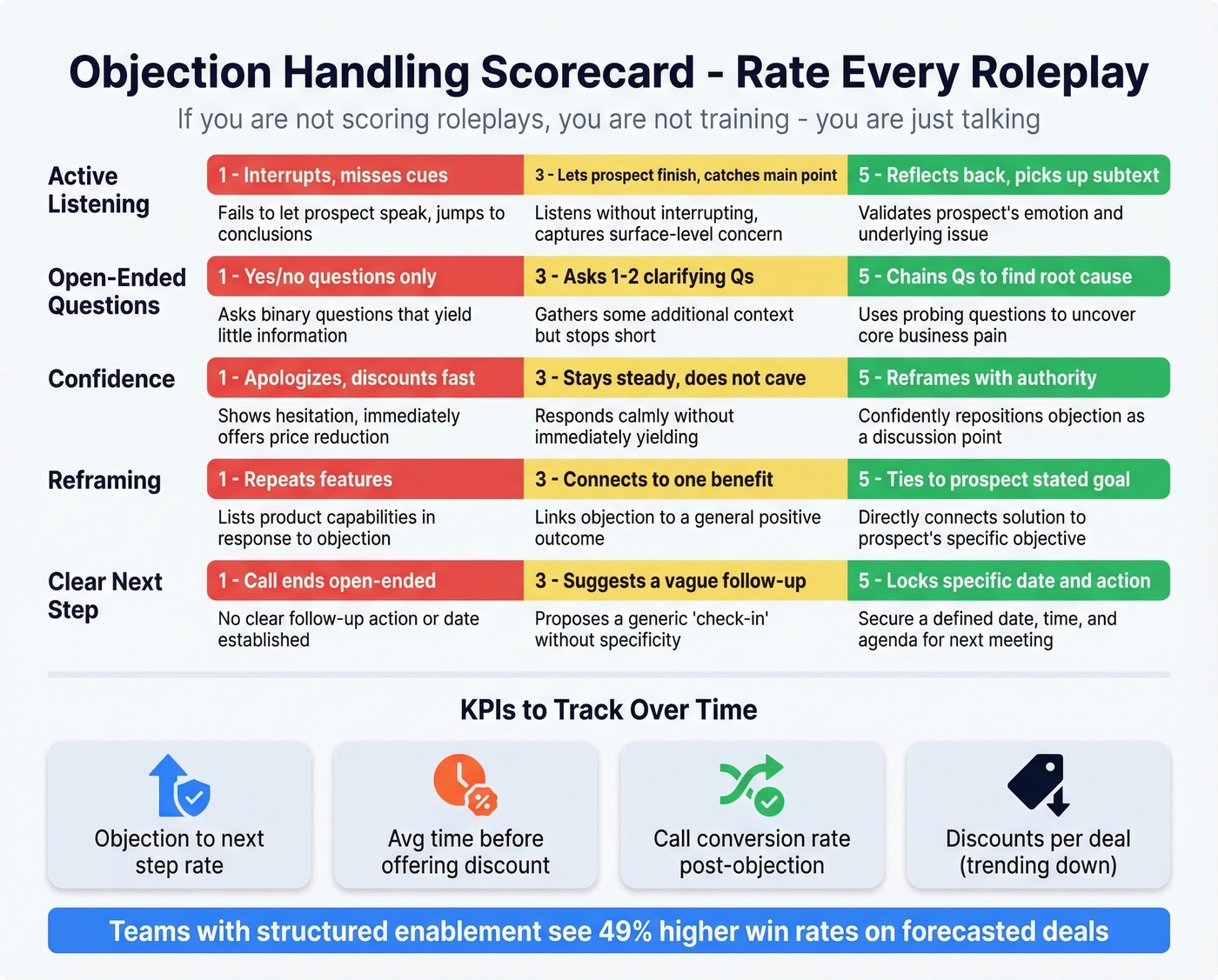
| Criteria | 1 (Needs Work) | 3 (Competent) | 5 (Expert) |
|---|---|---|---|
| Active listening | Interrupts; misses cues | Lets prospect finish; catches main point | Reflects back; picks up subtext |
| Open-ended questions | Yes/no questions only | Asks 1-2 clarifying Qs | Chains Qs to find root cause |
| Confidence | Apologizes; discounts fast | Stays steady; doesn't cave | Reframes with authority |
| Reframing | Repeats features | Connects to one benefit | Ties to prospect's stated goal |
| Clear next step | Call ends open-ended | Suggests a vague follow-up | Locks specific date/action |
Track these KPIs over time to see if training is actually moving the needle:
- Objection-to-next-step rate - are reps converting objections into meetings, demos, or commitments?
- Average time before offering a discount - if reps discount within 30 seconds of hearing "too expensive," your training isn't working.
- Call conversion rate post-objection - the percentage of calls that advance after an objection is raised.
- Discounts per deal (trending down) - this is the revenue metric that proves training ROI.
Organizations with structured enablement programs see 49% higher win rates on forecasted deals and cut onboarding time by 40-50%. We've seen reps offer 20% off before the prospect even finishes their sentence. That's not an objection-handling problem - it's a confidence problem. The rubric catches it early.
AI Roleplay: When It's Worth It
Niyati Parikh at Visa University was direct: leaders spending one to two hours per rep on roleplays "isn't scalable." When you've got 50 reps, the math doesn't work. AI roleplay tools solve this by letting reps practice daily on their own, with real-time feedback and competency-based scoring.
The numbers back this up. Organizations using AI sales coaching see 20-25% improvement in rep proficiency and 15% faster ramp time. Win rates improve by 32%.
Let's be honest, though: if your average deal size is under $10K, you probably don't need a $50K/year AI coaching platform. A shared Google Doc with your top ten objections, weekly 15-minute roleplays, and a manager who actually listens to calls will outperform any tool your reps don't use consistently.
The market splits into three categories: conversation intelligence tools like Gong, roleplay platforms like Hyperbound, Second Nature, and Yoodli, and closed-loop systems that connect insights to practice. Pricing runs $30-100/user/month for mid-market tools, $20K-80K/year for enterprise platforms. Use AI roleplay if your team has more than 10 reps and managers can't coach everyone weekly. Skip it if you've got a small team where the manager can run live roleplays consistently - human feedback still beats AI for nuance.
Prevent Objections First
Sandler's training philosophy has always emphasized prevention over handling: the best objection is the one that never gets raised. And the fastest way to prevent objections isn't a better script - it's better data.
Picture this: an SDR calls a prospect who's the wrong title at a company that doesn't match the ICP. The prospect says "not interested." The SDR logs it as an objection. The manager adds it to the training deck. But it was never an objection. It was a targeting failure.
Before you train reps to handle "not interested," make sure they're calling the right people.
The 4-Week Program
| Week | Focus | Drill | Homework | Assessment |
|---|---|---|---|---|
| 1: Foundation | Audit list; define categories; intro LAER | Categorize 20 real objections | Verify list; remove bad contacts | Quiz: ID category for 10 objections |
| 2: Drills | Rapid-fire + structured roleplay; scoring rubric | Two scored roleplays per rep | Record one real call; self-score | Manager scores two roleplays |
| 3: Messy Objections | Ambiguous scenarios; call review; "Yes, And" | Messy-objection roleplay | Practice 3 vague objections | Peer feedback on recording |
| 4: Assessment | Scored roleplays; KPI baseline; team playbook | Full scenario roleplay (scored) | Add 3 entries to playbook | Final rubric score + KPI baseline |
Week 1 is where most teams skip a critical step. Verify your prospect list before your team practices on real prospects. Remove bounced emails, outdated titles, and wrong-fit companies. Clean data makes every subsequent week of training more effective because reps build confidence on real conversations instead of wasting reps on dead leads.
Every vague "circle back later" your reps hear costs pipeline. When you start with verified decision-maker contacts - 98% email accuracy, 125M+ direct dials with 30% pickup rates - reps reach real buyers who engage with real objections, not gatekeepers brushing them off. That's training ground that actually builds skill.
Give your reps conversations worth having for $0.01 per lead.
Build Your Objection Playbook
Every team needs a living document that captures what works. Here's the template - fill it out as you go through the four-week program.
Each entry should include the objection verbatim (what the prospect actually says), what it really means (the underlying concern), two to three qualifying questions to clarify, the framework-based response that works, proof points like case studies or stats, and signals for when to escalate to a manager or SE.
Example entry - Price objection:
The prospect says "This is way more than we budgeted." That usually means value isn't clear yet, or they're comparing to a cheaper alternative that does less. Start by asking what they're benchmarking against, and whether it's the total cost or the per-seat price that's the concern. Using LAER, acknowledge the budget concern, explore what they're comparing to, then reframe around ROI or cost-of-inaction. Support with a customer case study showing payback period or a competitive comparison on total cost of ownership. Escalate if they've received a competing proposal and need executive-level negotiation.
Update this quarterly. Objections shift as your market, pricing, and competitors change.
FAQ
How long until we see results?
Expect four to six weeks of weekly practice before measurable improvement shows up. Structured programs typically produce a 19% increase in win rates. One-off workshops rarely stick - reps forget 70% within a week without reinforcement. Consistency beats intensity every time.
What's the best framework for beginners?
LAER. It's structured enough to teach in one session and flexible enough for real conversations. Master it before adding anything else - most reps only need one solid approach to handle 80% of what they hear.
Should we use AI roleplay or live roleplay?
Both serve different purposes. AI handles daily solo practice and solves the scalability problem. Live roleplay is better for team calibration and nuanced feedback. Use AI for volume, live sessions for depth.
How do we train for objections reps haven't heard before?
Practice with deliberately vague, ambiguous scenarios - prompts like "Hmm, I'm not sure this is for us" with no additional context. The skill isn't memorizing responses; it's staying calm and asking one clarifying question that reopens the conversation. Composure matters more than scripts.
What free tools help with objection training prep?
Prospeo's free tier gives you 75 verified emails per month - enough to ensure your training roleplays target realistic prospects, not fictional ones. Pair that with a shared Google Doc playbook and weekly 15-minute drills. Enterprise coaching platforms help at scale, but small teams get more from consistent practice with clean data.