

The Healthcare Sales Cycle: How Long It Takes, Who Decides, and How to Accelerate It
Your pipeline shows 40 deals. Twelve months later, three have closed. The rest are stuck in committee reviews, budget holds, and compliance loops that nobody warned you about. That's the healthcare sales cycle - 14.7 months on average with up to 22 decision-makers touching the deal before ink hits paper.
Here's what matters most:
- Cycle length varies wildly by deal type. A $10K clinic software sale can close in 60-90 days. An enterprise EHR takes two years. The benchmarks table below gives you ranges by segment.
- Pre-RFP positioning is the single highest-leverage activity. 60-70% of healthcare RFPs are effectively decided before they're issued. If you're responding cold, your win rate is 10-15%.
- The #1 mistake is engaging compliance too late. Compliance and security aren't a final hurdle - they're embedded in governance. Treat them as month-two work, not month-twelve work.
How Long Does It Actually Take?
It depends on what you're selling and to whom. Here's a practical benchmark framework drawn from real deal patterns we've tracked across dozens of healthcare accounts.
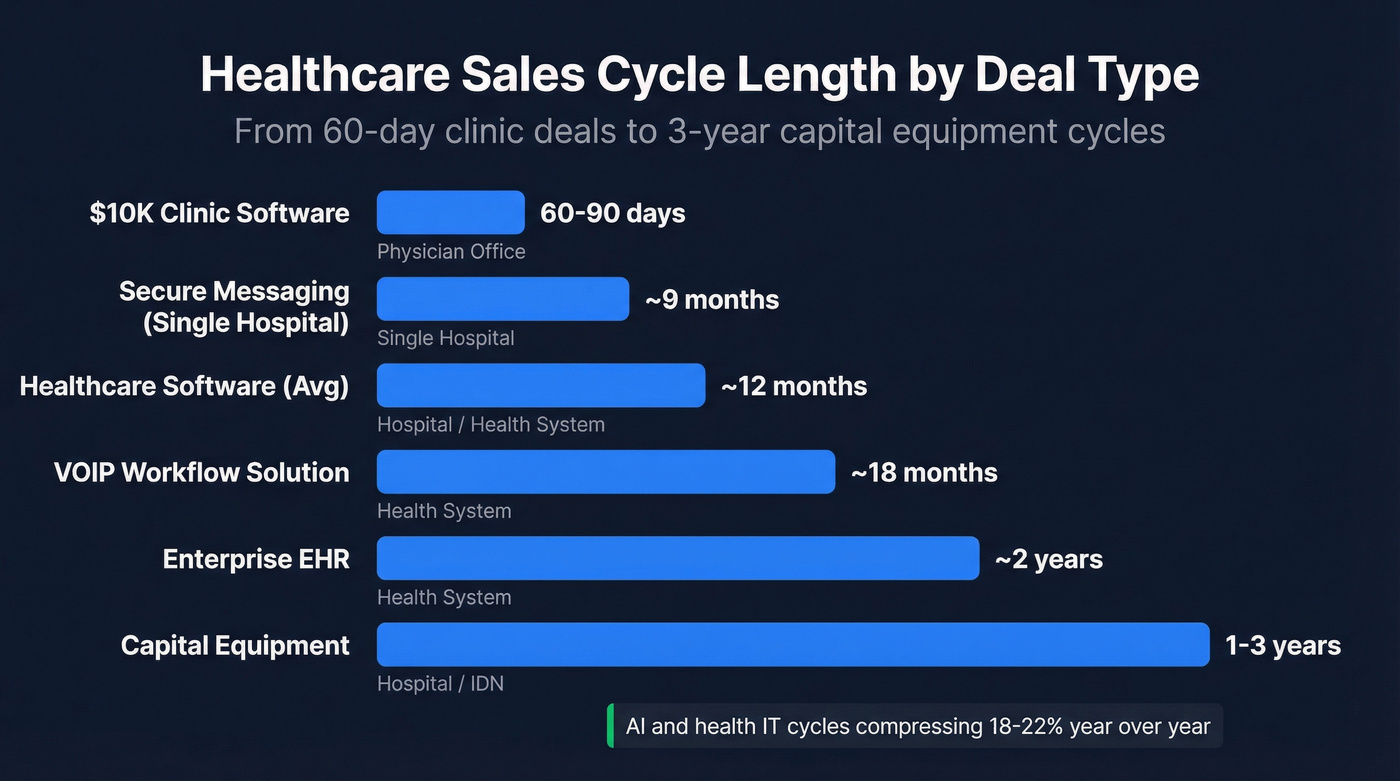
| Deal Type | Typical Buyer | Cycle Length |
|---|---|---|
| $10K clinic software | Physician office | 60-90 days |
| Secure messaging | Single hospital | ~9 months |
| Healthcare software (avg) | Hospital / health system | ~12 months, ~9 decision-makers |
| VOIP workflow solution | Health system | ~18 months |
| Enterprise EHR | Health system | ~2 years |
| Capital equipment | Hospital / IDN | 1-3 years |
These aren't outliers. A practitioner on r/sales described a 1-3 year capital cycle where the capital budget committee meets once a year, creating months of dead air between meaningful steps. And "average" is misleading: Health Launchpad documented a deal that started as a 12-month cycle, stalled when the buyer went through a merger, and restarted for another 20 months.
One encouraging trend: AI and health IT procurement cycles are compressing. Menlo Ventures surveyed 700+ healthcare executives and found health systems shortened average buying cycles from 8.0 to 6.6 months (18% faster), while outpatient providers dropped from 6.0 to 4.7 months (22% faster).
Why Selling to Healthcare Takes So Long
Healthcare buyers aren't optimizing for speed. They're avoiding regret.
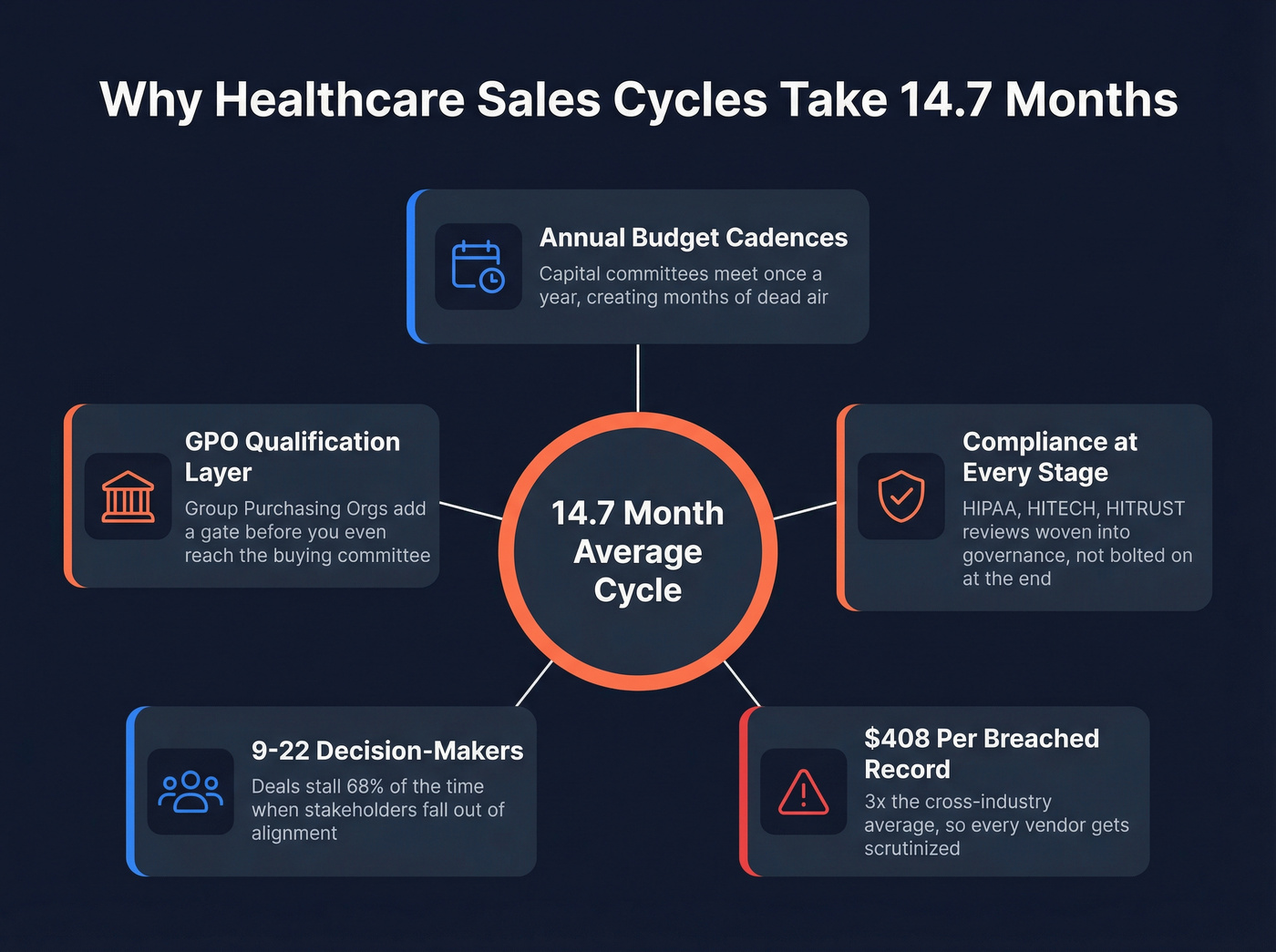
A bad purchasing decision doesn't just waste budget - it can affect patient outcomes, trigger compliance violations, or create integration nightmares with Epic, Cerner, or Meditech that take years to untangle. A single data breach costs healthcare organizations $408 per record, roughly 3x the cross-industry average. That's why every vendor gets scrutinized like they're applying for a security clearance.
Several structural forces compound the problem. Annual capital budget cadences create dead zones where nothing moves for months. Group Purchasing Organizations add a qualification layer before you even reach the buying committee. Compliance and security reviews are woven into governance at every stage, not bolted on at the end. And when stakeholders fall out of alignment mid-process, deals stall 68% of the time. With 9-22 people involved, alignment is fragile. A single stakeholder departure mid-cycle can reset evaluation criteria and send you back to square one - we've seen it happen on deals that were two weeks from close.
For context, the tech sales cycle averages 3-6 months for mid-market deals, and even fintech - which involves its own regulatory hurdles - typically closes in 6-9 months. Healthcare's 14.7-month average dwarfs both because clinical risk and patient safety add layers that simply don't exist in other verticals.

With 9-22 stakeholders on every healthcare deal, one dead contact can stall your 14.7-month cycle for weeks. Prospeo gives you 98% accurate emails and 125M+ verified mobile numbers with a 7-day refresh cycle - so you're reaching the CFO, CMIO, and VAC members with current data, not bouncing off outdated records.
Stop losing months to bad contact data in healthcare sales.
The Six Stages of Healthcare Procurement
Every healthcare deal follows roughly the same arc, even if the timeline varies by deal size.
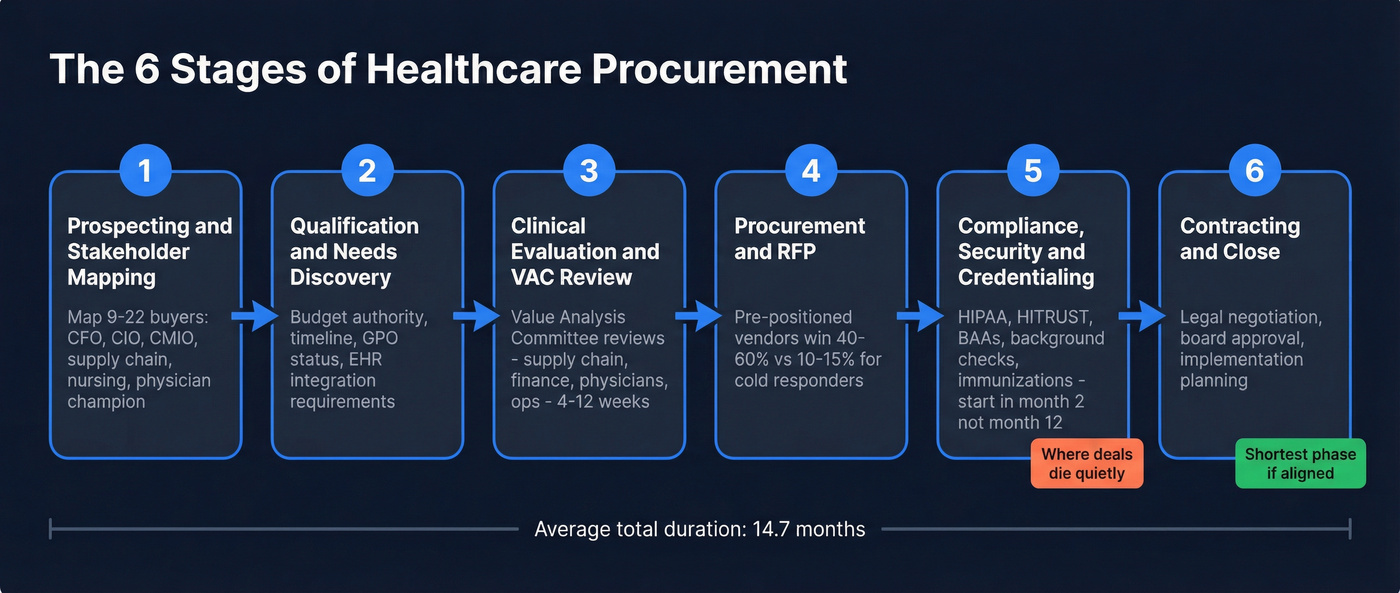
1. Prospecting & Stakeholder Mapping
Healthcare buying committees average 9-22 people, and that doesn't count informal influencers like department heads or senior nurses who shape opinions without formal authority. Map every stakeholder early: CFO, CIO, CMIO, supply chain director, nursing leadership, and the physician who'll champion your product internally.
You need verified emails and direct dials for each of them, not generic department addresses. Prospeo's 30+ search filters - including technographics, headcount growth, and buyer intent powered by Bombora - let you zero in on health systems actively evaluating solutions in your category, with 98% email accuracy and a 7-day data refresh cycle so you're not burning weeks chasing dead contacts.

2. Qualification & Needs Discovery
Determine budget authority, timeline, and buying window. Is there an existing contract expiring? Are they on a GPO that limits vendor selection? Is this capex or opex? Does their IT stack require HL7/FHIR interoperability - and if so, which EHR are you integrating with? These questions save you months of wasted effort.
Skip this stage at your own peril. We've watched reps invest six months in a deal only to discover the hospital was locked into a GPO contract for another two years.
3. Clinical Evaluation & VAC Review
The Value Analysis Committee is the central gatekeeper for most hospital procurement. The core cast typically includes supply chain, nursing leadership, a physician champion, finance, and operations/risk. Each cares about different things:
- Supply chain wants standardization and fewer SKUs
- Finance wants total cost of ownership with realistic payback
- Physicians care about clinical benefit and ease of use
- Operations evaluates workflow disruption and training burden
VAC review often takes 4-12 weeks depending on meeting cadence. Don't expect to rush it.
4. Procurement & RFP
If an RFP lands and you haven't been shaping the requirements for months, you're probably losing. The vendor who helped define the evaluation criteria wins the deal - everyone else is filling out paperwork for nothing.
5. Compliance, Security & Credentialing
Here's where deals die quietly. Vendor credentialing can require government ID, background checks, immunization records, HIPAA training certificates, proof of insurance, drug screening, and badge requests - often 1-4 weeks just for facility access. Layer on HIPAA/HITECH security assessments, HITRUST certification reviews, BAAs, and legal review, and you've added months if you waited until the end to start.
6. Contracting & Close
The clinical and financial case is made. What remains is legal negotiation, final board approval for large deals, and implementation planning. If you've done the alignment work in stages one through three, this should be the shortest phase.
Budget Cycles & RFP Timing
Timing in healthcare sales isn't a nice-to-have. It's the difference between a 9-month deal and a 24-month deal.
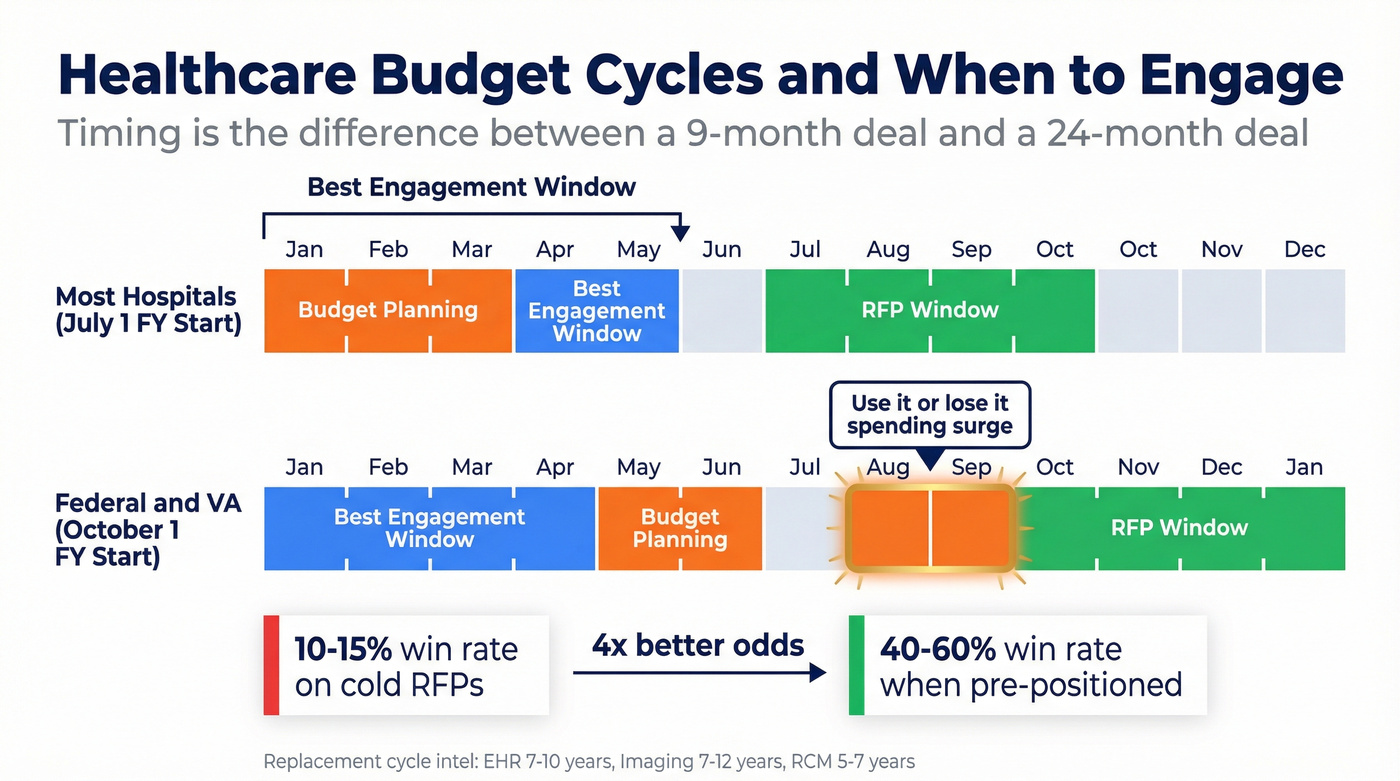
| Fiscal Year Start | Budget Planning | RFP Window | Best Engagement |
|---|---|---|---|
| July 1 (most hospitals) | Jan-Mar | Jul-Oct | Jan-May |
| October 1 (federal/VA) | Apr-Jun | Oct-Jan | Jan-Apr |
For federal and VA facilities, watch for the "use it or lose it" spending surge in August and September.
Let's be honest about the math here: cold RFP win rates run 10-15%. Pre-positioned vendors win 40-60%. That gap is enormous. If you're not engaging during the planning window, you're playing a losing game.
Replacement cycle intelligence helps you forecast opportunities before they surface. EHR lifecycles run 7-10 years, imaging and capital equipment 7-12 years, and revenue cycle management systems 5-7 years. Track install dates and you can predict when a hospital will start looking.
Three Ways to Shorten the Cycle
A critical caveat: "shorten" means removing friction, not pressuring buyers. Rushing a healthcare buyer backfires every time.
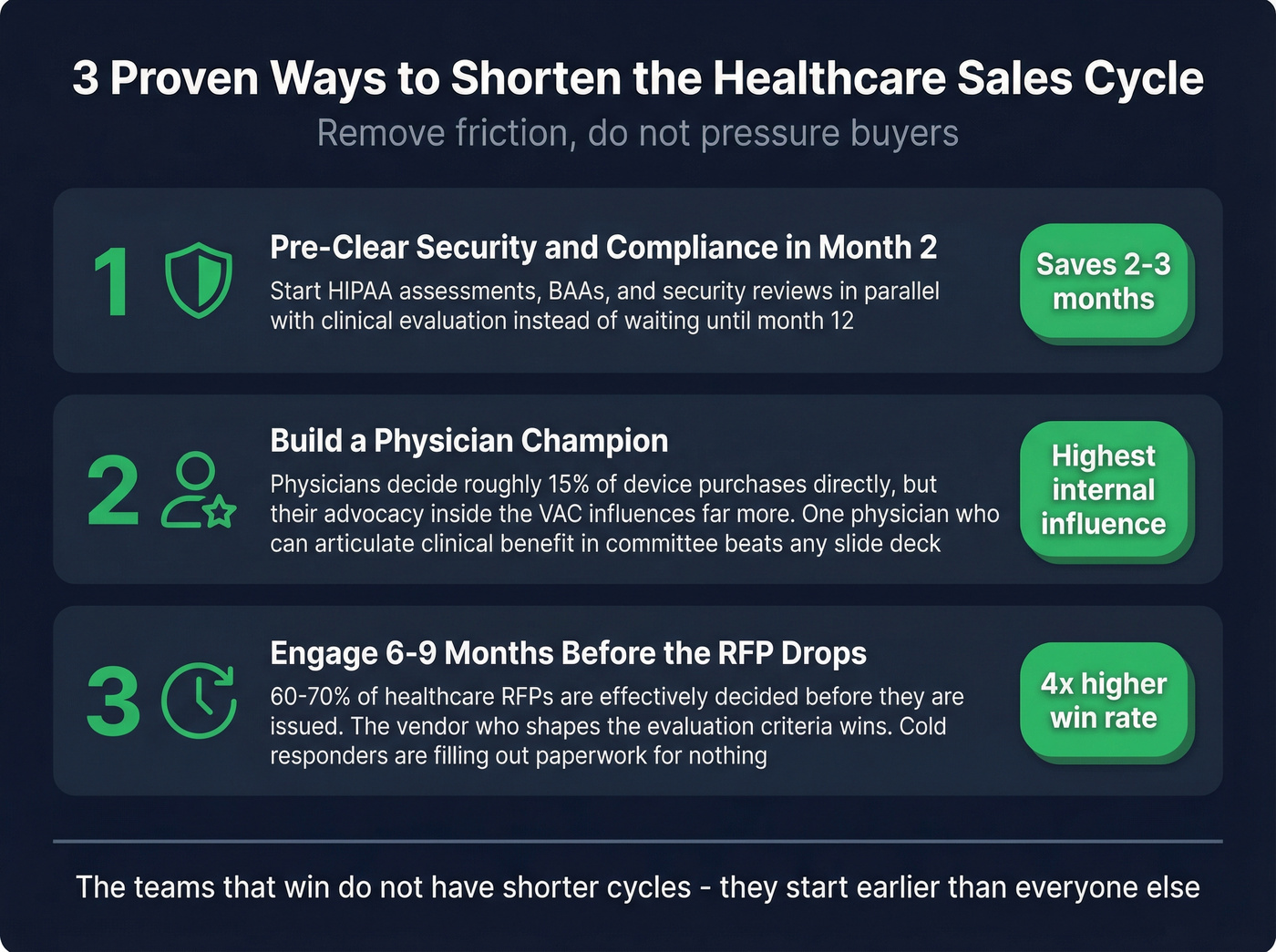
1. Pre-clear security and compliance in month two. Start HIPAA assessments, BAAs, and security reviews in parallel with clinical evaluation. In our experience, teams that front-load this work shave 2-3 months off their cycle - it's the single easiest win because most competitors don't do it.
2. Build a physician champion. Physicians directly decide on roughly 15% of device purchases, but their advocacy inside the VAC influences far more. One physician who can articulate clinical benefit in committee is worth more than any slide deck you'll ever build.
3. Engage before the RFP drops. This is the single highest-leverage activity when selling to healthcare organizations. The Menlo Ventures data showing 18-22% cycle compression for AI tools proves cycles are becoming more predictable - but only if you're already in the conversation when requirements are being defined.
Look, most sales teams treat the healthcare sales cycle as a problem to solve with better tactics. It's not. It's a structural reality you plan around. The teams that win don't have shorter cycles - they start earlier than everyone else.
FAQ
What's the average length?
The Healthcare Sales Association's benchmark study puts it at 14.7 months with 22 decision-makers on average. Software deals average roughly 12 months with about 9 decision-makers. Clinic sales can close in 60-90 days, while capital equipment routinely takes 1-3 years.
What is a Value Analysis Committee?
A cross-functional hospital committee - supply chain, nursing, finance, physicians, and operations - that evaluates new purchases on standardization, total cost of ownership, clinical benefit, and workflow impact. They're the central gatekeeper for most hospital procurement and typically meet on a set cadence, which is why reviews stretch 4-12 weeks.
How do you accelerate the process?
Three moves have the biggest impact: engage 6-9 months before the buyer's fiscal year starts so you're shaping the RFP instead of reacting to it, front-load compliance and security reviews in month two instead of month twelve, and build a physician champion who can advocate for your solution inside the Value Analysis Committee.
How does healthcare compare to other industries?
Healthcare is among the longest B2B cycles. Manufacturing typically runs 3-9 months, education averages 6-12 months due to academic-year budget constraints, and fintech falls in the 6-9 month range. Healthcare's combination of clinical validation, multi-stakeholder governance, and strict regulatory requirements pushes it well past all of these.
Pre-RFP positioning wins 60-70% of healthcare deals - but only if you reach the right stakeholders before the process starts. Prospeo's Bombora-powered intent data tracks 15,000 topics so you can identify health systems actively evaluating solutions in your category, then pull verified contacts for the entire buying committee in minutes.
Reach healthcare buyers before the RFP drops - not after.