

HeyBounce vs Apollo.io: Scalpel vs Swiss Army Knife
HeyBounce vs Apollo.io isn't a fair fight - you're comparing a dedicated email verifier to a full sales platform. That's like asking whether a chef's knife is better than a kitchen. But if you're here, you need to pick one or figure out if you need both.
Let's cut through it fast.
30-Second Verdict
Pick HeyBounce if you already have a prospecting tool and just need a cheap, dedicated verifier to clean lists before sending.
Pick Apollo if you need a full prospecting database plus outreach sequences and can tolerate 15-25% bounce rates - or plan to re-verify externally.
What Each Tool Actually Does
HeyBounce is a standalone email verification service founded in 2024 out of Turkey. You upload a CSV or XLSX, it runs SMTP checks, flags disposable addresses, filters spam traps, and returns valid/invalid/unknown statuses. The REST API clocks 71ms response times and returns granular flags - role-based addresses, academic domains, private relays, typo suggestions - not just a binary valid/invalid. It's GDPR and CCPA ready from day one, lean, focused, and brand new, which means it has a very limited public review footprint so far.
Apollo.io is a full-stack sales platform with 275M+ contacts and built-in outreach sequences. Email verification is one feature among many, and not the one Apollo's known for. Apollo touts a 7-step verification process with 91% claimed accuracy, but real-world results tell a different story.
Feature-by-Feature Comparison
| Feature | HeyBounce | Apollo.io |
|---|---|---|
| Primary function | Email verification | Sales platform |
| Verification method | SMTP + MX + syntax | 7-step + contributor network |
| Catch-all handling | Detection + flagging | Claims to differentiate valid vs invalid on catch-all domains via contributor network |
| API speed | ~71ms | Not published |
| Bulk upload | CSV/XLSX | CSV import |
| Prospecting database | No | 275M+ contacts |
| Outreach sequences | No | Built-in |
| Intent data | No | No |
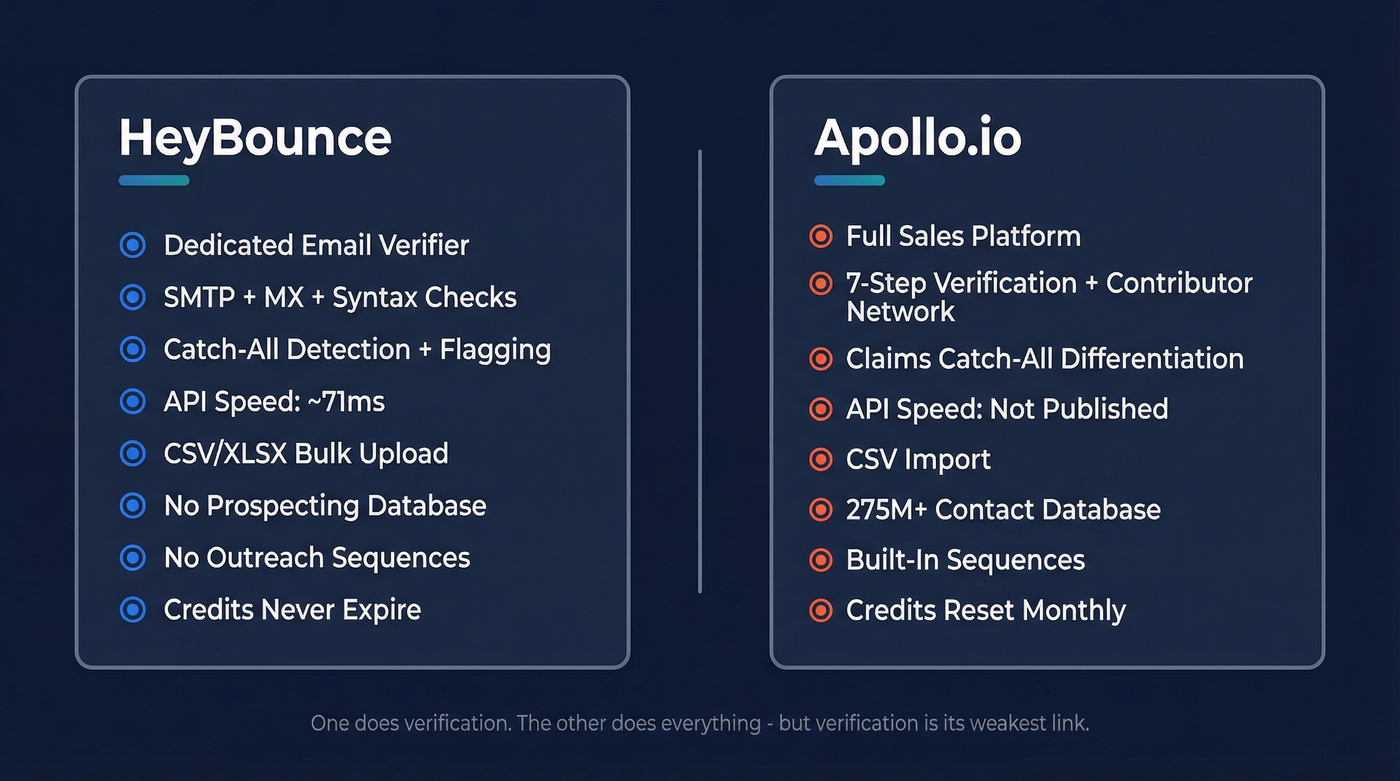
HeyBounce does one thing. Apollo does fifteen things, one of which overlaps with HeyBounce. The real question is whether that one overlapping feature is good enough.

Apollo's 15-25% bounce rates kill domains. HeyBounce cleans the mess but adds a manual step. Prospeo skips both problems - 300M+ profiles with 98% email accuracy baked in through a proprietary 5-step verification process, refreshed every 7 days.
Get verified emails at the source - no second tool required.
Verification Accuracy: Where It Gets Ugly
Here's where it gets uncomfortable for Apollo.
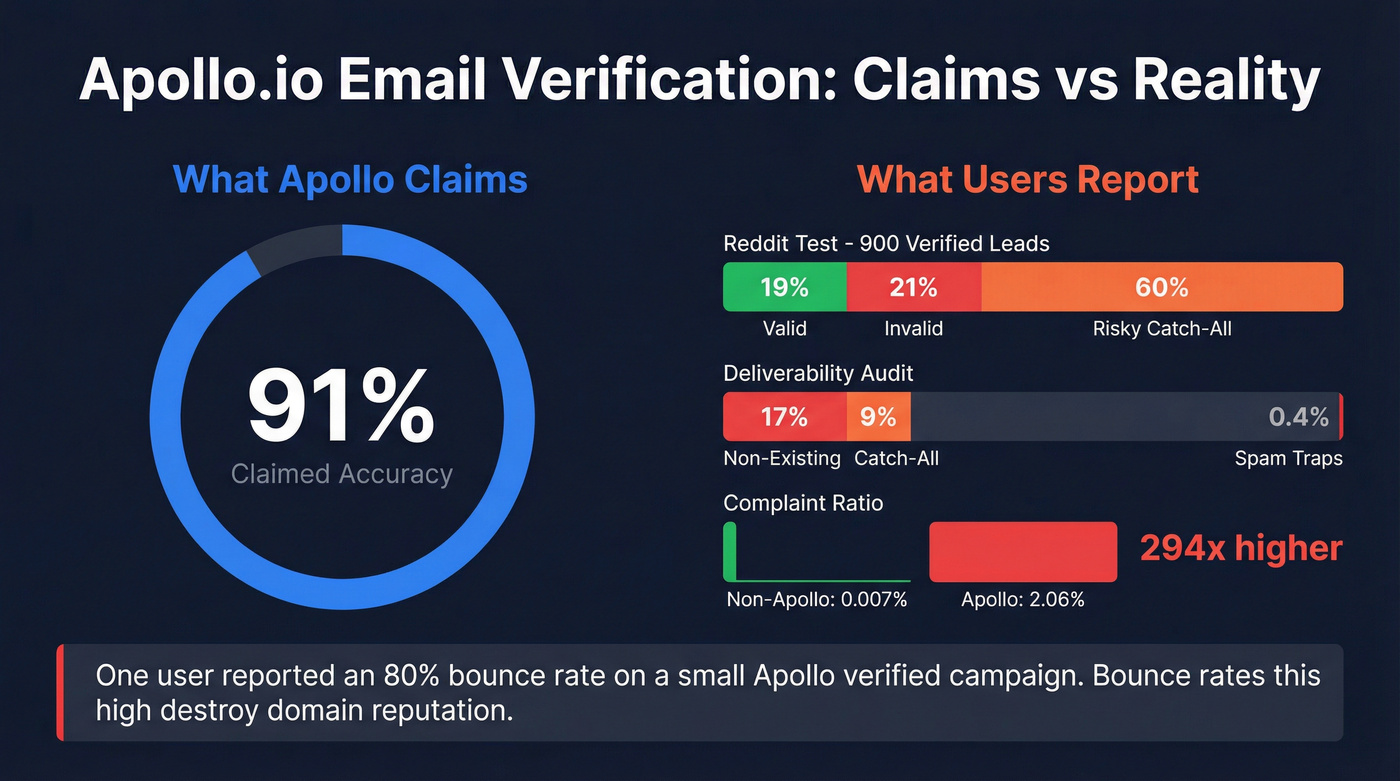
Apollo claims 91% email accuracy. In practice, overall data accuracy sits closer to 65%, with bounce rates on Apollo-sourced contacts running 15-25%. One Reddit user exported roughly 900 Apollo leads marked "Verified," ran them through MillionVerifier, and found only about 19% came back valid - 21% were invalid and 60% were risky catch-alls. Another user reported an 80% bounce rate on a small Apollo "verified" campaign. That's not a rounding error. That's a domain reputation killer.

A deliverability-focused breakdown on r/coldemail pegged Apollo data at 17% non-existing emails, 9% catch-all addresses, and 0.4% spam traps on average. Apollo-sourced leads also generate a 2.06% complaint ratio versus 0.007% from non-Apollo sources - a 294x difference that tanks sender reputation fast. Apollo's massive user base means the same contacts get emailed by dozens of teams, driving up complaints and lowering response rates. Apollo does refund credits for bounced "verified" emails, but that doesn't undo the domain reputation damage from sending to bad addresses in the first place.
HeyBounce doesn't have independent benchmarks yet - it's too new. But dedicated verifiers as a category consistently outperform built-in platform verification. A LeadMagic benchmark of 10,000 emails put ZeroBounce at 97.8% and NeverBounce at 96.9%. A Hunter benchmark across 3,000 emails used stricter methodology with more enterprise domains, landing top tools around 65-70% - but even there, dedicated verifiers dramatically outperformed Apollo's real-world numbers.
Here's the thing: if your average deal size is under $25k, you probably don't need Apollo's full platform. A focused verifier plus a good data source will outperform the all-in-one approach on deliverability every single time.
Pricing Breakdown
| Volume | HeyBounce | Apollo.io |
|---|---|---|
| Entry | 100 free credits | Free tier (limited) |
| 1,000 emails | $8 | $49+/mo (bundled) |
| 5,000 emails | $30 | $49+/mo (bundled) |
| 10,000 emails | $55 | $79+/mo (bundled) |
| Credit expiry | Never | Monthly reset |
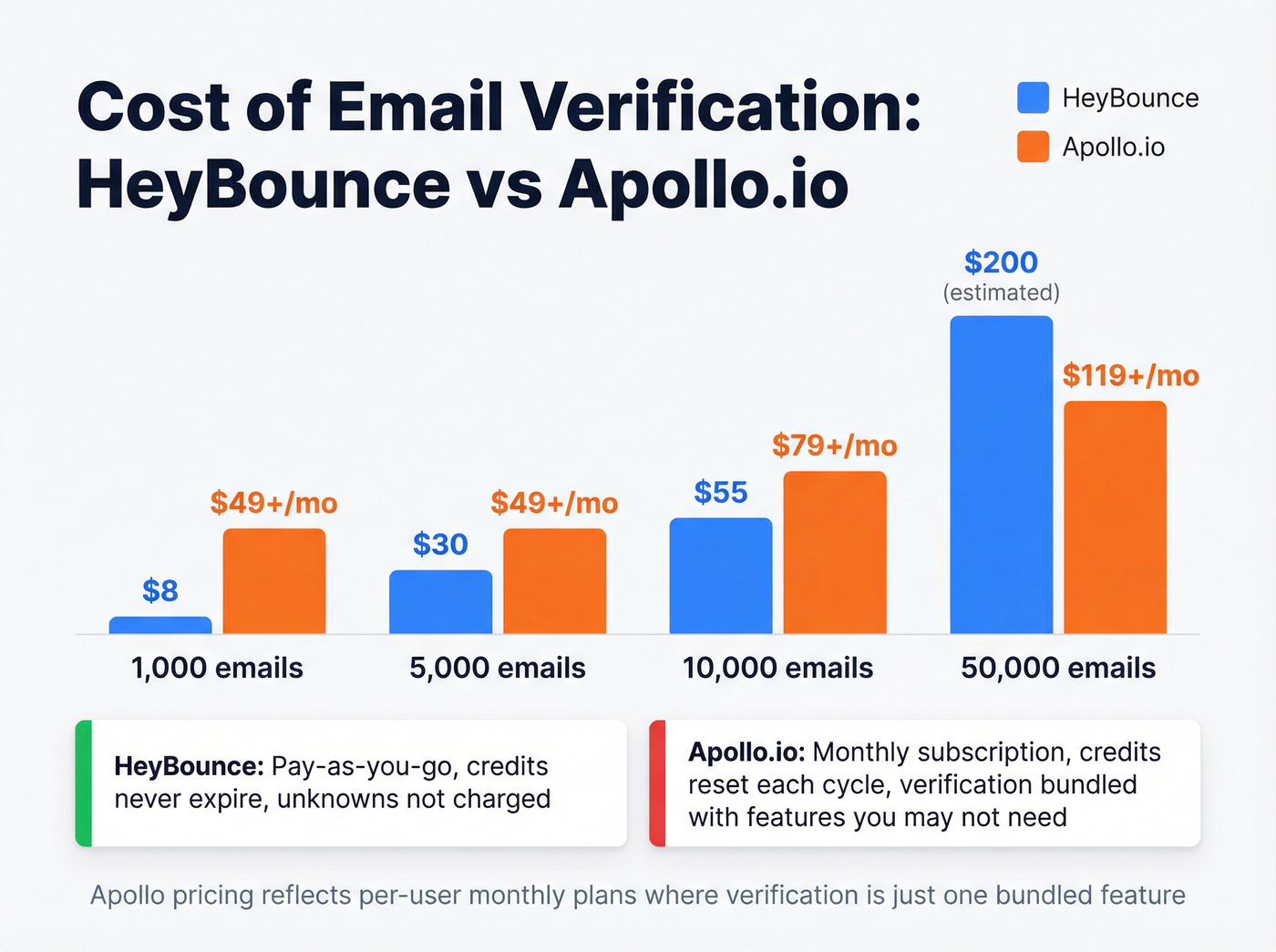
HeyBounce works out to $8 per 1,000 verifications on pay-as-you-go pricing. Credits never expire, and unknown results don't get charged - a nice touch.
Apollo's verification is bundled into paid plans starting around $49/user/month for Basic, $79/user/month for Professional, and $119/user/month for Organization with a minimum of 3 seats. Credits don't roll over and expire each billing cycle. If you only need verification, Apollo is wildly overpriced. You're paying for a database and sequences just to access mediocre email checking.
When to Use Which
Use HeyBounce if you've already got a prospecting source - whether that's Apollo, a purchased list, or scraped data - and you just need clean emails before loading sequences. At $8/1K, it's cheap insurance.
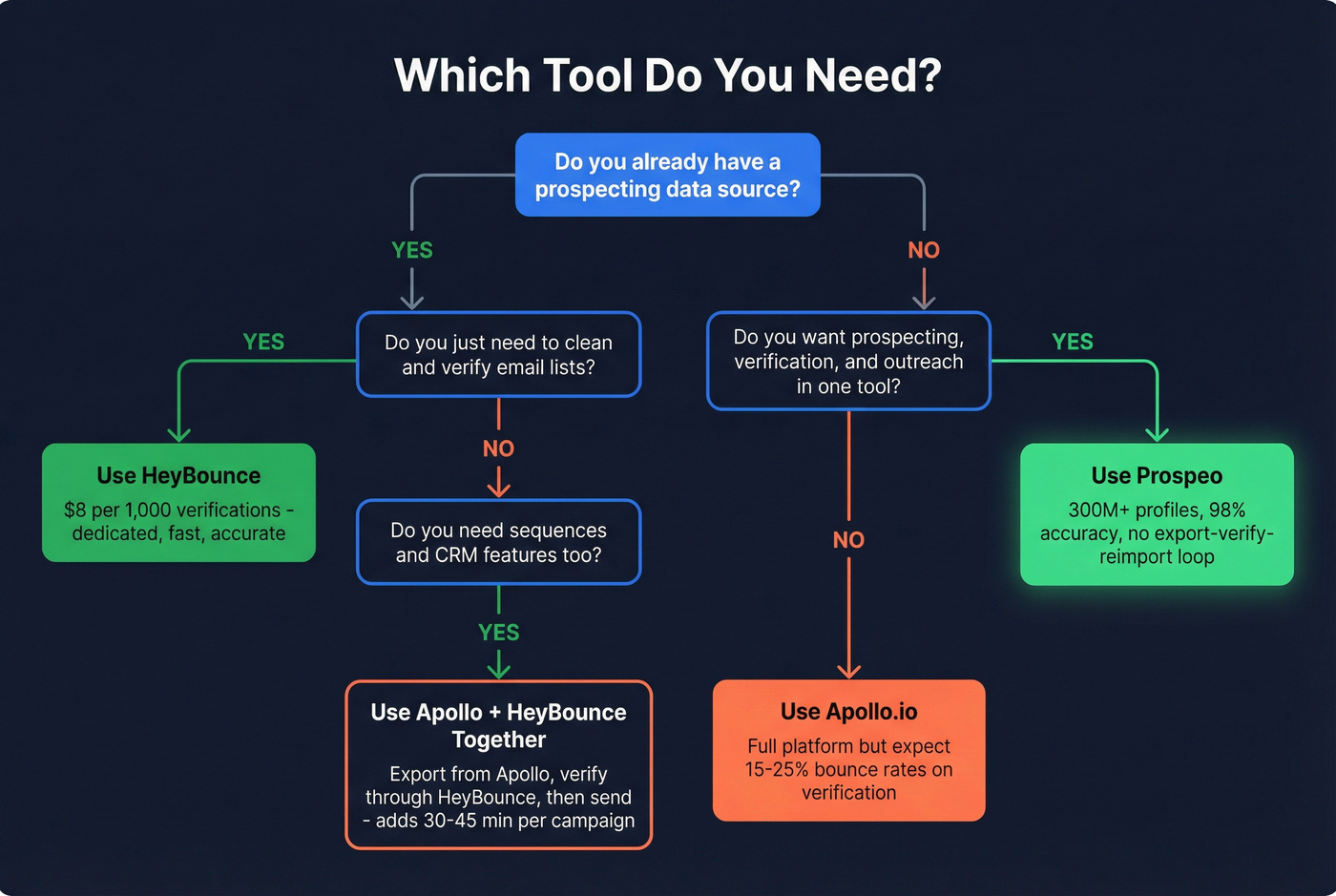
Use Apollo for teams that need the database, the sequences, and the workflow in one place, and can accept that verification is a weak link. Many teams run Apollo as their prospecting engine and live with the tradeoff.
Use both together - and plenty of teams do. Export from Apollo, verify through HeyBounce, then load the clean list into your sequencer. It works, but it adds friction and a manual step that slows things down. We've seen teams burn 30-45 minutes per campaign just on the export-verify-reimport loop, and that adds up fast when you're running 10+ campaigns a week.
Skip the Two-Tool Stack
There's a cleaner path. Prospeo combines 300M+ profiles with 98% email accuracy through a proprietary 5-step verification process that includes catch-all handling and spam-trap removal. Data refreshes every 7 days versus the 6-week industry average. You get 30+ search filters, intent data across 15,000 topics, and native integrations with Salesforce, HubSpot, Instantly, and Lemlist. Sign up, search, send - no sales calls or annual commitments.
In our testing, teams using a single platform with built-in verification consistently outperform the export-verify-reimport workflow on both speed and deliverability. The free tier includes 75 emails and 100 Chrome extension credits per month - enough to validate the difference yourself.
The export-verify-reimport loop burns 30+ minutes per campaign. Prospeo combines prospecting, verification, and intent data in one workflow - 30+ filters, 15,000 intent topics, and native integrations with your sequencer. All at $0.01/email.
Ditch the two-tool stack and start sending in minutes.
FAQ
Is HeyBounce more accurate than Apollo's built-in verification?
Almost certainly. Dedicated verifiers score 95-98% accuracy in third-party tests (ZeroBounce hit 97.8%), while Apollo's real-world accuracy runs closer to 65% with 15-25% bounce rates. Purpose-built verifiers consistently outperform bundled platform features.
Can I use HeyBounce and Apollo together?
Yes - it's a common workflow. Export Apollo contacts, run them through HeyBounce before loading into sequences. This adds $8 per 1,000 contacts and an extra step, but it protects your sender reputation from Apollo's unreliable verification.
What if I want prospecting and verification in one tool?
Prospeo handles both - 300M+ profiles with 98% email accuracy, 5-step verification including catch-all handling, and a free tier with 75 credits to test. No second tool, no export-verify-reimport friction, and data refreshes every 7 days.