

HitHorizons vs Pubrio: Which B2B Data Tool Wins in 2026?
Your RevOps lead just told you 40% of the company data in your CRM is stale. You look into HitHorizons and Pubrio - and immediately hit a wall: these tools don't solve the same problem. One's a European firmographic database. The other's a global sales intelligence platform with a strong APAC focus. Comparing them is like comparing a census bureau to a sales floor.
We've spent time digging into both platforms so you don't have to piece it together from scattered review sites. Let's break it down.
30-Second Verdict
HitHorizons is European company data for market research, KYB/compliance checks, or CRM enrichment. It's not a contact database for outbound.
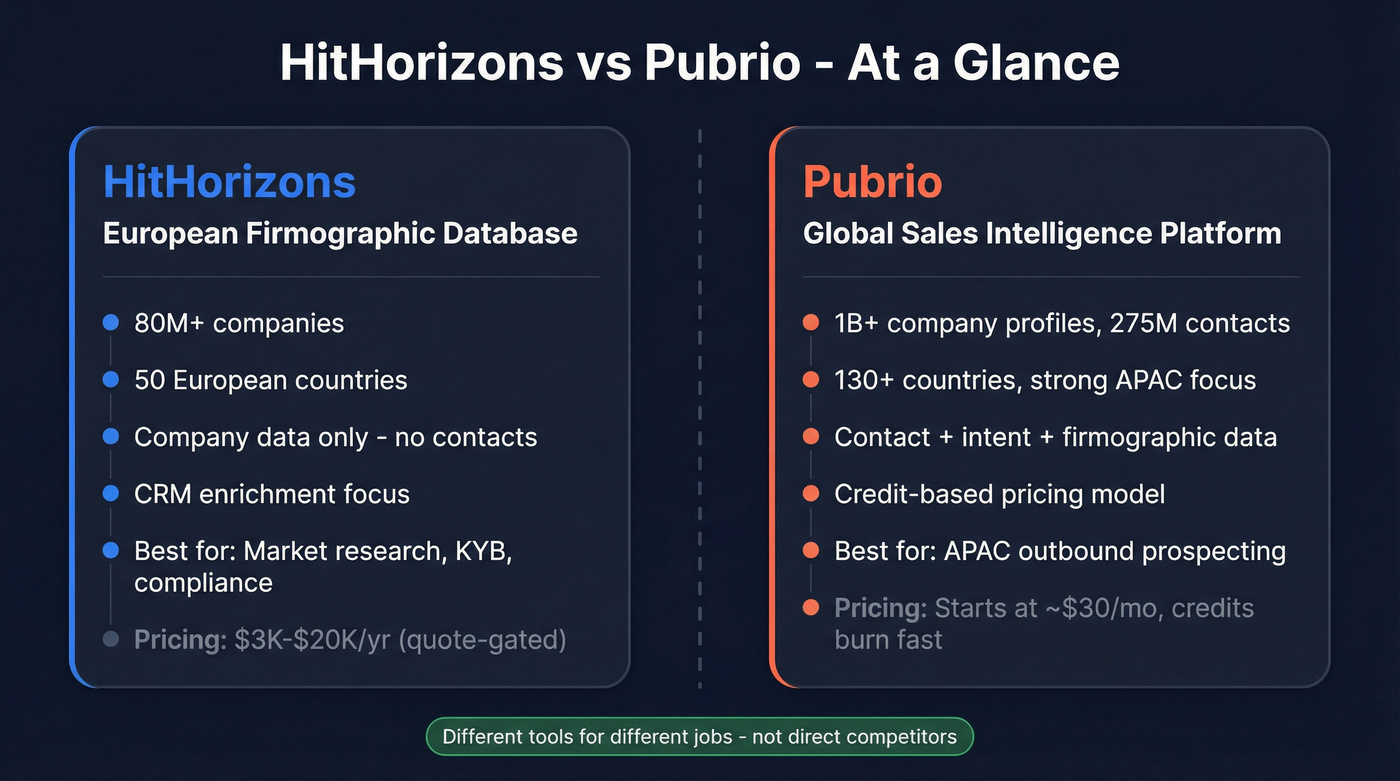
Pubrio is global contact data with intent signals, built with a strong APAC focus. The credit model burns through budget faster than you'd expect.
What Is HitHorizons?
HitHorizons is a firmographic database covering 80M+ companies across 50 European countries, with 30+ API data points per record. It's built for market analysis and company enrichment workflows, not outbound prospecting.

It integrates with Microsoft, Salesforce, and SAP for CRM enrichment. A verified buyer review on Datarade calls the data "valid and regularly updated," noting it helps avoid contacting companies that disappeared years ago. That's genuinely useful for compliance and market sizing - just don't expect it to help your SDRs book meetings.
Pricing isn't public. Expect $3K-$20K/year depending on API access and licensing scope.
What Is Pubrio?
Pubrio positions itself as a "glocalized" sales intelligence platform that continuously connects and normalizes business, people, and intent signals from 50+ localized sources into a single global business graph. The company claims 80%+ global B2B data coverage.
Scale claims include 1B+ company profiles, 275M contacts, 156M emails, and 120M direct dials. Pubrio promotes 50+ attributes per company. The real differentiator is the APAC angle - markets like Korea and Japan where ZoomInfo and Apollo have notable blind spots.

The platform includes intent signals, automated sequences, a Chrome extension, and a REST API with access determined by your subscription plan. On G2, Pubrio holds a 5.0/5 rating based on just 2 reviews - impressive but statistically meaningless. Users on Revuary note the search interface feels clunky compared to Apollo, so expect a learning curve.
Pick Pubrio if you're prospecting globally with a heavy APAC focus. Skip it if you want predictable per-seat pricing - credit systems are notoriously hard to forecast - or if your priority is US/EMEA depth where established providers already dominate.

Pubrio charges ~$0.45 per unverified contact. Prospeo delivers verified emails at $0.01 each with 98% accuracy. No credit guesswork, no quote-gated pricing - 75 free emails/month to start.
Stop paying per search attempt. Pay per verified result.
Feature-by-Feature Comparison
| Category | HitHorizons | Pubrio | Winner |
|---|---|---|---|
| Database size | 80M+ companies | 1B+ company profiles, 275M contacts | Pubrio |
| Geography | 50 European countries | 130+ countries, APAC focus | Pubrio (global), HitHorizons (EU depth) |
| Data types | Company firmographics | Contact + intent + firmographic | Pubrio |
| Emails | Not a contact database | 156M emails | Prospeo (143M+ verified, 98% accuracy) |
| Email accuracy | N/A | 90% claimed | Prospeo (98% verified) |
| Mobile numbers | Not a contact database | 120M direct dials | Prospeo (125M+ verified) |
| API | 30+ data points | REST (people search + enrichment) | Tie |
| Integrations | Microsoft, Salesforce, SAP | API + sequences | HitHorizons (CRM depth) |
| Pricing clarity | Quote-gated | Credit-based, listed | Pubrio |
Here's the thing - this table makes them look like competitors, but they're not. HitHorizons is company-level firmographics. Pubrio is built for contact discovery plus intent and workflow features. The overlap is small. There isn't much Reddit discussion about either tool; most user feedback lives on marketplace review sites like Datarade and G2, which tells you how niche both platforms remain.
Pricing Breakdown
| HitHorizons | Pubrio | |
|---|---|---|
| Free tier | None | 150 credits/month, $0.07 per top-up credit |
| Entry paid | ~$3K-$20K/yr (quote) | Growth ₹2,520/mo |
| Mid-tier | Quote-based | Business ₹9,000/mo |
| Enterprise | Custom | Organization tier, ~$0.005/top-up credit |
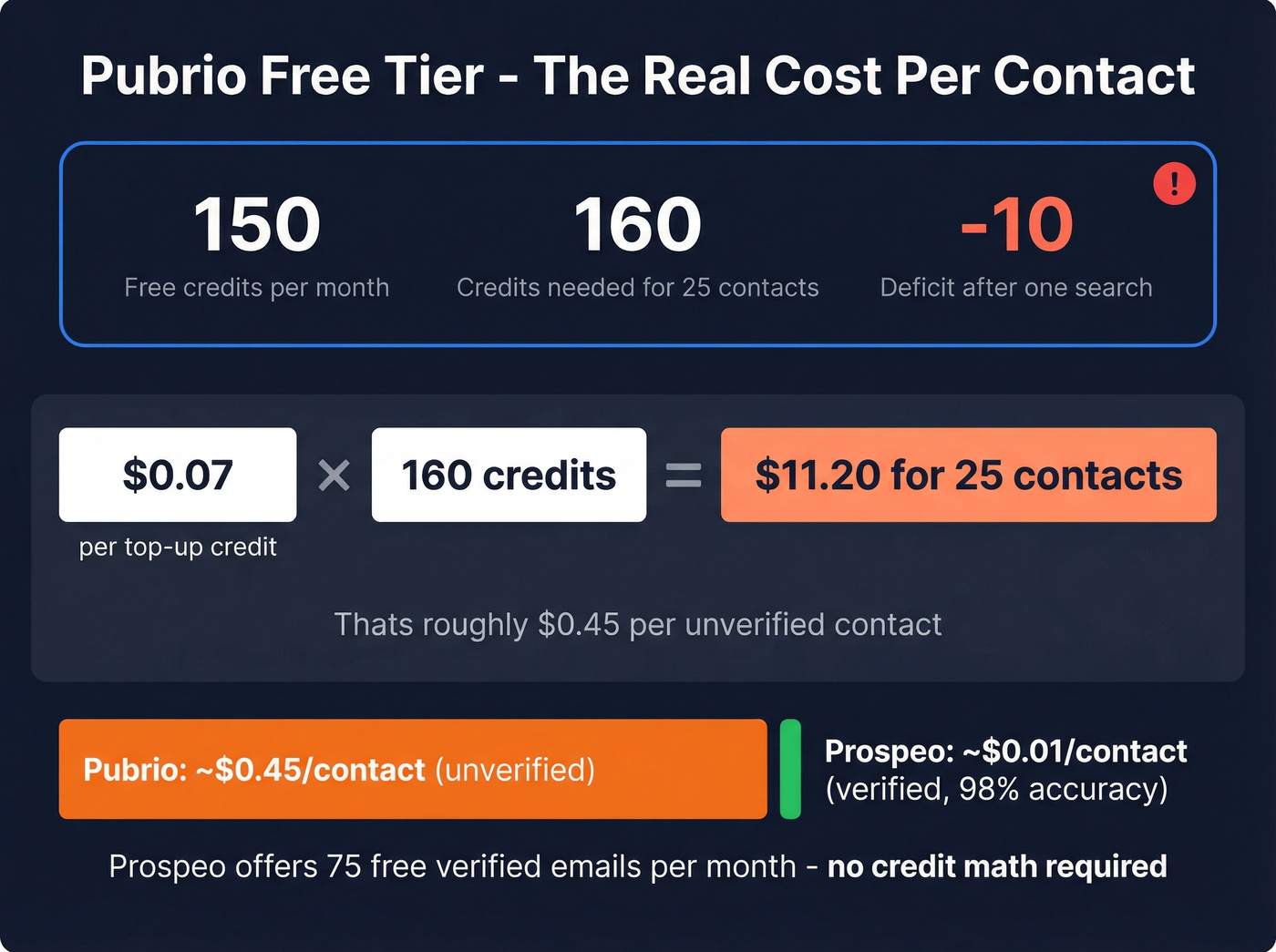
Pubrio's credit depletion is faster than you'd expect. Users report needing roughly 160 credits to pull just 25 contacts. On the free tier at $0.07 per top-up credit, that's about $0.45 per contact - before you've verified anything. The free plan's 150 monthly credits won't cover a single 25-contact pull. It's a taste test, not a working plan.
Look, if your average deal size sits below $15K, neither of these tools justifies the friction. HitHorizons gates pricing behind a sales email. Pubrio's credit math punishes small teams. You're better off with a self-serve platform that charges per verified result, not per search attempt - something like Prospeo's pricing model at roughly $0.01 per email with 75 free verified emails per month, no contracts, no sales calls.
When to Choose Which
Choose HitHorizons
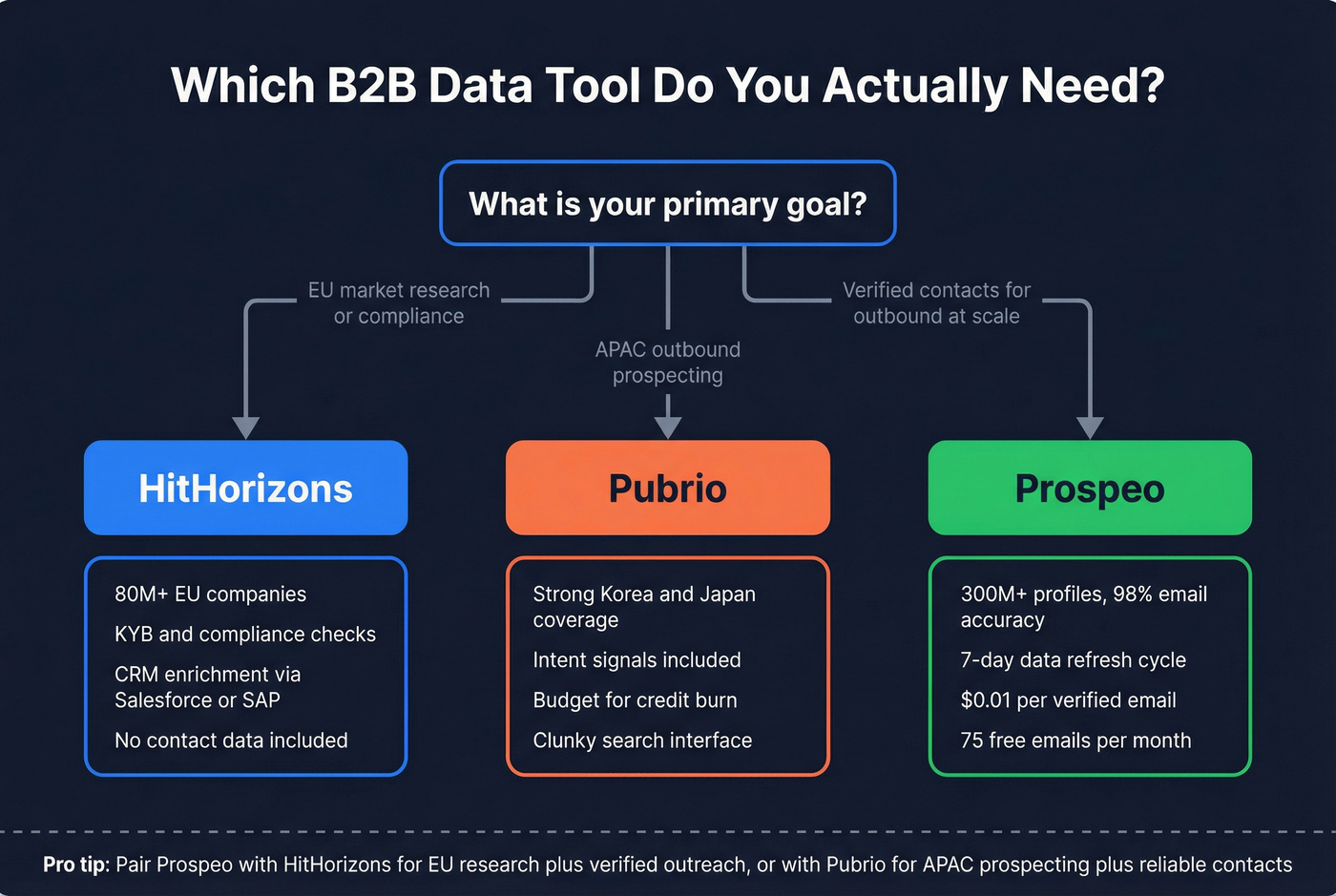
You need European company data at scale - market sizing, expansion analysis, KYB/compliance checks. It's a solid census-style database. Your SDRs won't find contacts here, but your market research team will love it.
Choose Pubrio
You're running outbound into APAC markets where mainstream providers fall short. Pubrio's glocalized sourcing across 50+ localized data sources is designed to fill gaps that bigger databases miss entirely. Budget for credit burn, though. We've seen teams blow through a month's credits in a single prospecting session when they're not careful about search scope.
When Neither Works
For teams that need verified contact data without the guesswork, a verification-first approach matters more than raw database size. One of our customers, Meritt, saw their bounce rate drop from 35% to under 4% after switching - their pipeline tripled from $100K to $300K per week. That's the kind of difference accurate data makes versus just having a lot of data.
What Both Tools Miss
Neither tool solves verified contact accuracy the way a verification-first platform does. HitHorizons isn't a contact database at all. Pubrio claims 90% accuracy, but credit depletion undermines the value before accuracy even matters.
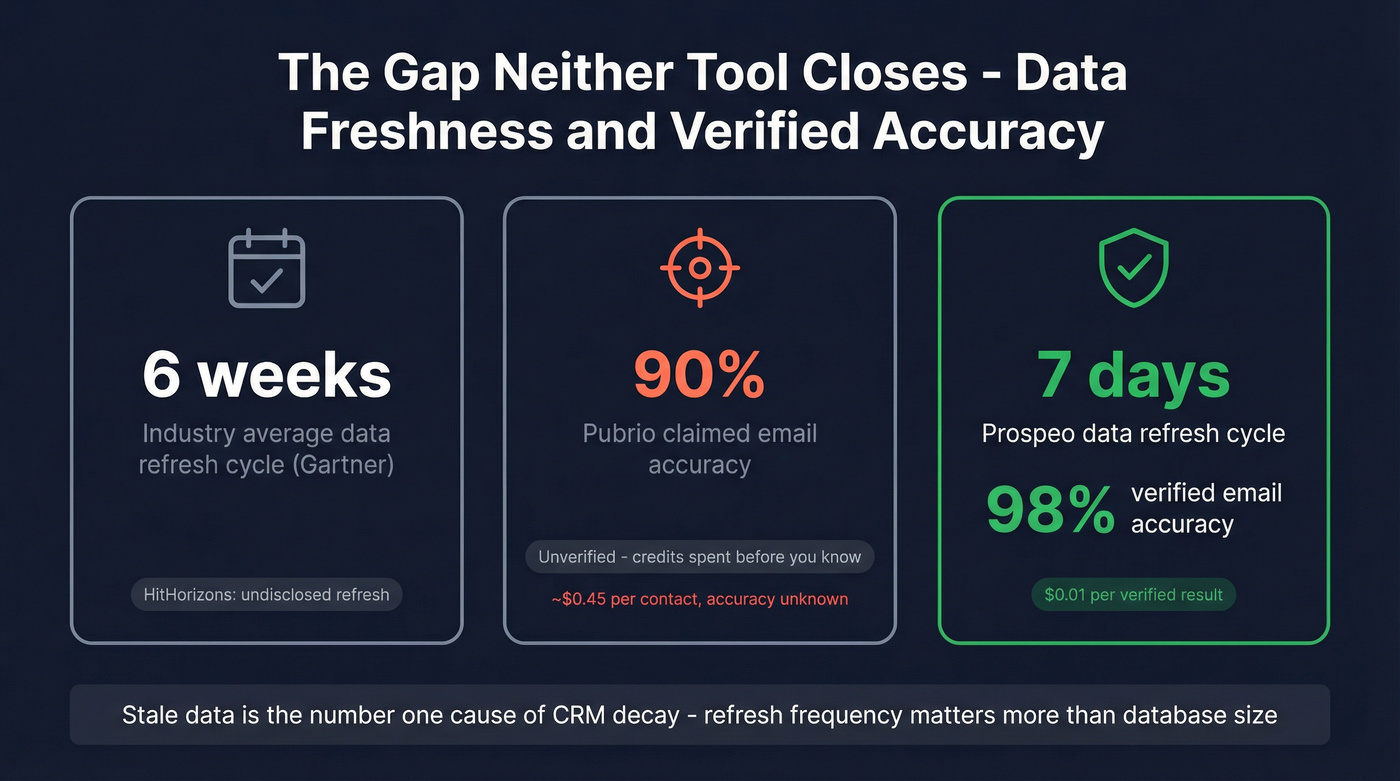
A 7-day data refresh cycle versus the 6-week industry average makes a real difference when you're running outbound at scale. Pair a tool like Prospeo with HitHorizons for EU research plus verified outreach, or with Pubrio for APAC prospecting plus reliable contact data. That combination covers more ground than either platform alone.
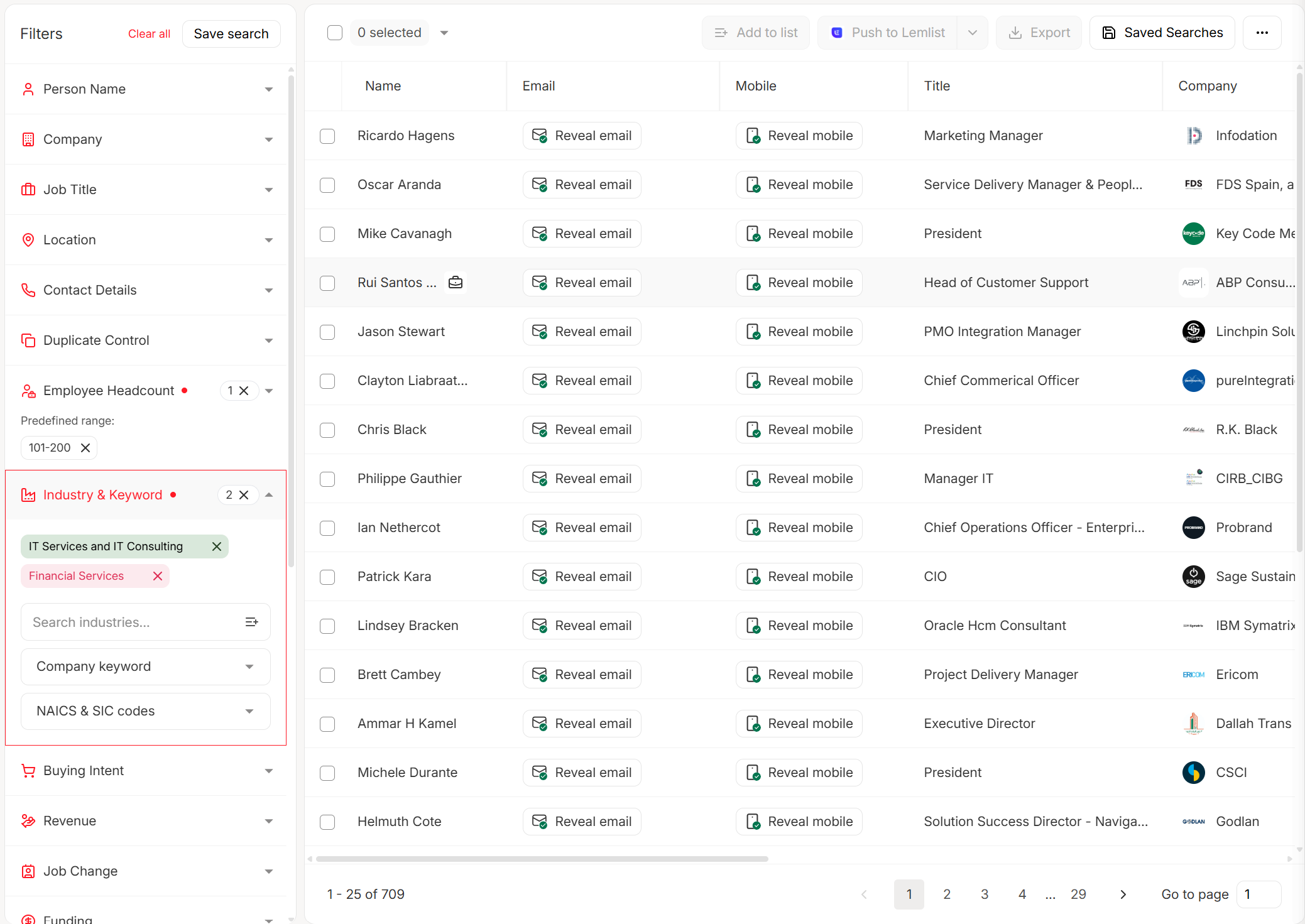
Neither HitHorizons nor Pubrio refreshes data weekly. Prospeo's 7-day refresh cycle keeps 300M+ profiles current - so your EMEA and APAC outreach hits real inboxes, not dead ends.
Pair fresh, verified contacts with any regional database you already use.
FAQ
Does HitHorizons provide contact emails or phone numbers?
No. HitHorizons is a company firmographic database - it covers company name, address, industry, revenue, headcount, and similar fields across 50 European countries. For verified emails and direct dials, you'll need a dedicated contact data provider.
Is Pubrio's free plan enough for real prospecting?
Barely. You get 150 credits per month, but pulling 25 contacts costs roughly 160 credits - so one search exhausts your allowance. Treat it as a data quality test, not a production workflow.
Can I use HitHorizons outside Europe?
No. HitHorizons covers 50 European countries exclusively. For global or APAC coverage, you need a different provider - Pubrio for APAC-heavy prospecting, or a broader B2B database for worldwide reach with verified contact data.
How do HitHorizons and Pubrio compare on data freshness?
HitHorizons describes its data as "regularly updated" but doesn't publish a refresh cadence. Pubrio doesn't disclose refresh cycles either. For context, the industry average sits around 6 weeks. Stale data is the top cause of CRM decay, so refresh frequency matters more than database size - something worth asking both vendors about before you sign anything.