

How to Build a Virtual Sales Team: The Operator's Playbook
We hired three remote SDRs for a client last year. Two quit within 60 days - not because they were bad reps, but because there was no onboarding plan, no verified prospect data, and a commission-only comp structure that attracted hustlers instead of closers. The third rep stayed, ramped in six weeks with a real playbook, and now carries 40% of the company's pipeline. The difference wasn't talent. It was infrastructure.
If you're figuring out how to build a virtual sales team, that distinction matters more than anything else you'll read today. 36% of employees now prefer fully remote for their next role, and 46% would leave rather than return to an office full-time. The talent pool is there. The question is whether you can build the system to support them.
What You Need (Quick Version)
- Define your sales motion - inbound, outbound, or hybrid. Everything else flows from this.
- Budget around $94k/year per in-house rep (loaded), or $3k-$5.5k/mo if you outsource.
- Start with one SDR. Don't hire three reps and hope. Prove the motion with one.
- Build a 5-tool stack - CRM, sequencer, scheduler, call recorder, and a data/verification layer.
- Give them 90 days to ramp. Structured 30-60-90 onboarding, not "here's a laptop, go sell."
What It Actually Costs
The cost gap between models is wider than most founders expect.
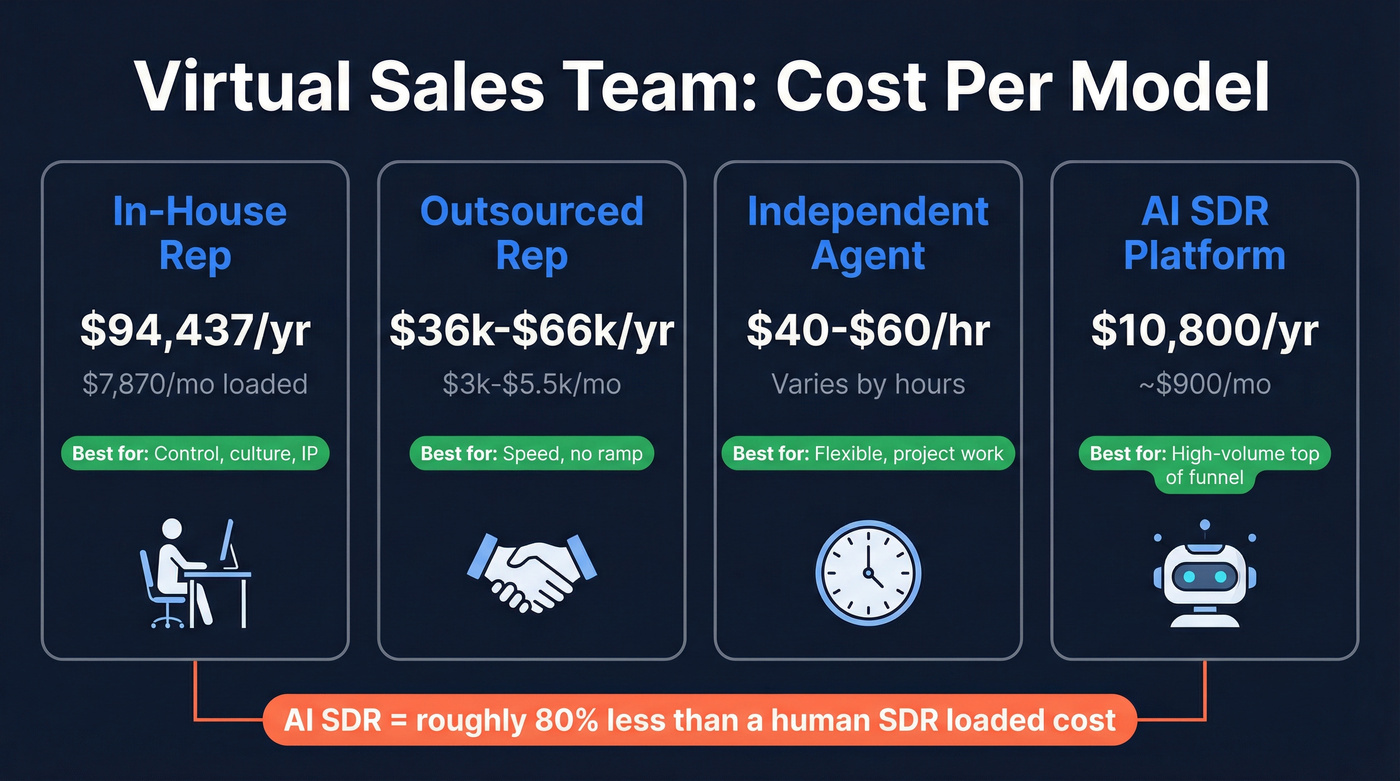
| Model | Monthly Cost | Annual Cost | Best For |
|---|---|---|---|
| In-house rep | ~$7,870/mo (loaded) | $94,437 + ~$4,125 onboarding | Control, culture, IP |
| Outsourced rep | $3,000-$5,500 | $36k-$66k | Speed, no ramp mgmt |
| Independent agent | $40-$60/hr | Varies by hours | Flexible, project-based |
| AI SDR platform | ~$900/mo | ~$10,800 | High-volume top-of-funnel |
An in-house sales rep runs about $87/hr fully loaded. An independent agent costs $40-$60/hr with no benefits burden. AI SDR platforms like AiSDR clock in around $900/mo - roughly 80% less than a human SDR's loaded cost. The smart move is pairing AI for top-of-funnel volume with human reps for discovery, objections, and the relationship work that actually closes deals.
81% of sales teams are now investing in AI, and reps who partner with AI tools are 3.7x more likely to hit quota. That's not a trend you can afford to ignore.
Here's the thing: most early-stage teams should still start with one in-house rep. You'll learn more about your sales motion in 90 days with a real person running real conversations than you will in a year of outsourced experiments where you never see the call recordings.
Define Your Sales Motion First
Before you write a single job description, answer one question: are you running inbound, outbound, or hybrid?
Inbound means your reps qualify and close leads that marketing generates. Outbound means your reps find, contact, and convert cold prospects. Hybrid means both - and it requires a different skill set than either alone.
This decision determines every hire, tool, and comp plan that follows, and getting it wrong creates a structural problem that looks like a people problem. An SDR built for cold calling 60 dials a day won't thrive qualifying inbound demo requests, and the reverse is just as true. We've watched founders blame three consecutive hires before realizing the role description was the issue, not the candidates.
Roles and Comp Plans
Commission-only comp attracts mercenaries, not builders. It selects for people who'll cherry-pick easy deals and bail when pipeline gets thin.
Pay a real base.
| Role | OTE Range | Pay Mix (Base:Variable) | Notes |
|---|---|---|---|
| SDR/BDR | $70k-$90k | 70:30 | Activity-driven quota |
| Inside Sales Rep | $90k-$110k | 60:40 | Full-cycle closing |
| Mid-Market AE | $120k-$160k | 50:50 | Quota = 4-5x OTE |
| Enterprise AE | $180k-$250k+ | 50:50 | Longer cycles, bigger deals |
The SaaStr rule of thumb holds: reps should take home roughly 20-25% of ACV all-in, and their quota should be 4-5x their OTE. If you're paying an SDR $80k OTE, they need to generate $320k-$400k in pipeline that converts. SPIFFs work for short-term pushes - keep them at 5-10% of variable comp, clearly defined, and time-bound.
Let's be honest about something: if your average deal size is under $10k, you don't need enterprise-grade comp plans with complex accelerators and decelerators. We've seen teams adopt BigCo-style structures and watch revenue per lead drop 50%+ within a quarter because reps gamed the plan instead of selling. Keep it simple until you have 10+ reps and a comp analyst who can model the edge cases.

Bad data is the #1 reason new virtual sales teams fail in their first 90 days. Prospeo's 98% email accuracy and 7-day refresh cycle mean your reps spend time selling, not recovering from bounced emails and burned domains.
Give your first rep verified data on day one - not a domain reputation problem.
Build Your Remote Tech Stack
Sales reps spend only 28-30% of their week actually selling. The rest is admin, data entry, and fighting with tools that don't talk to each other. Your stack should eliminate friction, not create it. Five categories - everything else is optional until you have revenue.
| Category | Tool | Starting Price |
|---|---|---|
| CRM | HubSpot / Pipedrive / Close | Free / $14/mo / $9/mo |
| Sequencing | Instantly / Lemlist | ~$30-$59/mo |
| Scheduling | Calendly | Free / $10/mo |
| Call Recording | Fathom | Free / $19/user/mo |
| Data & Verification | Prospeo | Free / ~$39/mo |
Your data provider matters more than your CRM. Bad data kills new outbound teams before they get traction - high bounce rates torch your domain reputation, and once that's damaged, even good emails land in spam. This is the single fastest way to waste your first 90 days.
Prospeo's 98% email accuracy and 7-day data refresh cycle solve this at the foundation. The free tier gives you 75 verified emails per month plus 100 Chrome extension credits to prove the motion, and it integrates natively with Salesforce, HubSpot, Smartlead, Instantly, Lemlist, Clay, Zapier, and Make. When GreyScout switched, they cut bounce rates from 38% to under 4% and slashed rep ramp time from 8-10 weeks to 4 weeks.

GreyScout cut rep ramp time from 8-10 weeks to 4 weeks after switching to Prospeo. With 300M+ profiles, 30+ search filters, and native integrations with HubSpot, Salesforce, Instantly, and Lemlist - your remote stack is ready on day one.
Ramp your virtual reps faster with data they can actually trust.
Onboard in 90 Days
6 in 10 managers have lost employees during probation because of poor onboarding. Preboarding alone - sending equipment, logins, and a welcome packet before day one - lifts first-year retention by 11%. And here's a stat that surprises people: remote learning retention runs 25-60% compared to just 8-10% for traditional face-to-face training. Virtual onboarding isn't a compromise. It's actually better for knowledge retention.
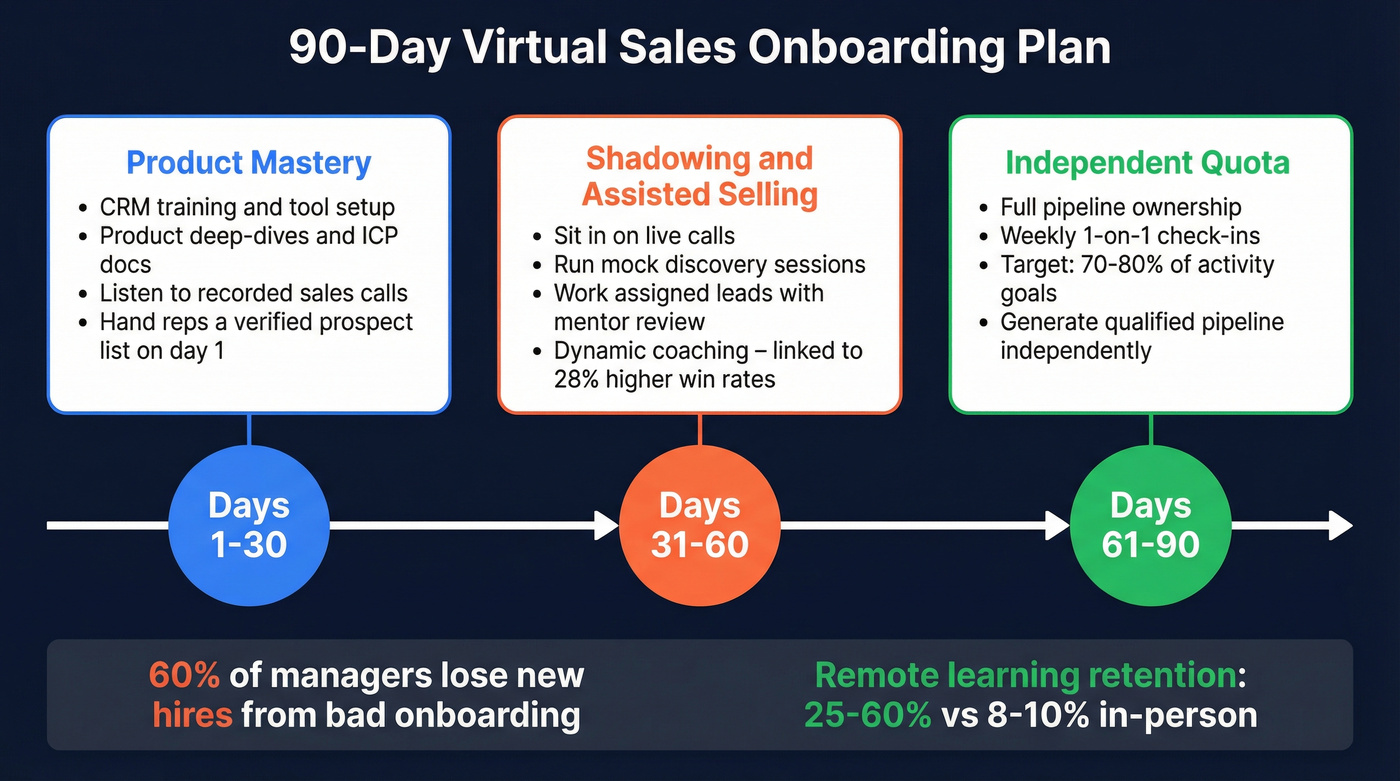
Days 1-30: Product mastery. CRM training, product deep-dives, ICP documentation, and listening to recorded calls. Hand your first SDR a verified prospect list on day one - don't make them waste week one scraping contacts from random sources.
Days 31-60: Shadowing and assisted selling. Reps sit in on live calls, run mock discovery sessions, and start working assigned leads with a mentor reviewing every interaction. Dynamic coaching and roleplay are linked to 28% higher win rates.
Days 61-90: Independent quota. Full pipeline ownership with weekly 1:1s. By day 90, a ramped SDR should hit 70-80% of their activity targets and generate qualified pipeline independently.
Recreate the Sales Floor
The consensus on r/sales is that the hardest part of remote selling isn't the selling - it's the isolation. You can't fully replicate the energy of sitting together and cold calling, but you can get close.
Run always-on Slack huddles or Zoom rooms during call blocks so reps hear each other dialing. Schedule weekly blitz competitions where the team sprints together for 90 minutes. Hold "deal clinics" where reps workshop stuck opportunities live. These rituals sound small, but they're the difference between a team and a collection of individuals working from home who happen to share a Slack workspace.
KPIs That Actually Matter
43.5% of sales professionals hit quota. That means 69% miss it. And 17% of reps generate 81% of revenue. Your KPI framework needs to separate signal from noise fast - especially when you can't walk the floor and watch reps work.
| Metric | Benchmark | Context |
|---|---|---|
| Quota attainment | 43.5% avg | Top performers skew this heavily |
| Touchpoints to close | ~8 touches | Multi-channel required |
| Engaged to meeting | 40%+ | Below 30% = messaging issue |
| Meetings to pipeline | 60-70% | Below 50% = qualification issue |
| Daily activity (calls) | 40-80/day | Depends on dialer + ICP |
Don't over-index on activity metrics. A rep making 80 calls a day into an unverified list will book fewer meetings than a rep making 40 calls into a clean, targeted list with accurate direct dials. Track leading indicators weekly and lagging indicators monthly. If a rep's engaged-to-meeting rate is strong but their activity volume is low, that's a coaching conversation about time management - not a performance problem.
Mistakes That Kill Remote Sales Orgs
In our experience, these four mistakes account for most virtual sales team failures. Skip the learning curve and avoid them from day one.
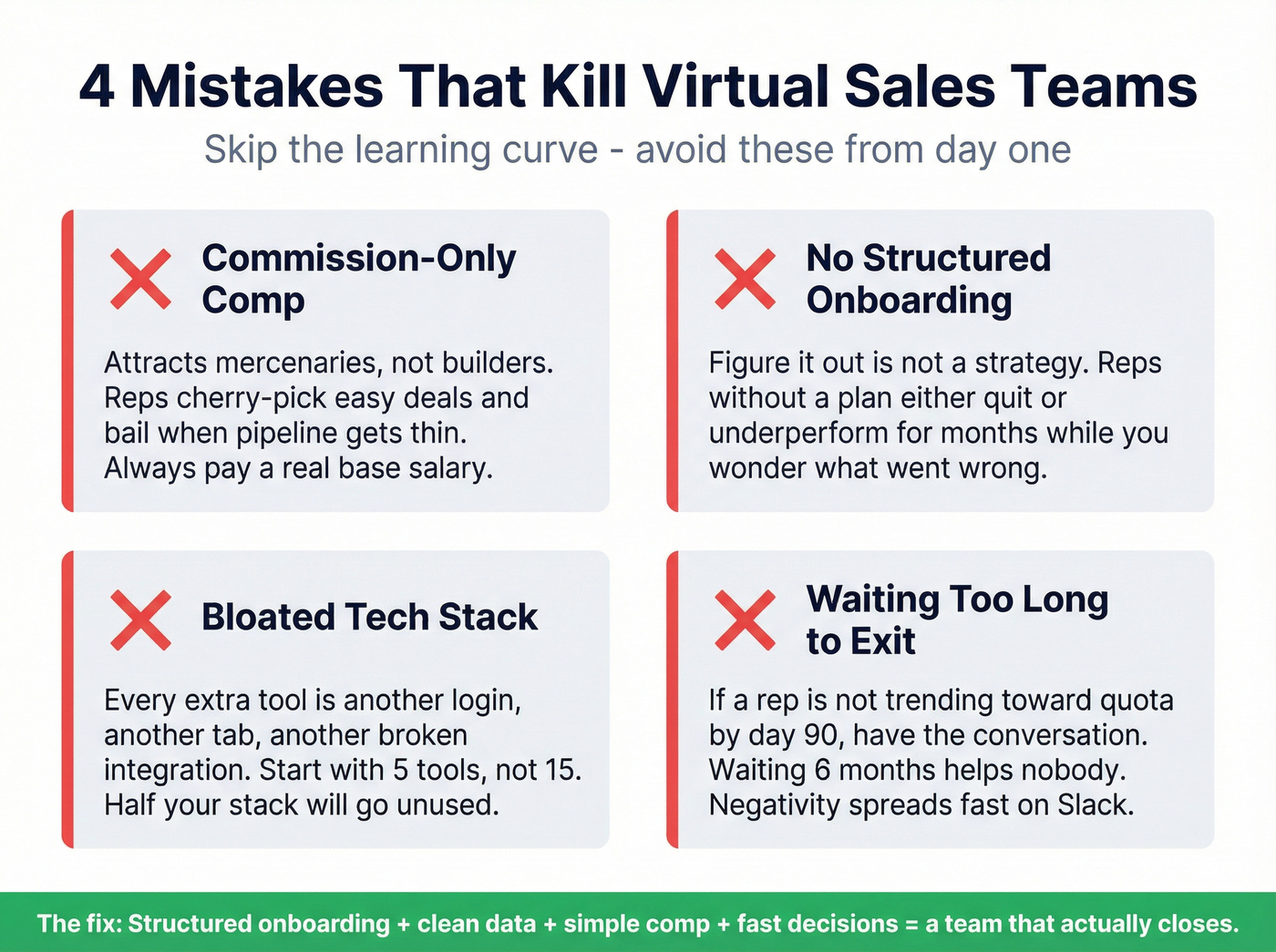
Commission-only comp. We already said it, but it bears repeating. It attracts mercenaries, not builders. Pay a base. Always.
No structured onboarding. "Figure it out" isn't a strategy. Reps who ramp without a plan either quit or underperform for months while you wonder what went wrong. Use a 30-60-90 onboarding structure.
Bloated tech stack. Every tool you add is another login, another tab, another integration to maintain. Five tools. Not fifteen. The r/salesops community is full of horror stories about teams running 12+ tools where nobody uses half of them and the data between systems never matches. If you're building outbound, start with proven SDR tools and add complexity later.
Waiting too long to exit non-performers. If a rep isn't trending toward quota by day 90, have the conversation. Waiting six months helps no one - and negativity in a remote team spreads through Slack just as fast as it does across a sales floor.
FAQ
Where do I find remote sales reps?
Post on LinkedIn, Wellfound, We Work Remotely, and Built In. Staffing marketplaces like Overpass and CrewBloom source candidates fast, and nearshore firms like Wow Remote Teams can deliver interview-ready candidates in around 72 hours. Screen for CRM fluency and outbound experience - not just "sales" on a resume.
Should I outsource or hire in-house?
Hire in-house for control over messaging, culture, and IP - budget roughly $94k/year loaded. Outsource at $3k-$5.5k/mo per rep if you need speed and can't manage ramp. If budget allows, start with one in-house rep. You'll learn your motion faster than any agency can teach it to you.
How do I keep prospect data clean?
Use a verified data provider with 98%+ email accuracy and a fast refresh cycle instead of letting reps manually scrape contacts. Prospeo refreshes records every 7 days versus the 6-week industry average and includes catch-all verification, spam-trap removal, and honeypot filtering - so your domain reputation stays intact from day one.
What's the fastest way to build a virtual sales team on a tight budget?
Start with one SDR, a 5-tool stack, and a 30-60-90 onboarding plan. Prospeo's free tier covers your first 75 verified emails per month, HubSpot CRM is free, and Fathom offers free call recording. Total out-of-pocket for tooling can stay under $100/month while you validate the motion. Once you're booking meetings consistently, scale the team and the budget together.