

How to Build an Ideal Customer Profile That Doesn't Collect Dust
Your SDR sent 500 emails last week and booked three meetings. Two were with companies that'll never close. The problem isn't the messaging or the cadence - it's that nobody defined who to actually target.
Companies with a well-defined ICP see 68% higher win rates, 28% higher deal values, and 40% more revenue from marketing campaigns. The gap between teams that crush quota and teams that grind isn't effort. It's targeting.
What a Finished ICP Actually Contains
A finished ICP has three layers, not one:
- Firmographics - industry, size, geography
- Technographics - what's in their tech stack and why it matters to you
- Intent and behavioral signals - who's actively researching your category right now
Most guides stop at "create a one-pager with your ideal company description." That's not an ICP - that's a wishlist. A real ICP includes a scoring rubric with point values and tiers, an Anti-ICP that defines who to actively avoid, and a clear path to turn those criteria into a live prospect list.
ICP vs. Buyer Persona
An ideal customer profile defines the type of company that's the best fit for your product. It's account-level: industry, revenue, headcount, tech stack, buying signals. It's not a buyer persona. A buyer persona describes the individual - the VP of Sales who champions your deal, their goals, their daily frustrations. Build the ICP first to identify the right accounts, then layer personas on top to reach the right people inside those accounts.
This distinction matters more than it sounds. Defining your profile at the account level before you think about personas is what separates strategic outbound from spray-and-pray.
The Three Layers of a Modern ICP
Firmographics filter noise. Industry, company size, geography, revenue range - these are the minimum. They tell you whether an account is even in your universe. But firmographics alone don't indicate in-market readiness. Relying only on them is a 2015 approach.
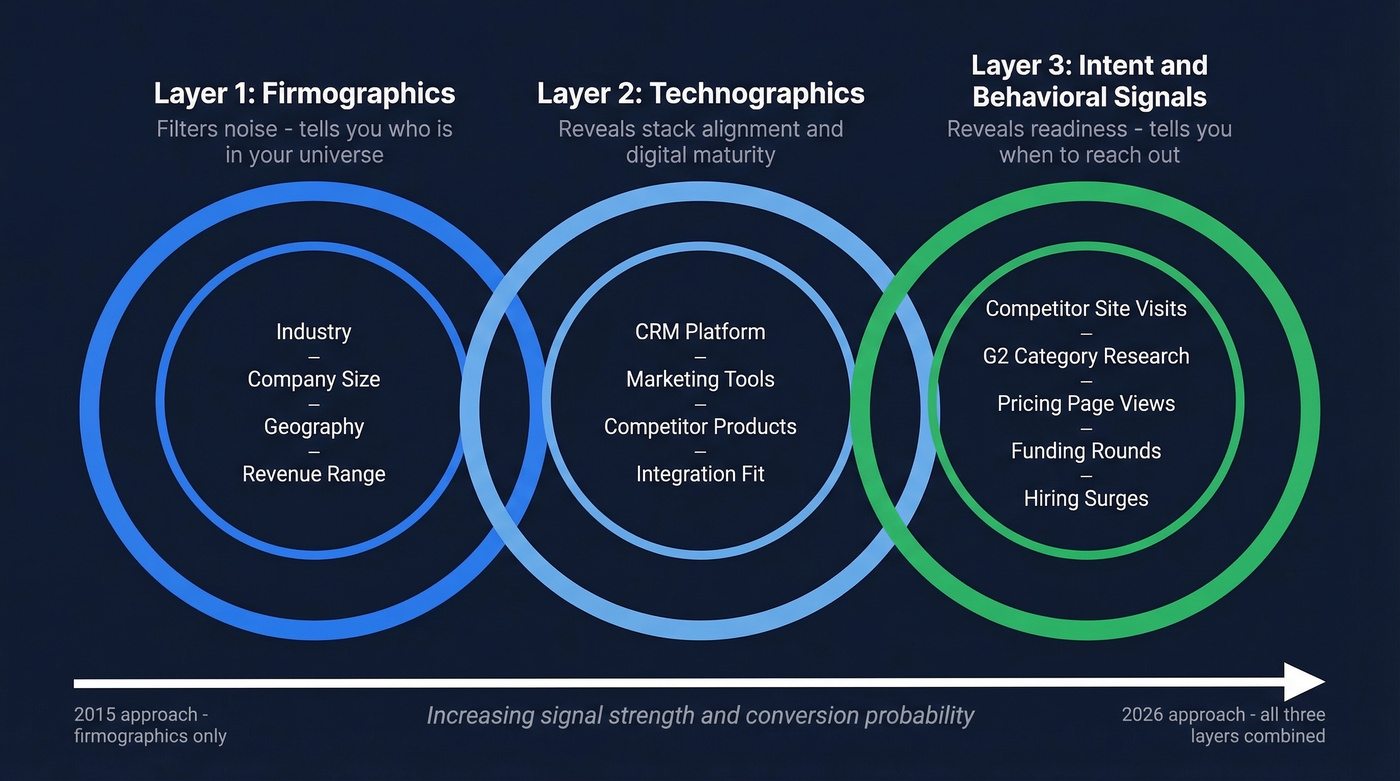
Technographics reveal stack alignment. If a prospect runs Salesforce and Outreach, your integration story writes itself. If they're deep into a competitor's ecosystem, you know the displacement cost is high. Technographic data also signals digital maturity - a company running modern RevTech is more likely to adopt your tool quickly than one still living in spreadsheets.
Intent and behavioral signals reveal readiness. Competitor site visits, category research on G2, pricing page views, recent funding rounds, hiring surges in relevant departments - these tell you when to reach out, not just who. Intent data tracking across thousands of topics can surface accounts actively researching your category before they ever fill out a form.
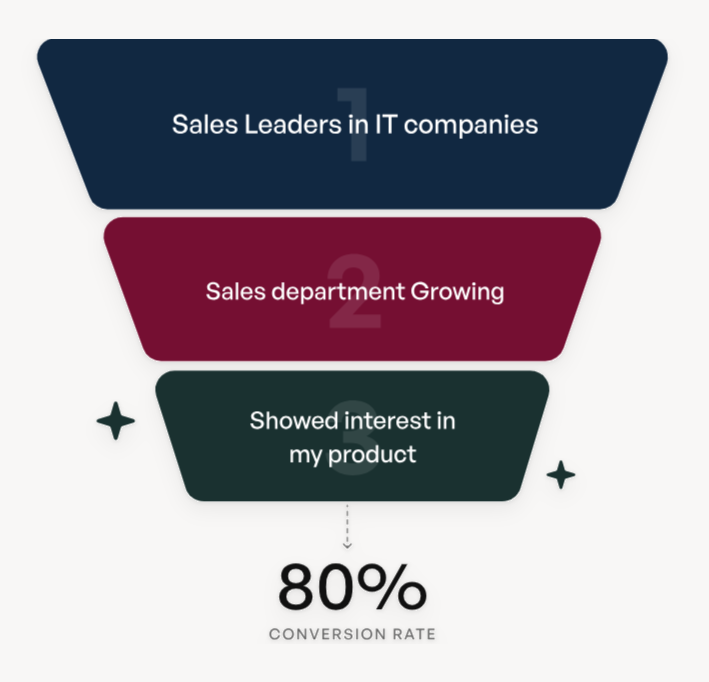

Your ICP has three layers - firmographics, technographics, and intent signals. Prospeo lets you activate all three in one search. Filter 300M+ profiles by industry, tech stack, headcount growth, funding, and 15,000 intent topics to surface Tier A accounts already researching your category.
Stop scoring accounts manually. Let the data do the filtering.
How to Build Your ICP Step by Step
Align Your Teams First
Don't build your ICP in a marketing silo. Pull in at least one rep from sales, customer success, marketing, and product. Sales knows which deals close fastest. CS knows which customers churn. Product knows which use cases drive real adoption.
Skip this step and you'll end up with what the consensus on r/sales calls "fairytale personas built by marketers who don't talk to customers." We've seen it happen more than once.
Identify Your Best Customers
Start with 50-100 closed-won deals from the last 12 months. Tag each one with firmographic and technographic attributes. In our experience, 70-80% share three to five common traits. Selection criteria that matter most:
- Highest NPS scores
- Highest ACV or total contract value
- Longest tenure with strong product adoption
- Customers who've referred others
This isn't about who you wish you sold to. It's about who you've already won and retained. Defining ICP criteria from real customer data is the only way to avoid building fiction.
Interview Your Best-Fit Customers
Talk to customers who've been with you 12+ months and spend above average - they're your highest-signal cohort. Run a minimum of five interviews; eight to ten gives you real confidence that the patterns you're seeing are trends, not noise.
Cover these areas:
- Learning patterns - where they get industry info, which communities they trust
- Industry challenges and common objections
- Role and org dynamics - reporting lines, success metrics, team structure
- Goals and why they matter to the business
- Past attempts - what they tried before you, what failed
- Decision process - stakeholders, triggers, the "aha moment," regulatory or contractual constraints that affect adoption
Before finalizing, run mandatory checks: Does this customer segment have financial readiness? Urgency? Willingness to change existing workflows? These filters prevent you from building a profile around segments that'll never convert.
Build Your Template
Here's a filled-in example for a mid-market B2B SaaS company:
| Attribute | Example Entry |
|---|---|
| Industry | B2B SaaS |
| Company size | 200-500 employees |
| Revenue | $20-50M |
| Geography | North America, Western Europe |
| Tech stack | Salesforce, HubSpot, Slack |
| Budget range | $50K-$100K/year |
| Key decision-makers | VP Sales, RevOps Lead |
| Pain points | Low conversion, data quality issues |
| Buying triggers | New CRO, missed quarter, funding |
Adapt the fields to your business. Fill one in with data from your actual best customers, not aspirational guesses.
Score and Tier Accounts
A description isn't enough. You need a scoring rubric that turns qualitative fit into a number. Businesses using account scoring see a 77% boost in lead generation ROI. Here's a 100-point model:
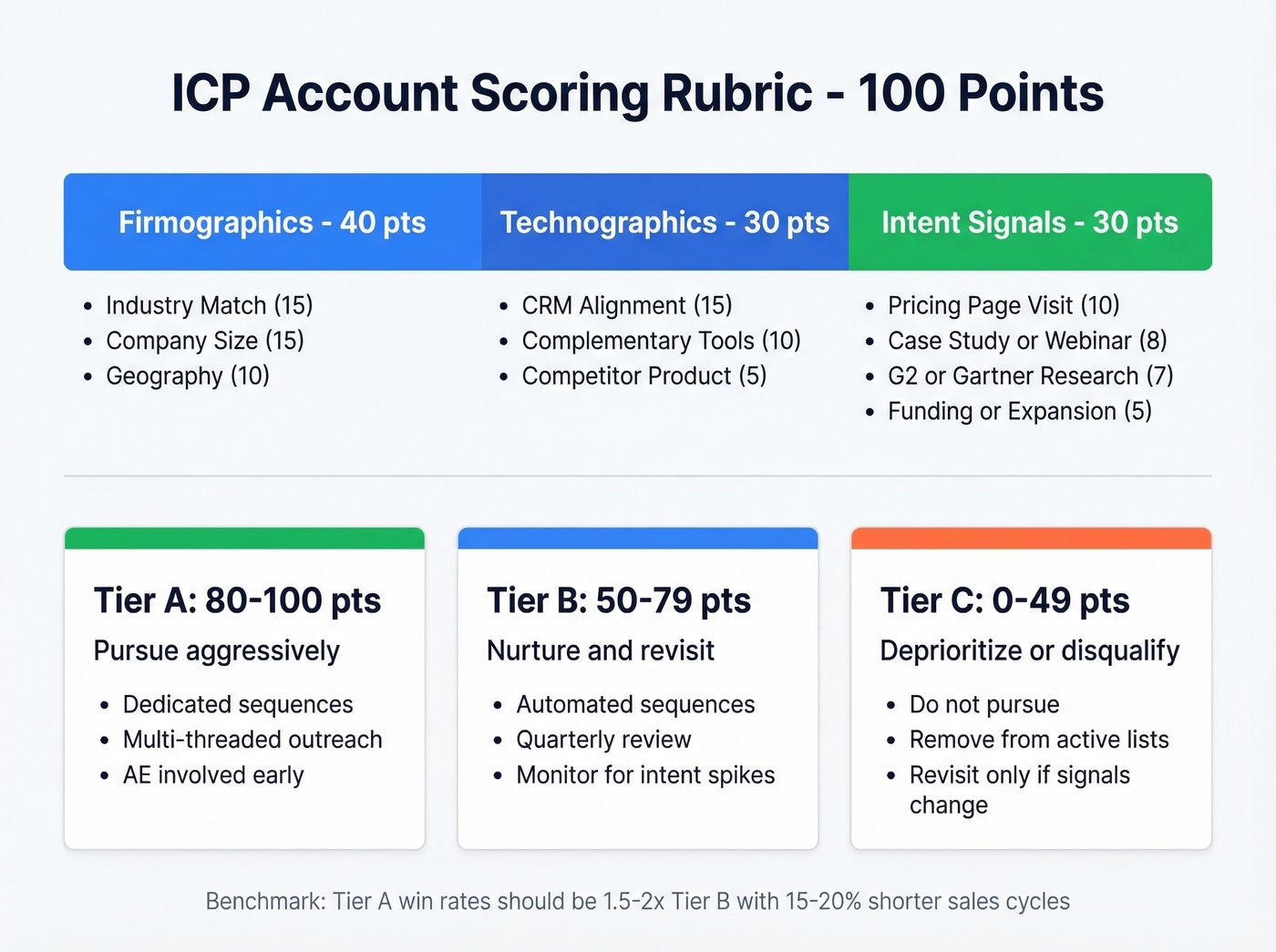
| Category | Attribute | Points |
|---|---|---|
| Firmographics (40) | Industry match | 15 |
| Company size | 15 | |
| Geography | 10 | |
| Technographics (30) | CRM alignment | 15 |
| Complementary tools | 10 | |
| Competitor product | 5 | |
| Intent signals (30) | Pricing page visit | 10 |
| Case study/webinar | 8 | |
| G2/Gartner research | 7 | |
| Funding/expansion | 5 |
Now tier them. Tier A (80-100): pursue aggressively - dedicated sequences, multi-threaded outreach, AE involvement early. Tier B (50-79): nurture with automated sequences, revisit quarterly. Tier C (0-49): deprioritize or disqualify entirely.
Validation benchmark: Tier A win rates should run 1.5-2x Tier B, with 15-20% shorter sales cycles. If they don't, your scoring needs recalibration.
Define Your Anti-ICP
Here's the thing: knowing who not to sell to is just as valuable as knowing who to target.
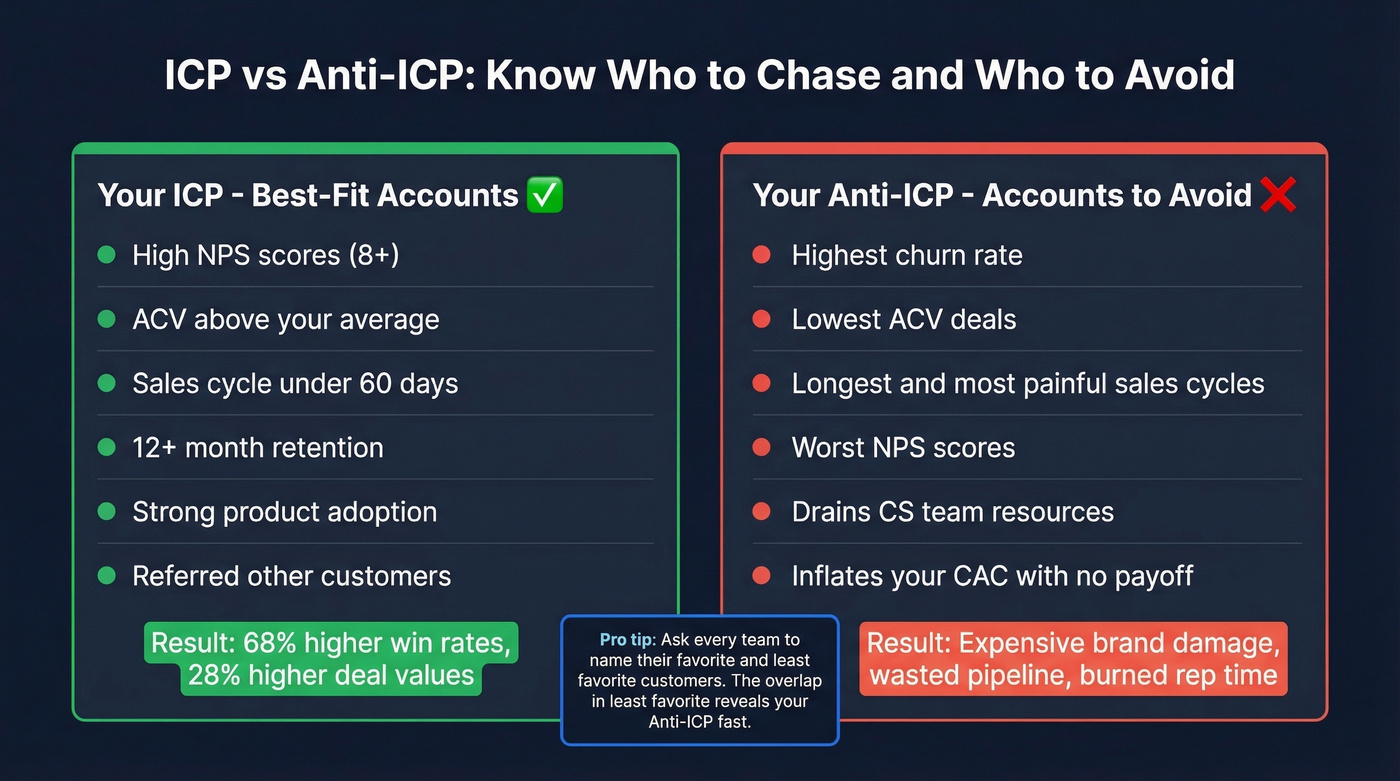
The Anti-ICP defines accounts that churn quickly, inflate your CAC, and drain CS time. We've seen teams spend north of $5K chasing a big-logo account, win the deal after a brutal sales cycle, and watch the customer churn within months. That's not revenue - that's expensive brand damage.
To build yours, analyze your worst-fit customers: highest churn, lowest ACV, longest sales cycles, worst NPS. Then run a simple internal exercise - ask each team to name their favorite and least favorite customers. The overlap in "least favorite" reveals your Anti-ICP patterns fast.
Let's be honest: most teams don't need a more sophisticated ICP. They need an Anti-ICP they actually enforce. The biggest pipeline gains we've seen come not from finding better accounts, but from ruthlessly disqualifying the wrong ones. Stop chasing logos that look impressive on a case study but destroy your unit economics.
Activate Your ICP in Outbound
An ICP that lives in a Google Doc and never touches your CRM is a waste of the three hours you spent building it.
The whole point is to translate those criteria into CRM fields, lead routing rules, outbound list filters, and ABM account lists. This is where the profile becomes a working system - and where most ICP development efforts stall. Build a search that mirrors your Tier A criteria - industry, headcount range, tech stack, funding signals, intent topics - and export verified contacts straight into your sequencer.
Prospeo's 30+ search filters map directly to the ICP dimensions you just defined, including buyer intent across 15,000 Bombora topics, technographics, and headcount growth. With 98% email accuracy and a 7-day data refresh cycle, the list you pull today is still accurate next week. Free tier available with 75 emails and 100 Chrome extension credits per month - no contracts, self-serve setup.

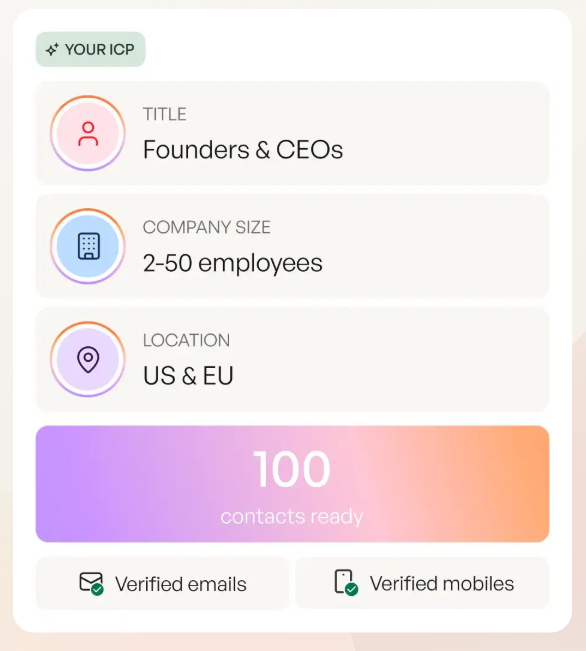
An ICP without activation is just a document. Prospeo turns your scoring rubric into a live pipeline - 30+ filters match your firmographic and technographic criteria, while Bombora intent data flags accounts showing buying signals right now. Every email is 98% verified, so your reps reach real buyers, not dead inboxes.
Turn your ICP from a slide deck into booked meetings this week.
Mistakes That Kill Your ICP
Building a wishlist instead of analyzing actual customers. Start with closed-won data, not aspirations. If you haven't pulled your CRM data yet, nothing else in this article matters.
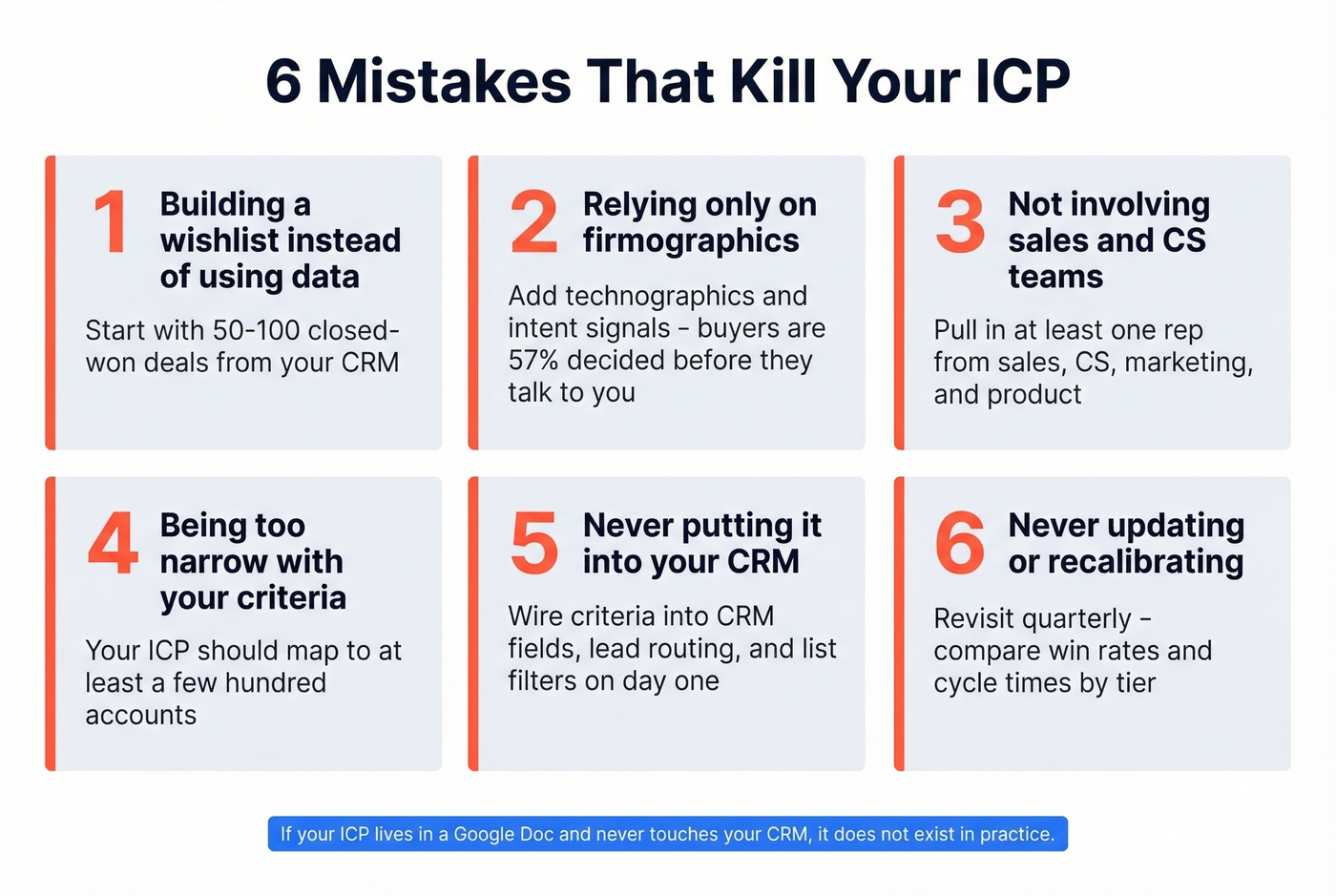
Relying solely on firmographics. Without technographics and intent, you're targeting companies that look right but aren't ready to buy. According to Gartner's B2B buying research, buyers are 57% through their decision process before they ever talk to a rep - intent data is how you catch them earlier.
Not involving sales and CS. We've watched teams build beautiful ICP documents that never leave the Google Doc because sales had zero input and zero buy-in. That's how you get shelfware personas.
Being too narrow. If your ICP only describes three accounts on earth, you've over-constrained yourself. A good ICP should map to at least a few hundred accounts in your addressable market (and your addressable market math should prove it).
Never operationalizing it. If your criteria aren't in your CRM fields and lead routing logic, the profile doesn't exist in practice. You need to define it and then immediately wire it into the systems your reps use every day. HubSpot's ICP guide walks through the CRM implementation side well.
Never updating it. Markets shift. Your product evolves. Revisit quarterly - compare win rates and cycle times by tier, and recalibrate. Skip this and your ICP will be stale within two quarters, guaranteed.
FAQ
What's the difference between an ICP and a buyer persona?
An ICP defines the type of company that's the best fit - industry, size, tech stack, budget, buying signals. A buyer persona describes the individual within that company who makes or influences the purchase decision - their role, goals, and pain points. Build the ICP first to identify target accounts, then layer personas to reach the right people inside them.
How often should I update my ICP?
Revisit quarterly at minimum. Compare win rates, deal sizes, and cycle times by tier each quarter. If Tier A accounts aren't outperforming Tier B by at least 1.5x on win rate, your scoring needs recalibration. Markets shift, products evolve, and last year's best-fit segment won't necessarily be this year's.
How do I turn my ICP into a prospect list?
Use a B2B data platform to match accounts at scale. Filter by intent, technographics, headcount growth, and funding - then export verified emails and direct dials into your outbound workflow. Forrester's research on intent data confirms that layering intent signals onto firmographic filters dramatically improves conversion rates.
Where should I start if I've never built one before?
Follow the step-by-step process above: align your cross-functional team, pull closed-won data, interview your best customers, fill in the template, score and tier accounts, then activate the criteria in your outbound tools. Even a first-pass ICP built from real data will outperform no ICP at all - refine the scoring as you collect more signal each quarter.