

How to Call Warm Leads: The Script, the Data, and the 3 Things That Actually Matter
It's 10am. You've got 40 warm leads from yesterday's webinar sitting in your CRM. By 2pm, three competitors have already called them. 60-70% of B2B sales come from warm leads, but only if you get to them first - with the right words, the right data, and a system that doesn't leave anything to chance. Knowing how to call warm leads effectively comes down to speed, data, and a script that earns the next 90 seconds.
Here's the system.
What Makes a Lead "Warm"
A warm lead is someone who's already raised their hand - downloaded your whitepaper, attended your webinar, visited your pricing page, or got referred by a mutual connection. They're not cold and they're not hot. They're somewhere in between, and that means you still need a script, a plan, and verified contact data.
Don't mistake "warm" for "easy." A warm lead still has trepidation the moment a sales number pops up on their phone. And here's what most guides skip: warm leads go cold fast. When marketing budgets get cut or campaign quality dips, one SDR on r/sales reported conversations dropping from 6-8 per day to 1-3 overnight. Build your system to handle that variance.
The 5-Minute Rule
MIT researchers analyzed 1.25 million sales leads and found that leads contacted within 5 minutes are 100x more likely to convert than leads contacted 30 minutes later. A separate HBR study of 2.2 million leads showed you're 21x more likely to qualify a lead within 5 minutes versus 30.
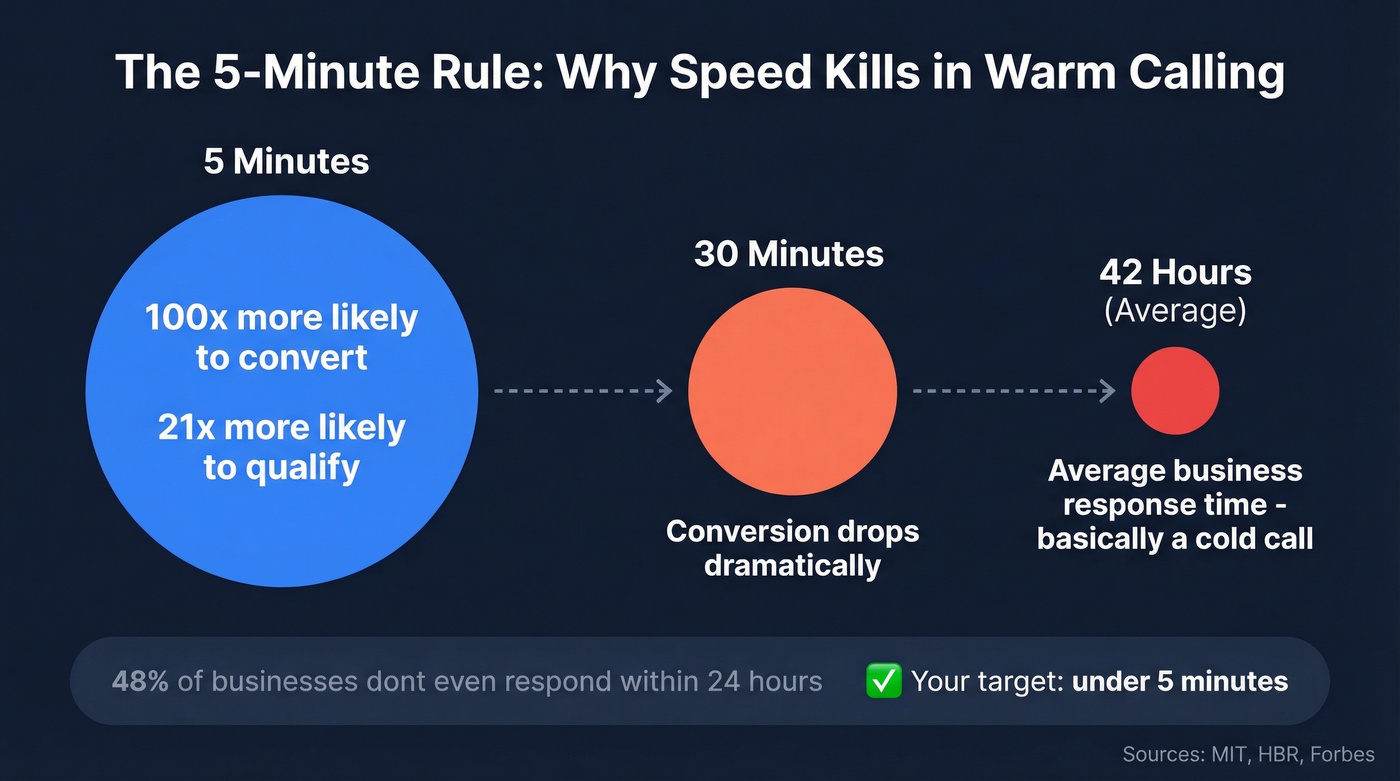
The average business response time? 42 hours. 48% of businesses don't even respond within 24 hours. At that point, it's not a warm call - it's a cold call with extra steps.
3-Minute Prep Before Every Dial
Every warm call deserves three minutes of prep. Not thirty. Three.
- Company context. Size, funding stage, recent news. One relevant detail is enough to personalize your opener.
- Prospect research. Role, background, shared connections. Mentioning a mutual connection increases meeting chances by 70%.
- Prior touchpoint review. What did they download, attend, or click? This is your opening line.
- Data verification. B2B contact data decays at 2.1% per month - that's 22.5% annually. Phone-verified mobile numbers are 87% accurate; AI-powered verification pushes that to 98%.
Most teams skip verification and burn through call blocks dialing dead numbers. We've watched teams cut their disconnected-number rate from 30% to under 5% just by running verification first. That alone saves 30-40 minutes per call block.
If your lead list hasn't been verified in the last 7 days, you're not running a warm-call block - you're running a lottery.

Prioritize Before You Dial
Not all warm leads are equally warm. Before you start calling, sort your list by engagement signals: pricing page visits beat blog reads, webinar attendees who asked questions beat passive registrants, and referrals beat everything.
We've seen teams double their connect-to-meeting rate just by reordering who they call first. If your CRM tracks email opens, link clicks, or page visits, use that data. Call the hottest leads within 5 minutes and work your way down. When a prospect has visited your pricing page and opened three emails in the same day, you're no longer in warm territory - that's closer to a closing call than a discovery call, and you should treat it accordingly.

You just read that unverified data wastes 30-40 minutes per call block. Prospeo refreshes 300M+ contacts every 7 days - not every 6 weeks - so your warm leads never go stale. 98% email accuracy. 125M+ verified mobiles. 30% pickup rate.
Stop dialing dead numbers. Start connecting with real buyers.
The 6-Step Warm Call Script
This follows the EBQ framework - six steps, under five minutes.
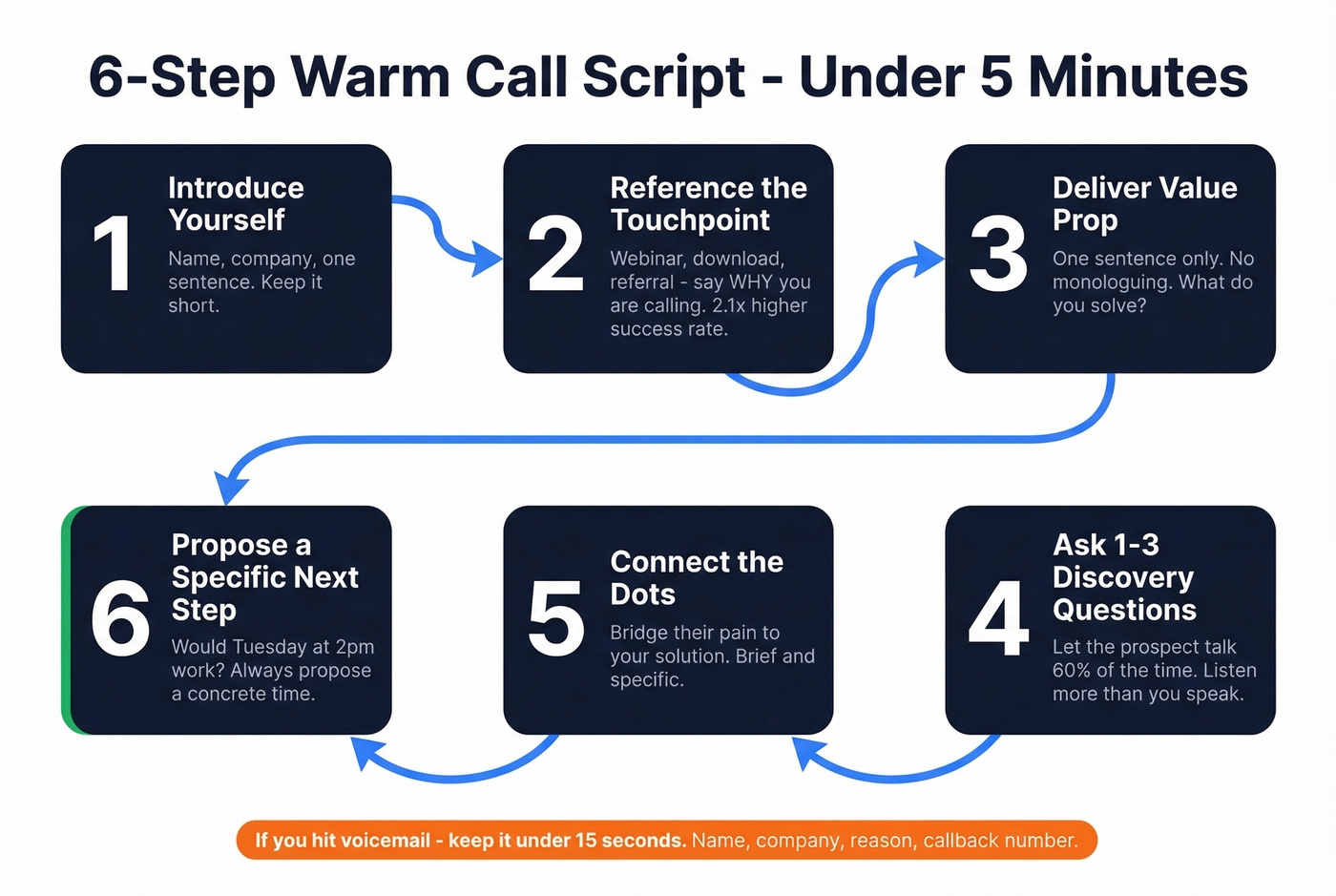
Step 1: Introduce Yourself
Keep it short. Name, company, one sentence. "Hi Sarah, this is James from Acme. Quick question for you."
Step 2: Reference the Touchpoint
This is what separates warm from cold. Pick the opener that matches your lead source:
- Trigger-event opener: "I noticed you attended our webinar on pipeline forecasting last week - what prompted that?"
- Referral opener: "Mark Chen suggested I reach out. He mentioned you're rethinking your outbound stack."
- Content-download opener: "You grabbed our SDR benchmarks report - was there a specific metric that caught your eye?"
Explaining why you're calling produces a [2.1x higher success rate](https://www.gong.io/blog/cold-call-stats) according to Gong benchmarks. And whatever you do, don't ask "Is this a bad time?" That decreases meeting chances by 40%.
Step 3: Deliver a Tight Value Prop
One sentence. "We help B2B sales teams cut list-building time by 80% and triple their connect rates." No monologuing.
Step 4: Ask 1-3 Discovery Questions
"How are you currently handling [pain point]?" and "What's preventing you from [goal] right now?" Let the prospect talk. Top performers let prospects speak roughly 60% of the call.
Step 5: Connect the Dots
Bridge their answer to your solution. Brief. Specific. No feature dumps.
Step 6: Propose a Specific Next Step
"Would Tuesday at 2pm work for 15 minutes?" Always propose a concrete time. As one r/sales contributor put it bluntly: book the next meeting before the call ends - failing to schedule next steps loses deals to competitors who will.
If you hit voicemail: Keep it under 15 seconds. Name, company, why you're calling, callback number. Done.
EBQ recommends keeping calls under 5 minutes, but successful calls often run longer - one widely shared benchmark puts them at 5:50 on average. The extra minute usually comes from genuine two-way discovery, the part where the prospect actually talks.
Objection Handling - 4 Rebuttals
Listen, clarify, respond with value. Don't get defensive. Don't argue price.
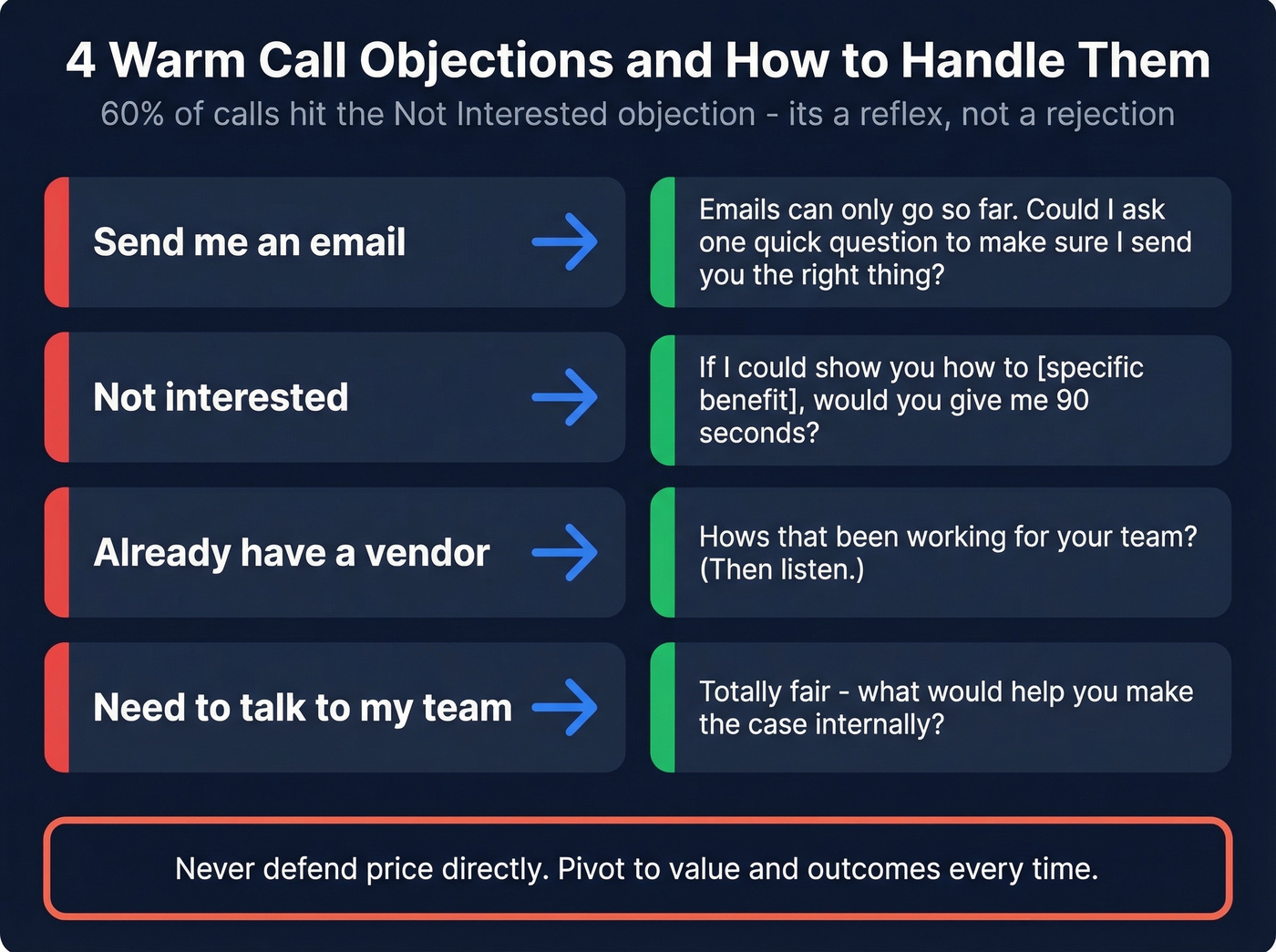
| Objection | Rebuttal |
|---|---|
| "Send me an email" | "Emails can only go so far. Could I ask one quick question to make sure I send you the right thing?" |
| "Not interested" | "If I could show you how to [specific benefit], would you give me 90 seconds?" |
| "Already have a vendor" | "How's that been working for your team?" (Then listen.) |
| "Need to talk to my team" | "Totally fair - what would help you make the case internally?" |
60% of calls encounter the "not interested" objection. It's not a rejection - it's a reflex. Your job is to earn 90 more seconds, not close the deal on the spot. And per ActiveCampaign's guidance, never defend price directly. Pivot to value and outcomes every time.
Mistakes That Kill Warm Calls
The "talking brochure" opener. "You requested some info - any questions?" hands all control to the prospect and blocks discovery. You're not a FAQ page. Lead with a value statement.
No research. You have data on what they downloaded, where they work, and who referred them. Calling blind when that context exists is malpractice.
Monologuing. If you're talking more than 70% of the call, you've lost. Ask questions. Pause. Let silence do the work.
No next step. Book the meeting before you hang up. "I'll follow up" isn't a next step - it's a prayer.
Dialing unverified numbers. Your SDR just burned through 25 dials. Eight were disconnected. That's not a warm-call block - that's a data problem. Run your list through a verification tool like Prospeo before you start dialing; its 7-day refresh cycle catches numbers that went stale since your last campaign.
Skipping call review. Record your warm calls and review them every two weeks. In our experience, reps who self-review improve their connect-to-meeting rate faster than reps who only get coached in 1:1s.
After the Call - Follow-Up Cadence
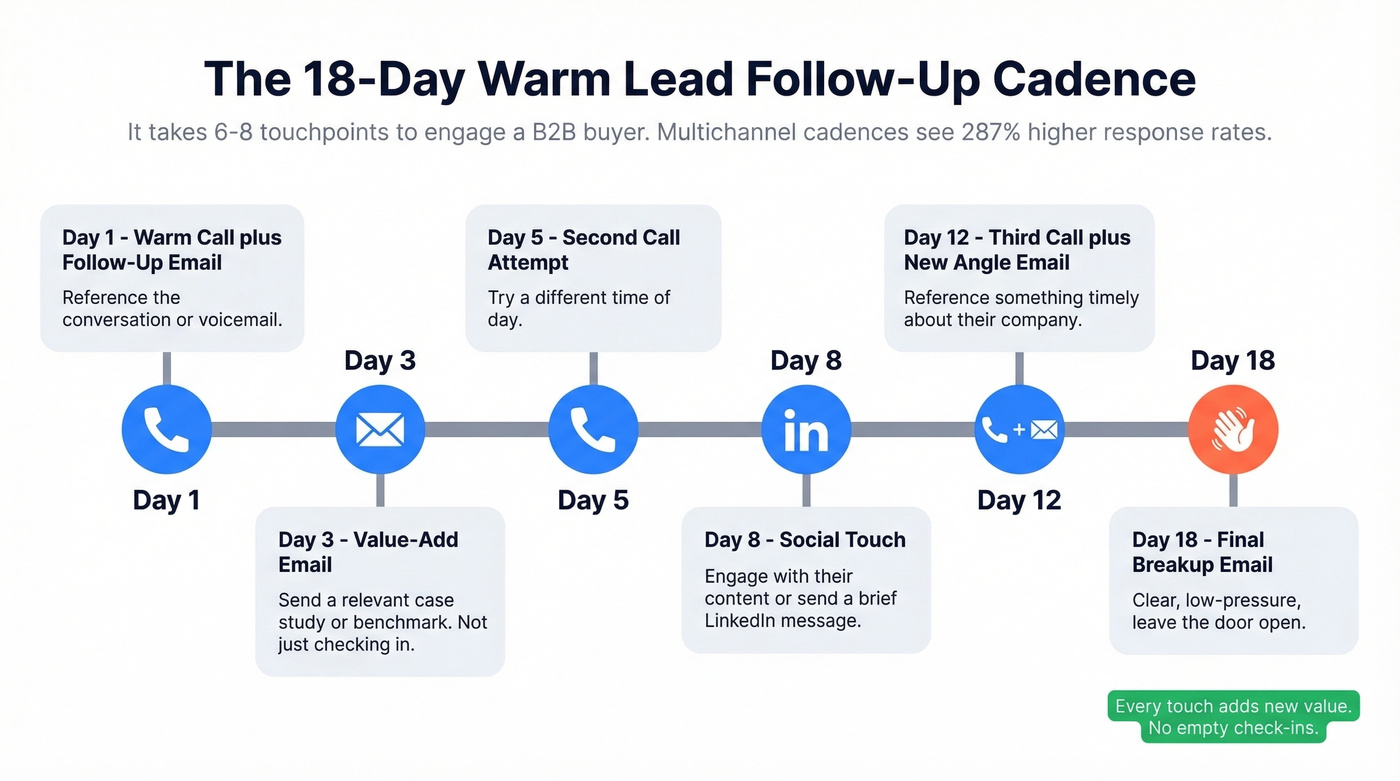
One call isn't a strategy. It takes 6-8 touchpoints to engage a B2B buyer, and multichannel cadences see 287% higher response rates than single-channel outreach. 77% of customers expect immediate interaction when they engage with a company - so start the cadence the same day.
Let's talk about pre-heating. A 2-4 week sequence of retargeting ads, social engagement, and light email touches before the first call can produce a 10x response lift by the time you pick up the phone.
- Day 1: Warm call + follow-up email referencing the conversation (or voicemail).
- Day 3: Value-add email - a relevant case study or benchmark. Not "just checking in."
- Day 5: Second call attempt. Different time of day.
- Day 8: Social touch - engage with their content or send a brief message.
- Day 12: Third call + new angle email. Reference something timely about their company.
- Day 18: Final breakup email. Clear, low-pressure, leaves the door open.
Every touch adds new value. The reps who build a real multichannel cadence - not just "call three times and give up" - are the ones who actually convert warm leads into pipeline. Skip this if you only have a handful of leads per week; at low volume, a personal, ad-hoc approach beats a rigid sequence.
The 5-minute rule only works if the number is real. Teams using Prospeo cut disconnected-number rates from 30% to under 5% and triple their connect rates - turning warm leads into booked meetings, not wasted dials.
Beat your competitors to the call with data that actually picks up.
FAQ
What's the difference between warm and cold calling?
Cold calling means zero prior interaction - the prospect doesn't know you exist. Warm calling means the lead has already engaged through content, events, or a referral. Warm leads convert at significantly higher rates because baseline trust already exists, and referencing a prior touchpoint creates a 2.1x higher success rate versus opening cold.
How many times should I follow up with a warm lead?
Plan 6-8 touchpoints across phone, email, and social over roughly 18 days. Start with 2-3 day spacing, then extend to 5-7 days. Every follow-up should deliver new value - a resource, an insight, a case study. "Just checking in" is the fastest way to get ignored.
What's the best time to call warm leads?
Within 5 minutes of their engagement - leads contacted that fast are 100x more likely to convert. Beyond that initial window, mid-morning (10-11am) and mid-afternoon (2-3pm) in the prospect's local time zone consistently outperform other windows. Avoid Monday mornings and Friday afternoons.
How do I verify phone numbers before a call block?
Run your list through a verification platform with a weekly refresh cycle and 98%+ email accuracy. Verification takes minutes and typically cuts disconnected-number rates from 30% to under 5%, which means more live conversations per hour and less wasted time.
What warm calling tips help new SDRs ramp faster?
Start with the 3-minute prep checklist before every dial - company context, prospect research, and prior touchpoint review. One well-researched call converts better than five blind dials. Record yourself, review the tape weekly, and treat every warm call as permission-based: the prospect gave you a signal, so acknowledge it immediately and earn the right to continue.