

How to Circle Back on an Email Without Sounding Passive-Aggressive
You sent a proposal three days ago. Radio silence. Now you're drafting a follow-up in your head, deleting it, rewriting it, and wondering if "just checking in" makes you sound desperate. Knowing how to circle back on an email is a real skill - and most people get it wrong because of timing, phrasing, or bad contact data.
Let's fix all three.
The Short Version
- Keep it short. Your follow-up body should be under 50 words. Aim for 25 - that's the reply-rate sweet spot from a Jeremy Donovan study of 4 million emails. Reply in the original thread. Wait at least 3 days; a three-day gap boosts reply rates by 31% compared to next-day follow-ups.
- Use a graduated cadence. Space follow-ups at 2, 4, 7, then 14 days. Stop after 3-4 emails. Period.
Why Most Follow-Up Emails Fail
The Ladders named "circle back" one of the most hated phrases in workplace communication. A Perkbox Insights study found 33% of workers voted "per my last message" the most annoying email phrase, while 19% flagged "just checking in."
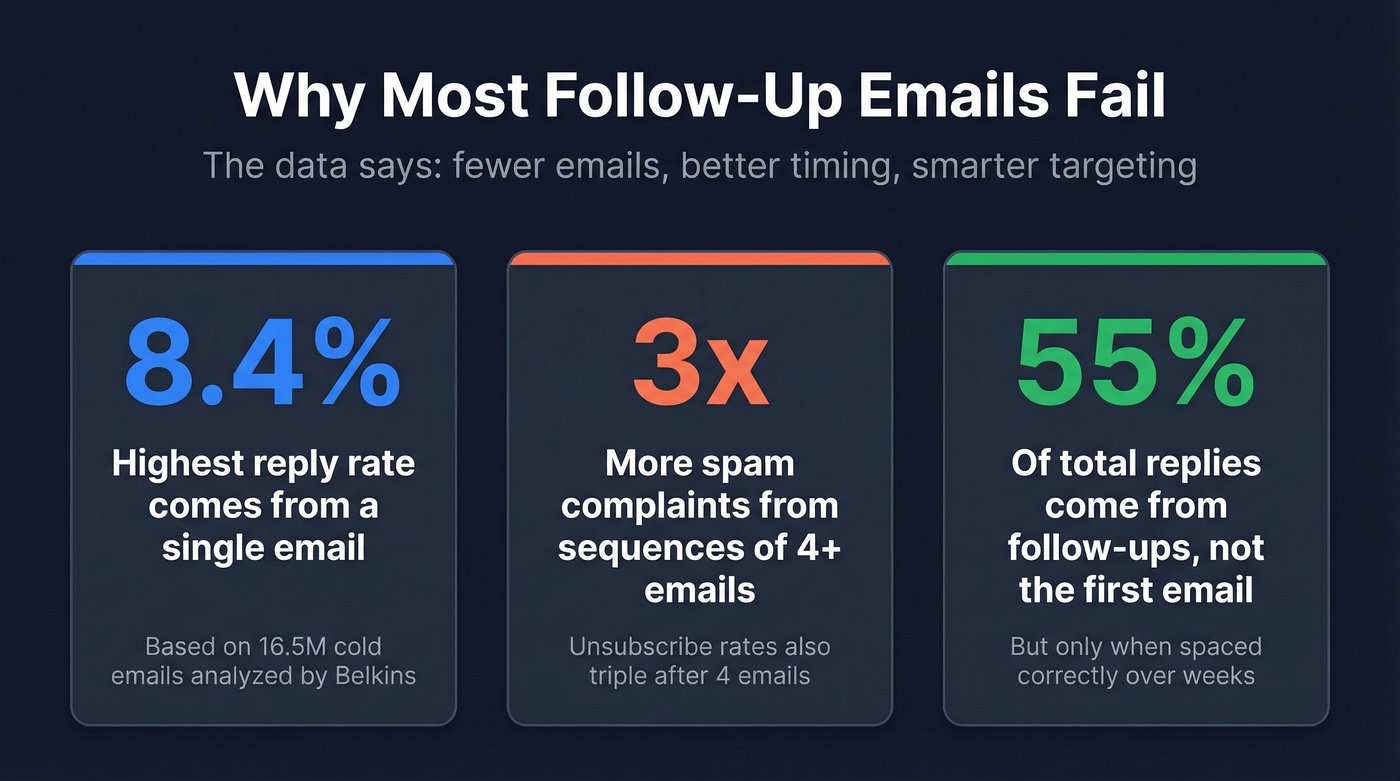
Bad phrasing is only half the problem, though. Belkins analyzed 16.5M cold emails across 93 business domains and found the highest reply rate - 8.4% - came from a single email. Every additional follow-up dragged that number down. Sequences of 4+ emails more than tripled spam complaints and unsubscribe rates.
The takeaway isn't "never follow up." It's that most people follow up too many times, with too many words, using phrases that make the recipient cringe. If you need more than three follow-ups, the problem isn't your email - it's your targeting, your offer, or your data.
Phrases to Use vs. Phrases to Avoid
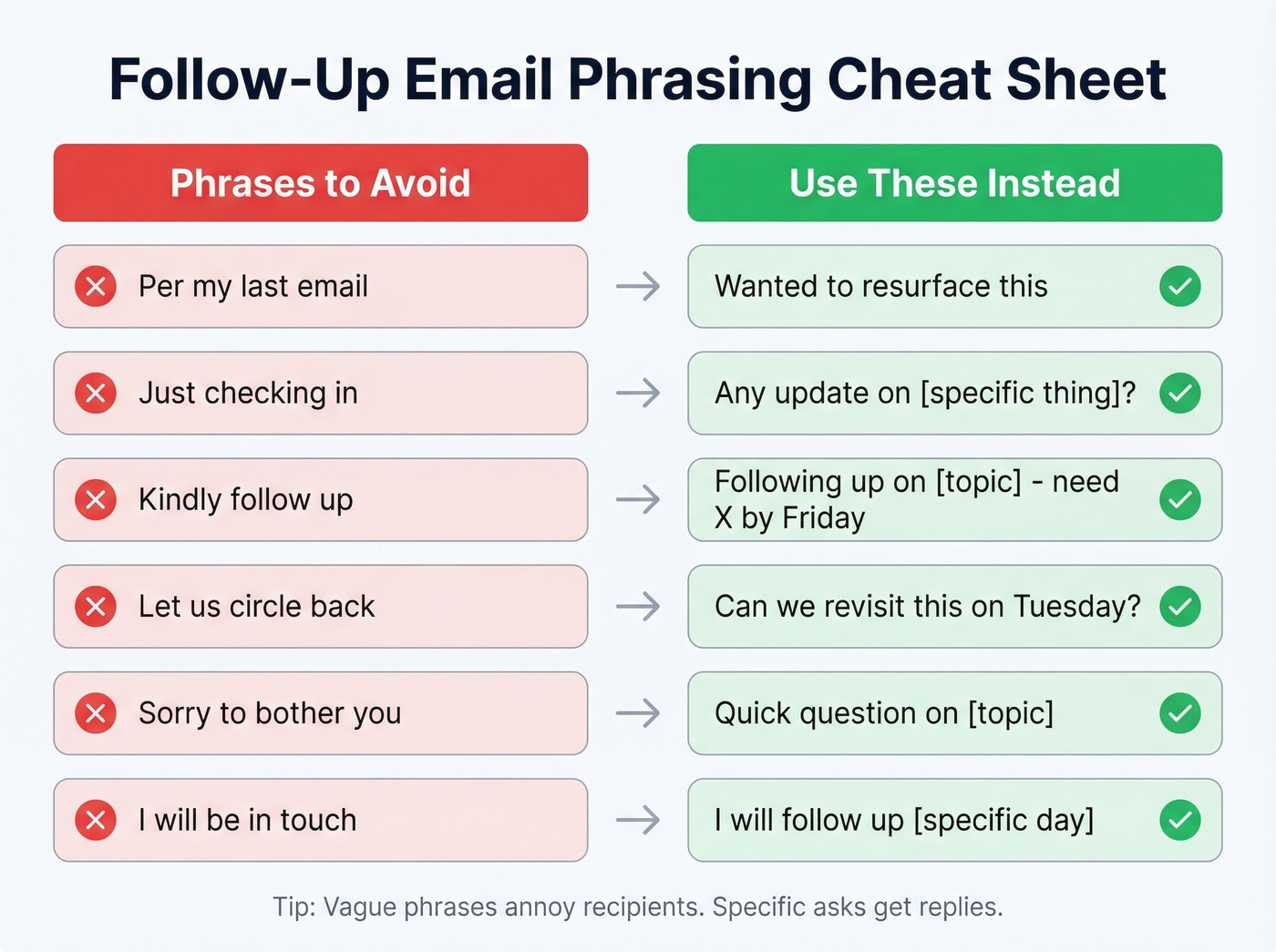
A quick note for non-native English speakers: "kindly" in "kindly follow up" reads as condescending in most English-speaking workplaces. It sounds polite in translation but passive-aggressive in practice. The consensus on that Reddit thread is pretty clear - just don't.
| Avoid | Use Instead |
|---|---|
| "Per my last email" | "Wanted to resurface this" |
| "Just checking in" | "Any update on [specific thing]?" |
| "Kindly follow up" | "Following up on [topic] - need X by Friday" |
| "Let's circle back" | "Can we revisit this on Tuesday?" |
| "Sorry to bother you" | "Quick question on [topic]" |
| "I'll be in touch" | "I'll follow up [specific day]" |

Perfect phrasing won't save a follow-up sent to a dead inbox. 30% of B2B emails go stale every year. Prospeo's 5-step verification - with catch-all handling, spam-trap removal, and honeypot filtering - delivers 98% accuracy so your circle-back actually reaches a human.
Stop following up into the void. Verify the address first.
5 Ready-to-Use Templates
Every template below keeps the body under 50 words. We've tested dozens of variations over the years - short always wins. Stop writing longer follow-ups.
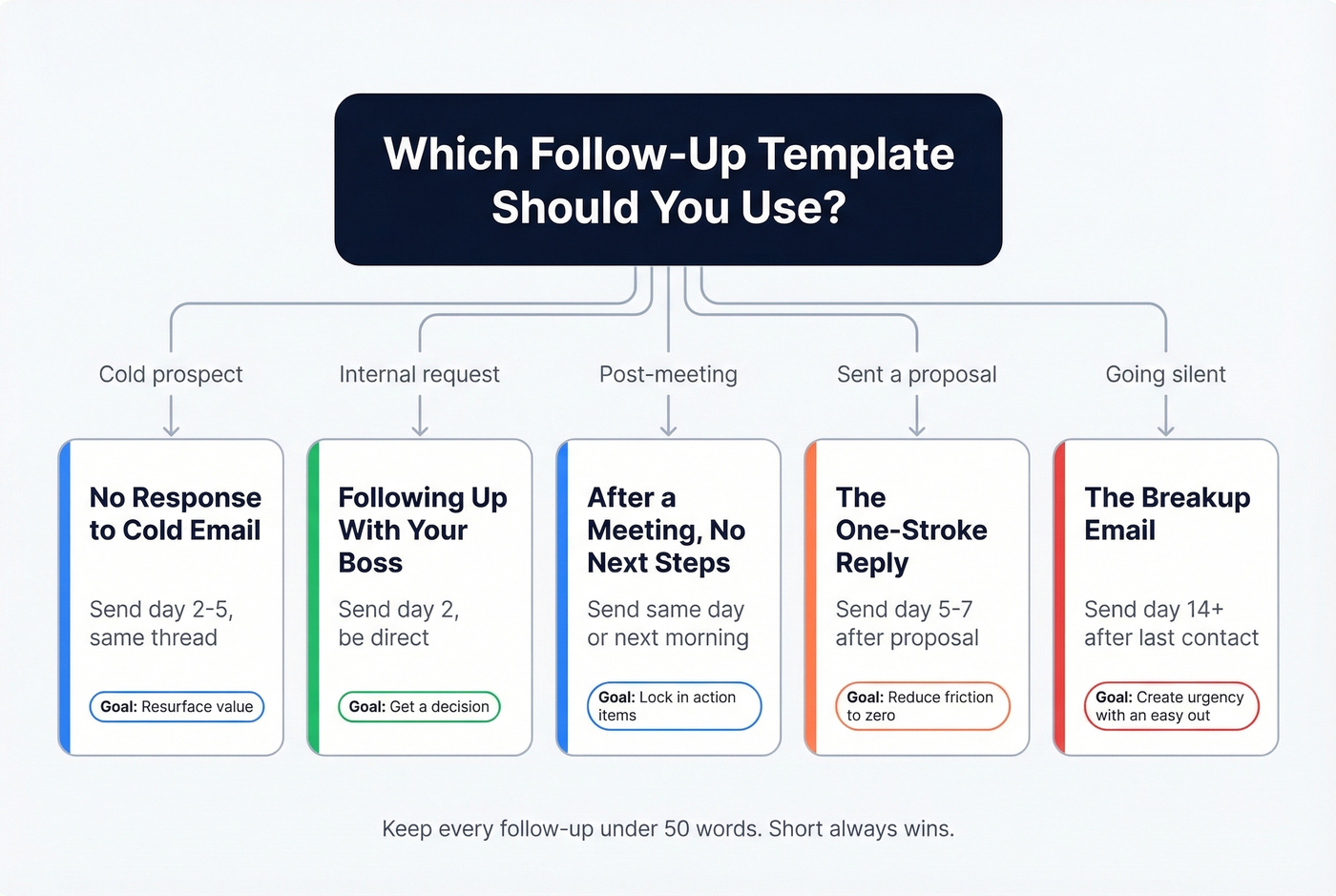
No Response to a Cold Email
Send 2-5 days after your initial email. Reply in the same thread - don't start a new one.
Hi [Name], I sent this over a few days ago and wanted to make sure it didn't get buried. Would a quick idea for [specific value] be worth a follow-up next week?
Following Up With Your Boss
No softeners needed - your boss wants directness. Send this 2 days after your original request.
Hi [Name], circling back on this - I need your input on [specific decision] by [date] to keep [project] on track. Happy to jump on a 5-min call if easier.
After a Meeting With No Next Steps
Send same day or next morning. This isn't really a follow-up - it's a polite accountability tool.
Subject: Re: [meeting topic]
Great conversation today. To recap: [one key takeaway]. I'll handle [your action item]. Could you send over [their action item] by [date]?
The One-Stroke Reply
This is the most underrated template on the list. Send it 5-7 days after a proposal. Reducing friction is the whole game.
Hi [Name], wanted to make this easy. Hit reply with: 1 = let's move forward, 2 = not right now, 3 = wrong person.
I first saw a version of this in an outbound Slack community, and it consistently pulls higher reply rates than any paragraph-length follow-up we've sent. People love a low-effort response option.
The Breakup Email
Subject: Should I close your file?
Hi [Name], I haven't heard back and don't want to be a pest. Should I close this out? No hard feelings - just let me know.
Send this 14+ days after last contact. In our experience, the breakup email outperforms every other follow-up in a sequence. The implied loss of access creates urgency without pressure.
Optimal Timing and Cadence
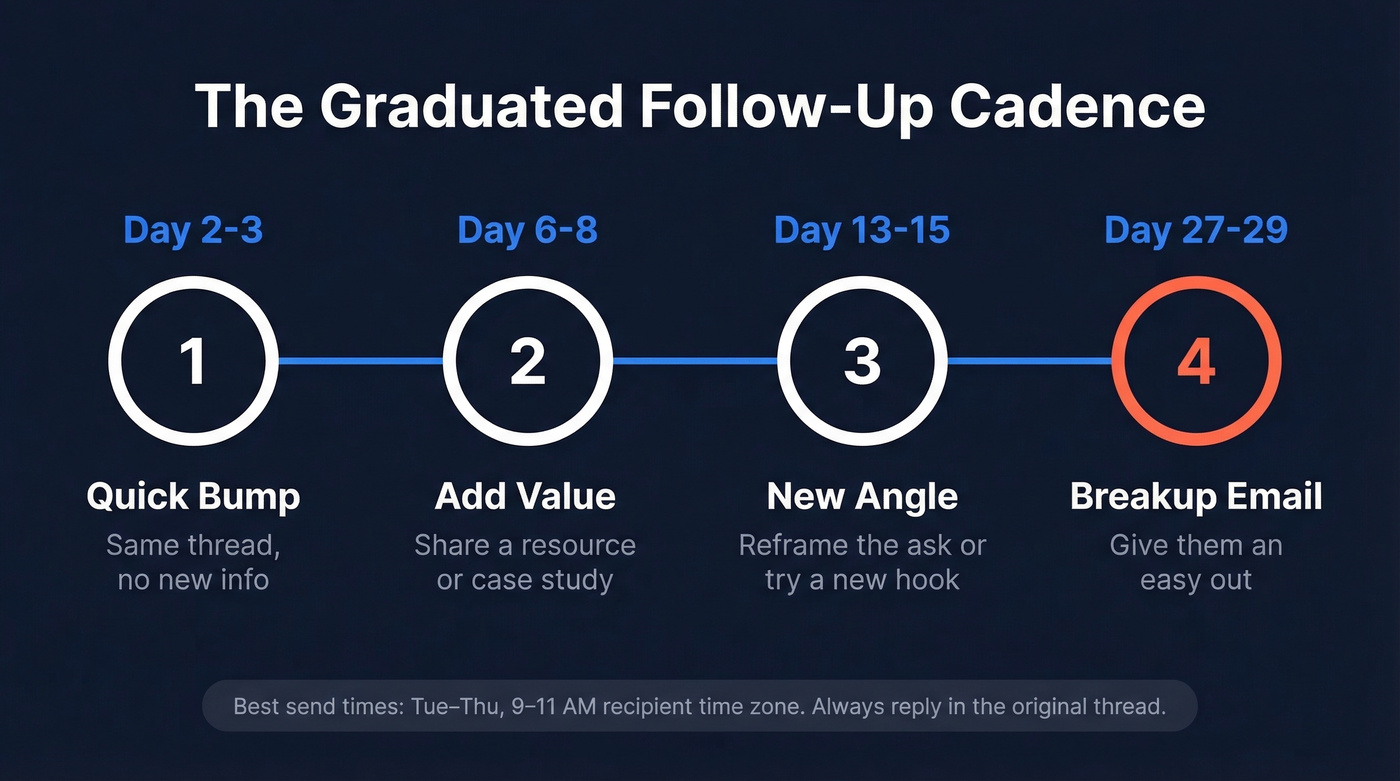
Timing matters as much as wording. Here's the graduated cadence we use:
| Touchpoint | Timing | What to Do |
|---|---|---|
| 1st follow-up | Day 2-3 | Quick bump, same thread, no new info |
| 2nd follow-up | Day 6-8 | Add value - a resource, case study, or insight |
| 3rd follow-up | Day 13-15 | New angle - reframe the ask or try a different hook |
| Final follow-up | Day 27-29 | Breakup email - give them an easy out |
Send Tuesday through Thursday, 9-11 AM in the recipient's time zone (or 1-2 PM if you miss the morning window). Mondays are inbox chaos. Fridays are mental checkout.
Always reply in the original thread. It preserves context and makes it obvious they haven't responded - without you having to say so.
Here's the nuance most sales blogs get wrong: while the first email gets the highest individual reply rate, 55% of total replies come from follow-ups - the key is spacing them right. And that "12-13 touches to convert a lead" stat floating around? That's across all channels - email, phone, social, voicemail. It doesn't mean send 13 emails. After 3-4 emails with no response, switch channels entirely. A social message plus profile visit combo hit 11.87% reply rates in Belkins' data - higher than any email-only sequence.
Here's the thing: if someone hasn't replied after three well-timed, well-written emails, the answer is already no. A fourth email won't change their mind. A different channel or a better offer might.
Make Sure Your Email Actually Arrives
Most follow-up guides skip this entirely, and it drives us crazy. Around 30% of B2B email addresses go stale every year. People change jobs, companies restructure, domains expire. A bounced email doesn't always generate a clear notification - sometimes it just vanishes into server logs you never check.
Before you send another follow-up, verify the address. Prospeo runs a 5-step verification process - catch-all handling, spam-trap removal, honeypot filtering - and delivers 98% email accuracy. The free tier gives you 75 verifications per month. It takes seconds, and it'll tell you whether your silence problem is actually a data problem.
Skip this step if you're only following up with people who've already replied to you before - their address is obviously valid. But for cold outreach or contacts you haven't heard from in months? Verify first.
If you're building a bigger outbound system, pair verification with data enrichment and a clean contact management workflow so follow-ups go to the right person, at the right company, every time.
If three well-timed follow-ups get silence, the problem isn't your copy - it's your data. Prospeo gives you 300M+ verified contacts with emails refreshed every 7 days, so you're never circling back to someone who left the company two months ago.
Fresh data means fewer follow-ups and more replies.
FAQ
How long should I wait before following up on an email?
Wait at least three days. A three-day gap boosts reply rates by 31% compared to next-day follow-ups. For cold outreach, 3-5 days is the sweet spot; for internal emails to colleagues, two business days works fine.
How many follow-up emails is too many?
Three to four, maximum. Sequences of 4+ emails more than triple spam complaints and unsubscribe rates. After three with no response, switch to phone, social, or a different value proposition entirely.
What if my follow-up emails never get any replies at all?
The problem is likely bad contact data, not your wording. Around 30% of B2B addresses go stale annually, and bounced emails often generate no notification. Verify addresses before sending another follow-up - if they're valid and you're still getting silence after three attempts, switch channels or rethink your offer.