

How to Gather Competitive Intelligence: The Practitioner's Playbook
The average sales team rates itself 3.8 out of 10 for competitive preparedness. Let that number sit for a second. A RevOps lead we know ran a quarterly CI review and discovered her reps couldn't name the primary competitor in most lost deals - the CRM "competitor" field was blank, the battlecards were stale, and the so-called "competitive intelligence program" was one PMM Googling things when a deal got stuck.
She's not alone. 68% of B2B sales deals involve at least one direct competitor, yet nearly half of reps don't know who they're competing against until negotiation. That gap between "we do CI" and "CI changes how we sell" is where programs die.
Here's how to build one that doesn't.
What You Need (Quick Version)
- Define 5-7 Key Intelligence Questions tied to outcomes - not "what's the competitor doing?" but "why are we losing to them in mid-market healthcare?"
- Set a weekly 30-minute monitoring cadence. Consistency beats intensity.
- Run win/loss interviews on every closed deal. The single highest-ROI CI activity, and most teams skip it.
- Build one living battlecard per top competitor. Teams that update battlecards monthly report up to a 59% win-rate lift.
- Measure adoption, not collection. A battlecard nobody opens is worse than no battlecard at all.
Here's the thing: you don't need a $30K CI platform to run a CI program. You need a disciplined process and clean data. The tools come later.
Gathering Competitive Intelligence in 7 Steps
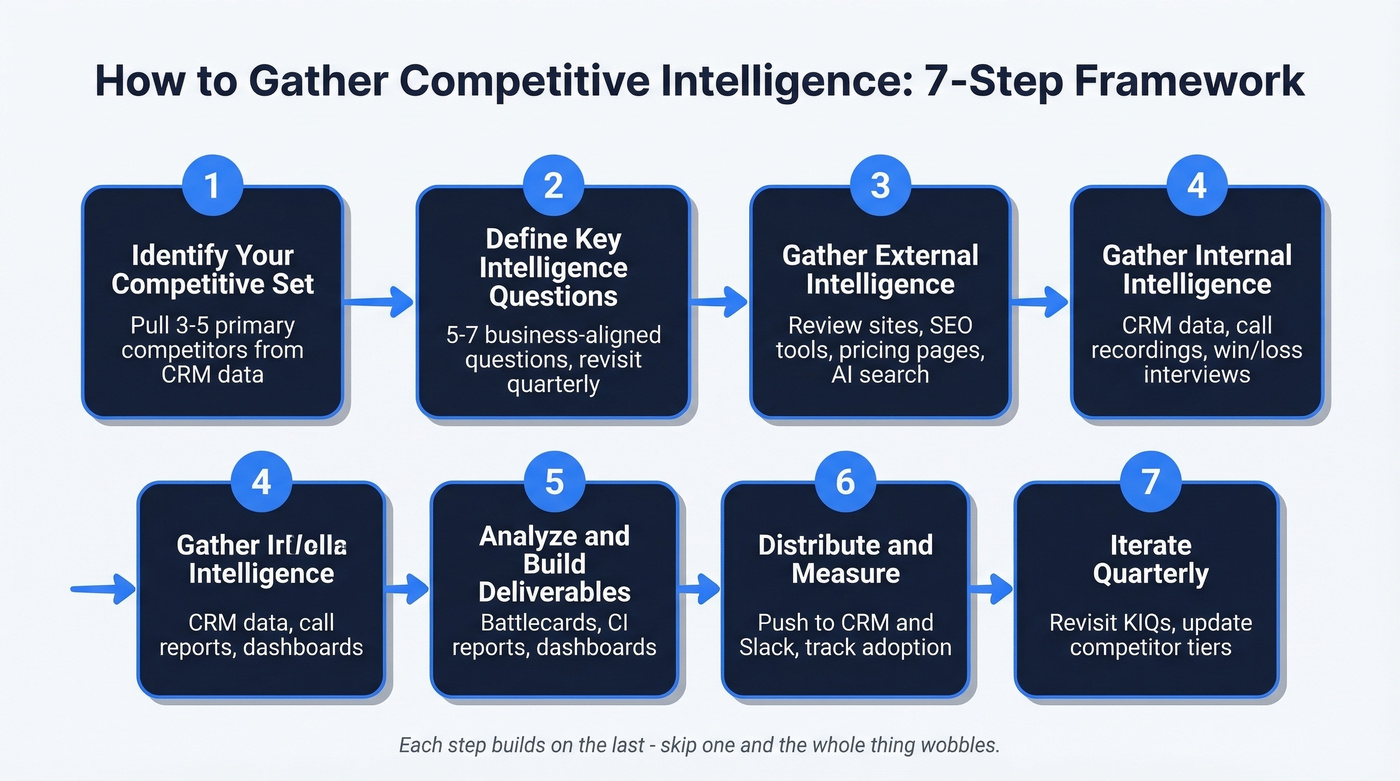
Each step builds on the last. Skip one and the whole thing wobbles.
1. Identify Your Competitive Set
Pull every competitor name from closed-won and closed-lost deals in the past 12 months. Sort by frequency. Your primary competitors are the 3-5 names that appear most often - the ones reps actually face in live deals, not the ones your CEO worries about at conferences. Add a secondary tier of emerging players from RFPs, and an aspirational tier of market leaders you position against.
Three tiers, clearly defined. Don't try to track 20 competitors equally. You'll drown.
2. Define Key Intelligence Questions
This step separates useful CI from a pile of screenshots. Key Intelligence Questions (KIQs) are the specific, business-aligned questions your program exists to answer:
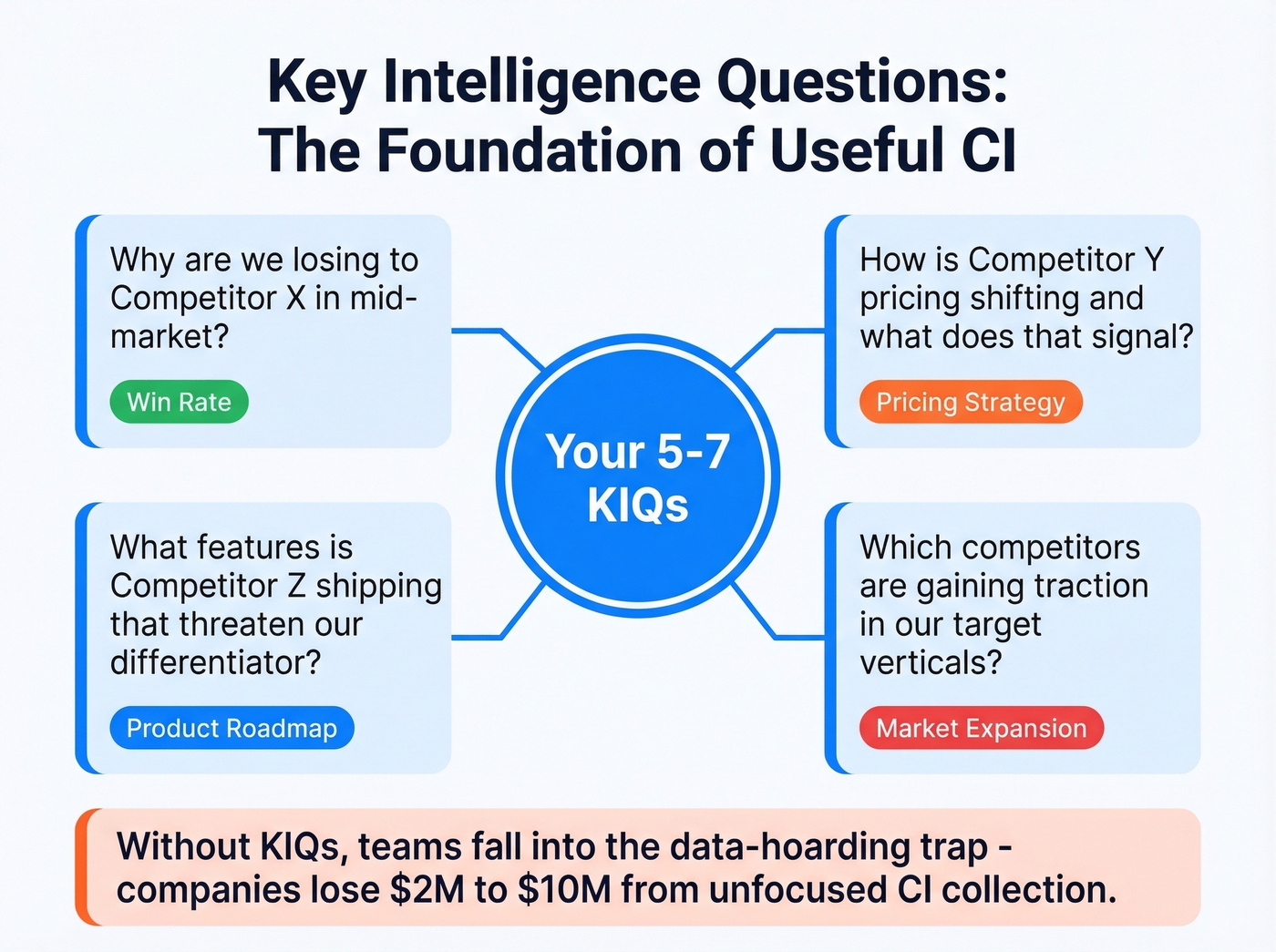
- Why are we losing to Competitor X in mid-market?
- How is Competitor Y's pricing shifting, and what does that signal?
- What features is Competitor Z shipping that threaten our differentiator?
- Which competitors are gaining traction in verticals we're entering?
Without KIQs, teams fall into the data-hoarding trap - companies lose an estimated $2-$10M from unfocused CI collection. Five to seven KIQs is the sweet spot. Revisit them quarterly.
3. Gather External Intelligence
Knowing which data sources to tap first saves you from drowning in noise. Review sites like G2, Capterra, and TrustRadius are goldmines - read competitors' 1-star and 3-star reviews for real objections and unmet needs. Competitor websites and pricing pages deserve monthly tracking; tools like Visualping catch messaging shifts and pricing restructures automatically.
For SEO and content analysis, Semrush and Ahrefs reveal what competitors rank for, what content they're investing in, and where paid spend is going. These aren't just marketing tactics - they're strategic priorities made visible. Monitor AI search results too: check how competitors appear in ChatGPT, Gemini, and Perplexity responses weekly. When a prospect asks an AI assistant "what's the best [your category] tool?", who shows up?
Round out monitoring with Google Alerts (free) and Feedly ($6/mo) for organized news feeds.
4. Gather Internal Intelligence
External data tells you what competitors are doing. Internal data tells you what's actually working against you in deals - and it's far more valuable.
CRM data is the foundation: win/loss ratios by competitor, deal velocity, discount depth. If your competitor field is unreliable (and it probably is), fixing that is job one. Sales call recordings from Gong or Chorus surface objections and positioning gaps that never make it into CRM notes.
Win/loss interviews are the most valuable CI activity you can run. Period. Talking to buyers who chose you - and especially those who didn't - produces insights no dashboard replicates. The catch: reaching churned customers and lost prospects requires verified contact data. If your outreach bounces, you never get the interview. We've found that Prospeo's 98% email accuracy with a 7-day refresh cycle means interview requests actually land instead of disappearing into the void.
Customer feedback from support tickets, NPS surveys, and QBRs fills the remaining gaps. Look for patterns in why customers considered switching and which competitors they evaluated.

5. Analyze and Build Deliverables
Collection without analysis is hoarding. Analyze against your KIQs - if a competitor launched a feature that doesn't affect your target segment, note it and move on. Map competitor offerings against your value proposition, identify genuine differentiation vs. parity, and flag where competitors are pulling ahead.
Think of your CI deliverables like a library system, not a bookstore - everything organized, searchable, and maintained. You need three types:
- Battlecards - one per primary competitor with positioning, objections, pricing, and win/lose patterns
- CI reports - quarterly strategic documents for leadership
- Dashboards - real-time win rates by competitor in your CRM or BI tool
74% of technology and service providers now prioritize CI. Battlecards are how that priority reaches the sales floor.
6. Distribute and Measure
Push battlecards into tools reps already use - CRM, Slack, Gong. If a rep has to leave their workflow to find CI, they won't use it.
Track opens, not just creation. Among companies using battlecards, 71% report improved win rates, but only when reps actually open them. Reps save 8-12 hours per month on competitor research when CI tools are properly deployed - that's the adoption metric worth tracking, not "number of competitor updates published."
Win/Loss Programs: CI's Highest Lever
Win/loss deserves its own section because it's the highest-leverage CI activity and the one most teams either skip or botch entirely. The fastest way to make CI useful is to turn it into buyer-backed insights that sales, product, and leadership actually act on.
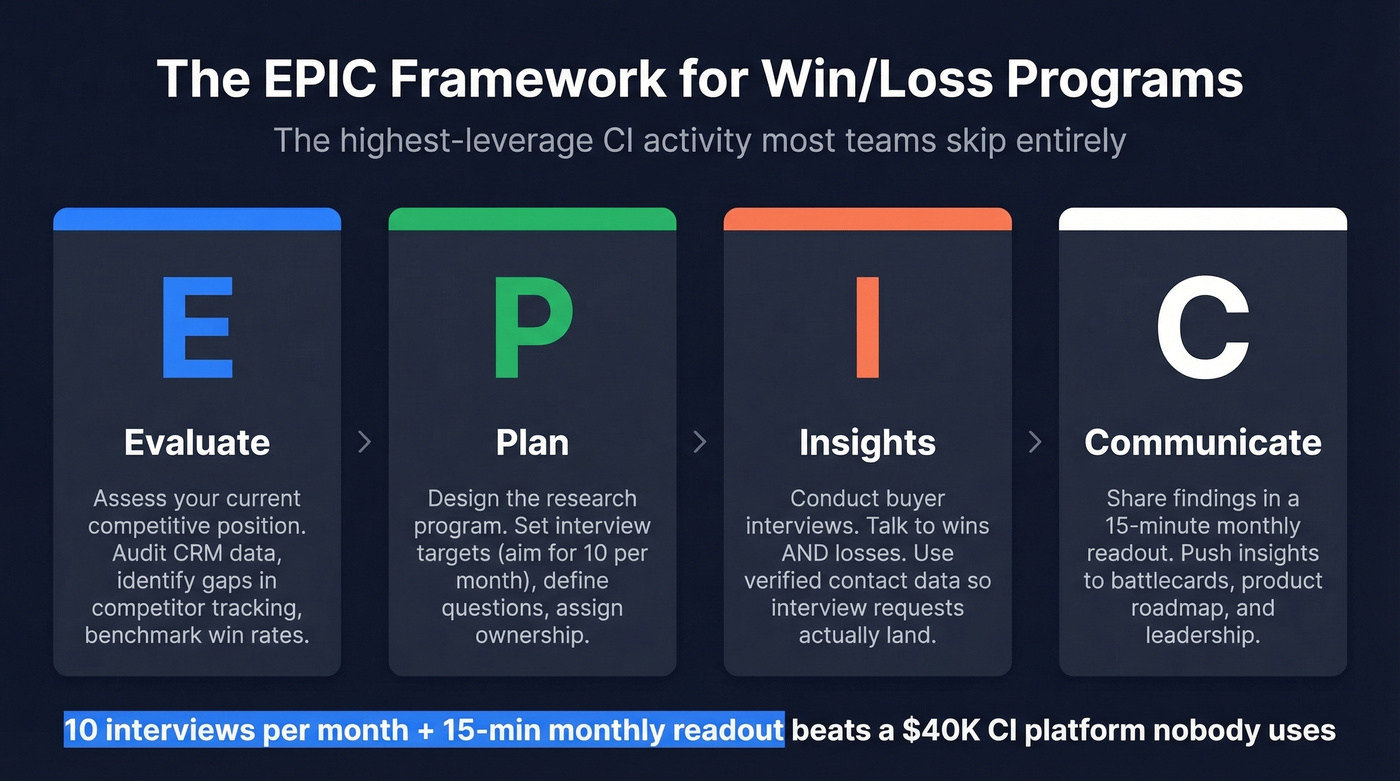
The EPIC framework provides structure: Evaluate your competitive position, Plan the research program, generate Insights through interviews, and Communicate findings to drive action. Nearly all mature win/loss programs now have executive visibility, and the best ones aren't built FOR leadership - they're built WITH leadership.
Let's be honest about what works: a win/loss program that interviews 10 buyers per month and shares findings in a 15-minute monthly readout will outperform a $40K CI platform that nobody uses. Start with the interviews. The consensus on r/sales is that most reps have never once been asked to participate in a structured win/loss debrief, which tells you how much low-hanging fruit exists.

Your win/loss program dies when interview requests bounce. Prospeo's 98% email accuracy and 7-day data refresh mean you actually reach the buyers who chose your competitor - so you get the insights that change how you sell.
Stop losing CI interviews to bad contact data.
CI Tool Stack with Pricing
SoftwareOne's $1.4B acquisition of Crayon in 2025 signaled how seriously the market takes CI tooling. Here's what exists and what it costs:
| Category | Tool | Best For | Starting Price |
|---|---|---|---|
| All-in-One CI | Crayon | Battlecards, auto tracking | ~$20K-$40K/yr |
| All-in-One CI | Klue | Sales enablement, win/loss | ~$20K-$40K/yr |
| All-in-One CI | Kompyte | Budget CI platform | From $300/yr |
| SEO & Traffic | Semrush | Competitor SEO, ads | From $139/mo |
| SEO & Traffic | Ahrefs | Backlinks, content gaps | From $129/mo |
| SEO & Traffic | SimilarWeb | Traffic benchmarking | From $125/mo |
| SEO & Traffic | SpyFu | PPC competitor research | From $39/mo |
| Social & Monitoring | Brand24 | Social listening | From $199/mo |
| Social & Monitoring | Feedly | News/content monitoring | From $6/mo |
| Social & Monitoring | Google Alerts | Basic news monitoring | Free |
| AI Search Intel | AIclicks | AI citation tracking | From $79/mo |
| Market Intel | AlphaSense | Financial/market research | ~$24K/yr per user |
| Market Intel | Crunchbase | Funding, company data | From $99/mo |
| B2B Data | Prospeo | Verified emails (98%), 7-day refresh | Free tier; ~$0.01/email |
| B2B Data | ZoomInfo | Enterprise contact DB | From ~$15K/yr |
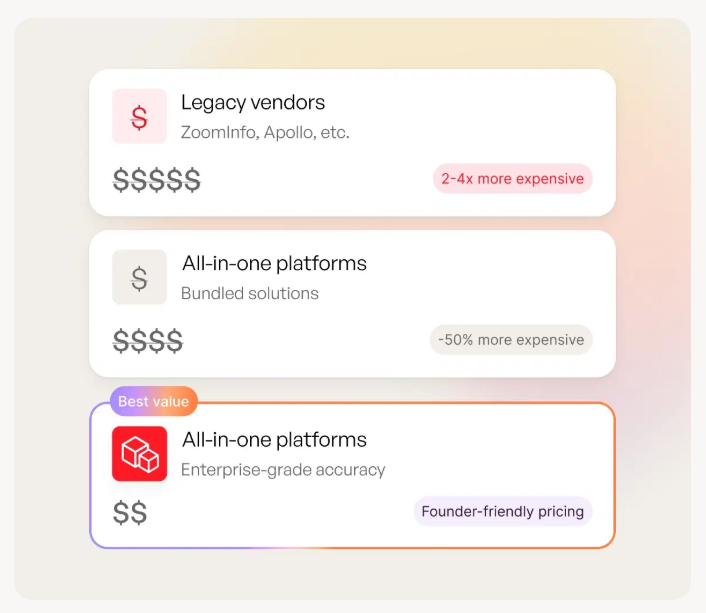
Building from scratch on a real budget? Semrush ($139/mo) for competitor SEO and ad intelligence, Google Alerts (free) for news monitoring, and a verified email tool for win/loss interview outreach. Under $150/mo covers 80% of what you need. Add Crayon or Klue when your program matures and you've got the internal process to justify the spend.
Skip AlphaSense unless you're in financial services or doing heavy M&A research - it's powerful but wildly expensive for standard CI work.
CI Mistakes That Kill Programs
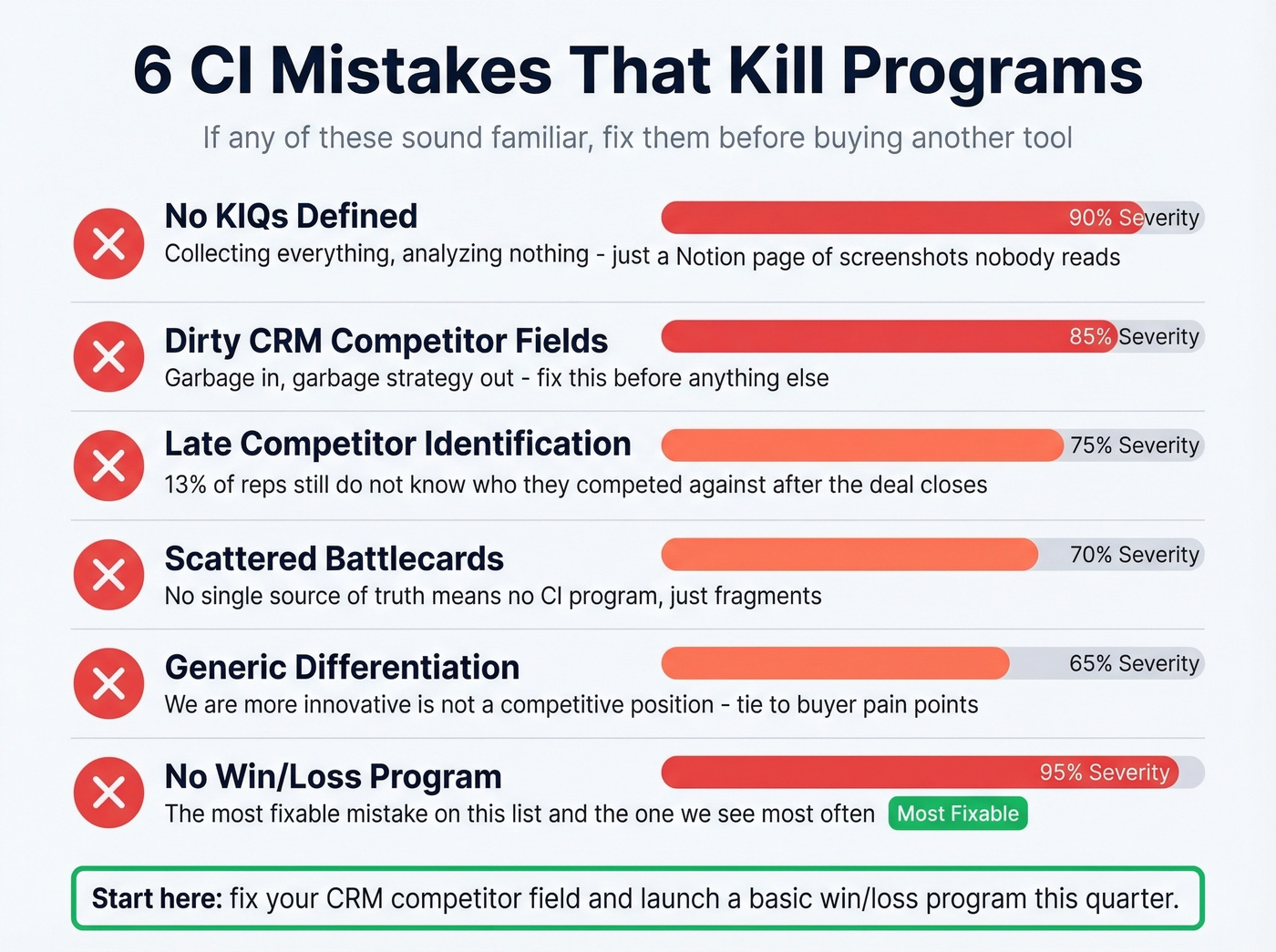
- No KIQs defined. Teams collect everything and analyze nothing. You end up with a Notion page of competitor screenshots nobody reads.
- Dirty CRM competitor fields. Garbage in, garbage strategy out.
- Late competitor identification. 13% of reps still don't know who they competed against after the deal closes. By then, CI can't help.
- Scattered battlecards. No single source of truth means no CI program - just fragments.
- Generic differentiation. "We're more innovative" isn't a competitive position. Tie every differentiator to a specific buyer pain point with evidence from win/loss interviews.
- No win/loss program. The most fixable mistake on this list, and the one we see most often.
Measuring CI ROI
If you can't tie CI to numbers the CFO cares about, your program gets cut in the next budget cycle. Benchmark ranges that justify investment:
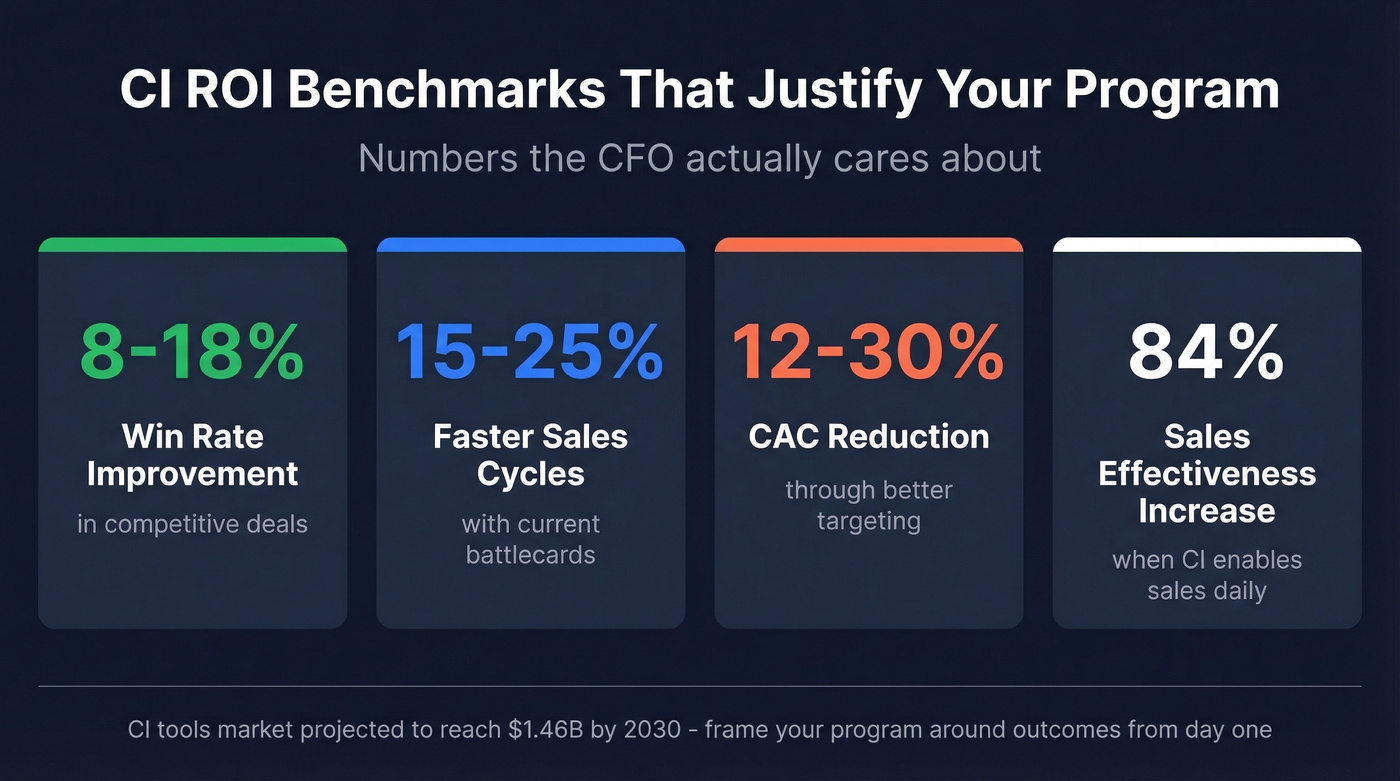
- 8-18% win rate improvements in competitive deals
- 15-25% faster sales cycles with current battlecards
- 12-30% CAC reduction through better targeting
- 84% increase in competitive sales effectiveness when CI enables sales daily
The CI tools market is projected to reach $1.46B by 2030. Frame your program around outcomes from day one - not "we collected 47 competitor updates" but "battlecard-assisted deals closed at 14% higher rates."
CI Techniques for the AI Era
AI search engines - ChatGPT, Gemini, Perplexity - are becoming a primary research channel for B2B buyers, and most CI programs aren't tracking competitor visibility there at all. AI adoption within CI teams has surged 76% year-over-year, with 60% of practitioners using AI tools daily.
The real opportunity is monitoring AI outputs. When a prospect asks Perplexity "what's the best project management tool for mid-market?" - does your product appear? Tools like AIclicks ($79/mo) track this, but even manual weekly checks of 10-15 category prompts across ChatGPT and Perplexity give you signal your competitors are missing entirely. In our experience, this is the 2026 differentiator that separates CI programs running on autopilot from ones generating genuine strategic advantage.
Competitive intelligence starts with knowing who you're losing to - and reaching them. Prospeo gives you 300M+ verified profiles with 30+ filters so you can build targeted lists of churned accounts, lost prospects, and competitor customers in minutes.
Turn your competitor's customers into your best intelligence source.
FAQ
What's the difference between competitive and market intelligence?
CI focuses on specific competitors - their products, pricing, positioning, and why you win or lose against them. Market intelligence covers broader industry trends and segment dynamics. Most CI programs use market intelligence as context, but the deliverables are competitor-specific.
What are the best sources of competitive intelligence?
The highest-value sources combine external and internal data. Externally: review sites like G2 and Capterra, competitor websites, SEC filings, and SEO tools like Semrush. Internally: CRM win/loss data, sales call recordings, and buyer interviews. The internal sources are almost always more actionable.
How often should you update battlecards?
Monthly at minimum. Assign ownership per competitor, review CRM win/loss data each cycle, and prioritize the cards that need the most attention. Stale battlecards erode rep trust fast - if a rep finds outdated pricing once, they stop checking entirely.
Is competitive intelligence legal?
Yes - when gathered from public sources like websites, review sites, SEC filings, and patent databases. CI crosses the line with theft, bribery, hacking, or misrepresentation. If you'd be uncomfortable explaining your method to a journalist, don't do it.