

How to Generate Leads for SEO in 2026 (Data + Playbook)
You're getting 10,000 organic sessions a month and generating 12 leads. Your content team is proud of the traffic graph. Your sales team is wondering where the pipeline is. The disconnect isn't your domain authority or your publishing cadence - it's that you're targeting the wrong keywords and letting conversions leak through broken pages. If you want to generate leads through SEO, the answer starts with intent, not volume.
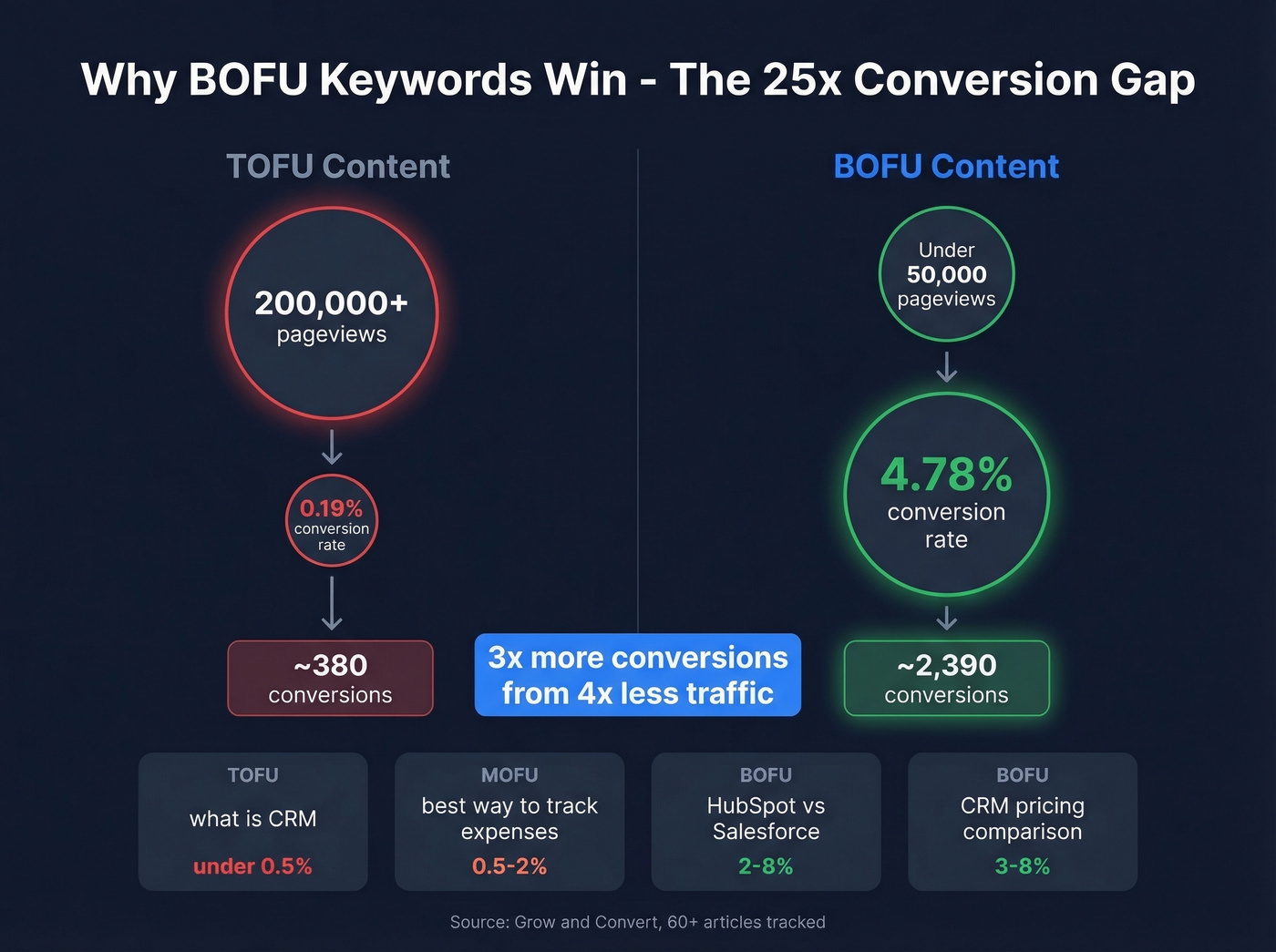
BOFU content converts at 4.78% - that's 25x higher than TOFU's 0.19%. The rest of this playbook shows you how to exploit that gap.
The Short Version
Website and blog SEO is the #1 ROI-generating channel for marketers, and 32.9% of internet users discover new brands through search. But traffic alone doesn't close deals.
- Target BOFU keywords first. Comparison pages, pricing pages, and case studies convert 25x better than awareness content.
- Fix conversion paths before chasing more traffic. CTAs, forms, trust signals - audit them now.
- Measure leads, not sessions. Set up GA4 event tracking for forms, calls, and chat before you publish another blog post.
- Build pages for buyers, not browsers. Decision-stage content drives pipeline. Informational content drives vanity metrics.
- Verify contact data before your sales team calls. A form submission with a dead email is a wasted click.
SEO Lead Gen Benchmarks
Before you optimize anything, you need to know what "good" looks like. These benchmarks come from First Page Sage's analysis of 124 clients and Ruler Analytics' 100M+ datapoint study.
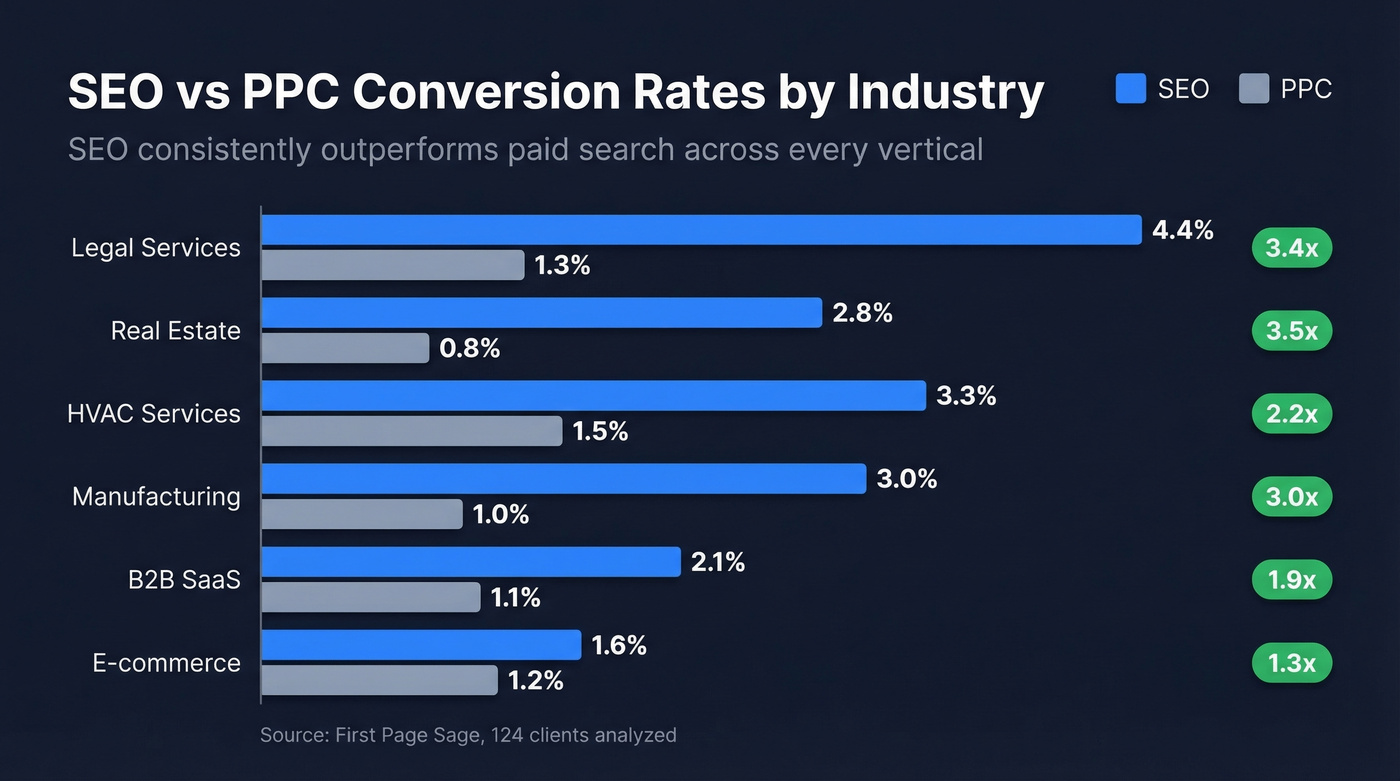
| Industry | SEO Conv. Rate | PPC Conv. Rate | SEO Advantage |
|---|---|---|---|
| Legal Services | 4.4% | 1.3% | 3.4x |
| HVAC Services | 3.3% | 1.5% | 2.2x |
| Manufacturing | 3.0% | 1.0% | 3.0x |
| Real Estate | 2.8% | 0.8% | 3.5x |
| B2B SaaS | 2.1% | 1.1% | 1.9x |
| E-commerce | 1.6% | 1.2% | 1.3x |
For legal services, that 3.4x advantage means SEO drives more than three times the conversions per visit compared to paid search. For real estate, it's 3.5x. These aren't marginal differences - they're fundamentally different economics.
The cross-industry average sits at 2.9% for qualified leads, split roughly between a 1.7% form rate and a 1.2% call rate. If you're below 1.5%, you've got a sales conversion rate problem, not a traffic problem.
First Page Sage ran a budget illustration for a commercial insurance company spending $250k/year. SEO generated roughly 11,000 visitors at a 1.7% conversion rate - 187 MQLs, 37 closed clients. The same budget on PPC? 8,600 visitors, 0.9% conversion, 77 MQLs, 15 clients. Less than half the output. Organic search consistently outperforms paid channels when you measure downstream revenue rather than just clicks.
For trades and home services, the gap is even wider. CI Web Group's latest data shows SEO delivering 19.9x ROAS vs 4.4x for paid ads, with a cost per paying customer of $126.09 (SEO) vs $552.93 (PPC).
Target BOFU Keywords First
This is the single highest-leverage change most teams can make. Grow & Convert tracked conversion rates across 60+ articles and found BOFU content converting at 4.78% while TOFU content limped along at 0.19%. Even when TOFU drove 200k+ pageviews compared to under 50k for BOFU, the bottom-of-funnel content generated 3x more conversions.
Most content teams default to awareness-stage keywords because they have higher search volume. That's backwards.
Map your keywords to funnel stages before you write a single word:
| Funnel Stage | Keyword Pattern | Example | Typical Conv. Rate |
|---|---|---|---|
| TOFU | "what is [topic]" | "what is CRM" | <0.5% |
| MOFU | "best way to [solve]" | "best way to track expenses" | 0.5-2% |
| BOFU | "[brand] vs [brand]" | "HubSpot vs Salesforce" | 2-8% |
| BOFU | "[solution] pricing" | "CRM pricing comparison" | 3-8% |
The BOFU content formats that actually drive pipeline: pricing pages, competitor comparison pages, case studies with real numbers, and demo/trial landing pages. These aren't sexy content marketing - they're revenue infrastructure.
Adelman Travel proved this at scale. By prioritizing buyer-intent keywords and building decision-maker pages targeting "best" and "vendor comparison" queries, they saw a 120% increase in qualified leads and $15.5M in pipeline - up from $9.8M the prior year. That's not a content experiment. That's a business outcome driven by keyword intent.
Here's the thing: if your average deal size is under $5k, you probably don't need a 50-article content hub. You need five killer BOFU pages and a conversion path that works. Most teams over-invest in awareness content because it feels productive. Writing a comparison page that ranks for 200 searches/month and converts at 5% will outperform a thought leadership piece that ranks for 10,000 searches/month and converts at 0.1%. Every time.
Build Pages That Convert
Ranking isn't the finish line. The page has to convert the visitor once they arrive. We've audited B2B sites where teams rank #1 for high-intent keywords and still generate almost no leads because the page itself was broken - buried CTAs, seven-field forms, zero social proof. The fix is usually straightforward.
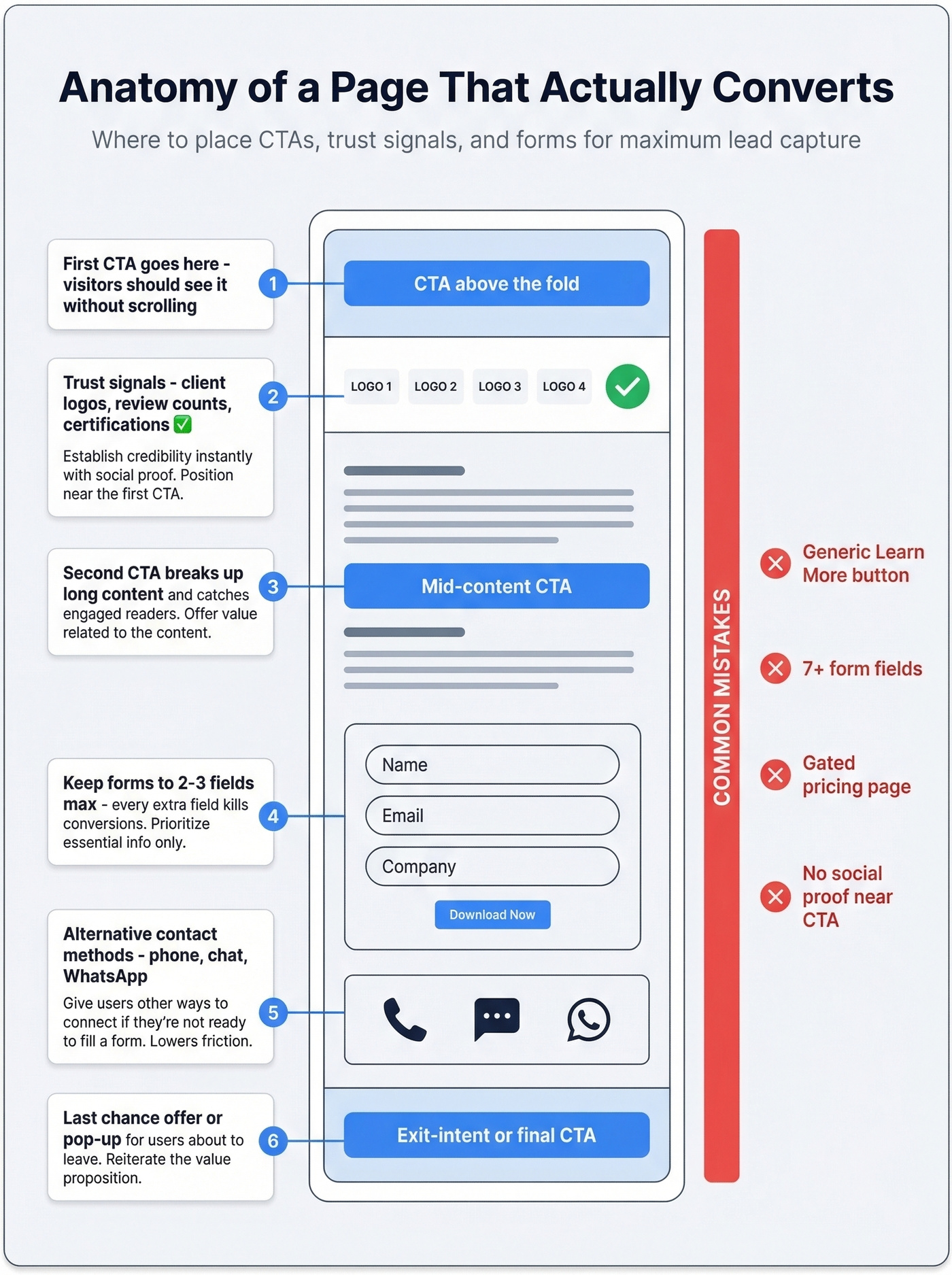
Do this:
- Place a CTA above the fold, another mid-content, and an exit-intent offer. One CTA at the bottom of a 2,000-word post isn't enough.
- Keep forms to 2-3 fields. Name, email, maybe company. Every additional field drops conversion rate.
- Offer alternative contact methods - phone, chat, WhatsApp - for prospects who won't fill out forms. 67% of customers prefer self-service over talking to a rep, so make the self-serve path frictionless.
- Add trust signals near every CTA: client logos, case study snippets, review counts, certifications. Test mobile UX obsessively - if your form is painful on a phone, you're losing half your traffic.
Skip this if you're tempted: Don't gate every piece of content. A pricing comparison page shouldn't require an email to view - that kills the conversion it's designed to create. Don't use generic CTAs like "Learn More" or "Contact Us." Specificity wins: "Get Your Free Audit," "See Pricing," "Book a 15-Min Demo." And don't bury your conversion path under navigation menus and sidebar widgets. The page should have one job. Let it do that job.
Content That Drives Pipeline
Your content calendar probably has 80% awareness content and 20% decision-stage content. Flip that ratio. That doesn't mean you never write TOFU - it means you don't start there.
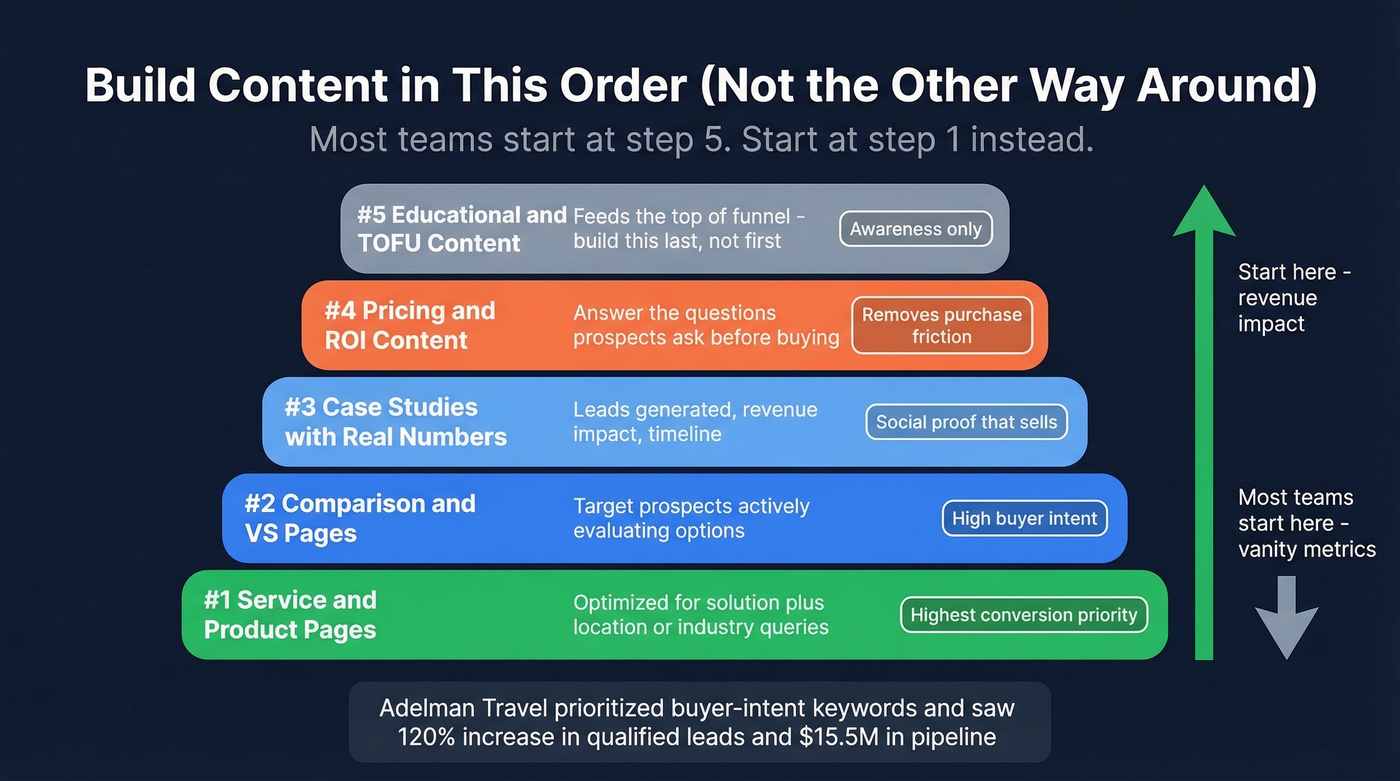
Build your content engine in this order:
- Service/product pages optimized for "[solution] + [location/industry]" queries
- Comparison and "vs" pages targeting prospects actively evaluating options
- Case studies with specific numbers - leads generated, revenue impact, timeline
- Pricing and ROI content that answers the questions prospects ask before buying
- Then educational content that feeds the top of the funnel
For local businesses, service area pages and an optimized Google Business Profile are non-negotiable. A plumber in Denver ranking for "emergency plumber Denver" is printing leads. A plumber ranking for "how to fix a leaky faucet" is giving away free advice.
One trend worth watching: roughly 30% of marketers report decreased search traffic as consumers shift to AI tools. The response isn't to abandon SEO - it's to double down on high-intent, conversion-optimized content that AI overviews can't fully replace. Nobody's buying enterprise software from a ChatGPT summary. They're still clicking through to comparison pages and pricing breakdowns.

BOFU content converts 25x better - but only if your sales team can actually reach the leads that convert. Prospeo gives you 98% verified emails and 125M+ direct dials so every form fill, every demo request, every hand-raiser gets contacted on the first try. No bounces. No dead numbers.
Stop losing SEO leads to bad contact data.
Technical SEO That Supports Lead Gen
None of the conversion work matters if Google can't crawl and render your pages properly. This isn't glamorous, but it's table stakes.
Pages should load in under 3 seconds. Use PageSpeed Insights to diagnose, compress images, defer non-critical JavaScript, and get on a CDN. Google primarily uses the mobile version of content for indexing and ranking, so if your mobile experience is degraded, your rankings suffer regardless of how good the desktop version looks.
HTTPS everywhere - no exceptions. Mixed content warnings destroy trust. Add schema markup for services, FAQ, and review content. This won't directly produce leads, but it improves click-through rates from SERPs, which feeds the entire funnel.
The most overlooked technical lever for lead generation is internal linking to money pages. Most teams link heavily between blog posts and forget to link to their actual service or product pages. Every relevant blog post should link to the page where the conversion happens. When you're selecting keywords, prioritize terms with clear purchase intent and link those posts directly to your highest-converting landing pages.
Measure Leads, Not Traffic
If your SEO dashboard shows sessions, pageviews, and keyword rankings but not leads, you're measuring the wrong things. CRO is the second-most-used optimization technique among marketers, and lead-to-customer conversion is the #2 most important KPI. Yet most teams don't have proper conversion tracking in place.
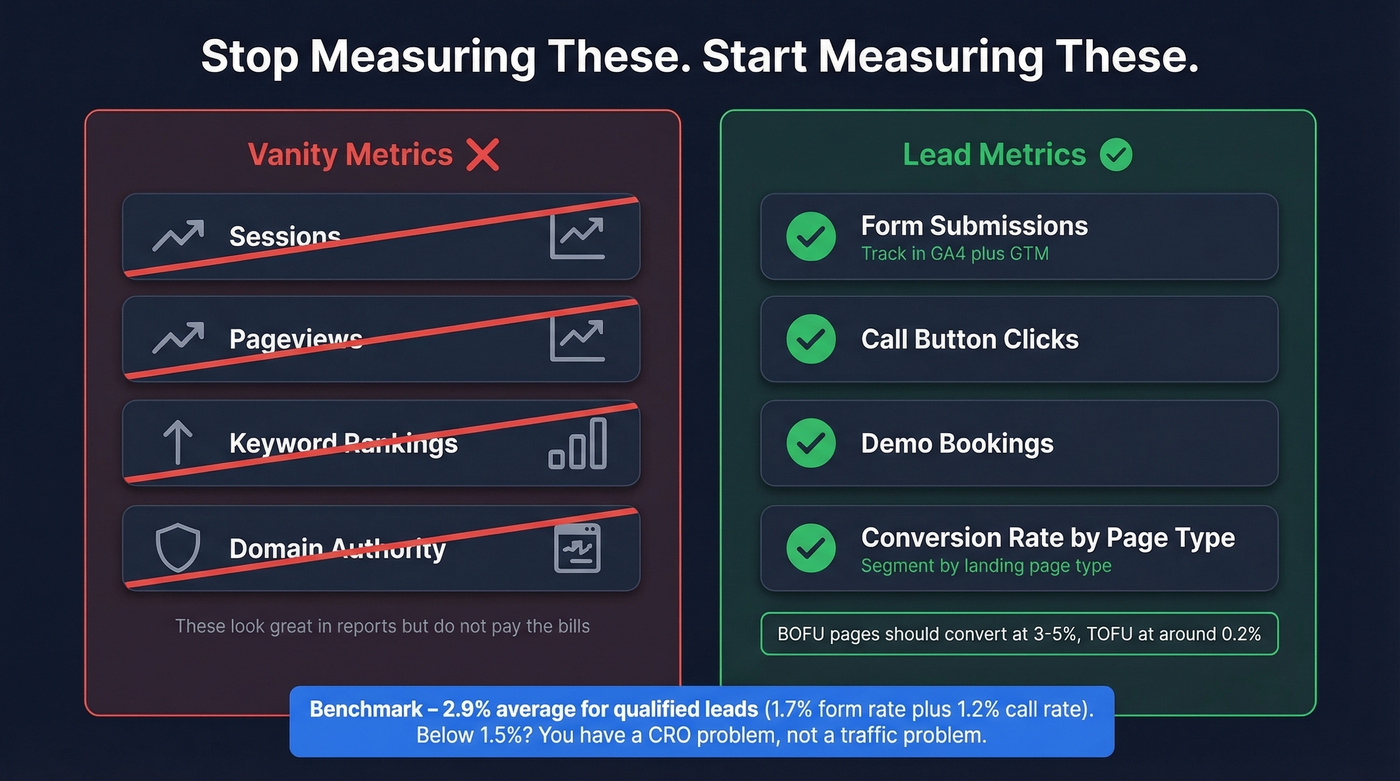
Set up GA4 + Google Tag Manager to track every lead action: form submissions, call button clicks, chat initiations, and demo bookings. Define what a "qualified lead" means before you start - not after you've been reporting inflated numbers for six months.
Track conversion rates by page type and keyword intent tier. Your BOFU comparison page should convert at 3-5%. Your TOFU blog post will convert around 0.2%. Both are fine - as long as you know which is which and allocate resources accordingly.
For teams on a budget, start with Hotjar's free tier for heatmaps and session recordings. Watch real users interact with your pages. You'll find conversion killers in 30 minutes that no amount of A/B test planning would surface.
Getting Traffic But No Leads?
This is the #1 complaint on r/SEO and r/sales: teams ranking well but generating zero pipeline. If that's you, run through this diagnostic.
Intent problems:
- You're ranking for informational queries but need transactional ones. Audit your top 20 pages by traffic and check if any target buyer-intent keywords.
- Your blog post explains the problem perfectly but never suggests your solution. Add a bridge paragraph and CTA.
UX problems:
- Weak or hidden CTAs. Add one above the fold and another mid-content. Make it visually distinct from the surrounding text.
- Poor mobile experience. Test every conversion path on a phone. Fix form fields, button sizes, and load times.
- Long forms. Cut to 2-3 fields. You can qualify later.
Trust and tracking problems:
- Missing trust signals. Add client logos, review counts, or case study links within scroll distance of your CTA.
- No conversion tracking. You might be getting leads and not knowing it. Set up GA4 events today.
- Weak internal linking. Blog posts link to other blog posts but never to your service and product pages. Fix the link architecture.
The Last Mile: Reaching the Leads You Capture
Let's be honest about a gap most SEO lead generation guides ignore entirely. A prospect finds your comparison page, reads your case study, fills out a form. Your SDR calls the number - disconnected. Sends an email - bounces. That lead took months of SEO investment to generate, and it evaporated because the contact data was stale.
We've seen this happen to teams running otherwise excellent inbound programs. You can rank, convert, and capture - but if you can't actually reach the person, the entire funnel breaks. Prospeo closes that gap with 143M+ verified emails at 98% accuracy and a 7-day data refresh cycle, so you can enrich inbound leads through CRM integrations with HubSpot and Salesforce before your sales team touches them. SEO spent months warming up that lead - don't lose them to a bounced email.

The Complete Tool Stack
| Category | Tool | Price | Notes |
|---|---|---|---|
| Keyword Research | Ahrefs | ~$99/mo | Best for backlink + SERP analysis |
| Keyword Research | Semrush | ~$130/mo | Stronger on content gap identification |
| Keyword Research | Google KW Planner | Free | Good enough for BOFU research |
| Technical SEO | Google Search Console | Free | Essential, non-negotiable |
| Technical SEO | PageSpeed Insights | Free | Core Web Vitals diagnostics |
| CRO | Hotjar | Free / ~$32/mo | Heatmaps + session recordings |
| CRO | Crazy Egg | ~$29/mo | A/B testing + scroll maps |
| Analytics | GA4 + GTM | Free | Event tracking for leads |
| Contact Data | Prospeo | Free (75 emails/mo) / ~$0.01/email | 98% accuracy, 7-day refresh, CRM enrichment |
| Automation | HubSpot CRM | Free tier | Lead routing + nurture |
| Automation | Zapier | ~$20/mo | Connect everything |
You just read that a 35% bounce rate killed pipeline for teams spending six figures on content. Prospeo's 5-step email verification and 7-day data refresh keep bounce rates under 4% - so the organic leads you worked months to rank for actually turn into conversations.
Get 98% email accuracy for $0.01 per lead - no contract required.
FAQ
How long does SEO lead generation take?
Most businesses see initial lead flow in 3-6 months, with compounding returns over 12-18 months. BOFU content targeting low-competition buyer-intent keywords can generate leads within weeks of indexing. Prioritize decision-stage pages first for the fastest pipeline impact.
What's a good conversion rate for SEO leads?
The cross-industry average is 2.9%. Above 2% is solid; below 1.5% signals a CRO problem. Legal services averages 4.4%, B2B SaaS sits around 2.1%, and e-commerce runs closer to 1.6%.
Is SEO better than PPC for lead generation?
On average, yes. SEO converts at 2.4% vs PPC's 1.3% across industries, and SEO's compounding nature means cost per lead drops over time while PPC stays flat. In trades, SEO delivers 19.9x ROAS vs 4.4x for paid ads.
How do I verify leads captured through SEO forms?
Use a data enrichment tool to validate emails and phone numbers before your sales team follows up. Prospeo's CRM enrichment returns 50+ data points per contact at 98% email accuracy, catching bounces and stale records before they waste rep time. ZoomInfo and Clearbit are alternatives, though both cost significantly more per record.