

How to Sell Managed Services: The Practitioner's Playbook
Every prospect you call already has an IT guy. Maybe it's a one-person break-fix shop, maybe it's a mid-tier MSP they signed with three years ago. Either way, they'll tell you they're happy - even when they're not. And if you've spent any time on r/msp or r/sales, the vibe is blunt: learning how to sell managed services can feel like selling paper towels. Everyone already has some, and nobody's excited to switch brands.
Here's the thing: you're not losing deals because your service is worse. You're losing them because you're selling "managed services" - a term that means nothing to the business owner writing the check. Stop selling the category. Start selling outcomes: less downtime, predictable IT costs, fewer 2 a.m. security incidents. That shift changes everything about your discovery calls, your proposals, and your close rate.
What You Need (Quick Version)
- Price per-user at $100-$250/month for most SMB clients. Adjust for industry and complexity.
- Offer 2-3 tiers, not six. Decision fatigue kills deals.
- Lead with outcomes, not features. "Prevent costly downtime" beats "24/7 monitoring and patching."
- Expect 30-90 days from first touch to signed contract for SMB deals. Enterprise takes longer.
Finding the Right Prospects
Before you write a single outreach email, make sure you're emailing the right person at a verified address. Most MSP reps waste hours chasing generic info@ addresses or outdated contacts from a conference two years ago. That's dead time you can't get back.
Start with what you already have. Check your CRM for unsigned contracts, old form fills, and stale Calendly bookings - reactivation is one of the fastest pipeline sources most MSPs ignore. Then ask your happiest clients for industry-specific referrals. Don't say "know anyone who needs IT help?" Say "know any other dental practices in the area dealing with HIPAA headaches?"
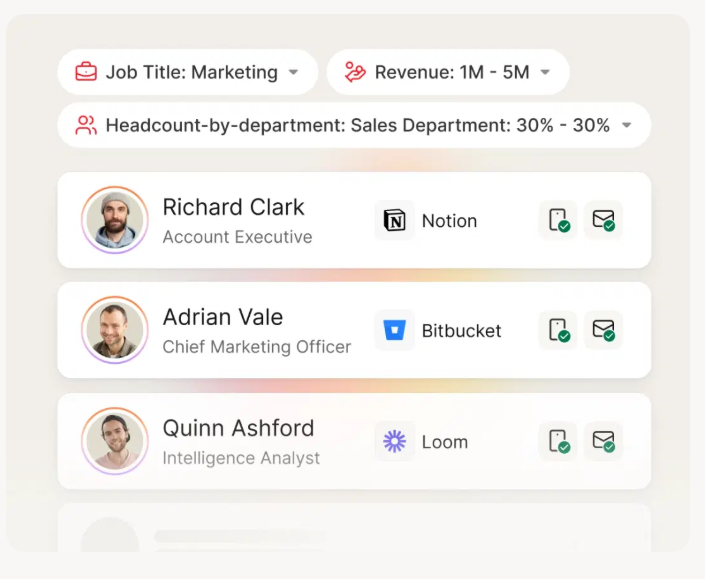
For outbound, build a segmented list and plan 5-6 touchpoints over 2-3 weeks. Trigger events matter: office moves, headcount growth, compliance deadlines, and leadership changes all signal a prospect who's open to switching. Prospeo makes this step fast - filter by company size, industry, and job title across 30+ search criteria, then export verified emails with 98% accuracy. The free tier gets you started without a credit card.
Nailing the Discovery Call
Good discovery separates MSPs who close from MSPs who quote and pray. These eight questions do the heavy lifting:
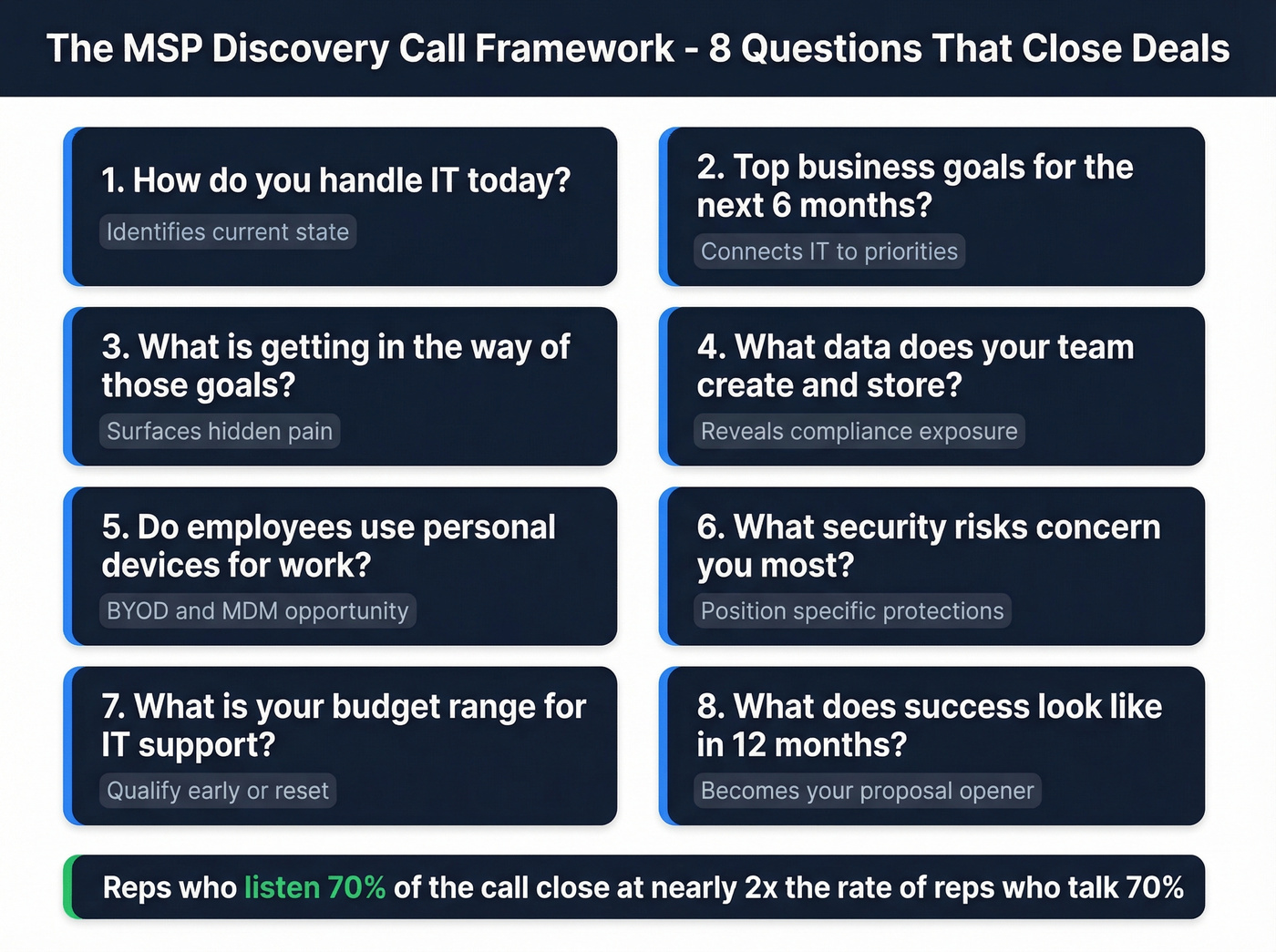
- How do you handle IT today? - Break-fix, incumbent MSP, or the office manager who "knows computers."
- What are your top business goals for the next 6 months? - Connects your service to their priorities.
- What's getting in the way of those goals? - Surfaces pain they don't associate with IT yet.
- What types of data does your team create and store? - Reveals compliance exposure like HIPAA, PCI, or SOC 2.
- Do employees use personal devices for work? - BYOD means MDM opportunity and a security conversation.
- What security risks concern you most? - Position specific protections, not generic "cybersecurity."
- What's your budget range for IT support? - Qualify early. If they expect $500/month for 50 users, reset now.
- What does success look like 12 months from now? - Their answer becomes your proposal's opening paragraph.
Every answer maps to a service tier or add-on. Listen more than you pitch. We've found that reps who spend 70% of the discovery call listening close at nearly double the rate of reps who spend 70% talking.

Your discovery calls only matter if you're talking to the right person. Prospeo gives you verified emails and direct dials for SMB owners, IT directors, and office managers - filtered by company size, industry, and headcount growth. 98% email accuracy means your outreach actually lands.
Stop quoting prospects who never open your email.
Pricing Your MSP Services
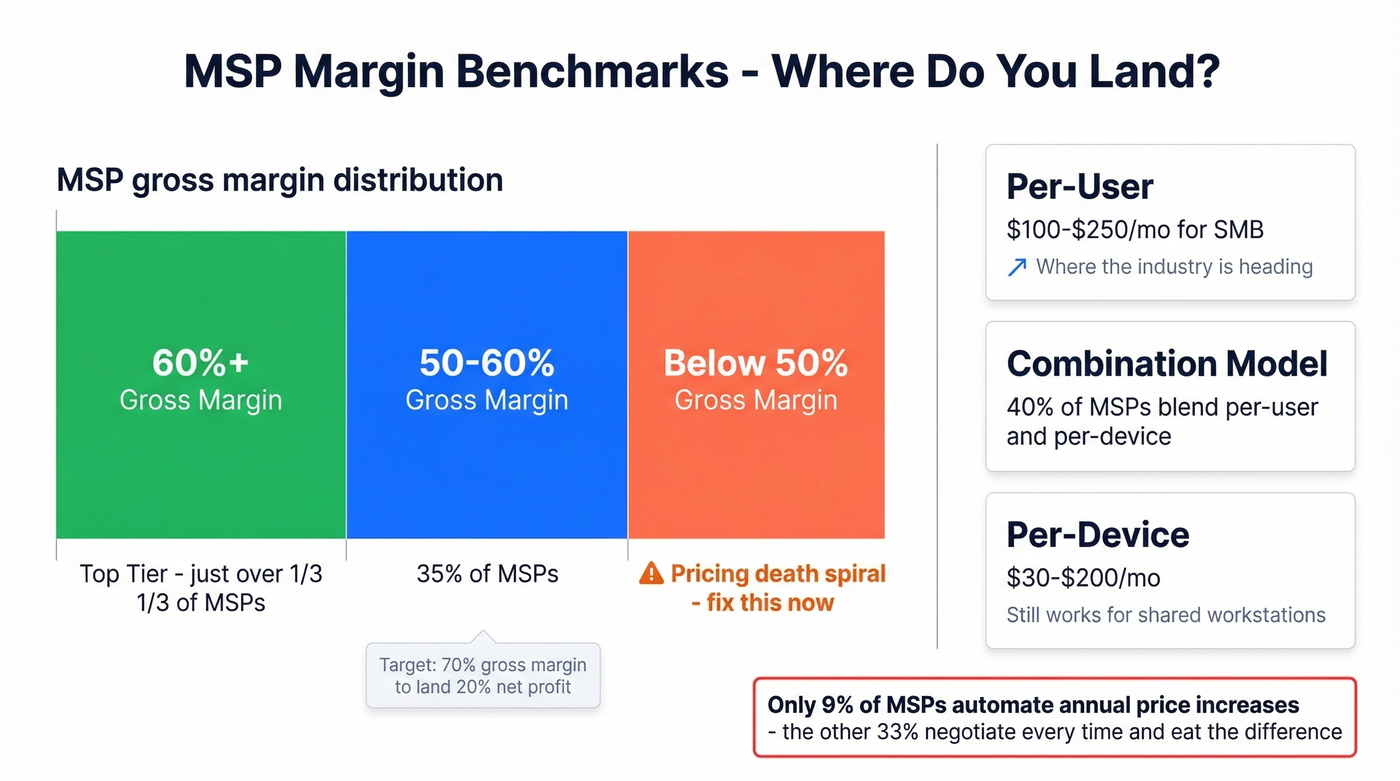
Per-user pricing is the cleanest model for most MSPs. It aligns with hybrid work, simplifies quoting, and makes MRR predictable - a 100-user client at $150/user is $15K MRR you can plan around. About 40% of MSPs now use a combination model, blending per-user and per-device depending on the client. Pure per-device still works for shared-workstation environments, but per-user is where the industry's heading.
| Segment | Per-User/Month | Per-Device/Month | Notes |
|---|---|---|---|
| SMB (1-50) | $70-$150 | $30-$100 | Basic support from ~$50 |
| Mid-market (51-250) | $100-$250 | $50-$150 | 100 users = $10K-$20K/mo |
| Enterprise (250+) | $150-$500 | $100-$200 | Complex environments |
| Healthcare | +20-30% premium | +20-30% premium | HIPAA compliance |
| Finance | $180-$300 | $100-$200 | Regulatory overhead |
Margin is where this gets real. Just over a third of MSPs hit 60%+ gross service margin - that's the top tier. Another 35% land between 50-60%. If you're below 50%, you're in a pricing death spiral that'll catch up with you on the first bad quarter. One MSP we've studied prices to 70% gross margin to consistently land 20% net profit. That's the math you should be running.
Build 3-5% annual increases into your contracts. 42% of MSPs review pricing annually, but only 9% automate the increase - which means the other 33% negotiate it every single time and often eat the difference.
Let's be honest: if your average contract value is under $3K/month, you don't need a complex pricing model. Pick per-user, set your margin target at 60%+, and stop agonizing. The MSPs who obsess over pricing architecture instead of pipeline are the ones posting "why can't I grow?" on Reddit.
Packaging and Proposals
Stick to 2-3 Tiers
71% of MSPs offer 2-3 tiers, and there's a reason. Six to eight bundles cause decision fatigue - prospects stall, ask for a custom quote, and then ghost you. Your standard tier should be all-inclusive: monitoring, endpoint management, security essentials, and help desk. Don't let clients strip out backups or security to save $20/month. That's how breaches happen, and that's how you lose the account.
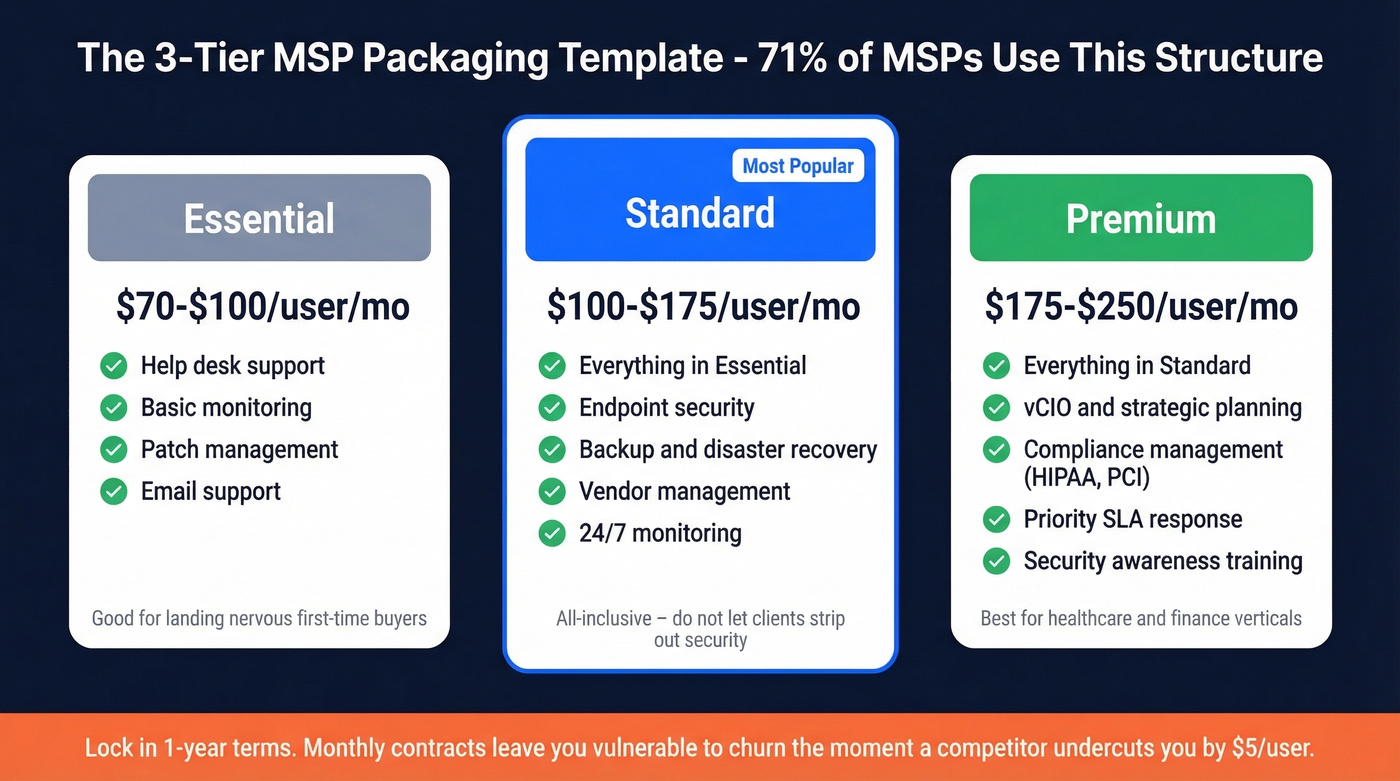
Lock in 1-year terms. 60% of MSPs do, and it protects your revenue. Monthly contracts work for landing nervous first-time buyers, but they leave you vulnerable to churn the moment a competitor undercuts you by $5/user.
What Goes in the Proposal
A winning MSP proposal needs six sections, and skipping any of them costs you credibility:
- Proprietary notice / NDA - signals professionalism and protects your pricing from being shopped around.
- Value-based overview - "reduce or eliminate computer problems without the expense of a full-time IT staff." Frame the problem, then frame your solution.
- Tiered service levels with pricing - who, what, when, and how much per tier. No ambiguity.
- FAQ section - preempt the objections before the prospect raises them. If you've heard it three times, it belongs here.
- Customer proof - testimonials, case studies, or review links. 88% of consumers trust online reviews as much as a personal recommendation, and B2B buyers aren't different.
- Free-start offer - a network audit or security assessment that gets you in the door with zero risk. This is your foot in the door, and it works because it shifts the conversation from "should we hire an MSP?" to "what did the assessment find?"
Skip the free-start offer if you're already in a competitive bake-off where the prospect has narrowed to 2-3 vendors. At that point, giving away work signals desperation, not confidence.
Objection Scripts That Work
Every MSP objection maps to a root cause. Price means they haven't connected the cost to the risk. "We already have a provider" means you haven't built enough trust. Use the Validate, Isolate, Reframe approach:
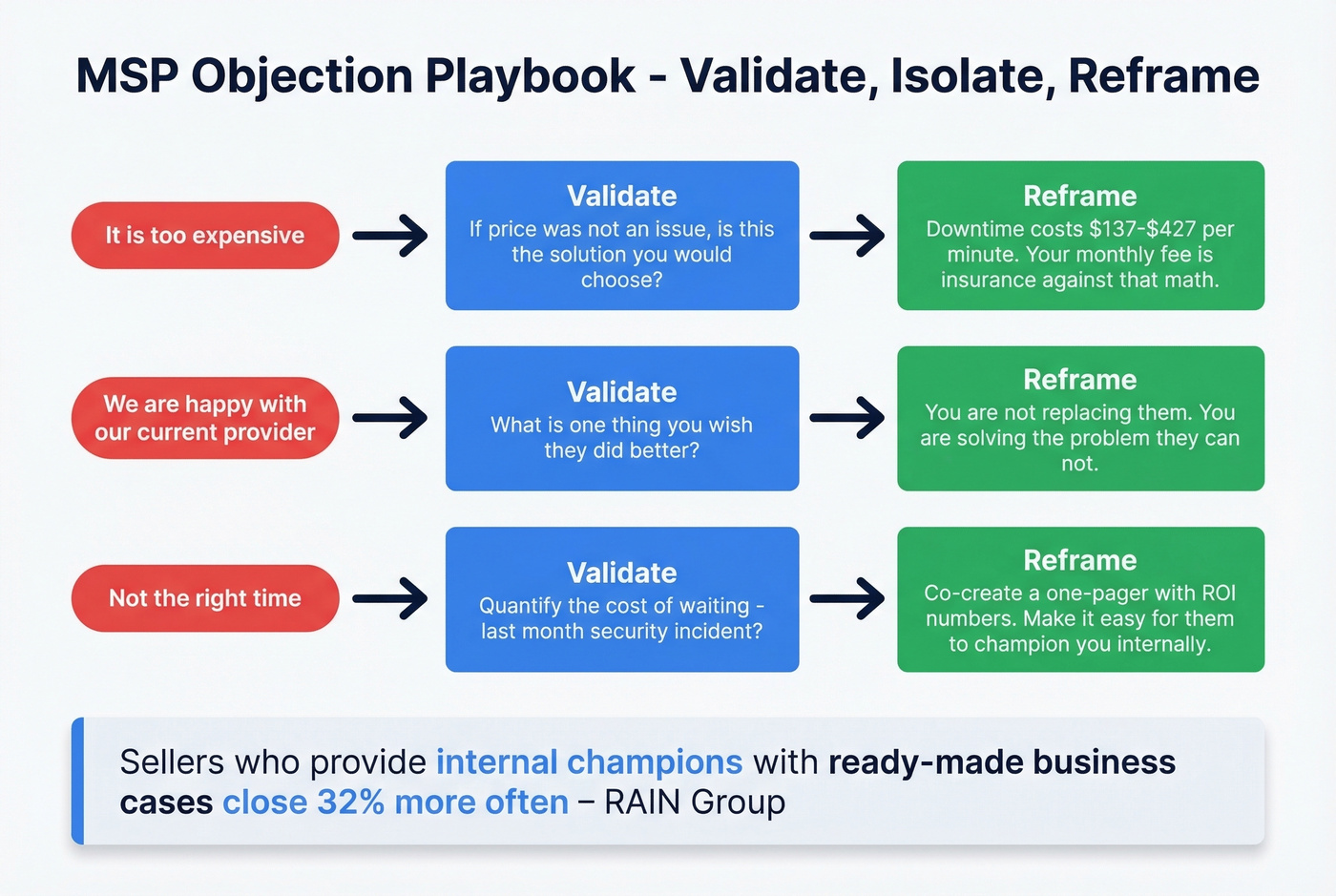
"It's too expensive."
"If price wasn't an issue, is this the solution you'd choose to solve [their stated problem]?" If yes, walk through the ROI. According to Gartner, downtime costs small businesses $137-$427 per minute depending on the industry. Your monthly fee is insurance against that math.
"We're happy with our current provider."
In our experience, this is the most common objection - and the most beatable. Ask one question: "What's one thing you wish they did better?" Every provider has a gap. Find it, then reframe your entire pitch around that specific weakness. You're not replacing their provider. You're solving the problem their provider can't.
"Not the right time" / "I need to run this by my boss."
These two share a root cause: the prospect doesn't feel enough urgency or confidence to act. For timing, quantify the cost of waiting - if they had a security incident last month, waiting isn't neutral, it's a bet. For the internal sell, offer to co-create a one-pager with ROI numbers and a comparison to current spend. Make it easy for them to champion you internally. RAIN Group's research shows that sellers who provide internal champions with ready-made business cases close 32% more often.
Mistakes That Kill MSP Deals
The fastest way to kill an MSP deal isn't a competitor - it's self-inflicted.
Too many tiers confuse buyers who just want someone to make IT stop being a problem. Underpricing to win a logo feels smart until margins below 50% GSM put you one bad month from layoffs. I've watched MSPs lose accounts over SLA violations that could have been prevented with better expectation-setting upfront - a 15-minute conversation about response times during onboarding would have saved a $8K/month contract.
Then there's the marketing problem. Leading with jargon - "managed services," "NOC," "RMM" - means nothing to the business owner signing the check. If your website looks like it was built in 2018 and you have zero Google reviews, cold outreach is an uphill battle before you even dial. Fix the foundation before you scale the outbound. Get 10 five-star reviews on Google, update your homepage to speak in outcomes, and make sure your contact page actually works on mobile.
Trigger events like office moves, headcount growth, and leadership changes are gold for MSP outbound - but only if you reach the new decision-maker before your competitor does. Prospeo refreshes data every 7 days, so you're never emailing someone who left six weeks ago.
Reach the right buyer while the trigger is still warm.
FAQ
What's the average price for managed IT services?
Most SMBs pay $100-$250 per user per month for managed IT services. Per-device pricing runs $30-$200/month depending on complexity. Healthcare and finance clients typically command 20-30% premiums due to HIPAA, PCI, and other compliance requirements. A 25-person company should expect $2,500-$5,000/month all-in.
Should I price per user or per device?
Per-user is the cleaner model for most MSPs - it aligns with hybrid work where one person uses a laptop, phone, and tablet. Billing per device penalizes that reality. About 40% of MSPs now use a combination model, but per-user simplifies quoting and makes monthly revenue predictable.
How do I find MSP prospects to contact?
Start with reactivation: unsigned contracts, old form fills, and stale leads already in your CRM. Ask recent clients for industry-specific referrals. For outbound, tools like Prospeo let you filter by company size, industry, and job title - with 98% email accuracy and 125M+ verified mobile numbers, you're reaching decision-makers instead of gatekeepers.
What's the best way to sell managed services to small businesses?
Sell the outcome, not the stack. Small business owners don't care about your RMM tool or your NOC. They care about not getting hacked, not losing files, and not paying $200/hour every time something breaks. Frame your pitch around those three fears, price per-user to keep it simple, and offer a free network assessment to get in the door.