

How to Send a Follow-Up Email After a Meeting - A Repeatable System
You spent 45 minutes in a great meeting. Real decisions got made. Then three Slack threads, a fire drill, and a coffee run later, you're staring at a blank compose window trying to remember what was actually agreed on. Knowing how to send a follow-up email after a meeting shouldn't be this hard - but it is, because most people treat follow-ups as one-off writing tasks instead of a repeatable process.
The Five-Part Structure (Quick Version)
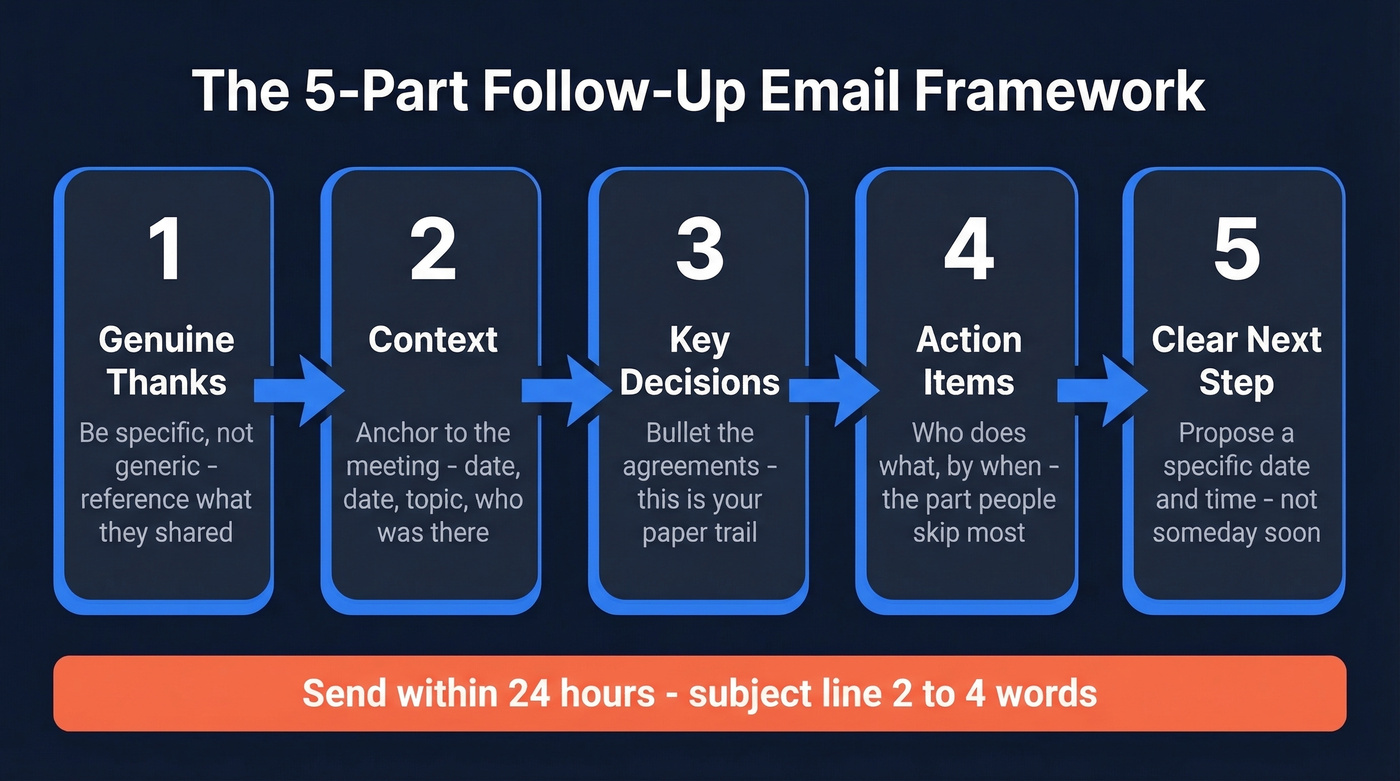
A solid follow-up email has five parts: thanks, context, recap, next steps, close. Send it within 24 hours. Keep your subject line to 2-4 words. The templates below cover the most common situations - internal recaps, sales follow-ups, networking events, and informational interviews.
Why Meeting Follow-Ups Matter
First follow-ups boost reply rates by 49%. That alone justifies the five minutes.
But there's a less obvious reason, and it's one the consensus on r/LifeProTips keeps hammering: documentation. When someone later says "that's not what we discussed," your recap email settles it. It's a paper trail that protects everyone - less about politeness, more about professional insurance.
Cold outreach averages about 3% reply rates across industries. A follow-up after a real conversation starts with built-in context and goodwill, so expect dramatically higher engagement. Don't waste that advantage by not sending one.
Subject Lines That Get Opened
An analysis of 5.5 million emails reveals a few clear rules.
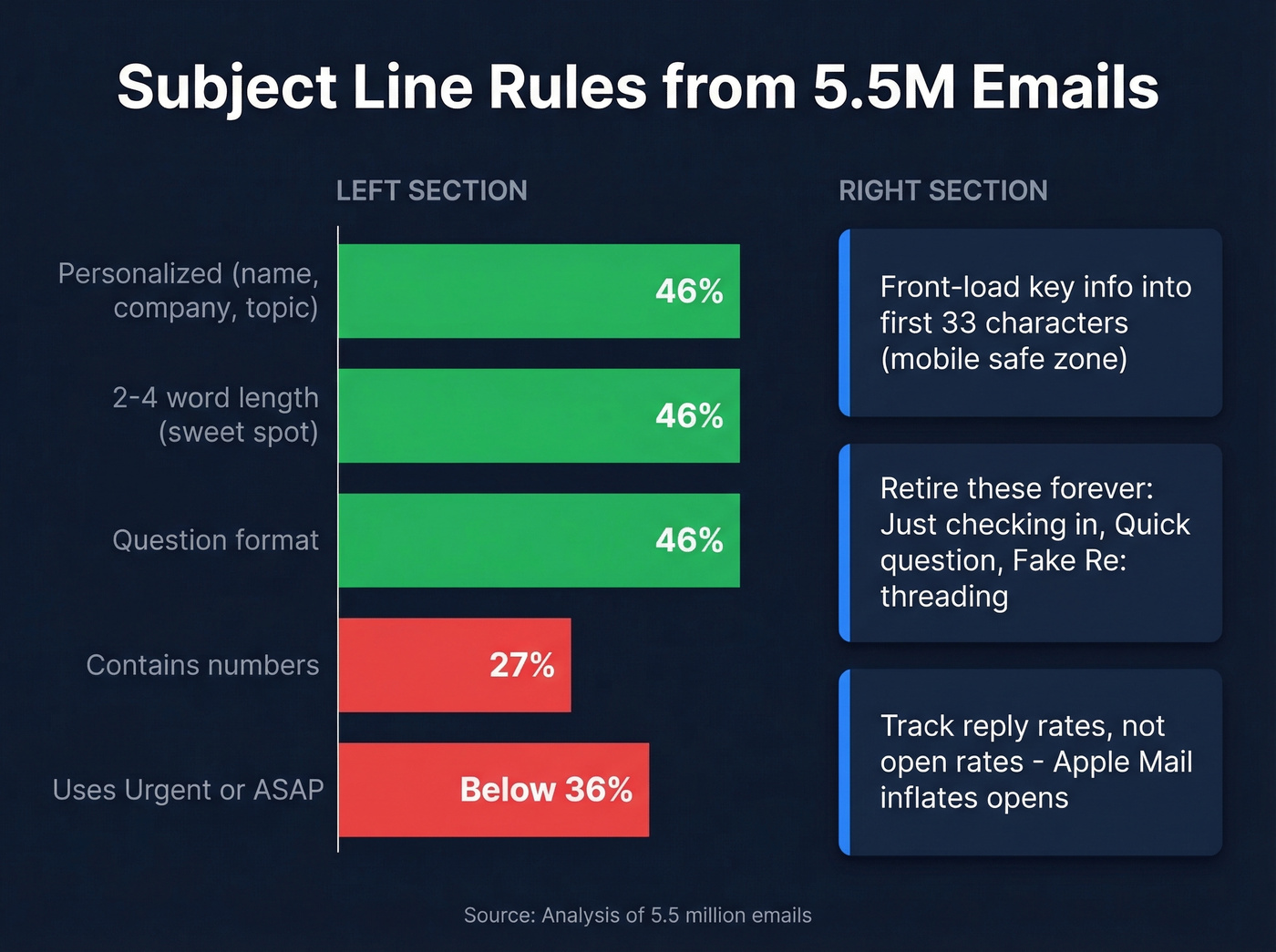
Personalized subject lines hit 46% open rates versus 35% for generic ones. Include the person's name, company, or a specific reference to your conversation. "Great chat about Q3 pipeline" beats "Following up" every time.
Keep it to 2-4 words - that's the sweet spot at 46% opens. Once you cross seven words, performance drops. Question formats also hit 46%. Avoid numbers in subject lines; they pull opens down to 27%.
Front-load your key message into the first 33 characters. That's the mobile inbox safe zone before truncation kicks in.
Lines to retire permanently: "Just checking in," "Quick question," fake "Re:" threading on a new conversation, and anything with "ASAP" or "Urgent" (these push opens below 36%). One caveat worth noting: Apple Mail Privacy Protection inflates open-rate tracking, so treat reply rates as your real signal.

Your follow-up is only as good as the email address it lands on. Prospeo's Email Finder delivers 98% verified accuracy across 300M+ professional profiles - so your perfectly crafted post-meeting email actually reaches the inbox, not a dead end.
Don't let a great meeting die in a bounce folder.
Anatomy of a Great Follow-Up
Here's the five-part framework, adapted from Fellow's meeting follow-up guide:
Genuine thanks. Not performative - specific. "Thanks for walking me through the onboarding timeline" beats "Thanks for your time." Workhuman's research found that five moments of recognition per year reduces voluntary turnover by 22%.
Context. One sentence anchoring the email to the specific meeting - date, topic, who was there.
Key decisions and recap. What was agreed on? Bullet points work here.
Action items with owners. Who's doing what, by when? This is the part people skip, and it's the part that matters most.
Clear next step with a date. "Let's reconnect Thursday at 2pm" - not "Let's circle back soon."
Think of the follow-up as one step in a chain: capture notes, synthesize decisions, update your CRM, send the external follow-up, align your team internally. The best follow-up emails are half-written before the meeting ends. If you know the agenda, you know the structure - you're just filling in blanks afterward.
Quick CC/BCC rules: To = people who need to act. CC = people who need to know. BCC = almost never, and definitely not to hide someone on a thread.
Templates for Every Meeting Type
Internal Meeting Recap
When priorities shift and someone forgets what was agreed, this thread is your evidence. In our experience, the recap email is the one people skip most - and regret most.
Subject: Decisions from [project] sync
Hi team,
Thanks for a productive session today. Here's what we landed on:
- [Decision 1]
- [Decision 2]
Action items:
- [Name] → [task] by [date]
- [Name] → [task] by [date]
Next sync: [date/time]. Agenda doc is [here].
What NOT to include: lengthy meeting minutes, side conversations that went nowhere, or anything already captured in your project management tool. If it's in Jira, don't repeat it in email.
Sales or Prospect Follow-Up
Here's the thing: never send a sales follow-up that's just "checking in." Always add value - a relevant stat, a case study, an answer to something they asked. That's what separates a follow-up from noise. Knowing how to write a post-meeting email that actually moves a deal forward is one of the highest-return skills in sales, and it's surprisingly rare to see it done well because most reps default to generic templates that sound like every other email in the prospect's inbox.
If you want more plug-and-play options, use these sales follow-up templates.
Subject: [Specific topic] next steps
Hi [Name],
Great conversation today - especially your point about [specific challenge]. I pulled a case study on how [similar company] solved that exact problem: [link].
Based on what we discussed, I'd suggest [specific next step]. Does [day] at [time] work for a 20-minute deep dive?
After Meeting Someone New
Send this within 24-48 hours. If you've got a name and company but no email, Prospeo's Email Finder can pull a verified address in seconds - 98% accuracy, free tier covering 75 lookups per month, which handles most conferences without breaking a sweat.
Subject: [Reference to conversation]
Hi [Name],
Really enjoyed our conversation about [specific topic] at [event]. Your take on [specific point] stuck with me.
I mentioned [resource/article/intro] - here's the link: [link]. Happy to continue the conversation over coffee if you're up for it.
Informational Interview Thank-You
Send this one the same day. Informational interviews are a gift of someone's time, and a fast, specific thank-you makes you memorable.
Subject: Thanks for the insight
Hi [Name],
I really appreciate you taking the time today. Your perspective on [specific insight] was exactly what I needed - I'm going to apply that to [specific situation].
I'd love to stay in touch as things develop. Happy to return the favor anytime.
When NOT to send a follow-up: If the meeting was a quick status check with no action items, or if everything discussed is already captured in a shared tool, skip the email. Nobody needs inbox clutter confirming what's already documented.
When to Send - Timing Cheat Sheet
| Meeting Type | Send Within | Why |
|---|---|---|
| Internal recap | Same day | Details fade fast |
| Sales follow-up | 24 hours | Momentum dies quickly |
| Networking event | 24-48 hours | Before they forget you |
| Informational interview | Same day | Shows respect |
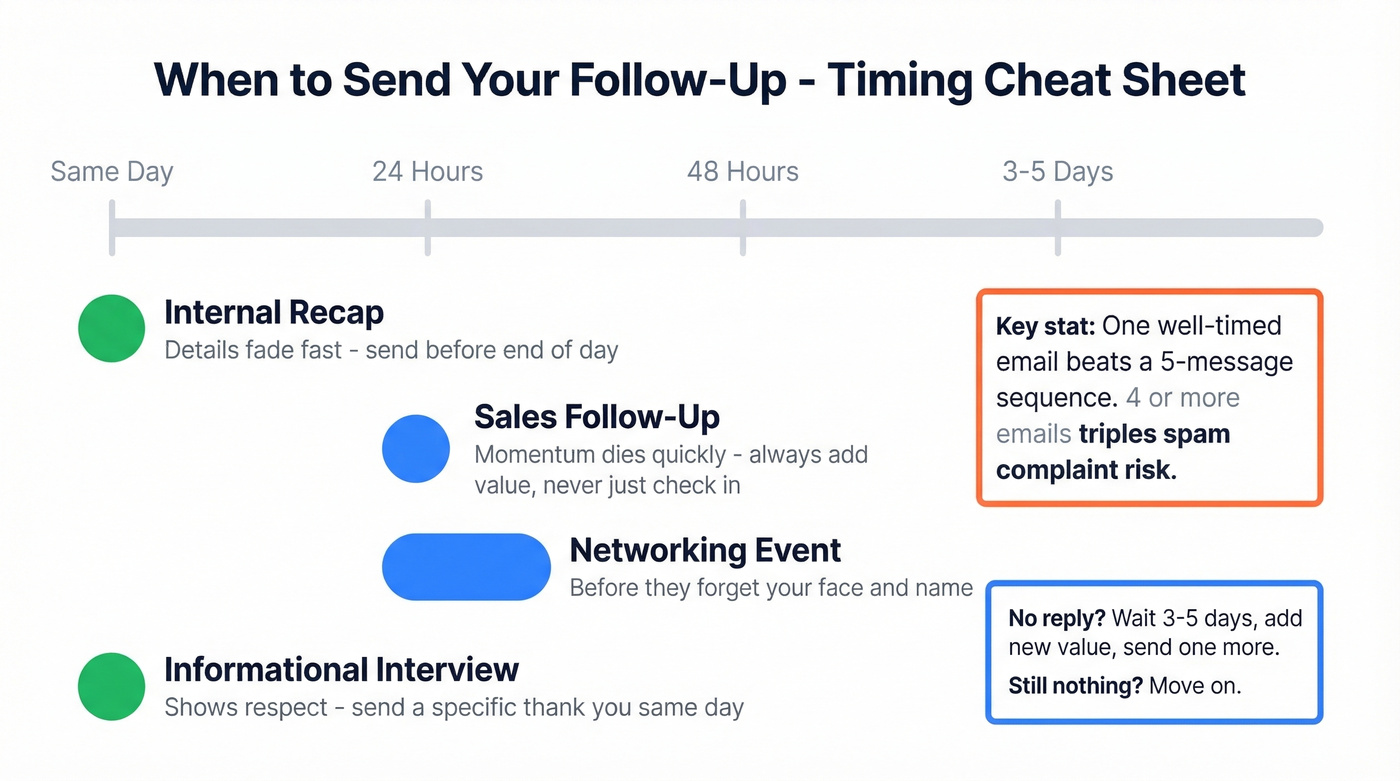
Belkins' analysis of 16.5 million emails found the best cold-email reply rate - 8.4% - came from a single, well-timed email. Warm follow-ups after a real conversation typically crush that number. But the principle holds: one thoughtful email beats a five-message sequence. Sending four or more emails triples spam complaint risk.
For high-value contacts, pair your email with a profile visit on their professional network - that combo hits 11.87% reply rates.
If you don't hear back, wait 3-5 business days and send one more email that adds new value. Still silence? Move on. Persistence has a ceiling.
Tools That Speed This Up
| Tool | Best For | Price |
|---|---|---|
| Prospeo | Finding verified emails | Free tier + credit-based plans |
| Otter.ai | Free transcription | Free-$20/mo |
| Fellow | Team note-taking | From $7/user/mo |
| Fireflies.ai | Searchable archive | Free-$19/mo |
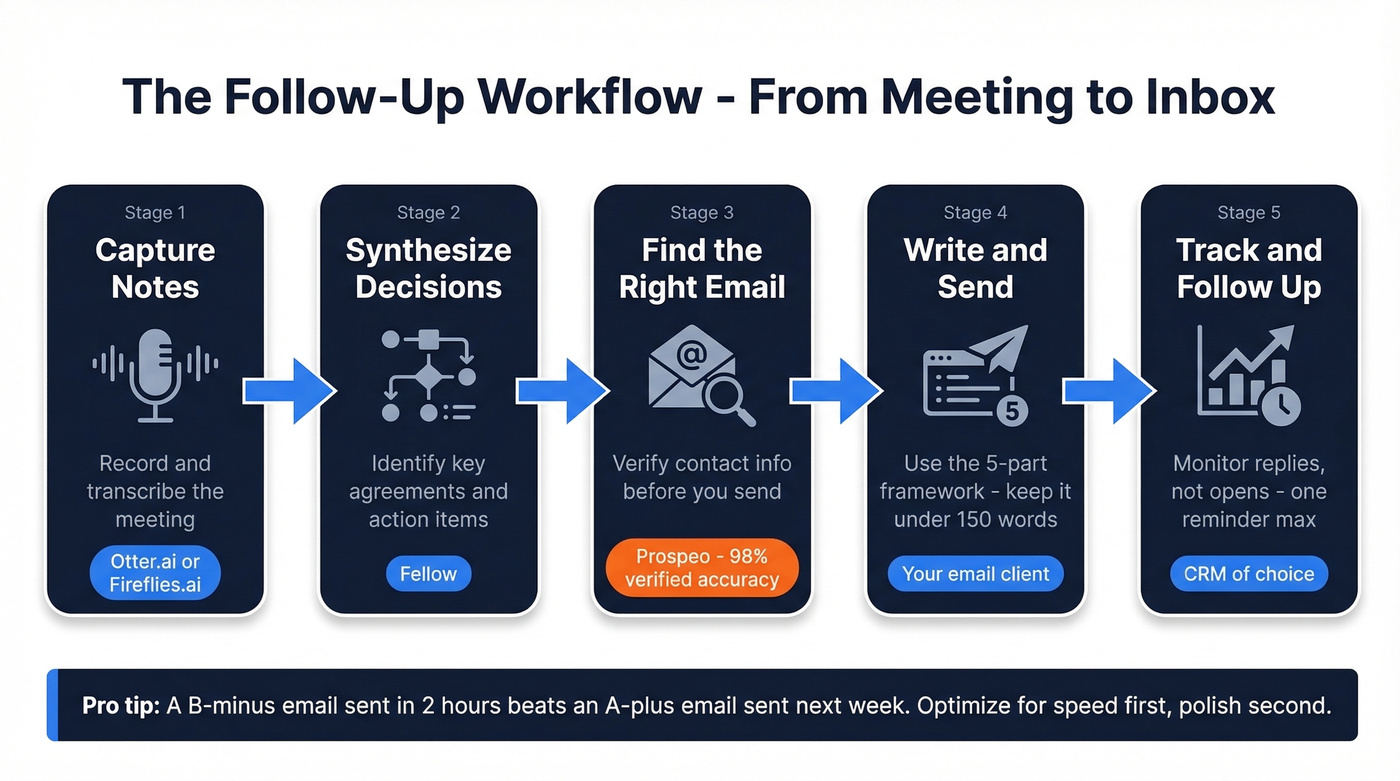
AI tools handle the writing and transcription. An email finder handles the "who do I send it to" problem. They solve different parts of the workflow.
Let's be honest about the real failure mode here: most people obsess over writing the perfect follow-up when the actual bottleneck is never sending one at all. We've seen it on our team dozens of times - a B-minus email sent within two hours beats an A-plus email sent next week. Optimize for speed first, polish second. If you remember nothing else about how to send a follow-up email after a meeting, remember that.
If you need help with the follow-up itself (and the second nudge), this guide on when should I follow up on an email pairs well with the timing cheat sheet above.
Met 50 people at a conference and only grabbed half their contacts? Prospeo's free tier gives you 75 verified email lookups per month. Just enter a name and company domain - get a verified email in seconds, then send that follow-up while the conversation is still fresh.
Turn every handshake into a verified contact before they forget your name.
FAQ
How long should a follow-up email be?
75-150 words. That's enough to recap key decisions, reference a specific moment, and propose a concrete next step. If it takes more than 60 seconds to read, cut it.
What if they don't respond to my follow-up?
Wait 3-5 business days, then send one more email that adds genuine value - a resource, an answer to something they asked, a relevant article. If there's still no response, stop. Data shows four or more emails in a sequence triples spam complaint risk.
How do I follow up after meeting someone I barely spoke with?
Keep it short and anchor on one specific detail from your conversation - even a brief exchange gives you something to reference. Mention where you met, what caught your attention, and offer a low-commitment next step like sharing a relevant link.
How soon after a meeting should I send a follow-up?
Same day for internal recaps and informational interviews. Within 24 hours for sales conversations. Within 48 hours for networking events. The faster you send it, the more details you'll capture accurately - and the more impressed the recipient will be.