

HubSpot Enrichment: What It Does, What It Costs, and How to Fill the Gaps
You imported 3,000 contacts from last quarter's trade show. Within six months, 675 of them are wrong - new jobs, new companies, dead email addresses. B2B contact data decays at roughly 2.1% per month, compounding to 22.5% annually. HubSpot enrichment handles part of the problem. The rest? You're on your own.
The Short Version
What HubSpot Contact Enrichment Actually Does
Breeze Intelligence is HubSpot's enrichment engine, built on the Clearbit acquisition. It draws from 200M+ buyer and company profiles to auto-fill fields on your contact and company records. The enrichment breaks into three buckets:
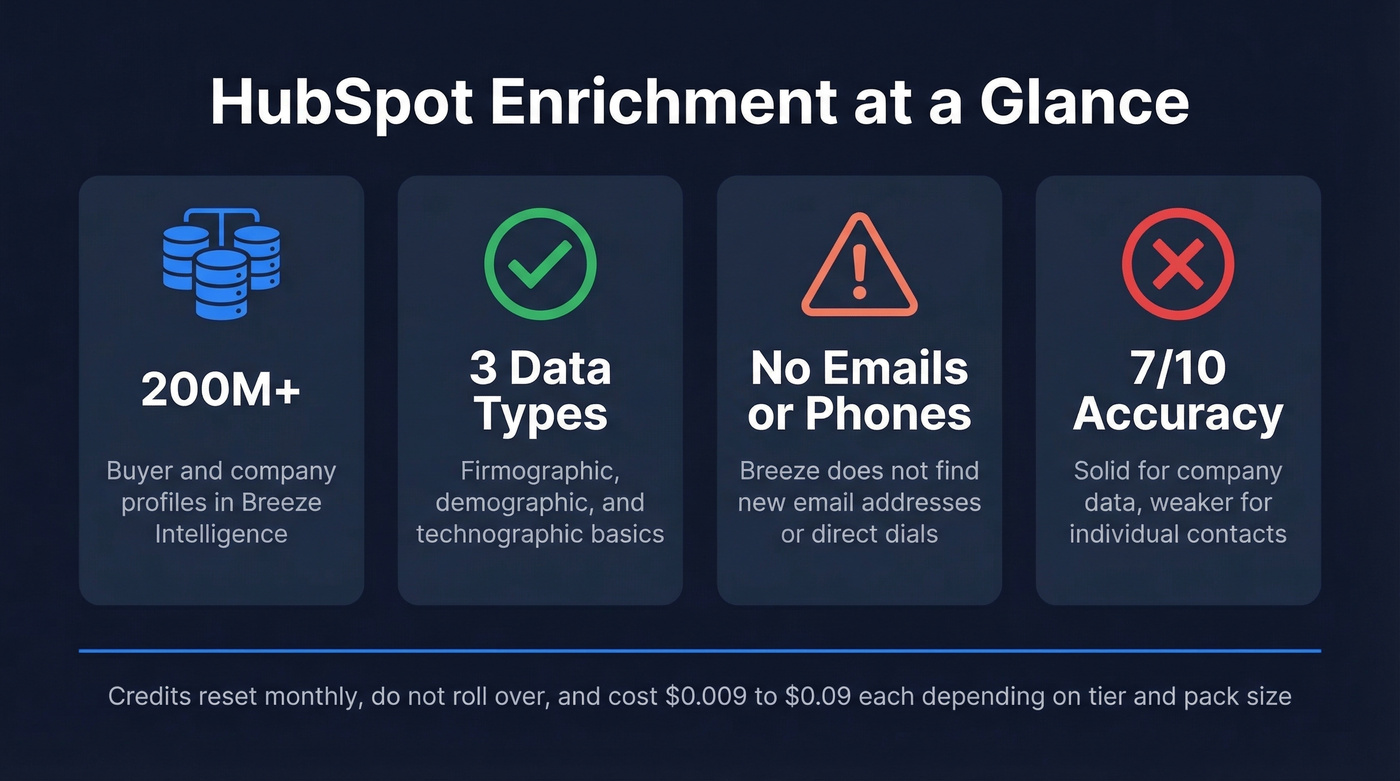
Firmographic data covers company size, revenue, industry, and location. Demographic data fills job title, seniority level, and department. For deeper technographics - what tools a company uses - dedicated tools like BuiltWith or Wappalyzer go much deeper than native CRM enrichment.
When a new contact enters your CRM, Breeze automatically populates empty fields without manual research. You can also configure overwrite behavior, choosing whether enrichment data replaces existing values or only fills blanks. Here's a nuance most teams miss: if a user or another system edits an enriched property value, continuous enrichment stops updating that property. That distinction matters more than you'd think, and we'll get to why.
What Breeze Intelligence Can't Do
Breeze Intelligence enriches contacts that already exist in your CRM. It doesn't discover net-new work emails. It doesn't provide phone numbers. If you're hoping to import a list of company names and get back verified work emails and direct dials, native enrichment won't do that.
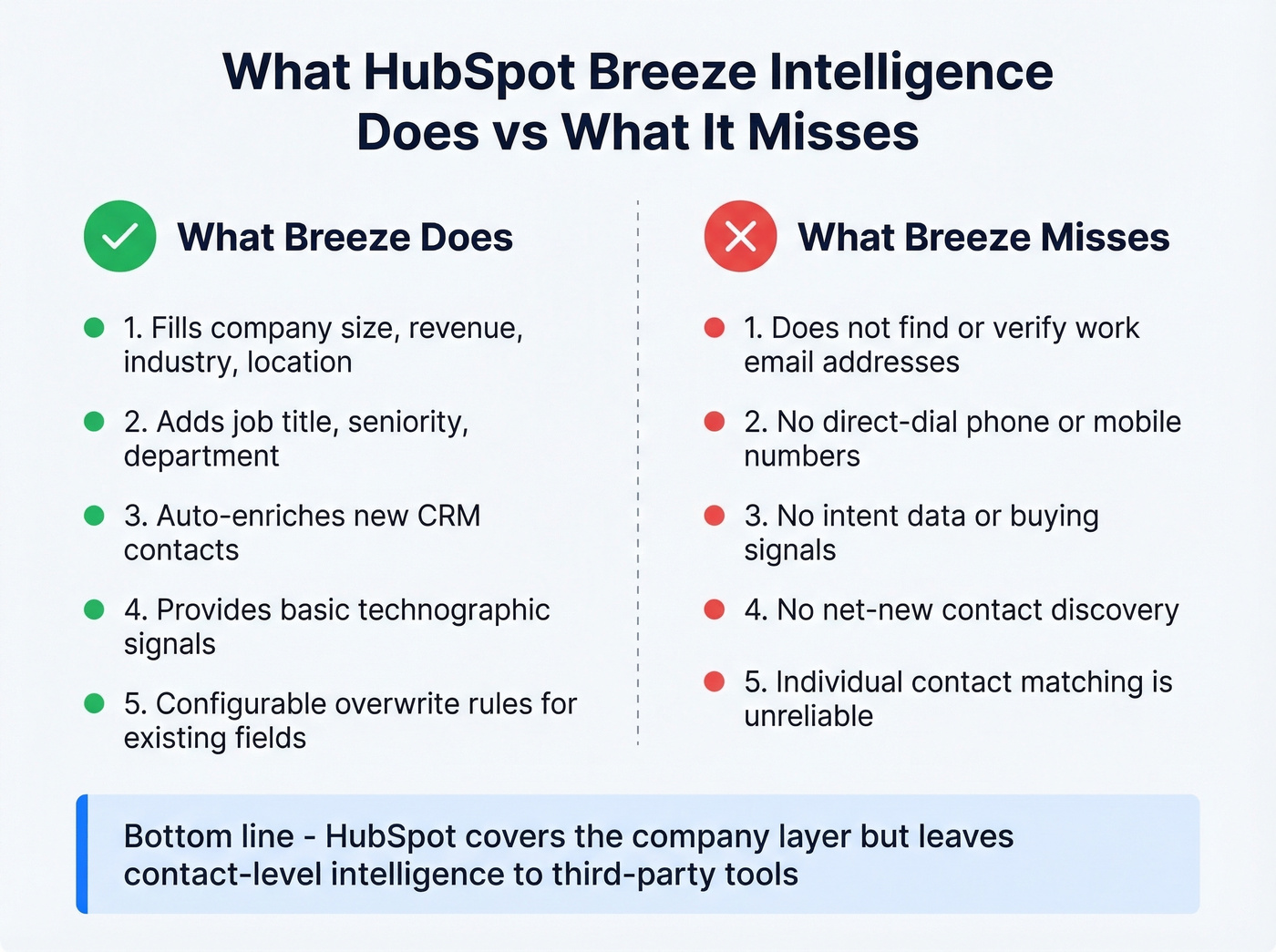
It does:
- Fill firmographic and demographic fields on existing records
- Auto-enrich new contacts as they enter your CRM
- Provide company-level data (size, revenue, industry)
It doesn't:
- Find email addresses for contacts you don't already have emails for
- Provide direct-dial phone numbers or mobile numbers
- Offer intent data, buying signals, or activity intelligence
- Guarantee accuracy on individual contact matching
Warmly rates Breeze's data quality around 7/10, which tracks with what we've seen - solid for company-level data, noticeably less reliable for individual contact details. HubSpot covers the firmographic layer but leaves most contact-level intelligence to third-party tools. That's why teams serious about CRM data enrichment almost always layer in at least one external data source.

HubSpot gives you firmographics. It won't give you verified emails or direct dials. Prospeo's CRM enrichment returns 50+ data points per contact at a 92% match rate - including 143M+ verified emails and 125M+ mobile numbers that Breeze Intelligence simply doesn't cover. At ~$0.01 per email, you'll spend less on 10,000 enriched contacts than one HubSpot 30K credit pack.
Stop paying HubSpot credits for data that still has no email attached.
How Enrichment Credits Work
HubSpot enrichment runs on credits, and the mechanics are worth understanding before you commit.
Your monthly allotment depends on your highest subscription tier:
| HubSpot Tier | Included Credits/Mo | Add-On: 5K Pack | Add-On: 30K Pack | Add-On: 100K Pack |
|---|---|---|---|---|
| Starter | 500 | $45/mo | $270/mo | $900/mo |
| Professional | 3,000 | $45/mo | $270/mo | $900/mo |
| Enterprise | 5,000 | $45/mo | $270/mo | $900/mo |
Credits reset monthly and don't roll over. Use 200 out of 500, and those remaining 300 vanish at the end of the billing cycle.
Let's walk through a real scenario. You're on Professional with 3,000 credits/month and need to enrich 10,000 records after a conference. You'd burn through your monthly allotment immediately and need an add-on pack - say 30K credits for $270/month - and you're still only getting firmographic and demographic data. No emails. No phones.
The trap nobody warns you about: purchasing additional credits and then exceeding your credit limit can trigger an automatic upgrade to a higher credit tier for the rest of your contract. Downgrading only happens at the end of your commitment term.
It's getting worse, too. As of late 2025, HubSpot expanded credit requirements beyond enrichment - credits now get consumed by the Prospecting Agent, AI actions in workflows, and Data Studio syncs, with a grace period running through April 14, 2026. If your team uses any of these features, your credit burn rate will spike faster than enrichment volume alone would suggest.
Only users with paid seats (Core, Sales, Service, or Commerce) and Partner seats can use credits. Free and view-only users are locked out entirely.
The Overwrite Problem
Here's the thing: enrichment that overwrites good data with bad data is worse than no enrichment at all.
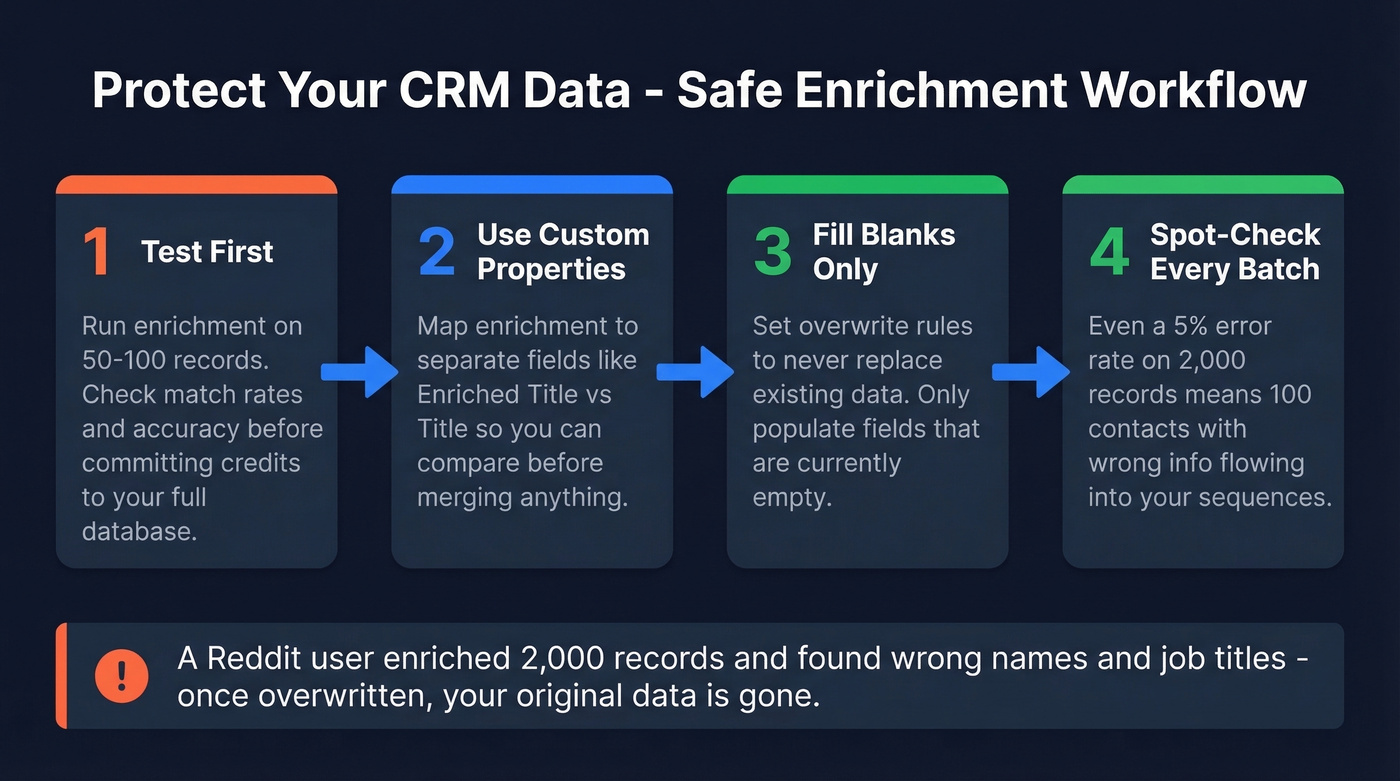
A Reddit user enriched roughly 2,000 records through HubSpot and found a ton of errors - wrong profile matches that changed last names and job titles to completely different people. Once enrichment overwrites a field, your original data is gone unless you've built in safeguards.
Before you enrich at scale, protect yourself:
- Test on 50-100 records first. Run a data test to check match rates and accuracy before committing credits to your full database.
- Use custom properties. Map enrichment data to separate fields like "Enriched Title" vs. "Title" so you can compare before merging.
- Set overwrite rules to "fill blanks only." Never let enrichment replace existing data unless you've validated the source.
- Spot-check after every batch. Even a 5% error rate on 2,000 records means 100 contacts with wrong information flowing into your sequences.
Best Tools for HubSpot Enrichment
Native enrichment covers the firmographic layer. For everything else - verified emails, direct dials, intent signals, deeper technographics - you need a third-party tool. Here's what's worth your time.
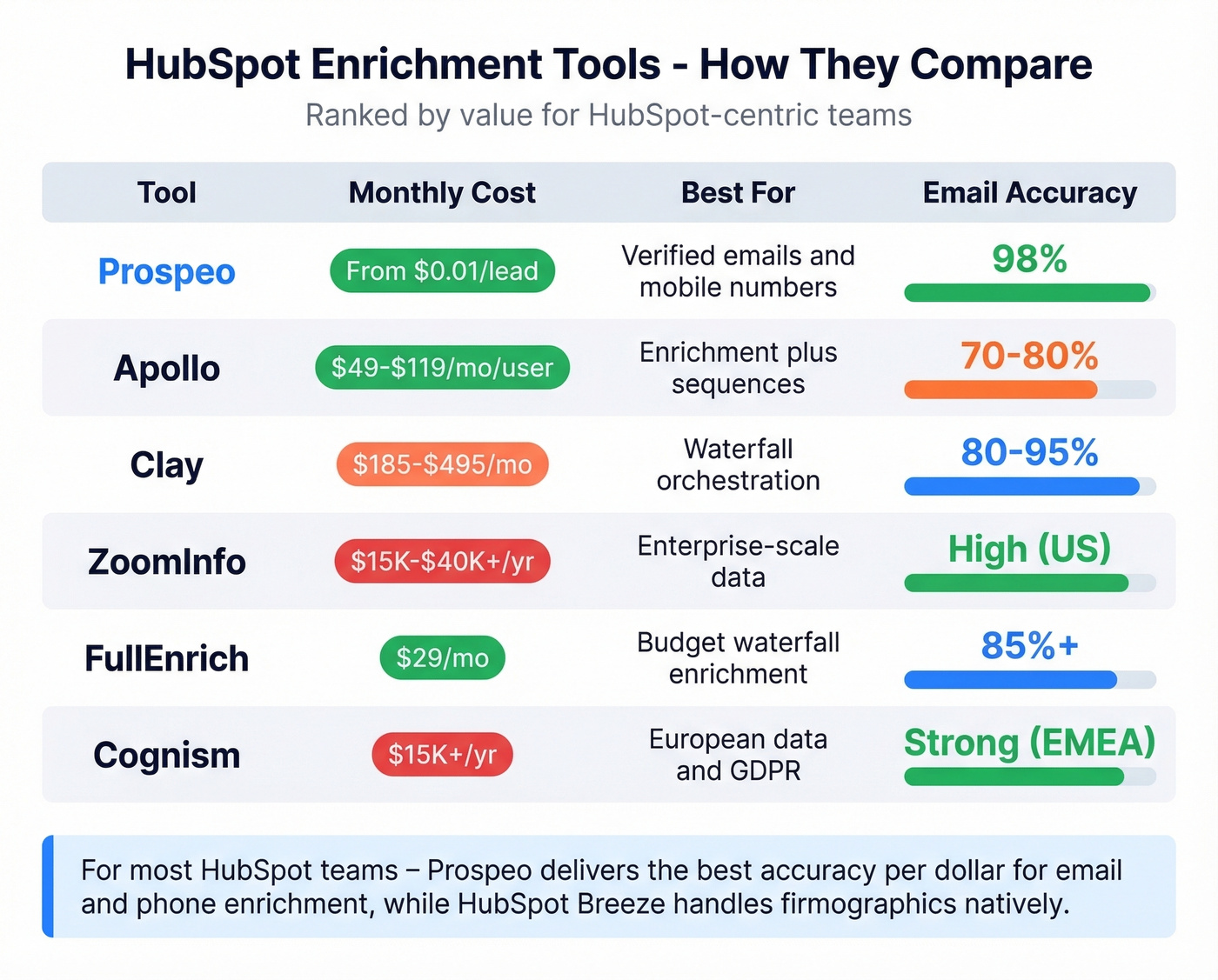
| Tool | Best For | HubSpot Integration | Pricing | Accuracy |
|---|---|---|---|---|
| Prospeo | Emails + mobiles | Native | ~$0.01/lead | 98% email |
| Apollo | Enrichment + sequences | Native | $49-$119/mo/user | 70-80% |
| Clay | Waterfall orchestration | Growth tier+ | $185-$495/mo | 80-95% |
| ZoomInfo | Enterprise data | Native | $15K-$40K+/yr | High (US) |
| FullEnrich | Budget waterfall | HubSpot-compatible | $29/mo | 85%+ |
| Cognism | European data + GDPR | Native | ~$15K+/yr | Strong (EMEA) |
Prospeo
Use this if you need verified emails and direct-dial mobile numbers to complement HubSpot's firmographic enrichment - without signing an enterprise contract.
Prospeo's database covers 300M+ professional profiles with 143M+ verified emails and 125M+ verified mobile numbers. The 98% email accuracy rate comes from a proprietary 5-step verification process that includes catch-all handling, spam-trap removal, and honeypot filtering - the kind of infrastructure that prevents your domain from getting flagged. Every record refreshes on a 7-day cycle, dramatically faster than the 6-week industry average.
The native HubSpot integration pushes enriched data directly into your CRM - 50+ data points per contact at an 83% enrichment match rate. At roughly $0.01 per lead, you'd enrich 10,000 contacts for about $100. Compare that to HubSpot's $270 for an add-on pack that still won't return emails or phones. The free tier gives you 75 emails and 100 Chrome extension credits per month to test before committing.
We've used Prospeo to backfill contact data on conference imports, and the difference in sequence reply rates was immediate - bounces dropped from double digits to under 4%, which is the kind of shift that actually moves pipeline.
Apollo.io
Apollo's free tier is generous enough to test the waters - 50 AI credits and up to 2 sequences. Paid plans run from $49/month (Basic) to $119/month (Organization), with Organization requiring a minimum of 3 seats. The enrichment hit rate runs around 70-80% based on HubSpot Community discussions, which is solid for the price but noticeably below dedicated data tools.
Skip this if email accuracy is critical to your deliverability. Apollo's strength is breadth and workflow integration, not data precision. Credits don't roll over, so monitor usage carefully.
Clay
Clay is the power tool for RevOps teams that want waterfall enrichment - querying dozens of data sources in sequence until a match is found. After their March 2026 pricing overhaul, self-serve plans start at $185/month (Launch) and $495/month (Growth). HubSpot auto-sync requires the Growth tier or above, so budget $495-$800/month depending on your plan.
The platform is powerful but complex. Expect 2-4 hours to build a production workflow with proper field mapping. Clay doesn't charge for failed lookups under the new model, which helps with cost predictability. But if you don't have dedicated RevOps bandwidth, you'll spend more time configuring Clay than actually enriching contacts.
ZoomInfo
ZoomInfo is still the most comprehensive B2B data platform on the market. Most HubSpot teams don't need it.
It starts at $15,000+/year for Professional and climbs fast. Mid-market teams regularly hit ~$50,000/year once you add extra credits, email verification, and global data. Multi-year contracts with tight auto-renewal windows make it hard to leave. If your average deal size is under $25K, you're almost certainly overpaying for intent, chat, and workflow features you'll never configure.
FullEnrich
Waterfall enrichment across 20+ sources at $29/month with credits that actually roll over - a rarity in this space. Users in the HubSpot Community report 85%+ match rates with triple-verified emails. Worth testing if you want a lightweight enrichment layer without the complexity of Clay or the price tag of ZoomInfo.
Cognism
Best for teams selling into Europe where GDPR compliance and phone coverage matter most. Strong mobile number database for EMEA markets. Runs ~$15K+/year, which puts it in enterprise territory - but if your ICP is European, the data quality justifies the spend. Their compliance infrastructure is genuinely best-in-class for EU-focused outbound.
Other tools worth knowing: Store Leads ($75-$250/month) is useful for enriching company-level data on ecommerce and SaaS businesses. Hublead ($40-$80/month) adds a browser extension layer for pulling contact data directly into HubSpot while browsing web profiles. Neither replaces a full enrichment tool, but both fill niche gaps.
Build Your Enrichment Workflow
Enrichment without workflows is expensive data entry. The data only matters if it triggers action.
Step 1: Let HubSpot handle firmographics. Use Breeze Intelligence to auto-fill company size, industry, revenue, and location on new records. This is what it's good at - don't fight it.
Step 2: Enrich emails and phones with a dedicated tool. Use a native HubSpot integration to push verified emails and direct dials into your contact records. An 83%+ match rate means most of your database gets actionable contact data within minutes, not days.
Step 3: Add a verification layer. For contacts entering through forms or imports, add a "Run a code snippet" action in your HubSpot workflows that calls an email verification API. The pattern: check the safe_to_send response, and route invalid emails to a cleanup list before they enter your sequences. This single automation prevents more deliverability damage than any other workflow you'll build.
Step 4: Map enriched fields to workflow triggers. This is where enrichment pays for itself. Connect enriched data to lead scoring so that company size combined with seniority determines priority. Route contacts by industry to the right rep automatically. When an intent signal lands on a contact with a verified phone number, fire a real-time sales alert. The value isn't in the data - it's in the automation the data powers. If you want to go deeper, start with CRM automation basics and build from there.
We've seen teams spend thousands on enrichment tools and then let the data sit in custom properties nobody looks at. Build the workflows first, then buy the data.
Bad enrichment data overwrites good records and tanks your deliverability. Prospeo's 5-step verification - with catch-all handling, spam-trap removal, and honeypot filtering - delivers 98% email accuracy on a 7-day refresh cycle. That's why teams using Prospeo see bounce rates drop below 4% while HubSpot's native enrichment scores a 7/10 on data quality.
Get enrichment data accurate enough to actually send on.
FAQ
What's the difference between enrichment and data cleansing?
Enrichment adds missing fields - job titles, revenue, emails - while cleansing fixes or removes bad existing data like outdated addresses and duplicates. You need both: enrich first to fill gaps, then verify to catch errors. Running sequences on un-cleansed data is the fastest way to tank your sender reputation.
Which HubSpot plans include enrichment credits?
All paid hubs include monthly credits: Starter gets 500, Professional gets 3,000, and Enterprise gets 5,000. Free and view-only users can't use credits at all. Add-on packs start at $45/month for 5,000 additional credits, but credits now also power AI actions and the Prospecting Agent - so budget accordingly.
Can HubSpot enrichment find email addresses?
No. Breeze Intelligence fills firmographic and demographic fields on existing records but doesn't discover or verify net-new email addresses. For email finding, use a dedicated tool like Prospeo (98% accuracy, ~$0.01/lead) or Apollo (70-80% accuracy, $49+/month) with a native HubSpot integration.
How often should I re-enrich my contacts?
Quarterly at minimum, given the 2.1% monthly decay rate. Tools with faster refresh cycles keep data current automatically - a 7-day refresh cycle eliminates the need for manual re-enrichment runs and keeps your sequences hitting valid contacts instead of bouncing off stale records.
What about GDPR when enriching EU contacts?
You need a lawful basis for processing under GDPR - typically legitimate interest for B2B outreach. Use enrichment tools that enforce opt-outs globally and offer Data Processing Agreements. Cognism is the strongest option for EU-specific compliance, though other tools like Prospeo also maintain GDPR compliance with opt-out enforcement and available DPAs.