


Hunter.io Pros and Cons: What 930 Reviews Actually Say
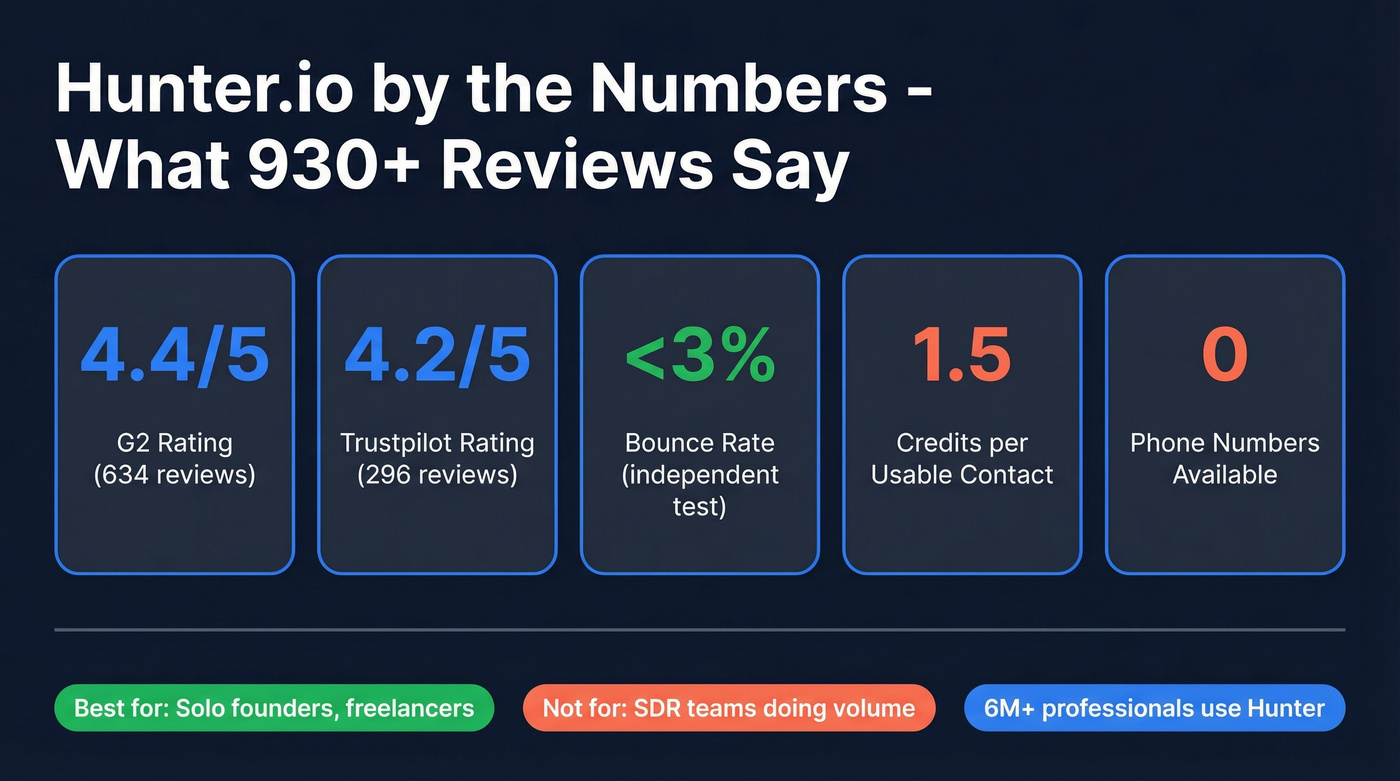
You signed up for Hunter's free plan, burned through 50 credits in 20 minutes, and now you're staring at a paywall. Before you pull out your credit card - or start shopping for alternatives - here's an honest breakdown of Hunter pros and cons based on 634 G2 reviews (4.4/5) and 296 Trustpilot reviews (4.2/5).
30-Second Verdict
Hunter.io is a clean, simple email finder that does domain search and verification well. It's best for freelancers and solo founders who need a handful of emails per week. It's not an outbound platform, and it's not built for SDR teams doing volume. If you've already hit the credit wall on the free plan, whether the Starter plan is worth $49/month depends entirely on how many contacts you actually need.
What Hunter Actually Does
Hunter indexes 76 million websites and pulls publicly available email data from them - a fundamentally different approach than database-first competitors like Apollo or ZoomInfo, which maintain proprietary contact records. The core features are domain search, email finder, email verifier, and a basic cold email campaign tool, used by 6M+ professionals. This web-indexing model explains both Hunter's strengths (transparent sourcing, GDPR compliance) and its biggest gaps.

Where Hunter Delivers
Clean UI and ease of use. This is the single most-cited positive on G2, with 33 mentions. You type in a domain, you get emails. In our testing, no other email finder gets you from zero to result faster.
Verification keeps bounces low. A Sparkle.io test of 2,469 emails sent through Hunter reported a bounce rate under 3%. The verifier is Hunter's strongest feature, full stop.
Chrome extension and Google Sheets add-on. Quick lookups without leaving your browser or spreadsheet. For solo operators, this is the workflow that matters most.
No credit charged on misses. If Hunter can't find or verify an email, you don't pay. Most credit-based tools charge you regardless of whether they return a result. Small detail, big deal.
Hunter also grew its profile volume by 211% between January and October 2024, with a further 50-100% increase through 2025. Coverage has improved substantially heading into 2026, though it still trails larger databases. And the platform is GDPR compliant, built around publicly available data with opt-out mechanisms baked in.

Hunter charges 1.5 credits per usable contact and still gives you zero phone numbers. Prospeo delivers 98% accurate emails at ~$0.01 each, plus 125M+ verified mobile numbers with a 30% pickup rate - on a 7-day data refresh cycle.
Stop paying more for less. Get emails and direct dials in one platform.
Where Hunter Falls Short
Here's the thing: your SDR manager asked you to pull 500 verified emails. That's roughly 750 Unified Credits - finding plus verifying each contact. On the Starter plan, that's 37% of your monthly quota, gone in one campaign. We've seen teams burn through Starter credits in under a week.
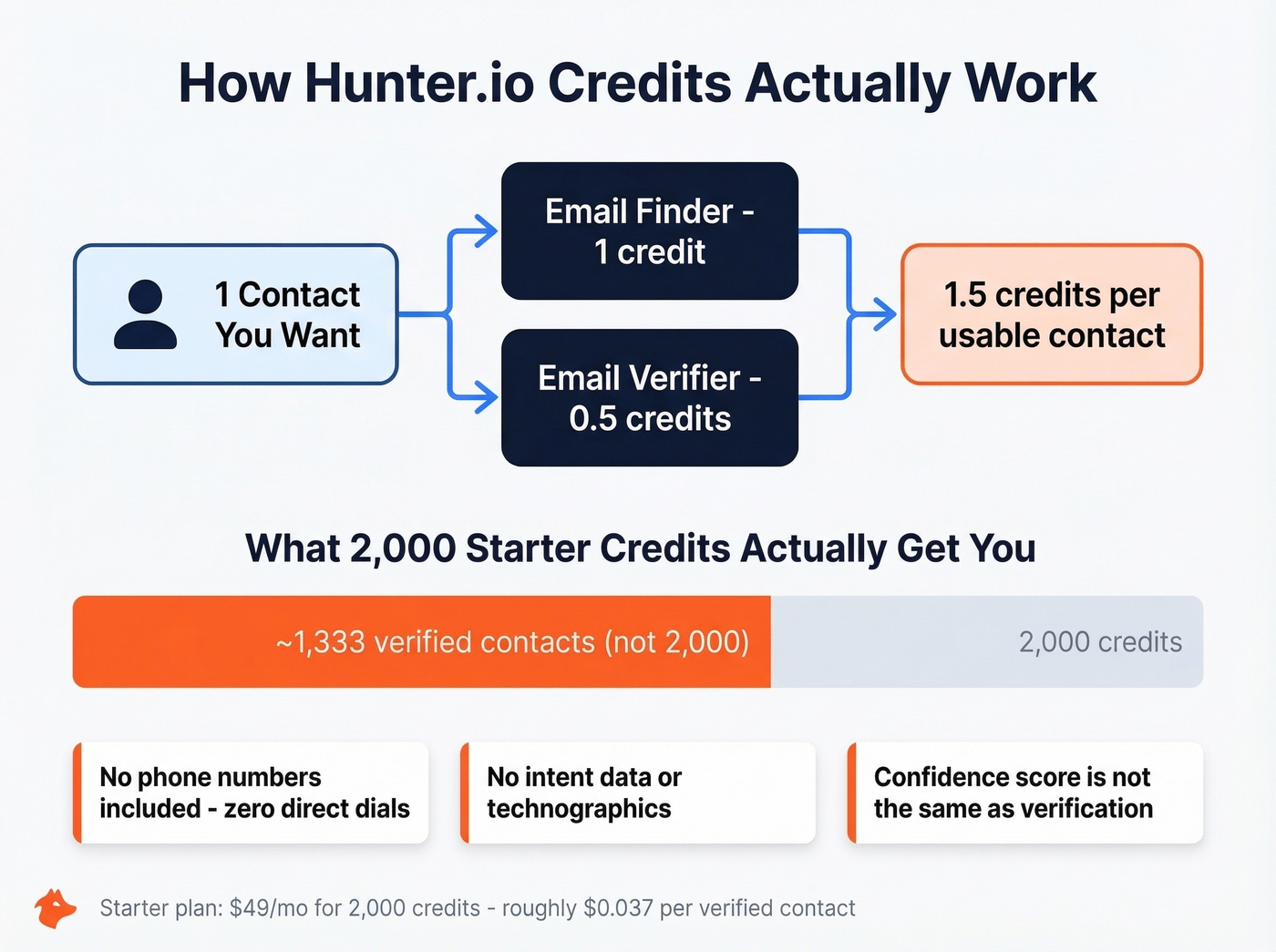
Credits burn fast. Finding an email costs 1 credit. Verifying it costs 0.5. Every usable contact effectively costs 1.5 credits. At scale, Hunter gets surprisingly expensive for a tool that only finds emails.
Data gaps for SMBs and non-public emails. Domain search works best for larger companies. Smaller businesses often return generic addresses or zero results, which is a real problem if you're prospecting mid-market or below.
Confidence score ≠ verification. Hunter's Email Finder returns a confidence percentage, not a verified result. A 60% score means Hunter is guessing based on email patterns - it hasn't confirmed the mailbox exists. This trips up a lot of new users who assume a returned result is a confirmed address.
Zero phone numbers, zero intent data. Hunter doesn't have mobile numbers at all. No direct dials, no intent signals, no technographics. If your outbound motion involves calling, Hunter can't help.
Campaigns are basic. No A/B testing, no inbox rotation, no multichannel sequences. Teams running serious outbound will outgrow it immediately.
No professional profile integration. Hunter removed this years ago and hasn't brought it back. The consensus across reviews is consistent: users praise the simplicity but recommend other platforms once they need phone numbers or volume.
Hunter Pricing in 2026
Since July 16, 2025, Hunter uses a single Unified Credit pool (previously separate Search and Verification pools). Here's what the tiers look like:
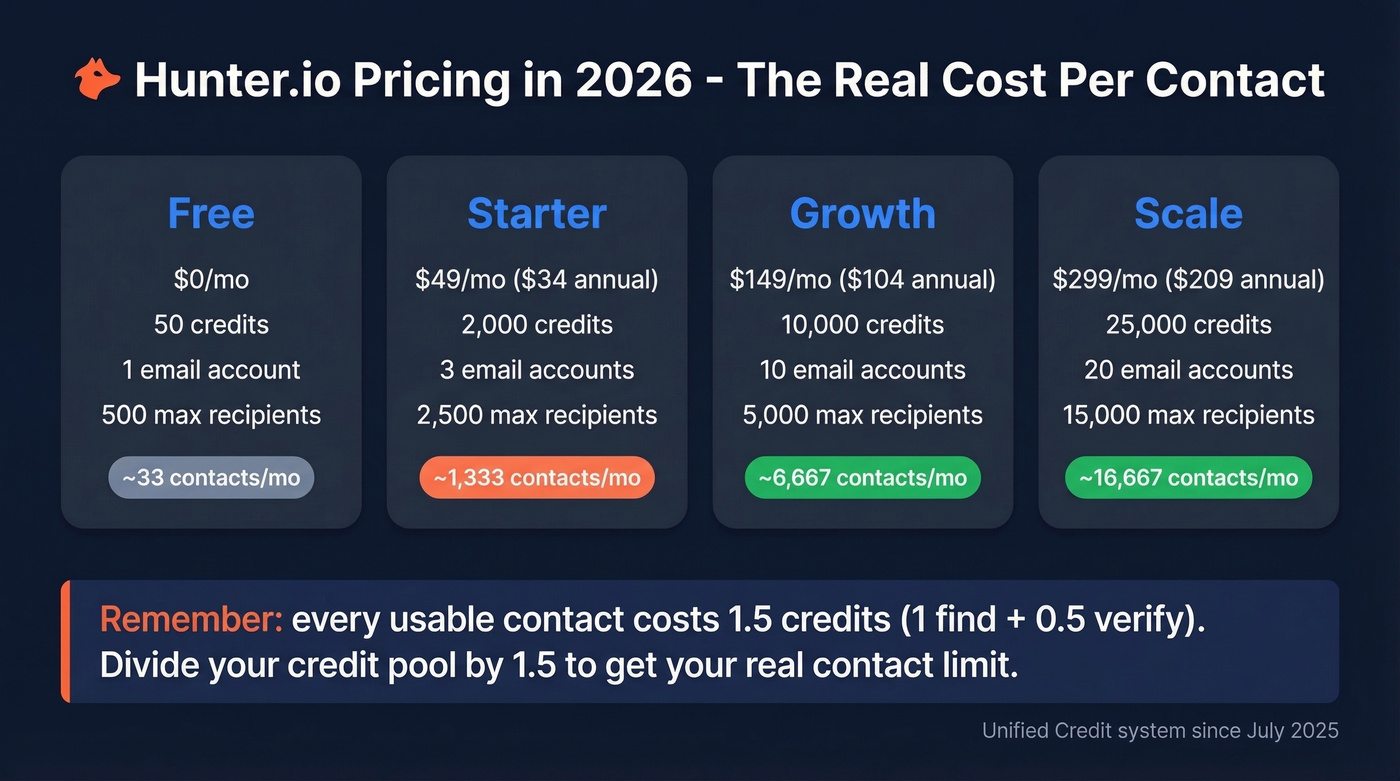
| Plan | Price (Mo / Annual) | Credits/Mo | Email Accts | Max Recipients |
|---|---|---|---|---|
| Free | $0 | 50 | 1 | 500 |
| Starter | $49 / $34 | 2,000 | 3 | 2,500 |
| Growth | $149 / $104 | 10,000 | 10 | 5,000 |
| Scale | $299 / $209 | 25,000 | 20 | 15,000 |
On Starter annual ($34/mo), you're paying roughly $0.028 per contact found and verified. Growth annual drops that to ~$0.010 - but Growth costs $1,248/year for a tool that only finds emails. That's the core tension with Hunter's pricing: it's cheap per credit, but credits don't stretch far when every usable contact eats 1.5 of them.
Who Should (and Shouldn't) Use Hunter
Hunter works well for freelancers, solo founders, and anyone doing occasional domain lookups. A handful of verified emails per week, budget under $50/month, no need for phone numbers or advanced sequencing. It's the fastest path from "I need this person's email" to having it in your clipboard.
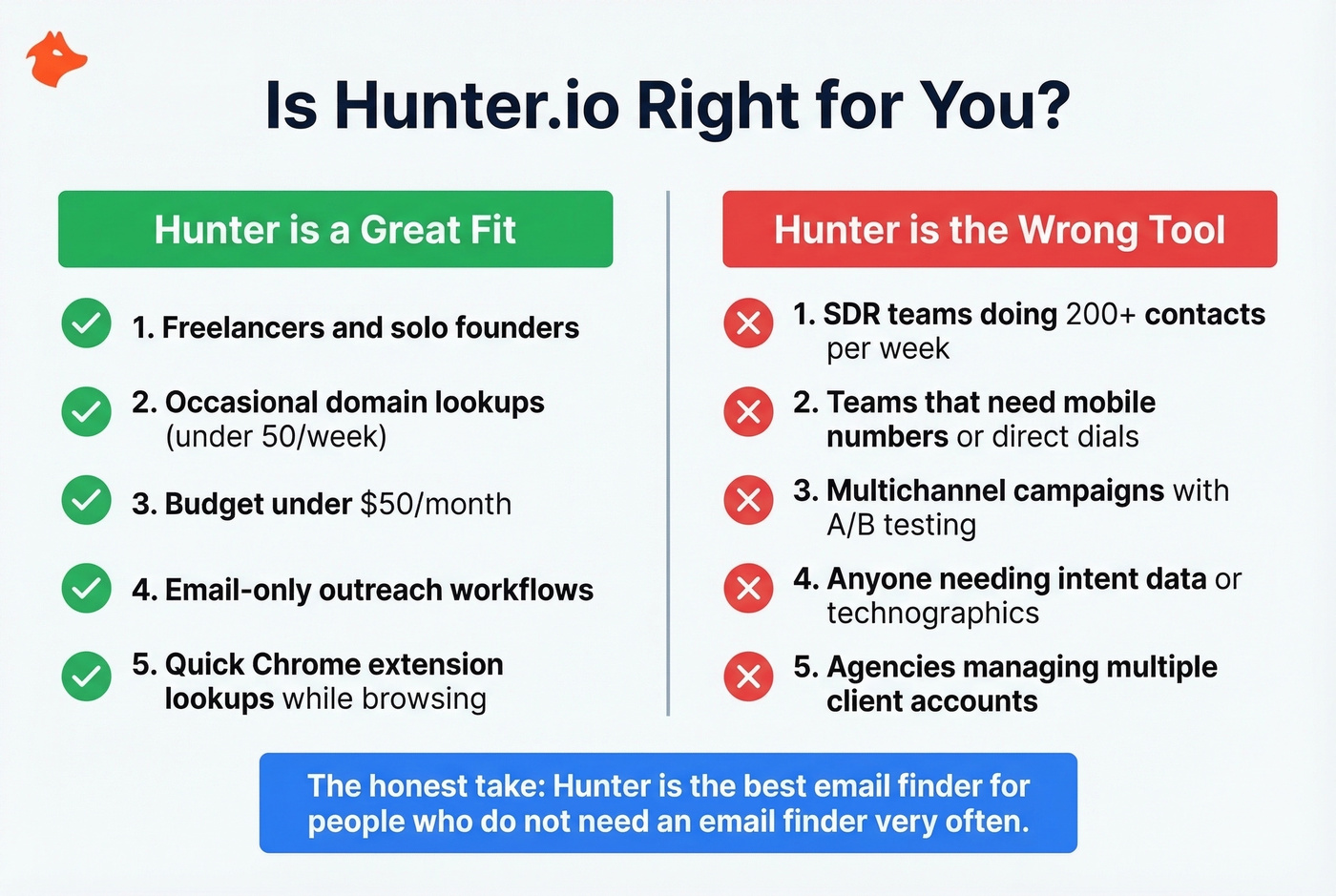
Skip it if you're an SDR team doing volume outbound, need mobile numbers or intent data, run multichannel campaigns with A/B testing and inbox rotation, or manage multiple clients. Hunter wasn't built for those workflows, and forcing it into them will frustrate your team and drain your credits.
Let's be honest: Hunter is the best email finder for people who don't need an email finder very often. The moment you need more than ~50 contacts a week, you've outgrown it.
Alternatives Worth Considering
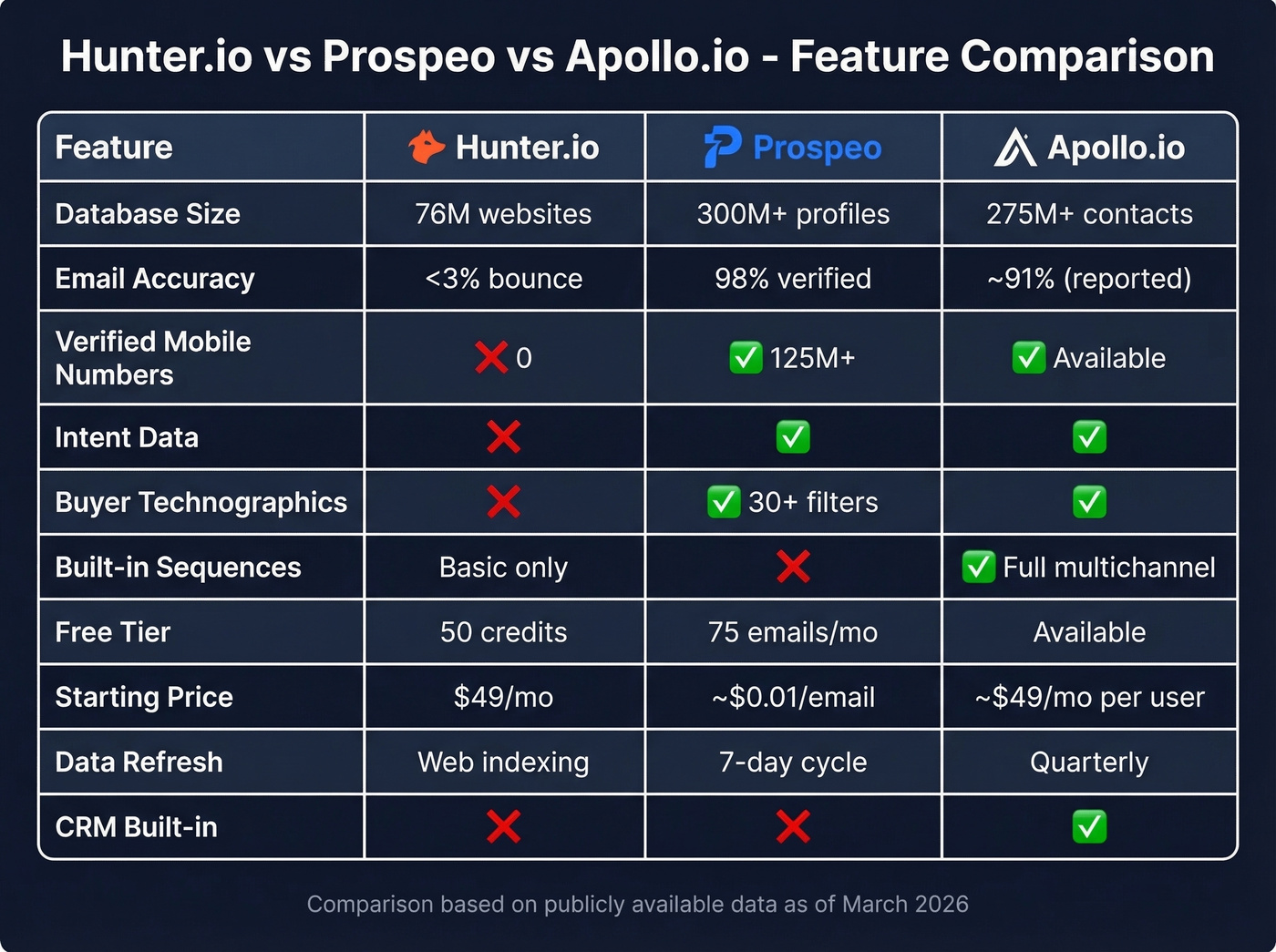
Prospeo directly addresses Hunter's top three gaps. There's no credit wall - the free tier gives 75 emails/month, and paid plans run ~$0.01/email with no contracts. You also get 125M+ verified mobile numbers (Hunter has zero) and 300M+ profiles vs. Hunter's 76M indexed websites. Email accuracy sits at 98% on a 7-day data refresh cycle, and the platform includes 30+ search filters covering buyer intent, technographics, and job changes.
Apollo.io is the all-in-one play: the largest B2B database plus built-in sequencing, a basic CRM, and intent signals. It holds a 4.7/5 on G2 from 9,200+ reviews. Free tier available, paid plans from ~$49-99/mo per user. Great if you want everything in one platform and don't mind a steeper learning curve.
RocketReach handles quick individual lookups when you need a specific person's email or phone. Plans run $39-249/mo. Less suited for bulk prospecting, but solid for one-off searches.
If you've outgrown Hunter's 50-credit free tier, you don't need a bigger credit pool - you need a bigger database. Prospeo gives you 300M+ profiles, 30+ search filters including buyer intent and technographics, and no annual contracts. Free tier included.
Replace Hunter's credit wall with 300M+ profiles and no contracts.
FAQ
Is Hunter.io accurate?
Hunter's verification keeps bounce rates under 3% in independent testing, which is solid. Its Email Finder, though, returns a confidence score - not a verified result. A 60% score means it's pattern-matching, not confirming a mailbox exists. Always run results through the verifier before sending.
Is Hunter.io free?
Hunter offers a free plan with 50 Unified Credits per month and one connected email account. That covers roughly 30-40 email lookups with verification. Most users exhaust it in a single session.
What's the best Hunter.io alternative for mobile numbers?
Prospeo is the strongest option if you need both verified emails and direct dials - 125M+ verified mobiles with a 30% pickup rate, plus 98% email accuracy across 300M+ profiles. Apollo.io is the better fit if you want built-in sequencing and CRM alongside your contact data.
Is Hunter worth it for SDR teams?
For most SDR teams running 200+ contacts per week, Hunter's credit model gets expensive fast, and the lack of phone numbers, intent data, and multichannel sequencing creates real workflow gaps. Teams at that volume typically need a platform with broader data coverage and built-in outreach tools.