

Hunter vs Farmer Sales: The 2026 Playbook
Your VP of Sales just proposed splitting the team. Half the AEs are excited - they've been begging to stop babysitting renewals. The other half are quietly updating their resumes because they know their strength is relationships, not cold outreach. The hunter vs farmer sales model sounds clean on a whiteboard. In practice, it's an org design decision that breaks more teams than it fixes - unless you get the numbers, the comp, and the handoff right.
Most guides give you two paragraphs of definitions and then say "it depends." We're not doing that. Here are the actual decision triggers, comp templates, and handoff SLAs to make the call.
The Short Version
If your sales team is five reps or fewer, stay generalist. The overhead of specialization - separate comp plans, handoff processes, management layers - doesn't pay off at that scale.
Once you're past six reps and you've got meaningful expansion revenue (not just auto-renewals, but real upsell and cross-sell motion), the split starts making sense. But only if you nail three things:
- Comp design - Hunters at 50/50 base/variable, farmers at 70/30 base/variable. Get this wrong and behavior follows the money, not the role.
- Handoff process - This is the #1 failure point. No SLA, no joint meetings, no documentation means churn risk and stalled expansion.
- Quota calibration - 60-75% of reps should be hitting quota. Below 60% means your quotas are broken, not your people.
Defining Hunter and Farmer Roles
Hunters find and close new business. Farmers retain, expand, and deepen existing accounts. The difference goes beyond personality - it's a structural distinction that shapes territory design, comp plans, and daily workflow.
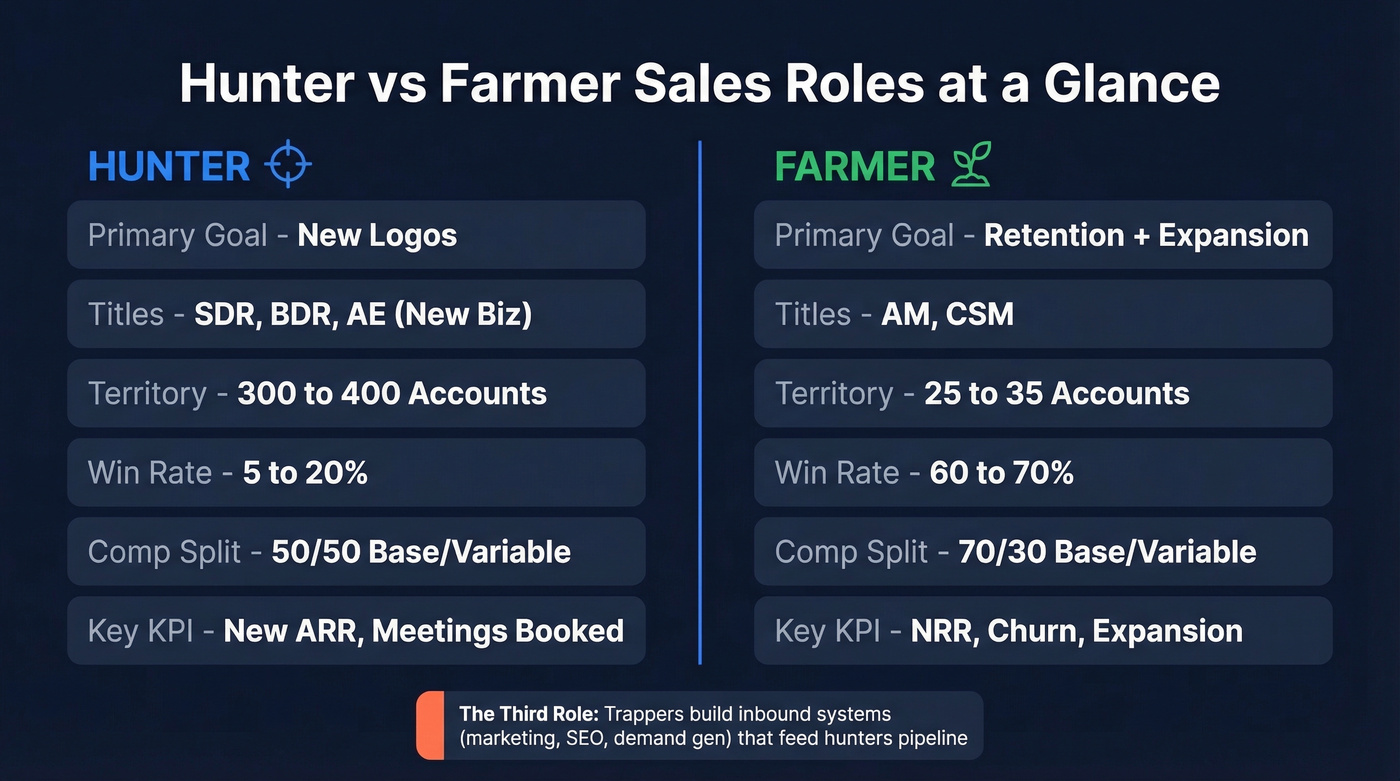
| Dimension | Hunter | Farmer |
|---|---|---|
| Primary goal | New logos | Retention + expansion |
| Typical titles | SDR/BDR, AE (new business) | AM, CSM |
| Territory size | 300-400 accounts | 25-35 accounts |
| Win rate | 5-20% | 60-70% |
| Comp split | 50/50 base/variable | 70/30 base/variable |
| Key KPI | New ARR, meetings booked | NRR, churn, expansion |
SDRs and BDRs sit within the hunter function - they prospect and create opportunities even if they don't carry a closing quota. The SEC Gold Standard Prospecting report found that 58% of SDRs manage over 75 accounts per quarter, which is why some orgs collapse SDR + AE into one full-cycle hunter role.
The Third Persona: Trappers
There's a third archetype that most guides skip: the trapper. Trappers build systems that attract inbound leads - content marketing, SEO, demand gen, paid campaigns. In a modern SaaS org, your marketing team is essentially the trapping function. Recognizing this matters because it changes how you source pipeline for your hunters.
How Common Is the Split?
Less common than you'd think. Alexander Group's research shows only about 15% of XaaS companies run a fully bifurcated model. The rest use cooperative, teamed, or single-owner structures.
The split shows up most in mid-market and SMB segments, particularly in fintech and e-commerce verticals where deal volumes justify dedicated new-business reps. Enterprise orgs with small logo pools tend to avoid it - when you're targeting 50 accounts, you can't afford to break the relationship thread. Best-in-class bifurcated orgs produce over $2.3M in growth ACV bookings per seller. That's the benchmark. If your hunters aren't getting close to that, the model isn't earning its keep.
The Numbers Behind Specialization
The math behind specialization is compelling, but only at scale.
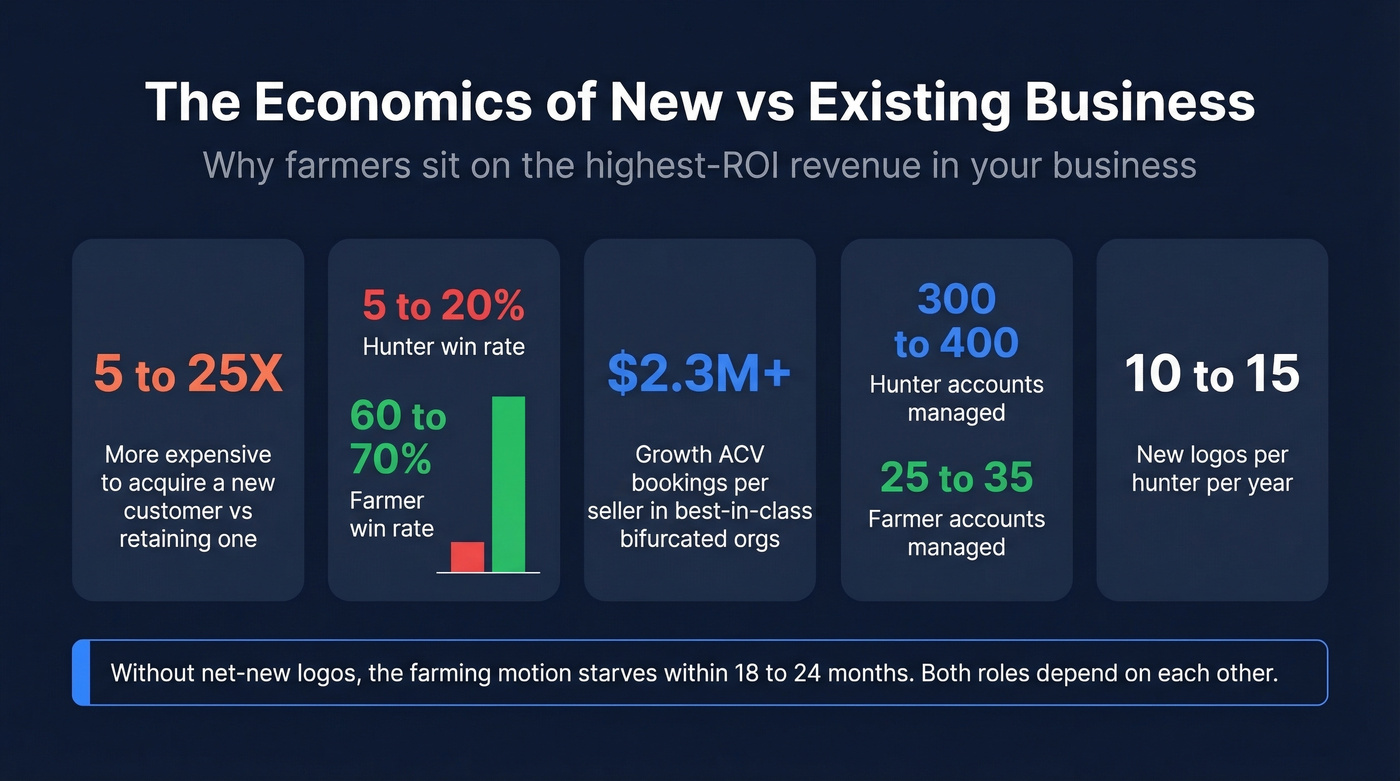
| Metric | New Business | Existing Accounts |
|---|---|---|
| Win rate | 5-20% | 60-70% |
| Cost to acquire | 5-25X more than retaining | Baseline |
| Accounts managed | 300-400 | 25-35 |
| New logos/year | 10-15 | N/A |
| Sales cycle | 3-6 months | Ongoing |
That gap - 60-70% vs. 5-20% - shows exactly where the efficient revenue lives. Acquiring a new customer costs 5-25X more than retaining one. The perception that farming is "easier" or "less valuable" is flat-out wrong and expensive. Farmers are sitting on the highest-ROI revenue in your business.
But hunters create the accounts that farmers eventually grow. Without net-new logos, the farming motion starves within 18-24 months. That's the tension every sales leader has to manage.

Hunters starve without pipeline. Prospeo's 300M+ verified profiles with 30+ filters - including buyer intent, job changes, and headcount growth - let your new-business reps target the right logos instead of chasing dead leads. 98% email accuracy means no bounced outreach burning your domain.
Stop feeding your hunters bad data. Give them contacts that actually connect.
When to Split (and When Not To)
Most companies split too early. We've seen teams of four reps try to run a dedicated hunter/farmer structure and end up with two underperforming micro-teams instead of one functional squad.
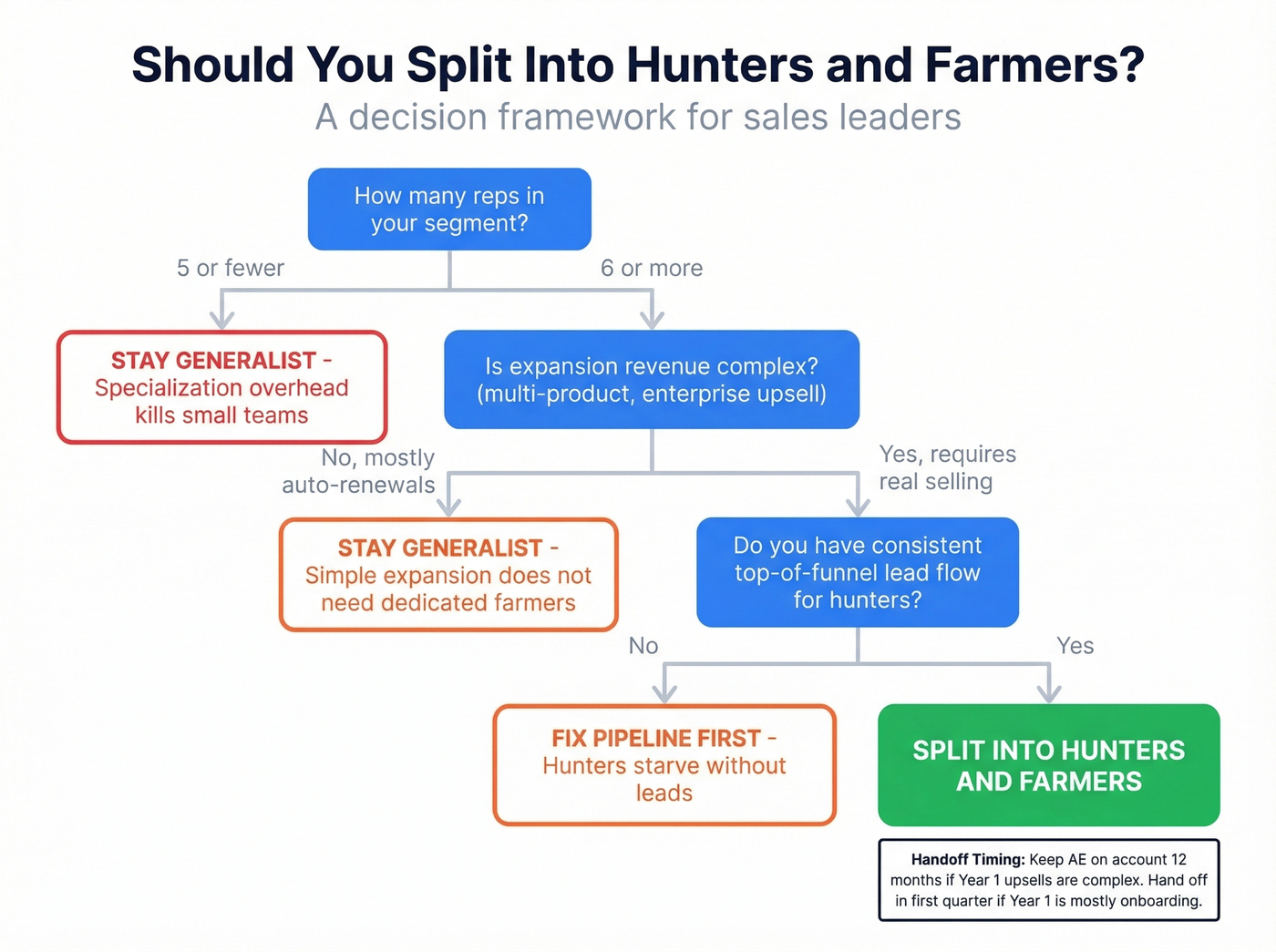
The Revenue Playbook's framework offers the clearest decision logic we've found:
Stay generalist when:
- Your team is five reps or fewer within a segment
- You can't staff at least one full team of AEs and one of AMs, each with a dedicated manager
- Your expansion revenue is simple - auto-renewals or usage-based growth that doesn't require selling
Split when:
- You're past six reps and scaling
- Expansion is complex enough to require dedicated attention, like multi-product or enterprise upsell
- You have consistent top-of-funnel lead flow to keep hunters fed
Handoff timing deserves its own logic. If Year 1 expansion involves high-complexity multi-stakeholder upsells, keep the closing AE on the account through the first renewal - roughly 12 months. If Year 1 is mostly onboarding with expansion kicking in Year 2+, hand off to an AM within the first quarter. The deciding factor is when the customer relationship has built enough trust to absorb the transition.
Here's the thing: stop asking "are you a hunter or a farmer?" in interviews. It's a lazy question that tells you nothing about how someone will actually perform. Ask about deal mechanics, pipeline management, and how they've handled account transitions. The role should shape the behavior, not the other way around.
Compensation Playbook
Comp plans cause more problems than personality mismatches. If your farmer is paid like a hunter, they'll hunt. If your hunter gets a fat base with thin variable, they'll coast. Design the incentive, and the behavior follows.
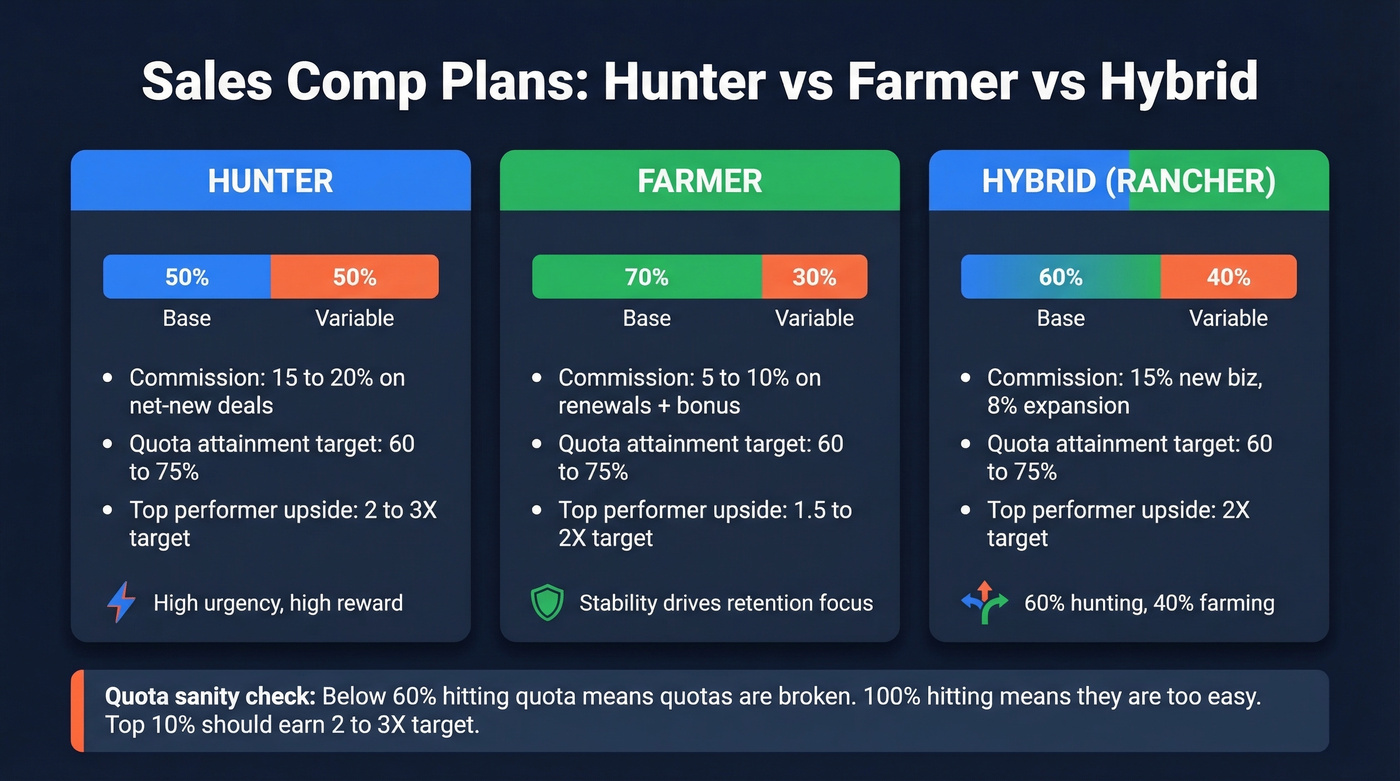
| Role | Base/Variable | Commission | Quota Target | Top Upside |
|---|---|---|---|---|
| Hunter | 50/50 | 15-20% net-new | 60-75% attainment | 2-3X target |
| Farmer | 70/30 | 5-10% renewals + bonus | 60-75% attainment | 1.5-2X target |
| Hybrid | 60/40 | 15% new / 8% expansion | 60-75% attainment | 2X target |
The hunter's 50/50 split creates urgency - half their income depends on closing. The farmer's 70/30 provides stability. You don't want your account managers panicking about rent instead of focusing on retention.
Farmers should also get a retention bonus when they hold accounts above 90% renewal rates. The hybrid "rancher" model - a term gaining traction - splits time roughly 60% hunting and 40% farming. One team running this model hit 30% YoY growth, though it requires reps who can genuinely context-switch between prospecting and account management.
A recurring debate on r/sales is whether hybrid reps inevitably default to low-hanging fruit - farming existing accounts instead of prospecting. The answer is yes, unless the comp plan explicitly weights new-business commission higher. That's why the rancher model uses 15% on new business vs. 8% on expansion.
The quota sanity check: if fewer than 60% of your reps are hitting quota, your quotas are too high. If 100% are hitting, they're too easy. The top 10% should be earning 2-3X their target incentive - that's what keeps your best people from taking recruiter calls.
Why the Split Fails
Your best AE closed a $200K deal. The account got handed to an AM who'd never spoken to the customer. Three months later, the renewal is at risk.
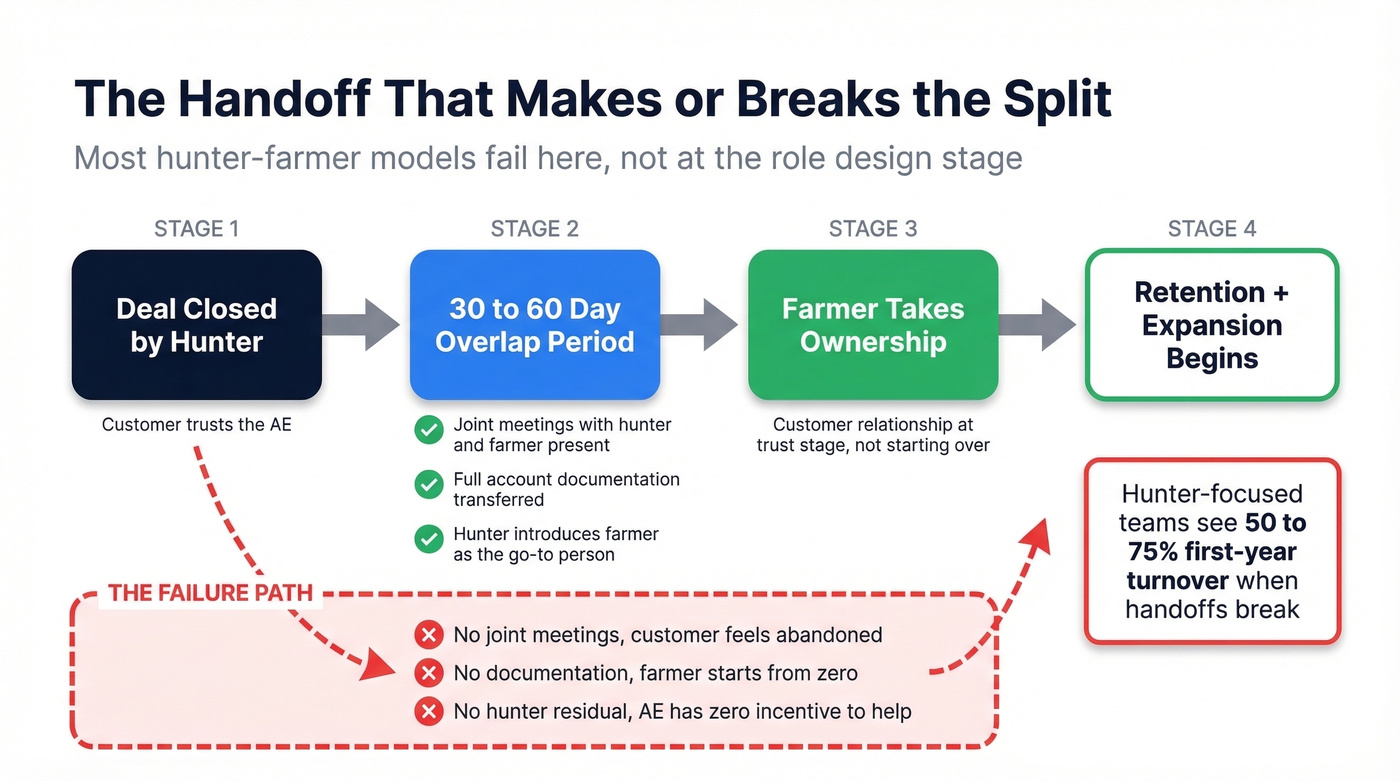
That's not a hypothetical - it's the most common failure mode of the hunter vs farmer sales model. The core issue is trust. Customers build relationships with people, not roles. The relationship lifecycle runs: aware, like, trust, buy, repeat, refer, reference. A handoff forces the relationship back to the "like" stage at best. Early handoffs - before the customer has enough positive experience to absorb the friction - are especially destructive.
Hunter-focused sales forces have historically seen 50-75% first-year turnover. If your first-year turnover exceeds 25%, you've got a design problem, not a people problem. The fixes require discipline, not complexity:
- Handoff SLAs - Define exactly when, how, and with what documentation an account transitions. No "warm intro email" handoffs. Use a handoff email template to standardize the basics.
- Joint meetings - Hunter and farmer overlap on the account for 30-60 days. The customer needs to see the new person endorsed by someone they trust.
- Comp that rewards continuity - Give hunters a small residual on accounts they close for the first 6-12 months. It keeps them invested in a clean transition.
Lessons from Ryder
Ryder, the Fortune 500 logistics company with roughly $9B in annual revenue, offers one of the better-documented implementation examples. They didn't mass-hire a bunch of hunters and hope for the best.
Instead, Ryder classified new headcount by role and filtered existing reps into the right seat using sales team assessments and manager input. The hardest part was account load - some hunters were carrying 13 accounts, way too many for a true new-business role. Ryder cut that down to five, redistributing accounts and resetting expectations across the team. Their biggest lesson: start with the customer. Before you redesign roles, understand how your customers buy and what they value at each stage. The org structure should serve the buying process, not the other way around.
Your Hunters Need Better Data
A hunter managing 300-400 accounts can't afford dead leads. When bounce rates run 30-40%, the pipeline math breaks completely. If your hunter needs 10-15 new logos per year and their outbound sequences are bouncing a third of the time, they're effectively working with a territory that's 30% smaller than it looks on paper.
This is where data quality becomes a structural issue, not just a nice-to-have. Prospeo delivers 98% email accuracy on a 7-day data refresh cycle - versus the 6-week industry average - which directly impacts hunter productivity. The Chrome extension lets reps verify contacts in real time while prospecting, and with 300M+ professional profiles behind it, your reps aren't wasting sequences on dead addresses. If you're evaluating vendors, start with a shortlist of data enrichment services and compare coverage vs. refresh rate.

Let's look at what this means in practice. Snyk runs 50 AEs prospecting four to six hours per week. Before switching data sources, bounce rates ran 35-40%. After the switch, bounces dropped under 5% and AE-sourced pipeline jumped 180% - over 200 new opportunities per month. That's not a marginal improvement. That's fundamentally different pipeline math for every hunter on the team.
If you're trying to fix the top of the funnel, pair better data with better execution: tighten your sales prospecting techniques, upgrade your SDR tools, and keep a library of sales follow-up templates so reps don't improvise under pressure.
Whether your team runs hunters, farmers, or full-cycle reps, bad contact data kills every model. Prospeo refreshes all 300M+ records every 7 days - not the 6-week industry average - so your hunters reach real buyers and your farmers never lose touch with expansion contacts.
Great sales structure means nothing if the data underneath it is stale.
FAQ
Is farming easier than hunting?
No - different stress profile, not a lighter workload. Hunters face constant rejection across hundreds of accounts; farmers manage retention risk and the pressure of protecting existing revenue. Anyone who thinks farming is easy hasn't tried saving a six-figure renewal going sideways.
Which role pays more?
Hunters have higher variable upside thanks to the 50/50 comp split, so top hunters typically out-earn top farmers. Median comp across both roles is often similar because the farmer's 70/30 structure provides more income stability and predictable earnings.
Can one person do both?
Yes, in teams of five or fewer. At scale, hybrid reps default to whichever motion comes naturally. Use the rancher comp model - 60/40 split, 15% new business / 8% expansion - and accept you're optimizing for flexibility over peak performance. Skip this approach if you're past 10 reps and have the pipeline volume to justify full specialization.
What tools do hunters need most?
Verified contact data, a CRM, and a sequencing tool - in that order. Bad data is the #1 pipeline bottleneck. Pair a strong data layer with HubSpot or Salesforce for pipeline management and Outreach or Lemlist for sequences.
What's a "trapper" in sales?
The inbound-focused third persona - demand gen, content marketing, SEO, paid campaigns. Trappers build systems that attract leads rather than chasing them. Your marketing team is essentially the trapping function that feeds your hunters pipeline.