

Hunter.io Domain Search: What It Actually Costs, How Accurate It Is, and When to Use Something Else
You ran a Hunter.io domain search on a target account, got 30 results, exported them, and 8 bounced on the first sequence. That's not a hypothetical - it's the experience that sends thousands of users to Google every month looking for answers. Hunter won't write this guide, so we will.
The Quick Verdict
Hunter.io Domain Search works well for occasional lookups on large, well-indexed companies - especially on the free plan. It falls short when you need scale, when you're targeting SMBs, or when accuracy isn't optional.
- Use Hunter's free plan for one-off domain lookups (50 searches/month)
- Skip Hunter if you're running outbound sequences where bounces damage your sender reputation
What the Domain Search Tool Does
Hunter's Domain Search takes a company domain and returns every publicly available email address it can find. Results come back in about half a second. The output includes confidence scores, department filters, and the original web sources where each address was discovered.

The tool covers 78M+ domains, and that number keeps growing. You can filter by department - marketing, engineering, HR - and results include seniority and department fields to help you prioritize the right contacts. Each result also flags whether the email is verified or unverified, and whether the domain is catch-all.
For quick recon on a target company, it's genuinely useful. The UI is clean and fast, which is why 42 out of 634 G2 reviewers specifically praise ease of use.
Those confidence scores deserve a quick explanation. They're calculated from a mix of SMTP verification signals, the quality and quantity of web sources where the email appeared, and how well the address matches the company's detected email pattern. A high score doesn't guarantee deliverability, but it's a reasonable signal.
The problem isn't what the tool does. It's what it costs and how often the results actually work.
How Credits Actually Work
Hunter's credit system is where most people get surprised.
Search credits: One search credit covers up to 10 emails found for a single domain. If a domain returns 43 email addresses, that costs 5 search credits (43 / 10, rounded up). Simple enough.
But here's the part that stings: verification is separate. Each email verification costs 0.5 credits. Skip verification and you're rolling the dice - that's how people end up with the ugly bounce-rate stories you see on Reddit.
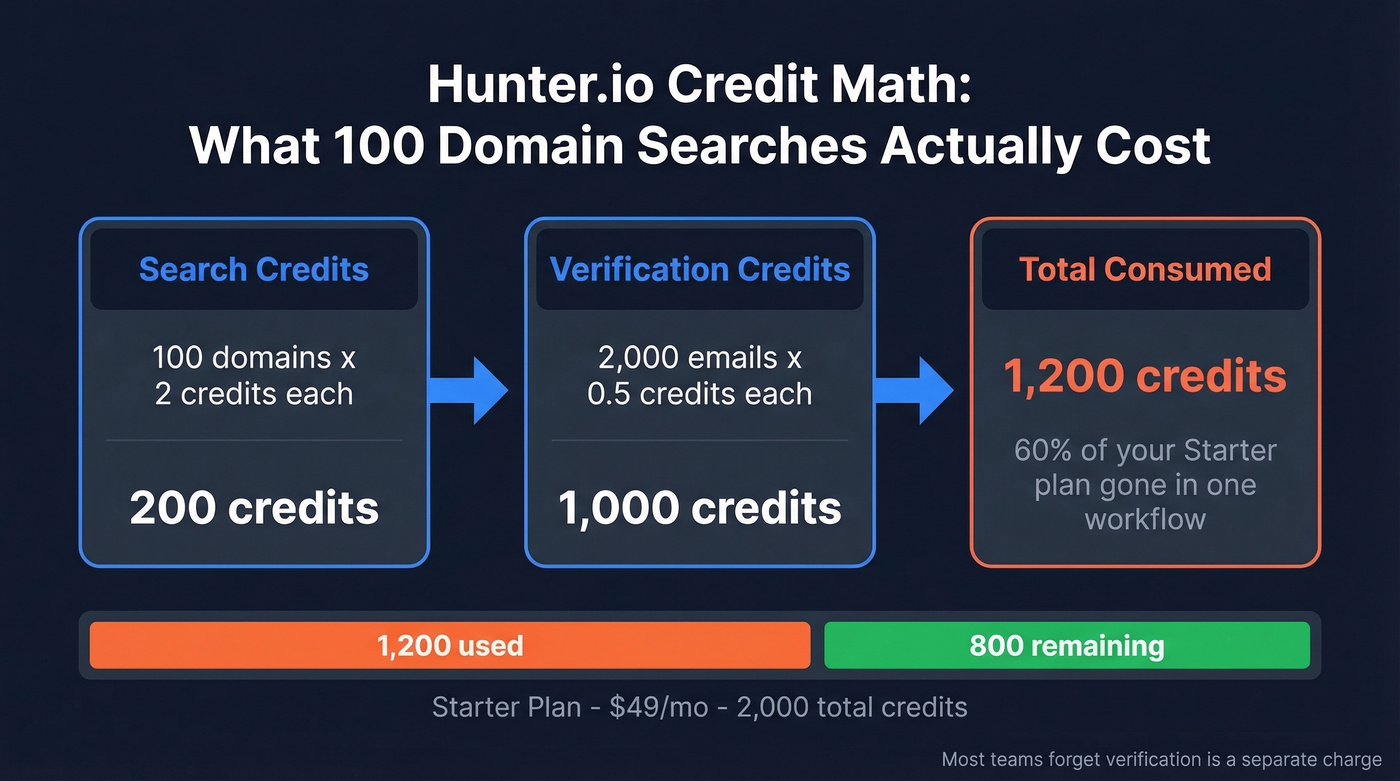
Let's run the math on a real workflow. Say you're searching 100 domains and averaging 20 emails per domain:
- Search credits: 100 domains x 2 credits each = 200 credits
- Verification credits: 2,000 emails x 0.5 credits = 1,000 credits
- Total: 1,200 credits consumed
On the Starter plan ($49/mo), you get 2,000 credits. That single workflow eats 60% of your monthly allotment. And on the free plan, you get 50 searches/month. If most domains return 10 emails or fewer, that's 50 domain searches. If your target domains are larger, you'll burn through those 50 much faster.
Here's the thing: most teams underestimate how fast Hunter credits disappear because they forget verification is a separate charge. We've seen teams blow through a Starter plan in the first week of a campaign.

That 1,200-credit workflow you just calculated? On Prospeo, those 2,000 emails cost roughly $20 - with verification built in. 98% email accuracy means under 4% bounce rates, not 20-25%.
Stop paying credits twice for emails that still bounce.
Hunter.io Pricing in 2026
Full breakdown per Hunter's pricing page:
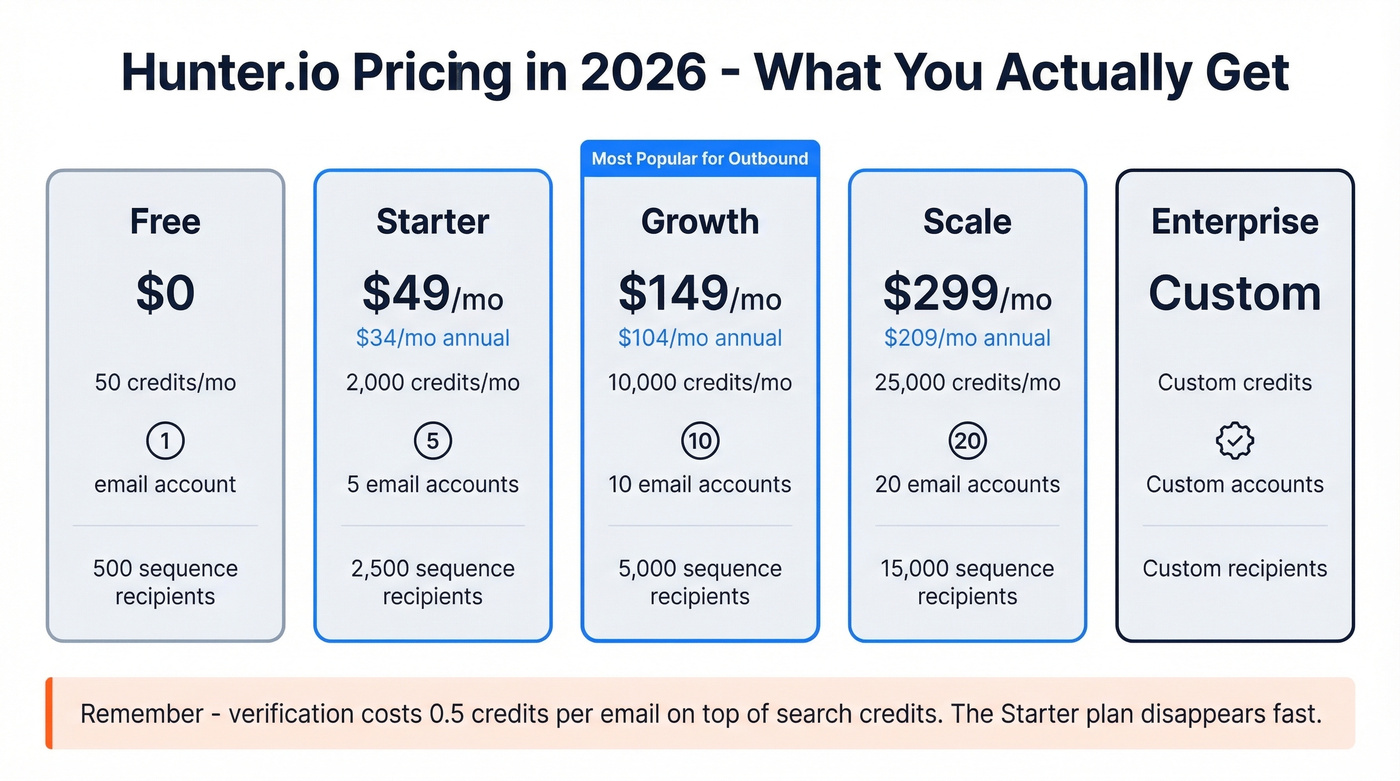
| Plan | Monthly | Annual | Credits/mo | Sequences |
|---|---|---|---|---|
| Free | $0 | $0 | 50 | 500 recipients |
| Starter | $49 | $34/mo | 2,000 | 2,500 recipients |
| Growth | $149 | $104/mo | 10,000 | 5,000 recipients |
| Scale | $299 | $209/mo | 25,000 | 15,000 recipients |
| Enterprise | Custom | Custom | Custom | Custom |
Annual billing saves roughly 30%. Connected email accounts scale from 1 on the free plan to 20 on Scale.
For teams needing credits beyond their plan, Hunter sells bulk packs - one example on their pricing page is $6,500 for 1,000 search credits plus 200,000 verification credits, usable over 12 months. For teams doing serious outbound, the Growth plan at $104/mo annual is the realistic starting point. The Starter plan's 2,000 credits vanish fast once verification enters the picture.
The Accuracy Problem
Hunter published their own benchmark - a test of 15 email verifiers using 3,000 emails (2,700 real addresses from outreach campaigns plus 300 known-invalid test addresses). Hunter's verifier scored 70% overall accuracy. They also explicitly acknowledge potential bias, since the test dataset was based on email activity recorded in their own system.
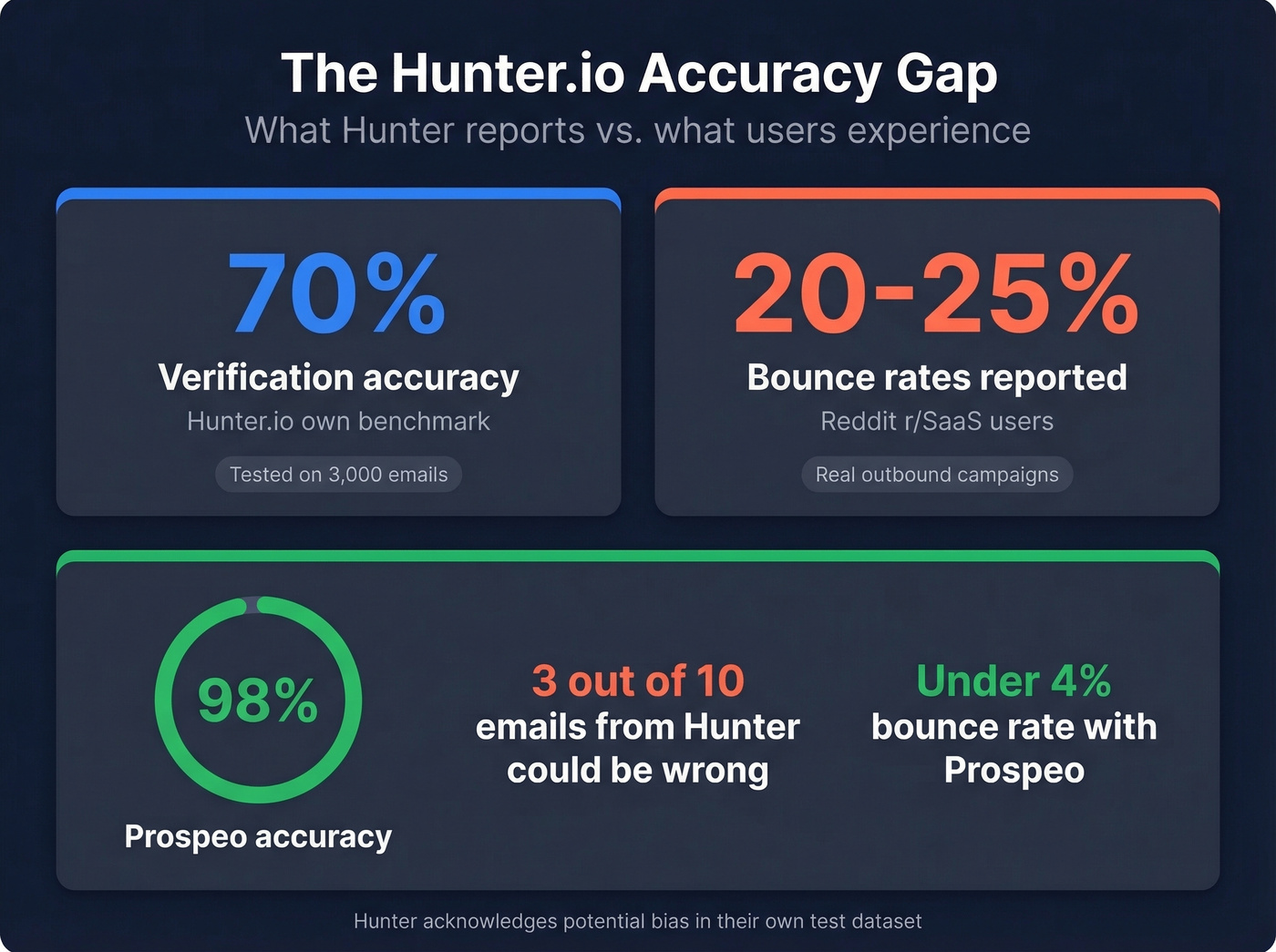
An important distinction: that 70% figure measures verification accuracy, not the domain search tool's ability to find emails. But the two are linked. If you rely on Hunter to both find and verify your emails, a 70% verification accuracy means roughly 3 out of every 10 emails you trust could still be wrong.

Reddit paints a harsher picture. Users on r/SaaS talk about bounce rates in the 20-25% range and complain about paying credits regardless of whether emails work. Another recurring take is that Hunter works better as a verification layer than a primary source - a distinction that should shape how you use the tool. In our experience, any tool that can't consistently stay below a 5% bounce rate is a liability for outbound teams who care about domain health (see email bounce rate benchmarks).
G2 reviews tell a split story: 22 reviewers praise accuracy, but 6 flag data quality issues, and 6 call out limited contacts for smaller companies. If you're prospecting into mid-market or SMB accounts, expect gaps.
Using Domain Search via API
For developers building enrichment pipelines, Hunter's API is straightforward:
GET https://api.hunter.io/v2/domain-search?domain=intercom.com
The response includes useful fields beyond just email addresses: confidence scores, sources with URLs and timestamps, verification status, seniority, department, pattern (showing the email format like {first}.{last}@domain.com), and domain-level flags like accept_all and disposable. Pagination is handled via limit and offset parameters.
Authentication works three ways: api_key as a query parameter, an X-API-KEY header, or Authorization: Bearer YOUR_API_KEY. Hunter also provides a test key (test-api-key) that returns dummy data - handy for validating your integration before burning real credits.
Watch for these error codes:
- 403 - rate limit hit; back off and retry
- 429 - plan usage exhausted; upgrade or wait for reset
- 451 - unavailable for legal reasons
That 451 code is a detail most guides skip. It means Hunter won't return data for certain individuals due to legal restrictions - a real compliance consideration if you're building automated pipelines across regions with strict data protection laws.
Alternatives Worth Considering
If Hunter's credit model or accuracy isn't cutting it, these tools are worth testing (or see our full list of Hunter alternatives).
Prospeo
Prospeo takes a fundamentally different approach. Instead of crawling the web and hoping emails are still valid, it runs a proprietary email-finding infrastructure with 5-step verification including catch-all handling, spam-trap removal, and honeypot filtering. The result is 98% email accuracy across 300M+ professional profiles, with data refreshed every 7 days versus the 6-week industry average.
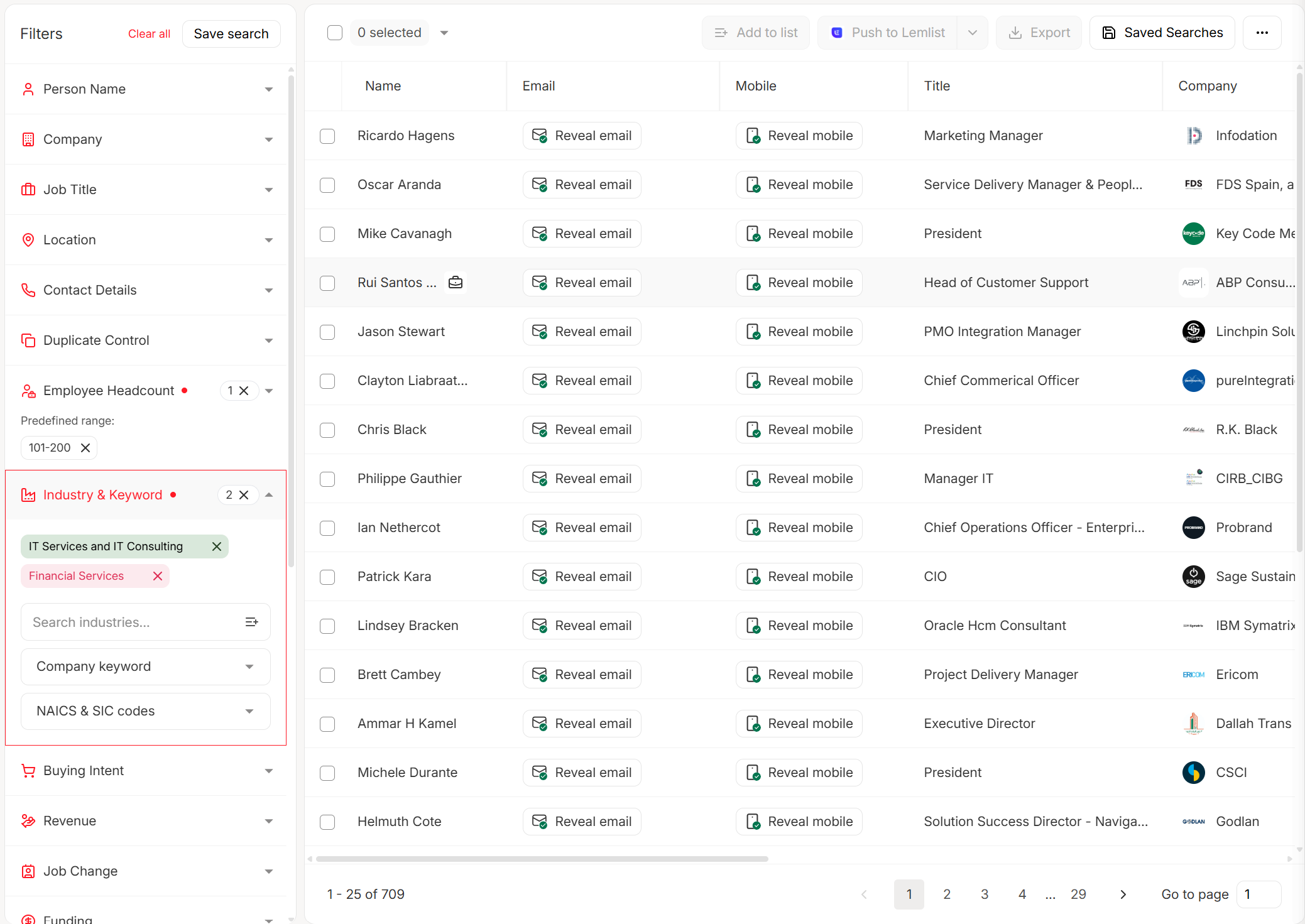
You get 30+ search filters including buyer intent powered by Bombora (15,000 topics), technographics, job changes, and headcount growth signals. Native integrations with Salesforce, HubSpot, Lemlist, Instantly, and Clay mean verified contacts flow directly into your sequencer. Teams that switch report booking 26% more meetings than they did with ZoomInfo and 35% more than with Apollo - largely because fewer emails bounce and more actually reach inboxes.
Pricing starts at ~$0.01 per email with 75 free emails per month. No contracts, no sales calls required.
Apollo.io
Apollo is the "give me everything in one tool" play. Its database covers 275M+ contacts, and the platform doubles as a lightweight CRM with sequencing built in. The free tier is generous enough to run a real test. Starting price runs ~$49/mo per user.
Use this if you want a large database with built-in outreach and don't mind doing your own verification. Skip this if you're sending at scale - older contacts in Apollo's database tend to bounce. We've run head-to-head tests where Apollo's raw email lists bounced at 15%+ before external verification (more on email deliverability and what actually moves it).
Snov.io
Snov.io is a strong option for international leads, with built-in email automation starting around $39/mo. If your ICP includes European or APAC companies, it's worth testing Snov alongside Hunter. It won't match Prospeo on accuracy, but the automation features are solid for smaller teams running multi-channel sequences.
How They Compare
| Tool | Email Accuracy | Starting Price | Key Strength | Best For |
|---|---|---|---|---|
| Prospeo | 98% | ~$0.01/email | Real-time verification, 7-day refresh | Accuracy-first outbound |
| Hunter.io | ~70% (their own test) | $49/mo | Easy UI, domain-level search | Quick one-off lookups |
| Apollo.io | Not published | ~$49/mo/user | Large DB, CRM + sequencing | All-in-one teams |
| Snov.io | Not published | ~$39/mo | International coverage, automation | Non-NA prospecting |
Hunter's own benchmark shows 70% verification accuracy. Prospeo's proprietary 5-step verification delivers 98% - refreshed every 7 days, not scraped from stale web sources. Your sender reputation deserves better.
Get emails accurate enough to protect your domain health.
FAQ
Is Hunter.io Domain Search free?
Yes, the free plan includes 50 searches per month, where one credit covers up to 10 emails found per domain. Verification costs an additional 0.5 credits per email. For most prospecting workflows, you'll hit the free limit quickly once you're actively researching multiple accounts.
Does Hunter.io work for small companies?
Often poorly. G2 reviewers flag "limited contacts for smaller companies" as a recurring issue. Hunter's 78M+ domain coverage skews toward larger, well-indexed companies with significant web presence. If you're prospecting into startups or SMBs, expect thin results - and consider pairing Hunter with a tool that has broader coverage.
What's the most accurate alternative to Hunter.io for finding emails by domain?
Prospeo delivers 98% email accuracy with real-time verification across 300M+ professional profiles. Unlike Hunter, you only pay for emails that pass verification - no wasted credits on bounces. The free tier includes 75 verified emails per month, enough to run a real comparison before committing.