

Hunting and Farming in Sales: The Operational Guide Nobody Wrote
Your best AE just closed a $200K deal. Now she's supposed to nurture that account, run QBRs, and chase expansion - while also filling her pipeline with net-new logos. She'll do neither well.
The hunting and farming in sales metaphor has been floating around sales orgs for decades, and it's still one of the most misunderstood concepts in revenue operations. The real question isn't whether to split the roles - it's when to split, how to compensate each side, and what infrastructure makes either motion actually work.
The Short Version
- Under $5M ARR? Don't split. Run hybrid reps with a 60/40 hunting-to-farming time allocation. Premature specialization creates overhead you can't afford.
- Your first specialization hire isn't another AE - it's a CSM. Add one around $1M ARR to handle onboarding and adoption so your closers can keep closing.
- The #1 thing that kills hunting isn't strategy - it's bad contact data. If 30% of your emails bounce, your reps are burning hours and domain reputation. Fix the data layer before optimizing anything else.
What Hunters and Farmers Actually Do
Hunters - SDRs, BDRs, and outbound AEs - focus on net-new revenue. They prospect, qualify, demo, negotiate, and close logos that have never paid you before. Farmers - Account Managers, CSMs, and renewal specialists - focus on existing revenue. They onboard, retain, expand, and renew accounts already in the book.
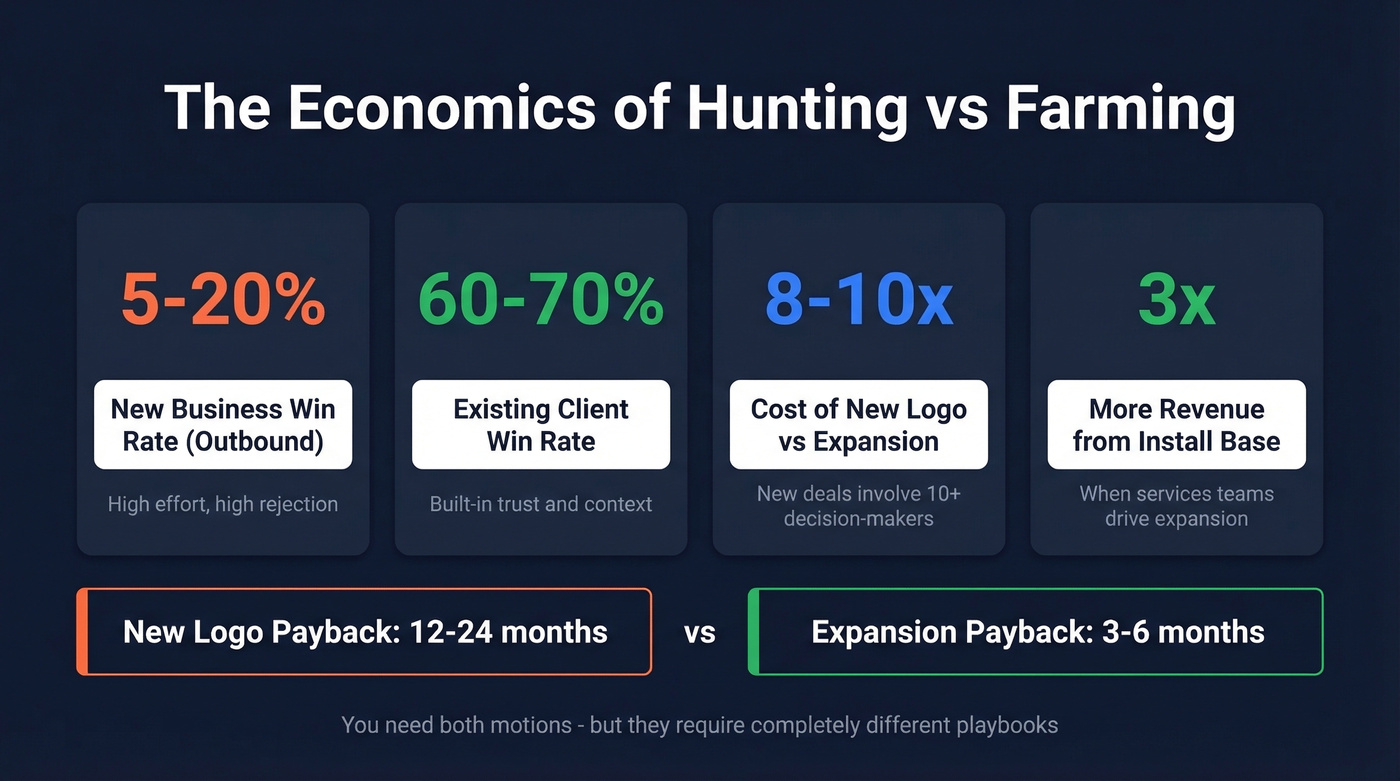
The economics are starkly different. Existing-client win rates run 60-70%, while new-business win rates often sit at 5-20% for outbound motions. Enterprise new-logo acquisition cycles can stretch to 6-18 months and cost 8-10x more than expansion, partly because deals now involve 10+ decision-makers on the buyer side. That's not an argument against hunting - you need new logos to grow. It's an argument for treating these as fundamentally different motions that require different skills, comp plans, and KPIs.
Companies that use services teams as a lead-generation engine for install-base expansion gain nearly 3x more revenue from existing customers than those that don't. If you're ignoring your farming infrastructure, you're leaving the cheapest revenue on the table.
| Dimension | Hunter | Farmer |
|---|---|---|
| Titles | SDR, BDR, AE | AM, CSM, Renewal Mgr |
| Focus | Net-new logos | Retention + expansion |
| Win rate | 5-20% (outbound) | 60-70% |
| Cycle length | Weeks to 18 months | Ongoing |
| Risk profile | High rejection | Churn management |
The 7-Stage Lifecycle - Who Owns What
Most orgs fumble the handoff. They close a deal, toss it to an AM with a Slack message, and wonder why the customer feels abandoned three months later. We've watched this play out dozens of times, and the pattern is always the same: NPS drops in the first quarter and expansion conversations stall before they start.
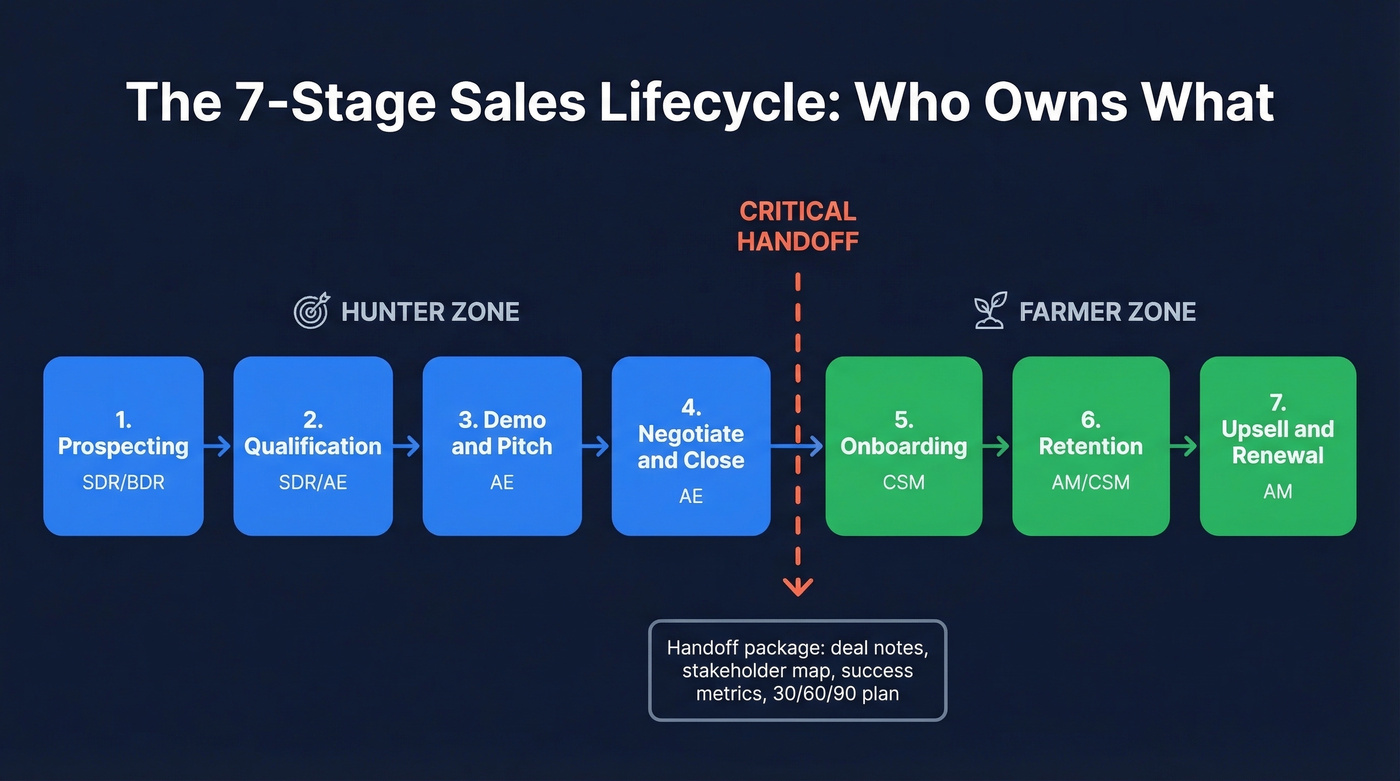
| Stage | Owner | Handoff Trigger |
|---|---|---|
| 1. Prospecting | Hunter | - |
| 2. Qualification | Hunter | - |
| 3. Demo / Pitch | Hunter | - |
| 4. Negotiation / Close | Hunter | Signed contract |
| 5. Onboarding | Farmer (CSM) | 30-day activation |
| 6. Retention | Farmer (AM/CSM) | Renewal cycle |
| 7. Upsell / Renewal | Farmer (AM) | Expansion signal |
The critical moment is between stages 4 and 5. Every handover creates a trust gap - the buyer built a relationship with the hunter, and now they're meeting someone new. The fix: a 3-6 month shared-account period where both hunter and farmer attend calls. For high-expansion accounts, stretch that to 12-24 months. Yes, it's expensive. It's cheaper than churn.
Minimum handoff package: signed contract plus deal notes in CRM, stakeholder map with roles and influence levels, agreed success metrics, and a 30/60/90 onboarding plan co-owned by hunter and farmer.

You just read that bad contact data is the #1 thing killing hunting motions. Prospeo delivers 98% email accuracy with a 7-day refresh cycle - so your hunters aren't burning domain reputation on stale data, and your farmers get enriched stakeholder maps for every account in their book.
Fix your data layer before you split another role.
When to Split - The ARR-Stage Framework
Here's the thing: only about 15% of XaaS companies actually run a fully bifurcated hunter/farmer model. Most teams are somewhere in between, and that's fine. If your average deal size sits below $25K, you probably don't need full bifurcation - the overhead will eat the efficiency gains.
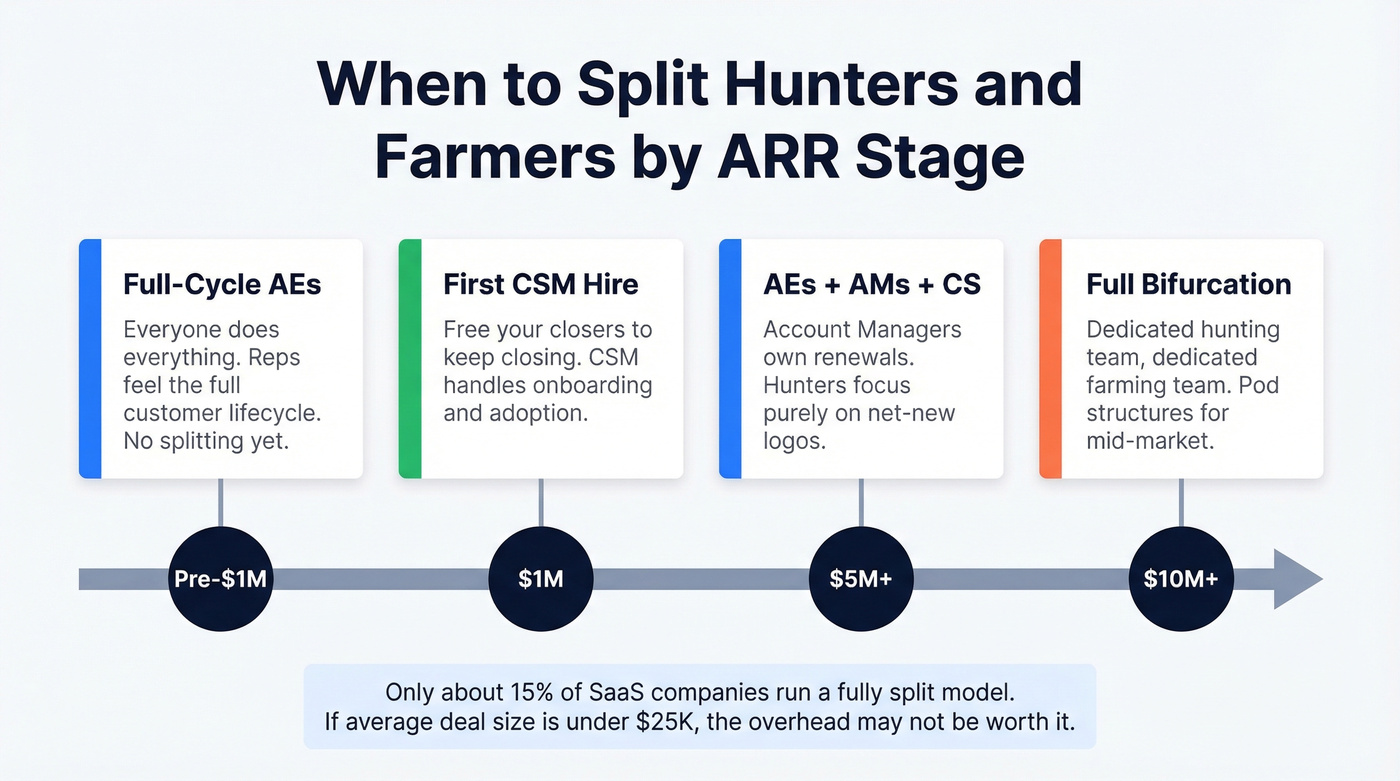
| ARR Stage | Org Design | Key Hire |
|---|---|---|
| Pre-$1M | Full-cycle AEs | None - reps do it all |
| ~$1M | AEs + first CSM | CSM for onboarding |
| $5M+ | AEs + AMs + CS | AMs own renewals |
| $10M+ | Full bifurcation | Dedicated hunting team |
Before $1M, splitting roles is premature optimization. Your AEs need to feel the full customer lifecycle - it makes them better closers and gives you product feedback loops you can't get any other way. Beyond the hunter/farmer binary, some teams run pod structures where a hunter, farmer, and CSM share a book of accounts. This works well in mid-market but tends to break down at enterprise scale where deal complexity demands dedicated attention.
Best-in-class bifurcated orgs produce over $2.3M in growth ACV bookings per seller, and bifurcated models are most common in mid-market/SMB segments and verticals like fintech and e-commerce where expansion pathways are complex. But if growth is mostly expansion-driven, a hybrid "rancher" model - 60% hunting, 40% farming - often outperforms a forced split. Don't specialize for the sake of an org chart.
Expansion deals typically pay back in 3-6 months vs. 12-24 months for new logos. That alone should shape how you invest as you scale.
Comp Plans That Actually Work
Compensation is where the hunter-farmer model either sings or falls apart. Get this wrong and your hunters will cherry-pick easy renewals while your farmers ignore expansion opportunities.
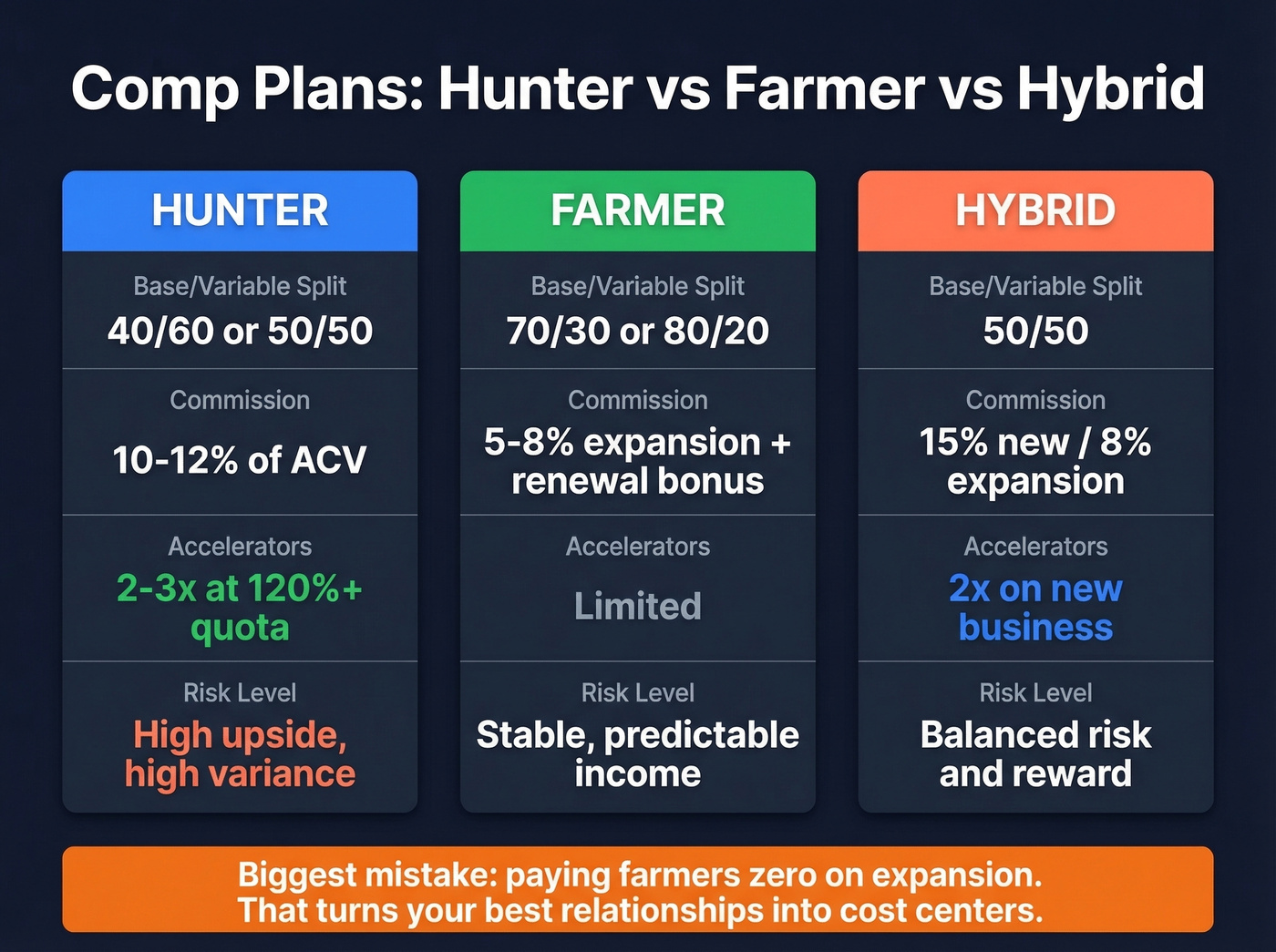
| Component | Hunter | Farmer | Hybrid/Rancher |
|---|---|---|---|
| Base/variable split | 40/60 or 50/50 | 70/30 or 80/20 | 50/50 |
| Accelerators | 2-3x at 120%+ | Limited | 2x on new biz |
| Commission example | 10-12% of ACV | 5-8% of expansion + renewal bonus | 15% new / 8% expansion |
| Quota attainment target | 60-75% of reps | 60-75% of reps | 60-75% of reps |
Hunters need aggressive variable comp because their job is inherently inconsistent. Accelerators at 2-3x for overachievement reward the feast-or-famine nature of new business. Farmers need stability because their value compounds over time - a 70/30 or 80/20 split keeps them focused on retention without the anxiety of a missed month tanking their income.
The biggest comp mistake we see is paying farmers zero incentive on expansion. That turns your best account relationships into cost centers instead of growth engines. If you want farmers to spot upsell signals, pay them to care.
KPIs - What to Measure
Don't give hunters and farmers the same dashboard. They're playing different games.
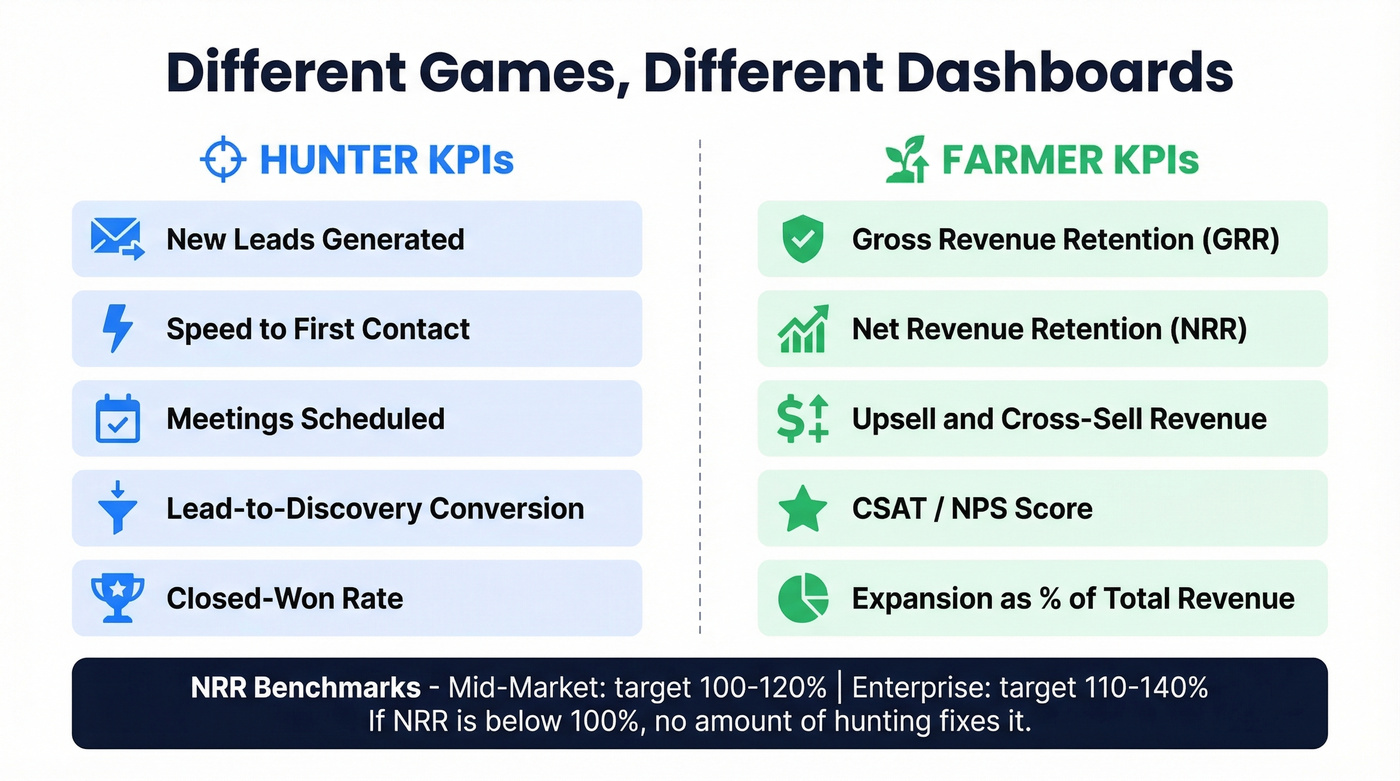
| Hunter KPIs | Farmer KPIs |
|---|---|
| New leads generated | Retention rate (GRR) |
| Speed to first contact | Net revenue retention |
| Meetings scheduled | Upsell/cross-sell revenue |
| Lead-to-discovery conversion | CSAT / NPS |
| Closed-won rate | Expansion as % of total |
For SaaS, layer in standard NRR benchmarks: mid-market should target 100-120% NRR, enterprise 110-140%. If your farmers aren't driving NRR above 100%, you've got a retention problem that no amount of hunting will fix.
A hunter who generates 40 qualified opportunities and closes 8 is more valuable than one who closes 4 from 10. The first rep is building a scalable pipeline. The second is getting lucky.
The Data Problem That Kills Hunting
Look, this is where most hunting orgs lose money without realizing it. Reps pull lists, write sequences, and hit send - and bad data quietly taxes every step. Bounced emails chip away at sender domain reputation, making the next campaign perform worse. Dead phone numbers waste dial time. The team ends up "working hard" without actually reaching buyers.
This isn't hypothetical. Snyk had 50 AEs prospecting 4-6 hours per week with bounce rates running 35-40%. After switching to Prospeo, bounces dropped under 5%, AE-sourced pipeline jumped 180%, and the team generated 200+ new opportunities per month. The platform covers 300M+ professional profiles with 143M+ verified emails at 98% accuracy and 125M+ verified mobile numbers, all refreshed every 7 days - compared to the 6-week industry average. With 30+ search filters and intent data across 15,000 topics, reps build targeted lists in minutes instead of hours.

Whether you're running a dedicated hunting team or hybrid reps balancing both motions, the prospecting engine lives or dies on data quality. Strategy, comp plans, and org design all matter - but none of it works if your reps are sending emails into the void. If you're tightening the data layer, start with data enrichment and a clean lead generation workflow so reps aren't rebuilding lists every week. The consensus on r/sales is pretty clear on this: reps who spend more time cleaning lists than actually selling burn out fast and hit quota less often.
Enterprise deals involve 10+ decision-makers. Your hunters need every one of them. Prospeo's 300M+ profiles, 125M+ verified mobiles, and 30+ filters - including buyer intent and job changes - let reps map the full buying committee in minutes, not days.
Give your hunters the contact data that actually connects them to real buyers.
FAQ
Is hunting or farming better for introverts?
Farming suits introverts who thrive on deep relationships and long-term account strategy. Hunting rewards resilience and comfort with high-volume outreach. Neither is exclusively introvert or extrovert territory - it depends on whether you prefer depth with fewer accounts or breadth across more prospects in your daily work.
Do hunters or farmers earn more?
Hunters have higher upside - 40-60% variable comp with 2-3x accelerators means a great quarter can be exceptional. Farmers earn more predictably with 70-80% base comp but lower ceilings. At $10M+ ARR orgs, top hunters typically out-earn top farmers by 20-30% in peak years, though farmers rarely have a truly bad quarter either.
What tools do sales hunters need?
At minimum: a CRM like Salesforce or HubSpot, a verified contact data platform like Prospeo for accurate emails and direct dials, a sequencing tool like Instantly or Outreach, and intent data to prioritize accounts showing active buying signals. The stack doesn't need to be complex - it needs to be accurate.
When should a startup split hunter and farmer roles?
Most startups should wait until $5M+ ARR before full bifurcation. The first specialization hire - typically a CSM around $1M ARR - frees closers to keep hunting without abandoning new customers. Skip this if you're a two-person sales team under $1M ARR; you'll create more problems than you solve by splitting too early.