

The Hybrid Sales Model: What Works in 2026 (+ What Breaks)
A RevOps lead we know merged her hunter and farmer teams into "hybrid reps" last year. Within two quarters, enterprise pipeline dried up because every rep defaulted to farming their existing book. The model wasn't wrong - the execution was. Hybrid sales is the highest-performing B2B motion available right now, but most teams implement it in ways that guarantee failure.
The short version: this model means the org operates across digital and in-person channels - not that every rep does everything. Three things kill it: role ambiguity, misaligned comp, and bad contact data. Fix those three and the McKinsey numbers - up to 50% more revenue, 4x account reach - become realistic.
Looking for hybrid vehicle sales? Hybrids hit 15% of U.S. auto transactions in Q3 2025, with Ford alone moving 228,000+ units that year. For vehicle data, check the LA Times auto section. This article covers B2B sales strategy.
What Is Hybrid Selling?
Hybrid sales combines digital and in-person motions at the organizational level. Not field sales with a Zoom account bolted on - a deliberate model where some interactions happen remotely, others happen face-to-face, and the org designs roles, comp, and data flows so both channels reinforce each other.
The shift is structural. Gallup finds nearly 8 in 10 remote-capable employees already work hybrid or fully remote - the workforce has moved, and the sales model needs to catch up. McKinsey's data shows B2B buyers now use 10+ channels in a single purchase journey, double from five years prior. Field-only and inside-only models can't cover that surface area. A blended approach can.
Why This Model Outperforms
McKinsey's research across 2,500+ sales organizations found hybrid selling drives up to 50% more revenue by enabling broader customer engagement. Remote reps reach 4x as many accounts as field reps. Buyers will spend real money without shaking hands - 71% will commit $50k+ via remote or self-serve channels, 27% above $500k.
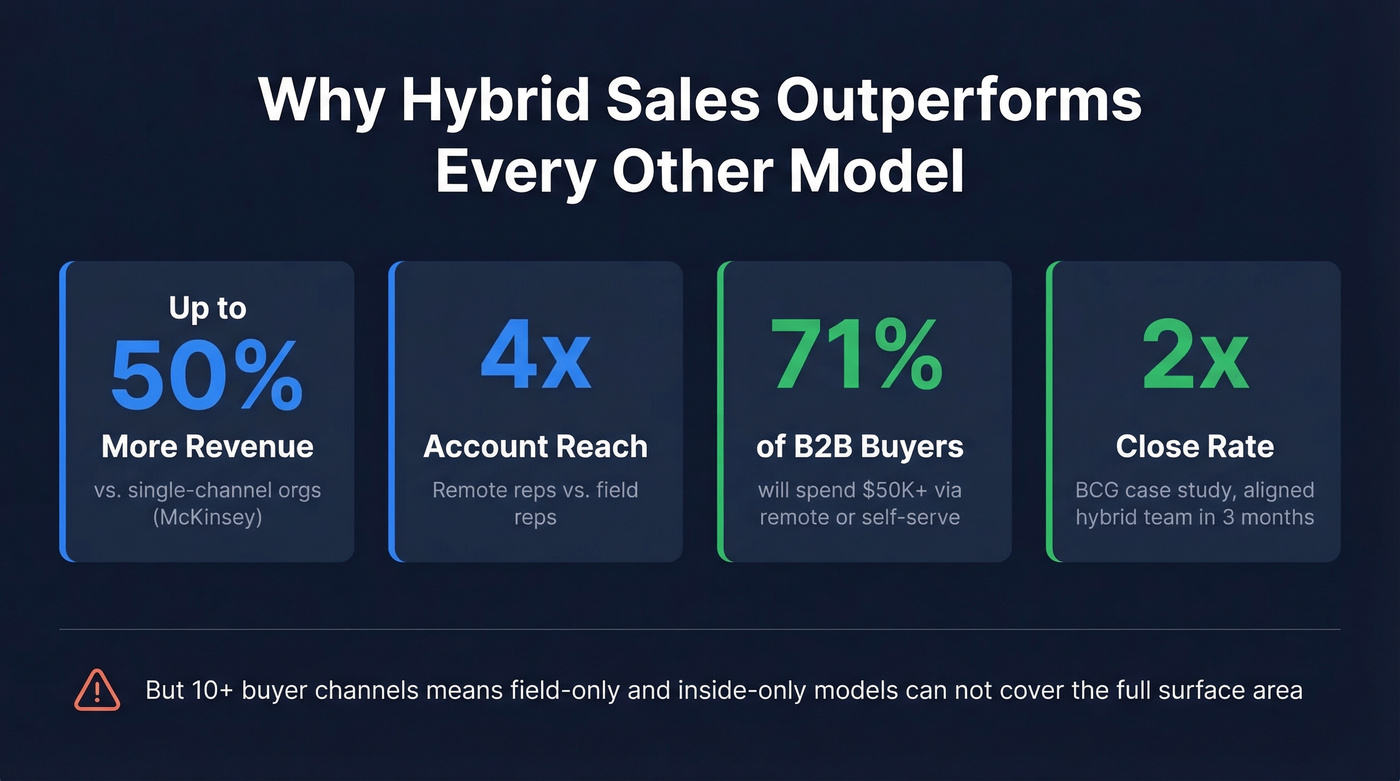
The cost math works too. Each remote rep saves roughly $11,000 in overhead compared to a field counterpart. Across a 20-person team, that's $220k in annual savings before counting revenue lift. Digital-only has its own ceiling, though - buyer response rates are declining as outreach volume climbs, and robocall fatigue makes cold calls harder to land. That's exactly why a blended motion outperforms pure-digital: you deploy in-person strategically instead of defaulting to it or abandoning it entirely.
BCG documented a Fortune 100 B2B services company that aligned tools, training, and scorecards across channels. Within three months, they doubled their close rate. Not a marginal improvement. A structural advantage.
When Hybrid Roles Fail
The consensus on r/sales is blunt: these roles fail when they're designed as "one rep does everything" instead of "the org covers every channel." We've seen this pattern across dozens of teams, and three failure modes show up every time.
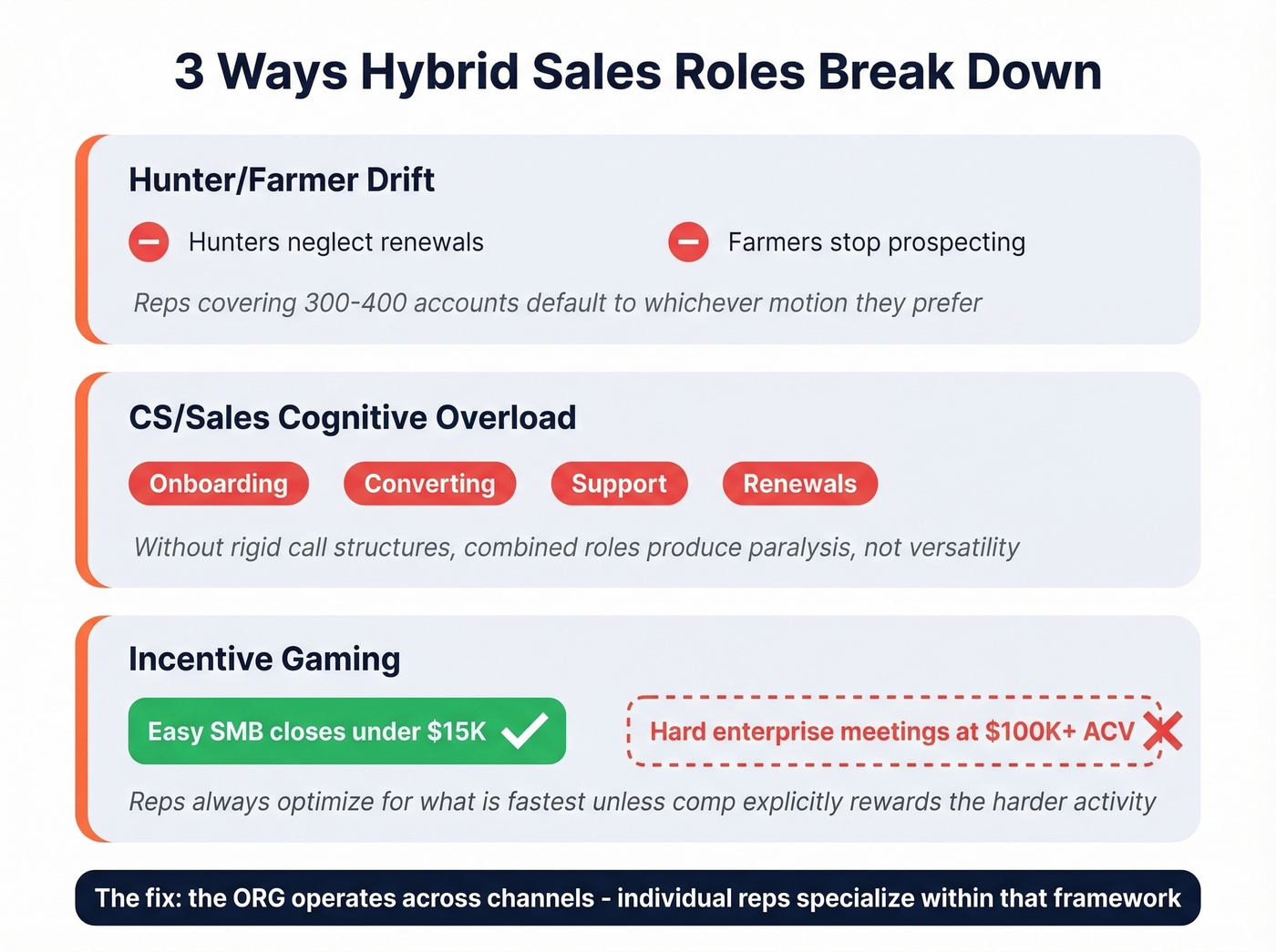
Hunter/farmer drift. An enterprise SaaS team consolidated into blended reps covering 300-400 accounts each, expected to hunt 10-15 new logos per year while farming their book. Reps defaulted to whichever motion they preferred. Hunters neglected renewals. Farmers stopped prospecting. The title didn't create the behavior.
CS/Sales cognitive overload. One practitioner on r/CustomerSuccess described freezing on calls because the role required simultaneously onboarding free users, converting to paid, handling support, and managing renewals. Without rigid call structures and deep product mastery, combined CS/Sales roles produce paralysis, not versatility.
Incentive gaming. A classic Reddit thread describes the SDR+closer dilemma: book enterprise meetings at $100k+ ACV and close SMB deals under $15k. The easy SMB closes win every time. Without comp that explicitly rewards the harder activity, reps optimize for what's fastest.
Here's the thing most articles miss: hybrid sales doesn't mean every rep does everything. The organization operates across channels. Individual reps can - and often should - specialize within that framework.

Hybrid models fail when reps waste digital touches on bad emails and wrong numbers. Prospeo gives your blended team 300M+ profiles with 98% email accuracy, 125M+ verified mobiles, and intent data across 15,000 topics - refreshed every 7 days so every channel starts clean.
Fix the data layer before you redesign the roles.
Comp Design That Prevents Channel Conflict
HP learned this the hard way. They built a threshold model where inside reps earned commission up to $75k and field reps earned above $75k. The two teams became direct competitors. Inside reps sandbagged deals to keep them under the cap. Field reps ignored small opportunities. The fix: field reps earned credit on all territory orders, with a modest quota uplift to keep costs neutral.
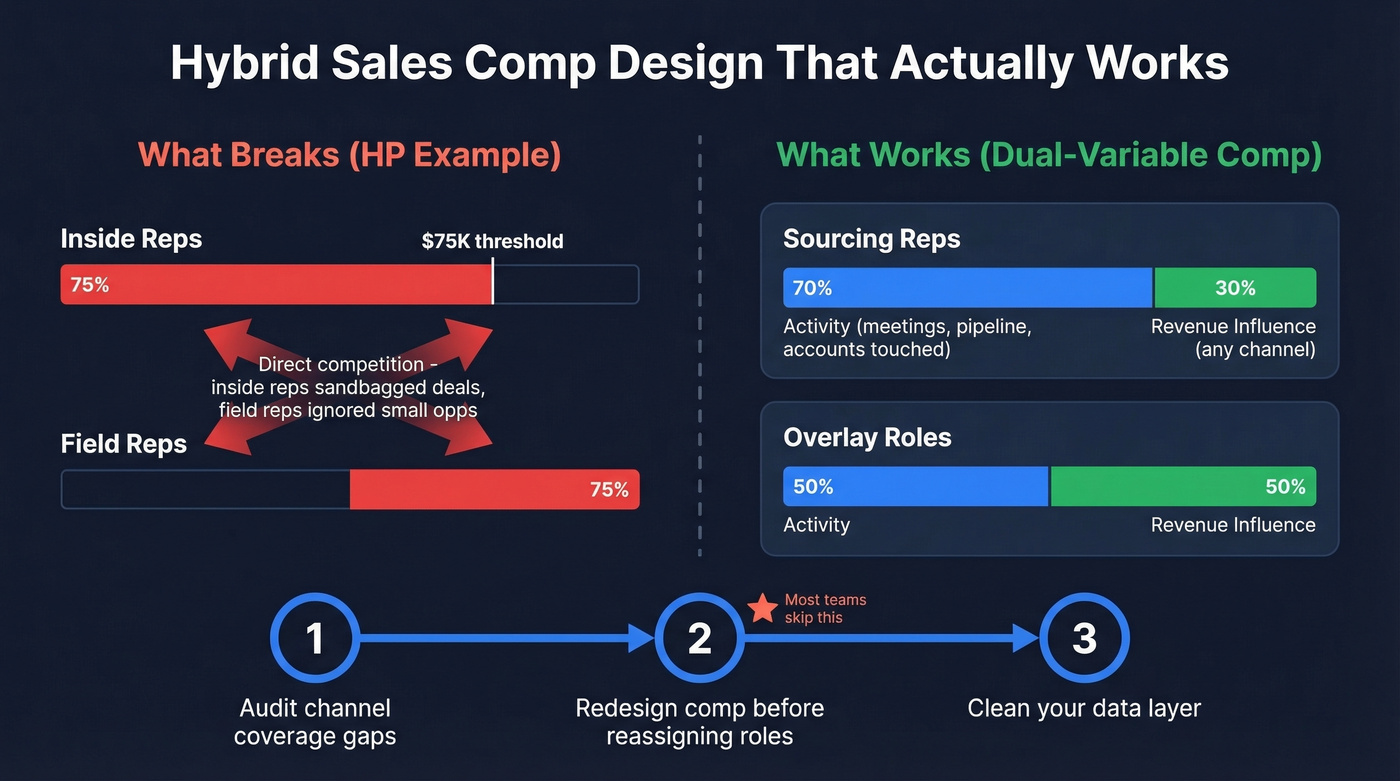
In our experience, the teams that nail hybrid sales fix comp first and channels second. The right structure is dual-variable comp: one component tied to activity - meetings booked, pipeline created, accounts touched - and another tied to revenue influence regardless of channel. Common splits run 70/30 for reps who primarily source, 50/50 for overlay roles. If the comp plan makes channels compete, the customer loses and so does the pipeline.
Three-step implementation sequence. First, audit your current channel coverage gaps. Second, redesign comp before reassigning roles - this is where most teams skip ahead and regret it. Third, clean your data layer so every channel starts with accurate contacts.
The Tech Stack for Hybrid Sales Teams
Start with three things: a CRM, verified contact data, and conversation intelligence. Everything else is a nice-to-have until those three work.
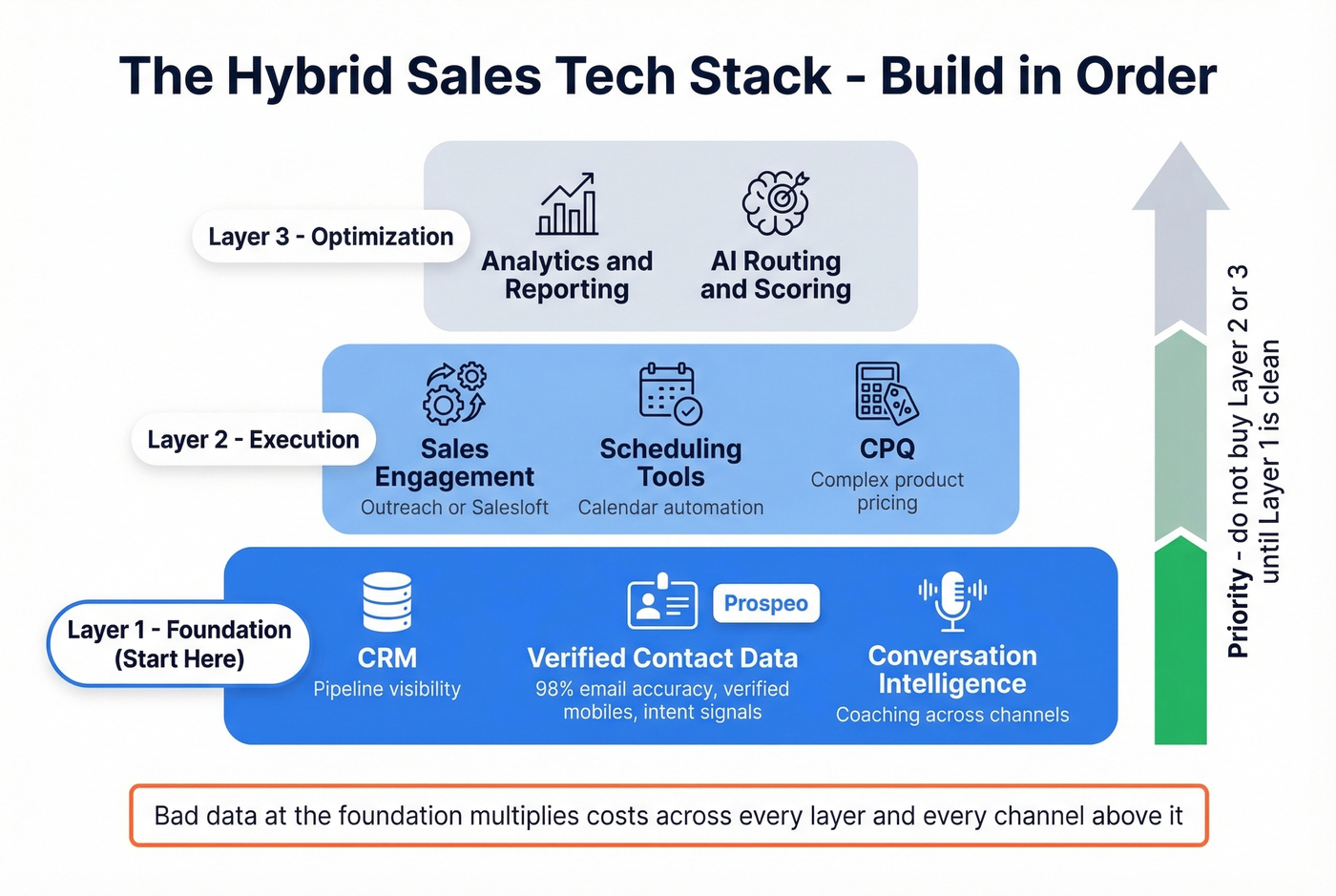
Operating across multiple channels multiplies the cost of bad data. Bounced emails waste digital touches. Wrong numbers waste call blocks. No-shows from outdated contacts waste flights. Prospeo handles the data foundation - 300M+ professional profiles, 98% email accuracy, and 125M+ verified mobile numbers refreshed every 7 days, plus intent data tracking 15,000 topics via Bombora so reps know which accounts are actively in-market. At roughly $0.01 per email with no annual contract, it costs less than a single bounced-email penalty from your ESP.

Once the foundation is solid, layer on a sales engagement platform like Outreach or Salesloft, scheduling tools, and CPQ for complex products. But don't buy five tools before the data feeding them is clean. The best stack for virtual selling is the one where every tool shares a single source of truth.
Your field reps cost $11K more per head than remote reps. Don't let bad data waste those flights. Prospeo delivers verified emails at $0.01 each and mobile numbers with a 30% pickup rate - no contracts, no sales calls required.
Stop burning budget on bounced contacts across every channel.
AI + Human in Digital-First Selling
Gartner predicts that by 2030, 75% of B2B buyers will prefer sales experiences that prioritize human interaction over AI. There's an "uncanny valley" problem - AI that mimics human sellers without delivering genuine empathy actually erodes trust. The debate around digital-first selling vs. relationship selling misses the point entirely: the best hybrid teams do both, routing each interaction to the channel where it creates the most value.
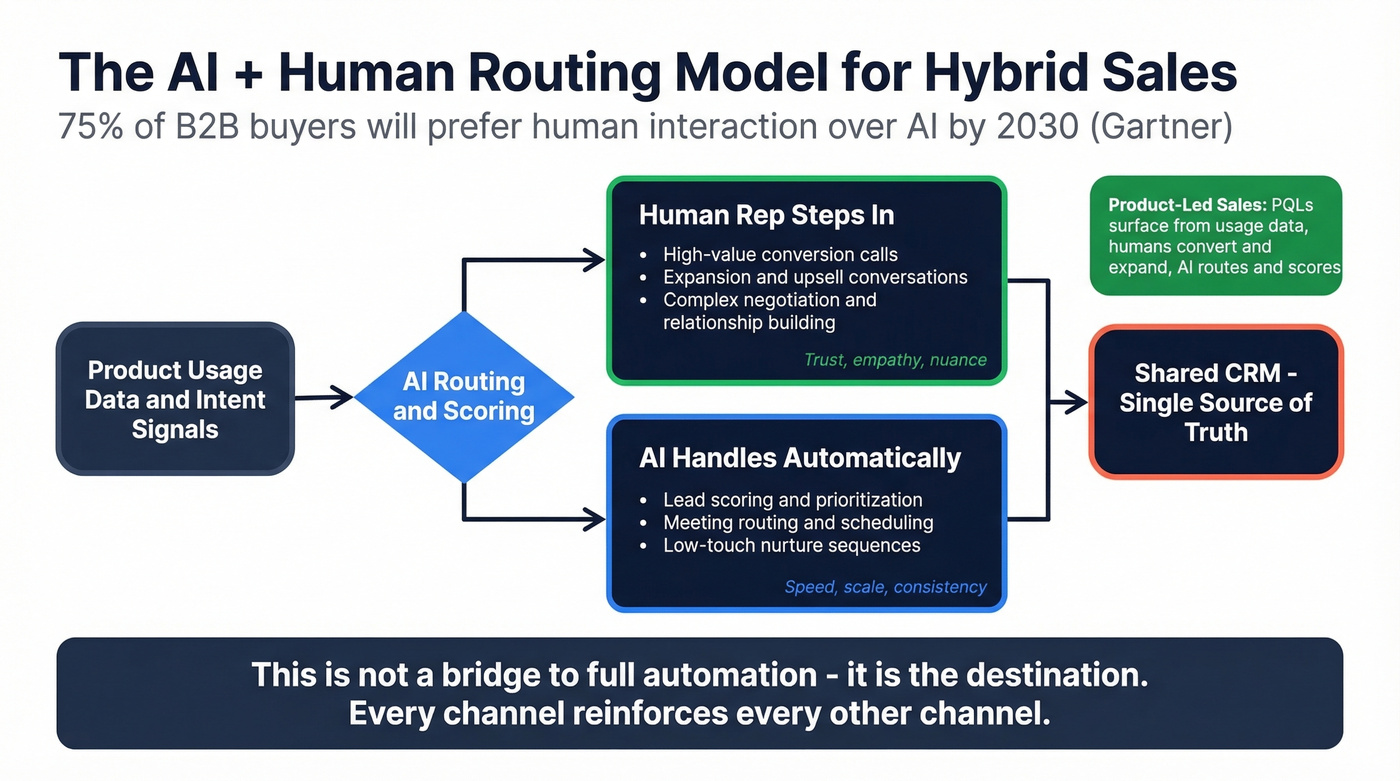
This model isn't a bridge to full automation. It's the destination. Pocus found that every company in their 200+ SaaS sample had adopted some form of blended motion by 2022. In practice, this plays out as Product-Led Sales: product usage data surfaces PQLs, human reps step in for conversion and expansion, and AI handles routing and scoring. The human handles the relationship. That's the model that scales.
FAQ
Is hybrid selling the same as omnichannel?
Omnichannel means the buyer can engage through any channel. Hybrid sales is the operational model behind it - the org combines digital and in-person motions with aligned comp, roles, and shared data. Omnichannel is the experience; the blended model is the engine.
Does this model work for SMBs?
Yes, but simplified. SMBs typically combine inside selling with occasional in-person meetings for high-value deals. The core principles - aligned comp, shared CRM data, clear role boundaries - apply at any scale.
What tools do hybrid teams need first?
CRM for pipeline visibility, verified contact data so every channel starts clean, and conversation intelligence for coaching. Those three form the foundation before adding engagement platforms or CPQ. Budget $0.01-$1.00 per lead for data depending on provider - accuracy differences at that layer compound across every downstream channel.
How do I run an effective virtual sales meeting?
Send a one-page agenda 24 hours ahead, lead with a discovery question instead of a slide deck, and end with a clear next step confirmed on-camera. Reps who follow this structure consistently outperform those who treat video calls as informal check-ins. Keep meetings under 30 minutes for mid-funnel touchpoints - nobody wants another hour-long demo that should've been a 15-minute call.