

Inbound Selling: A Complete Guide for Sales Teams in 2026
A RevOps lead we know spent six months building an inbound engine - blog posts, gated content, webinar series, the whole playbook. Pipeline tripled. Then the sales team complained that half the leads were junk: burner emails, wrong titles, people who'd never buy. The inbound machine worked. The handoff didn't.
That gap between generating interest and actually closing revenue is where inbound selling lives, and it's where most teams leave money on the table.
Three Things to Get Right Before Anything Else
- Shared MQL/SQL definitions with marketing. If your VP of Marketing and VP of Sales can't agree on what a qualified lead looks like, nothing downstream works.
- A sub-5-minute response SLA for high-intent leads. Contacting an inbound lead within 5 minutes increases conversion up to 9x - every minute after that, you're losing ground.
- Real-time email verification. If reps are chasing dead addresses from form fills, you're burning time and trust. Verify at point of capture.
The framework that ties it all together: Identify, Connect, Explore, Advise. Let's break each stage down.
What Is Inbound Selling?
It's the rep-side behavior of meeting buyers where they already are - responding to buying signals rather than cold-pitching strangers. If someone's already reading your pricing page, downloading your whitepaper, or attending your webinar, the sales conversation should feel like a helpful follow-up, not an interruption.
A quick terminology note, because this trips people up. Inbound selling is the rep's behavior - how they qualify, consult, and close. Inbound sales is the broader motion encompassing marketing, content, and the full funnel. Inside sales is an operating model for remote selling, not a methodology. Salesloft draws this distinction clearly, and it matters because conflating them leads to misaligned expectations.
HubSpot popularized the Identify, Connect, Explore, Advise framework in Brian Signorelli's Inbound Selling. The stages map cleanly to the buyer's journey: awareness, consideration, decision. Vendors rebrand stages every few years. The work stays the same.
Why It Matters in 2026
Buyers don't need you the way they used to. 61% of B2B buyers now prefer a rep-free buying experience, according to Gartner research (survey of 632 B2B buyers, fielded Aug-Sep 2024). That same study found 73% actively avoid suppliers who send irrelevant outreach, and 69% report inconsistencies between what a company's website says and what the seller tells them. Meanwhile, 70% of customers don't want to meet with a sales rep in person before making a buying decision - they prefer chat, messaging, and async communication.
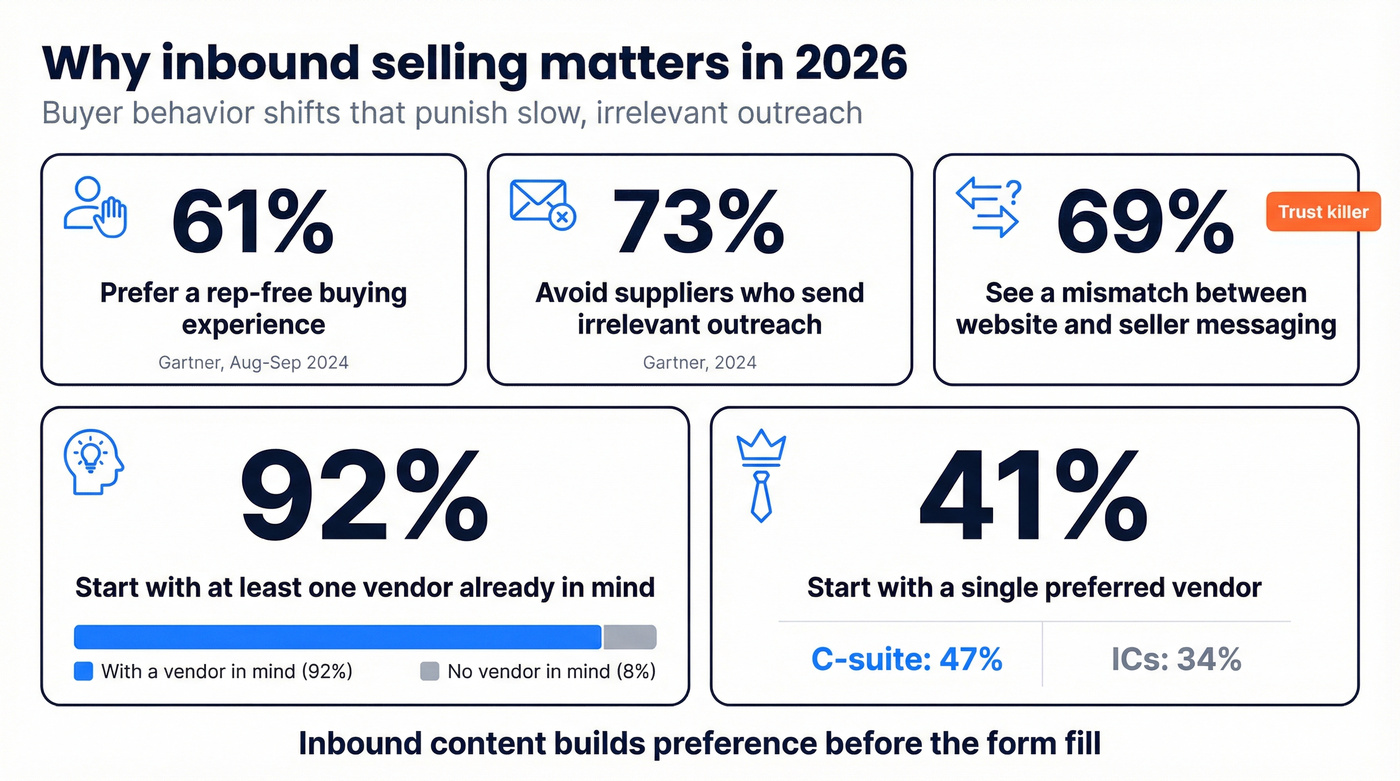
That inconsistency stat is the quiet killer. Your website says one thing. Your SDR says another. The buyer loses trust before the first meeting even happens.
It gets worse. Forrester's 2024 Buyers' Journey Survey found that 92% of buyers start with at least one vendor in mind, and 41% start with a single preferred vendor before any formal evaluation begins. C-suite buyers are even more locked in - 47% enter with a preference versus 34% of individual contributors.
Forrester's framing is blunt: B2B buying today is "confirmation, not selection." Your inbound content doesn't just need to capture leads - it needs to build preference before the form fill ever happens. If you're not on the shortlist before the buyer reaches out, you're already playing defense.
Inbound vs Outbound Sales
| Dimension | Outbound | Inbound |
|---|---|---|
| Approach | Rep-initiated | Buyer-initiated |
| Lead source | Cold lists, prospecting | Content, SEO, referrals |
| Cost per lead | Higher | ~60% lower |
| Conversion rate | ~1.7% | ~14.6% |
| Rep behavior | Pitch-first | Listen-first |
| Volume vs quality | High volume | High intent |
| Time to ROI | Immediate | 6-12 months |
| Compounding effect | Linear | Exponential after 6-12 months |
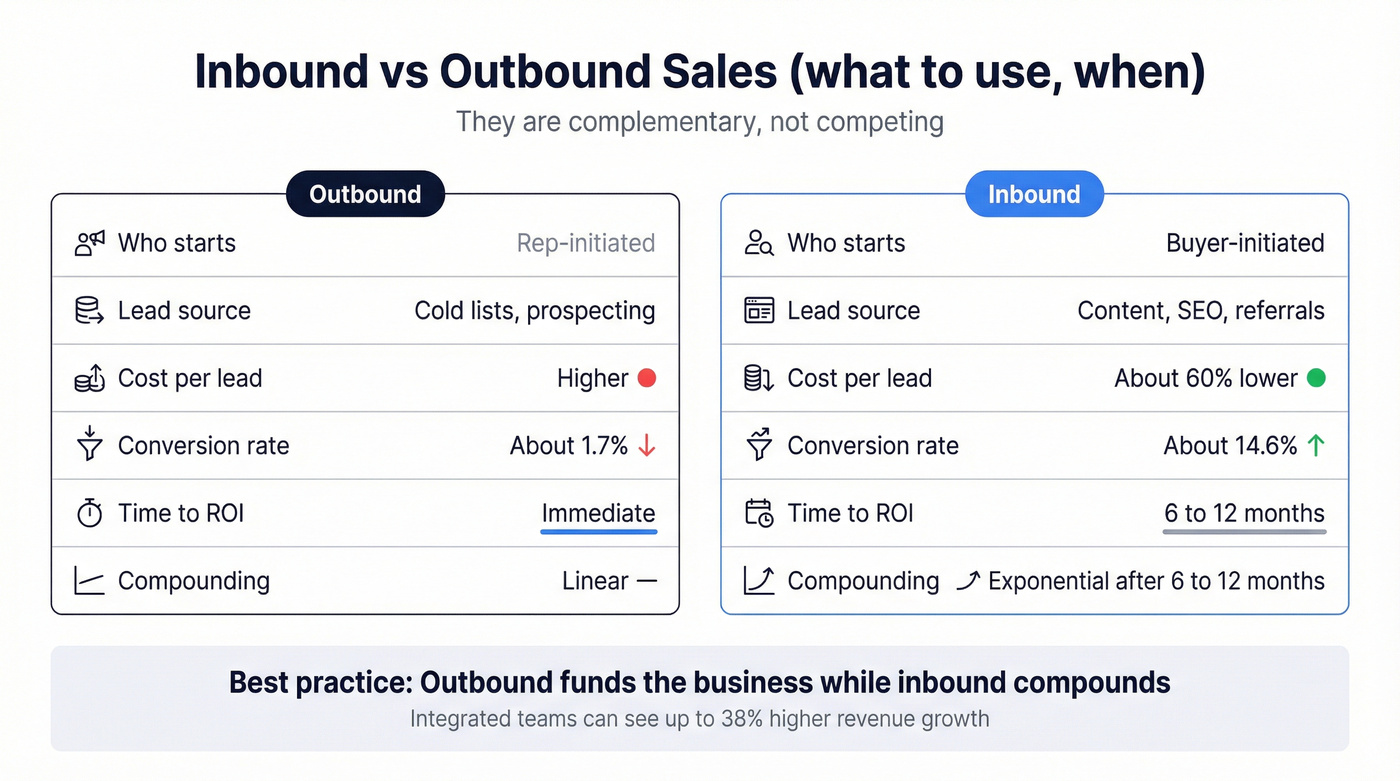
The conversion gap is real - inbound leads convert at roughly 14.6% versus 1.7% for outbound. But inbound takes time to compound. A fintech SaaS founder on r/b2bmarketing reported that after a full year of inbound experiments, 95% of revenue still came from outbound. Inbound produced 80-100 qualified leads with 20-25% conversion, but the ROI felt low compared to direct outbound effort.
The answer isn't picking one. Integrated teams running both motions see up to 38% higher revenue growth. Outbound funds the business while inbound compounds. The mistake is treating them as competing philosophies instead of complementary strategies.

Inbound selling fails at the handoff: burner emails, wrong titles, dead records. Prospeo verifies emails in real time with 98% accuracy and refreshes data every 7 days - so reps follow up in minutes, not hours.
Clean your inbound leads before your SLA clock starts.
The 4-Stage Framework
Identify
Identification is about spotting who's already showing buying intent - not guessing who might be interested. The signals are concrete: pricing-page visits, repeat content downloads, webinar attendance, multiple email opens, and return visits within a short window.
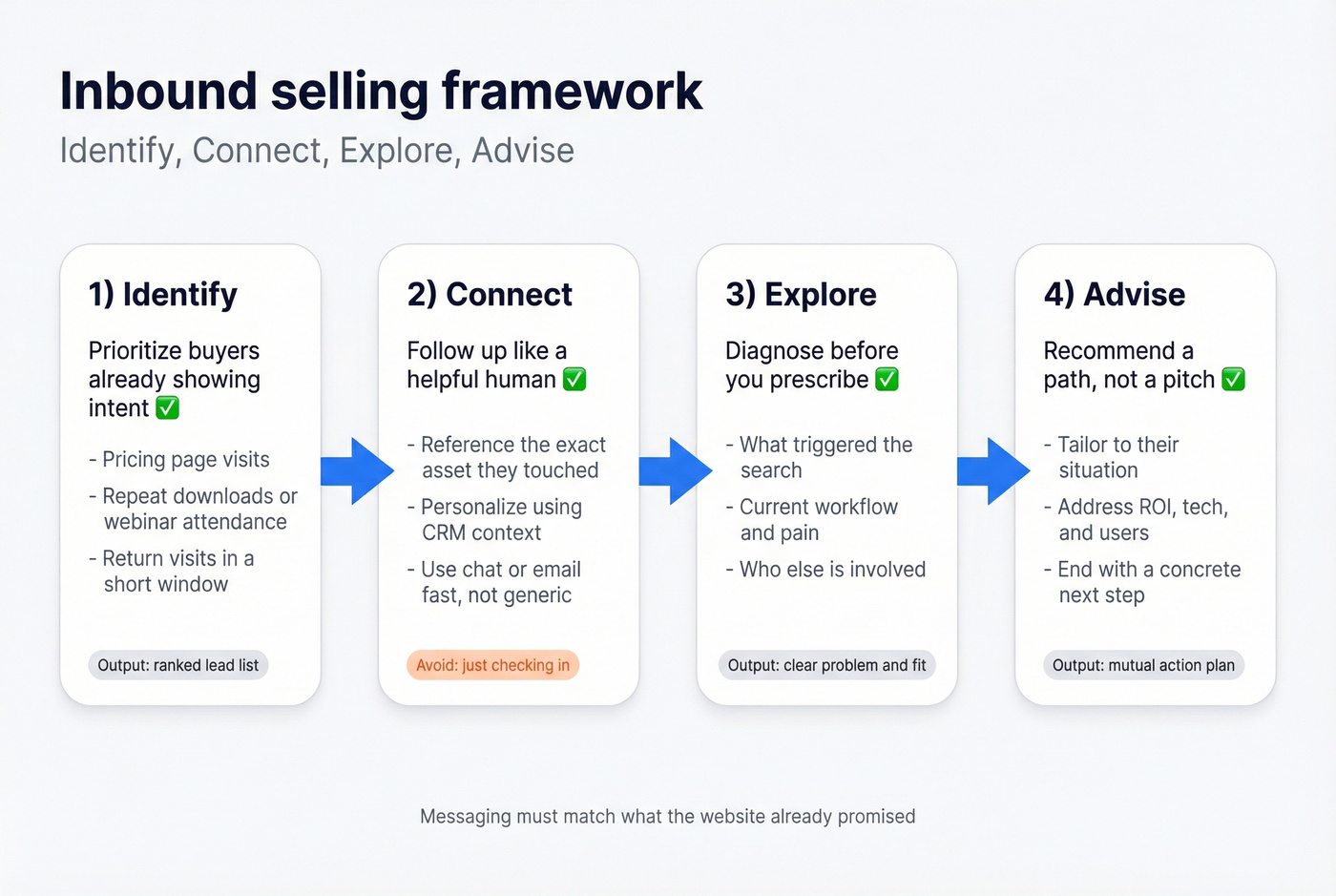
Layer in third-party intent data - Bombora-style topic signals, for example - and you can see which accounts are actively researching your category before they ever fill out a form. Build buyer personas for your top two or three ICPs so reps know which signals matter most for which segments. The goal at this stage isn't outreach. It's prioritization. Your reps should spend time on leads who are already moving, not cold accounts that might move someday.
Connect
Here's where most teams blow it.
The buyer has shown interest. They've downloaded something, visited your pricing page, started a free trial. And then an SDR hits them with a generic "just checking in" email that could've been sent to anyone. We've seen this pattern tank conversion rates at companies with otherwise solid inbound engines.
Connection outreach should feel like a helpful follow-up, not a cold pitch. Reference the specific content they engaged with. Use CRM data to personalize. AI tools can help here - use them to draft personalized first-touch emails based on the prospect's engagement history, or deploy chatbots to engage high-intent visitors the moment they land on your pricing page. A good chatbot can acknowledge and start qualification in under 60 seconds, which is faster than any human SDR.
A concrete cadence that works: Day 1, send a personalized email referencing the content they engaged with. Day 3, follow up with a relevant case study. Day 5, make a phone call. Day 7, a brief social touch. Adjust timing based on intent signal strength - a pricing-page visitor gets a faster cadence than a blog reader. This kind of structured follow-up separates high-performing teams from everyone else.
And remember that 69% inconsistency stat - your messaging must match what your website already told them. If your site says "no annual contracts" and your SDR opens with a 12-month commitment pitch, you've lost trust instantly.
Explore
Discovery in an inbound context is different from outbound discovery. The buyer already has context. They've done research. They probably know more about your product than your junior reps do.
Adapt your discovery frameworks accordingly. BANT, SPIN, MEDDIC - any of these work as scaffolding, but the posture matters more than the framework. Diagnose before prescribing. Ask about their current state, what triggered the search, who else is involved in the decision. Be willing to say "this isn't the right fit yet" - that honesty builds more pipeline long-term than forcing a deal that'll churn in three months.
Advise
The advise stage isn't a product demo. It's a tailored recommendation based on everything you learned in Explore. Generic pitch decks die here.
Build your recommendation around the buyer's specific situation, not your feature list. Address the concerns of multiple stakeholders - the economic buyer cares about ROI, the technical evaluator cares about integration, the end user cares about daily workflow. Multi-thread from the start. Always end with a concrete next step: a mutual action plan, a timeline, a commitment. "Let me know if you have questions" isn't a close - it's a dead end.
How to Start an Inbound Sales Strategy
Map buyer questions by journey stage. What does your buyer ask during awareness? Consideration? Decision? Your content and your reps' talk tracks should answer these questions at the right time, not all at once.
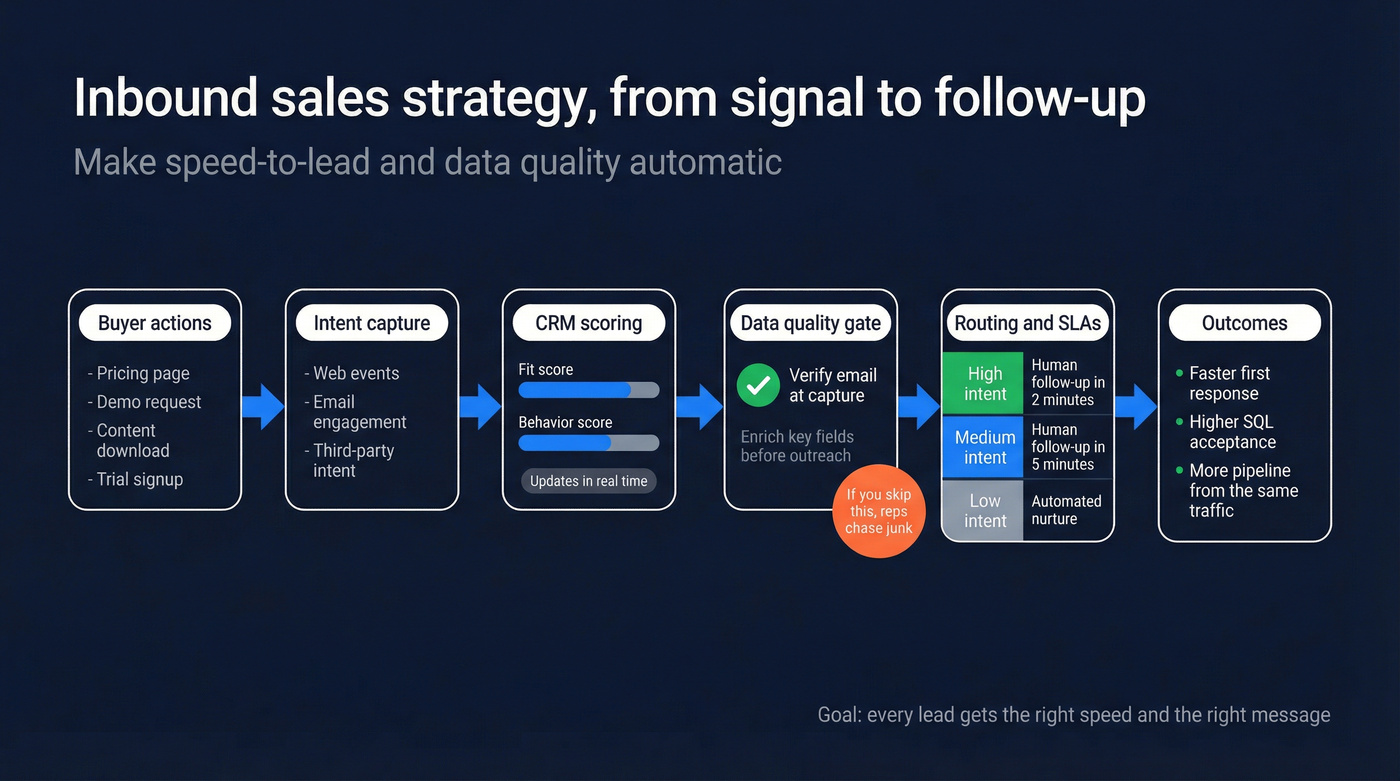
Instrument intent signals into your CRM. Set up lifecycle stages, lead scoring with both fit and behavior signals, and routing rules. A VP of Engineering who visited your pricing page three times this week should route differently than a student who downloaded a whitepaper. AI-powered lead scoring models can weigh dozens of behavioral signals simultaneously and update scores in real time - if your CRM supports it, turn it on.
Set tiered speed-to-lead SLAs. Not all leads deserve the same response time. New high-intent leads from pricing pages or demo requests should get human follow-up within 2 minutes. Existing customers exploring new products get a 5-minute window. Lower-intent content downloads can route to automated nurture. Target under 60 seconds for automated acknowledgment across the board.
Build nurture sequences for leads who aren't ready. Not every form fill is a buying signal. Some people are researching. Some are early-stage. Route them into nurture tracks instead of forcing them into a sales conversation they don't want yet.
Verify and enrich lead data before first outreach. This is the step most teams skip, and it quietly tanks everything downstream. Prospeo verifies email addresses in real time with 98% accuracy and enriches contacts with 50+ data points - job title, company size, tech stack, funding stage - so your SDR's first call reaches a real buyer, not a burner address.
Sales and Marketing Alignment
Your VP of Marketing is celebrating a record month of MQLs. Your VP of Sales is complaining that none of them convert. They're both right.
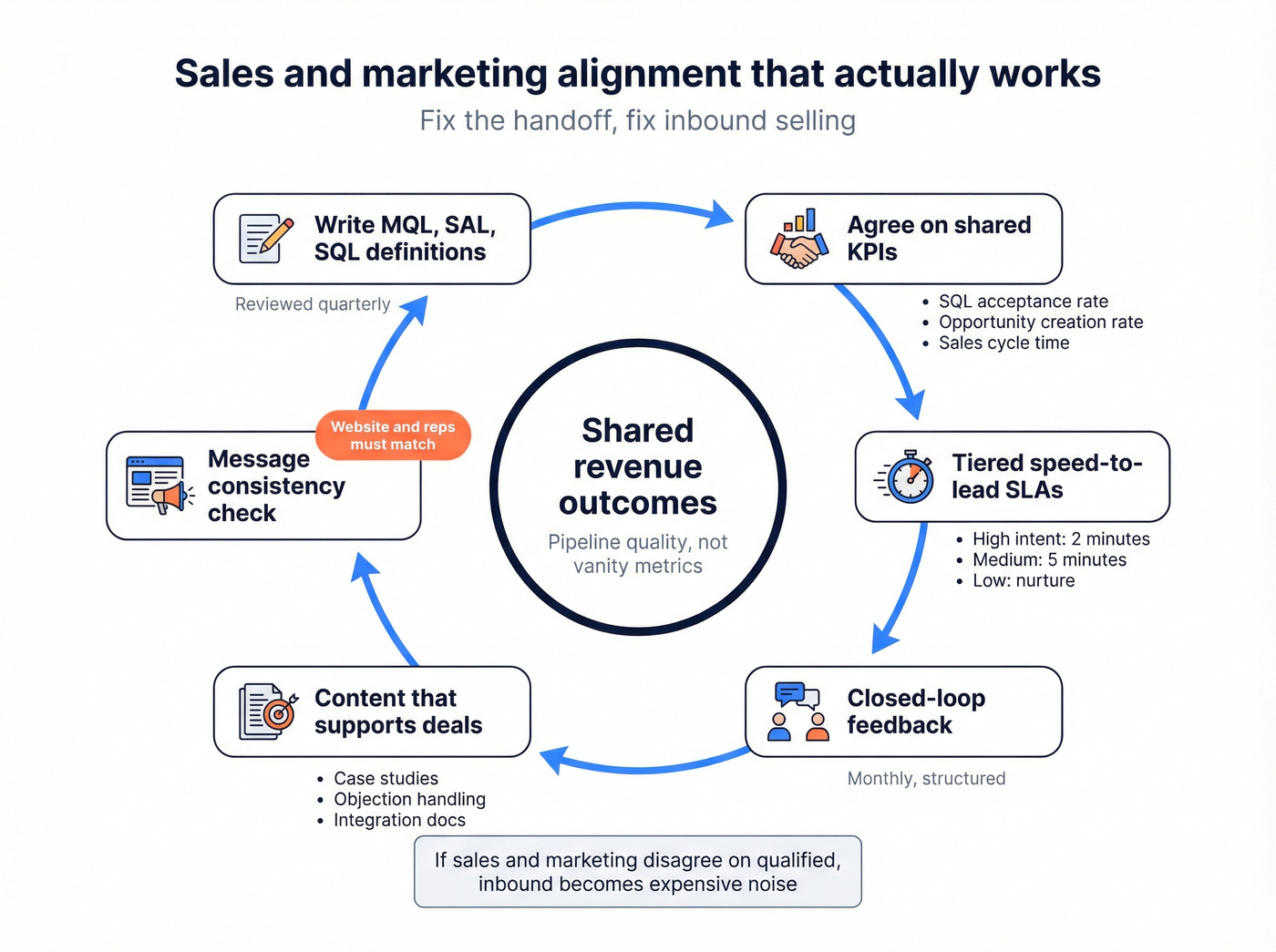
This is the alignment problem, and it kills inbound selling faster than bad content or slow response times. Here are the six failure modes we see repeatedly:
- The marketing expertise trap - marketing optimizes for what they can measure (traffic, form fills) instead of what sales needs: qualified pipeline. Fix: shared KPIs tied to revenue, not vanity metrics.
- KPI fights - marketing measures MQL volume, sales measures closed-won. Fix: adopt shared metrics like SQL acceptance rate, opportunity creation rate, and sales cycle time.
- No shared lead definitions - marketing's "qualified" and sales' "qualified" mean different things. Fix: define MQL, SAL, and SQL together, in writing, reviewed quarterly.
- No sales feedback loop - marketing never hears which content actually helps close deals. Fix: monthly structured feedback sessions covering objections, asset usefulness, and lost-deal patterns.
- Tech silos - marketing automation and CRM don't talk to each other. Fix: integrate your stack or accept that leads will die in the gap.
- Misaligned incentives - marketing gets bonused on leads, sales on revenue. Fix: tie a portion of marketing comp to pipeline or revenue metrics.
The operational fix is an SLA. A real one, not a handshake agreement. It should include a common revenue goal, shared definitions, lead handoff rules with a 24-hour follow-up SLA for accepted MQLs, nurturing responsibilities, lead management protocols, and a review cadence. Organizations with formal SLAs see 20% annual revenue growth versus 4% decline without alignment. Getting this right is the foundation of any effective inbound sales methodology.
Measuring Performance
| Metric | Benchmark | Notes |
|---|---|---|
| MQL to SQL | 15-21% | Biggest bottleneck |
| Lead to customer | 2-5% | Full-funnel |
| Median sales cycle | 84 days | B2B SaaS |
| Win rate | 20-30% | Opportunity to close |
These benchmarks are compiled ranges across SMB and mid-market B2B. Your numbers will vary by segment, deal size, and sales motion.
The audit tip that saves the most time: if your MQL-to-SQL rate is below 15%, check lead scoring and SDR follow-up speed first. Those two variables explain the majority of conversion gaps at that stage. Track these KPIs weekly: first response time at p50 and p90, connect rate, qualified rate, time to first meeting, and revenue per lead source. That last one is critical - it tells you which channels actually produce revenue, not just leads.
Common Mistakes and Fixes
Enforce SLAs with automation. Leads go cold in minutes, not hours. If a human can't respond in 5 minutes, a bot should respond in 5 seconds. This is the number-one fixable problem in the inbound sales process.
Single-threading kills deals. Are your reps only talking to the person who filled out the form? That person is rarely the one who signs the check. Multi-thread from the start - ask about the buying committee in your first real conversation. If you're only single-threaded by the second meeting, you're building on sand.
No lead scoring. Treating every form fill the same wastes rep time on unqualified leads. Build a fit-plus-behavior scoring model. Company size and title get you fit; page visits and content engagement get you behavior.
Burner emails and bad data. Without controls, 5-30% of inbound form fills can be low-quality or spam. Verify at capture with tools like Prospeo's email finder - 98% accuracy catches invalids before they hit your CRM, and enrichment fills in the data gaps that make routing and scoring possible.
Pushing too fast. An awareness-stage lead doesn't want a demo. Match your pace to the buyer's stage. Nurture until they signal readiness. The fastest way to lose an inbound lead is to treat them like an outbound target.
Look, here's our hot take: most failures aren't methodology problems - they're data problems. You can nail the framework, build perfect nurture sequences, and train your reps on consultative selling. But if a chunk of your form fills are garbage emails and your enrichment is stale, none of it matters. Fix the data layer first. Everything else gets easier after that.
Content treadmill fatigue. Inbound requires ongoing content investment, and teams burn out producing net-new material. The fix is aggressive repurposing. One webinar becomes a blog post, a social carousel, three email snippets, and a case study excerpt. Don't just produce - extract.
Prioritize the right “Identify → Connect” targets, fast. Use Prospeo’s 30+ filters plus Bombora intent (15,000 topics) to route high-intent accounts to reps, then enrich CRM/CSV with 50+ data points at a 92% API match rate.
Turn inbound interest into a ranked, enriched call list today.
FAQ
Is inbound selling the same as inbound marketing?
No. Inbound marketing generates leads through content, SEO, and paid channels. Inbound selling is what the sales rep does once that lead arrives - qualifying, consulting, and closing. Marketing fills the top of the funnel; the sales team converts it.
How long does it take to produce results?
Expect 6-12 months before inbound generates consistent pipeline. Content needs time to rank, leads need nurturing, and reps need to learn the consultative motion. Use outbound to bridge the revenue gap while inbound compounds.
Can you run inbound and outbound simultaneously?
Yes - and you should. Hybrid teams see up to 38% higher revenue growth than single-motion teams. Outbound generates immediate pipeline. Inbound builds a compounding asset that reduces cost per lead over time. They're complementary, not competing.
What's the biggest reason inbound selling fails?
The sales-marketing handoff. If MQL and SQL definitions aren't shared, follow-up SLAs don't exist, and there's no feedback loop, leads die in the gap between teams. Fix the handoff before you optimize anything else.
How do you handle bad inbound lead data?
Verify emails at point of capture and enrich contacts before routing to sales. Real-time verification catches invalids before they enter your CRM, and enrichment returns data points like job title, company size, and tech stack so reps call real buyers with complete context - not bounced addresses with missing information.