


5 InboxAware Alternatives That Cost Less and Do More in 2026
You're paying $450 a month to find out your emails land in spam. And the tool can't do a thing about it. If you're looking for InboxAware alternatives, you're probably tired of monitoring the symptom - bad inbox placement - without touching the cause: bad data, stale records, and spam traps hiding in your list.
Monitoring where emails land is only useful if you can actually fix the problem upstream. Let's break down what actually works.
Why People Switch From InboxAware
InboxAware's pricing starts steep and climbs fast. The Essential plan runs $450/month, Professional hits $1,216/month, and Enterprise tops out at $2,250/month. For that money, you get seed list testing, automated alerts, and dashboards - but you're still looking at the problem after the fact.
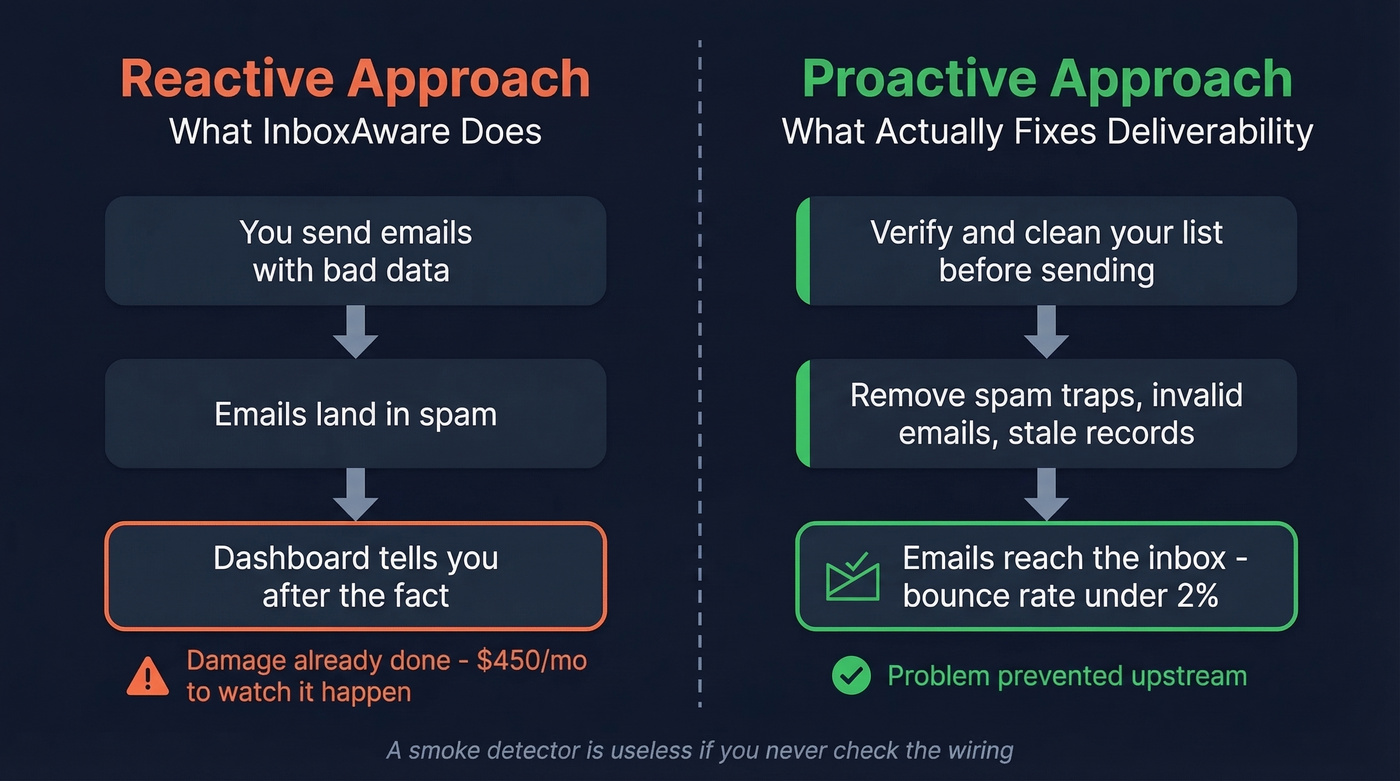
InboxAware also has a limited public review footprint compared to bigger deliverability suites, which makes it harder to validate the spend before you commit. In deliverability circles, practitioners often question whether inbox placement tools give truly actionable results versus just another dashboard to stare at.
The bigger issue is philosophical. InboxAware tells you where your emails ended up after you've already sent them. It doesn't prevent bounces, remove spam traps, or clean your list before the damage is done. That's like paying for a smoke detector but never checking the wiring.
Our Picks (TL;DR)
- Prospeo - Best for fixing the root cause. 98% email accuracy prevents bounces and spam traps before they tank placement. Free tier, ~$0.01/email paid.
- GlockApps - Best direct replacement. Seed list testing plus DMARC monitoring from $59/mo - 87% cheaper than InboxAware's entry tier.
- Validity Everest - Best for enterprise monitoring. Panel-based inbox data, competitive benchmarking, predictive analytics. $20/mo to $65K+/year.

InboxAware charges $450/mo to tell you emails landed in spam. Prospeo costs $0.01/email to make sure they don't. With 98% email accuracy, spam-trap removal, and a 7-day data refresh cycle, you fix deliverability at the source - not in a dashboard after the damage is done.
Clean data beats inbox monitoring. Every single time.
The Best Alternatives to InboxAware
Prospeo - Fix the Root Cause
Most deliverability problems don't start in the inbox. They start in your contact list - invalid emails, recycled spam traps, and records that went stale months ago. Prospeo attacks this with 5-step email verification including catch-all handling, spam-trap removal, and honeypot filtering, delivering 98% email accuracy across 143M+ verified addresses.

Here's why this matters: Google's enforcement threshold sits at a 0.3% spam complaint rate, and best practice targets bounce rates under 2%. Prospeo's 7-day data refresh cycle keeps records current so you're not sending to dead addresses that spike your bounce rate. We've seen the results firsthand - customers like Stack Optimize maintain 94%+ deliverability with bounce rates under 3% and zero domain flags across all clients. Snyk's team of 50 AEs cut their bounce rate from 35-40% to under 5% after switching.
Use it if you're seeing high bounce rates or spam folder placement and suspect your contact data is the problem. Pair it with any inbox placement tester for full visibility.
Skip it if you only need to monitor inbox placement and your data hygiene is already locked down.
Pricing: free tier with 75 emails/month, paid plans at ~$0.01 per email. No contracts.
GlockApps - Seed List Testing at 87% Less
GlockApps is the closest direct replacement for InboxAware's core feature - seed list inbox placement testing - at a fraction of the cost.

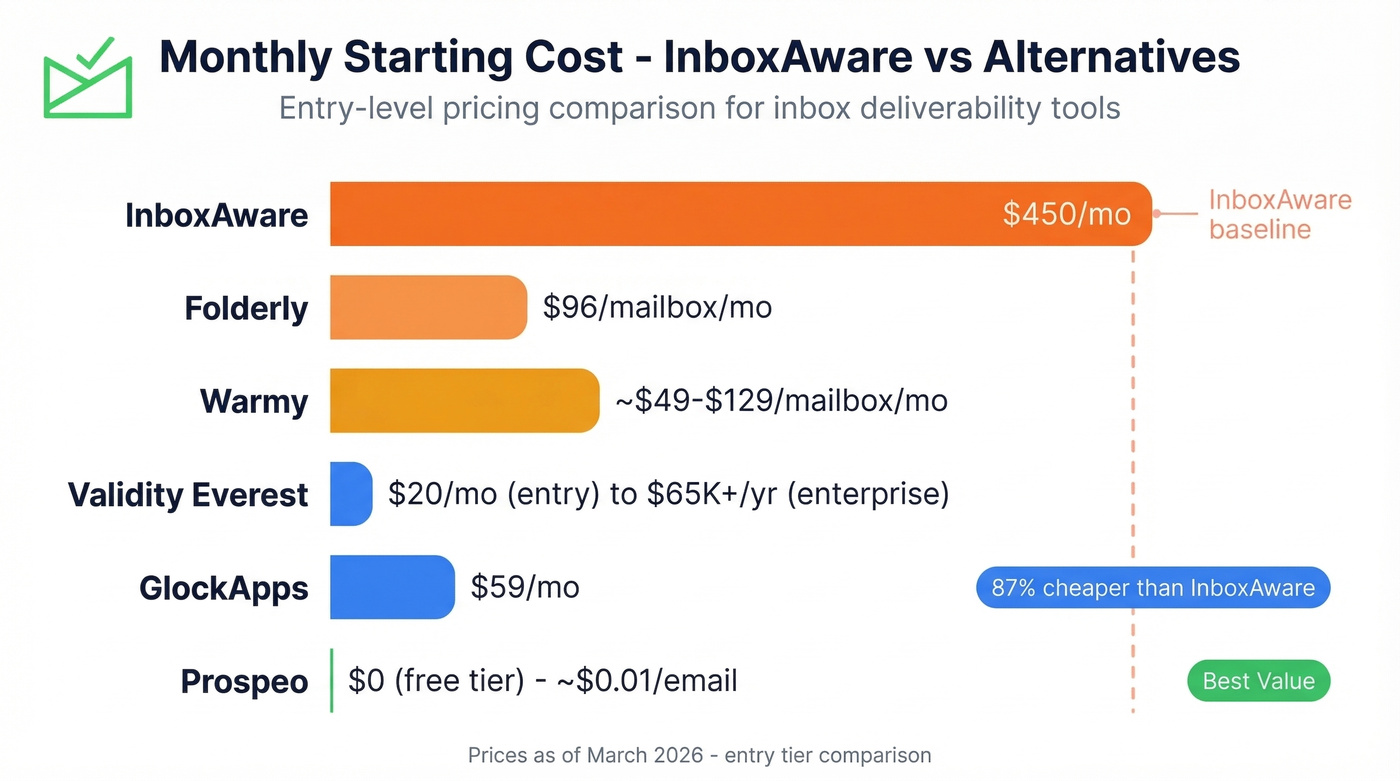
Pricing starts free with 2 spam tests per month. Paid plans run $59/month for 360 tests, $99/month for 1,080 tests, and $129/month for 1,800 tests. The Essential plan alone saves you $391/month versus InboxAware. Every paid tier includes DMARC analytics with message caps ranging from 600K to 12M, plus blacklist monitoring against 50+ lists.
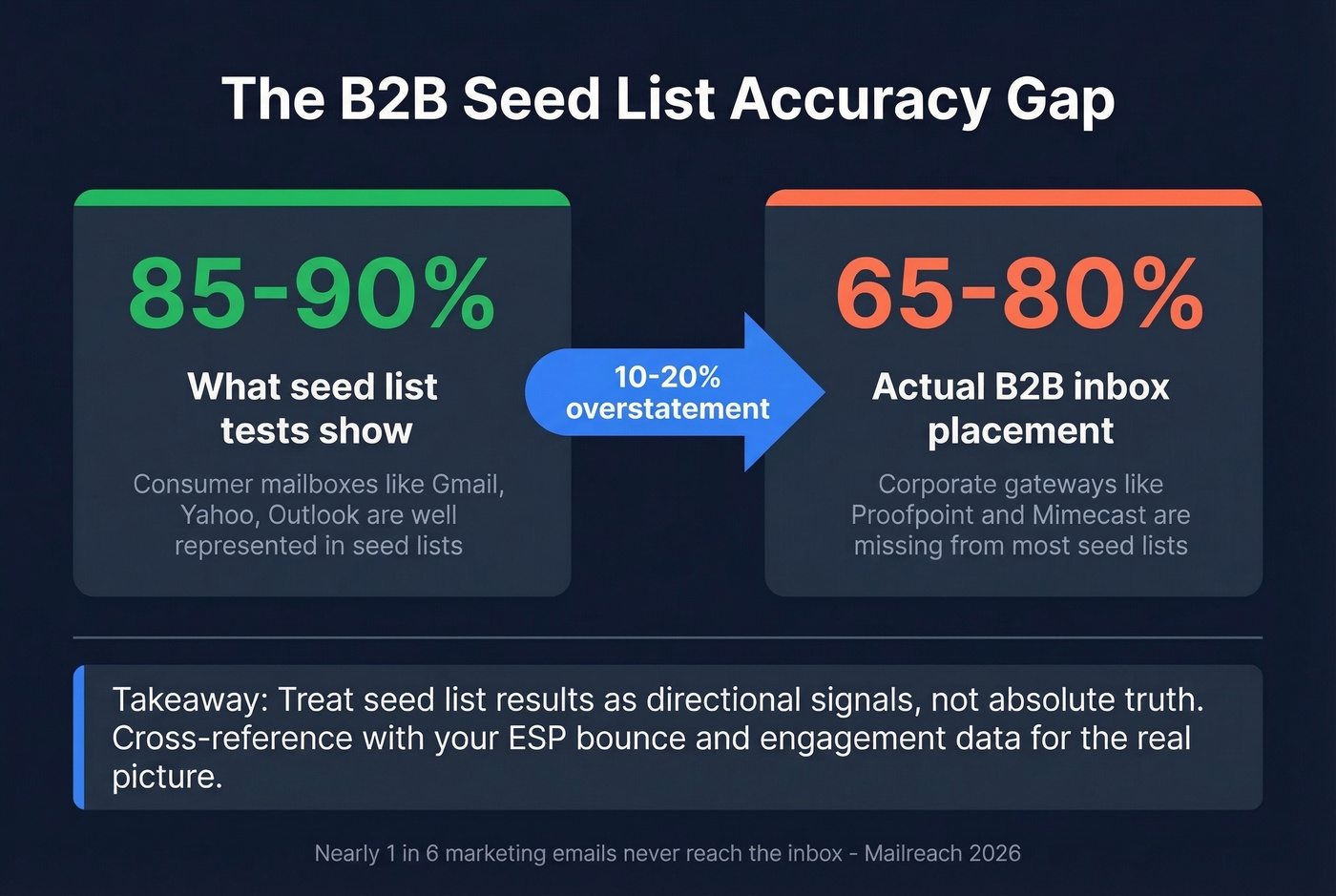
The tradeoff is scope. The seed list runs roughly 100 mailboxes, so treat results as directional rather than absolute - the seed list skews consumer-heavy, which means it can overstate B2B inbox placement because corporate Secure Email Gateways like Proofpoint and Mimecast aren't well represented. There's no warmup or list cleaning built in either. For most teams, GlockApps at $59/month covers 80% of what InboxAware does at $450/month.
Validity Everest - Enterprise Monitoring
Everest starts at $20/month on the Elements tier, but the real power lives in Elements Plus at $525/month and enterprise contracts that typically land in the $35K-$65K/year range.
This is the enterprise-grade option for inbox monitoring, consistently positioned as the top alternative on G2's Inbox Tracker comparison pages.
Use it if you need panel-based inbox data, competitive benchmarking against industry peers, and predictive analytics. Built for email marketing orgs sending millions of messages monthly.
Skip it if you're a small team or startup. The entry tier is affordable, but you'll outgrow it fast and the jump to enterprise pricing is brutal.
Folderly - Warmup Plus Placement
Folderly combines domain warmup with inbox placement testing in one platform. Users consistently praise the clean UI and fast onboarding. But the economics get tricky at scale: pricing runs from $96/mailbox/month on yearly billing to around $120/mailbox/month, and the Inbox Insights add-on costs another $79/month for 100 tests.
Do the math. Five mailboxes at $120 each is $600/month before testing add-ons - more than InboxAware. Users have also reported issues with DNS control and unexpected email volume spikes. Folderly works well for one to three mailboxes. Beyond that, budget carefully.
Warmy - Domain Warmup and Recovery
Warmy specializes in warming damaged or new domains back to healthy sender reputation. It's not an inbox placement tester - it's a recovery tool. Pricing isn't published, but expect around $49-$129 per mailbox per month for a typical warmup setup. There's a 7-day free trial with no credit card required.
Worth noting: if your domain reputation tanked because of bad list data, warming alone won't fix it. You'll keep re-damaging the domain unless you clean the source. Pair Warmy with proper email verification for lasting results.
Snyk cut bounce rates from 35% to under 5%. Stack Optimize holds 94%+ deliverability with zero domain flags. The difference isn't a better monitoring tool - it's 5-step verified emails with catch-all handling and honeypot filtering built in.
Stop monitoring the symptom. Eliminate the cause at $0.01/email.
Pricing Comparison
| Tool | Starting Price | Pricing Model | Free Tier |
|---|---|---|---|
| InboxAware | $450/mo | Tiered plans | No |
| Prospeo | $0 | Per email (~$0.01) | Yes (75/mo) |
| GlockApps | $0 | Credit-based (2-1,800 tests/mo) | Yes (2 tests/mo) |
| Everest | $20/mo | Tiered + enterprise | No |
| Folderly | $96-$120/mailbox/mo | Per mailbox + add-ons | No |
| Warmy | ~$49-$129/mailbox/mo | Per mailbox | 7-day trial |
How to Choose the Right Tool
Match the tool to the problem, not the feature list.
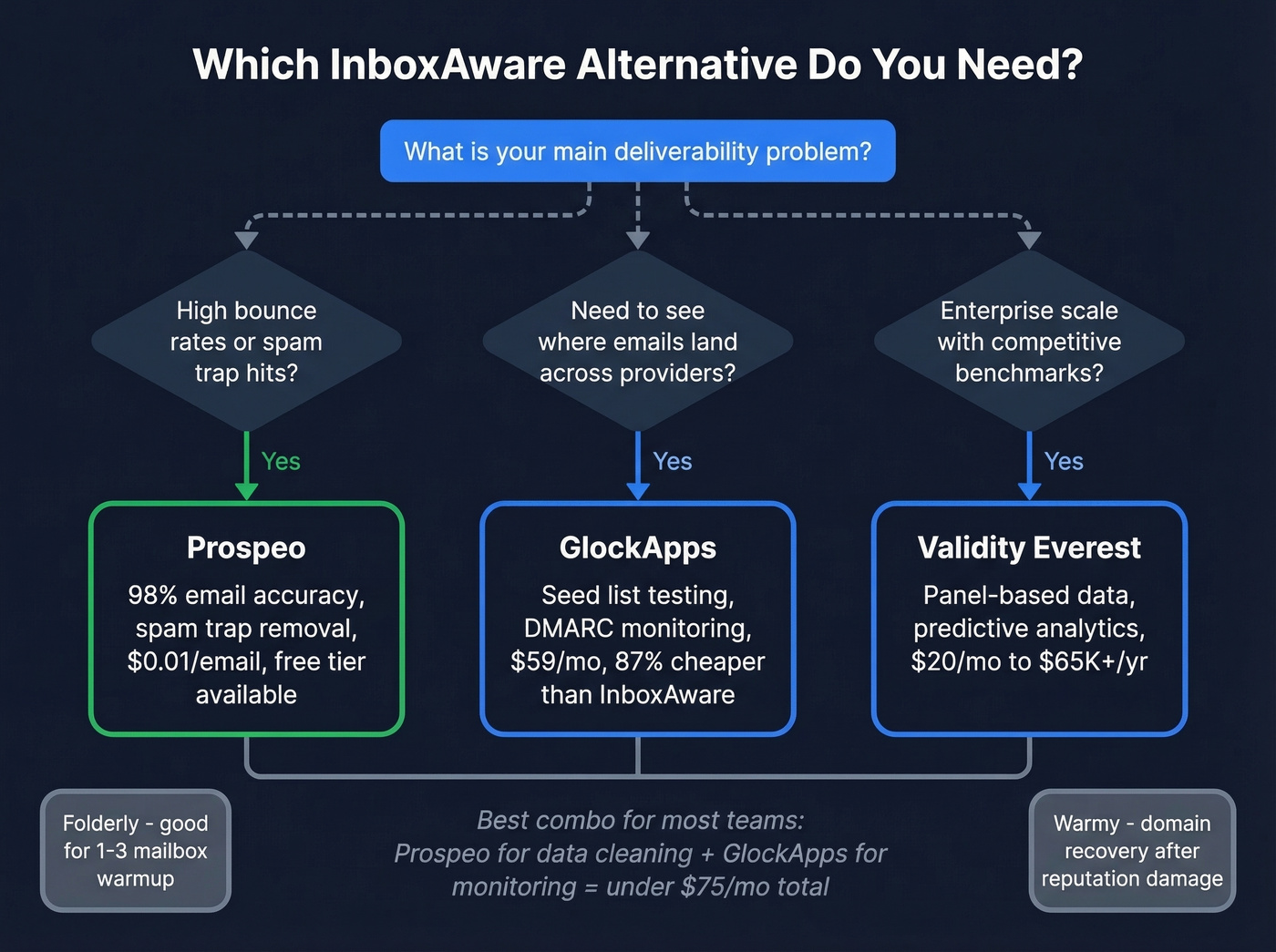
Your emails bounce or hit spam traps? Clean your data first. If your bounce rate is above 2% or you're seeing spam trap hits in your postmaster reports, the issue is upstream data quality. Verify and clean your list before sending. Snyk cut bounce rates from 35-40% to under 5% just by switching to verified data - that's not a monitoring fix, that's a data fix.
You need to know where emails land? GlockApps. Seed list testing gives you a directional read on inbox versus spam placement across major providers. Just remember that consumer-heavy seed lists don't capture corporate gateways like Proofpoint or Mimecast, so B2B placement numbers will differ from what the dashboard shows.
You need enterprise-scale competitive benchmarking? Everest. Panel-based data, predictive analytics, and industry benchmarks for teams sending at volume. Budget accordingly - this is a five-figure annual commitment at the tiers that matter.
Look, here's our honest take after working with dozens of outbound teams: most deliverability problems are data problems. Nearly 1 in 6 marketing emails never reach the inbox, and the majority of those failures trace back to list quality. Fix the data first, then monitor the results. That's why the best InboxAware alternatives address root causes - not just symptoms.
FAQ
What does InboxAware actually do?
InboxAware uses seed list testing to measure inbox placement rates across providers like Gmail, Yahoo, and Outlook. It includes automated alerts, threshold monitoring, and custom dashboards. Plans start at $450/month for the Essential tier, scaling to $2,250/month for Enterprise.
Is seed list testing accurate for B2B email?
Seed lists skew toward consumer mailboxes and typically miss corporate gateways like Proofpoint and Mimecast. B2B inbox placement can be overstated by 10-20% compared to actual delivery. Treat seed list results as directional signals, not absolute measurements, and cross-reference with your ESP's bounce and engagement data.
Can email verification replace inbox monitoring?
They solve different problems, but verification has higher leverage. Cleaning invalid addresses, spam traps, and stale records before sending prevents the bounce spikes and reputation damage that cause poor placement in the first place. Pair verification with a tool like GlockApps at $59/month for complete coverage at a fraction of InboxAware's cost.
What's the cheapest way to monitor inbox placement?
GlockApps offers a free tier with 2 spam tests per month - enough for a quick health check. Paid plans start at $59/month for 360 tests, which is 87% cheaper than InboxAware's $450/month entry point. For teams under 50K sends/month, GlockApps' Essential plan covers most monitoring needs.