

Insight Selling: What It Is, Why It Works, and How to Actually Do It
Your SDR just sent 200 emails with a Forrester stat in the subject line. Open rate: 4%. Reply rate: zero. 61% of B2B buyers now prefer a rep-free buying experience, and 73% actively avoid suppliers who send irrelevant outreach. The bar for earning a buyer's attention isn't high - it's existential.
Insight selling offers a way through. It's a research-backed methodology where the seller educates the buyer with ideas they couldn't find on their own - not sharing stats, but reframing how the buyer sees their problem. RAIN Group's research across 700+ B2B purchases found that winners do this almost 3x more often than runners-up.
Gartner's survey of 632 B2B buyers paints a brutal picture for reps who show up with recycled analyst quotes. Buyers average 3.0 activities both online and with reps, but only 2.3 with reps directly. The rep interaction window is shrinking. When buyers do engage, 69% report inconsistencies between the vendor website and what the seller tells them. Trust is fragile before the first call even starts.
Here's the thing: buyers aren't anti-rep. They're anti-waste. A rep who delivers a genuine insight - something the buyer hadn't considered, framed around their specific situation - still wins. The problem is that most reps pitch, demo, and share a stat from a webinar they attended last quarter, then call it "thought leadership." When buyers can self-educate on features, pricing, and competitive comparisons without ever talking to you, the only reason to take your call is if you teach them something they didn't already know.
What Is Insight Selling?
The term comes from Mike Schultz and John Doerr at RAIN Group, who studied 700+ B2B purchases representing $3.1B in annual purchasing power. They wanted to know what separated sales winners from second-place finishers - not what made a good rep, but what made the rep who actually won different from the one who came close.
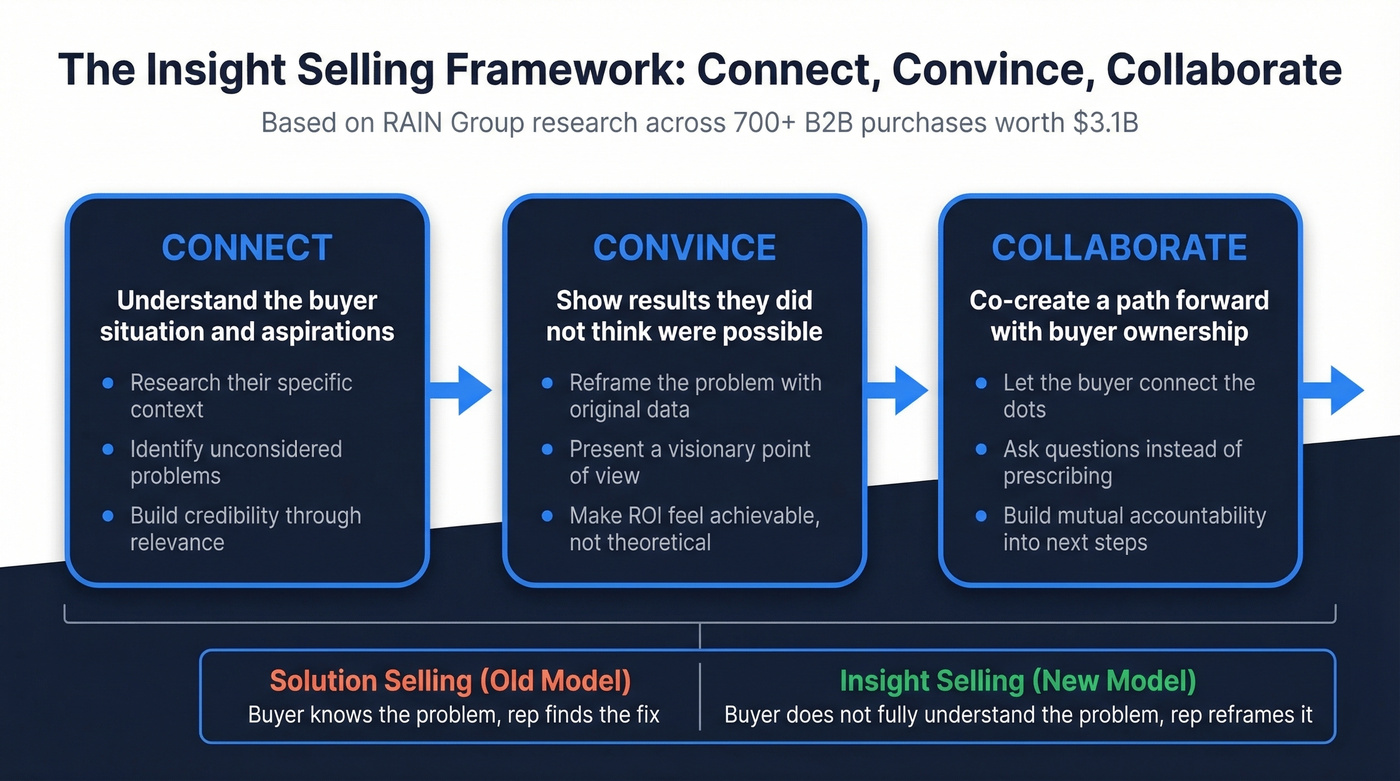
The top differentiator: winners educated buyers with new ideas and perspectives. They did this almost 3x as often as second-place finishers. Other separating factors included collaboration, persuading buyers that results were achievable, and genuine listening - but education was the headline.
Schultz and Doerr built this into a three-part framework: Connect, Convince, Collaborate. Connect with the buyer's situation and aspirations. Convince them you can deliver results they didn't think were possible. Collaborate on a path forward where the buyer feels ownership.
This is a direct evolution from solution selling. HBR argued in "The End of Solution Sales" that traditional solution selling isn't sufficient on its own anymore. Solution selling assumes the buyer has a defined problem and needs help finding the right solution. The insight-based approach assumes the buyer doesn't fully understand their problem yet - and the rep's job is to reframe it. That reframe is the insight.
The 2026 Buyer Context
6sense's Buyer Experience Report surveyed nearly 4,000 B2B buyers and found that average buying cycles dropped from 11.3 months to 10.1 months year-over-year. The point of first contact shifted earlier - from 69% of the journey to 61%, roughly 6-7 weeks sooner. Buyers are engaging reps earlier, but they're also more informed when they do.
The stat that should keep every seller up at night: the vendor favored before engaging sellers wins approximately 80% of the time. The winning vendor is on the buyer's Day One shortlist 95% of the time. If you're not on that shortlist, you're fighting for scraps.
86% of B2B purchases stall at some point, and 94% of buyers now use LLMs during their journey. Buyers synthesize information faster, validate claims in real time, and arrive at conversations with more context than most reps expect. A recycled industry stat won't impress someone who asked ChatGPT the same question twenty minutes ago. An original reframe of their specific problem will.
What Types of Insights Actually Work?
Corporate Visions found that 81% of companies say they're selling with insights. Yet 73% of buyers actively avoid irrelevant outreach. That gap - between companies who think they're delivering insights and buyers who disagree - is the whole problem.
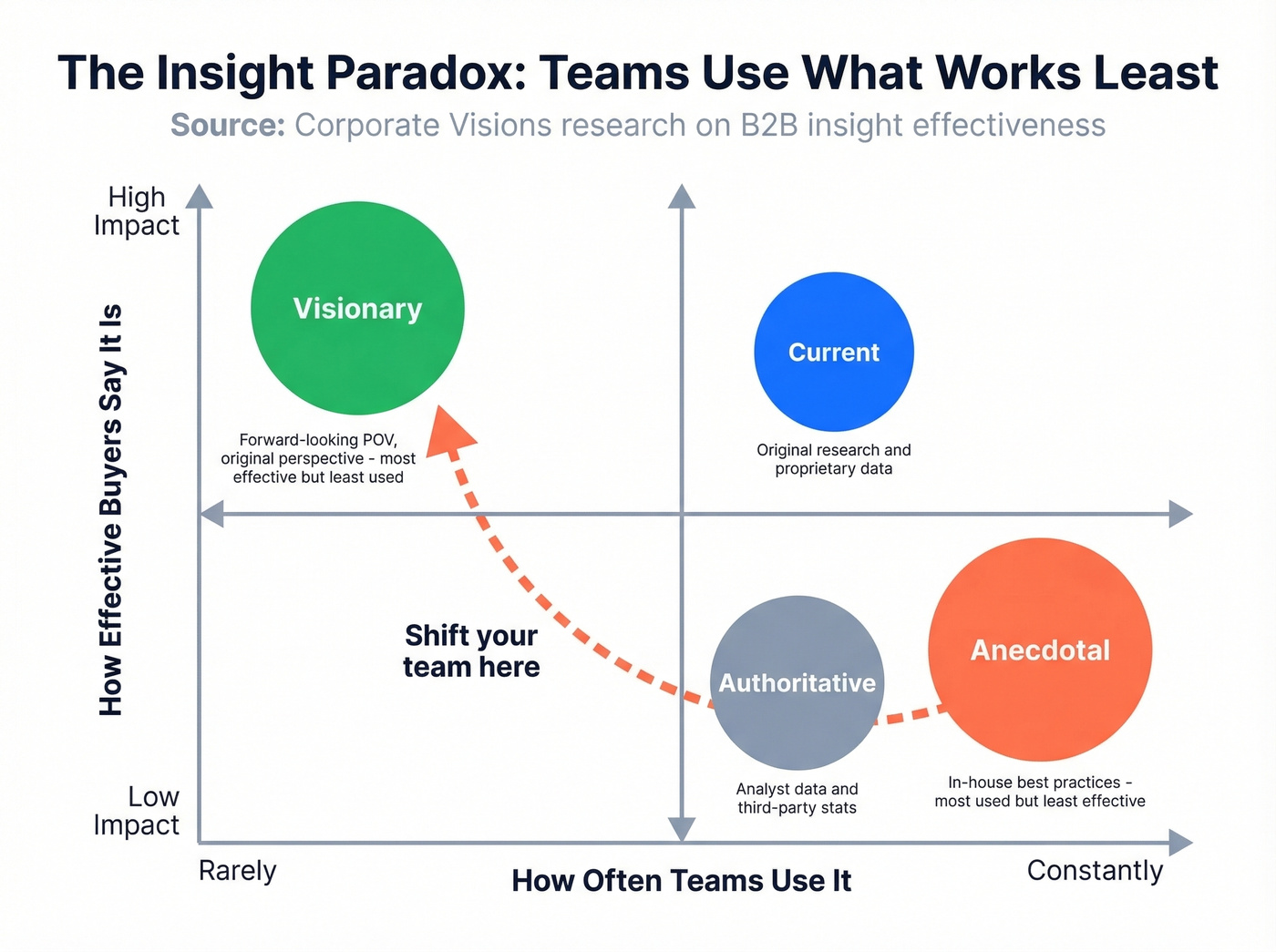
Corporate Visions breaks insights into four types:
| Insight Type | Definition | Usage | Effectiveness |
|---|---|---|---|
| Anecdotal | In-house best practices | Most used | Least effective |
| Authoritative | Analyst data | Commonly used | Moderate |
| Current | Original research | Less common | High |
| Visionary | Forward-looking POV | Least used | Most effective |
The irony is painful. Teams default to anecdotal and authoritative insights because they're easy. But buyers rate visionary insights - original, exclusive, forward-looking perspectives - as the most effective. In our experience, teams that default to authoritative insights do so because they're afraid of being wrong. "Safe" insights are invisible insights.
Corporate Visions calls recycled analyst stats "true but ultimately useless information." Telling a VP of Sales that "B2B buying cycles are getting shorter" isn't an insight - it's a headline they already read. Telling them that their specific deal velocity is 40% slower than their peer group because their proposal process creates comprehension gaps? That's an insight.
Methodology Comparison
We've seen teams get paralyzed trying to pick the "right" methodology. Let's be honest about the tradeoffs:
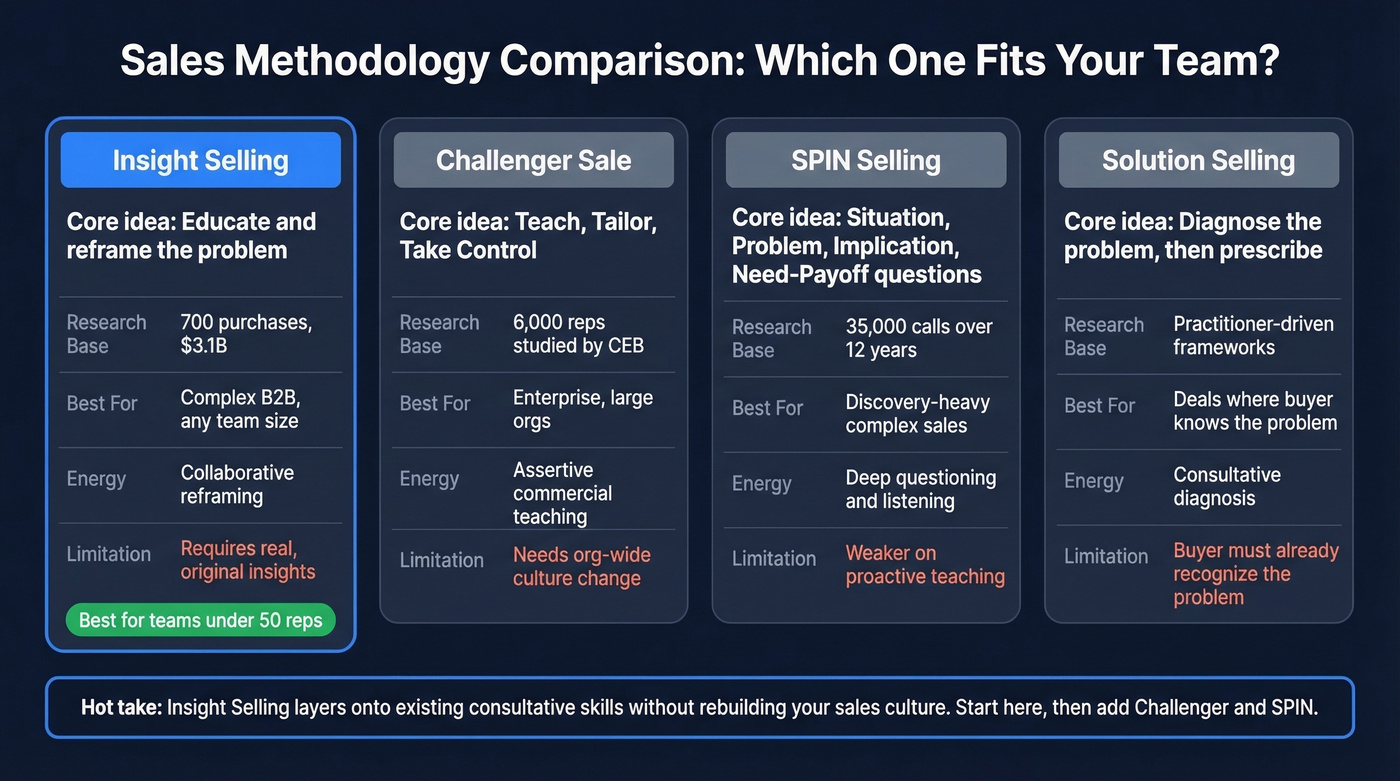
| Methodology | Core Principle | Research Base | Best For | Limitation |
|---|---|---|---|---|
| Insight Selling | Educate + reframe | 700 purchases, $3.1B | Complex B2B, any size | Requires real insights |
| Challenger Sale | Teach, Tailor, Control | 6,000 reps (CEB) | Enterprise, large orgs | Needs org-wide adoption |
| SPIN Selling | S-P-I-N questioning | 35,000 calls, 12 yrs | Discovery-heavy sales | Weaker on teaching |
| Solution Selling | Diagnose then prescribe | Practitioner-driven | Defined-problem deals | Buyer must know the problem |
Challenger and insight-based selling are cousins, not competitors. Both emphasize teaching the buyer something new. The difference is energy: Challenger leans into assertive "commercial teaching" with a take-control posture, while the insight approach emphasizes collaborative reframing. Xerox saw a 17% increase in sales and $65M in contract value after implementing Challenger - impressive, but Challenger requires significant organizational overhaul.
Our hot take: the insight methodology is more practical than Challenger for any team under 50 reps because it doesn't require rebuilding your entire sales culture. It's a research discipline you layer onto existing consultative skills. It works when you bring a credible point of view, but it backfires fast when the "insight" is generic or condescending. Read Insight Selling by Schultz and Doerr first. Add The Challenger Sale by Dixon and Adamson second. Add SPIN Selling by Rackham third for discovery foundations.

Insight selling only works when you know more about the buyer than they expect. Prospeo's 30+ search filters - including buyer intent across 15,000 topics, technographics, and headcount growth - give you the raw material to build visionary insights, not recycled stats.
Stop guessing what buyers care about. Let their signals tell you.
Insight Selling in Action
Here's a solution selling pitch vs. an insight-driven reframe for the same product - proposal software:
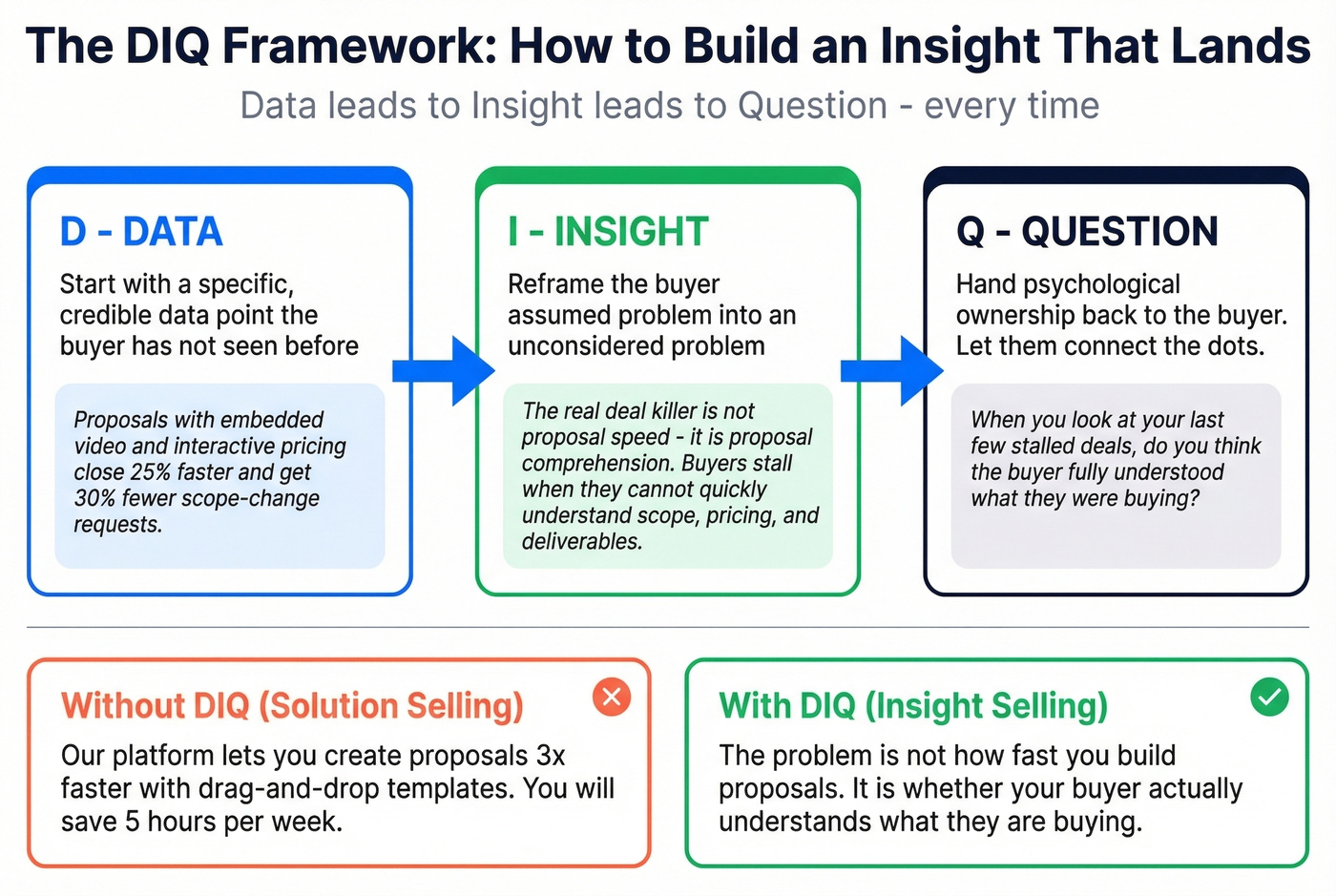
Solution selling approach: "Our platform lets you create proposals 3x faster with drag-and-drop templates. You'll save your team 5 hours per week."
Insight-driven reframe: "We've found that proposal speed isn't actually what kills deals - it's proposal comprehension. When buyers can't quickly understand scope, pricing, and deliverables, they stall. Proposals with embedded video and interactive pricing close 25% faster and get 30% fewer scope-change requests. The problem isn't how fast you build proposals. It's whether your buyer actually understands what they're buying."
The difference is structural, not cosmetic. The reframe version repositions the buyer's assumed problem - speed - into an unconsidered problem: comprehension. This is the DIQ framework in action: Data leads to Insight leads to Question. The question at the end hands psychological ownership back to the buyer. You're not telling them they have a problem - you're inviting them to evaluate whether they do. That collaborative posture separates this approach from lecturing.
Mistakes That Kill Deals
RAIN Group catalogued 19 common failure modes. Here are the seven that matter most:
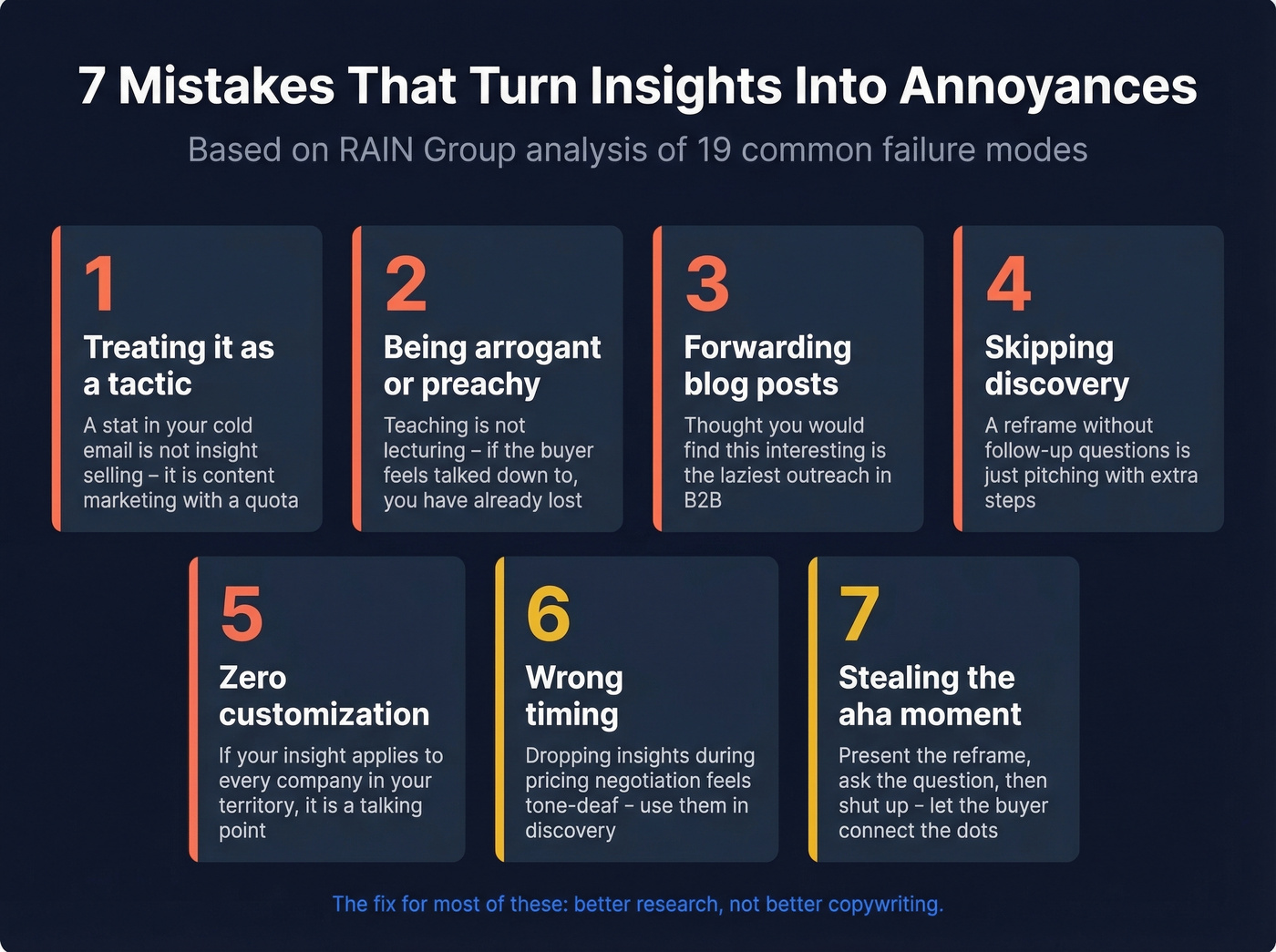
Treating it as a tactic, not a mindset. Sharing a stat in your cold email isn't insight-based selling. It's content marketing with a quota. The methodology applies to every buyer interaction, not just the opener.
Being arrogant or preachy. Buyers report sellers push "too far, too hard, too fast." Teaching isn't lecturing. If the buyer feels talked down to, you've lost them regardless of how good your insight is.
Equating email content-sharing with real insights. Forwarding a blog post with "thought you'd find this interesting" is low-effort and buyers see right through it.
Abandoning questioning and listening. This methodology doesn't replace discovery - it enhances it. Reps who show up with a reframe but never ask a follow-up question are just pitching with extra steps.
Lack of customization. A generic insight isn't an insight. If your "reframe" applies equally to every company in your territory, it's a talking point. The fix isn't better copywriting - it's better data. When you can enrich your list with intent signals and 50+ data points per prospect, your outreach is genuinely tailored to the account's actual situation, not a template.
Poor timing. Dropping an insight during a pricing negotiation feels tone-deaf. Insights land during discovery and early-stage conversations, not when the buyer is comparing final bids.
Stealing psychological ownership. If you present the reframe and then immediately prescribe the solution, you've taken credit for the buyer's "aha moment." Let them connect the dots. Ask the question and then shut up.
The Insight Creation Workflow
Here's the contrarian take most methodology articles won't give you: this isn't a messaging framework. It's a research discipline. 80% preparation, 20% delivery.
Step 1: Identify target accounts with intent signals. Don't spray insights at everyone. Focus on accounts actively researching your category or adjacent problems.
Step 2: Research account context. Tech stack, hiring patterns, funding events, headcount growth, leadership changes. You're looking for signals that suggest a shift - something the buyer is dealing with that they haven't fully processed yet.
Step 3: Form a hypothesis about the buyer's unconsidered problem. Based on what you've learned, what assumption is this buyer making that might be wrong?
Step 4: Build a reframe with tailored proof. Connect your hypothesis to data - customer outcomes, industry benchmarks, or original research. Without proof, you're speculating.
Step 5: Craft the opening message. Use the DIQ framework: lead with data, deliver the insight, close with a question that invites the buyer to evaluate.

Look, the bottleneck for most teams is Steps 1 and 2. You can't form a credible hypothesis about a buyer's unconsidered problem if you don't know what's happening inside their business. A rep using Prospeo for account research would see that the target account just started evaluating a new technology category, their engineering team grew 30% last quarter, and they're running a competitor's stack. That's three signals that form a hypothesis in minutes, not hours. A recycled Gartner stat is a brochure. Three current, account-specific signals are the raw material for a real insight.
80% of deals go to the vendor on the buyer's Day One shortlist. Getting there means reaching decision-makers with a reframe they haven't heard - and reaching them with verified contact data. Prospeo delivers 98% email accuracy and 125M+ verified mobiles so your insight actually lands.
Your best insight is worthless if it bounces. Make every send count.
How to Implement Across Your Team
Don't go "ready, fire, aim." As Mike Kunkle argues, this methodology fails when organizations rush deployment without validated insights or aligned messaging.
Phase 1 - Readiness. Create and validate actual insights before training anyone. Align marketing, product, and enablement on the reframes you'll use. If your insight suggests the buyer needs real-time analytics but your product takes 6 weeks to implement, you've got a credibility problem.
Phase 2 - Training. Blended learning works best: classroom or virtual sessions, followed by role plays, simulations, and feedback loops. Manager coaching is non-negotiable. Reps need to practice forming hypotheses and delivering reframes in low-stakes environments before doing it on a real call. If your reps can't run a solid discovery call with diagnostic questions and active listening, skip this and layer that foundation first - the insight layer comes second.
Phase 3 - Reinforcement. Mastery takes 6+ months of ongoing coaching, real-deal feedback, and iteration. Build a learning system that sustains the methodology - not a one-time workshop everyone forgets in two weeks. This is the number one implementation failure we see: teams train once and expect permanent behavior change.
FAQ
Is insight selling the same as the Challenger Sale?
No. Both involve educating buyers, but Challenger emphasizes assertive "commercial teaching" while the insight methodology emphasizes collaborative reframing. Think of them as cousins with different energy - insight-based approaches layer onto existing consultative skills more easily without requiring an org-wide overhaul.
When doesn't this methodology work?
In pure RFP or bid environments where the buyer has already defined the problem and solution. Once the spec sheet is written, you're in solution-selling territory whether you like it or not. Insights land in early-stage discovery conversations, not during final-bid comparisons.
Where do sales insights come from?
Structured account research - intent signals, tech stack data, hiring patterns, funding events - synthesized into a hypothesis about the buyer's unconsidered problem. Tools like Prospeo track 15,000 intent topics and return 50+ data points per contact, giving reps the raw material to build reframes in minutes instead of hours.
How long does it take to train a team?
Expect 2-3 months for initial competency using a Readiness, Training, Reinforcement model. Mastery takes 6+ months of coaching, role plays, and real-deal feedback loops. Teams that train once and stop see regression within 8 weeks.
What's the best book on insight selling?
Insight Selling by Mike Schultz and John Doerr. Add The Challenger Sale second and SPIN Selling third. That three-book stack covers education, assertive teaching, and diagnostic questioning - the full spectrum of modern B2B sales methodology.