How to Build a Joint Go-to-Market Strategy That Actually Executes
A RevOps lead we know spent a quarter reaching out to 47 companies about "strategic partnerships." He got three polite replies and zero follow-through. Twelve coffee chats produced what he later called "networking theater" - lots of head-nodding, not a single shared deal. 95% of strategic partnerships die after the initial handshake, almost always because nobody defined what "partnering" actually means in operational terms.
Here's how to build a joint go-to-market strategy that survives past the first meeting.
What Is Joint GTM?
A joint go-to-market strategy is two or more companies co-executing sales, marketing, and enablement against a shared ICP. It's not a channel program. It's not a referral agreement with a rev-share link. It's peer-level collaboration where both teams have skin in the game, shared pipeline targets, and co-owned outcomes.
When it works, each company uses the other's relationships and expertise to win deals neither could close alone.
Why Partner-Led Deals Outperform
Mid-market and enterprise companies report 35% of new pipeline is partner-influenced. That number alone should get your attention.
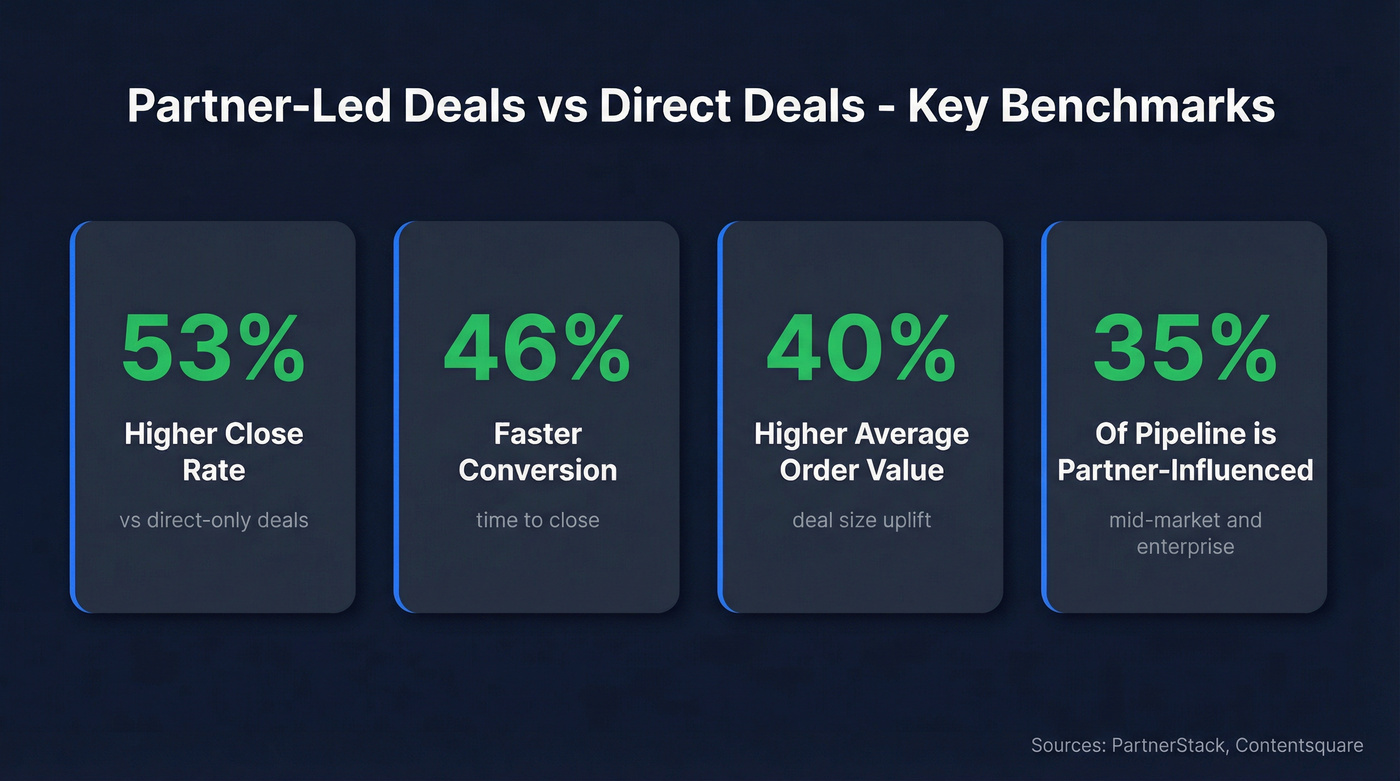
Industry benchmarks tell a consistent story: partner-involved deals close at 53% higher rates, convert 46% faster, and carry 40% higher average order values. Even when partner-sourced leads represent only 5-10% of pipeline, they can contribute 15-20% of ARR once the motion has real accountability behind it. Contentsquare's marketplace program is a good example of what "structured" looks like at scale - co-sell opportunities were 81% larger, closed 11% faster, and ACV increased 106% compared to direct deals.
Partnerships don't fail because the market opportunity isn't there. They fail because nobody builds the operating system to capture it.

Joint GTM dies when reps walk into co-sell calls with bad data. Prospeo enriches shared prospect lists with 50+ data points per contact - verified emails, direct dials, tech stack, headcount - refreshed every 7 days. Both partner teams sell from the same accurate list, not last quarter's export.
Stop letting stale CRM data sabotage your co-sell pipeline.
The Co-Sell Playbook: Step by Step
Pick the Right Partner
Forget emailing 40 companies about "exploring synergies." Map your customer journey and identify specific gaps. Where do customers hit friction your product doesn't solve? Which companies already serve your ICP but don't compete?
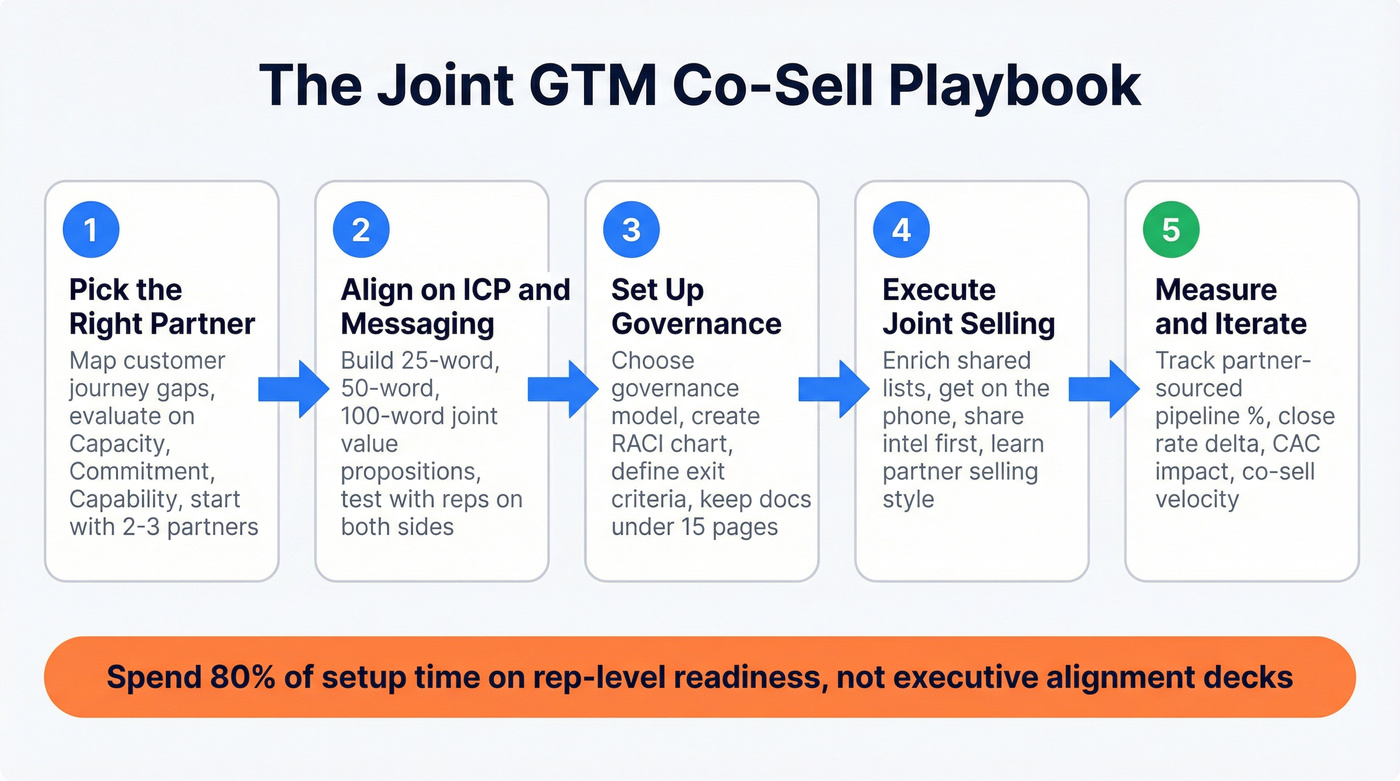
Evaluate candidates on three dimensions - Capacity, Commitment, and Capability - and start with two or three where there's a clear mutual business problem. A shared customer pain point beats a shared TAM slide every time. The best multi-partner strategies start narrow and expand only after documenting what works.
Align on ICP and Messaging
Build a joint value proposition. Bridge Partners recommends crafting a 25-word, 50-word, and 100-word JVP narrative that explains why the combined offering beats the alternative. The 25-word version forces clarity - if you can't say it in one breath, you haven't figured it out yet.
GTM alignment partnerships live or die on this step. If both teams can't agree on who they're selling to and why the combined solution matters, the rest of the playbook is irrelevant. Share drafts with sales stakeholders on both sides. If reps can't articulate it in 30 seconds, it's not ready.
Set Up Governance Early
This is where most partnerships quietly die. Three models work:
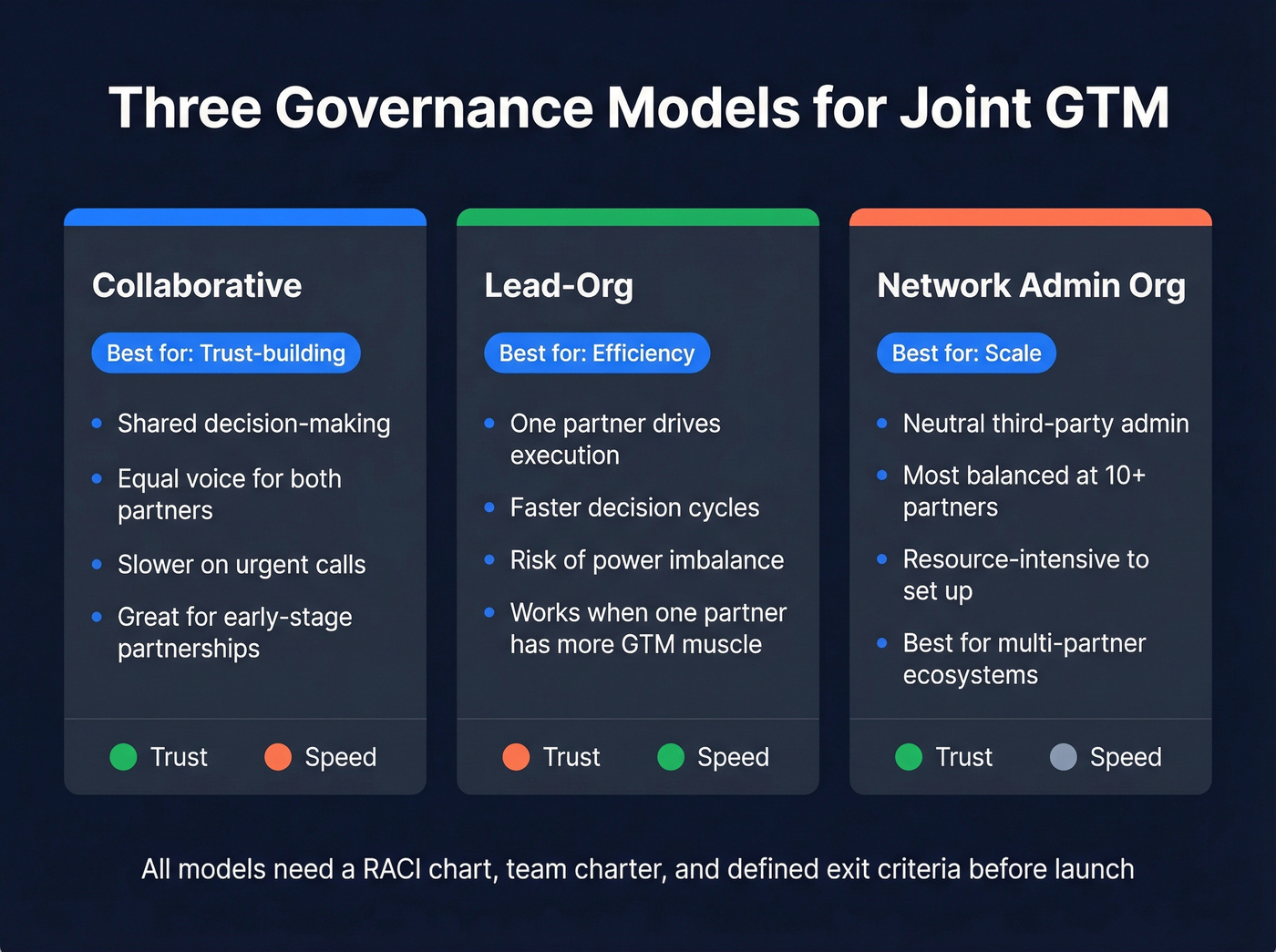
- Collaborative governance - shared decision-making, great for trust, slower for urgent calls
- Lead-org model - one partner drives, efficient but risks imbalance
- Network Administrative Organization - neutral admin body, best for scale, resource-intensive
You need a RACI chart and a team charter co-created by both sides. Your joint marketing agreement should cover scope, roles, cost split, branding, confidentiality, and data sharing rules.
Define exit criteria before you need them. Keep the governance doc to 10-15 pages - enough for daily operations, short enough that people actually read it. Expect 60-70% of early meeting time to go toward trust-building. That's normal, and trying to skip it is how you end up with a partnership that looks great on paper and produces nothing.
Execute the Joint Selling Motion
Let's be honest: co-selling fails when reps treat partners like lead vending machines. The anti-patterns are predictable. Expecting a lead on the first call. Assuming trust because the companies signed a deal. Showing up empty-handed asking "so, who can you introduce me to?"
Get on the phone - not email, not Slack. Share what you know first: press mentions, 10-K insights, recent conversations. Be the giver. Learn your partner rep's selling style before you try to run a joint deal. Joint selling requires the same preparation and trust-building you'd invest in any high-stakes sales motion, except you're coordinating across two org charts instead of one, which means twice the communication overhead and twice the opportunities for misalignment.
Before the first co-sell call, enrich your shared prospect list so both reps walk in prepared. We've seen teams use Prospeo to verify emails and mobile numbers across combined lists, returning 50+ data points per contact - company context, tech stack, headcount - so nobody's working off stale records.
Here's the thing most teams get wrong: they over-invest in partner selection and under-invest in co-sell enablement. The partner doesn't matter if your reps don't know how to run a joint call. Spend 80% of your setup time on rep-level readiness, not executive alignment decks.
Measure and Iterate
Track four things: partner-sourced pipeline as a percentage of total, close rate delta on partner-involved deals vs. direct, CAC impact, and co-sell velocity from first joint touch to closed-won.
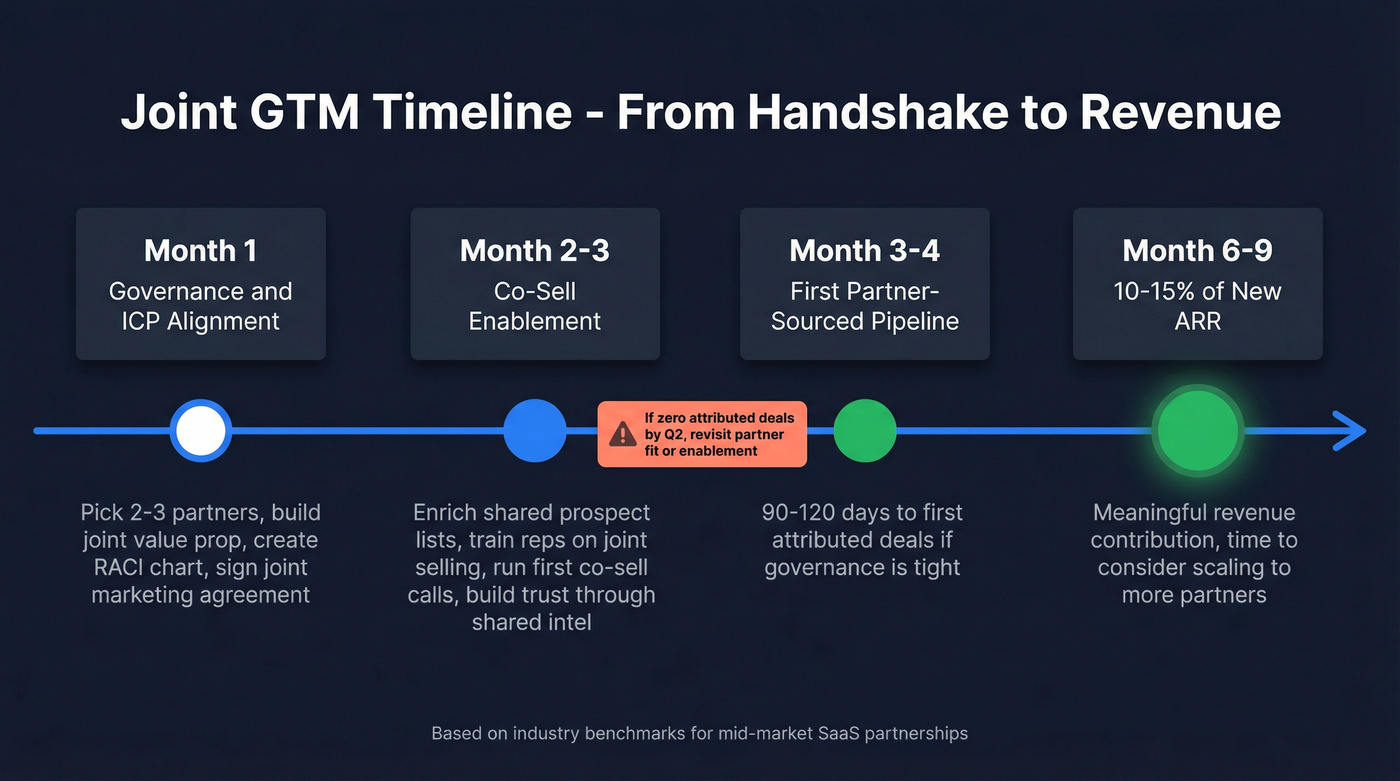
Run monthly ops reviews and quarterly strategic reviews. If partner referrals aren't contributing measurable pipeline within two quarters, revisit the partner selection or the motion itself - don't just add more partners and hope volume fixes a structural problem.
Tech Stack for Joint GTM
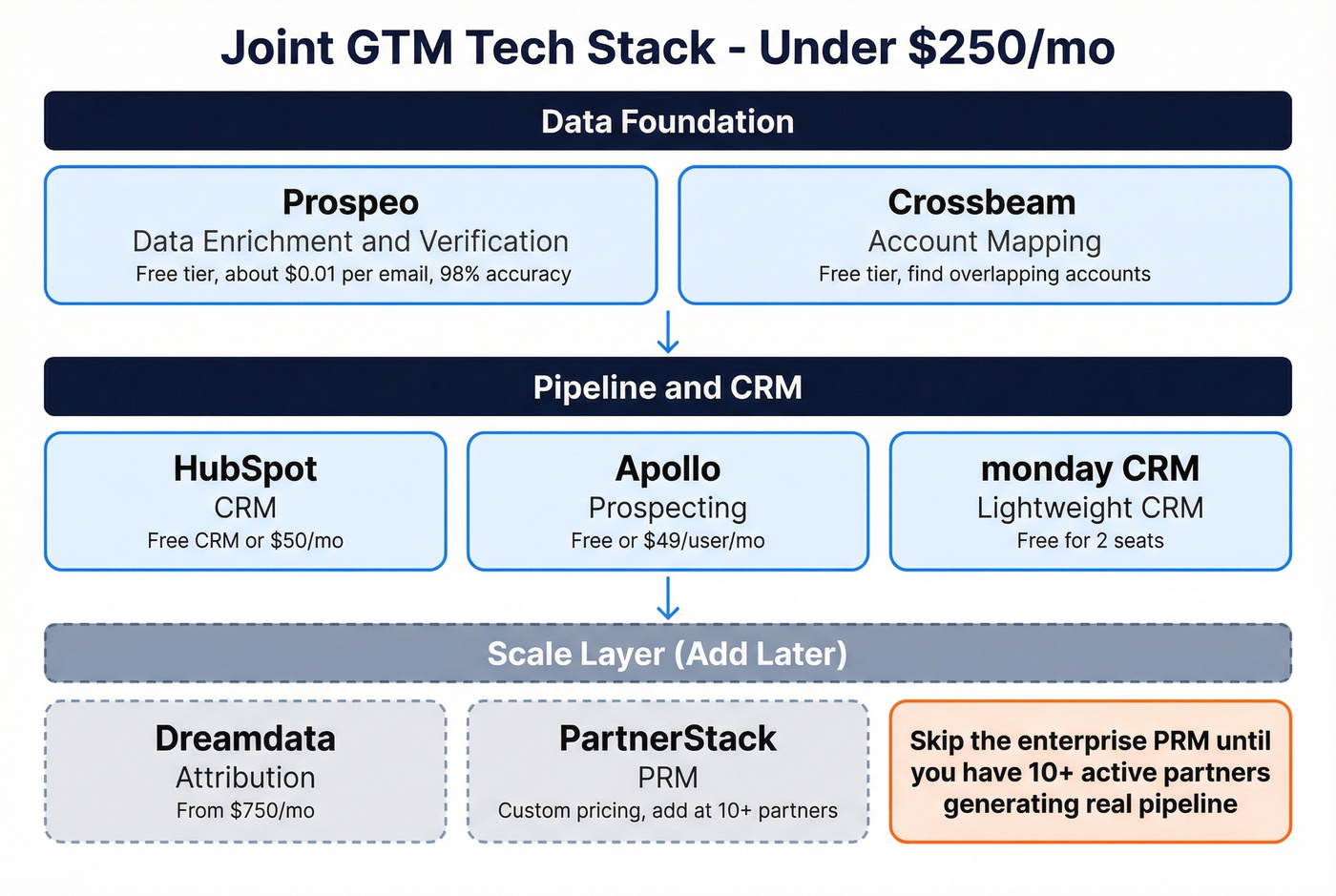
You don't need a PRM to run a joint GTM motion. For your first partnerships, a shared Slack channel, a Google Sheet with deal reg rules, and a monthly review call will outperform any $5K/month platform. In our experience, a CRM, an account mapping tool, and a data enrichment layer can run under $250/month for a small team if you start with free tiers and only pay for what you actually use.
When partners share prospect lists, bad contact data kills the motion fast. Bounced emails damage both brands' sender reputation. Prospeo verifies and enriches shared data with 98% email accuracy, 125M+ verified mobiles, and a 7-day refresh cycle - the list you share on Monday is still accurate on Friday.
Skip the enterprise PRM until you have 10+ active partners generating real pipeline. Before that point, the software just gives you a fancier way to track zero.
| Category | Tool | Starting Price |
|---|---|---|
| Data Enrichment & Verification | Prospeo | Free; ~$0.01/email |
| Account Mapping | Crossbeam | Free; paid from $4,800/yr |
| CRM | HubSpot | Free CRM; $50/mo |
| Prospecting | Apollo | Free; $49/user/mo |
| Enrichment Workflows | Clay | From $134/mo |
| Attribution | Dreamdata | From $750/mo |
| Lightweight CRM | monday CRM | Free (2 seats); $9/seat/mo |
| PRM (Enterprise) | PartnerStack | Custom pricing |
Bounced emails on a partner's shared list don't just kill deals - they tank both brands' sender reputation. Prospeo's 98% email accuracy and 125M+ verified mobiles mean the prospect data you share with partners actually connects. At $0.01 per email, cleaning a combined list costs less than one awkward 'sorry about that bounce' Slack message.
Protect both brands' deliverability before you hit send.
FAQ
How is joint GTM different from a channel partner program?
Joint GTM means co-execution with shared pipeline ownership - both companies sell together and split accountability. Channel programs are a vendor-reseller hierarchy where one company recruits and enables partners to sell on its behalf. The governance, economics, and day-to-day operations are fundamentally different.
How many partners should we start with?
Two or three where there's a clear mutual business problem. Document what works, then scale. The spray-and-pray approach of contacting 40+ companies consistently fails because you can't build operational rhythm across that many relationships simultaneously.
What tools do we need to launch a co-sell motion?
At minimum: a shared CRM workspace, an account mapping tool like Crossbeam to identify overlapping accounts, and a data enrichment layer to verify shared prospect lists before outreach. Add a PRM only when you have 10+ active partners generating real pipeline.
How long before a joint go-to-market strategy shows pipeline impact?
Expect 90-120 days to first partner-sourced pipeline if governance and ICP alignment are tight. Most teams see meaningful revenue contribution - 10-15% of new ARR - by quarter three. If you're past two quarters with zero attributed deals, revisit partner fit or co-sell enablement before adding more partners.