


7 Best Kleio Alternatives for Enterprise Conversational AI in 2026
Kleio.ai isn't Kleo the LinkedIn content tool, and it's not Clio the legal practice management software. If you're looking for Kleio alternatives - the enterprise agentic AI platform for complex sales journeys - you're in the right place. With roughly 650 conversational AI providers in the market and 40% of enterprise apps expected to feature AI agents by end of 2026, here are the options worth your time.
Our Picks (TL;DR)
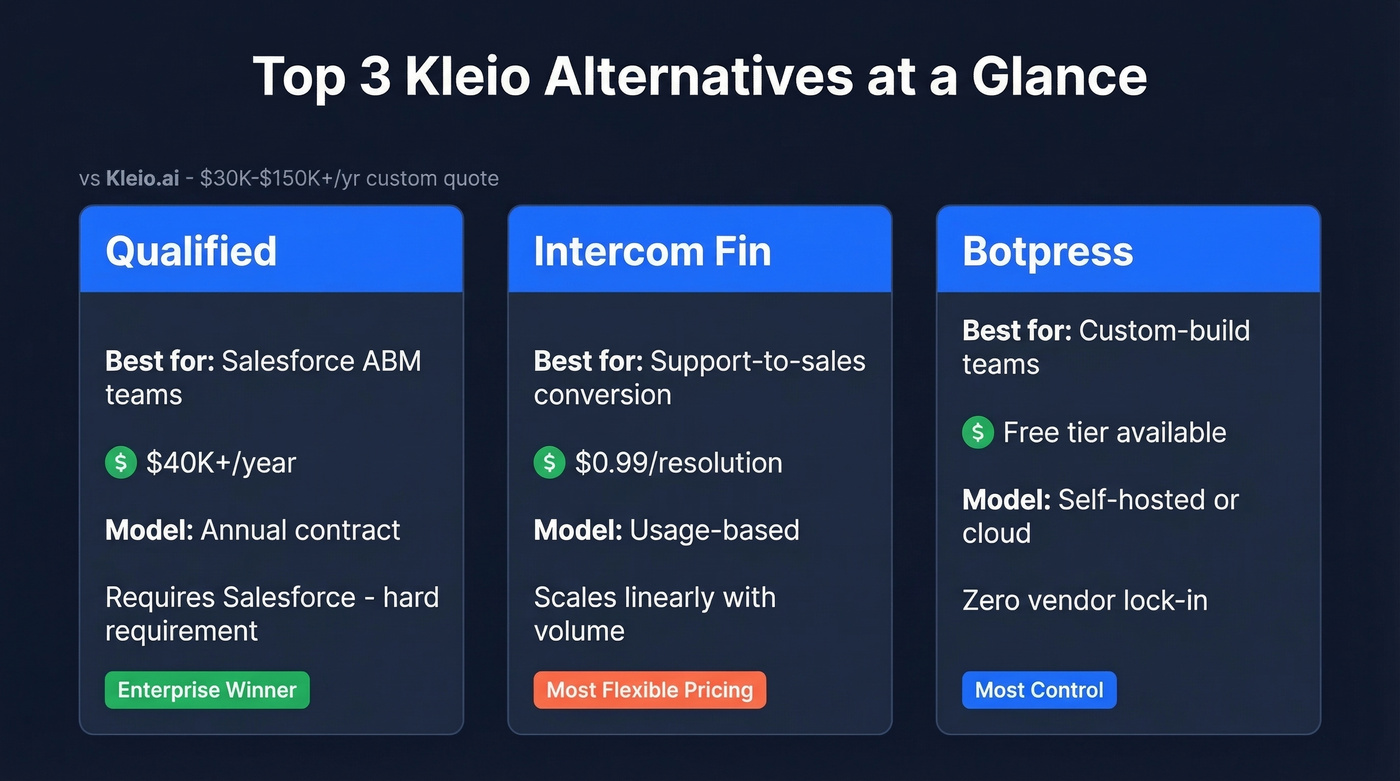
- Qualified - Gold standard for Salesforce-native enterprise teams. Budget: $40K+/year.
- Intercom Fin - Best usage-based model for support-to-sales conversion. $0.99/resolution.
- Botpress - Zero vendor lock-in, self-hostable, and a strong option if you want maximum control.
What Kleio.ai Actually Does
Kleio.ai builds agentic AI for complex sales journeys - multi-agent orchestration, knowledge graphs, AI-powered product discovery, and guided purchasing conversations that can hand off to sales. Pricing isn't public, but based on category norms expect $30K-$150K+/year depending on traffic, channels, and integrations.
Teams typically start shopping for competitors because of pricing opacity and overall fit. Integration requirements, implementation timelines, and how much control you actually get over workflows are the usual friction points.

You're spending $30K-$150K on conversational AI to qualify leads. But none of that matters if your rep dials a dead number or bounces an email. Prospeo delivers 143M+ verified emails at 98% accuracy and 125M+ mobile numbers with a 30% pickup rate - refreshed every 7 days, not every 6 weeks.
Don't let stale data waste your conversational AI investment.
Top Conversational AI Platforms to Consider
Qualified
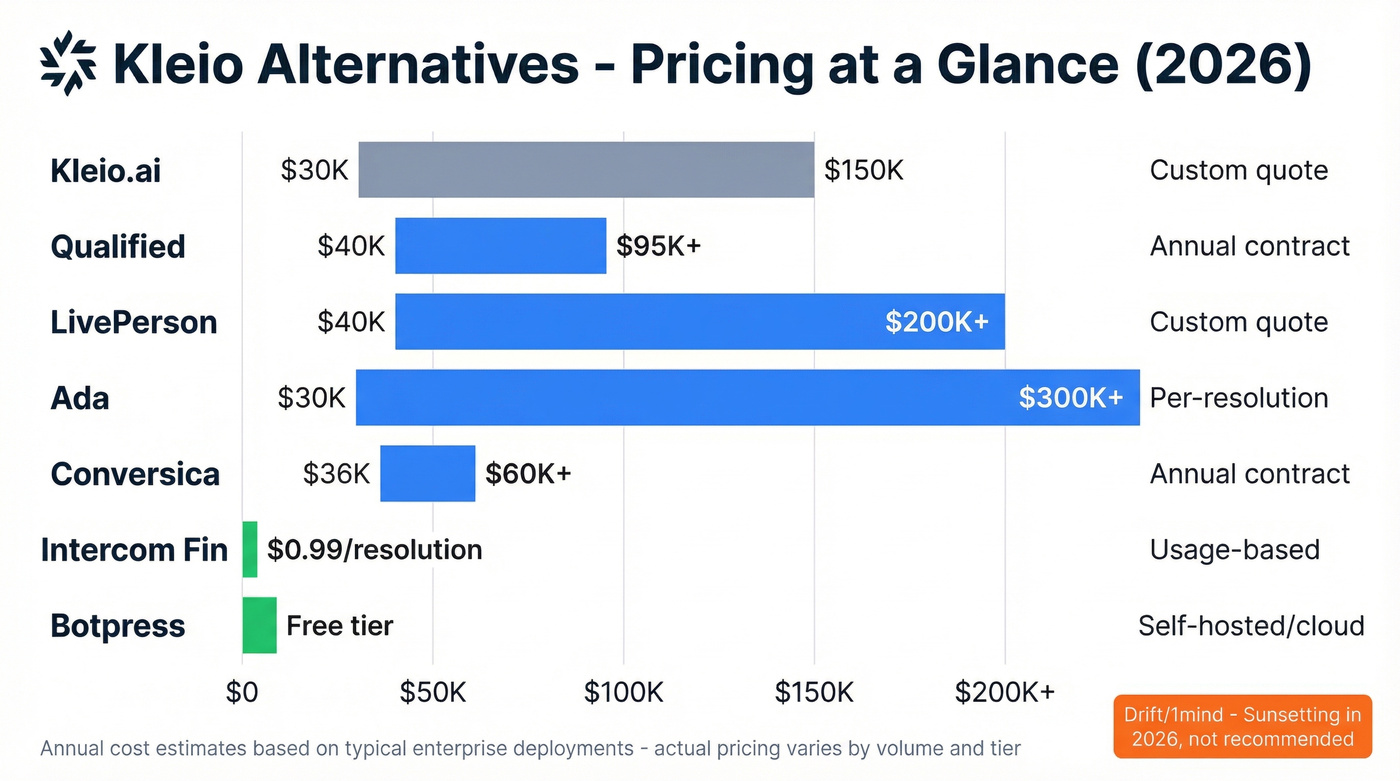
Use this if you're a Salesforce shop running ABM and need your website to do more than collect form fills. Qualified turns anonymous website traffic into real-time sales conversations routed to the right rep. Pricing runs ~$40K-$50K/year negotiated for the Premier tier, with list price at ~$68K/year for 25 users. Enterprise tiers push past $95K/year, and once you stack Salesforce licensing, implementation, and intent data add-ons, Year-1 TCO lands between $95K-$165K.
In our experience, the Salesforce requirement eliminates Qualified for about half the teams evaluating it. A recent Reddit thread testing B2B AI chat tools named Qualified the enterprise winner - consistent with what we've seen.

Skip this if you don't run Salesforce. It's a hard requirement, not a nice-to-have.
Intercom (Fin)
Fin charges $0.99 per resolved conversation - a usage-based model that's wildly different from the $40K+ annual commitments everywhere else. For teams handling moderate volume, costs scale linearly and predictably. Fin reads your help center, answers questions end-to-end, and only escalates what it can't handle.
Here's the thing: Fin is strong for support-to-sales conversion, but if your primary use case is top-of-funnel lead qualification on marketing pages, it isn't built for that. It works from the support side up.
Conversica
The always-on AI SDR that works massive backlogs of unworked leads via email and SMS. G2 rating sits at 4.5/5 across 187 reviews, with strong CRM integrations for Salesforce, HubSpot, and Marketo out of the box. Excellent for lead reactivation campaigns where you've got thousands of cold contacts sitting in your CRM doing nothing.
The trade-off: it's email-centric with no dialer or visitor identification by default, and AI accuracy drops when prospects go off-script - which happens constantly in enterprise sales. Minimum $2,999/mo with annual commitment. Enterprise implementations typically add $5K-$15K in setup.
Botpress
Use this if you have dev resources and want to build conversational AI without vendor lock-in. You can self-host, and it's a strong foundation for teams that need custom workflows beyond what most SaaS platforms allow. The community is active, the docs are solid, and the free tier is genuinely usable for prototyping.
Skip this if you need something working by next quarter without dedicated engineering time. Botpress rewards patience and technical investment; it punishes teams that just want to flip a switch.
LivePerson
Enterprise-grade omnichannel conversational AI for high-volume consumer-facing teams at $40K-$200K+/year. If you're handling millions of customer interactions across messaging, voice, and web, LivePerson has the infrastructure. It's overkill for B2B sales teams with fewer than 50K monthly conversations.
Ada
Support automation with per-resolution pricing ($1-$3.50/resolution), starting around $30K/year with enterprise contracts reaching $100K-$300K+. Strong for deflecting high-volume support tickets, less relevant for sales-led conversational AI.
Drift (1mind)
Stop evaluating Drift. It's sunsetting in 2026 after Salesloft named 1mind as its successor. A September 2025 OAuth breach impacted 700+ organizations including Cloudflare and Palo Alto Networks. Move on.
Pricing Comparison
Pricing models in this category range from traditional annual contracts to per-resolution and outcome-based structures. Here's how they stack up:
| Tool | Starting Price | Model | Best For |
|---|---|---|---|
| Kleio.ai | ~$30K-$150K/yr | Custom quote | Complex product discovery |
| Qualified | ~$40K/yr | Annual contract | Salesforce ABM teams |
| Intercom Fin | $0.99/resolution | Usage-based | Support-to-sales conversion |
| Conversica | $2,999/mo | Annual contract | Lead reactivation at scale |
| Botpress | Free tier available | Self-hosted/cloud | Custom-build teams |
| LivePerson | ~$40K-$200K/yr | Custom quote | High-volume consumer |
| Ada | ~$30K/yr | Per-resolution | Support ticket deflection |
The Data Layer Problem
Let's be honest about something most of these vendors won't tell you: teams overspend on conversational AI and underspend on the data feeding it. Your AI qualifies the lead, routes it to a rep, and then your rep calls a disconnected number or sends an email that bounces. The conversational layer worked perfectly. The data layer failed.
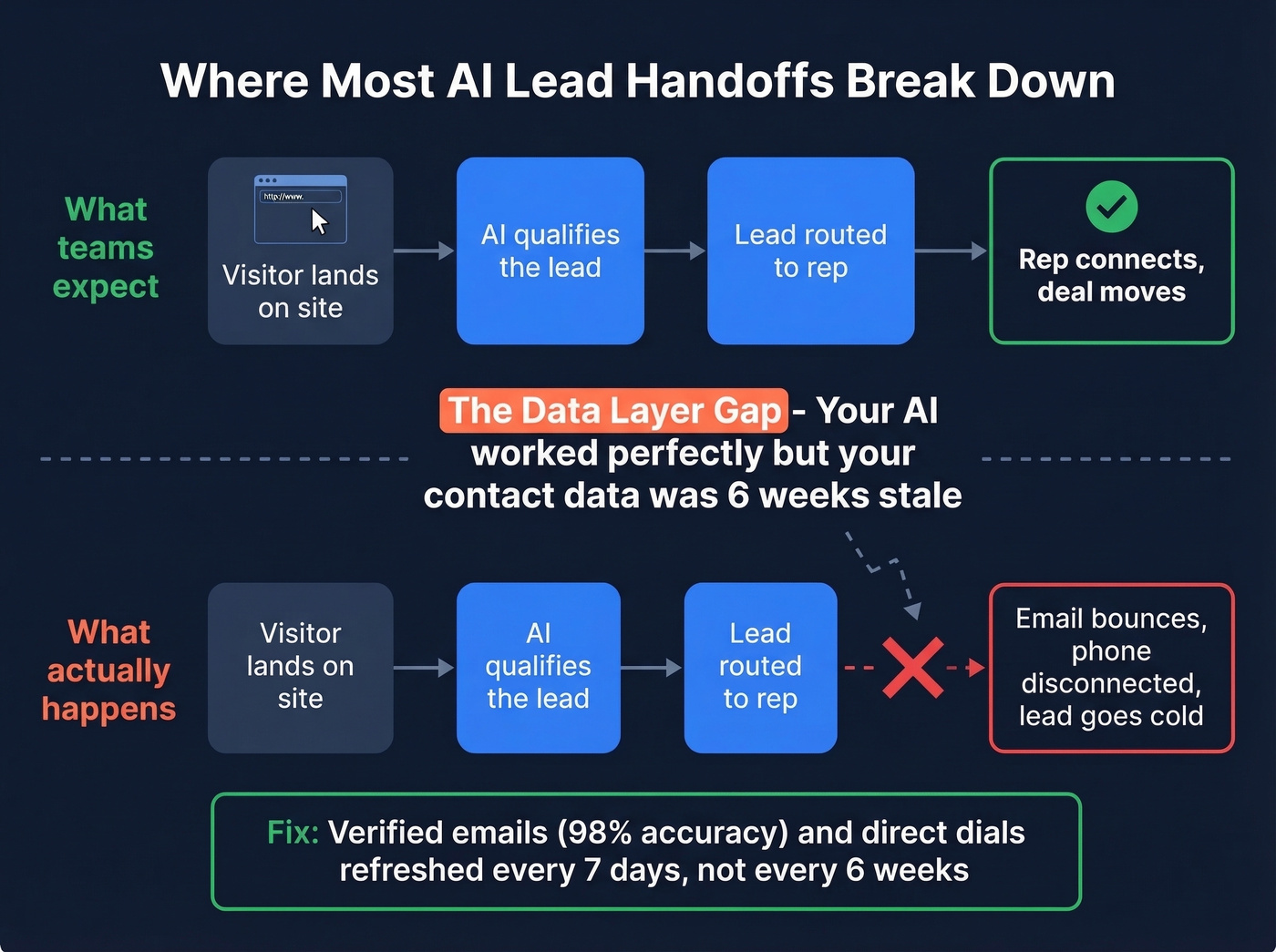
We've seen teams invest $50K+ in conversational AI only to lose deals because contact data was stale. Prospeo closes that gap - 143M+ verified emails at 98% accuracy and 125M+ verified mobile numbers hitting a 30% pickup rate, compared to the 11-12% industry average. Data refreshes every 7 days versus the typical 6-week cycle. Pair it with any tool on this list and your AI-to-rep handoff actually works.
If you're trying to fix the handoff end-to-end, start with data enrichment and a clean lead generation workflow so your routing logic isn't built on bad inputs.

Every tool on this list hands leads to your sales team. Prospeo ensures those handoffs convert. At $0.01 per email with 98% accuracy, you spend less on contact data than a single Intercom Fin resolution - and your reps connect with real buyers instead of dead ends.
Close the gap between AI-qualified and actually reachable.
FAQ
What does Kleio.ai actually do?
Kleio.ai is an enterprise agentic AI platform for complex sales journeys, combining multi-agent orchestration, knowledge graphs, AI-powered product discovery, and guided conversations that qualify and route buyers. Pricing isn't public but typically runs $30K-$150K+/year based on traffic and integrations.
How much does enterprise conversational AI cost?
Most platforms run $30K-$150K+/year on annual contracts. Usage-based models like Intercom Fin ($0.99/resolution) and Ada ($1-$3.50/resolution) offer more predictable costs at lower volumes - often 40-60% cheaper below 3,000 monthly conversations.
How do I make sure AI-qualified leads convert?
The biggest gap is stale contact data between AI qualification and human follow-up. Accurate, recently verified emails and direct dials - refreshed weekly, not monthly - close the handoff gap that costs most teams 15-25% of their AI-sourced pipeline.
Which Kleio alternative is best for small teams?
Botpress (free, self-hosted) or Intercom Fin ($0.99/resolution) are the most accessible starting points. Botpress requires engineering resources but has zero vendor lock-in. Fin works out of the box but focuses on support-to-sales rather than top-of-funnel qualification.