

LAARC Objection Handling: Scripts & Steps for 2026
Most LAARC guides define the acronym and stop. You already know what it stands for - what you need is what to actually say when a prospect hits you with "we're already using someone else" or "just send me an email."
Gong analyzed 300M+ cold calls and found the top 5 objections account for 74% of all pushback reps face. You don't need a playbook for every scenario. You need airtight responses for five situations. And speed matters: Outreach's data shows deals closed within 50 days hit a 47% win rate, compared to 20% or lower after that window. Every unresolved objection dragging your cycle out is killing your numbers.
What Is LAARC?
LAARC stands for Listen, Acknowledge, Assess, Respond, Confirm - a 5-step objection handling framework designed for B2B sales conversations where a simple "let me address that" isn't enough.
The earlier LAER model is attributed to Jack Carew's 1990 book You'll Never Get No for an Answer. Carew International still teaches LAER as "The Bonding Process", with the steps Listen, Acknowledge, Explore, Respond. The common evolution you'll see taught is LAER to LAERC (adds Confirm) to LAARC (swaps Assess for Explore).
What makes the framework useful is that it forces you to verify the prospect actually accepted your answer before you move on. A lot of articles credit HubSpot with creating LAER. They didn't. Carew did.
Objections vs. Brush-Offs
Before applying the framework, know what you're dealing with. Gong's data breaks all cold-call objections into three categories: 49.5% dismissive ("not interested"), 42.6% situational ("we already have a vendor"), and 7.9% existing-solution objections.
LAARC handles the last two. For the 49.5% that are pure brush-offs, Gong recommends a "disarmingly blunt" tone - something like: "I know I caught you cold. Give me 30 seconds, and if it's not relevant, I'll hang up myself." Once you've earned the conversation, the five steps kick in.
The 5 Steps, With a Running Dialogue
Here's the full framework using a single scenario. The prospect is a VP of Marketing using a competitor tool.
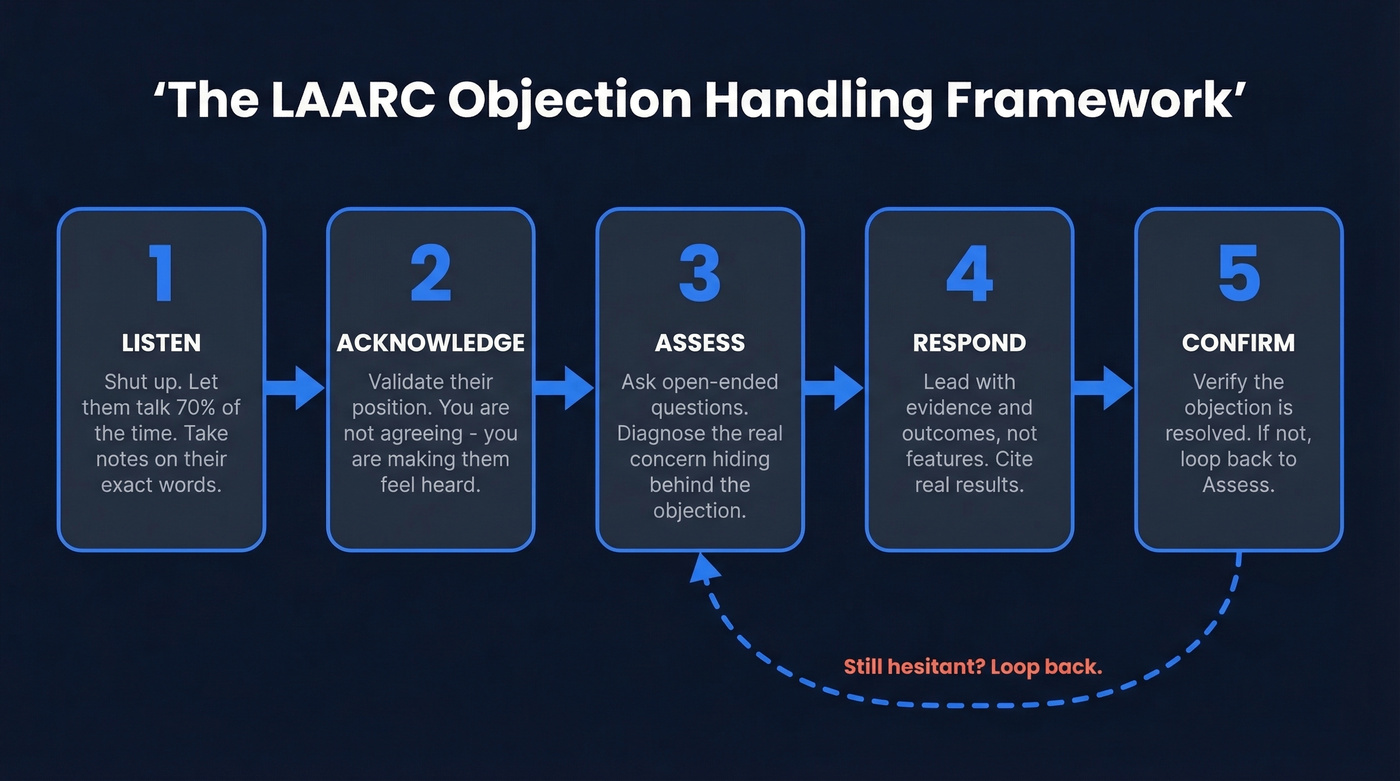
Step 1: Listen
"We're already using [Competitor] and it's working fine."
Shut up. The prospect should be talking 70% of the time. Don't interrupt. Take notes on the specific words they use - you'll mirror those words back later. We've watched reps mentally rehearse their rebuttal while the prospect is still mid-sentence, and they always botch the Assess step because they never actually heard the objection in the first place.
Step 2: Acknowledge
"That makes sense - switching tools when something's working is a hard sell. I wouldn't want to waste your time either."
This is Carew's "The Bonding Process" in action. You're not agreeing their current tool is perfect. You're validating their position so they feel heard, not cornered. The worst move here is pivoting immediately to your pitch.
Step 3: Assess
"Out of curiosity - when you say it's working, does that include [specific gap]? Or is that handled separately?"
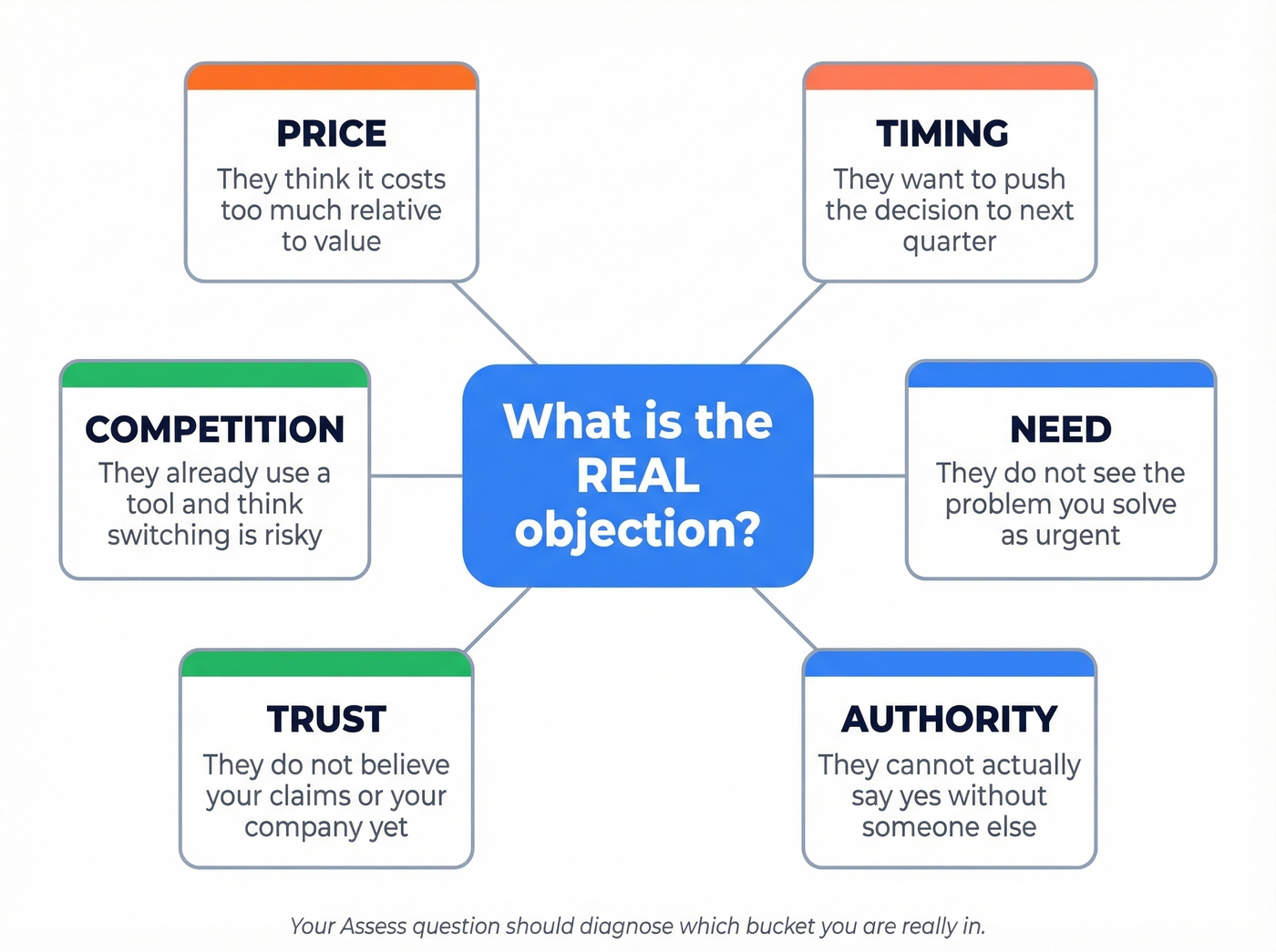
Here's where the method earns its keep. Most objections hide a deeper concern. Highspot breaks objections into four buckets - Price, Timing, Need, and Authority - though Trust and Competition deserve their own categories too. Your open-ended question should diagnose which bucket you're actually in.
Think of Assess as an isolation step. You're narrowing from a vague objection to a specific, addressable concern. If the prospect says "well, actually, our bounce rates have been creeping up," you've found your opening.
Step 4: Respond
"That's exactly what we hear from teams using [Competitor]. Most data providers refresh around every 4-6 weeks, which means contacts go stale between updates. One of our customers cut bounce rates from 35% to under 4% after switching to a weekly refresh - that's a real result, not a hypothetical."
Respond with evidence, not features. Nobody cares about a 7-day refresh cycle in the abstract - they care that it solves the bounce rate problem they just admitted to. Responding with confidence means knowing your prospect's situation before the call, which is why pre-call research tools matter so much. Prospeo surfaces 50+ data points per contact on a 7-day refresh cycle, so your response feels researched rather than rehearsed.
Step 5: Confirm
"Does that change how you're thinking about this?"
You've listened, acknowledged, diagnosed, and responded. Now verify the objection is actually resolved. If the prospect hesitates or raises a new concern, loop back to Assess. Don't advance while the objection still lingers - that's how you end up with a pipeline full of "let me think about it."

The Respond step falls flat without real evidence. Prospeo gives you 50+ data points per contact on a 7-day refresh cycle - so when a prospect admits their bounce rates are creeping up, you can cite the exact stat that closes the gap.
Stop rehearsing rebuttals. Start responding with proof.
Scripts for the Four Core Objection Types
Here's a steal-this-now table mapping each objection bucket to the Assess, Respond, and Confirm flow.
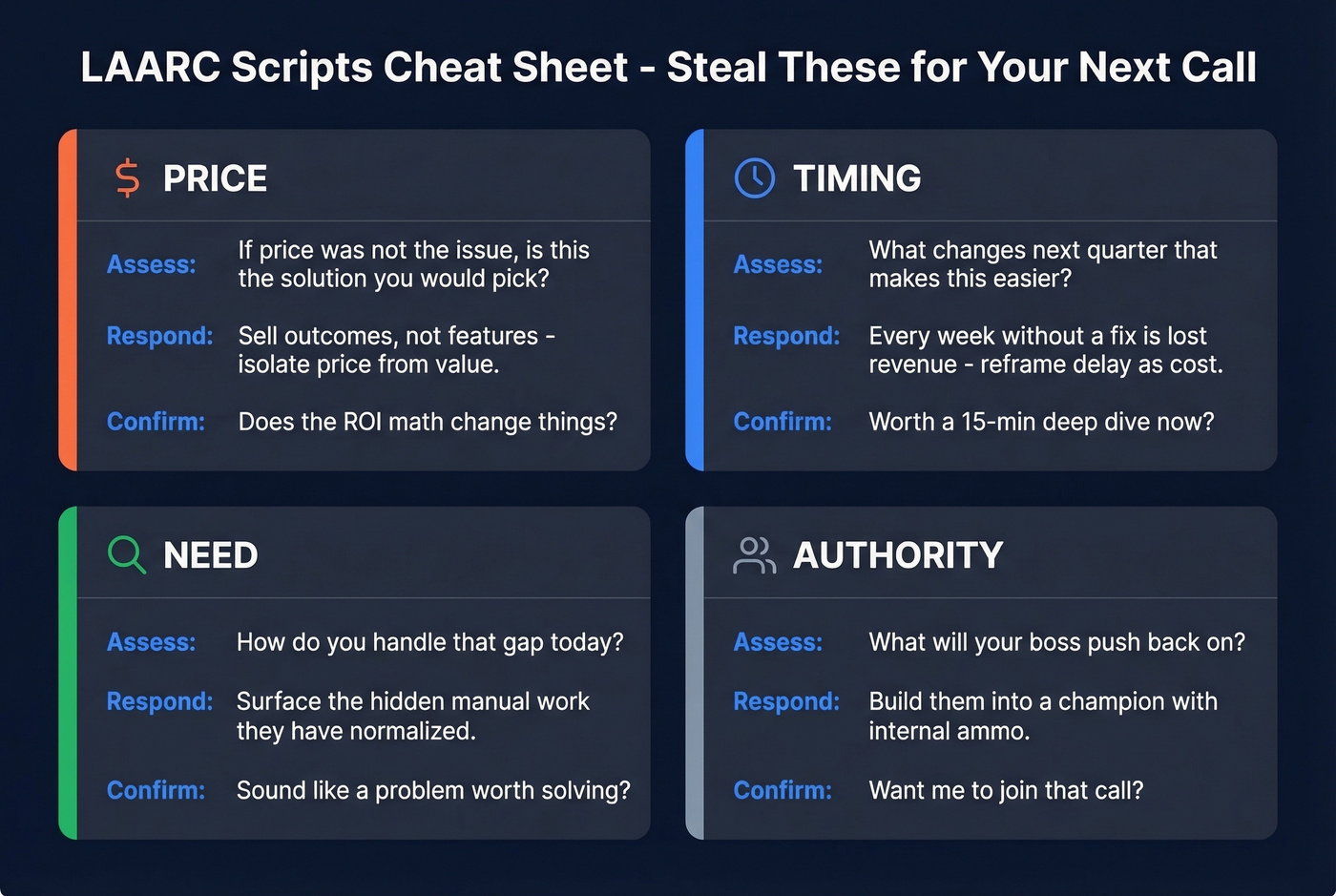
| Objection | Assess Move | Respond Move | Confirm |
|---|---|---|---|
| Price | "If price wasn't the issue, is this the solution?" | Isolate price from value - sell outcomes, not features | "Does the ROI math change things?" |
| Timing | "What changes next quarter that makes this easier?" | Reframe delay as cost - every week without a fix is lost revenue | "Worth a 15-min deep dive now?" |
| Need | "How do you handle [gap] today?" | Surface hidden manual work they've normalized | "Sound like a problem worth solving?" |
| Authority | "What will your boss push back on?" | Build them into a champion with internal ammo | "Want me to join that call?" |
Let's be honest: simpler frameworks like ARC (Acknowledge, Respond, Close) can work for transactional calls. But if you sell anything with a buying committee, skipping the Assess and Confirm steps is how you end up chasing ghosts. The extra steps aren't overhead - they're the whole point.
LAARC vs. Other Frameworks
| Framework | Steps | Best For | Limitation |
|---|---|---|---|
| LAARC | Listen, Acknowledge, Assess, Respond, Confirm | Complex B2B sales | More steps than you need for one-call closes |
| LAER | Listen, Acknowledge, Explore, Respond | Simpler B2B | No confirmation step |
| ARC | Acknowledge, Respond, Close | Transactional sales | Skips diagnosis entirely |
| FFF | Feel, Felt, Found | Quick consumer objections | Feels formulaic with experienced buyers |
| LAIR | Listen, Acknowledge, Identify, Reverse | Mid-complexity deals | "Reverse" can come off pushy |
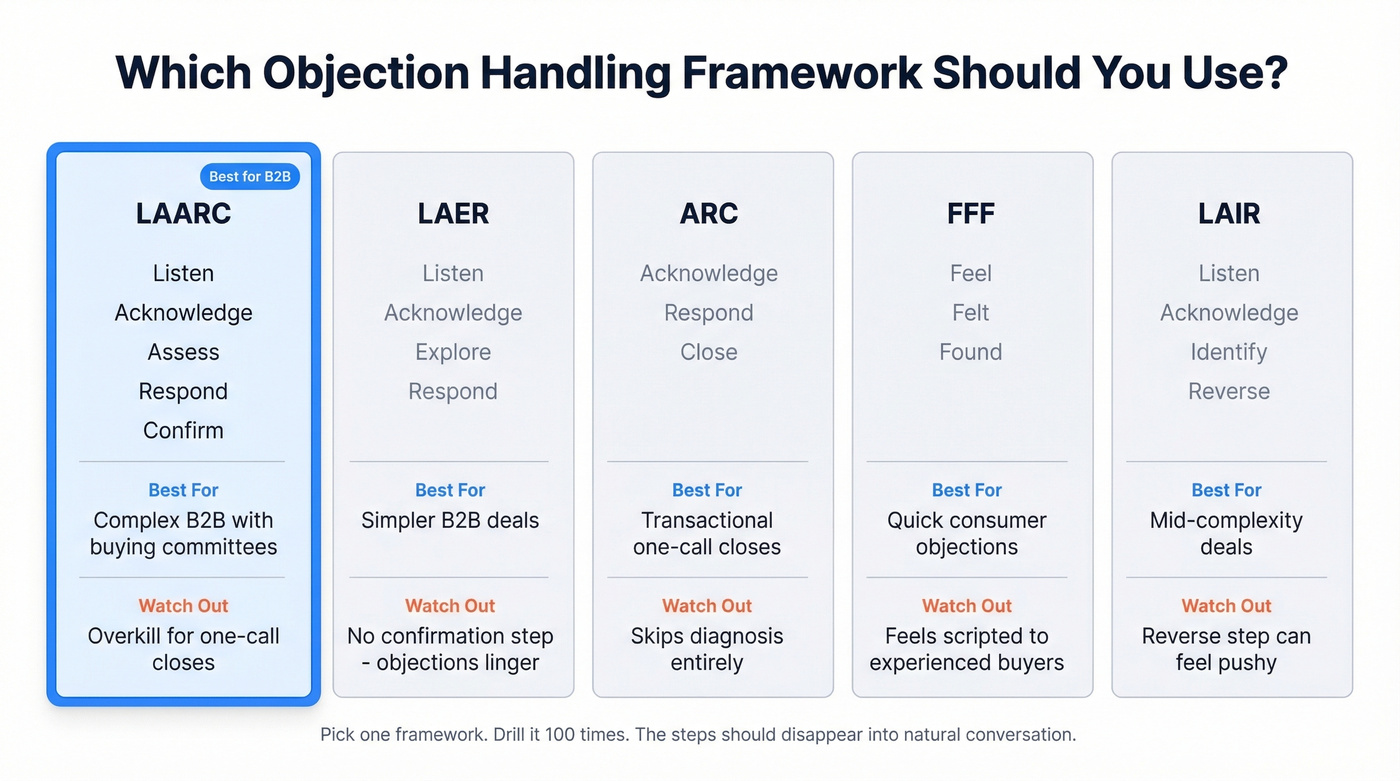
You don't need five frameworks. You need one, practiced 100 times. LAARC covers everything LAER does plus confirmation. Feel-Felt-Found is a crutch - skip it if you're selling to anyone with a procurement process. If you sell B2B, start here and don't look back.
The consensus on r/sales tends to agree: pick one framework, drill it until the steps disappear and the conversation feels natural. The reps who bounce between methods never internalize any of them.
The Part Nobody Talks About
Now you know how to handle the objection. The harder problem is making sure you're talking to the right person in the first place. In our experience, the single biggest reason objections go sideways isn't technique - it's that the rep is pitching someone who can't actually say yes. All the LAARC mastery in the world won't save a call to the wrong stakeholder.
If you're consistently hearing "send me an email," fix the upstream: tighten your ideal customer profile, improve your sales prospecting techniques, and build a repeatable cold calling system so you're not improvising your way into dead-end conversations.
LAARC only works when you reach the right person. Prospeo's 300M+ profiles with 98% email accuracy and 125M+ verified mobiles mean your objection handling skills actually get used - on live conversations, not voicemails.
Handle objections with decision-makers, not gatekeepers.
FAQ
What does LAARC stand for?
LAARC stands for Listen, Acknowledge, Assess, Respond, Confirm - a 5-step sales objection handling framework. It evolved from Jack Carew's original LAER model, adding a Confirm step so reps verify the prospect accepted their response before advancing the deal.
How is LAARC different from LAER?
LAER ends at Respond, leaving reps guessing whether the objection is resolved. LAARC adds Confirm and swaps Explore for Assess - a more targeted diagnostic step. For deals with multiple stakeholders, that confirmation loop prevents "let me think about it" stalls from clogging your pipeline.
When should I skip LAARC and use something simpler?
If you're running a one-call close on a low-ticket product, ARC or even Feel-Felt-Found will get the job done faster. LAARC shines when there's a buying committee, a multi-week sales cycle, or objections that tend to mutate between calls. For anything with a contract value above $5K, the extra steps pay for themselves.