

Law Firm Lead Generation: The Numbers-First Playbook for 2026
Your office manager just told you four of twelve leads went to voicemail yesterday. Two more came in through the website form over the weekend - nobody followed up until Monday afternoon. You don't have a lead generation problem. You have a conversion problem, and throwing more money at Google Ads won't fix it.
Here's the uncomfortable truth: 26% of law firms never respond to online leads at all. Before you spend another dollar generating leads, make sure you're not lighting the ones you already have on fire.
What You Need (Quick Version)
Most firms should fix intake before buying more leads. The median law firm response time is 13 minutes, and a quarter of firms don't respond at all. That's where your cases are dying.
Once intake is solid, invest in two channels: SEO for the lowest long-term CPL ($183 average) and Google Local Services Ads for immediate high-intent leads ($45-$249 depending on practice area). If your practice serves businesses - corporate, IP, employment, M&A - skip the consumer directories entirely and prospect decision-makers directly with verified contact data.
The benchmark to beat: 17.6% lead-to-client conversion when firms use structured intake and lead-capture forms. Below that? Your funnel has holes.
What Lead Generation Actually Costs
CPL by Channel
Here's what firms actually pay per lead, based on LEXGRO's PI benchmarks:
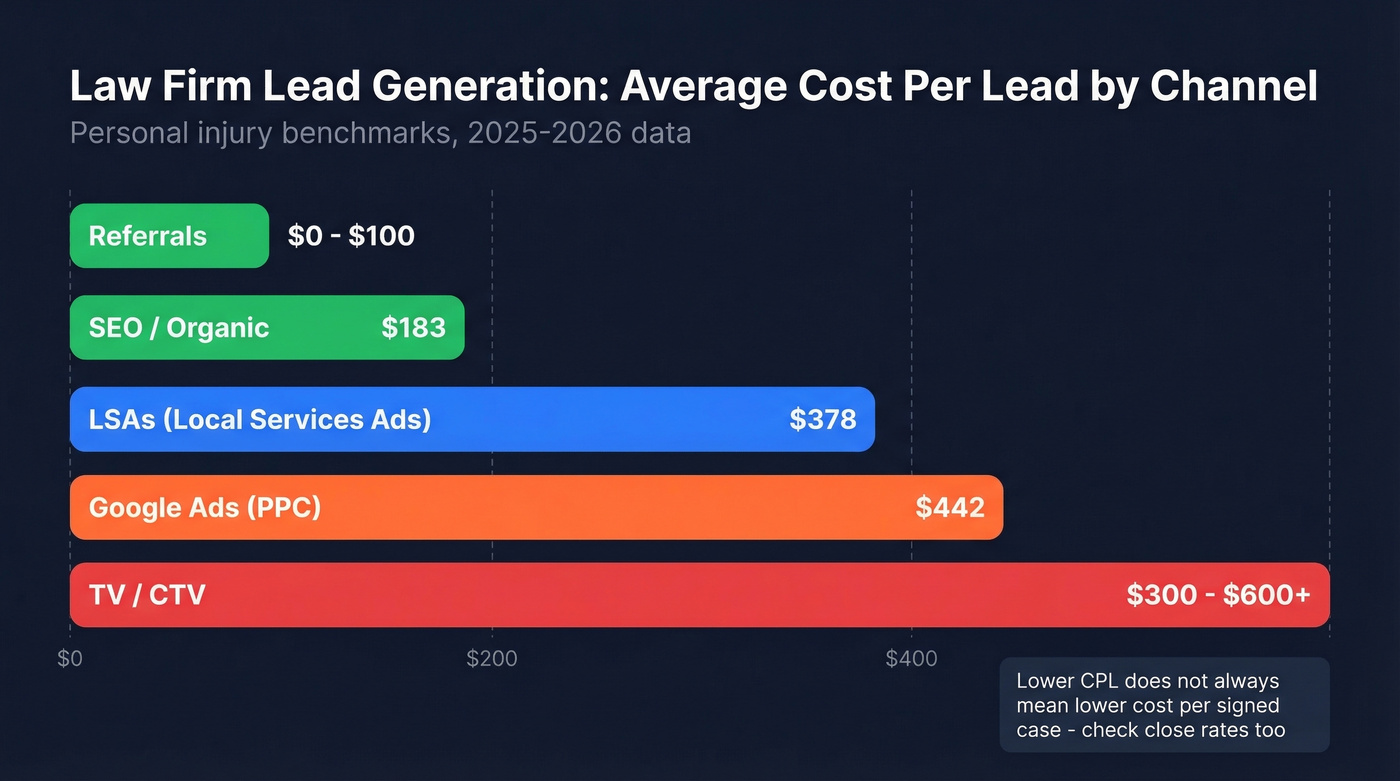
| Channel | Avg CPL | Notes |
|---|---|---|
| SEO / Organic | $183 | Lowest CPL, highest close rate |
| LSAs | $378 | High intent, 90%+ phone |
| Google Ads | $442 | Immediate but expensive |
| TV / CTV | $300-$600+ | Brand play, hard to attribute |
| Referrals | $0-$100 | Free but unpredictable |
These are PI-specific numbers. Other practice areas look different - estate planning LSAs can run as low as $45 per lead, while criminal and family law fall somewhere in between.
CPL by Practice Area
Not all personal injury cases cost the same to generate:
| Case Type | Avg CPL |
|---|---|
| Slip & Fall | $312 |
| Workplace Injury | $354 |
| Auto Accident | $391 |
| Product Liability | $476 |
| Medical Malpractice | $512 |
CPL by Region
| Region | Avg CPL |
|---|---|
| Midwest | $314 |
| South | $389 |
| West | $402 |
| Northeast | $468 |
The Midwest-to-Northeast gap is over $150 per lead. A PI firm in Boston and a PI firm in Indianapolis are playing fundamentally different economic games.
Why CPL Is the Wrong Metric
CPL tells you what a lead costs. It doesn't tell you what a signed case costs - and that's the number that actually matters.
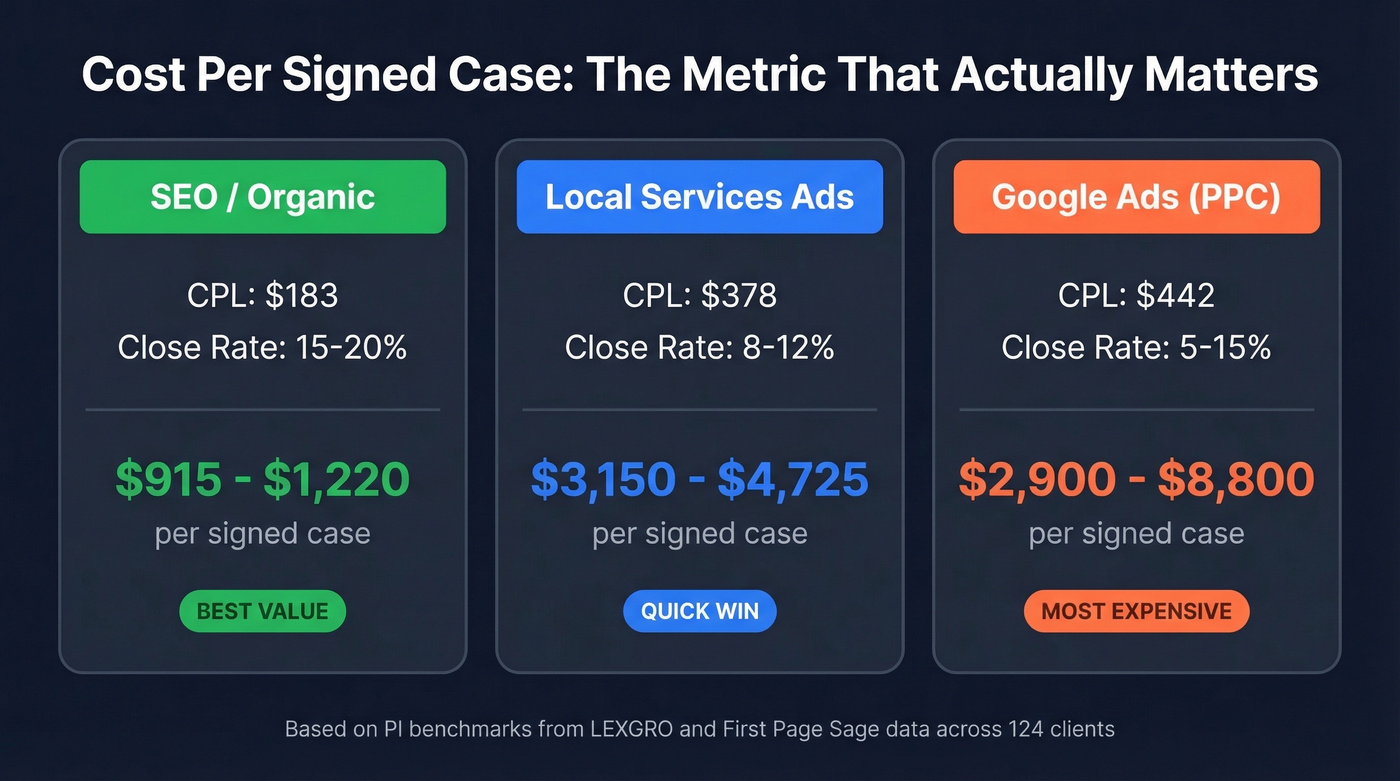
Google Ads at $442 CPL with a 5-15% signed-case rate means you're paying $2,900-$8,800 per signed case. SEO at $183 CPL with a 15-20% signed-case rate drops that to $915-$1,220 per signed case. LSAs land in between at $3,150-$4,725.
PPC conversion rates for legal services commonly benchmark anywhere from 2.2% up to 5.09%, depending on the source. Even at the generous end with a $53 Google Ads average CPL used in common benchmark math, you need roughly 13 leads to sign one PI case. That's a $689 floor. In competitive markets where the average legal CPC hits $181 or more, cost per signed case climbs past $1,429.
One more wrinkle. Exclusive leads cost $1,500-$2,500 per signed case, while shared leads - the kind most pay-per-lead vendors sell - run $3,000-$6,000. You're paying double for the privilege of racing three other firms to the phone.
Channels That Work (and One That Doesn't)
SEO - Lowest CPL, Highest Conversion
SEO delivers the best economics in legal marketing. Full stop. First Page Sage's data across 124 clients shows legal services SEO converting at 4.4% versus 2.2% for PPC - double the rate. Pair that with LEXGRO's CPL benchmarks ($183 vs $442), and the math is overwhelming. Over three years, legal SEO programs average a 526% ROI.
A good legal SEO program costs $2,000-$5,000/month in agency retainers and takes 6-12 months to compound. Most programs combine local optimization (Google Business Profile, citations), content targeting practice-area keywords, and technical site health. But once it's working, it's the cheapest source of signed cases you'll find. We've seen firms allocate roughly 75/25 between SEO and PPC - using paid to fill gaps while organic builds.
Google Local Services Ads - Best Quick Win
LSAs are the fastest path to high-intent leads for most practice areas. PI firms pay around $249 per LSA lead; estate planning attorneys pay as little as $45. Over 90% of LSA leads come in as phone calls, which means higher intent than form fills.
Getting in requires the Google Screened badge - license verification for every attorney listed, a Pinkerton background check, SSN/Tax ID confirmation, and business info matching your Google Business Profile. Google currently supports 17 legal categories, from bankruptcy and criminal to IP and immigration.
Google's algorithm favors firms that answer calls within 30 seconds and respond to messages within 4 hours. You'll also get roughly 6-7% of your spend back as credits for unqualified leads - dispute every bad one. Make sure your mobile experience is tight: click-to-call buttons should be prominent, pages should load in under 3 seconds, and mobile forms should require no more than 3-4 fields.
Google Ads - Expensive but Immediate
Legal CPCs average $181, and competitive PI keywords can exceed $400. Combined with a 2.2% conversion rate, the math gets brutal fast.
Google Ads make sense in two scenarios: you're in a saturated LSA market and need overflow, or you're targeting hyper-specific case types where organic competition is thin. For everyone else, the $2,900-$8,800 cost per signed case is hard to justify when SEO delivers the same cases for $915-$1,220.
Referrals - Free but Unscalable
About 40% of attorneys say referrals drive 40% or more of their new business. The CPL is effectively zero. The problem is obvious: you can't predict volume, you can't scale it, and you can't build a growth plan around it. Referrals are a bonus, not a strategy.
Social Media Organic - Skip It
Every law firm marketing guide lists organic social media as a lead generation channel. Almost no firm generates meaningful client volume from it. Your time is better spent on the four channels above.
Outbound Prospecting - The B2B Blind Spot
Everything above assumes you're a consumer-facing practice waiting for clients to find you. If your firm handles corporate law, IP, employment, or M&A, consumer directories and pay-per-lead platforms are useless. You need to reach in-house counsel and business decision-makers directly - these prospects aren't searching Google for a lawyer the way an accident victim does.
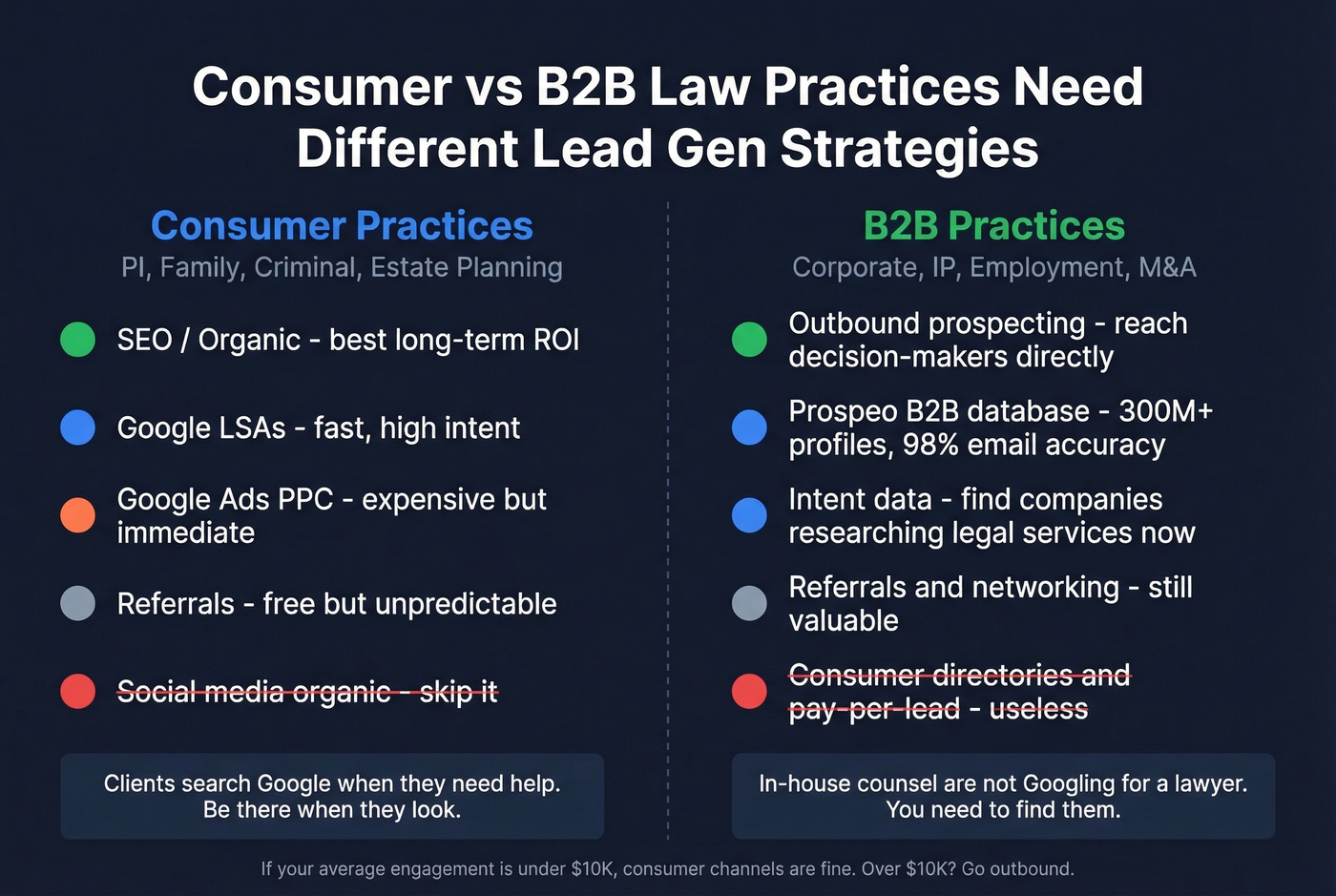
This is where Prospeo's B2B database fills a gap no legal marketing vendor covers. Build targeted prospect lists using 30+ filters - including intent data tracking 15,000 topics via Bombora - to find companies actively researching legal services. With 300M+ professional profiles and 98% email accuracy, you're reaching verified contacts instead of guessing at addresses. The free tier gives you 75 verified emails per month, enough to test whether outbound works for your practice before committing budget.

Let's be honest: if your average engagement value is under $10K, you probably don't need outbound prospecting or enterprise-grade data tools. But if you're chasing six-figure corporate retainers, the $45/month you'd spend on a directory listing is laughable compared to what one signed client is worth.
Speed-to-Lead - The Cheapest Fix
The Response-Time Benchmarks
Hennessey Digital's study across 1,300+ law firm websites and 150,000 data points paints a clear picture. 25% of firms respond to leads in under 5 minutes. The median is 13 minutes. And 26% never respond at all.
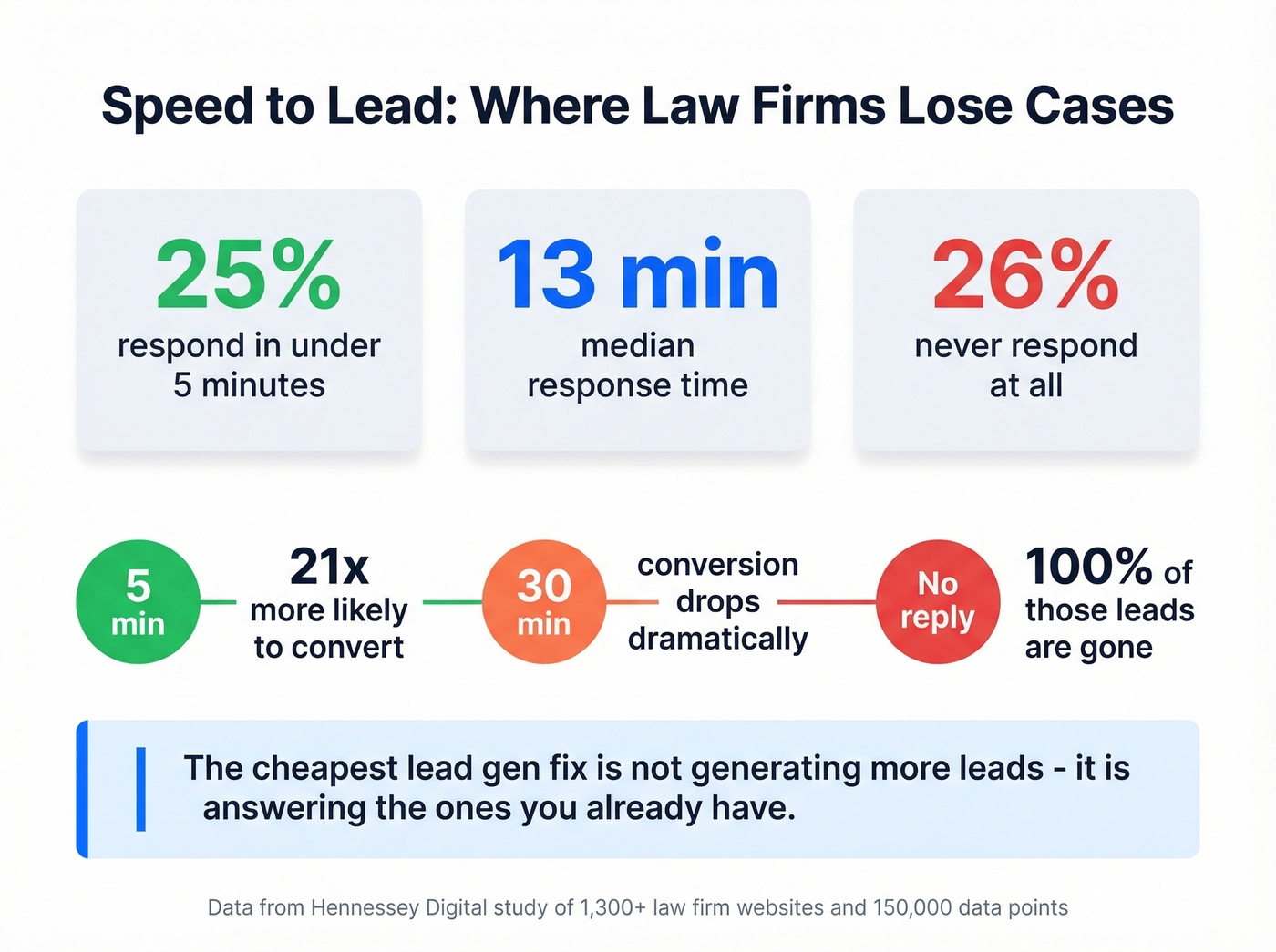
The improvement trend is real - 74% of firms now respond within 7 days, up from 59% in 2021. But "within 7 days" is a catastrophically low bar. Contacting a lead within 5 minutes makes conversion 21x more likely than waiting 30 minutes. Phone remains the dominant response channel at 87%, followed by email at 67%.
Intake as a Revenue Function
The firms winning at attorney lead generation treat intake like a revenue function, not an administrative task. MyCase's data across 58,395 leads shows a 17.6% lead-to-client conversion rate when firms use structured intake forms. That's the benchmark.
The operational playbook isn't complicated. Plan phone coverage for lunch hours and early evenings - that's when leads pile up unanswered. Prioritize form leads with the same urgency as phone calls. Reduce handoffs between the person who answers and the person who qualifies. Track return-call timing. Make multiple follow-up attempts instead of one call and done.
Once you're generating 30-50 leads per month, a dedicated intake specialist typically pays for itself in conversion improvements alone.
What Happens After First Contact
Most firms treat lead generation as a one-touch game: the lead comes in, you call, they either sign or they don't. That's leaving cases on the table.
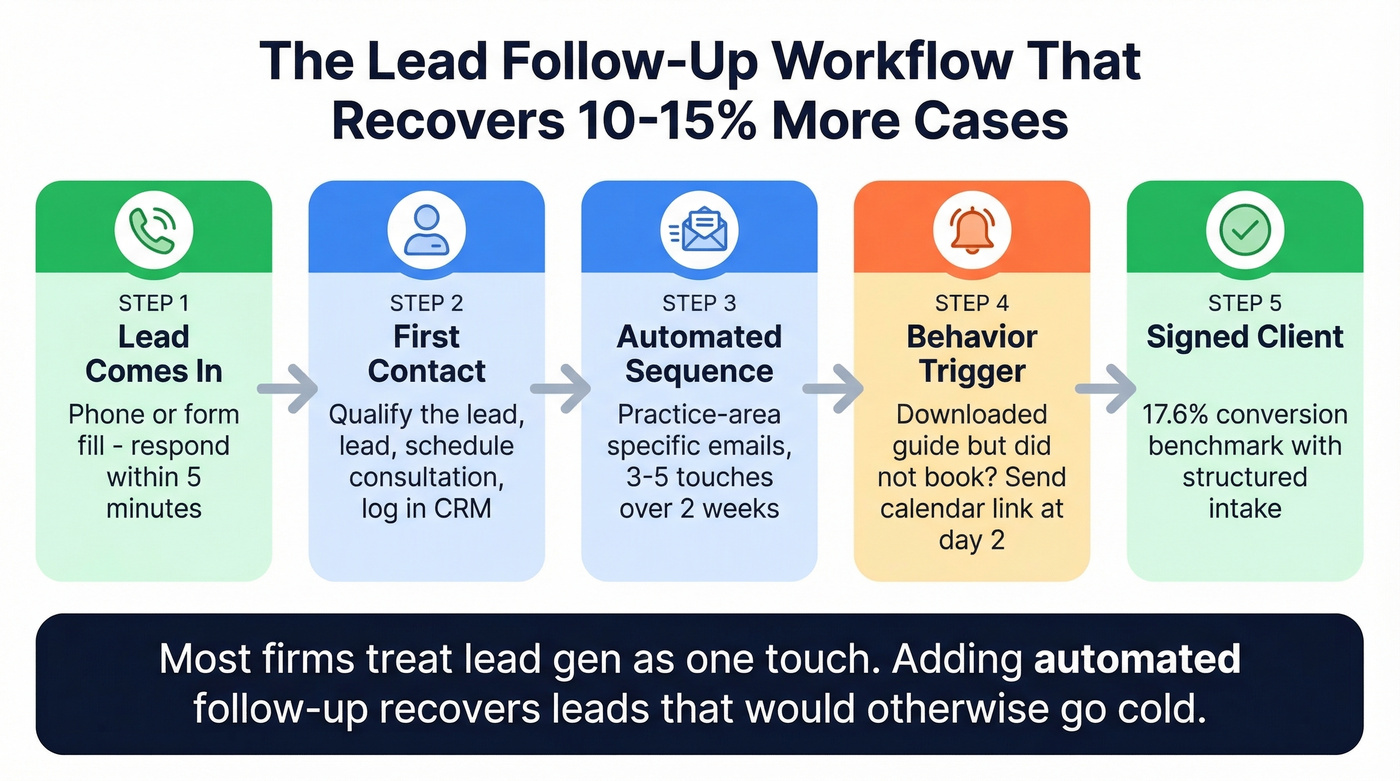
Set up automated email sequences segmented by practice area - a car accident inquiry gets different follow-up content than an estate planning question. Behavior-triggered automations work well here: if someone downloads your free consultation guide but doesn't book, a follow-up email two days later with a specific attorney's calendar link converts at a meaningfully higher rate than silence. Three to five follow-up touches over two weeks recover 10-15% of leads that would otherwise go cold.

Consumer lead gen channels don't work for corporate, IP, or employment law. Prospeo gives you direct access to in-house counsel and business decision-makers - 300M+ profiles, 98% email accuracy, 30+ filters including company size, funding, and industry. At $0.01 per email, one verified contact costs less than a single legal CPC.
Stop paying $181 per click when the right contact costs a penny.
How to Monetize Excess Website Leads
If your firm's website generates more inquiries than you can handle - or attracts leads outside your practice area - you have an asset most firms ignore. The simplest model: partner with non-competing firms in adjacent practice areas and route mismatched leads to them for a flat fee per qualified referral. This is ethically permissible under ABA Rule 7.2 as long as the arrangement is disclosed and the fee doesn't depend on case outcome. Some firms formalize this into a referral network that functions as a secondary revenue stream.
Lead-Gen Vendors and Pricing
| Vendor | Model | Price Range | Notes |
|---|---|---|---|
| Avvo | Subscription tiers | Free-$200+/mo | 8M+ monthly visitors, 650K prospect-attorney connections/mo |
| FindLaw | Monthly package | $200-$1,000+/mo | Largest legal directory; ROI varies widely |
| LegalMatch | Subscription | $100-$500+/mo | Leads matched by practice area and location |
| 4LegalLeads | Pay-per-lead | ~$50-$200+ per PI lead | Exclusive leads; pricing varies by market |
| Unbundled Attorney | Pay-per-lead | ~$40-$150 per lead | Focuses on unbundled/limited-scope services |
| Clio Grow | CRM / intake | $49/user/mo | Intake CRM, not a lead source |
| Lawmatics | CRM / intake | $199/mo | Automation-focused intake CRM |
| CallRail | Call tracking | $45/mo | Attribution, not lead generation |
The fact that almost every lead-gen vendor in legal hides their pricing tells you everything about the industry. One solo attorney on Reddit reported paying FindLaw $270/month and getting three potential clients - zero signed cases. The consensus on r/LawFirm threads isn't much kinder: most attorneys who've tried directory-based lead gen describe it as expensive and inconsistent.
The broader numbers confirm the skepticism. 78% of law firms use paid search, and 82% find the ROI underwhelming. Meanwhile, 75% of potential clients visit 2-5 firm websites before contacting anyone. You're not just competing for the lead - you're competing for the conversion after the lead lands.
Clio Grow and Lawmatics aren't lead-gen tools. They're intake CRMs. But they belong on this list because structured intake is what turns expensive leads into signed cases. A $49/month CRM that improves your conversion rate by 3 points is worth more than a $500/month directory listing.
Agencies vs. In-House
At some point every growing firm faces the build-or-buy decision. Agencies typically charge $2,000-$10,000/month and handle SEO, PPC, and sometimes intake optimization as a bundled offering. The advantage is speed - an experienced legal marketing agency already knows which keywords convert and which are money pits. The disadvantage is control: you're trusting someone else with your pipeline.
The hybrid approach works best for most mid-size firms. Keep intake and CRM management in-house where you have direct visibility into conversion rates, and outsource channel execution - SEO content, ad management, landing page testing - to a specialist. If you're spending under $3,000/month on marketing, an agency probably isn't worth the overhead. Do it yourself until the volume justifies the handoff.
Ethics - What Can Get You Disciplined
ABA Model Rules 7.1-7.3
Three rules govern virtually all legal marketing. Rule 7.1 prohibits false or misleading communications - no unverifiable claims like "best" or "top" unless you can back them up. Rule 7.2 draws the line between permissible marketing payments and impermissible referral steering. Rule 7.3 restricts live solicitation, and depending on your state, real-time chat and DMs can fall into problematic territory.
State-Specific Traps
| State | Key Restriction |
|---|---|
| Florida | Ad pre-filing 20 days before use, $150/filing ($250 late). No "expert" or "specialist" without board certification. |
| New York | 30-day restriction on targeted mail to accident victims. |
| Texas | 4-year ad retention required for all marketing materials. |
| New Jersey | Testimonial superlatives like "the best" in promoted client reviews can trigger disciplinary review. |
How to Vet a Lead-Gen Vendor
NYSBA Opinion 1294 provides a clean three-point test for whether a lead-gen platform is ethically permissible. The platform must not recommend you specifically. It must use neutral, disclosed criteria to select which attorneys receive leads. And your payment must not vary based on whether the client retains you or how much the fee is.
The disclosure requirement matters too - the platform needs clear and conspicuous consent from the consumer, not buried terms and conditions. If your vendor can't explain how they meet all three criteria, walk away.
The 6 Numbers Every Firm Should Track
If you can't fill in all six of these numbers for last month, you have a measurement problem - and no amount of lead-gen spend will fix it.
- Ad spend - total dollars out the door, all channels
- Total leads - deduplicated across sources
- Qualified leads - after intake screening
- Signed cases - actual retained clients
- Cost per lead - spend divided by total leads
- Cost per signed case - spend divided by signed cases
The gap between firms that track these and firms that don't is enormous. In our analysis of hundreds of law firm marketing programs, the firms that connect ad platforms to their CRM via UTMs and offline conversion tracking consistently cut cost per signed case by 20-30% within six months - not because they found better channels, but because they stopped funding the ones that weren't working.
If you want a tighter framework for attribution and pipeline math, start with B2B marketing measurement and a simple CRM lead source tracking setup.
B2B law firms waste thousands on shared leads and directories built for consumer practices. Prospeo's database lets you filter by job title, department, company revenue, and technographics - then delivers verified emails and direct dials so your outreach actually lands. 125M+ verified mobiles with a 30% pickup rate.
Reach the GC directly instead of waiting for them to Google you.
FAQ
What's a good cost per lead for a law firm?
PI Google Ads CPL averages $442, while SEO averages $183. Estate planning LSAs can run as low as $45. The better metric is cost per signed case - a $183 CPL with a 15-20% close rate beats a $100 CPL with a 3% close rate every time. Always track both numbers by channel.
Are lead generation companies worth it for lawyers?
Most aren't. Vet any vendor against the NYSBA three-point test and demand cost-per-signed-case data, not just lead volume. Shared leads are particularly risky - you're paying premium prices to race competitors to the phone. Ask for exclusive lead options and track your own conversion rates ruthlessly.
How fast should a law firm respond to online leads?
Under 5 minutes is best-in-class. Contacting a lead within 5 minutes makes conversion 21x more likely than waiting 30 minutes. The median firm response time is 13 minutes, and 26% never respond at all. Speed is the single cheapest improvement most firms can make.
What's the best lead generation channel for small firms?
Google Local Services Ads for immediate high-intent leads - especially outside PI, where CPLs are low - and SEO for long-term lowest cost per signed case. Start with LSAs for quick wins while your SEO program compounds over 6-12 months. Budget $2,000-$5,000/month for SEO and scale LSA spend as you dial in intake.
How do B2B-focused law firms find clients?
Corporate, IP, and employment practices need outbound prospecting, not consumer directories. Build targeted lists of in-house counsel and decision-makers using verified contact data and intent signals. Prospeo's B2B database with 30+ filters - including legal-industry targeting and Bombora intent data - helps you identify companies actively researching legal services, then reach the right person with a 98% verified email.