

How to Turn Local SEO Into a Lead Generation Machine in 2026
A home service business owner posted on r/digital_marketing about going from zero to 120+ inbound leads per month - no ads, no paid directories, just local SEO done right. Meanwhile, most businesses that "invest in SEO" watch their rankings climb while the phone stays quiet. That gap between ranking and actually generating leads is where most local strategies fall apart.
The problem isn't that local SEO doesn't work. It's that most businesses treat it like a checklist instead of a system. They hire an agency, get some citations built, maybe claim their Google Business Profile, and wonder why leads aren't flowing. Rankings are a means to an end - the end is a phone that rings, a form that fills, a calendar that books.
The System in Four Parts
- Fix your lead leaks - site speed, mobile UX, visible contact info
- Treat your Google Business Profile as your #1 asset - not an afterthought
- Build a review engine that runs on autopilot - ask after every job, respond to everything
- Publish one piece of locally relevant content per week - answer real questions from real people
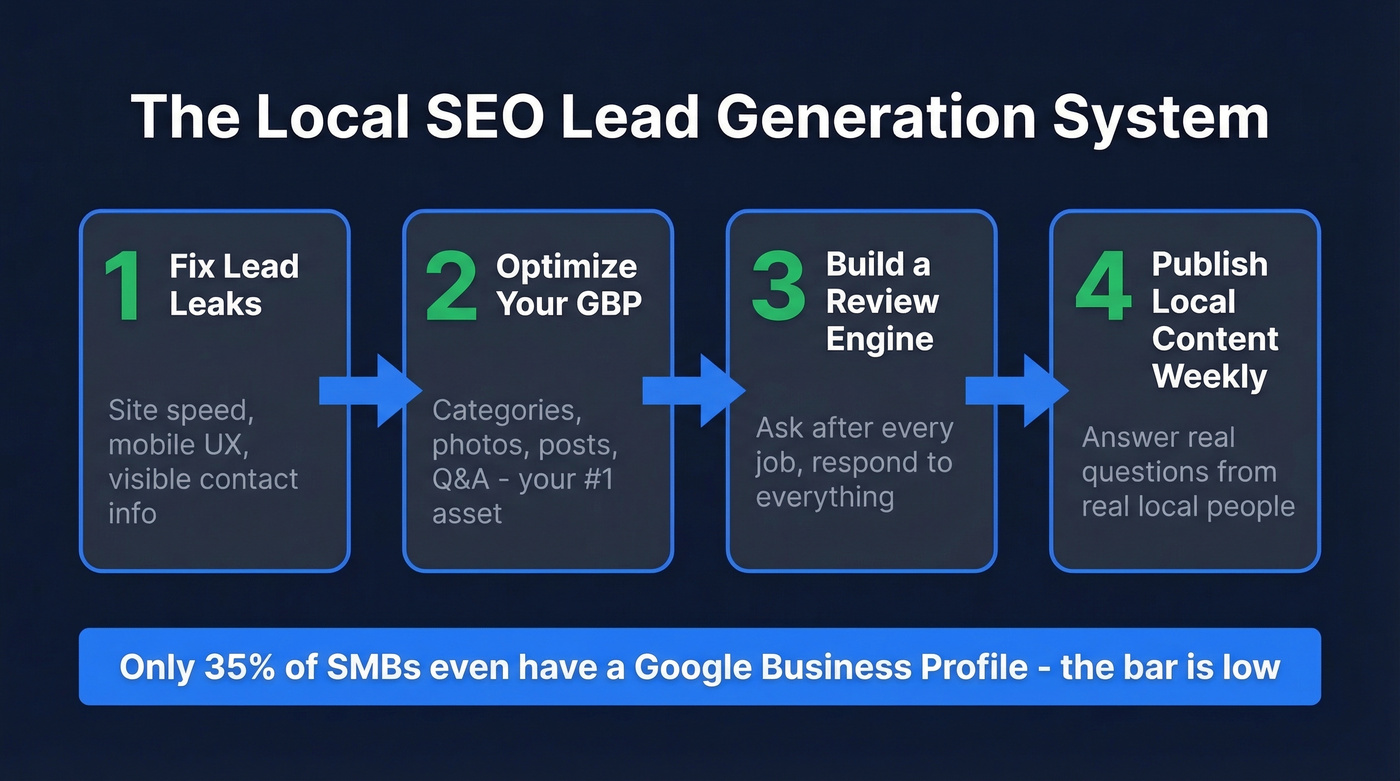
Here's the thing: only 35% of SMBs have a Google Business Profile, and only 40% even have a dedicated website. Most of your local competitors aren't doing step 2, let alone step 4. The bar is shockingly low.
What Changed in Local Search in 2026
How customers find local businesses has splintered. They discover you across AI summaries, map packs, voice queries, and zero-click results - and many decide based on your GBP photos, reviews, and hours without ever visiting your website.
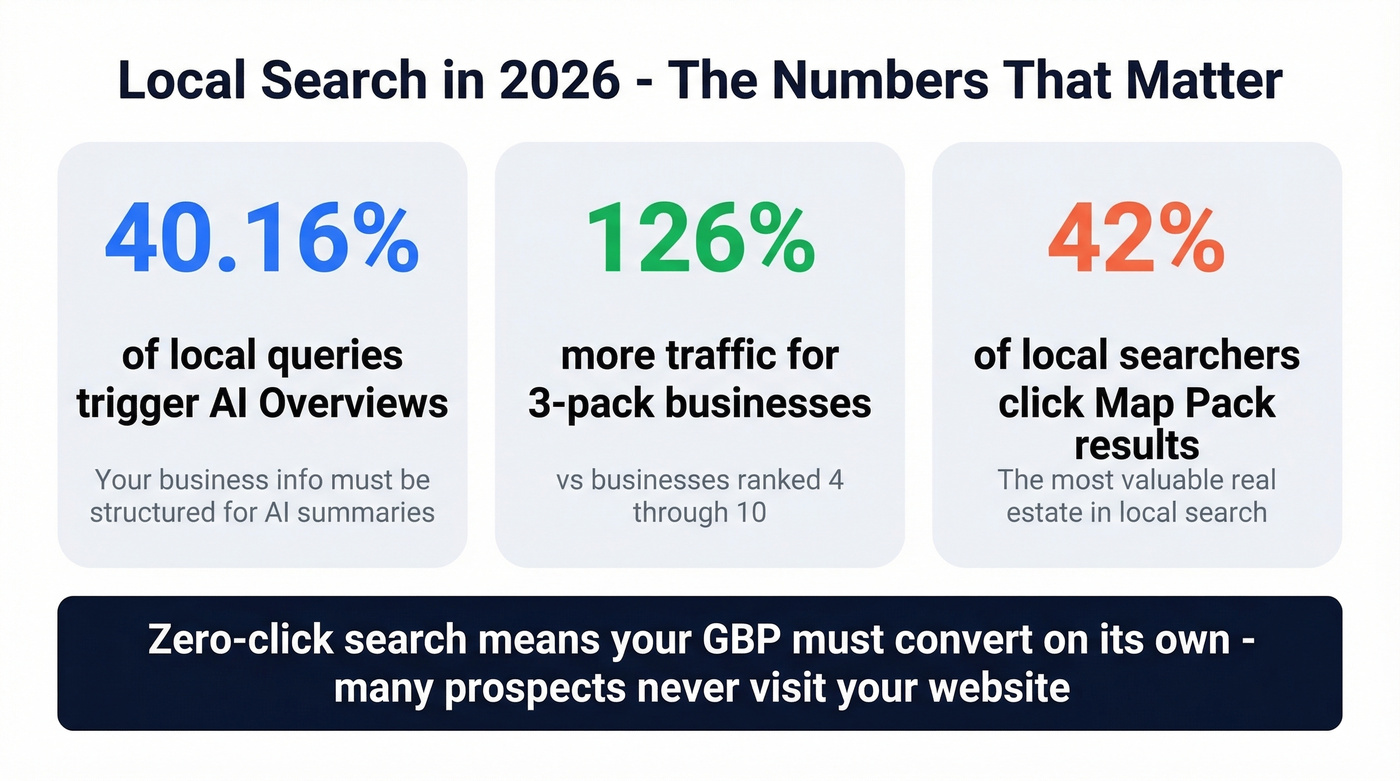
The numbers tell the story. 40.16% of local business queries now trigger Google AI Overviews, which means your business information needs to be structured and accurate enough for Google to pull into those summaries. Businesses that land in the local 3-pack get 126% more traffic and 93% more actions than those ranked 4-10. And 42% of local searchers click results in the Google Map Pack, making it the single most valuable piece of real estate for a local business.
Zero-click search means prospects often make decisions directly on the SERP - from your star rating, review count, and business hours - without ever clicking through. Your GBP needs to convert on its own.
Your Google Business Profile isn't just a listing anymore. It's a landing page.
Fix Your Lead Leaks First
Before you optimize anything, audit your conversion path. Rankings mean nothing if your site leaks leads at every step.
Start with mobile. 84% of "near me" searches happen on mobile devices, and if your site takes more than 3 seconds to load on a phone, you're losing people before they see your phone number. Click-to-call needs to be visible without scrolling. Your hours, address, and service area should appear sitewide - not buried on a contact page.
Check for these specific leaks:
- No click-to-call button above the fold on mobile
- Hidden phone number on service pages
- Slow mobile load time - test with PageSpeed Insights, aim for under 3 seconds
- No trust signals visible immediately - licenses, certifications, guarantees, real photos
- Overlapping service pages cannibalizing each other for the same keywords
One myth worth killing: writing "near me" on your pages doesn't help. Google interprets "near me" based on the searcher's location, not your page copy. Focus on your actual service areas, neighborhoods, and city names instead.
Another myth that trips up business owners constantly: "I searched my business and I'm #1!" Google personalizes results based on your location, search history, and device. You'll almost always see your own business ranked higher than everyone else does. Use a local grid rank tracker like Local Falcon to see where you actually stand across your service area. We've seen the reality check humble even confident business owners - and that's a good thing, because it shows exactly where the opportunity is.
The Local SEO Lead Gen System
Google Business Profile - Your #1 Asset
A complete Google Business Profile gets 7x more clicks than an incomplete one. Users are 2.7x more likely to trust a business with a fully filled-out profile. Photos alone increase direction requests by 42%. These aren't marginal gains - this is the single highest-leverage thing you can do for local lead generation.
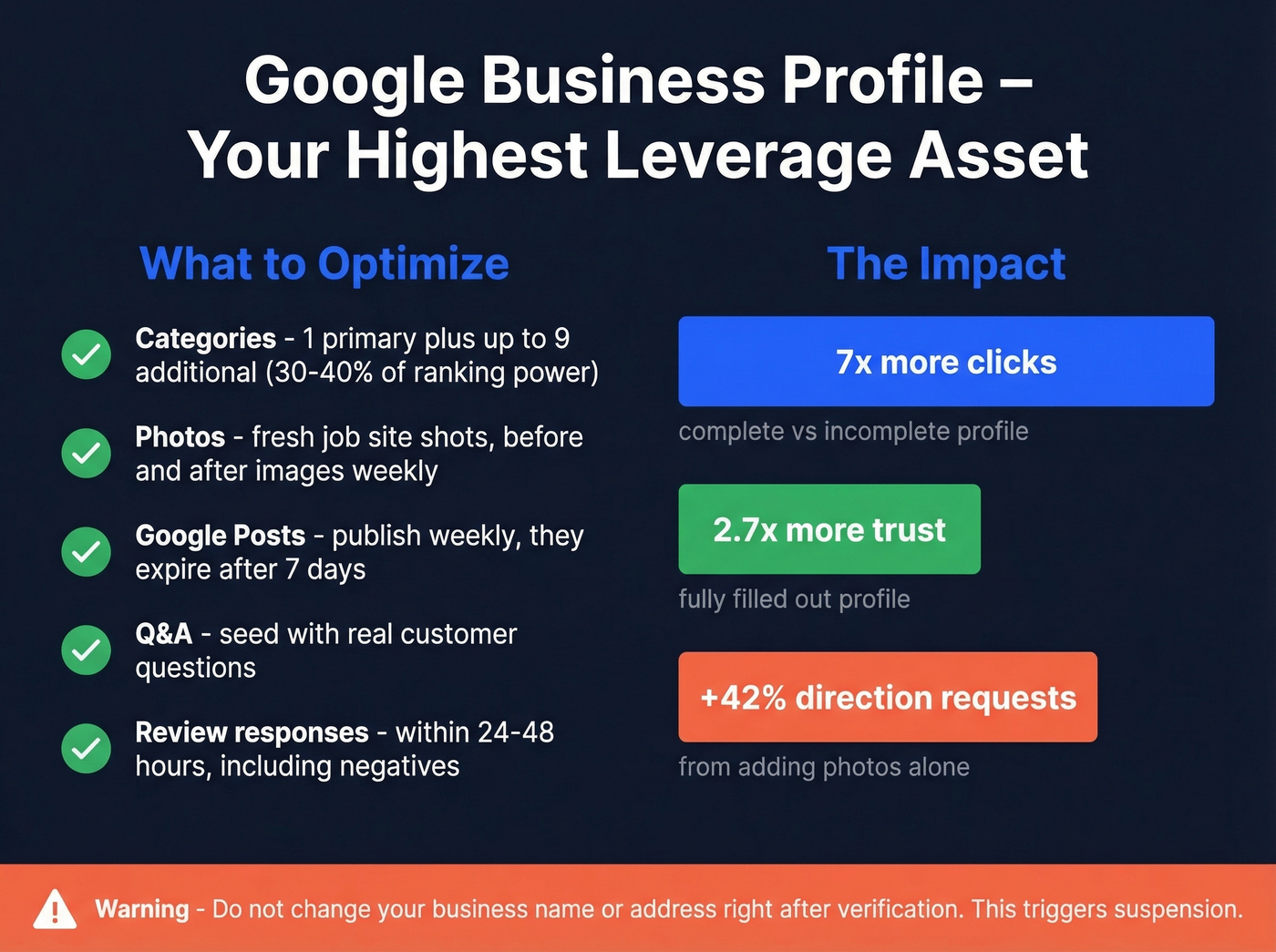
Categories drive 30-40% of your local ranking power. Google allows 1 primary category plus up to 9 additional categories, and getting these wrong is one of the most common audit findings in local SEO. Be specific. "Emergency Plumber" beats "Plumber" if that's your core service.
Your weekly GBP cadence should include fresh photos from job sites (before/after shots are gold), Google Posts (they expire after 7 days, so consistency matters), Q&A seeding with questions your customers actually ask, and review responses within 24-48 hours - including negative ones.
One critical warning: if you've just verified or unsuspended your profile, don't immediately change your business name or address. This frequently triggers another verification cycle and often a suspension.
Local Content and Keyword Strategy
Do this: Follow the one-keyword-per-page discipline. Create one page per primary service intent and one page per primary location intent. A plumber in Denver needs separate pages for "drain cleaning Denver" and "water heater repair Denver" - not one page trying to rank for both.
Do this: Use People Also Ask boxes and Reddit threads to find real questions people are asking. Answer them in blog posts and FAQs. A plumber in Denver could write: "Why Your Water Heater Pilot Light Keeps Going Out (Denver Altitude Fix)" - hyper-local, answers a real question, and no competitor is writing it. This is how the practitioner who hit 120+ leads/month built their content engine.
Skip this if you're tempted: Don't create location pages that are just city-name swaps. If you can swap the city name and nothing else changes, the page needs more depth. Include local photos, neighborhood-specific details, response times for that area, and testimonials from customers in that location.
Reviews on Autopilot
89% of consumers favor businesses that respond to reviews - positive or negative. Review velocity (how fast you accumulate new reviews) accounts for roughly 10% of local ranking factors. The consensus on r/localseo is that velocity matters more than total count for newer businesses. This isn't optional.
Build the system: ask after every job via text or email within 2 hours of completion. Automate the ask with tools like Podium or even a simple SMS template. Respond to every review, especially negatives - be professional, brief, and take it offline. Stay FTC compliant: don't offer incentives for reviews, don't gate negative feedback.
For context, the plumbing case study below faced competitors with 79-250 reviews. If you're sitting at 15 reviews, that gap is your biggest vulnerability and your biggest opportunity.
Local Authority - Links and Citations
One meaningful local link outweighs dozens of generic directory listings. A mention from your local chamber of commerce, a community nonprofit you sponsor, or a local news outlet covering your business carries more weight than 50 random citation sites.
That said, NAP consistency (Name, Address, Phone) across all your listings still matters as a baseline. 62% of consumers will avoid a business with incorrect information online. Get your core citations right on Google, Yelp, Facebook, and your top industry directories, then focus your energy on earning real local links.
Community partnerships are the underrated play here. Sponsor a Little League team, partner with a complementary local business for cross-referrals, post in local Facebook groups, volunteer at community events. These generate natural mentions, links, and referrals that no SEO tool can replicate. Build an email list from your existing customers while you're at it - it's the one channel you fully own.
Don't forget schema markup. LocalBusiness, Review, and FAQ schema help Google understand your business entity and can improve how you appear in rich results and AI Overviews.

Local SEO brings inbound leads, but the highest-value prospects rarely fill out a form. Use Prospeo to find verified emails and direct dials for decision-makers at local businesses in your service area - 300M+ profiles, 98% email accuracy, 30+ filters including company location and headcount.
Turn local prospects into booked meetings at $0.01 per verified email.
Page 2 to the 3-Pack in 6 Months
Let's break down a real progression. A plumbing business started with an Average Google Ranking of 10.82 - essentially invisible in local search. Six months later, they'd improved to 2.37, a 78% improvement that put them firmly in the local 3-pack.
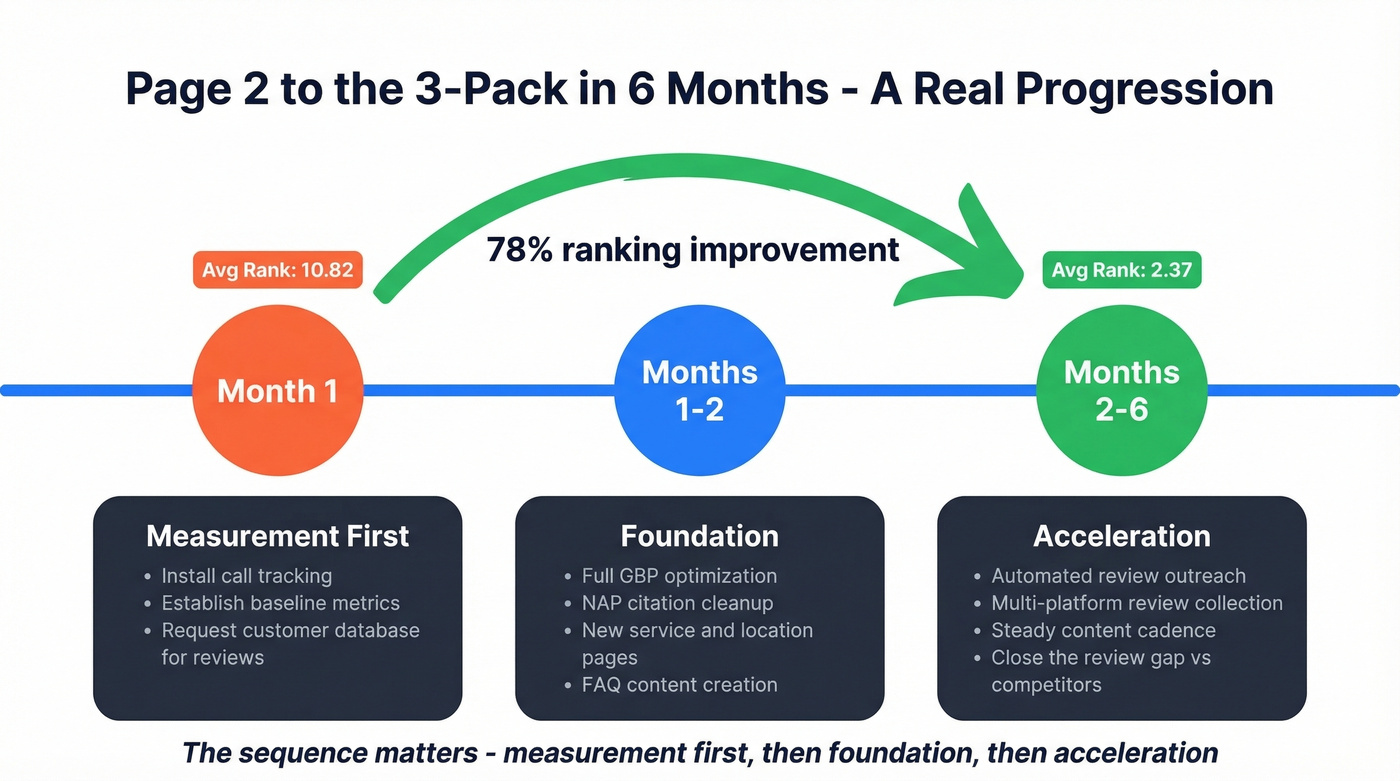
Month 1: Installed call tracking, established baseline metrics, and requested the customer database for review outreach. No rankings work yet - just measurement infrastructure.
Months 1-2: Full GBP optimization (categories, attributes, photos, posts, Q&A), NAP citation cleanup, new service pages, location landing pages, and FAQ content.
Months 2-6: Launched automated review outreach, expanded to multi-platform review collection, and maintained a steady content cadence. The review gap was critical - competitors had 79-250 reviews, and closing that gap drove much of the ranking improvement.
The sequence matters. Measurement first, then foundation, then acceleration. Most businesses skip straight to content and wonder why nothing moves.
Beyond Inbound: Adding Outbound to Your Local Strategy
Local SEO brings leads to you. Outbound lets you go find them. The best local businesses run both channels simultaneously, and the same geographic targeting that powers your search rankings applies when you're prospecting other businesses in your area.
If you want to systematize outbound alongside inbound, borrow a few sales prospecting techniques that still work in 2026.
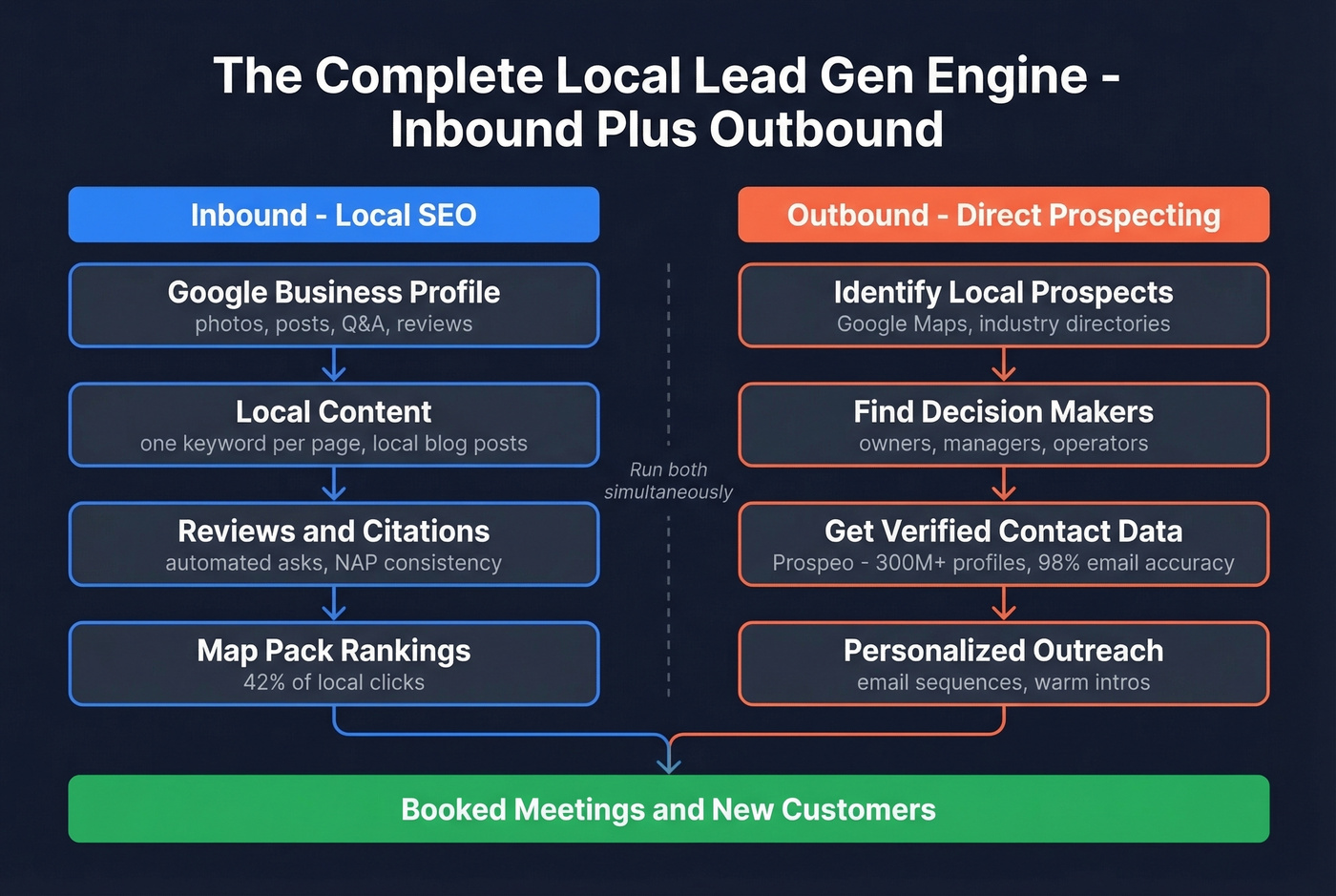
You can see local businesses on Google Maps, you can find their websites, but you can't easily reach the decision-maker. The owner of a 20-person HVAC company doesn't have their email on their website. The operations manager at a regional construction firm isn't answering cold calls from unknown numbers.
Offline tactics help - sponsoring events, posting on Nextdoor, building referral partnerships. But if you want to scale outbound, you need verified contact data. Prospeo's B2B database lets you search 300M+ professional profiles by location, industry, and job title with 98% email accuracy. Search for "HVAC company owners in Phoenix" or "dental practice managers in Austin" and you get verified emails you can actually reach. The free tier gives you 75 emails plus 100 Chrome extension credits per month - enough to test whether outbound works for your market before committing a dollar.
If you're building lists and enriching contacts, data enrichment is the lever that keeps your outreach clean and targeted.

Local SEO builds your inbound pipeline over months. Outbound generates conversations this week.
Your local content strategy attracts visitors. Prospeo turns them into pipeline. Enrich your inbound leads with 50+ data points, verify emails before outreach, and layer intent data across 15,000 topics to know which local businesses are actively buying.
Stop waiting for the phone to ring - reach local buyers directly.
How Long Until It Works?
The median SEO ROI sits at 748% - every dollar invested returns roughly $7.48. Service businesses like HVAC and plumbing typically break even in 5-6 months. Legal and higher education take longer, around 13-14 months.
Our honest take: If your average customer value is under $500, local SEO is still worth it - but only if you do the work yourself. Agency retainers of $1,500/month don't pencil out when you need 10+ new customers just to cover the SEO bill. Learn the system, execute it in-house, and save the agency budget for when you're ready to scale to multiple locations.
If you want to pressure-test whether the economics work, track your cost to acquire customer alongside CPL.
| Channel | Est. CPL | Trend Over Time |
|---|---|---|
| Local SEO | $15-$50 | Decreases (compounds) |
| Google LSAs | $25-$100 | Stable |
| Google Ads PPC | $30-$150 | Increases (competition) |
Real talk: the first 3-4 months feel slow. You're building infrastructure, collecting reviews, publishing content - and the phone isn't ringing much more than before. Months 5-6 is where the inflection typically happens. By month 12, you're generating leads at a fraction of what you'd pay for ads, and the compounding effect means your cost per lead keeps dropping while paid channels keep getting more expensive.
Local SEO Tools Worth Paying For
You don't need 15 tools. You need the right stack for your stage.
If you're looking for more options beyond SEO platforms, here are free lead generation tools that pair well with local strategies.
| Tier | Tools | Monthly Cost |
|---|---|---|
| Free | GBP, GSC, GA4 | $0 |
| Essential | BrightLocal, Local Falcon, Whitespark | ~$30-$100/mo depending on usage |
| Outbound | Prospeo | Free tier or ~$0.01/email |
| Optional | Semrush Local | Varies by plan |
The free tier handles 80% of what a single-location business needs. Google Business Profile is your command center, Google Search Console shows you what queries you're appearing for, and GA4 tracks conversions.
The essential tier adds grid rank tracking (Local Falcon), citation management and audits (BrightLocal), and citation building (Whitespark). These are worth it once you're past the foundation phase and need to monitor progress across your service area.
For teams working with an agency or freelancer, expect retainers in the $500-$2,500/mo range for SMB local SEO. Multi-location or competitive markets push higher.
If you're running outbound too, a lightweight contact management software setup prevents leads from slipping through the cracks.
FAQ
How long does local SEO take to generate leads?
Most service businesses see meaningful lead flow in 5-6 months. The median ROI across industries is 748%, but months 1-4 are infrastructure-building. The plumbing case study above went from rank 10.82 to 2.37 in exactly that timeframe.
Does writing "near me" on my pages help rankings?
No. Google interprets "near me" based on the searcher's physical location, not your page copy. Include your actual service areas, neighborhoods, and city names instead - that's what signals geographic relevance.
What's the single most important local SEO tactic?
A fully optimized Google Business Profile. Complete profiles get 7x more clicks than incomplete ones, and categories alone drive 30-40% of local ranking power. Start there before touching anything else.
How much does local SEO cost for a small business?
Agency retainers run $500-$2,500/mo for a single location. The essential tool stack adds $30-$100+/mo. Many foundational tactics - GBP optimization, review collection, content publishing - are free if you're willing to put in the time.
Can I combine local SEO with outbound prospecting?
Absolutely - and we'd argue you should. Local SEO builds inbound momentum over months, while outbound lets you reach decision-makers now. The free tier on most outbound tools is enough to test whether the channel works for your market before you commit budget.
Fix your leaks, optimize your GBP, build your review engine, publish local content. Local SEO lead generation compounds over time - the bar is low and the ROI is real. Start this week.