

How to Build a Lead Campaign That Actually Converts
A RevOps lead we know ran a lead campaign last quarter that generated 412 MQLs. Marketing celebrated. Sales called them garbage. Fourteen converted to meetings - fourteen out of 412. The problem wasn't targeting. It was everything that happened after the form fill: arbitrary scoring, manual handoffs, and an email list nobody verified before launch that bounced at 35%.
That's the pattern. 65% of marketers say generating traffic and leads is their biggest challenge, yet 99.5% of your target market isn't ready to buy right now. Most lead campaigns treat every form fill like it's equally valuable. They're not. The SDR burning through 500 "leads" with no scoring, no routing logic, and no nurture sequence isn't lazy - they're working inside a broken system.
We've watched this play out dozens of times. Let's break down the infrastructure, scoring, and economics that determine whether those leads actually convert or just inflate a dashboard.
The Five-Step Skeleton
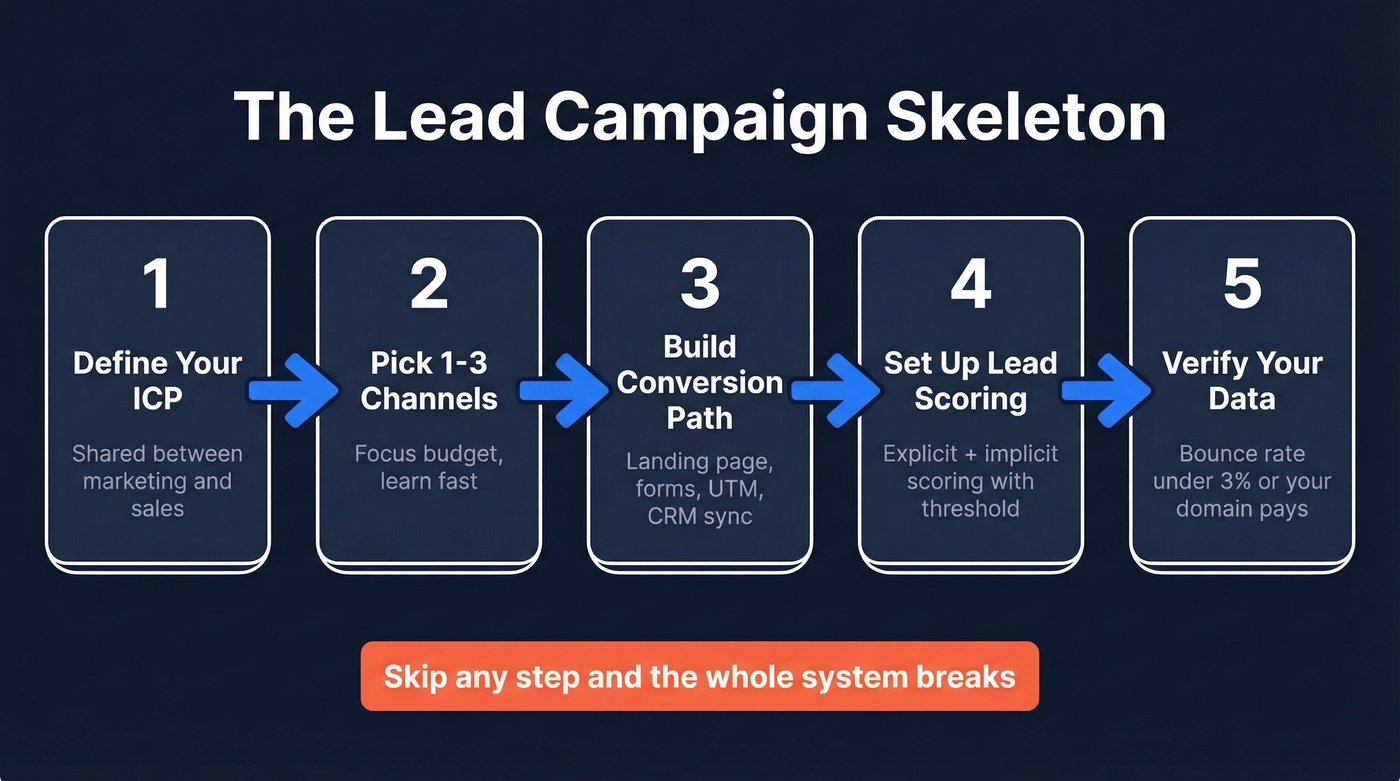
- Define your ICP - shared between marketing and sales, not just a marketing persona doc.
- Pick 1-3 channels - don't spread budget across six platforms on day one.
- Build your conversion path - landing page, form, UTM tracking, CRM sync.
- Set up lead scoring - explicit scoring for who they are, implicit scoring for what they do, with a threshold that triggers handoff.
- Verify your data - a 35% bounce rate doesn't just waste sends; it flags your domain.
What Is a Lead Campaign?
A lead campaign is a coordinated system tied to a specific problem, target market, and persona - designed to capture contact information and move those contacts toward a buying decision. It's not a single ad or a blog post with a form slapped on. It's a system where every piece is prepared before launch and revised through analytics.
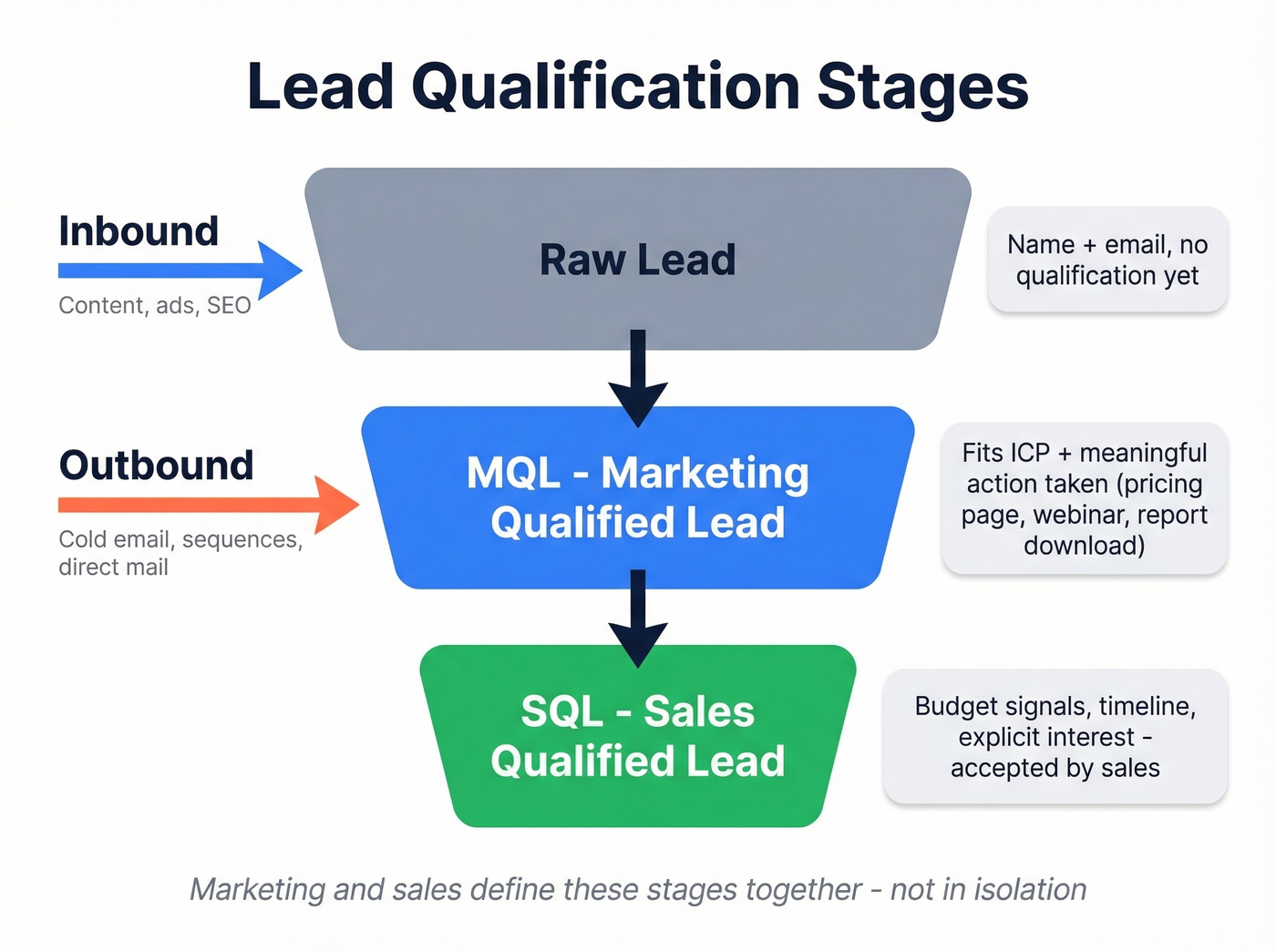
Three stages matter:
Raw Lead - someone enters your database. You have a name and an email, maybe a company. No qualification has happened.
MQL (Marketing Qualified Lead) - this person fits your ICP and has taken a meaningful action: downloaded a benchmark report, visited your pricing page twice, attended a webinar. Marketing says they're worth pursuing.
SQL (Sales Qualified Lead) - an MQL that's been vetted and accepted by sales for direct follow-up. They have budget signals, timeline indicators, or explicit interest.
Inbound campaigns pull leads in through content, ads, and SEO. Outbound campaigns push to prospects through cold email, sequences, and direct mail. Most high-performing B2B teams run both simultaneously, and the campaign itself should be designed by marketing and sales together - not thrown over the wall after marketing builds it in isolation.
How to Build a Lead Campaign Step by Step
Define Your ICP and Set SMART Goals
Start with a shared definition of who you're targeting. If marketing's ICP doc says "VP of Engineering at mid-market SaaS companies" but sales is chasing anyone with a pulse, your campaign is dead before it launches.
Set goals as MQL/SQL outcomes, not vanity metrics. A useful template: "Generate 75 MQLs and 15 SQLs in Q4, leading to 10 discovery calls and 3 closed deals." That gives both teams a number to work toward and a shared definition of success.
Layer in intent data as a targeting signal. 70% of B2B teams now use intent data, and companies using intent-driven strategies see conversion rates 78% higher than static lists. If you're still building campaigns off job title alone, you're leaving precision on the table.
Choose Your Offer and Channels
Your lead magnet determines your lead quality. Not all offers are equal - here's the hierarchy, ranked by how much intent they signal:
- Benchmark report or original research (highest intent)
- Diagnostic tool or calculator
- Deep-dive guide
- Webinar
- Newsletter signup (lowest intent)
Start with 1-3 channels. Spreading a $5K/month budget across six platforms guarantees you'll learn nothing useful. The table below shows what channels actually cost per lead - and the range is wider than most teams expect:
| Channel | Avg CPL |
|---|---|
| Referrals | $25 |
| Affiliate marketing | $73 |
| Paid Facebook ads | $142 |
| Multi-channel prospecting | $188 |
| SEO | $206 |
| Cold email | $225 |
| Direct mail | $250 |
| Webinars | $267 |
| Cold calling | $300 |
| Paid LinkedIn ads | $408 |
| PPC (Google) | $463 |
| Trade shows | $840 |
Direct mail deserves a second look for high-ACV deals: 80-90% open rates and 3-5% response rates make it surprisingly effective when paired with email sequences, though dimensional mail runs $50-250 per contact. If you're under $5K/month, cold email and SEO are your best starting points - they're the only channels where you can generate meaningful volume without burning through budget in a week.
Build Your Conversion Path
The conversion path is where lead data moves from "someone clicked" to "we can actually follow up." Get this wrong and nothing downstream works.
Your landing page should strip away navigation and focus on a single CTA. No distractions. Form fields should capture name, company, title, and business email - every extra field depresses conversion rate, so ask only what you need for initial qualification. UTM tracking goes on every link, every ad, every email. If you can't attribute a lead to a source, you can't optimize.
Leads should hit your CRM within minutes through real-time sync, not hours through manual CSV imports. And define SQL criteria and routing rules before launch - who gets the lead, what's the SLA for first touch. If you're figuring this out after leads start flowing, you're already behind.
Set Up Lead Scoring
Lead scoring separates the "downloaded a whitepaper out of curiosity" contacts from the "visited pricing three times and matches your ICP" prospects. Without it, your SDRs waste up to 40% of their time on dead-end contacts.
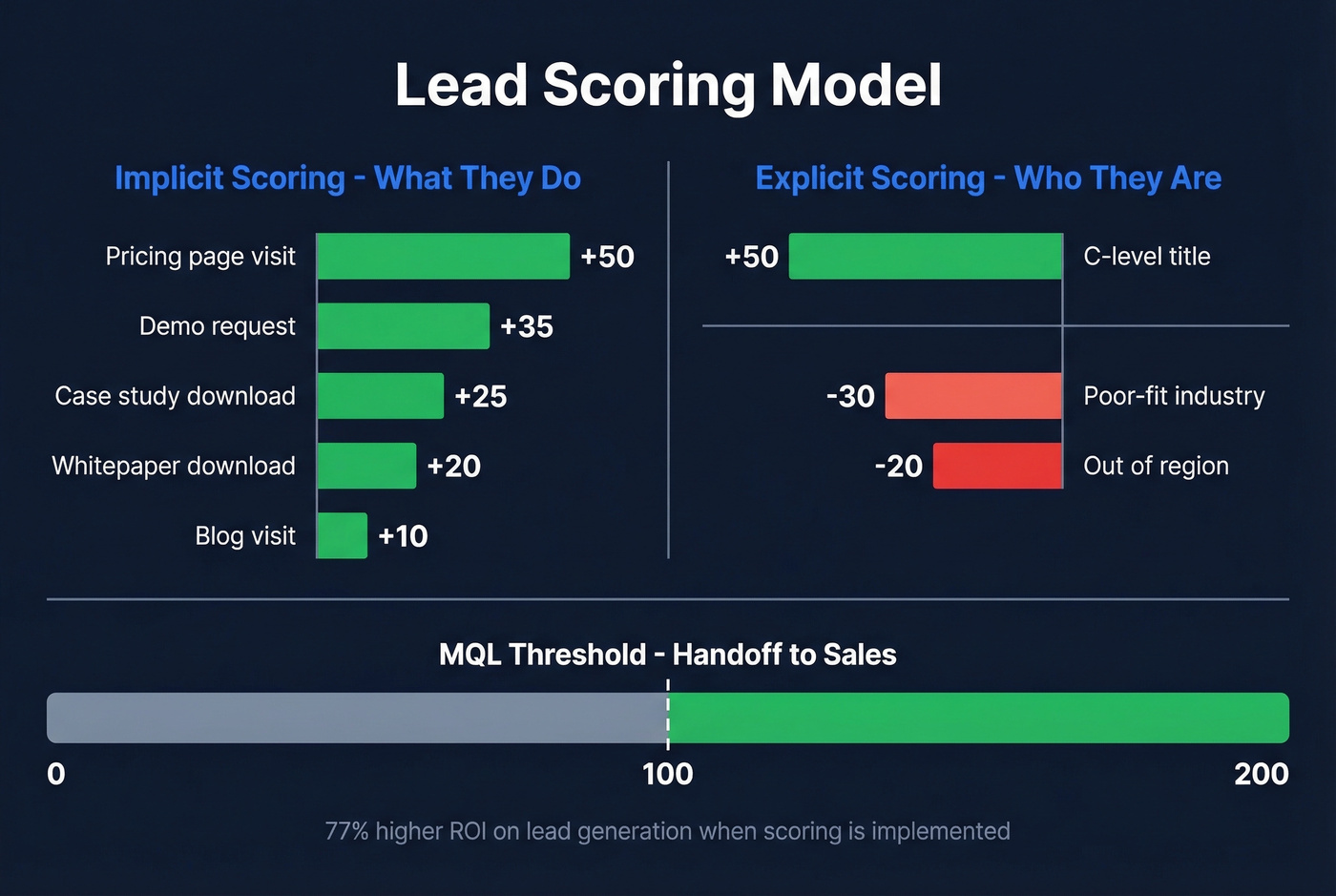
Two dimensions matter. Explicit scoring evaluates who they are - job title, company size, industry, revenue, geography. Implicit scoring evaluates what they do - page visits, content downloads, email engagement, form fills.
| Action/Attribute | Points |
|---|---|
| Pricing page visit | +50 |
| Demo request | +35 |
| Case study download | +25 |
| Whitepaper download | +20 |
| Blog visit | +10 |
| C-level title | +50 |
| Poor-fit industry | -30 |
| Out-of-region | -20 |
Companies using lead scoring see 77% higher return on lead generation. Product-qualified leads convert to opportunities 20-30% of the time. The math is clear.
Don't overcomplicate it on day one. Start with five explicit criteria, five implicit criteria, and one threshold score that triggers the marketing-to-sales handoff. You can refine after the first 90 days of data. Build in negative scoring too - if someone's in an industry you don't serve or a region you can't support, subtract points. Otherwise you're routing leads that'll never close.
Design Your Nurture Sequence
The optimal outreach window is 8-12 touches over 2-4 weeks across multiple channels. Multi-channel sequences combining email, phone, and social consistently outperform single-channel approaches.
Generic drip campaigns don't cut it anymore. Intent-based follow-up - where the next touch is triggered by what the lead actually did, not just a timer - converts at meaningfully higher rates. If someone visited your pricing page, the next email shouldn't be a blog roundup.
Here's the thing about speed-to-lead: it's a revenue lever most teams ignore. If your competitor engages a lead before you do, your connect rates drop and SDR burnout rises. Define a marketing-to-sales handoff SLA with specific response time commitments and consequences when they're missed. Write it down. Make it measurable.
Launch Infrastructure
This is the section most campaign guides skip, and it's where campaigns actually die.
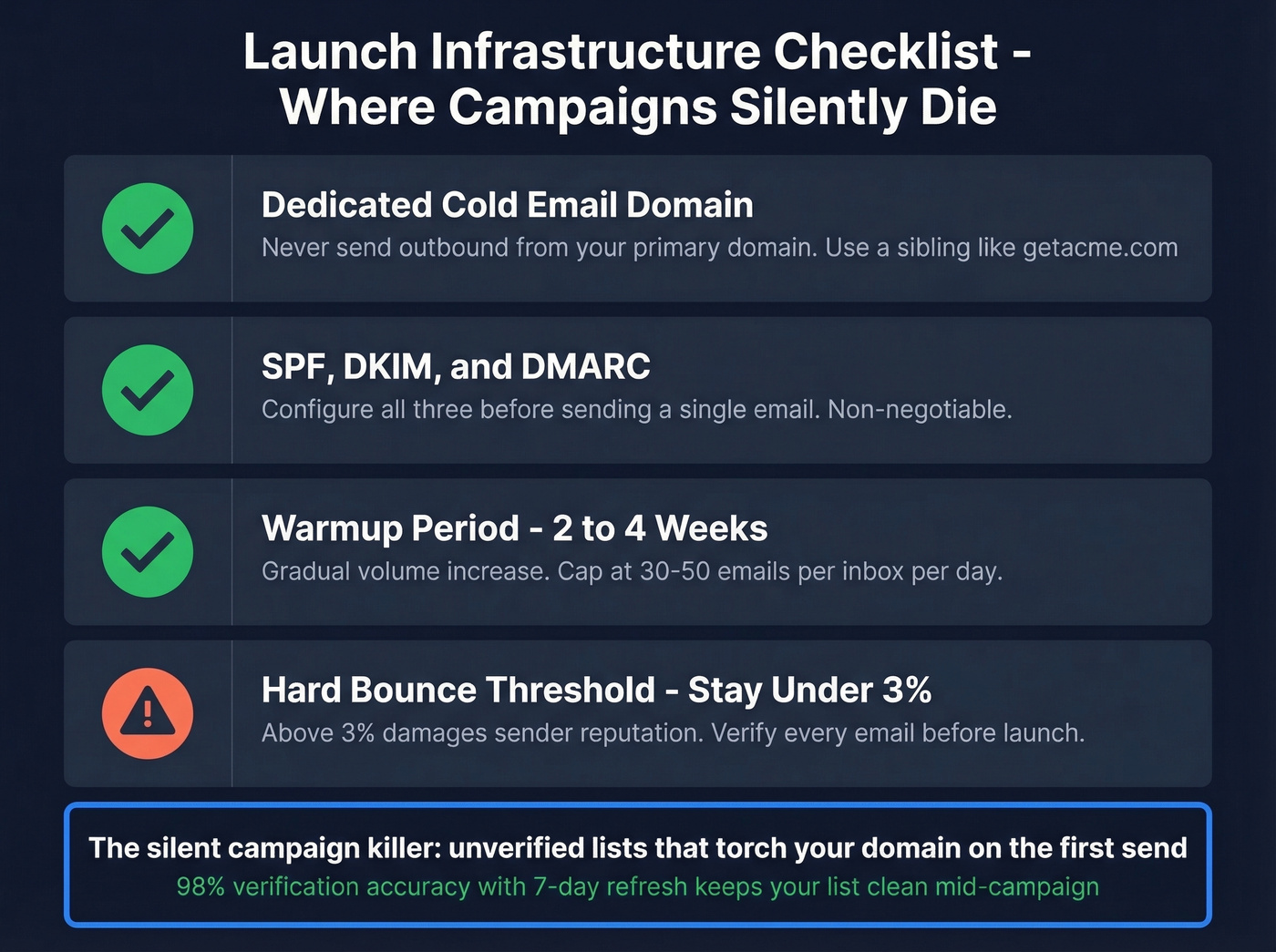
Dedicated cold email domain. Never send outbound from your primary domain. Set up a sibling domain like getacme.com if you're acme.com.
SPF/DKIM/DMARC. Configure all three before sending a single email. Non-negotiable.
Warmup period. New domains need 2-4 weeks of gradual volume increase before you scale. Cap daily sends at 30-50 emails per inbox - more than that and you're asking for deliverability problems.
Hard bounce threshold. Above 3% damages sender reputation. Full stop. This is where most campaigns silently fail: unverified lists that torch your domain on the first send. Verify emails before every campaign launch. Prospeo's real-time verification catches invalid addresses before they hit your sending infrastructure - 98% accuracy with a 7-day refresh cycle, so your list doesn't decay mid-campaign. Stack Optimize built their agency to $1M ARR using this approach: 94%+ deliverability, bounce rates under 3%, zero domain flags across all clients.

That 35% bounce rate killing your lead campaign? Prospeo's 5-step verification delivers 98% email accuracy - so your sends actually land. 143M+ verified emails, refreshed every 7 days, at $0.01 per lead.
Stop celebrating MQLs that bounce. Verify your list before you launch.
Lead Campaign Benchmarks
Benchmarks give you a sanity check. If your CPL is 3x the industry average, something's broken. If it's half, you're probably generating low-quality leads.
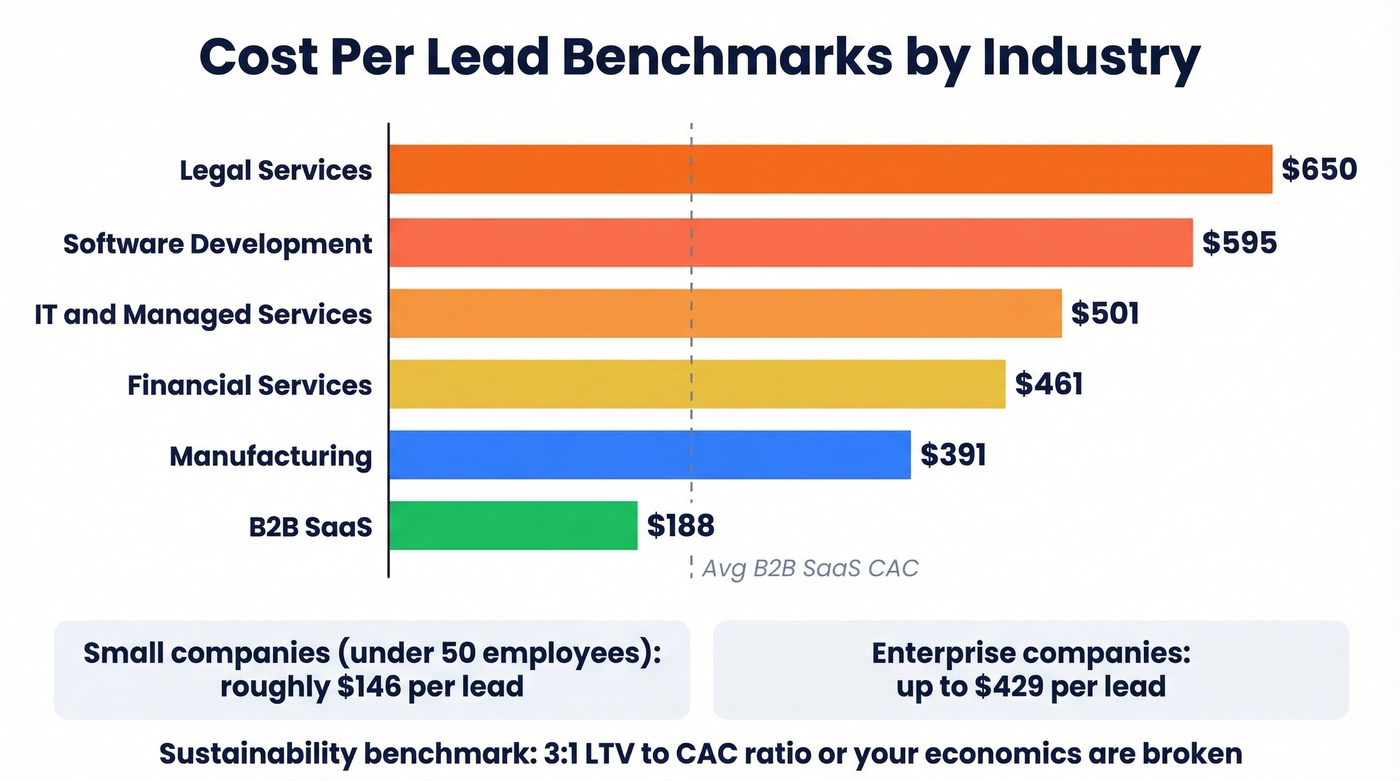
CPL by industry:
| Industry | Avg CPL |
|---|---|
| Legal Services | $650 |
| Software Dev | $595 |
| IT & Managed Services | $501 |
| Financial Services | $461 |
| Manufacturing | $391 |
| B2B SaaS | $188 |
Company size matters too. Businesses with fewer than 50 employees pay roughly $146/lead, while enterprise companies can hit $429/lead.
CAC by industry:
| Industry | Avg CAC |
|---|---|
| B2B SaaS | $239 |
| Manufacturing | $723 |
| Financial Services | $784 |
| Real Estate | $791 |
The sustainability benchmark is a 3:1 LTV:CAC ratio. If your lifetime value divided by your customer acquisition cost falls below that, your campaign economics don't work - regardless of how many leads you're generating. Volume without unit economics is just expensive noise.
CPL alone is a misleading metric. A $25 referral lead that converts at 15% is worth more than an $840 trade show lead that converts at 2%. Always track CPL alongside lead-to-SQL rate and cost-per-opportunity. We've seen teams celebrate low CPLs for months while ignoring that none of those leads convert downstream. That's not a win.
Managing Your Tool Stack
You don't need 10 tools. You need 4-5 that talk to each other. High-performing sales teams are 2.3x more likely to use integrated tech stacks, and CRM implementations alone yield a 29% increase in sales productivity.
CRM. HubSpot's free tier handles most early-stage needs. Salesforce starts around $25/user/month for entry plans and scales with you. Pick one and commit - switching CRMs mid-campaign is painful.
Marketing Automation. ActiveCampaign runs $29-149/month for SMBs; Marketo handles enterprise needs at enterprise pricing, typically $1,000+/month. Marketing automation users generate 50% more sales-ready leads at 33% lower CPL. The ROI is real.
Enrichment & Verification. This category most directly impacts campaign performance. Enrichment tools reduce manual research time by 70% and push contact accuracy above 95%. Prospeo has 300M+ professional profiles with 98% email accuracy and a 7-day refresh cycle compared to the 6-week industry average. The 92% API match rate means your enrichment workflows actually return usable data, and at roughly $0.01/email versus $1/email at ZoomInfo, the economics aren't close. Free tier gives you 75 emails plus 100 Chrome extension credits per month to test.

Cold Email / Sequencing. Instantly runs $30-97/month; Lemlist runs $39-159/month. Both handle multi-step sequences with deliverability features built in.
Integration. Zapier from $19.99/month or Clay starting around $149/month for more complex enrichment workflows. The glue that connects everything.
Let's be honest: if your average deal size is under $10K, you probably don't need a $30K/year data platform. A stack of HubSpot (free CRM) + Prospeo (verified data) + Instantly or Lemlist (sequencing) covers the entire campaign lifecycle for under $200/month. Save the enterprise spend for when your deal sizes justify it.
Layer intent data into your lead campaign targeting. Prospeo tracks 15,000 buyer intent topics and combines them with 30+ filters - job title, technographics, headcount growth, funding - so you build lists of prospects already in-market.
Teams using Prospeo book 26% more meetings than ZoomInfo users.
Why Lead Campaigns Fail
Most campaign failures happen after lead capture, not before. Here are the five patterns that kill campaigns - and we've seen every one of them firsthand.
Misaligned handoffs are the #1 killer. Marketing and sales never agreed on what "qualified" means. MQLs sit in a queue for days. Sales cherry-picks and ignores the rest. The fix: a written SLA with shared scoring definitions, response time commitments, and a feedback loop where sales flags quality issues back to marketing. Skip this and everything else is theater.
Low-quality placements generate impressive click-through rates and form fills, but downstream conversion is near zero. High CTR with zero intent means you're buying attention, not interest. Qualify by channel, track lead-to-SQL rate per source, and kill channels that generate volume without pipeline.
Broken attribution is the third pattern. Your CRM says one thing, your marketing automation says another, and your intent tool has its own dashboard. Nobody agrees on which campaign sourced the deal. The fix is a single customer view built on a connected stack. If your tools don't integrate, your data is fiction.
Slow lead activation is the silent killer. Leads get routed manually. Reps don't see them for hours. By the time someone calls, the prospect has already talked to a competitor. Automated routing rules, speed-to-lead as a tracked KPI, and real-time alerts when a lead crosses the scoring threshold solve this.
No real nurture. The "nurture sequence" is three generic emails over two weeks, then silence. Sales disengages after the first no-reply. Intent-based follow-up where the next touch is triggered by behavior - not a calendar - performs dramatically better. Multi-touch cadences across email, phone, and social, with a longer time horizon, match how B2B deals actually close.
Real Campaign Results
Three campaigns that worked, and why.
Mid-market manufacturing company: integrated automation + CRM overhaul. They replaced siloed marketing automation and CRM with an integrated stack, implemented lead scoring, and built proper nurture sequences. Result: 75% more leads in the first year. The scoring model alone eliminated the "marketing says qualified, sales says garbage" problem by giving both teams a shared language.
B2B services firm: multi-touch event orchestration. They combined an in-person event with direct mail, email sequences, and teleprospecting - all tracked through personalized URLs. Result: 300% ROI and 140 qualified leads. The email-plus-teleprospecting combination hit a 13.4% conversion rate to scheduled meetings. No single channel would've delivered that.
HR tech SaaS: six-month webinar series. Lead scoring was baked in from day one. Result: 40% increase in qualified leads, 80% attendance rate, and 50% of attendees converting to high-quality leads. The webinar wasn't the magic - the scoring and follow-up system behind it was.
The pattern across all three: every winning lead campaign is a system - offer, channels, scoring, nurture, measurement - not a one-shot tactic.
FAQ
What's the difference between a lead campaign and demand gen?
A lead campaign captures contact information for direct follow-up; demand gen builds awareness without gating content. Most B2B teams run both. Demand gen fills the top of funnel, and lead campaigns convert that awareness into actionable contacts your sales team can work.
How much should a lead campaign cost?
Average B2B CPL ranges from $25 for referrals to $840 for trade shows, with B2B SaaS averaging $188/lead. Your target CPL depends on customer lifetime value - aim for a 3:1 LTV:CAC ratio as the sustainability benchmark. If the math doesn't work at your current CPL, fix conversion rates before adding budget.
How many touches does it take to convert a B2B lead?
Eight to twelve touches over 2-4 weeks across multiple channels is the current benchmark. Multi-channel sequences combining email, phone, and social consistently outperform single-channel approaches. The days of "send two emails and call it nurture" are over.
What's a good lead-to-meeting conversion rate?
B2B benchmarks range from 5-15% depending on channel and lead quality. One documented campaign achieved 13.4% conversion to scheduled meetings using email combined with teleprospecting against a qualified house list. Below 5% means your scoring or targeting needs work.
How do I keep lead data clean during a campaign?
Verify emails before every send - hard bounce rates above 3% damage sender reputation and can tank deliverability for your entire domain. Build verification into your workflow as a non-negotiable step, not an afterthought. Tools like Prospeo refresh data on a 7-day cycle, which keeps lists from decaying mid-campaign.