

Lead Finder Reviews: 7 Tools Tested and Ranked for 2026
Most lead finder reviews compare database sizes like they're baseball cards. Bigger number wins, right? Wrong. A massive contact database means nothing if a meaningful chunk of those emails bounce and torch your sender reputation on the first sequence. 75% of B2B marketers rely on email as their primary lead gen channel - bad data doesn't just waste credits, it kills your most important pipeline source.
We tested seven lead finders across accuracy, pricing, data freshness, and real-world usability. We ran test batches, dug into verification methodologies, and tracked actual bounce rates. Here's what's worth your money.
Here's the thing: if your average deal size is under $15k and your team is fewer than five reps, you don't need a $1,000/month enterprise platform. You need accurate data and a good sequencer. Most teams are overpaying for features they'll never touch.
Our Top 3 Picks
- Prospeo - Best for email accuracy and data freshness. 98% verified emails, 7-day refresh cycle, free tier to test before you commit.
- Apollo.io - One of the largest databases in this roundup at 210M+ contacts with built-in sequencing. The obvious starting point if you need breadth and outreach in one platform.
- Hunter.io - Best for domain-level email discovery. Lightweight, precise, and fast when you already have a name and company.
Lead Finder Comparison Table
| Tool | Database Size | Verification / Quality Notes | Starting Price | Best For |
|---|---|---|---|---|
| Prospeo | 300M+ | 98% verified emails, 7-day refresh | Free tier | Accuracy + freshness |
| Apollo.io | 210M+ | Waterfall enrichment; G2: 4.7/5 | $49/mo | Breadth + outreach |
| Hunter.io | Domain-focused | Pattern-based discovery | Free (50 credits) | Domain discovery |
| Lusha | Not public | Credit-based reveals (email/phone) | Free (up to 70 credits) | Chrome extension |
| Snov.io | Not public | Seven-tier verification (marketed) | $29.25/mo | Budget + outreach |
| UpLead | Not public | Real-time verification at export | $99/mo | Verified contacts |
| Cognism | Not public | 16-step verification; DNC checks in 15 countries | ~$1,000-$3,000/mo | Enterprise compliance |
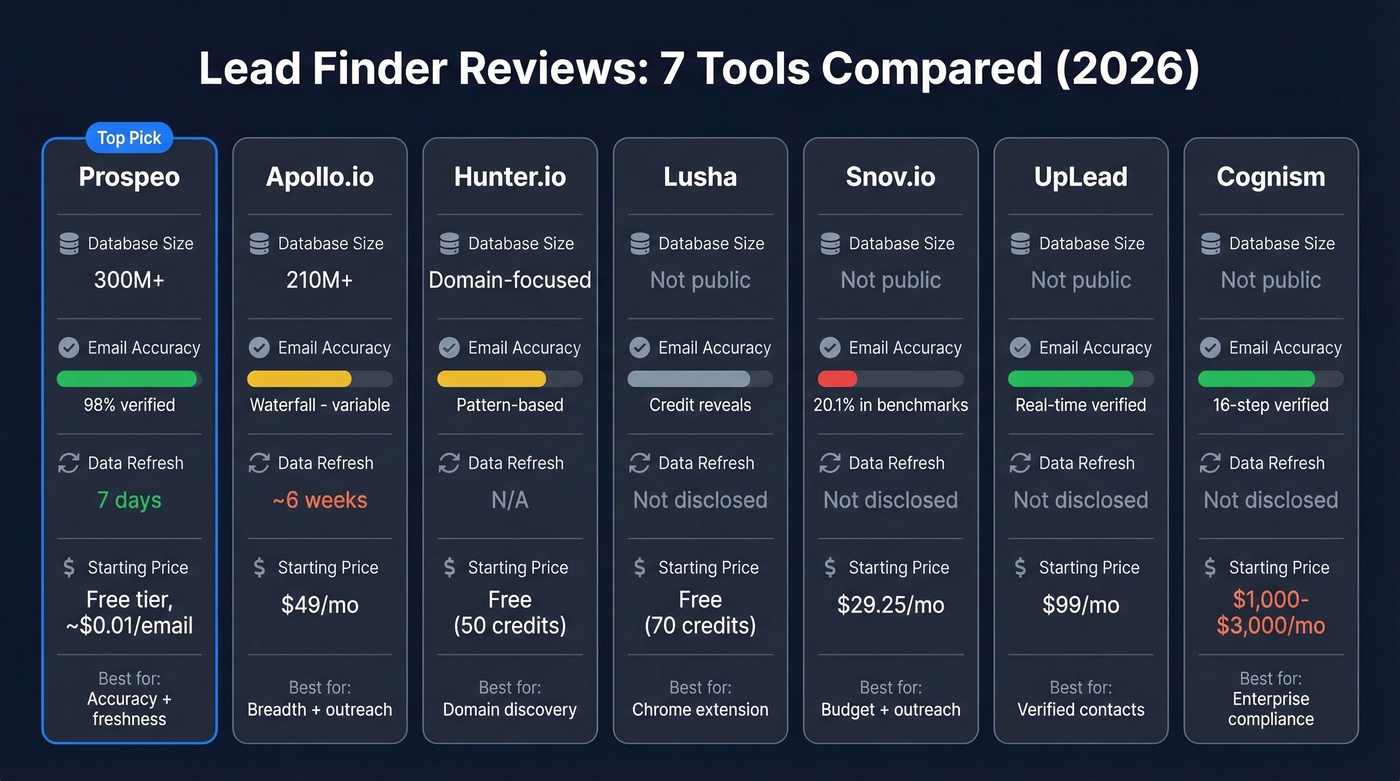

Every lead finder in this review charges you for data - but only one guarantees 98% email accuracy with a 7-day refresh. Prospeo's proprietary verification caught bounces that Apollo and Snov.io missed in our testing. Start free with 75 emails/month.
Stop paying for emails that bounce. Test the accuracy yourself.
The 7 Best Lead Finders, Reviewed
Prospeo
Use this if you're tired of bounced emails destroying your domain reputation and want the freshest data available without signing an annual contract.
Prospeo's database covers 300M+ professional profiles, 143M+ verified emails, and 125M+ verified mobile numbers - all refreshed on a 7-day cycle. The industry average is six weeks. That gap matters more than most teams realize: a contact who changed jobs three weeks ago is a wasted credit everywhere else, and it makes you look like you didn't do your homework.

The verification infrastructure is proprietary - no third-party email providers in the chain. Five-step verification with catch-all handling, spam-trap removal, and honeypot filtering delivers 98% email accuracy. We've seen this hold up across thousands of contacts in our own testing.
That translates to real outcomes. Stack Optimize built from $0 to $1M ARR using Prospeo data, maintaining 94%+ deliverability with bounce rates under 3% across all clients. Meritt tripled their pipeline from $100K to $300K/week and cut bounce rates from 35% to under 4%.
Thirty-plus search filters include buyer intent powered by Bombora across 15,000 topics, technographics, job changes, headcount growth, and funding signals. The Chrome extension has 40K+ users and works across company websites and professional profiles. Native integrations push directly into Salesforce, HubSpot, Instantly, Lemlist, Clay, and Zapier.
Pricing starts free - 75 emails and 100 Chrome extension credits per month. Paid plans run about $0.01 per email. No contracts, no sales calls, cancel anytime.
Apollo.io
Apollo's 210M+ contact database with 65+ filters is one of the biggest in this roundup. The platform combines lead discovery, enrichment, and outreach sequencing, which means fewer tools in your stack. For SMB teams running their first outbound motion, it's the fastest path from zero to sending. G2 reviewers rate it 4.7/5, and the breadth of data is the most common praise.
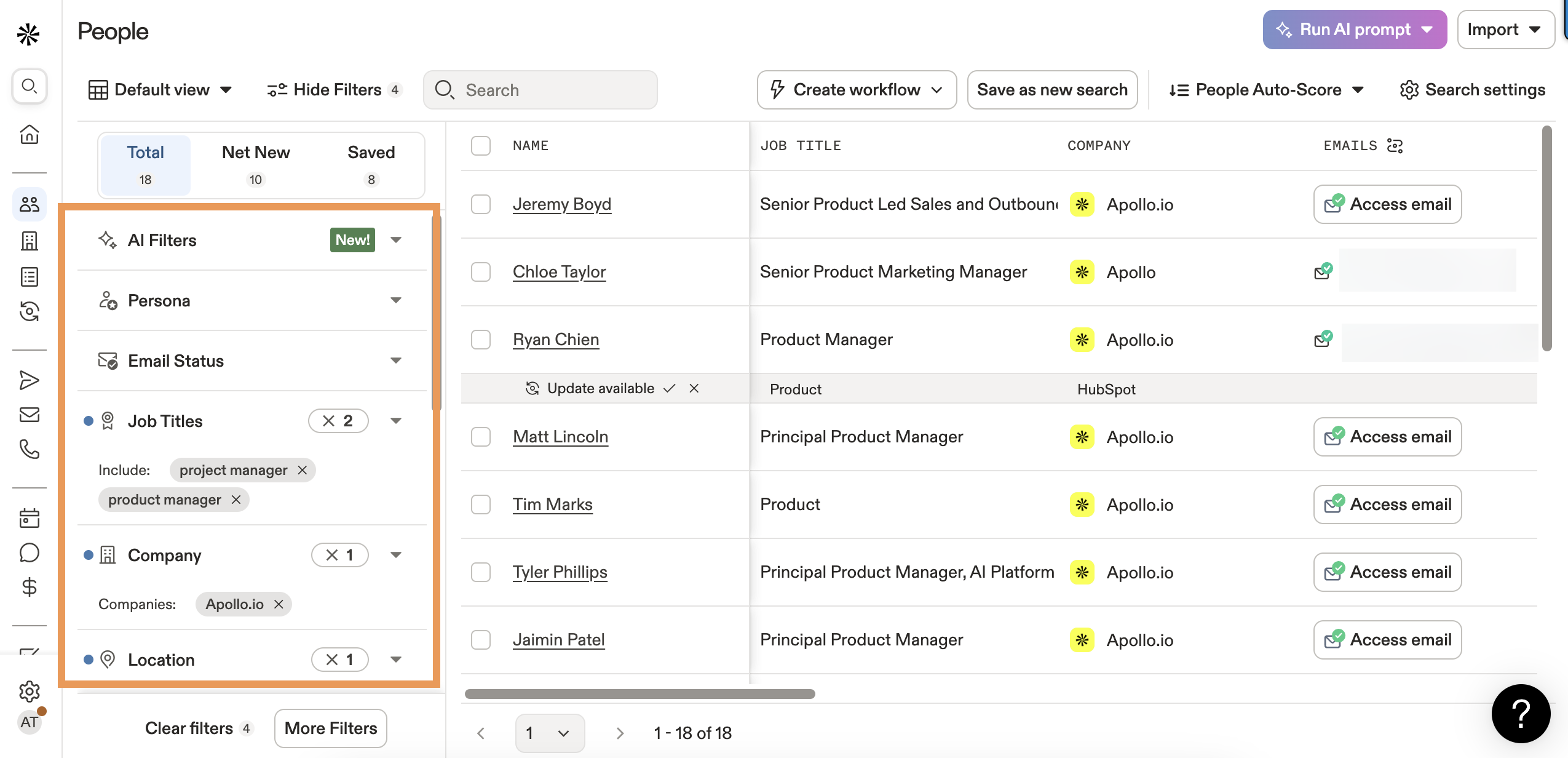
The catch: Apollo uses a 7-step verification process via third-party vendors through waterfall enrichment. That waterfall introduces accuracy gaps. In our testing, we saw noticeably higher bounce rates from Apollo-sourced contacts compared to tools with proprietary verification - a common complaint in user communities on Reddit and G2 reviews. Credits don't roll over either. They expire at the end of each billing cycle, which punishes inconsistent usage.
Pricing runs hybrid: per-user fees plus usage credits. Basic starts at $49/mo, Professional at $79/mo, and Organization at $119/mo with a minimum of three seats.
Skip this if you're sending high-volume cold email where bounce rates above 5% will flag your domain.
Hunter.io
Hunter isn't a full B2B database - it's a domain-level email discovery engine. Give it a company domain, and it returns known email patterns and discovered addresses. For that specific use case, it's excellent.
Free tier gives you 50 credits per month. Paid plans start at EUR 34/mo (Starter), scaling to EUR 104/mo (Growth) and EUR 209/mo (Scale). It's built for smaller, targeted lookups rather than building huge lists from scratch, and the simplicity is genuinely refreshing if you're drowning in bloated platforms.
Skip this if you need to build prospect lists from scratch. Hunter requires you to already know who you're looking for.
Lusha
The credit math tells the whole story with Lusha. The free plan includes up to 70 credits per month with a genuinely smooth Chrome extension - it's the tool's strongest selling point.
Pro runs $29.90/user/mo for 250 credits, Premium $69.90/user/mo for 600 credits. Phone number reveals cost 10 credits each. On monthly plans, unused credits roll over and can accumulate up to twice your credit limit, which helps if your usage is spiky.
For quick email lookups while browsing, Lusha is convenient. For anything at scale, the economics fall apart fast.
Snov.io
Snov.io's Starter plan at $29.25/mo with 1,000 credits is the cheapest all-in-one option here - email finding, outreach sequences, and email warm-up in a single platform. The Pro tier ($74.25/mo, 5,000 credits) adds more volume.
Let's be honest about the accuracy claims, though. Snov.io markets "seven-tier verification" and "98% accuracy," but benchmark data tells a different story. In Anymail Finder's Sep 2025 benchmark on 5,000 contacts, Snov.io's verified rate came in at just 20.1%. The bundled outreach features are nice, but not if the underlying data bounces. If accuracy matters more than price, look elsewhere.
UpLead
UpLead's real-time email verification at point of export is a solid concept, but the economics are rough. Essentials runs $99/mo for just 170 credits - about $0.58 per credit before overages ($0.40-$0.60/credit). Good data quality, but you'll pay for it.
Best suited for teams with small, highly targeted lists where every contact counts and you can't afford a single bounce.
Cognism
Cognism is the enterprise compliance play - 16-step verification, GDPR/CCPA compliant, and DNC checking across 15 countries. G2 reviewers rate it 4.6/5, with European data quality as the standout. Custom pricing typically runs $1,000-$3,000/mo for small teams.
If you're selling into regulated European markets, it's worth the conversation. For everyone else, it's overkill and overpriced.
The tools ranked above range from $0.01/email to $3,000/month. Prospeo delivers 300M+ profiles, 143M+ verified emails, and 30+ filters - including buyer intent across 15,000 topics - at a fraction of what Cognism or ZoomInfo charges. No contracts, no sales calls.
Get enterprise-grade lead data without the enterprise invoice.
How to Evaluate Lead Finder Tools
Most reviews obsess over database size. Ignore that. Three criteria predict whether a tool will actually work for your outbound:

Verification methodology. How many steps? Proprietary infrastructure or third-party waterfall? Tools that farm out verification to external providers introduce accuracy variability you can't control. A proprietary 5-step process consistently beats a 7-step waterfall that routes to the cheapest available vendor. Always ask whether the tool verifies in-house.
Cost-per-verified-contact. Cost-per-credit is a vanity metric. If a tool charges $0.05/credit but half the contacts bounce, your real cost is $0.10. Run a 50-contact test batch and calculate your actual cost per usable lead before committing to a paid plan. We've seen teams "save" money on cheaper tools only to spend 3x more replacing burned domains and rebuilding sender reputation.
Data freshness. A 300M-record database refreshed every six weeks is less useful than a 200M-record database refreshed weekly. People change jobs constantly - stale data doesn't just bounce, it makes you look unprofessional when you email someone at a company they left two months ago. Look for refresh cycles measured in days, not weeks.
One distinction worth understanding: an email finder takes a name plus a company and returns an address. A B2B database lets you build lists from scratch using filters. Most modern tools blur the line, but knowing which problem you're solving determines which tool fits.
FAQ
Can I trust lead finder reviews online?
Most are written by the tools themselves or by affiliates earning commissions. Look for reviews that include specific pricing breakdowns, independent accuracy benchmarks, and clear "skip this" recommendations. If a review praises every tool equally, it's a listicle designed to collect affiliate clicks - not an honest evaluation.
What's the difference between an email finder and a B2B database?
An email finder takes a name and company you already have and returns a verified email address. A B2B database lets you build prospect lists from scratch using filters like industry, title, company size, and intent signals. Most modern lead finders combine both, so you can discover and verify in one workflow.
How do I test a lead finder's data accuracy?
Run a 50-contact test batch through your actual outreach tool and measure the bounce rate. If it exceeds 5%, the data isn't verified well enough for cold email at scale. Free tiers from tools like Prospeo (75 emails/month) and Hunter (50 credits) let you validate accuracy before spending a dollar.
Are free lead finder plans worth using?
For evaluating data quality, absolutely. Free tiers give you enough credits to test accuracy on real prospects before committing. That's enough to run a meaningful test against your ICP and measure bounce rates firsthand - which tells you more than any review ever will.