

How to Build a Lead Gen Site That Actually Converts
Organizations generate an average of 1,877 leads per month. 80% of them never convert. That's not a volume problem - it's a conversion architecture problem.
The lead generation software market hit $7.4 billion in 2025 and is growing at 9.1% annually, which means more money than ever is flowing toward every lead gen site that bleeds prospects through bad forms, slow pages, and unverified data. A practitioner on r/Entrepreneur nailed it: "Lead gen has not become more complex. It has become less forgiving." Your site either converts in the first 8 seconds or it doesn't convert at all.
What You Need (Quick Version)
Every lead generation website that converts has five components:
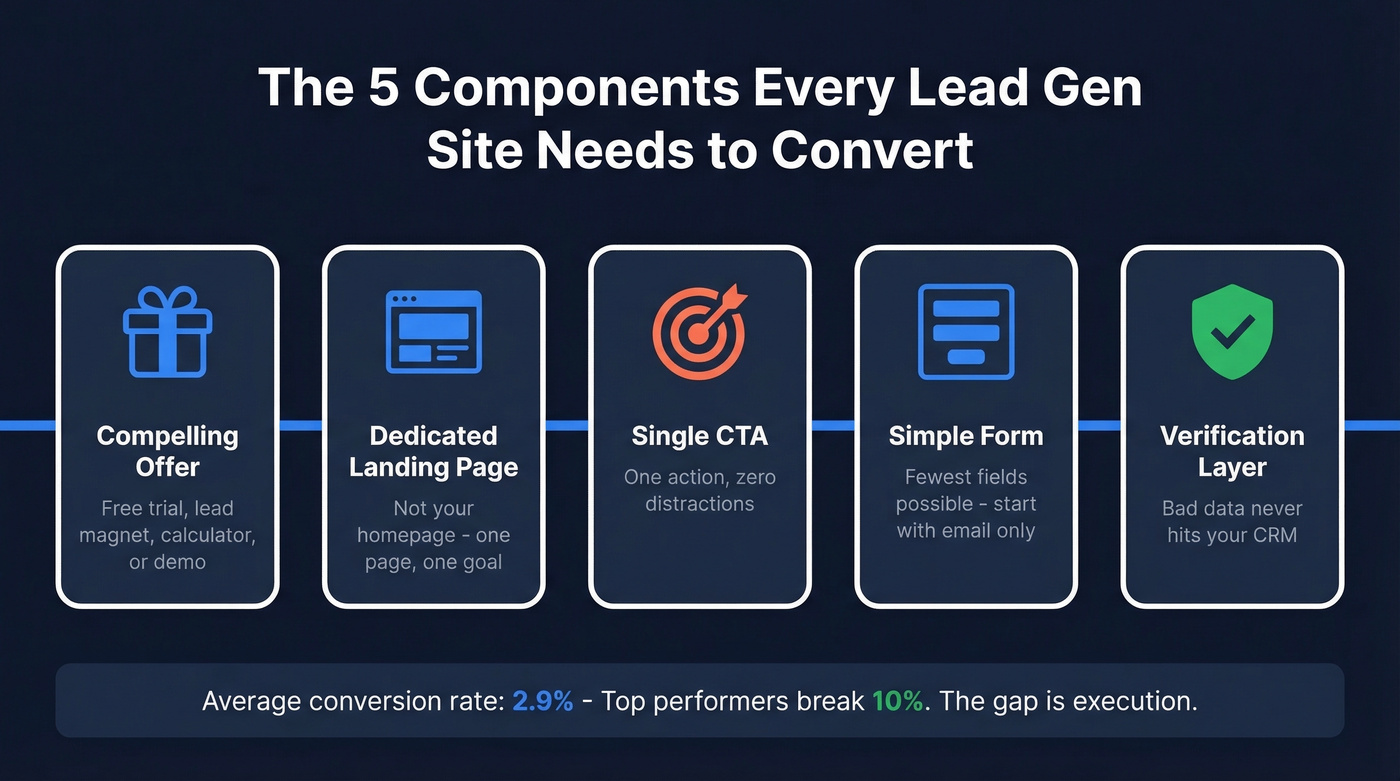
- A compelling offer - free trial, lead magnet, demo, calculator
- A dedicated landing page - not your homepage
- A single CTA - one action, no distractions
- A simple form - fewest fields possible
- A verification layer - so bad data never hits your CRM
The average conversion rate across 100M+ data points is 2.9%, with landing pages typically falling in the 2-5% range. Top performers break 10%. The gap between those numbers is entirely about execution.
Your starter stack: Unbounce or Leadpages for landing pages, HubSpot CRM on the free tier, Prospeo for email and data verification, and Hotjar for behavior analytics. Total cost to start: $0-200/month, depending on which paid tools you add.
What Is a Lead Gen Site?
A lead generation site is any web property designed to capture prospect information in exchange for something valuable. No e-commerce checkout, no content library navigation, no "about us" rabbit holes. The entire architecture serves one purpose: get a qualified person to raise their hand.
Here's where most teams get confused - they conflate landing pages with websites. You need both, but they do different jobs.
| Landing Page | Website | |
|---|---|---|
| Format | Single standalone page | Multi-page site |
| Purpose | Convert one campaign | Brand, credibility, SEO |
| Lifespan | Campaign-length | Permanent |
| CTA count | One (even if repeated) | Multiple |
| Best for | Paid traffic, launches | Organic, brand search |
A landing page is a conversion tool. A website is a credibility tool. Send paid traffic to a landing page. Let organic traffic find your website. Never send ad clicks to your homepage - that's the single most common mistake in lead generation, and we see it constantly.
67% of customers prefer self-service over talking to a rep. That stat alone justifies the form-first approach.
Let's be honest: you probably don't need an agency. Lead gen agencies charge $2,000-$10,000+/month for what you can build yourself with the right stack and a weekend of focused work. Save your money until you've validated your offer and conversion flow on your own.
Anatomy of a Page That Converts
The offer. This is the value exchange - a free trial, a calculator, a benchmark report, a template. Something worth giving up an email address for. If your offer isn't compelling enough to make someone pause mid-scroll, nothing else on the page matters.
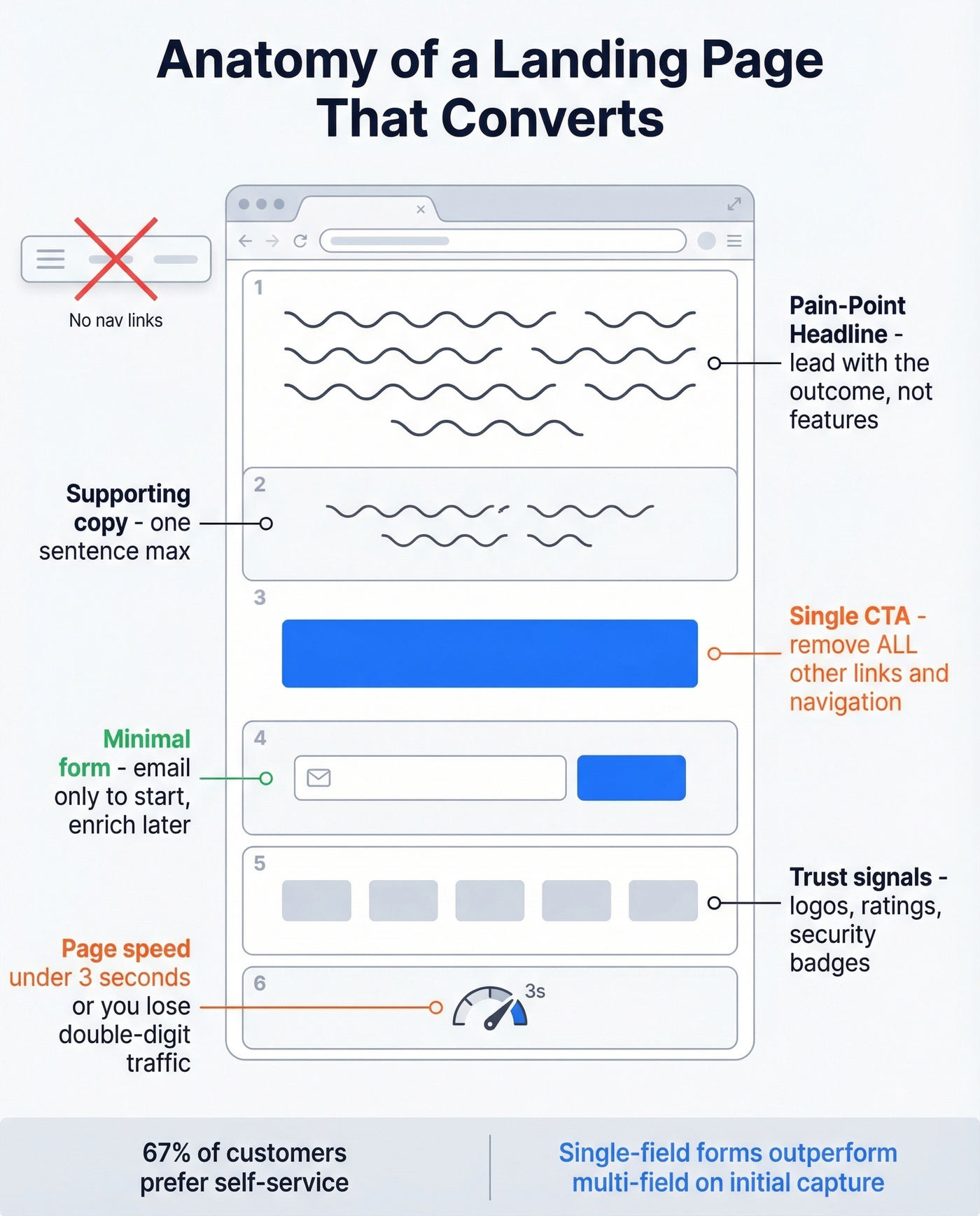
The CTA. One goal per page. Every additional link or button on a landing page is a potential exit. Remove your navigation. Remove your footer links. Strip everything that isn't the conversion action.
The form. Fewer fields, higher conversion. Data across 100M+ data points shows a 1.7% average form rate versus 1.2% for calls. The single-field entry pattern - just an email address to start - consistently outperforms multi-field forms on initial capture. Need more data? Use progressive profiling on subsequent touches, or enrich leads automatically after capture.
Trust signals. Customer logos, G2 or Capterra ratings, security badges, "no credit card required" language. HubSpot uses "free forever" messaging prominently - removing the objection before it forms.
Page speed. Every additional second of load time costs you conversions. If your landing page takes more than 3 seconds to load on mobile, you're losing double-digit percentages of your traffic before they even see your offer.
Mobile design. Over half your traffic is mobile. If your form is tiny, your CTA button is hard to tap, or your page requires horizontal scrolling, you've already lost.
Lead Gen Website Examples That Work
Rather than reviewing six sites the same way, let's group these by the conversion pattern they use - the pattern matters more than the brand.
Single-Field Starters: HubSpot and Calendly
HubSpot and Calendly both bet on the same insight: ask for one thing. HubSpot puts a single email field front and center with "free forever" messaging and "no credit card required" above the fold. Calendly does the same - email only, then progressive collection once you're committed. This pattern converts because it respects impatience. You're in before you realize you're filling out a form.
What to steal: Start with email only. Collect everything else later through progressive profiling or data enrichment tools. The initial conversion is the hardest - make it frictionless.
Multi-Step Approach: Shopify
Shopify takes the opposite approach and makes it work. Their signup uses a multi-step form with a progress indicator, breaking what would be an intimidating single form into micro-steps. The progress bar creates completion bias - once you've done step one, you want to finish.
What to steal: If you genuinely need multiple fields, break them into steps. Never show all fields at once.
Conversational Flow: Lemonade
Lemonade replaced the traditional form with a conversational quiz. Instead of filling out fields, you answer questions in a chat-like interface - it feels like a conversation, not a form. This approach reduces the psychological resistance that kills traditional forms, and it collects more data than a standard form would because each question feels natural in context. Chatbot-style lead capture is underused in B2B, and it's one of the biggest untapped opportunities right now.
What to steal: If your qualification process is complex, a conversational flow will outperform a long form every time.
Pain-Point Messaging: Databox and Evernote
Databox leads with audience-targeted messaging that names the specific pain their prospects feel - scattered data, too many dashboards. Evernote makes the user the hero with "Tame your work, organize your life." Both work because prospects don't care about your features. They care about their outcomes.
What to steal: Lead with the pain or the outcome, never the feature list.

You just read that 80% of leads never convert. Bad data is the #1 reason. Prospeo's 5-step email verification catches invalid addresses, spam traps, and catch-all domains - so only real buyers hit your CRM. At $0.01 per email with 98% accuracy, it's the cheapest insurance your lead gen site will ever have.
Stop feeding your pipeline garbage. Verify every lead automatically.
Biggest Mistakes That Kill Conversions
These are the seven mistakes we see destroy pipeline over and over. Most teams are making at least three right now.
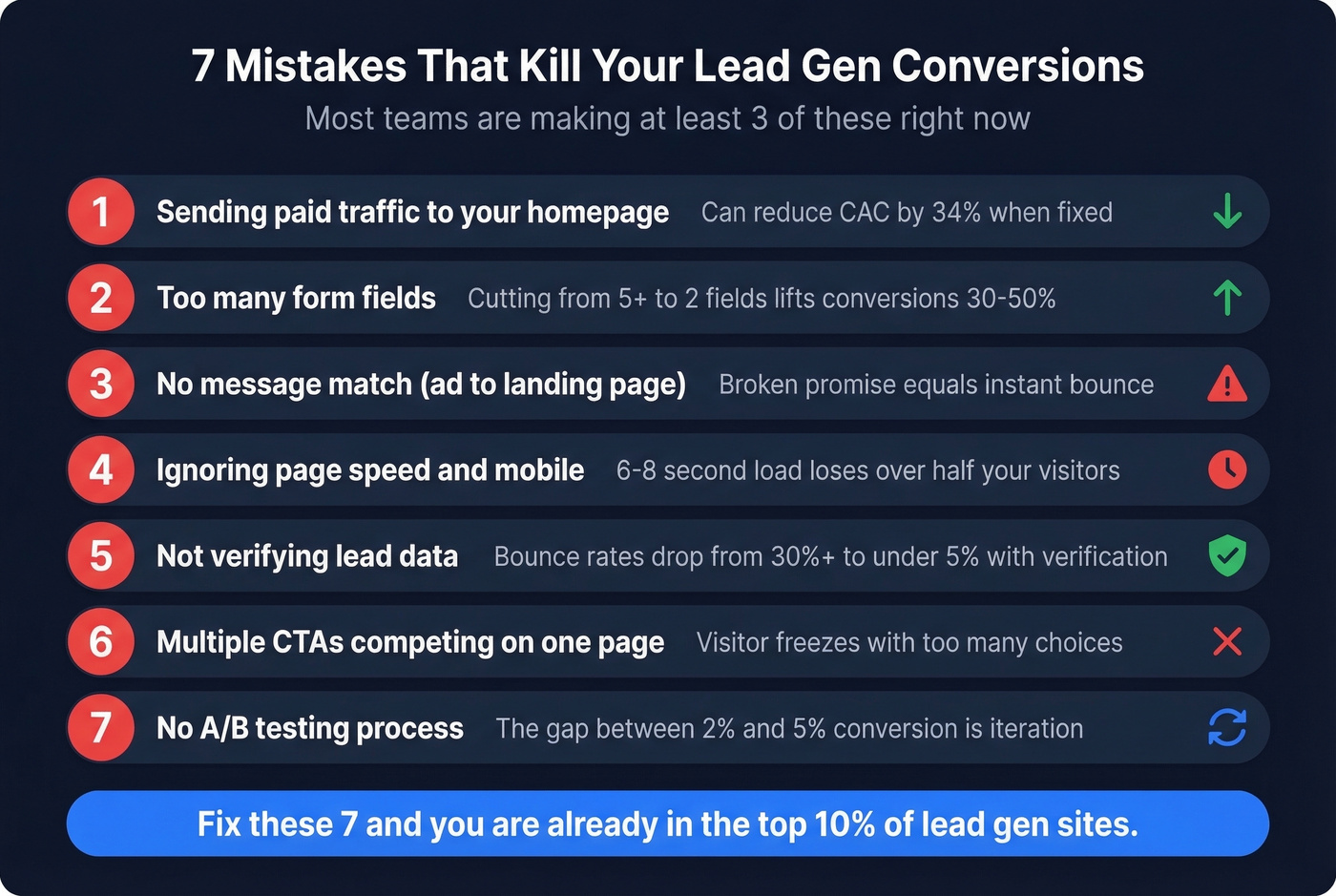
1. Sending paid traffic to your homepage. Your homepage has navigation, multiple CTAs, blog links, about pages - a dozen ways to leave without converting. Paid traffic needs a dedicated landing page with one goal. This single change can reduce CAC by 34%.
2. Asking for too many form fields. Every field you add increases friction. A thread on r/digital_marketing had dozens of marketers sharing the same experience: cutting forms from 5+ fields to 2 increased conversions by 30-50%. Name and email is enough for initial capture. Company size, phone number, job title - collect those later.
3. No message match between ad and landing page. If your ad says "free SEO audit" and your landing page headline says "grow your business with our marketing platform," you've broken the promise. The headline on your landing page should mirror the language in your ad. Exact match. No creative reinterpretation.
4. Ignoring page speed and mobile. We've audited sites loading in 6-8 seconds on mobile. At that speed, you're losing more than half your visitors before the page renders. Test with Google PageSpeed Insights. Compress images. Lazy-load below-the-fold elements.
5. Not verifying lead data. Here's the thing: this is the mistake nobody measures until their domain reputation is wrecked. Your form captures 500 leads, but 30% have typos, disposable emails, or invalid addresses. Those bad leads flow into your CRM, get sequenced, bounce, and tank your sender reputation. We've seen teams cut bounce rates from 30%+ to under 5% by adding verification to their capture flow. Verification isn't optional - it's infrastructure.

6. Multiple CTAs competing on one page. "Start free trial" and "book a demo" and "download the guide" and "watch the webinar" - all on the same page. The visitor freezes. Pick one action. Make it obvious. Repeat the same CTA button multiple times if the page is long, but it should always be the same action.
7. No A/B testing process. Most teams launch a landing page and never touch it again. The difference between 2% and 5% conversion is iterative testing - headlines, button colors, form placement, social proof positioning. One variable at a time. Monthly at minimum.
Lead Gen Site Tool Stack
B2B buyers now engage across roughly 10 channels before making a purchase decision, up from 5 in 2016. Your lead generation site is just the capture point. The stack behind it determines whether those leads become pipeline or noise.
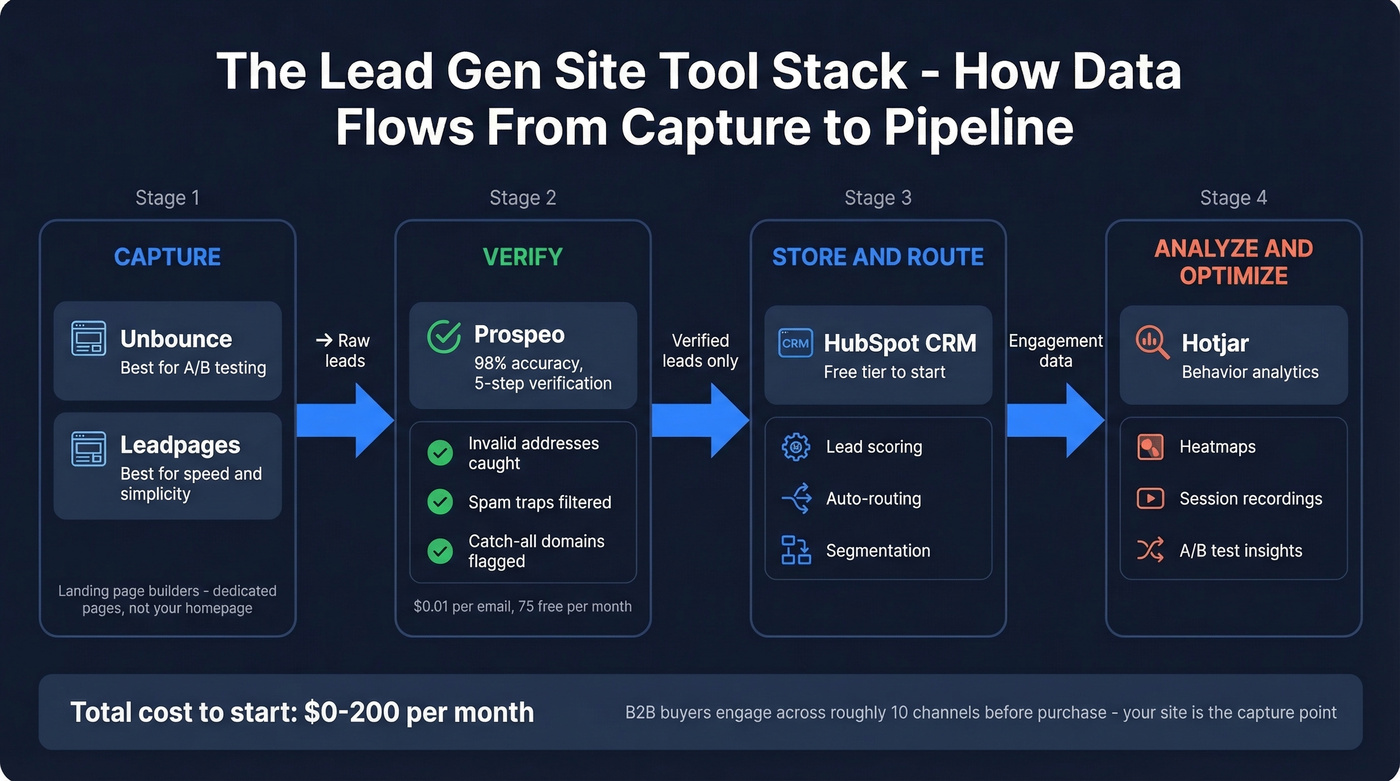
When evaluating tools, focus on three criteria: lead scoring and routing capabilities, native CRM integrations so data flows without manual exports, and whether the tool supports automation workflows that trigger based on lead behavior. Skip features you won't use in the first 90 days.
Capture: Landing Page Builders
Unbounce is the gold standard for A/B testing landing pages without developer involvement. Leadpages is simpler and cheaper - better for teams that want speed over customization. If you're just starting, Leadpages gets you live fastest.
Verify: Email and Data Quality
Your capture pages collect the data. Verification makes sure it's real. Prospeo delivers 98% email accuracy on 143M+ verified emails, with a 7-day data refresh cycle and a 5-step verification process that catches invalid addresses, spam traps, and honeypots before they hit your outreach sequence. The free tier gives you 75 emails per month, and paid plans run about $0.01 per email with no contracts.
Real results back this up: Meritt tripled their pipeline from $100K to $300K per week after adding verification, with bounce rates dropping from 35% to under 4%. That's the difference between a functioning outbound engine and one that's slowly destroying your domain reputation.
Nurture: Email and Outreach
Mailchimp works well for inbound nurture sequences on smaller lists. For outbound, Lemlist is purpose-built for cold email with personalization features that matter. The key is connecting your landing page form submissions directly to your nurture sequence - no manual CSV exports, no 48-hour delays.
CRM: Lead Management
HubSpot's free CRM is the obvious starting point for teams under 10 reps. It handles contact management, deal tracking, and basic marketing automation without costing anything. Paid tiers start at $15/user/mo. Salesforce starts at $25/user/mo and scales to enterprise, but it's overkill until you have a dedicated RevOps person to manage it.
Analytics: Behavior Tracking
Hotjar gives you heatmaps and session recordings that show exactly where visitors drop off on your lead capture pages. The insight you're looking for: where do people stop scrolling, where do they hover but not click, where do they rage-click? For B2B, consider adding a visitor identification tool like Leadfeeder to see which companies visit your site even when they don't fill out a form.
| Category | Tool | Free Tier | Paid From | Best For |
|---|---|---|---|---|
| Landing pages | Unbounce | 14-day trial | Premium pricing | A/B testing |
| Landing pages | Leadpages | 14-day trial | Lower-cost plans | Speed, simplicity |
| Verification | Prospeo | 75 emails/mo | ~$0.01/email | Email accuracy |
| CRM | HubSpot | Yes | $15/user/mo | SMBs |
| CRM | Salesforce | No | $25/user/mo | Enterprise |
| Mailchimp | Yes | Low-cost entry | Inbound nurture | |
| Outbound | Lemlist | No | Paid plans | Cold email |
| Analytics | Hotjar | Yes | Paid plans | Heatmaps |
| Automation | Zapier | Yes | $19.99/mo | Workflow glue |
| Scheduling | Calendly | Yes | Paid plans | Meeting booking |
The article says to collect just an email, then enrich later. That's exactly what Prospeo does - turn a single email into 50+ data points including verified phone numbers, job titles, company size, and intent signals. 92% match rate. No manual research. No second forms.
One email in, a full prospect profile out. That's enrichment done right.
Conversion Benchmarks for 2026
Before you optimize, you need to know what you're optimizing toward. Here are the numbers that matter, pulled from data across 100M+ data points by Ruler Analytics:
| Metric | Average | Top Performers |
|---|---|---|
| Overall conversion rate | 2.9% | 10%+ |
| Form conversion rate | 1.7% | 5%+ |
| Call conversion rate | 1.2% | - |
| LinkedIn Lead Gen Forms | ~13% | - |
| LinkedIn visitor-to-lead | 2.74% | - |
The 13% number on LinkedIn Lead Gen Forms is striking - roughly 4.5x the overall average. That's because pre-filled forms eliminate friction entirely. The lesson isn't "use LinkedIn." It's that every field your visitor has to type is a conversion tax.
91% of B2B marketers say lead gen is their top priority, but most benchmark against themselves rather than against industry data. If you're at 1.5% and think that's fine because it's better than last quarter, you're leaving money on the table. The top 10% of landing pages convert at 10%+. That's where you should be aiming.
CRO Playbook: From 2% to 5%
Getting from 2% to 5% conversion isn't about one big change. It's a systematic process of small, compounding improvements.
Isolate one variable per test. Headline, button color, form placement, social proof position - test one at a time. If you change three things simultaneously and conversions go up, you don't know which change drove it. Discipline here separates teams that improve from teams that guess.
Use progressive profiling. For B2B with longer sales cycles, don't ask for everything upfront. Capture email on the first visit. Ask for company and role on the second. Layer in budget and timeline on the third. Each interaction builds the profile without creating a wall of fields on day one.
Reduce form fields ruthlessly. If a field isn't essential for routing or qualifying the lead, remove it. You can enrich the rest after capture - tools that return 50+ data points per contact at a 92% match rate make this trivial. Every field you cut increases completion rates.
Install behavior analytics. Hotjar heatmaps and session recordings show you exactly where visitors hesitate, rage-click, or abandon. We've seen teams discover that their CTA button was below the fold on mobile - a fix that took 5 minutes and lifted conversions 20%.
Enforce message match. Audit every ad-to-landing-page combination. The headline on your landing page should use the same language as the ad that drove the click. Mismatched messaging is the #1 reason paid traffic bounces.
Score and segment by intent. Not all traffic is equal. Someone searching "best CRM for startups" is warmer than someone reading a blog post about sales tips. Build different landing pages for hot, warm, and cold traffic - the offer, the copy, and the form length should all vary by intent tier. Implement lead scoring in your CRM so sales only touches leads that have crossed a qualification threshold. This alone can double your sales team's efficiency.
FAQ
How much does it cost to build a lead gen site?
You can launch a functional lead generation site for $0-200/month. Free tiers from HubSpot, Prospeo (75 email verifications), and Hotjar cover the basics. Paid tools add A/B testing and automation, but you don't need them on day one.
What's a good conversion rate for a lead generation website?
The average across industries is 2.9%, with form-specific conversion at 1.7%. Top performers break 10%. If you're below 2%, there's likely a structural issue - message mismatch, too many form fields, or slow page speed. Benchmark against Ruler Analytics' industry data for your vertical.
Do I need a full website or just a landing page?
Both. Landing pages convert campaign traffic with a single focused CTA. A full website builds credibility, supports SEO, and gives prospects a place to research you. The rule: never send paid traffic to your homepage. Ads go to landing pages. Organic and brand search go to your website.
How do I improve lead quality, not just volume?
Verify data before it hits your CRM - catch invalid emails and disposable addresses at the point of capture. Use progressive profiling to collect qualifying information over multiple interactions. Score leads based on engagement and firmographic fit before routing to sales.
What's the biggest mistake with lead capture pages?
Sending paid traffic to a homepage instead of a dedicated landing page. Your homepage has navigation, multiple links, and competing messages - a dozen exit paths. A landing page strips all of that away and focuses the visitor on a single conversion action. This one change consistently produces the largest lift in conversion rates.