

Lead Generation for Construction Companies: What Actually Works in 2026
It's Tuesday morning. Your crew finishes a job Friday, and there's nothing lined up for next week. You've been meaning to "get serious about marketing" for two years, but the phone used to ring on its own. Now it doesn't - and you're competing with nearly 4 million active construction businesses in a $3.7 trillion market.
Here's the thing: most of those competitors are terrible at generating leads. That's your advantage. The channels that worked five years ago have shifted, and spreading your budget across five platforms is the fastest way to burn cash with nothing to show for it.
What You Need (Quick Version)
Residential contractors: Optimize your Google Business Profile. Turn on Google Local Service Ads. Build a review engine. You can do all of this for under $500/month combined, and it'll outperform every lead marketplace.
Commercial contractors: Get on a bid platform like Dodge or ConstructConnect for project flow. Use Prospeo to find GC, developer, and property manager emails for direct outreach before bids even drop. Build service-area landing pages so inbound finds you too.
Everyone: Stop spreading budget across five platforms. Pick two channels and go deep. That single piece of advice will save you more money than anything else in this article.
What Construction Leads Actually Cost
Before you spend a dollar, you need to know what a lead should cost - otherwise you can't tell whether a channel is working or bleeding you dry.
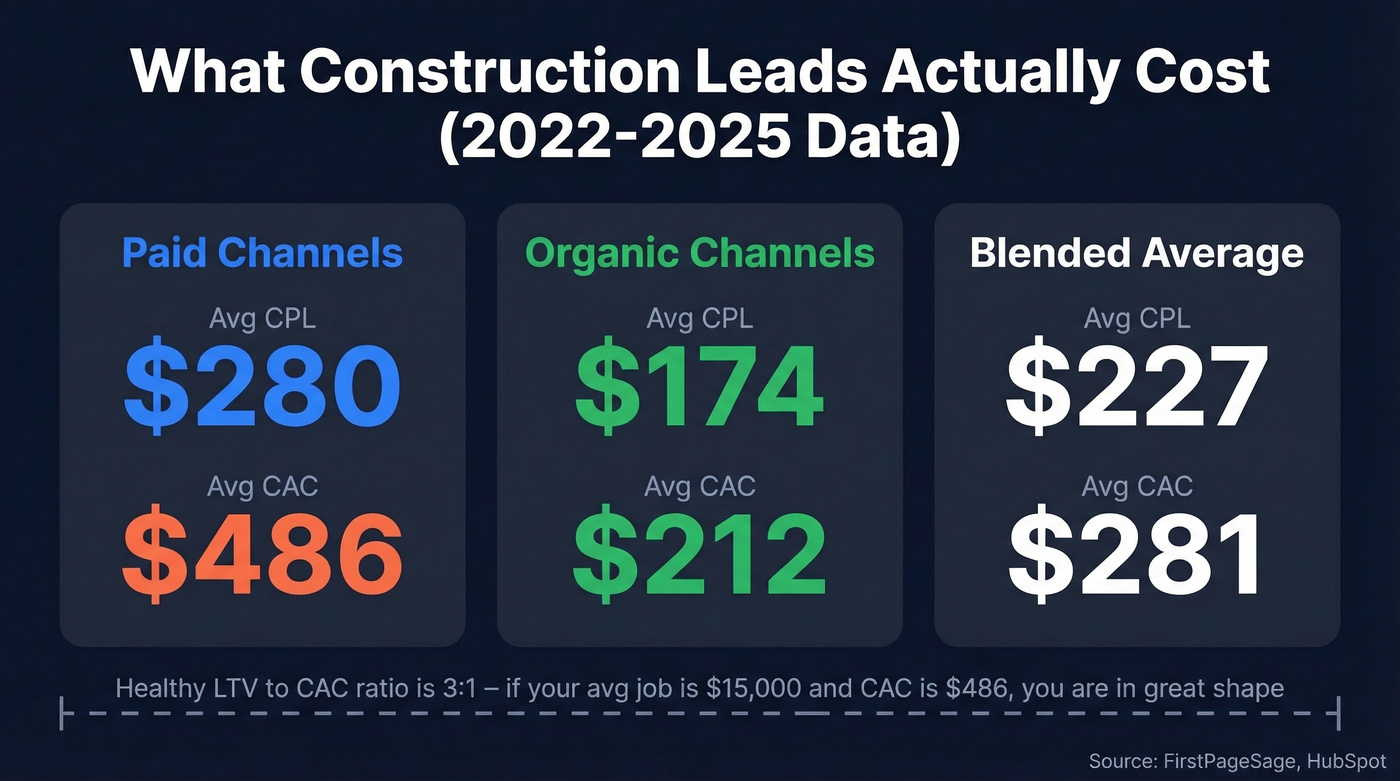
Here are the industry benchmarks for construction, based on data collected from January 2022 through June 2025:
| Metric | Paid Channels | Organic Channels | Blended |
|---|---|---|---|
| Avg CPL | $280 | $174 | $227 |
| Avg CAC | $486 | $212 | $281 |
CPL is what you pay to get someone's contact info. CAC is what it costs to actually close them. The gap between those two numbers is your sales process - and for a lot of contractors, that gap is where money goes to die.
Not all leads are equal, either. Someone downloading a "how to choose a contractor" guide needs nurturing. Someone filling out your estimate request form is ready for a call. Treating both the same wastes time and kills conversion rates.
The healthy benchmark for lifetime value to customer acquisition cost is 3:1. If your average job is $15,000 and it costs you $486 to acquire that customer through paid channels, you're in great shape. If your average job is $2,000 and you're paying $85 per shared Angi lead, the math gets ugly fast. Industry standard for marketing budget is 7-10% of revenue, which means a contractor doing $1M/year should be spending $70-100K on marketing. Most spend far less and wonder why the phone doesn't ring.
Where to Start: A Simple Decision Tree
Don't overthink this.
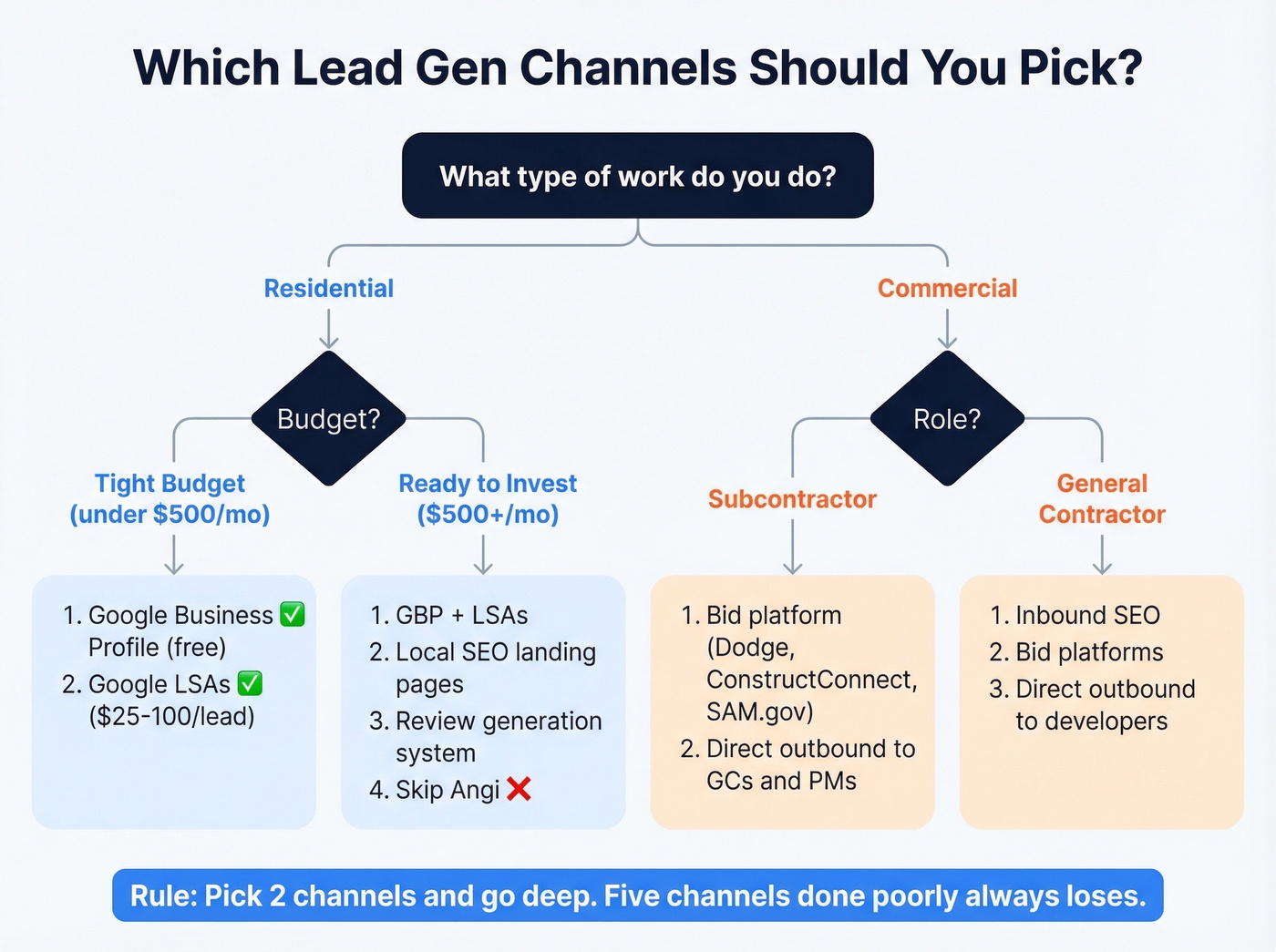
- Residential, tight budget: Google Business Profile (free) + Google LSAs ($25-100/lead). Master those before adding anything else.
- Residential, ready to invest: GBP + LSAs + local SEO landing pages + review generation system. Skip Angi.
- Commercial, subcontractor: Bid platform (Dodge, ConstructConnect, or SAM.gov for government work) + direct outbound to decision-makers before the ITB drops.
- Commercial, GC: Inbound SEO + bid platforms + direct outbound to developers and property managers.
Two channels, done well, will outperform five channels done poorly every single time.
Residential Contractor Channels
Google Business Profile (Free - Highest ROI)
97% of homeowners use Google to find local contractors, and 60%+ of those searches happen on mobile. Your Google Business Profile is the front door to your business for most potential customers, and it's completely free.
Upload real project photos weekly with descriptive filenames ("kitchen-remodel-austin-tx.jpg," not "IMG_4392.jpg"). Keep your NAP (name, address, phone) consistent between your website and GBP. Post weekly updates. Respond to every review. Enable messaging. Add FAQs.
One critical change that took effect in 2025 and still applies: Google tightened service area enforcement. Listing 30 cities you don't truly serve can now reduce your visibility or trigger a profile suspension. Focus on zip codes and cities where you actually have crews working.
Google Local Service Ads ($25-100+/Lead)
This is where your first paid dollar should go. Full stop.
LSAs appear above regular Google search ads, which means you're the first thing homeowners see. You pay per lead, not per click - so you're not burning money on tire-kickers who never call. The Google Guaranteed badge builds instant trust with homeowners who've never heard of you. For most residential contractors, LSAs are the best paid CPL channel to start with. Get these running before you even think about Angi or Thumbtack.
Angi / HomeAdvisor ($15-85/Lead + $288-300/Year)
Angi is a bad deal for most contractors.
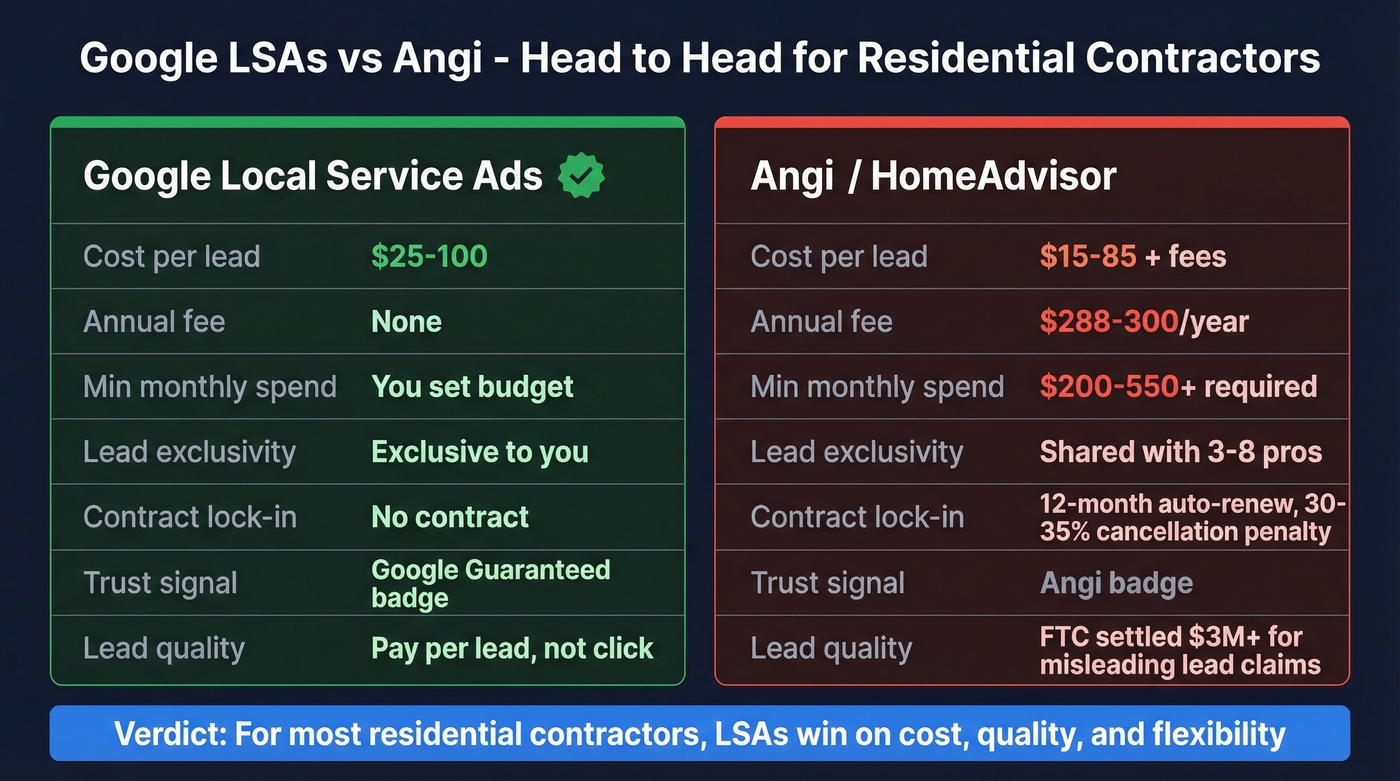
The pricing stacks up fast: an annual fee of ~$288-300, plus $15-85 per lead depending on your trade (roofing and remodeling sit at the high end), plus a minimum monthly ad spend of $200-550+. Those leads are shared with 3-8 other contractors simultaneously. You're paying premium prices for a bidding war.
It gets worse. Contracts auto-renew for 12 months with a 30-35% early cancellation penalty and 60 days' notice required. The January 2025 "homeowner choice" model shift reduced lead volume because homeowners now have to actively choose pros instead of being auto-matched.
The sentiment on r/Contractor is brutal. Contractors report "zombie leads" - recycled stale requests where the homeowner had the work done two years ago. One contractor paid $150 for a lead where the person never requested a quote. Multiple users describe needing to threaten legal action just to cancel. And this isn't just anecdotal frustration - the FTC settled with Angi in April 2023, mailing $3M+ in refund checks to 110,000+ contractors for misleading claims about lead quality and conversion rates.
For most small-to-mid residential contractors, Google LSAs deliver better leads at a lower effective cost without the contract traps.
Thumbtack, Houzz, Porch
Thumbtack runs a pay-to-quote model. It's lighter-weight than Angi with no annual contracts, but lead quality varies wildly by geography.
Houzz Pro uses a flat-rate subscription rather than pay-per-lead pricing. Worth it if you sell higher-ticket design-build or remodeling work and need portfolio visibility. Overkill for handyman services.
Porch partners with major home retailers for referrals and can be useful in some markets, but results vary a lot by trade and location.

The article above mentions using direct outreach to reach GCs, developers, and property managers before bids even drop. Prospeo gives you 300M+ profiles with 30+ filters - search by construction industry, job title, company size, and region. Every email is 98% verified. Every mobile number hits a 30% pickup rate. At $0.01 per email, one closed commercial contract pays for years of prospecting.
Stop waiting for bid invites. Reach decision-makers before your competitors even know the project exists.
Commercial Lead Generation Channels
Bid Platforms
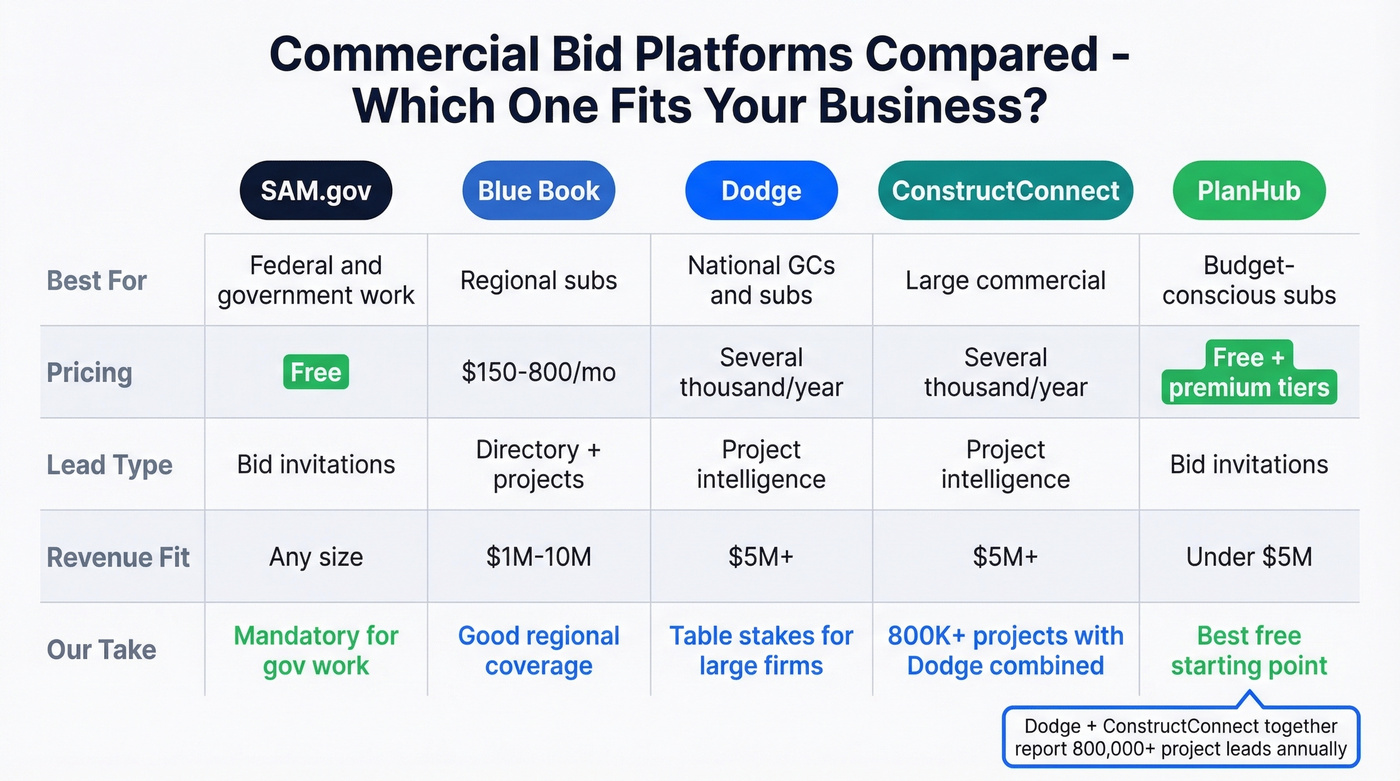
Commercial contractors live and die by bid flow. Here's how the major platforms compare:
| Platform | Best For | Pricing | Lead Type |
|---|---|---|---|
| SAM.gov | Federal/government | Free | Bid invitations |
| Blue Book | Regional subs | $150-800/mo | Directory + projects |
| Dodge | National GCs/subs | Starts at several thousand/year | Project intelligence |
| ConstructConnect | Large commercial | Starts at several thousand/year | Project intelligence |
| PlanHub | Budget subs | Free + premium tiers | Bid invitations |
Dodge and ConstructConnect together report access to 800,000+ project leads annually. If you're a commercial sub or GC doing $5M+ in revenue, one of these platforms is table stakes. SAM.gov is free and mandatory for government work. PlanHub is the best free starting point for smaller subs testing the waters.
Direct Outbound - Reaching Decision-Makers First
Most commercial contractors leave money on the table here. Bid boards give you project data, but they don't give you decision-maker contact info. By the time an ITB drops, you're competing with every sub in the region.
The smarter play is reaching GCs, developers, and property managers directly - before the bid goes out.

Identify target companies in your service area, find the project managers and estimators who make subcontractor decisions, and reach out with a capabilities pitch while they're still in pre-construction. This builds relationships that turn into preferred-sub status, which is worth more than any single bid. We've watched commercial contractors build preferred-sub relationships this way that generate repeat work for years. It's a fundamentally different motion than reactive bidding.
Prospeo makes this straightforward - search by industry, role, company size, and location to build a list of construction decision-makers with 98% email accuracy. The free tier gives you 75 emails per month, enough to test the approach before committing budget. Export your list, push it to your CRM, and start building relationships instead of waiting for bid boards to feed you.
Owned Channels That Compound
Website + Local SEO
Your website should have a dedicated landing page for every service-area city you work in. "Commercial Roofing Contractor in Dallas" is a different page than "Commercial Roofing Contractor in Fort Worth." Each page targets a specific local search query and builds organic visibility over time.
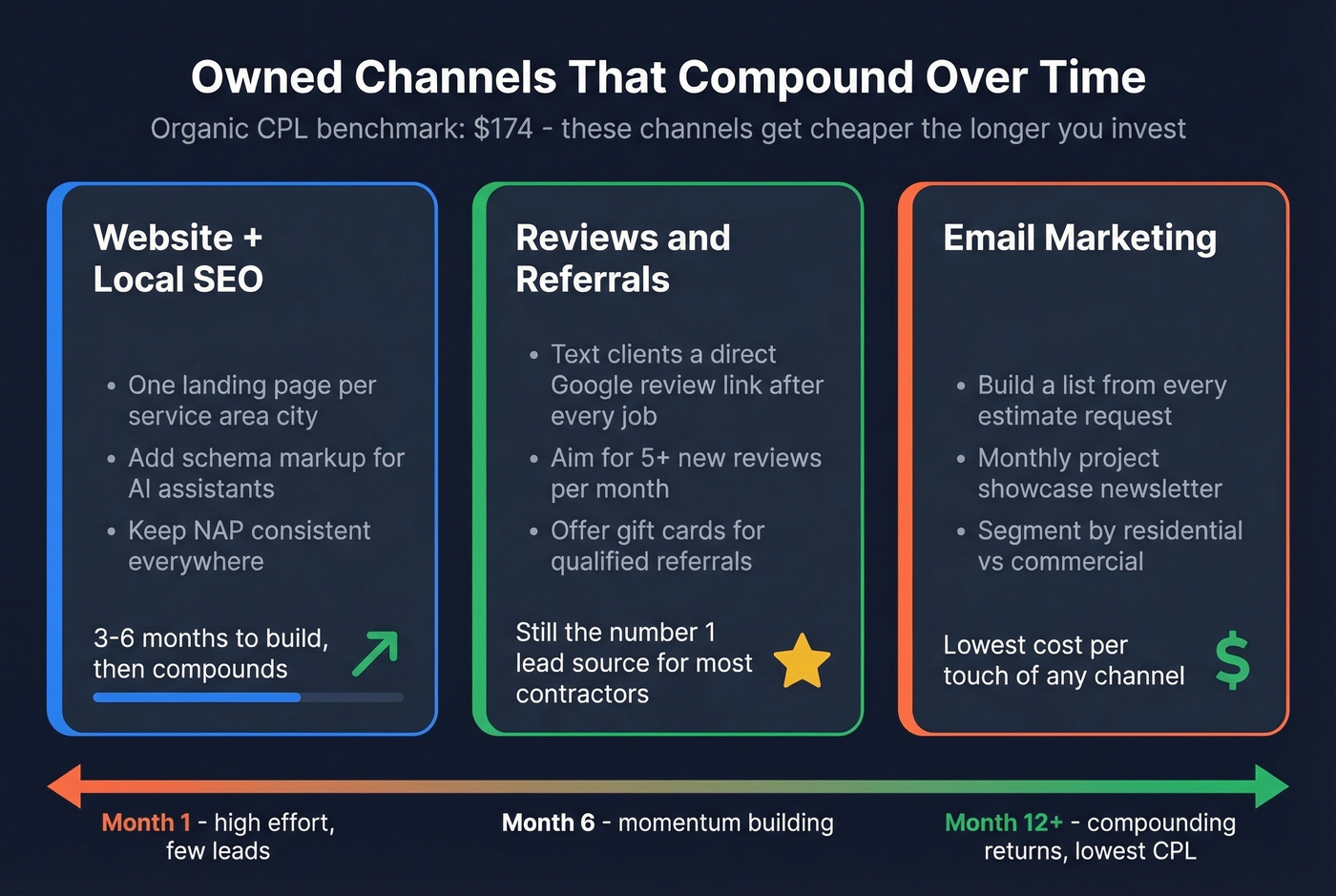
Add schema markup so search engines and AI assistants can parse your services, service areas, and reviews. Keep your NAP consistent everywhere. The organic CPL benchmark of $174 is the long-term payoff - it takes 3-6 months to build, but it compounds.
Reviews and Referrals
Build a system, not a hope. After every completed job, send a text with a direct link to your Google review page. Aim for 5+ new reviews per month. Respond to every review - positive and negative.
Referral programs work too: offer past clients a gift card or discount for sending you a qualified lead. Word-of-mouth is still the #1 lead source for most contractors. The difference between good and great contractors is whether they systematize it or just cross their fingers.
Email Marketing
Build a list from every past client, every estimate you've given, every business card you've collected. Send a monthly newsletter with project photos, seasonal maintenance tips, and a clear "we're booking for Q3" call to action. Email marketing costs almost nothing per lead because you already own the audience. A simple nurture sequence keeps you top-of-mind for repeat work and referrals.
Why Your Leads Aren't Converting
Let's be honest: most contractors don't have a lead problem. They have a lead handling problem.
Slow response. If you're calling back leads the next morning, you've already lost. Residential homeowners expect a response in minutes, not hours. The contractor who calls back in 5 minutes wins the job over the one who calls back in 5 hours - even if the second contractor is better.
No segmentation. A homeowner who needs emergency water damage repair isn't the same lead as someone "thinking about a kitchen remodel next year." Prioritize by urgency and project scope.
Giving up too early. One call, no answer, move on? That's not follow-up. A proper cadence is 5-7 touches across phone, text, and email over 2-3 weeks. Most contractors stop after one or two attempts. If you want a plug-and-play cadence, use these follow-up templates.
No tracking. If you can't tell me which channel produced which leads and which leads became jobs, you can't calculate ROI. You're flying blind. Even a simple spreadsheet tracking lead source to estimate to close is better than nothing.
We've seen contractors spend $1,200/month on Angi leads and close one $3,000 job. They think Angi is "working" because they got a job. The math says they lost money. Track from intake to outcome, or you'll never know what's actually performing.
Real Results - What Good Looks Like
Commercial construction firm (SEO + paid + outbound): A specialty commercial contractor went from zero inbound leads per month to 4-6 qualified leads monthly in under six months. They ranked for 103 page-one keywords and built a $1M+ pipeline by combining website optimization, targeted SEO, paid search, and outbound to GCs and architects.
Commercial roofing company (PPC + local SEO): A roofing contractor achieved 30X ROI on their digital marketing investment, generating $2-3M in annual revenue from online channels. Their PPC campaigns hit a 28.71% conversion rate with a 10.9% CTR, and one website lead turned into a $1M contract. They also drove 200+ calls and interactions per month from local search alone.
These aren't overnight results. Both took 3-6 months of consistent execution. But the compounding effect is real.
What's Changing in 2026
Voice search and AI assistants are reshaping how homeowners find contractors. The key insight: different assistants pull from different data sources. Siri routes through Apple Maps and Yelp. Google Assistant pulls from GBP, LSAs, and organic results. Alexa leans on Yelp and Bing.
Your GBP optimization covers Google Assistant, but you're invisible to Siri users if you don't have a Yelp profile. This is why maintaining a Yelp presence matters even if you've never gotten a lead from it directly - it's a data source for the assistants your customers are talking to. Schema markup on your website helps all AI tools parse your services and location. Think of it as making your business machine-readable, not just human-readable.
Social media can build brand awareness, but for direct lead generation it rarely outperforms GBP or LSAs for residential companies. Don't spread yourself thin chasing Facebook leads when your Google profile is half-finished.
If your average contract value is under $5,000, you probably don't need anything beyond GBP, LSAs, and a review system. The contractors who overcomplicate their marketing stack are usually the ones with the worst ROI. Simplicity scales. Complexity breaks.
The construction companies that'll win in 2026 aren't the ones with the biggest marketing budgets. They're the ones who pick two channels, execute consistently, and actually answer the phone when it rings.
FAQ
How much should a construction company spend on marketing?
The standard benchmark is 7-10% of annual revenue. A contractor doing $500K/year should budget $35-50K for marketing. Start with free channels - Google Business Profile and review generation - before scaling into paid. Every dollar should be trackable back to leads and closed jobs.
Are Angi leads worth it for contractors?
For most small-to-mid contractors, no. Shared leads at $15-85 each, 12-month lock-ins, 30-35% cancellation penalties, and a history that includes an FTC settlement for misleading lead quality claims make it a poor value. Google LSAs deliver better leads without the contract traps.
What's the best free lead source for contractors?
Google Business Profile. It's free, you own it, and 97% of homeowners start their contractor search on Google. Optimize it with weekly photos, consistent NAP info, and active review management. No other free channel comes close for residential contractors.
How do commercial contractors find leads?
Bid platforms like Dodge, ConstructConnect, and SAM.gov provide project flow. The highest-value play is direct outbound - finding GC, developer, and property manager emails with a tool like Prospeo, then reaching out before bids go public. Combine both for the strongest pipeline.
How fast should I respond to a new lead?
Within minutes, not hours. Speed-to-lead is the single biggest factor in converting inbound and purchased leads. The contractor who responds in five minutes wins over the one who calls back the next morning - regardless of qualifications or pricing.
Shared leads from Angi cost $15-85 each and pit you against 3-8 other contractors. Prospeo lets you build exclusive lists of property managers, developers, and general contractors with verified emails and direct dials - for a fraction of the cost. 125M+ verified mobile numbers mean you actually get people on the phone.
Skip the shared lead bidding wars. Build your own pipeline for $0.01 per contact.