

The B2B Lead Generation Funnel: Stages Are Easy - The Math Is What Matters
Every B2B team has a funnel diagram buried in a slide deck nobody opens. The problem isn't that people don't understand the stages - it's that they never run the numbers. The winning vendor lands on the buyer's Day One shortlist 95% of the time, and the pre-contact favorite wins roughly 80% of deals . With an average B2B buying cycle of 10.1 months, your funnel either earns that early preference or it doesn't.
The stages are just labels. The math tells you if anything's working.
TL;DR: Three things separate a working B2B lead generation funnel from a PowerPoint diagram: conversion benchmarks by stage, backward funnel math from your revenue target, and a diagnostic framework for leaks. If you only do one thing after reading this, run your funnel math backward from your revenue number.
What a B2B Lead Generation Funnel Actually Is
A lead gen funnel covers how you attract, capture, and qualify prospects - it's marketing-owned. The sales funnel picks up at the handoff and tracks deal progression to close. People use the terms interchangeably, but they shouldn't.
Forrester put it well: marketing's job is to "help buyers progress through their buying journey - not push leads through a funnel." That distinction matters because 95% of B2B purchases involve three or more people across two or more departments. You're not nurturing a lead. You're influencing a buying group.
Five Funnel Stages With Real Numbers
Most funnel guides list stages without telling you what "good" looks like. Here are B2B SaaS benchmarks from First Page Sage for post-lead stages, plus channel-level benchmarks for the top of funnel.
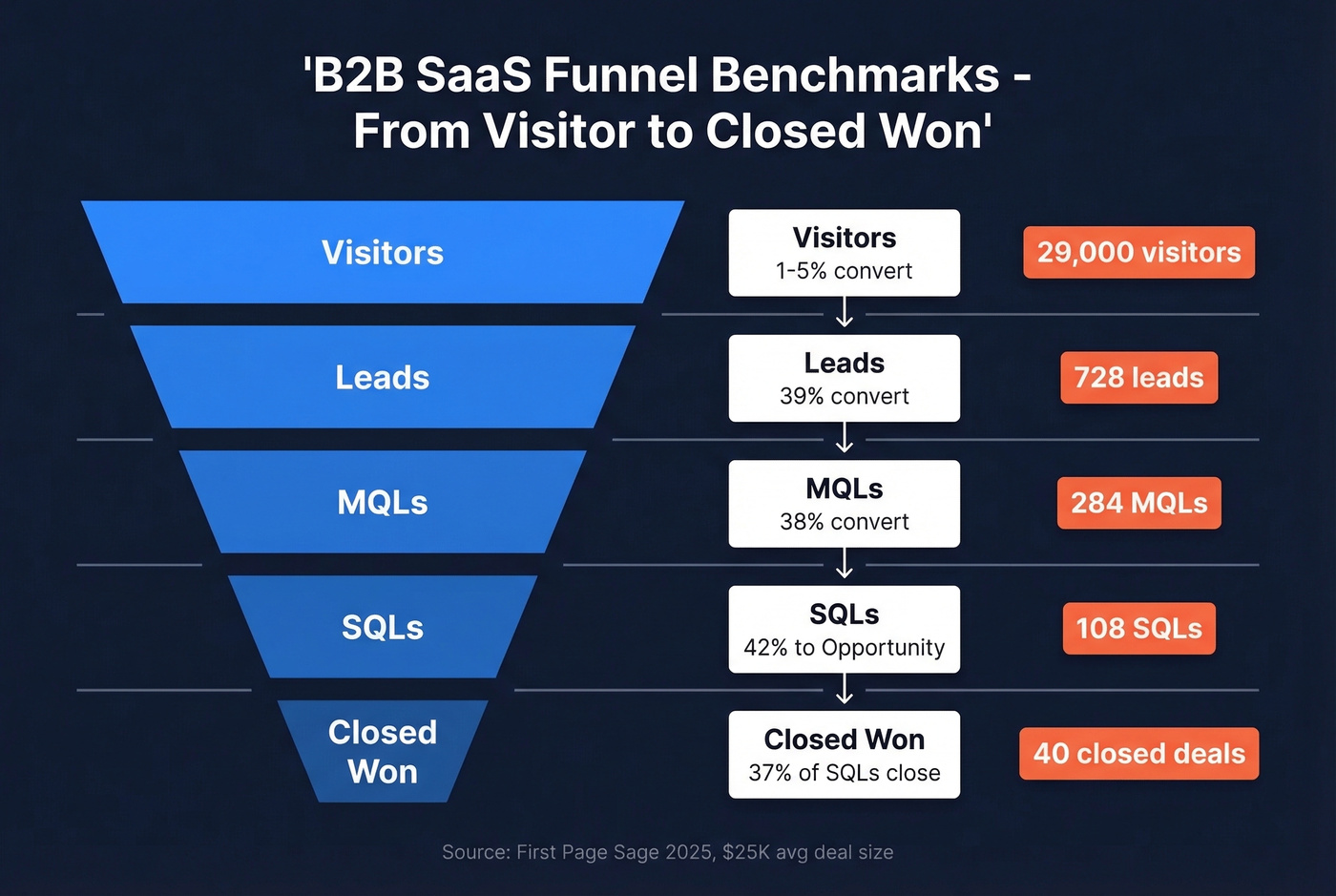
| Stage Transition | B2B SaaS Benchmark |
|---|---|
| Visitor → Lead | ~1-5% |
| Lead → MQL | 39% |
| MQL → SQL | 38% |
| SQL → Opportunity | 42% |
| SQL → Closed Won | 37% |
Awareness
Google search CPC averages $5.26 with a 7.52% conversion rate. LinkedIn CPC runs $3.94-$10+ but CTR is much lower at ~0.52%. Organic compounds over time but won't fill pipeline next quarter. Paid is the fastest lever - pick the channel that matches your ICP's buying behavior, not the one with the cheapest clicks.
Interest: Where Most Traffic Disappears
A ~1-5% visitor-to-lead rate means most of your traffic leaves without identifying themselves. The value exchange usually isn't strong enough. Ungated content builds trust; gated content captures emails. If your average deal size sits below $15K, lean toward ungated - you need volume, not friction.
Consideration
Here's where channel quality diverges sharply. LinkedIn Ads produce 14-18% MQL-to-SQL conversion rates versus 7-12% for Google. Higher CPL, better conversion. We'd take a $200 MQL that converts at 18% over a $50 MQL that converts at 8% every single time.
Decision
SQL to Closed Won converts at roughly 37%. If your number falls well below that, the problem is usually qualification criteria, not sales execution. Tighten your MQL-to-SQL definition before blaming your closers.
Expansion
Post-sale is where most funnels end and where the best ones accelerate. Renewal, cross-sell, and upsell opportunities should feed back into the same infrastructure. One practitioner on r/sales shared a fully automated funnel covering everything from scheduled social posts through invoicing and onboarding sequences - proof that post-sale automation isn't theoretical. Forrester's updated Revenue Waterfall explicitly includes existing customer opportunities in the demand mix for this reason.
Funnel Math - A Worked Example
Your VP of Sales wants to know why 500 MQLs last quarter produced only 12 closed deals. Let's work backward from a $1M ARR target.
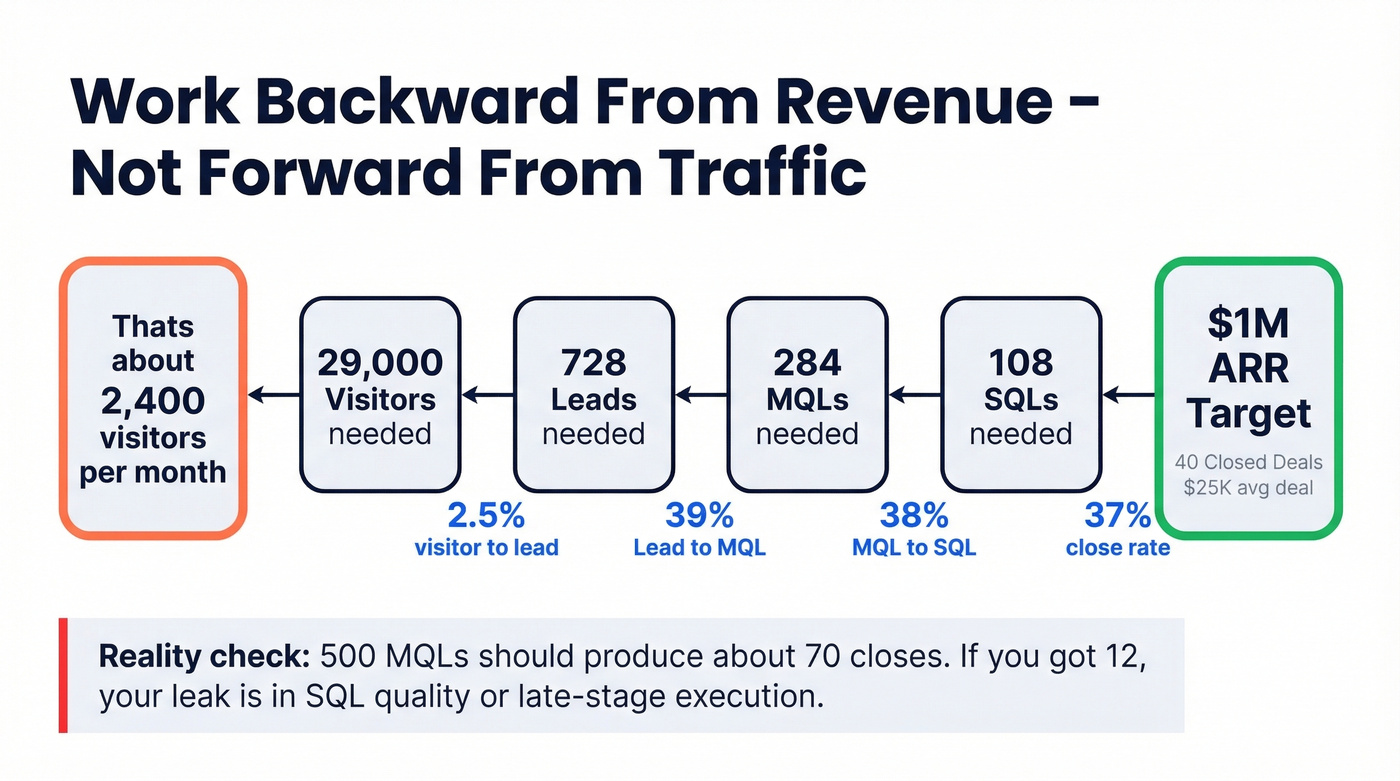
Assume a $25K average deal - that's 40 closes needed. At 37% SQL-to-close, you need ~108 SQLs. At 38% MQL-to-SQL, ~284 MQLs. At 39% lead-to-MQL, ~728 leads. At a 2.5% visitor-to-lead rate, you need roughly 29,000 visitors per year - about 2,400/month.
Now sanity-check the quarter you just lived through: 500 MQLs should produce ~190 SQLs and ~70 closes if everything downstream is healthy. You got 12. The leak is almost certainly in SQL quality and late-stage execution - and in many teams, it's also a definition problem where what you're calling an "SQL" isn't actually sales-qualified by any rigorous standard.
In our experience, teams that run this math backward find their first leak within 30 minutes.

You just ran the backward funnel math. Now ask: how many of those 284 SQLs are reachable? Bad contact data is the invisible leak that makes every conversion benchmark meaningless. Prospeo delivers 98% email accuracy on a 7-day refresh cycle - so the leads your funnel qualifies actually connect to real buyers.
Stop optimizing stages when your data is the real leak.
Where B2B Funnels Leak
Top-of-Funnel: Wrong Channels
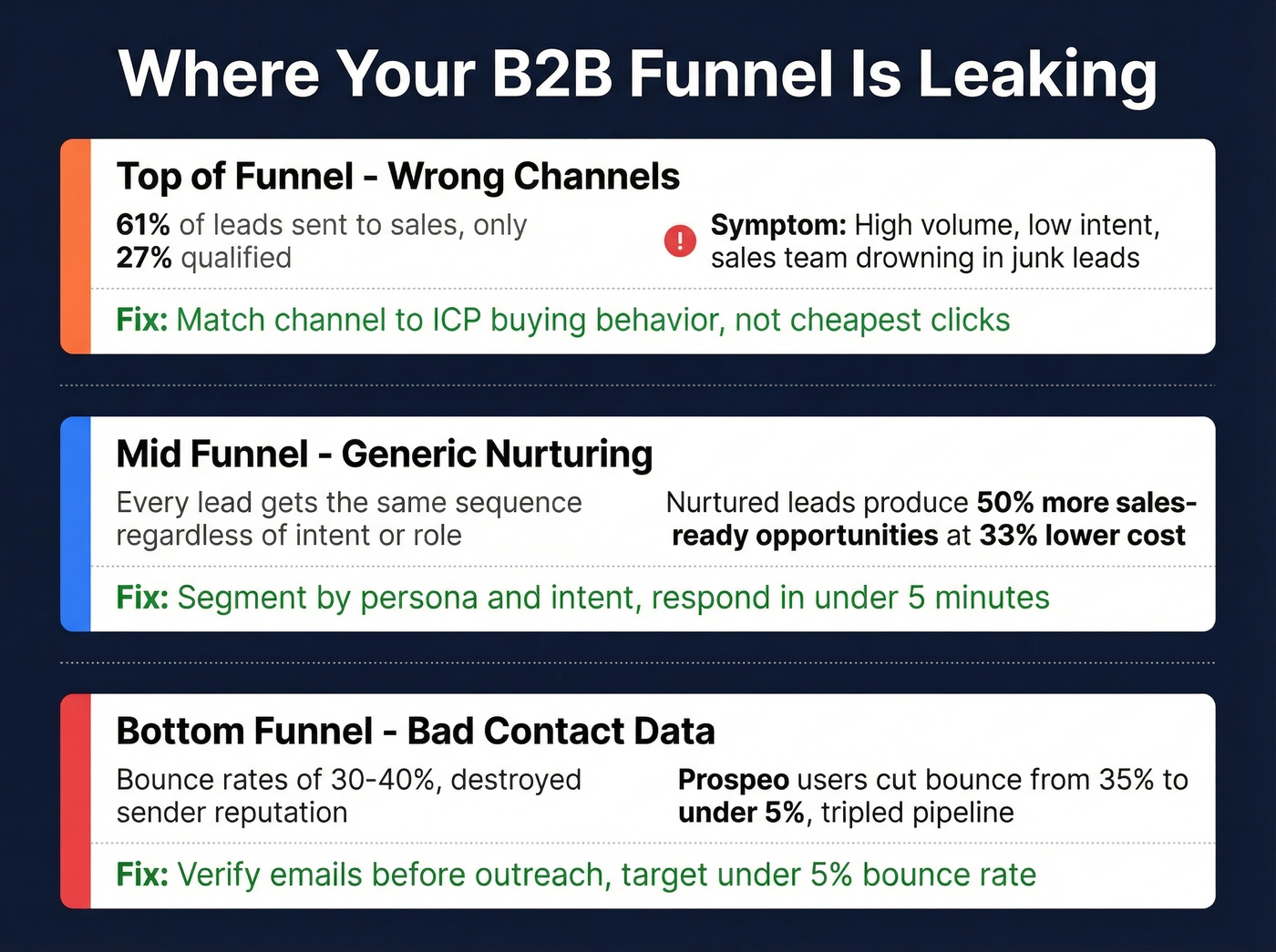
The most common leak is spending on channels that generate volume without intent. 61% of B2B marketers send all leads directly to sales, but only 27% are actually qualified. That's not a funnel - it's a firehose pointed at your sales team.
Mid-Funnel: Generic Nurturing
Nurtured leads produce 50% more sales-ready opportunities at 33% lower cost, and their purchases average 47% larger. Yet most nurture sequences treat every lead the same. Companies responding in under five minutes see materially higher conversion to meetings. If your SLA is "within 24 hours," you're losing deals to competitors who respond in minutes.
Bottom-Funnel: Bad Data Kills Deals
You can nail your ICP targeting, build great nurture sequences, and still watch pipeline evaporate because your contact data is garbage. Teams running outbound with bounce rates of 30-40% destroy sender reputation and make every downstream metric unreliable.
Here's the thing: this is the most fixable leak in any funnel. Prospeo's 98% email accuracy and 7-day data refresh cycle solve exactly this problem. Snyk cut bounce rates from 35-40% to under 5% and generated 200+ new opportunities per month. Meritt went from 35% bounce to under 4%, tripling pipeline from $100K to $300K per week.
If your bounce rate is above 10%, stop optimizing your funnel stages and fix your data first. Nothing else matters until deliverability is clean.
Snyk's 50 AEs cut bounce rates from 35-40% to under 5% and generated 200+ opportunities per month. Meritt tripled pipeline from $100K to $300K/week. The difference wasn't funnel strategy - it was switching to verified data at $0.01/email with 98% accuracy.
Every funnel stage downstream of bad data is a waste of budget.
The Minimum Viable Tool Stack
You don't need 10 tools. You need three: a CRM, an automation platform, and a verified data source. Add intent data after you've proven the basic funnel converts.
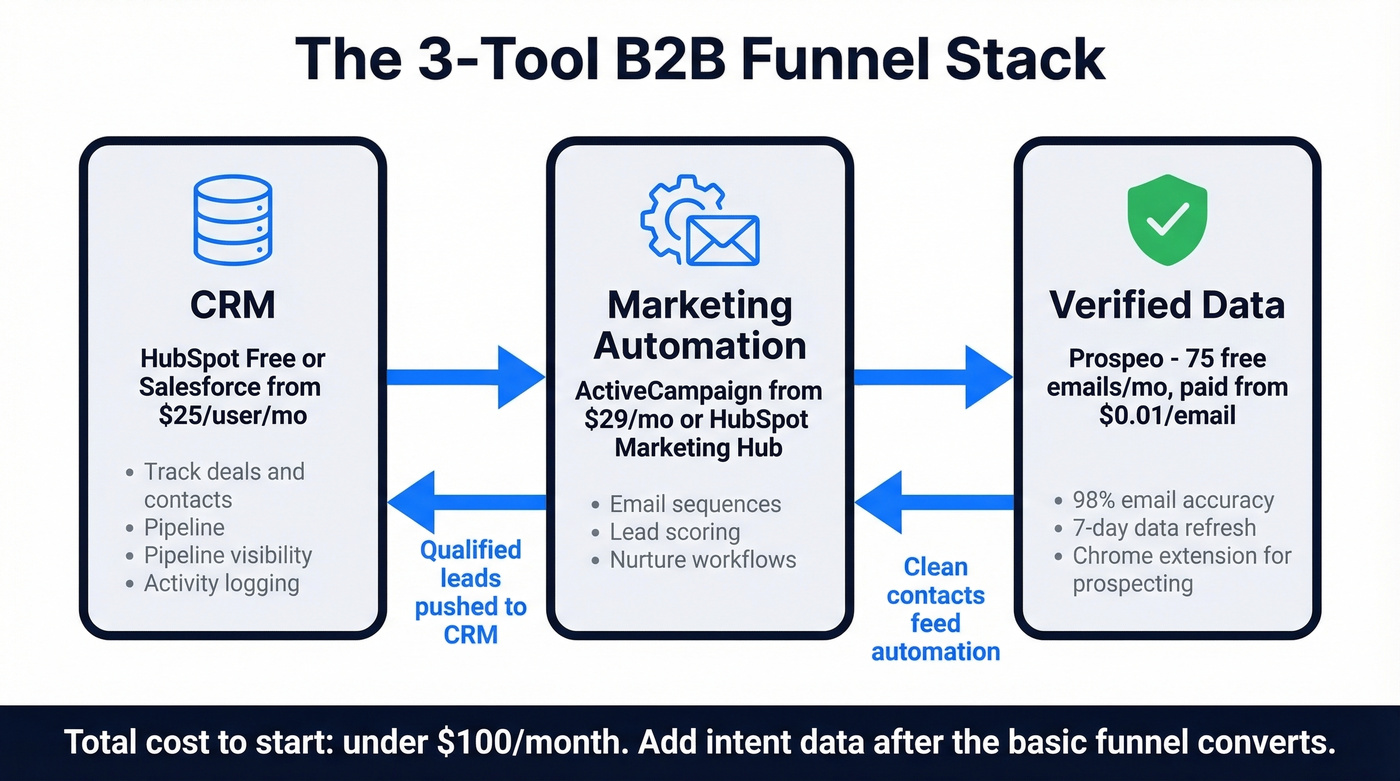
CRM: HubSpot's free tier or Salesforce from ~$25/user/mo. Either works. Pick whichever your team will actually use consistently - the best CRM is the one that gets updated after every call, not the one with the fanciest dashboard.
Marketing automation: ActiveCampaign from ~$29/mo or HubSpot Marketing Hub. If you're already on HubSpot CRM, staying in-ecosystem saves you integration headaches.
Data and enrichment: Prospeo's free tier gives you 75 emails and 100 Chrome extension credits per month. Paid plans run ~$0.01/email with 98% accuracy and no contracts. Three tools, under $100/month to start. Everything else is optimization.
How to Measure Your B2B Funnel
Stop measuring contacts. Start measuring accounts.
Account-level reporting prevents inflated signals from multiple contacts at the same company hitting different touchpoints. An AQA-to-SQA conversion rate above 20% typically indicates strong intent. Track stage velocity - how many days leads spend in each stage compared to prior periods. Slowdowns reveal process bottlenecks before they show up in revenue misses.
Look, 49% of demand gen leaders now measure success by pipeline and revenue, while only 23% still rely on MQLs and just 7% use MQAs. MQL volume is a vanity metric unless it's connected to pipeline generated and revenue closed.
Building a B2B lead generation funnel isn't about drawing prettier diagrams. It's about knowing your numbers at every stage, diagnosing where conversion breaks down, and fixing the weakest link - which, more often than not, is data quality at the bottom of the funnel. Run the math. Find the leak. Fix it. Then do it again next quarter. For a tighter KPI view, use funnel metrics and lead generation metrics to keep stage math honest.
FAQ
What's the difference between a lead generation funnel and a sales funnel?
A lead generation funnel focuses on attracting and qualifying prospects - it's marketing-owned and ends at the MQL-to-SQL handoff. A sales funnel tracks deal progression from qualified opportunity through close. Understanding this distinction is the first step when building a B2B funnel that actually produces revenue.
How long does it take to build a working B2B funnel?
Expect two to four months to build and instrument a basic funnel with a CRM, automation platform, and at least one inbound and one outbound channel. Most teams need two to three quarters before benchmarks stabilize enough to reliably diagnose leaks.
What's a good conversion rate for a B2B funnel?
For B2B SaaS: Lead-to-MQL 39%, MQL-to-SQL 38%, SQL-to-Closed 37%. If your numbers fall significantly below these, start diagnosing at the stage with the biggest drop-off. Check data quality first - bad emails skew every metric downstream.
How does a B2B lead generation funnel differ from a B2C funnel?
A B2B funnel is built around longer sales cycles (often 6-12 months), multi-stakeholder buying groups, and account-level qualification - not individual consumer conversions. The stages look similar on paper, but the metrics, nurture cadences, and handoff criteria are fundamentally different.