

How to Build a Lead Generation Pipeline That Actually Converts
Your marketing team generated 847 leads last month. Sales closed three. The CRM dashboard shows a "healthy pipeline," but it's lying to you.
79% of marketing leads never convert. The teams that win aren't generating more leads - they're building a lead generation pipeline that moves faster, leaks less, and measures velocity instead of volume. The B2B lead generation market is projected to hit $16.2B by 2034, and most of that spend will be wasted on pipelines that look full but produce nothing.
What You Need (Quick Version)
- Map your pipeline to 7 stages with conversion benchmarks at each transition.
- Build a lead scoring model weighting 40-50% behavioral signals, 30-40% firmographic fit, 20-30% buying signals.
- Track pipeline velocity, not lead count - the formula and a worked example are below.
What Is a Lead Generation Pipeline?
A lead generation pipeline is the system that moves a stranger from first touch to closed revenue - covering capture, enrichment, qualification, and handoff before sales ever gets involved.
It's not a funnel. A funnel is a marketing visualization. A sales pipeline starts at the opportunity stage. Your lead generation pipeline covers everything upstream - the messy, unglamorous work that determines whether sales ever gets a shot.
Most teams obsess over filling the top and neglect moving leads through to revenue. That's why MQL numbers climb while quota attainment flatlines.
The 7 Pipeline Stages
1. Lead Capture. Form fills, content downloads, event registrations, chatbot conversations. Collect enough to route the lead without creating friction that kills conversion.
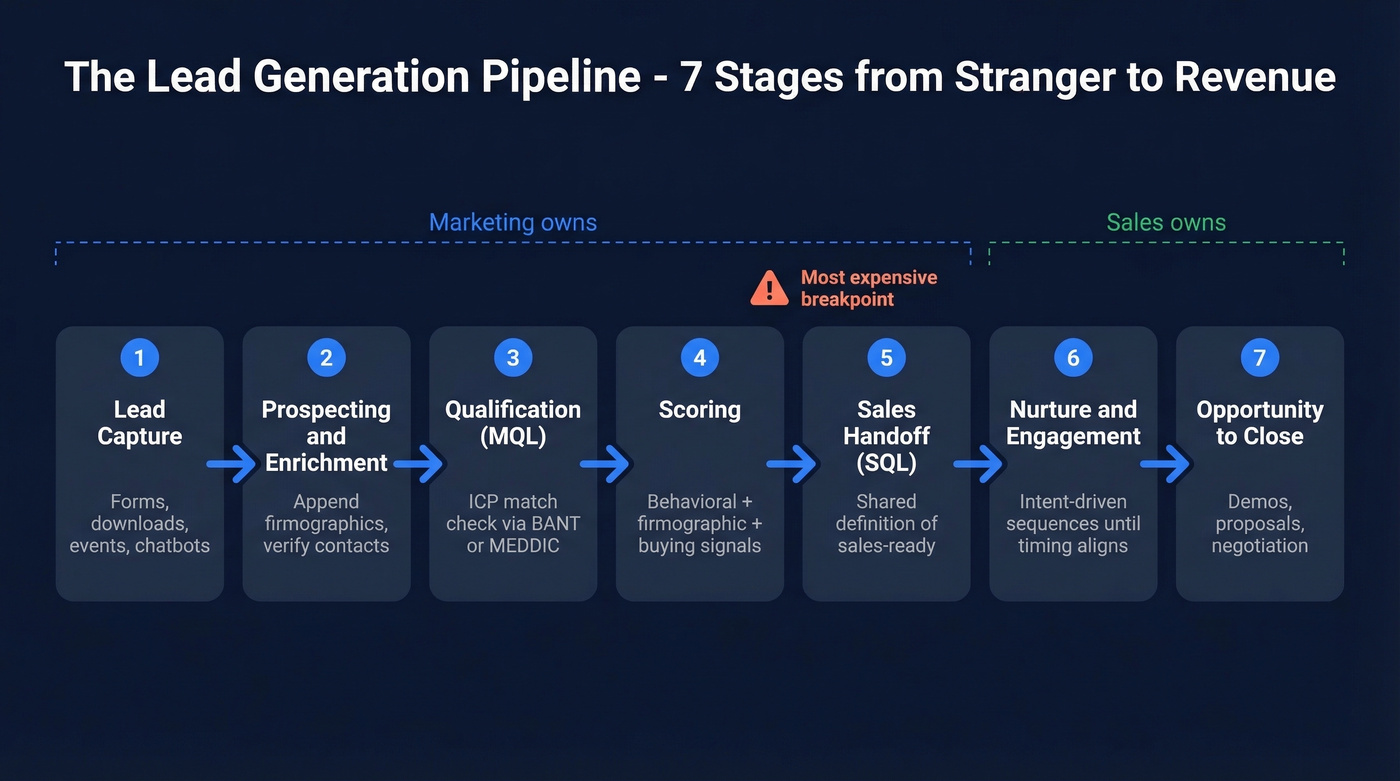
2. Prospecting & Enrichment. Raw leads need context. Append firmographic data, verify contact information, fill gaps your forms didn't capture. Prospeo handles this with 300M+ professional profiles, 98% email accuracy, and a 7-day data refresh cycle - so enrichment data is still accurate when your SDR reaches out days later.
3. Qualification (MQL). Does this lead match your ICP? Use BANT or MEDDIC, but the core question is simple: does this person work at a company that could buy, in a role that influences the decision?
4. Scoring. Not every MQL deserves the same urgency. Layer behavioral signals on top of firmographic fit to prioritize who gets called first.
5. Sales Handoff (SQL). The most expensive broken process in B2B. Marketing and sales need a shared, written definition of "sales-ready." Transfer behavior history and scoring rationale - not just a name and email.
6. Nurture & Engagement. Leads that aren't ready go into intent-driven sequences until timing aligns. Generic "just checking in" emails don't count.
7. Opportunity to Close. Sales takes over with demos, proposals, negotiation. Your pipeline's job is to deliver leads that actually show up.
Full-Funnel Benchmarks
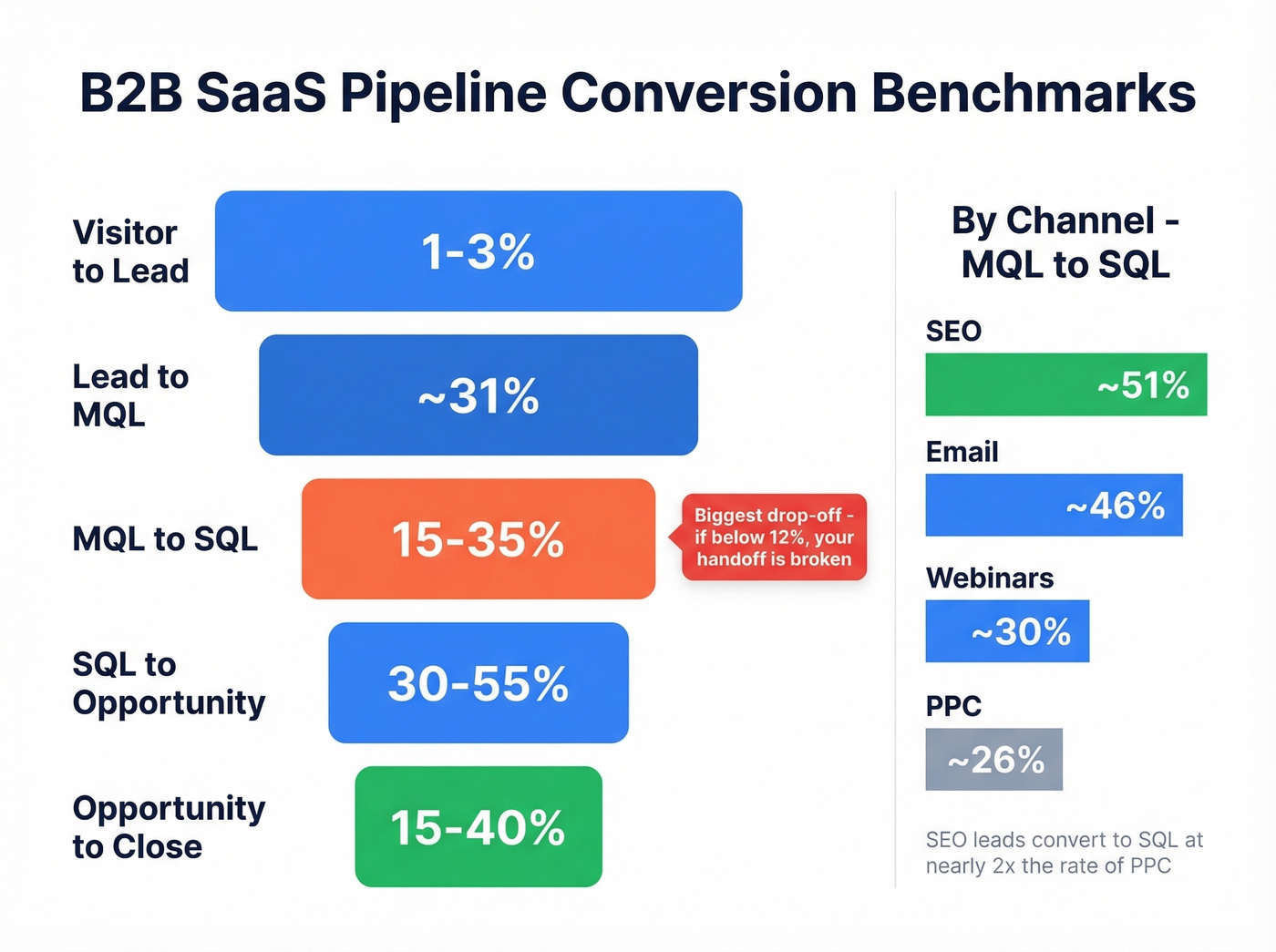
These are B2B SaaS benchmarks. Stop guessing whether your conversion rates are good.
| Stage Transition | Benchmark Range |
|---|---|
| Visitor to Lead | 1-3% |
| Lead to MQL | ~31% |
| MQL to SQL | 15-35% |
| SQL to Opportunity | 30-55% |
| Opportunity to Close | 15-40% |
The biggest drop-off is MQL to SQL. If yours is below 12%, your qualification criteria or your handoff process is broken - probably both. Not all MQLs are created equal, and channel dynamics explain most of the variance.
| Channel | MQL to SQL | Opp to Close |
|---|---|---|
| SEO | ~51% | ~36% |
| ~46% | ~33% | |
| Webinars | ~30% | ~40% |
| PPC | ~26% | ~35% |
SEO leads convert to SQL at nearly double the rate of PPC leads. Webinars convert fewer MQLs but close at the highest rate. Build your pipeline model around these channel dynamics, not blended averages - early-stage companies typically see MQL-to-Close rates of 1-2%, while enterprise orgs with mature processes hit 4-7%.

Bad data is the silent pipeline killer - 35% bounce rates shrink your pipeline overnight and torch your domain reputation. Prospeo's 5-step verification delivers 98% email accuracy with a 7-day refresh cycle, so your enrichment data is still valid when SDRs reach out. Meritt tripled their pipeline from $100K to $300K/week after switching.
Stop feeding your pipeline dead emails. Start with data that connects.
How to Build a Lead Scoring Model
Here's a scoring template you can implement this week, weighted across three signal categories:
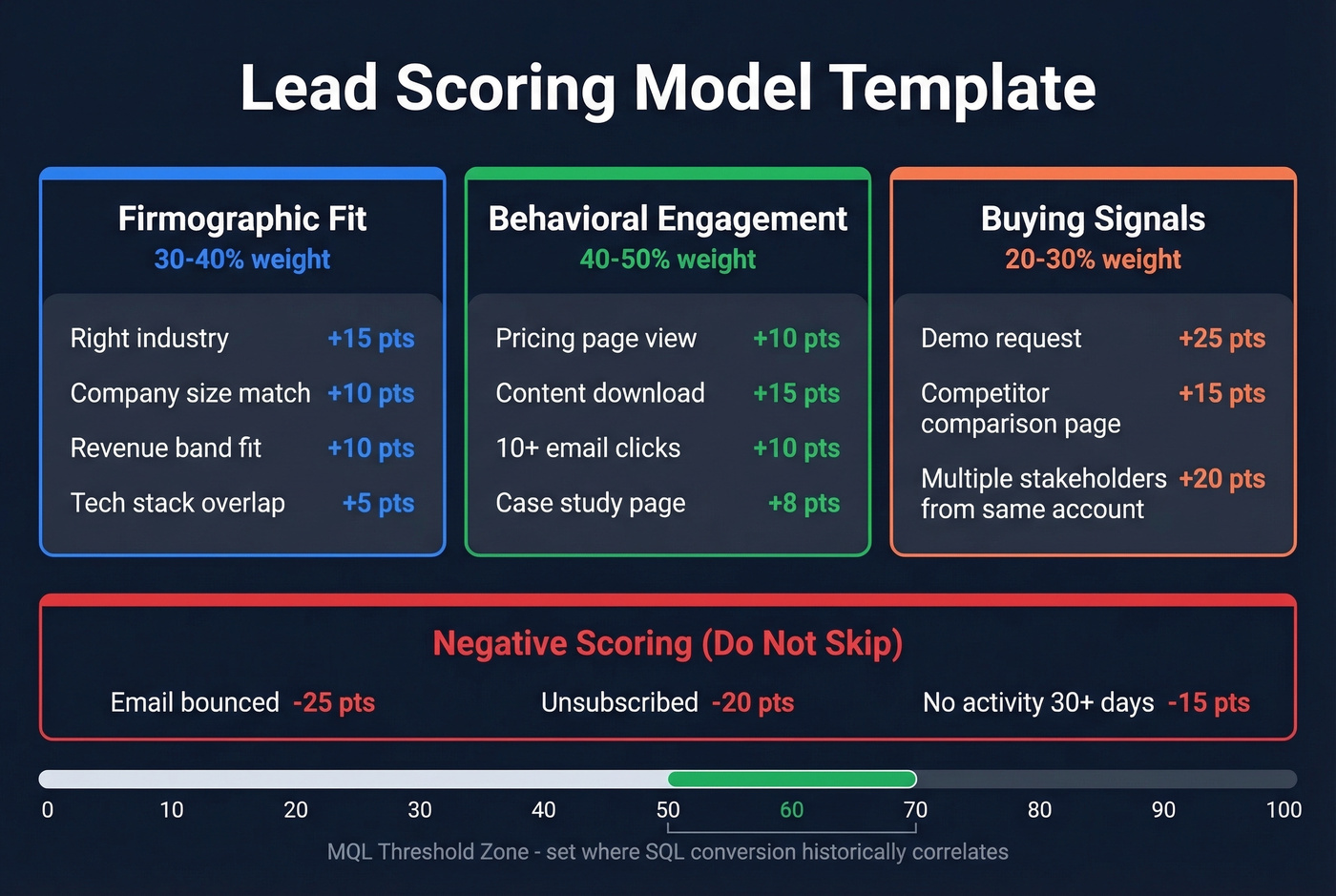
Firmographic fit (30-40%): Right industry, company size, revenue band, tech stack.
Behavioral engagement (40-50%): Pricing page views +10 pts, content downloads +15 pts, 10+ email clicks +10 pts. Prioritize on-site behavior over email opens - privacy changes have made open tracking unreliable.
Buying signals (20-30%): Demo requests, competitor comparison page visits, multiple stakeholders from the same account engaging.
Negative scoring matters just as much. Email bounced? That's -25 points. Unsubscribed? Subtract accordingly. In our experience, teams that skip negative scoring end up with inflated MQL counts that waste SDR hours. Set your MQL threshold at a score that historically correlates with SQL conversion - for most teams, somewhere around 50-70 points.
Pipeline Velocity Formula
Lead count is a vanity metric. Pipeline velocity tells you how fast your system generates revenue.
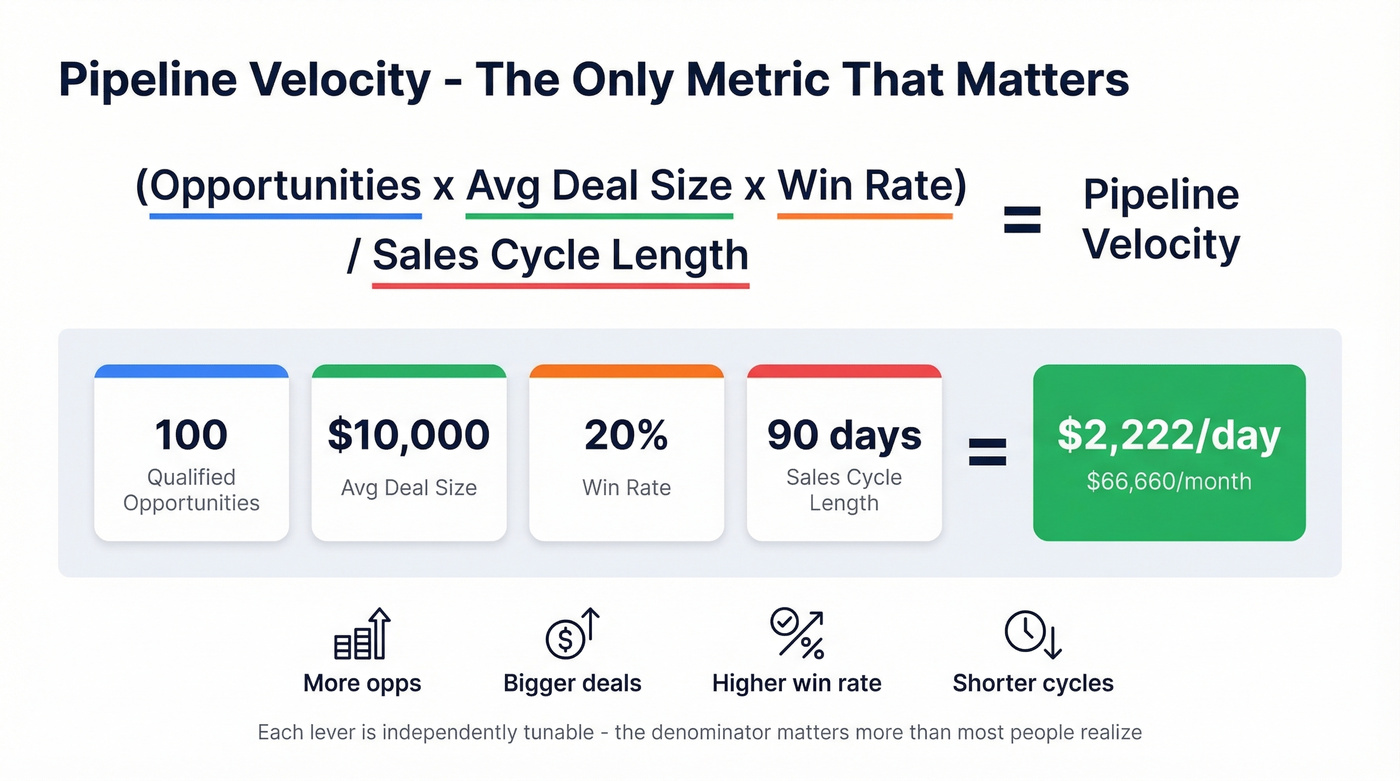
Pipeline Velocity = (Opportunities x Avg Deal Size x Win Rate) / Sales Cycle Length
Worked example: 100 qualified opportunities x $10,000 average deal x 20% win rate / 90-day sales cycle = $2,222/day, roughly $66,660/month.
Four levers, each independently tunable. We've watched teams obsess over opportunity count while ignoring cycle length - the denominator matters more than most people realize. Track this monthly or quarterly. Weekly is noise.
Five Ways Your Pipeline Breaks
1. Misaligned handoffs. Define a written SLA with response times and acceptance criteria tied to revenue outcomes, not activity metrics. If nobody owns the MQL-to-SQL transition, leads die in the gap.
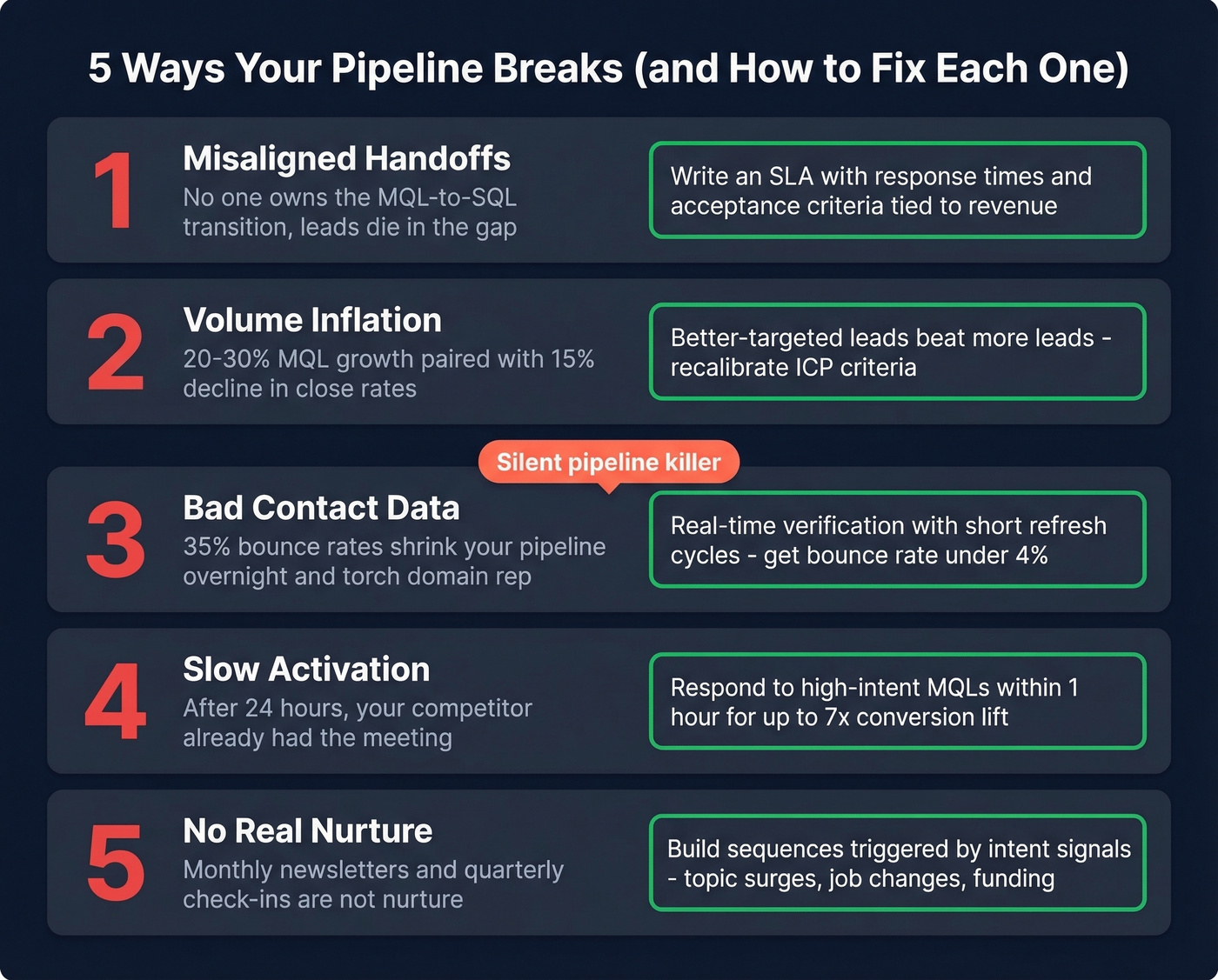
2. Volume inflation. Here's the thing: if your average deal size sits below $10K, you probably don't need 10,000 MQLs a month. We've seen 20-30% MQL growth paired with 15% declines in close rates repeatedly. Better-targeted leads beat more leads every time.
3. Bad contact data - the silent pipeline killer. Your SDR sends 500 emails Monday. By Wednesday, 180 have bounced. Your pipeline is a third smaller than your CRM claims, and your domain reputation just took a hit. Meritt saw their bounce rate drop from 35% to under 4% after switching to real-time verification, and their pipeline tripled from $100K to $300K per week.
4. Slow activation. Responding to high-intent MQLs within the first hour increases conversion probability up to 7x. After 24 hours, your competitor already had the meeting.
5. No real nurture. If your "nurture" is a monthly newsletter and a quarterly check-in, you don't have a nurture program. Build sequences triggered by intent signals - topic surges, job changes, funding events.
The Pipeline Tech Stack
You need four capabilities that talk to each other. Not fifteen tools. ~41% of sales reps' time goes to non-revenue activities, and over 30% of that is automatable. The right stack eliminates the waste. The wrong one creates it.
| Pipeline Stage | Tool Category | Options | Cost Range |
|---|---|---|---|
| CRM | Record system | HubSpot (Free-$150/user/mo) or Salesforce ($25-$350/user/mo) | Free-$350/user/mo |
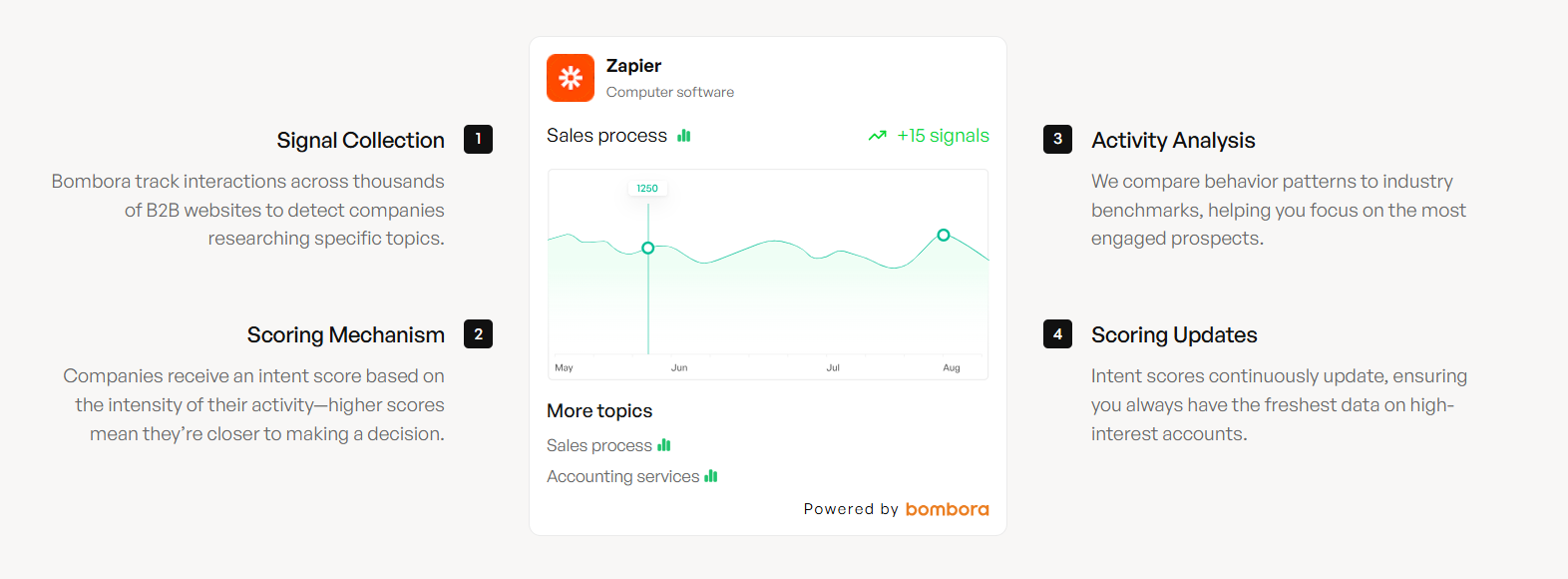
| Prospecting + Intent | Data, verification, buyer signals | Prospeo (includes Bombora intent data on 15,000 topics) | ~$0.01/email, free tier available |
| Engagement | Sequences + calls | Instantly (~$30/mo), Smartlead (~$39/mo), or Salesloft (~$75-$150/user/mo) | $30-$150/user/mo |
Connect these via native integrations or Zapier and you've covered the full pipeline without tool sprawl. Skip this section if you already have a working stack - adding tools to a broken process just makes the process break faster and more expensively.
Let's be honest about something the consensus on r/sales keeps reinforcing: the best tech stack in the world won't fix a pipeline where marketing and sales can't agree on what "qualified" means. Get the definitions right first. Then automate.
Stage 2 of your pipeline - enrichment - determines everything downstream. Prospeo fills the gaps with 300M+ profiles, 125M+ verified mobiles, and 30+ filters including buyer intent and technographics. At $0.01 per email, you get enterprise-grade enrichment without the enterprise contract.
Enrich every lead in your pipeline before your competitor books the meeting.
FAQ
How Long Does It Take to Build a Pipeline?
Expect 2-4 weeks for the framework - stages, scoring, handoff definitions, tool integrations. You'll need another 2-3 months of live data before conversion benchmarks are reliable enough to optimize against.
What's a Good Pipeline Coverage Ratio?
Maintain 3-4x your revenue target in active pipeline. A quarterly goal of $500K means $1.5-2M in qualified opportunities to absorb natural attrition at each stage.
Inbound vs. Outbound: Which Fills Faster?
Outbound fills faster - SQLs within days. Inbound converts better long-term, with SEO leads hitting ~51% MQL-to-SQL versus ~26% for PPC. The best pipelines blend both channels and weight scoring accordingly.
How Do I Fix Bad Contact Data?
Check your bounce rate first. If it's above 5%, your pipeline is inflated with phantom opportunities. Real-time verification with a short refresh cycle keeps bounce rates under 4% - Meritt and Snyk both saw 30%+ bounce rates drop below 5% after switching providers, with pipeline revenue following.