

Lead Lifecycle Stages: What They Are, How They Convert, and How to Design Yours
A RevOps lead we know rebuilt her lead lifecycle stages three times in one quarter - not because the CRM was broken, but because nobody agreed on what "MQL" meant. Marketing counted 400 MQLs. Sales said they got 40 worth calling. The funnel report was fiction.
That disconnect costs real money. Aberdeen Group found that companies with strong sales/marketing alignment achieve 20% annual growth, while poorly aligned orgs see a 4% revenue decline. The fix starts with nailing your lifecycle definitions, benchmarks, and handoff rules.
What Are Lead Lifecycle Stages?
Lead lifecycle stages are the macro phases a contact moves through from first touch to closed deal and beyond. Think of them as a one-way escalator: Subscriber, Lead, MQL, SQL, Opportunity, Customer, Evangelist - with "Other" as an exception bucket that shouldn't enter your funnel at all. Each stage has an owner (marketing or sales), an entry trigger, and a clear handoff point.
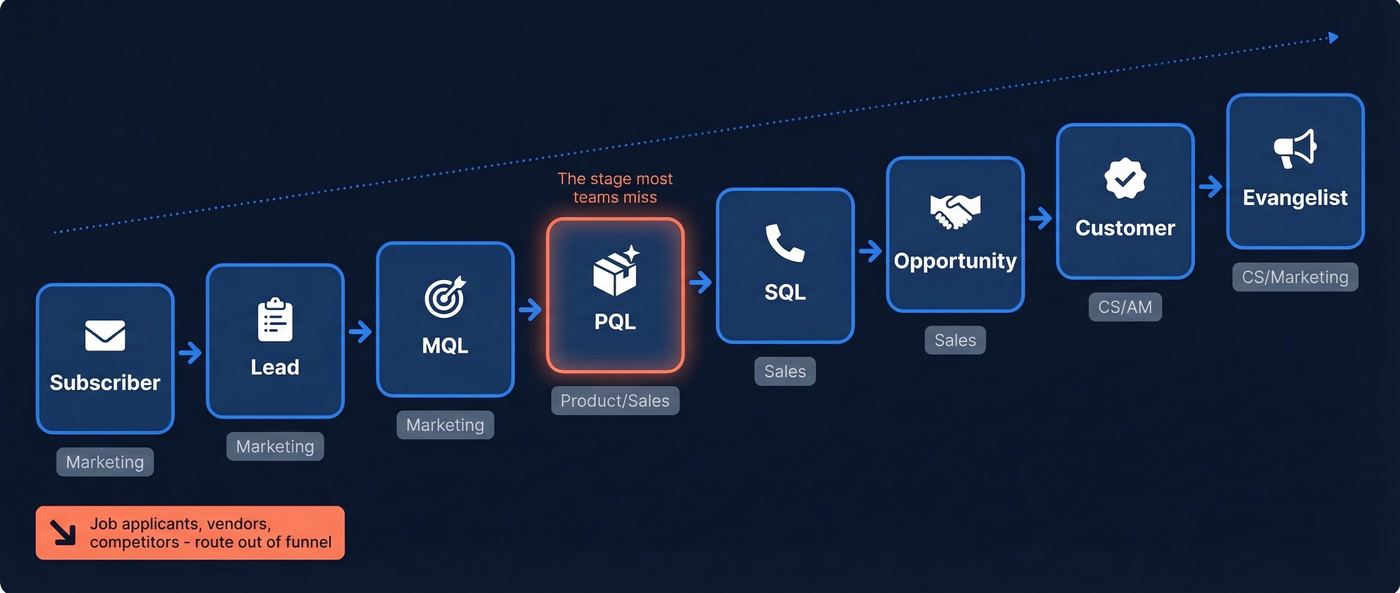
They're CRM-agnostic. Whether you're in HubSpot, Salesforce, or Marketo, the logic is the same even if the objects and field names differ. The purpose is alignment: marketing and sales agree on what each stage means, who owns it, and what triggers the transition. Getting your CRM lead stages right is the foundation - everything downstream depends on it.
Quick Version: What You Need
- The 7+1 stages for most B2B teams: Subscriber, Lead, MQL, PQL, SQL, Opportunity, Customer, Evangelist. PQL is the "+1" you add when you run a product-led motion.
- The biggest drop-off: MQL to SQL converts at just 15-35%. Fix it with lead scoring thresholds and an SLA that measures response time in minutes, not days.
- None of it works on bad data. If your contact data is wrong, your MQL count gets inflated and sales stops trusting the handoff. Verify before routing.
Lifecycle Stage vs. Lead Status vs. Deal Stage
These three concepts get conflated constantly, and it causes real damage to funnel reporting.
| Concept | Scope | Direction | Example |
|---|---|---|---|
| Lifecycle stage | Macro journey | Forward only | Lead → MQL → SQL |
| Lead status | Micro sales status | Bidirectional | Connected → Bad Timing |
| Deal stage | Opportunity pipeline | Bidirectional | Discovery → Proposal |
Lifecycle stages track the person's relationship with your company. Lead statuses track where a salesperson is in working that person right now. Deal stages track a specific opportunity through your pipeline.
Two mistakes NewBreed flags that we see constantly: matching lifecycle stage to lead status one-to-one (they serve different purposes), and not using lead statuses at all, which makes recycling and nurture impossible without moving lifecycle backward.

Bad data inflates your MQL count and destroys sales trust in the handoff. Prospeo's 98% email accuracy and 7-day refresh cycle mean every lead that hits SQL actually has a working email and verified phone number - no more fictional funnel reports.
Stop routing dead contacts to sales. Verify before you qualify.
The 7 Stages Plus One Most Teams Miss
| Stage | Entry Trigger | Owner |
|---|---|---|
| Subscriber | Opts into content | Marketing |
| Lead | Fills out a form or downloads | Marketing |
| MQL | Hits scoring threshold | Marketing |
| PQL | Product usage signals | Product/Sales |
| SQL | Sales validates fit + interest | Sales |
| Opportunity | Discovery done, deal created | Sales |
| Customer | Closed-won | CS/AM |
| Evangelist | Refers, reviews, advocates | CS/Marketing |
The stage most teams miss is PQL - product-qualified lead. If you're running any PLG motion (free trial, freemium, interactive demo), you need it. A PQL has experienced your product and shown intent through behavior, not just content engagement. Gartner's research supports this: 83% of the buying journey is complete before a prospect talks to sales. PQLs capture that reality.
Example PQL triggers to calibrate against your own data: logging in 5-10 times per week, inviting collaborators, running multiple workflows, or viewing the pricing page. These signals are far stronger than downloading a whitepaper, and behavior-triggered campaigns built around them drive up to 4x more revenue than batch emails.
PLG conversion benchmarks worth knowing: CRM free trials convert to paid at roughly 29%, general free trials at 18-29%, and freemium at just 3.4%. If your PQL-to-paid rate falls below these ranges, your product-qualification triggers need recalibrating.
Conversion Benchmarks by Stage
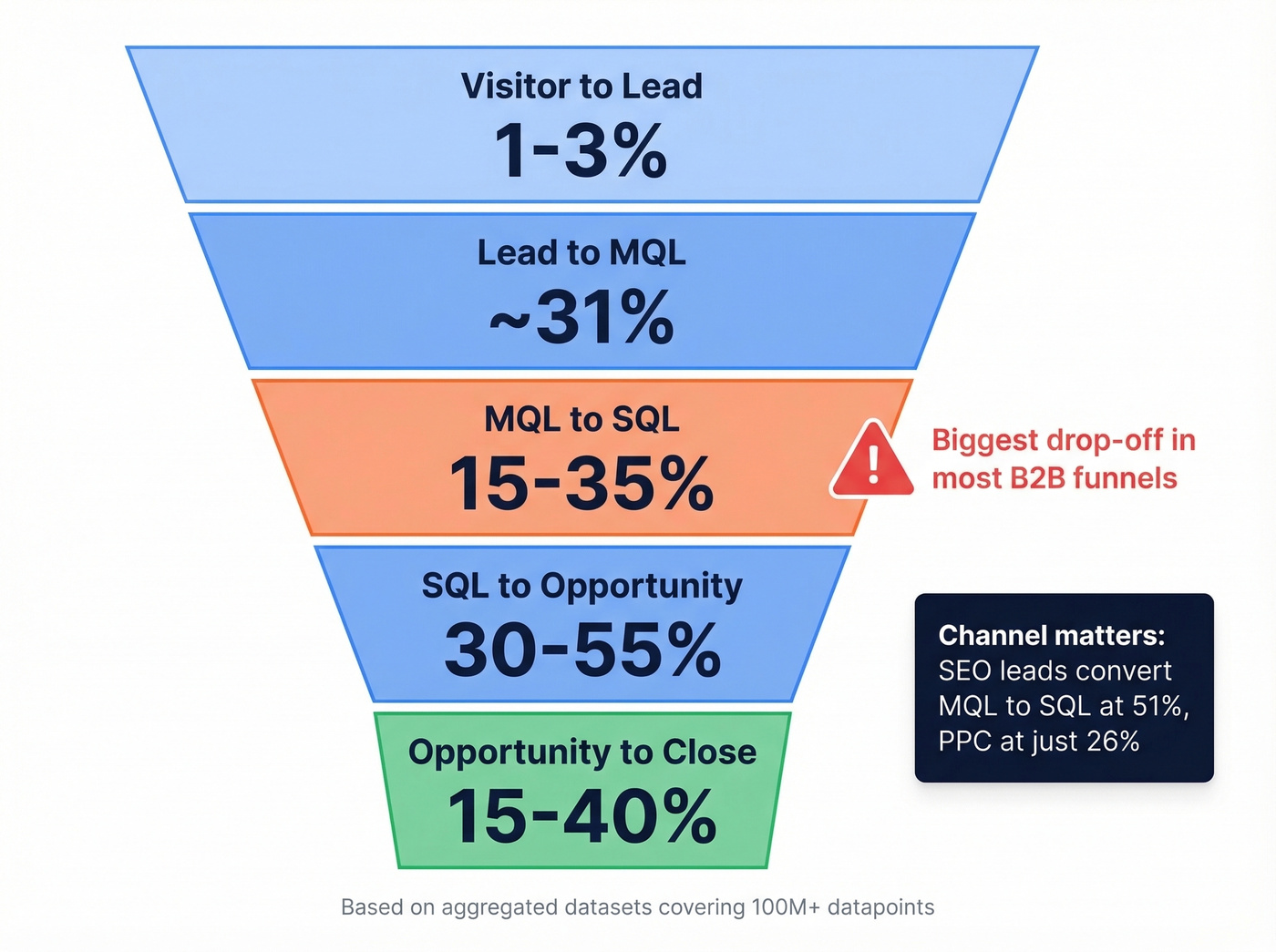
These ranges come from aggregated datasets covering 100M+ datapoints:
| Transition | Benchmark Range |
|---|---|
| Visitor → Lead | 1-3% |
| Lead → MQL | ~31% |
| MQL → SQL | 15-35% |
| SQL → Opportunity | 30-55% |
| Opportunity → Close | 15-40% |
The MQL-to-SQL transition is the biggest drop-off in virtually every B2B funnel. MarketJoy's client data benchmarks it at just 15%.
Industry matters enormously. First Page Sage's analysis across 2019-2026 data shows significant variance:
| Industry | MQL → SQL |
|---|---|
| B2B SaaS | 13% |
| eCommerce | 23% |
| Business Insurance | 26% |
| Cybersecurity | 15% |
| Higher Education | 21% |
| Financial Services | 13% |
| Construction | 12% |
Channel matters too. SEO-sourced MQLs convert to SQL at 51%, while PPC-sourced MQLs convert at just 26%. If you aren't segmenting conversion rates by source, your benchmarks are misleading you.
Here's the thing: if your blended MQL-to-SQL rate is above 50%, your scoring threshold is probably too conservative. You're leaving pipeline on the table by only passing slam dunks to sales.
Company maturity also shifts expectations. Early-stage companies typically see 1-2% MQL-to-Close, growth-stage 2-4%, and enterprise 4-7%. Stop comparing your Series A funnel to Salesforce's.
Scoring as a Qualification Gate
Lead scoring can drive up to 77% higher lead-gen ROI and shorten sales cycles by 23% when the MQL definition is aligned across teams. Yet most teams either over-engineer scoring or barely invest in it.
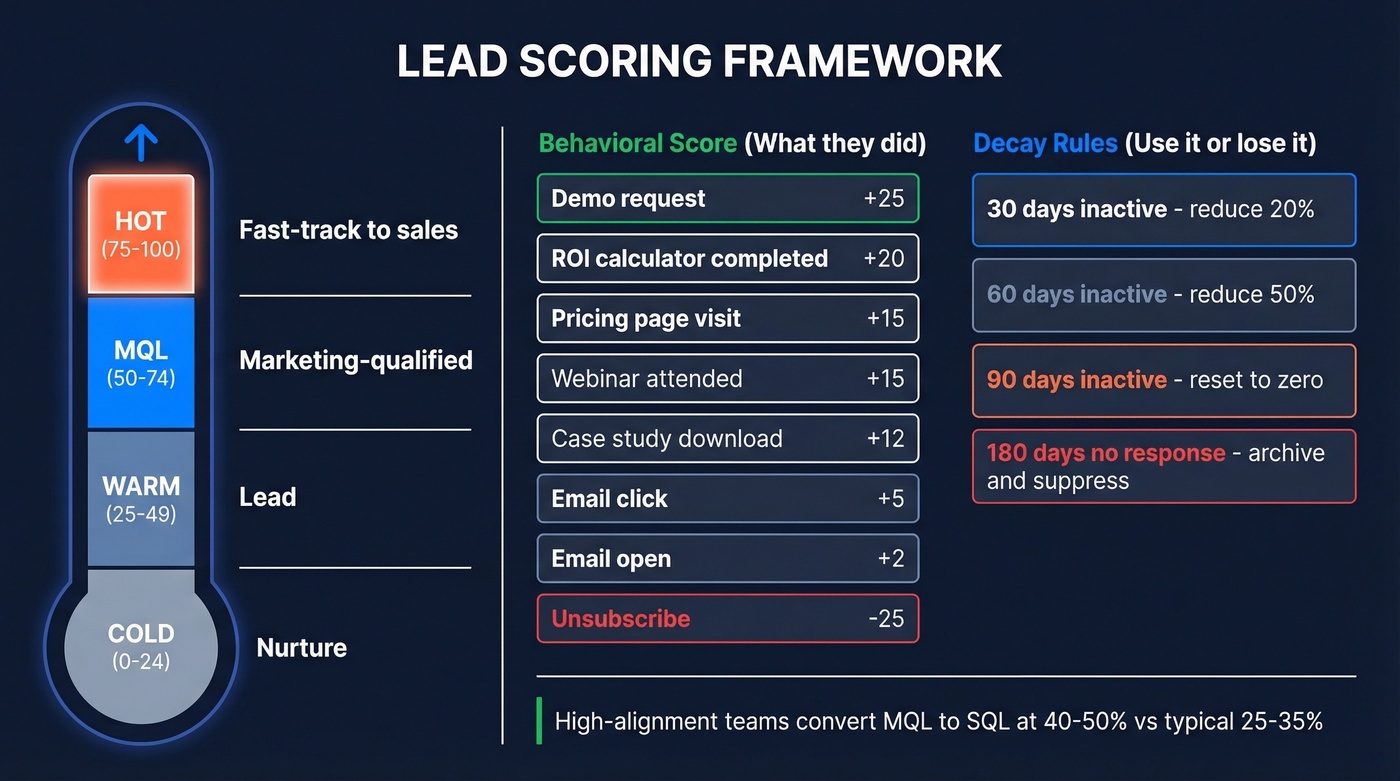
The key distinction: score measures behavioral intent (what they did), while grade measures firmographic fit (who they are). You need both. Together they power the qualification stage - the moment a lead earns enough points and profile fit to warrant a sales conversation.
| Band | Score | Stage |
|---|---|---|
| Cold | 0-24 | Nurture |
| Warm | 25-49 | Lead |
| MQL | 50-74 | Marketing-qualified |
| Hot | 75-100 | Fast-track to sales |
Starting point values we've found useful: pricing page visit +15, demo request +25, case study download +12, ROI calculator completed +20, webinar attended +15, email open +2, email click +5, unsubscribe -25. Adjust based on what actually correlates with closed-won in your data - these are starting points, not gospel.
Decay rules prevent stale leads from clogging the funnel. After 30 days of inactivity, reduce behavioral score by 20%. At 60 days, cut it 50%. At 90 days, reset to zero and trigger re-engagement. At 180 days with no response, archive and suppress. Without decay, your MQL pool fills with ghosts.
High-alignment organizations convert MQL to SQL at 40-50%, compared to a typical 25-35%. The difference isn't just better scoring - it's cleaner data feeding the model. When sales can't reach leads because the email bounces or the phone number's dead, they stop trusting every handoff marketing sends over. In our experience, data quality is the silent killer of MQL-to-SQL conversion more often than scoring logic is.
Your scoring model is only as good as the data feeding it. With 83% enrichment match rates and 50+ data points per contact, Prospeo gives you the firmographic and behavioral signals you need to score leads accurately - at $0.01 per email, not $1.
Enrich every lead in your lifecycle with data sales actually trusts.
How to Design Your Own Lifecycle Framework
Don't start with CRM configuration. Start with stakeholder interviews. Then follow this framework:
1. Map the actual workflow. Sit marketing, sales, and CS in a room. Document how leads really move today before touching a single field. We've seen teams skip this step and spend months configuring a CRM workflow that nobody follows - the old process just continues in spreadsheets and Slack DMs.
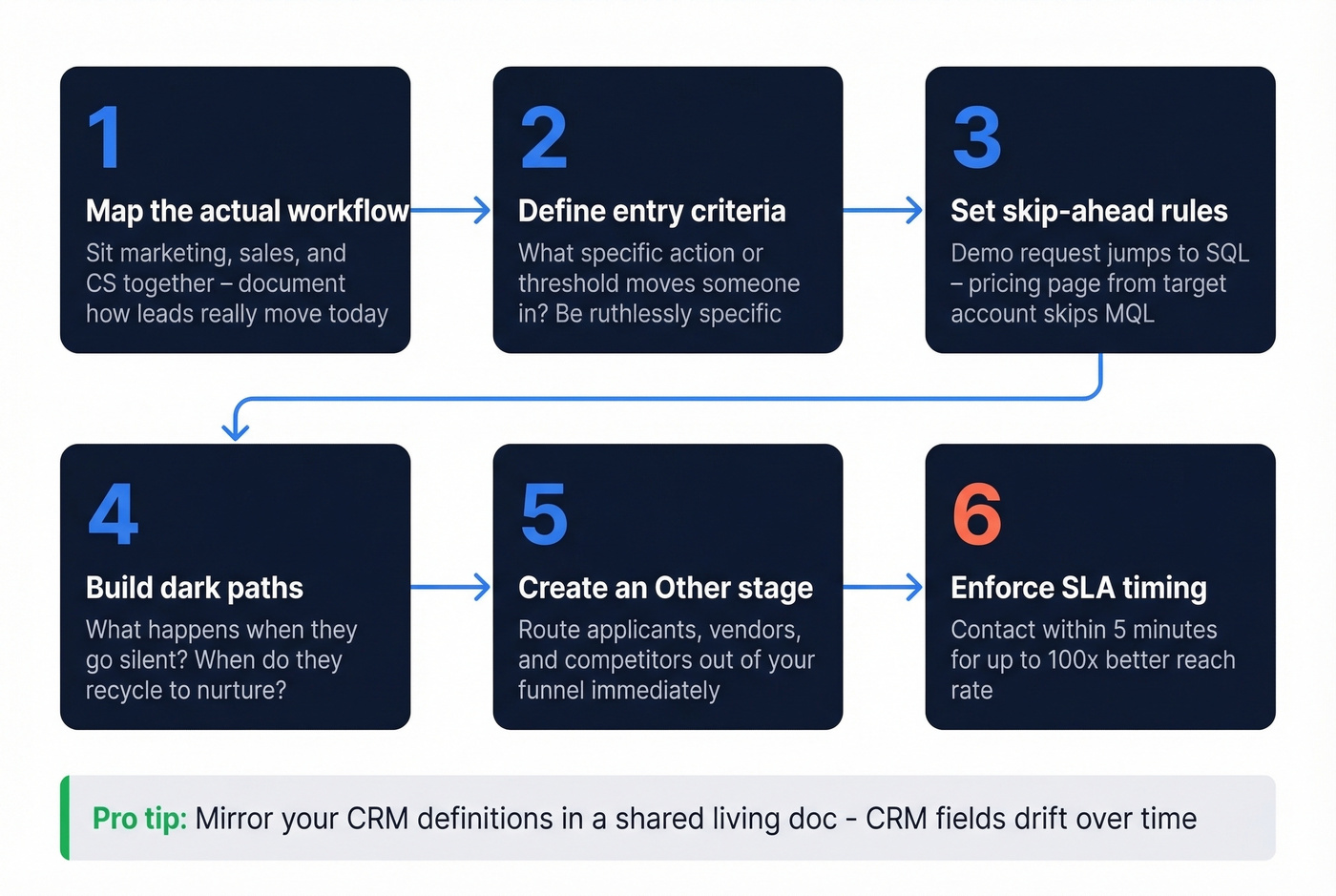
2. Define entry criteria for each stage. What specific action or threshold moves someone in? Be ruthlessly specific. "Engaged" isn't a trigger.
3. Set skip-ahead rules. A demo request can jump straight to SQL. A pricing page visit from a ideal customer profile might skip MQL entirely. Document the conditions so reps don't have to guess.
4. Build dark paths. What happens when they go silent? At what point do they recycle to nurture? When does sales get re-notified if they return? Effective lifecycle management means having automated re-engagement sequences that fire before leads go completely cold.
5. Create an "Other" stage. Job applicants, vendors, employees, and competitors aren't prospects. Route them out of your funnel immediately so they don't pollute metrics.
6. Enforce SLA timing. Contacting leads within 24 hours increases conversion by 5x, and contacting a lead within 5 minutes can increase your chances of reaching them by up to 100x. The best teams we've worked with measure response time in minutes, not hours.
Once your lead stages in CRM are configured, mirror the definitions in a shared document that both marketing and sales reference. CRM fields drift over time; a living doc keeps everyone honest.
Let's be clear about one more thing: separate lifecycle stages from sales methodologies. MEDDIC, Sandler, BANT - these belong in opportunity fields, not lifecycle definitions. Trying to encode your qualification framework into lifecycle stages creates a mess nobody maintains.
FAQ
How many stages should I use?
Most B2B teams need 7-8: Subscriber through Evangelist, plus PQL if running product-led growth. Start simple and add stages only when you have a genuine routing decision that requires one. Over-engineering with 12+ stages creates CRM clutter nobody maintains.
What's the difference between MQL and SQL?
An MQL is marketing-qualified - enough engagement or fit signals to warrant sales attention, automated via scoring. An SQL is sales-qualified - a salesperson has confirmed interest and scheduled discovery. MQL is an automated threshold; SQL requires human validation.
How does bad contact data affect lifecycle reporting?
Leads with invalid emails or disconnected phones stall at MQL - sales marks them "Unqualified" even when they were genuinely interested. This inflates disqualification rates and breaks funnel reporting. Verifying contact data before it enters your CRM keeps lifecycle metrics accurate and ensures sales can actually reach the leads marketing generated.
What MQL-to-SQL conversion rate should I target?
For B2B SaaS, 13-20% is typical; 30%+ signals strong alignment between marketing scoring and sales expectations. Below 10% means your scoring model is too loose or your data quality needs work. Above 50% often means you're being too conservative and starving the pipeline.