

The Best Lead Mining Software in 2026
A 10-seat sales intelligence contract with mobile numbers and intent data can easily run $30-60k/year. Meanwhile, your reps bounce enough emails to damage deliverability and torch your sender domain in the process. The lead mining software market hit $2.7B in 2026 and is racing toward $17.4B by 2035 at a 23% CAGR - which means there are more options than ever, and more ways to waste money than ever.
Why Lead Mining Matters Now
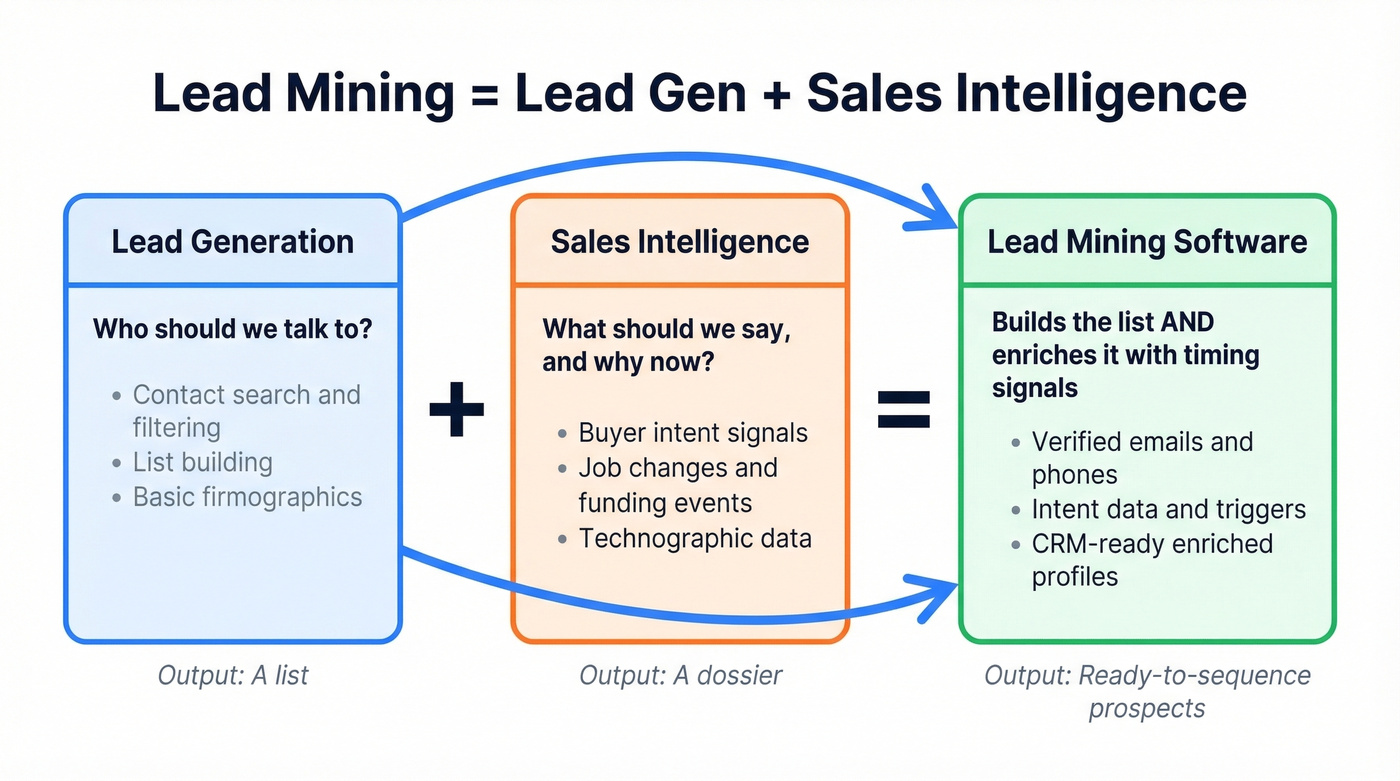
Lead generation answers "who should we talk to?" and outputs a list. Sales intelligence answers "what should we say, and why now?" and outputs a dossier. Lead mining software does both - it builds the list AND enriches it with timing signals like buyer intent, job changes, and funding events so you know who to call and when.
The core capabilities you're evaluating: contact search and filtering, email/phone verification, data enrichment, intent data, and CRM integration. Every tool on this list covers at least three. The difference is how well they execute each one, and what it actually costs once you're past the free tier.
Our Picks (TL;DR)
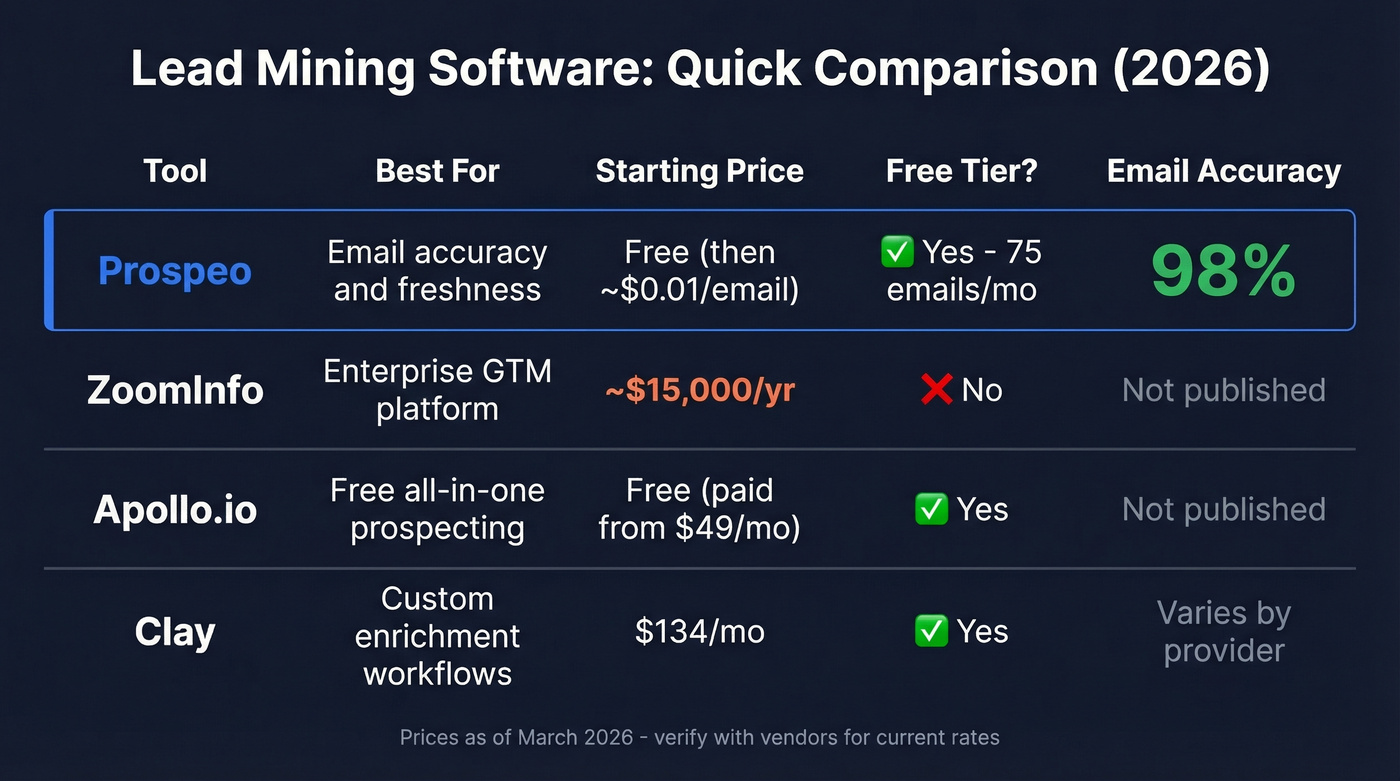
If we had to trial three this week: Prospeo for email accuracy, Apollo for a free all-in-one, and Clay if your ops team wants custom enrichment workflows.
| Tool | Best For | Starting Price | Database Size | Free Tier |
|---|---|---|---|---|
| Prospeo | Email accuracy & freshness | Free (75 emails + 100 extension credits/mo) | 300M+ profiles | Yes |
| ZoomInfo | Enterprise GTM platform | ~$15,000/yr | 500M+ contacts | No |
| Apollo.io | Free all-in-one prospecting | Free | 275M+ contacts | Yes |
| Cognism | EMEA compliance & mobiles | ~$15,000/yr | Global coverage | No |
| Clay | Custom enrichment workflows | $134/mo (annual) | 50+ data sources | Yes |
| Lusha | Quick individual lookups | $22.45/mo | Not public | Yes |
| UpLead | Mid-market verified data | $99/mo | 108M+ contacts | Trial (7 days) |
| RocketReach | Broad coverage on a budget | $33/mo (annual) | 700M+ profiles | Yes (limited) |
| Hunter | Domain email search | Free | Not public | Yes |
| Snov.io | Solopreneurs + drip campaigns | Free | Not public | Yes |
Top 10 Lead Mining Tools Reviewed
Prospeo
Use this if you're tired of bouncing emails and want the freshest data in the category without signing an annual contract.
Prospeo's database covers 300M+ professional profiles, 143M+ verified emails, and 125M+ verified mobile numbers - all refreshed on a 7-day cycle. That refresh cadence matters more than raw database size. The industry average is six weeks, which means most tools serve stale data by default.

The 98% email accuracy comes from a proprietary 5-step verification process that handles catch-all domains, spam traps, and honeypots. Snyk's team of 50 AEs saw bounce rates drop from 35-40% to under 5% after switching, generating 200+ new opportunities per month. Over 30 search filters include Bombora intent data across 15,000 topics, technographics, job changes, and funding signals. Native integrations cover Salesforce, HubSpot, Smartlead, Instantly, Lemlist, Clay, Zapier, Make, and more. Pricing runs ~$0.01 per email with a free tier of 75 verified emails monthly. No contracts, no sales calls.
Pair with Instantly or Lemlist if you need outreach sequencing - Prospeo handles the data, they handle the sending.
ZoomInfo
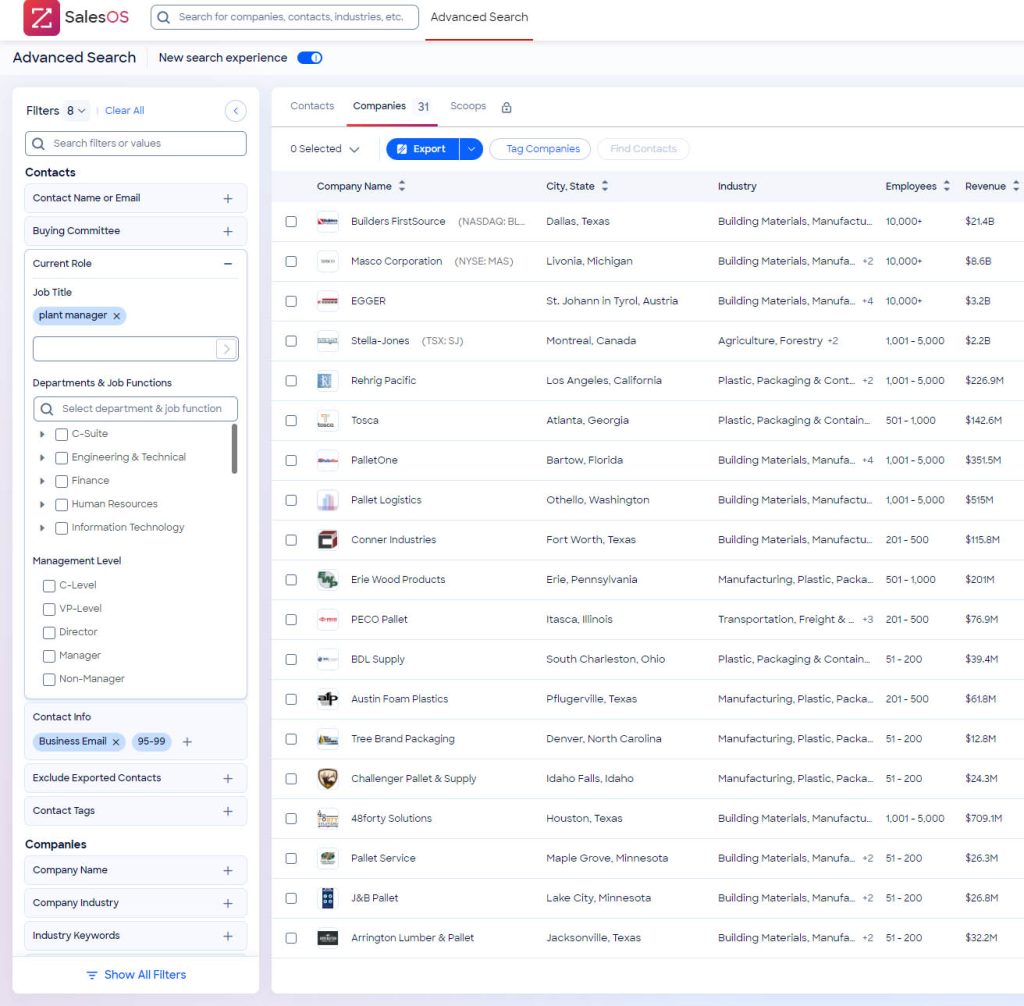
ZoomInfo is the incumbent for a reason. Users on G2 often praise its contact depth, ease of use, and feature breadth - 4.5/5 from 9,035 reviews. But the #1 complaint? Price. Specifically, paying for modules you don't use.
Professional starts at $15,000/year. Advanced runs $24,000+. Elite hits $40,000+. Then add-ons stack: Global Data ($9,995), extra credits (~$3,000 per 5,000), and NeverBounce verification (~$3,000). Some teams end up paying close to $50,000/year once all fees land. Discounts of 30-65% are common if you negotiate hard, but you shouldn't have to fight your vendor for a fair price.
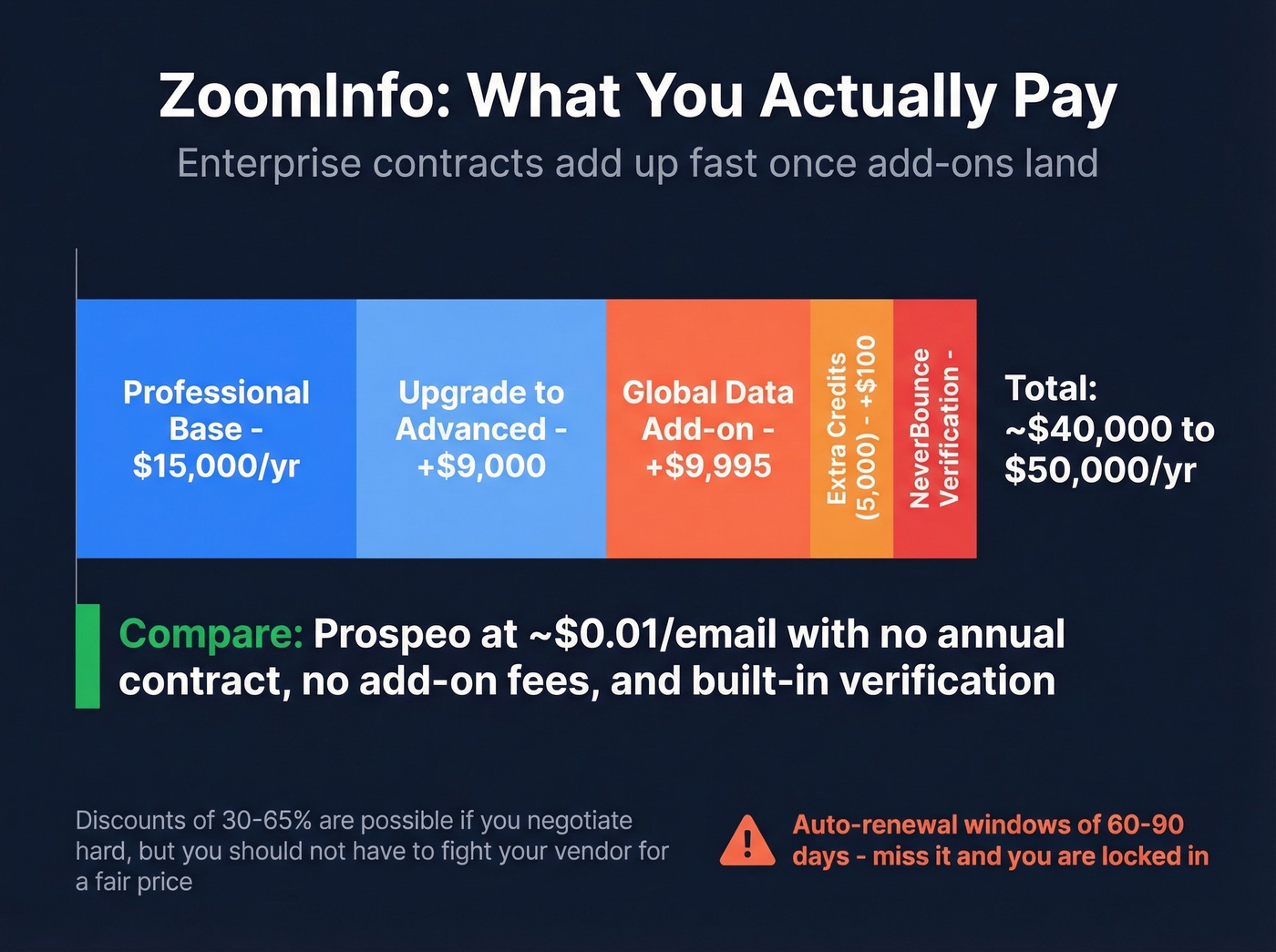
Contracts run 2-3 years with auto-renewal windows of 60-90 days - miss that window and you're locked in. Here's the thing: most teams under 50 reps are overpaying by 40-60%. If you're not using the intent modules, the chat features, and the workflow automation, you're subsidizing features you'll never touch. When your average deal size doesn't justify enterprise tooling, you almost certainly don't need ZoomInfo-level infrastructure.
Skip this if your team is under 20 reps or your budget is under $20k/year.
Apollo.io
Apollo flips the traditional model on its head. Instead of gating everything behind a sales call, the free plan includes 50 AI credits and up to 2 sequences - enough to build your first list and run a test sequence. Basic runs $49/mo, Professional $79/mo, and Organization $119/mo (minimum 3 seats).
The catch: credits don't roll over. They're tied to your billing cycle, and automatic overages can surprise you. We've seen teams love Apollo in month one, then panic about credit burn by month three. Where Apollo beats ZoomInfo: speed to value - a rep can sign up, build a list, and launch a sequence in 30 minutes. Where ZoomInfo still wins: database depth for enterprise accounts and intent data sophistication.
Skip this if you need predictable monthly costs or you're running high-volume enrichment workflows.
Cognism
Cognism's sweet spot is EMEA-heavy prospecting with verified mobile numbers. The platform carries GDPR, SOC2, and ISO27001 certifications and handles DNC list checks natively - a real differentiator if you're selling into the UK or EU.
Pricing isn't public. The typical structure: a platform fee (~$15,000/year for Grow, ~$25,000 for Elevate) plus per-seat licensing (~$1,500-$2,500/user/year). "Unlimited" access is capped by fair use - expect roughly 2,000 records per user per month. Onboarding runs $500-$5,000 depending on team size, intent topic add-ons cost $75-$400 each, and renewal increases of 10-15% annually are standard. No free trial.
Skip this if you're NA-only and don't need GDPR-specific compliance tooling.
Clay
Clay isn't a database. It's a no-code orchestration layer that connects 50+ data sources through waterfall enrichment - try Provider A, then B, then C - yielding 20-40% higher match rates than single-provider tools. G2 gives it a 4.9/5, and the community enthusiasm on Reddit is genuine; ops teams treat it like a superpower.
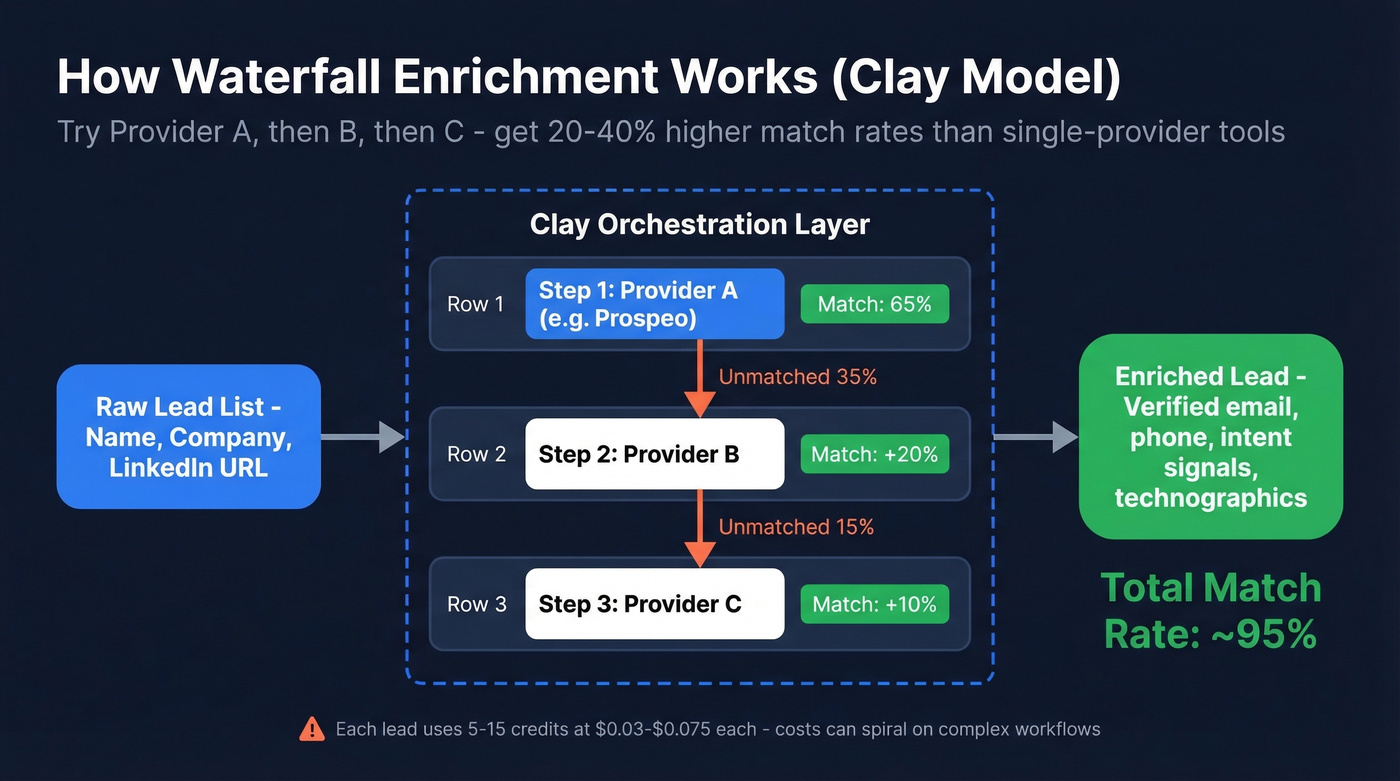
Starter runs $134/mo (2,000 credits), Explorer $314/mo, Pro $720/mo. Each lead consumes 5-15 credits at $0.03-$0.075 each, so costs can spiral on complex workflows. No outreach built in - you'll need a sending tool alongside it. Brilliant for ops teams who love building workflows, but the learning curve is real. If your team doesn't have someone who enjoys tinkering with automations, Clay will collect dust.
Lusha
Lusha starts at $22.45/mo with annual billing and offers a free plan. The Chrome extension is fast for individual reps doing quick lookups - find a prospect, grab the number, move on. Think of it as a lead grabber for reps who need one contact at a time rather than bulk exports. At scale, it's less compelling.
UpLead
UpLead runs from $99/mo with a 7-day trial. The database covers 108M+ B2B contacts with real-time email verification on export - no separate verification step needed. A solid mid-market option for teams that want verified data without enterprise pricing or enterprise complexity.
RocketReach
RocketReach starts at $33/mo on annual billing and covers 700M+ profiles. Bounce rates tend to run higher than tools with built-in verification, so plan on running exports through a verification layer before sequencing. The breadth is impressive; the accuracy requires a safety net.
Hunter
Hunter offers a free tier with paid plans from ~$49/mo. It's domain-search focused - great for finding every email at a known company, less useful for building prospect lists from scratch using firmographic filters.
Snov.io
Snov.io has a free tier with paid plans from ~$39/mo. It combines an email finder with built-in drip campaigns, making it a strong all-in-one for solopreneurs and small teams running outbound on a tight budget.

Most lead mining software serves data that's 6 weeks stale. Prospeo refreshes every 7 days across 300M+ profiles, 143M+ verified emails, and 125M+ mobiles - with 98% email accuracy from a proprietary 5-step verification process.
Start mining verified leads at $0.01 per email - no contract required.
Snyk's 50 AEs dropped bounce rates from 35-40% to under 5% and generated 200+ new opportunities per month. That's what happens when your lead mining software actually verifies data instead of just claiming to.
Get 75 free verified emails and see the accuracy difference yourself.
How to Choose the Right Tool
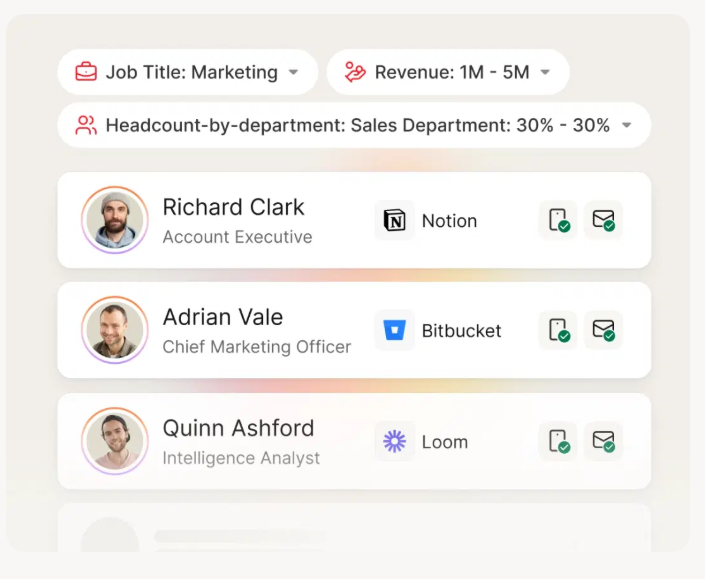
Start with your budget model. Self-serve monthly billing from tools like Apollo and Lusha gives you flexibility to scale up or cancel without penalty. Annual enterprise contracts from ZoomInfo and Cognism lock you in but sometimes unlock deeper discounts. If you aren't sure you'll use a tool for 12+ months, don't sign for 12 months.
Team size changes everything. A solo founder running outbound from a laptop needs a different tool than a 50-AE org with Salesforce, Outreach, and a RevOps team managing data hygiene. Solo reps thrive on Lusha or Snov.io. Larger teams need CRM integrations, admin controls, and usage reporting - and they need those integrations to actually work without manual CSV exports bridging the gap.
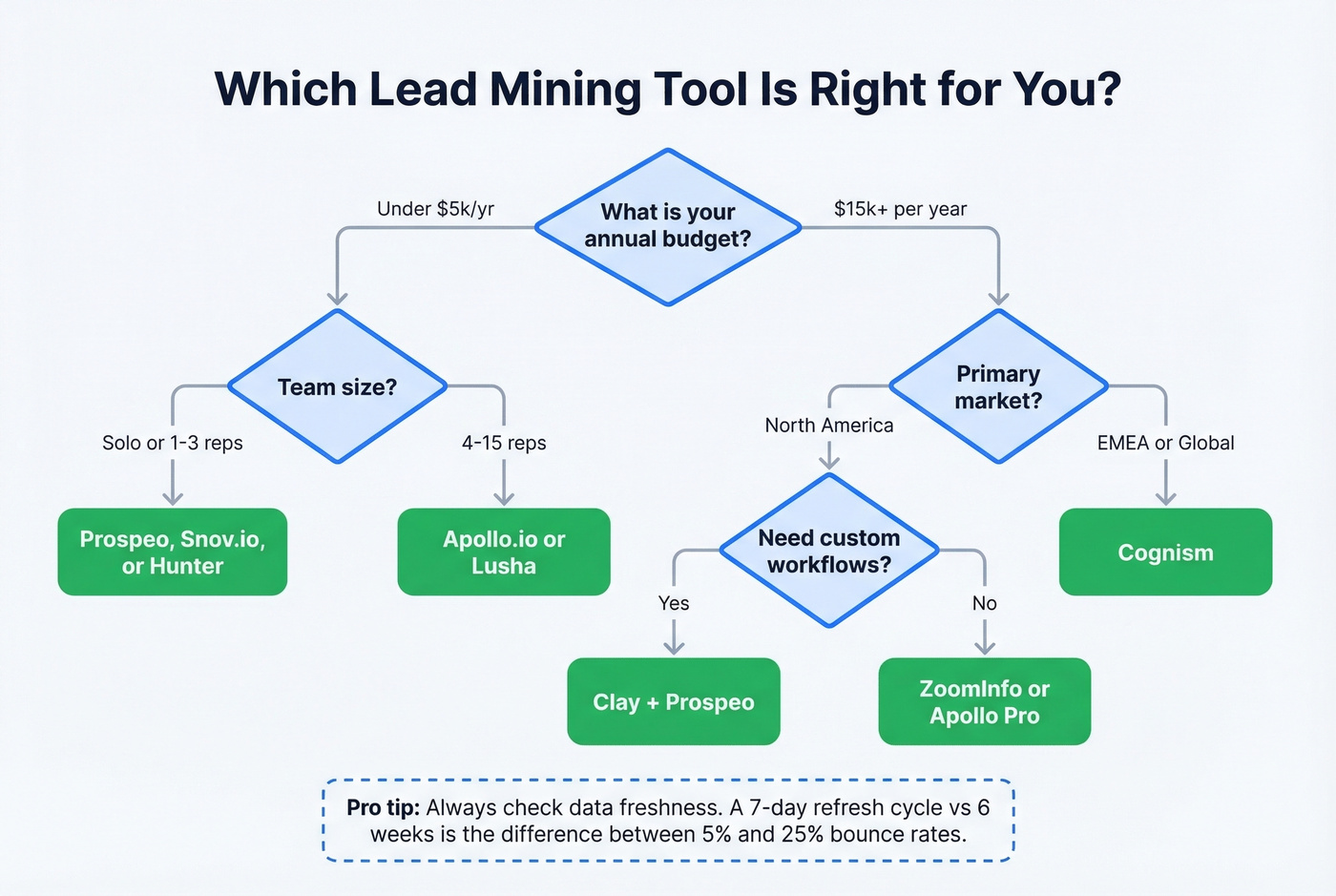
Geography matters more than people think. For teams selling into EMEA, Cognism's compliance stack is hard to beat. NA-only teams have a wider, cheaper field to choose from. Before you trial anything, check native integrations with your existing stack - a tool that doesn't push data cleanly into your CRM creates manual work that kills adoption within weeks.
Let's be honest about data freshness, because it's the factor most buyers underweight. Some practitioners on r/coldemail skip databases entirely, stitching together niche SaaS free trials and AI-powered scraping to build lists at near-zero cost. The time investment is brutal and the data quality is inconsistent, but it highlights a real point: stale data destroys deliverability. A 7-day refresh cycle versus a 6-week cycle is the difference between 5% bounce rates and 25%.
Hidden Costs to Watch
ZoomInfo's sticker price is just the starting point. Add Global Data, extra credits, and NeverBounce verification, and a $15k contract becomes $50k. Apollo's credit non-rollover means you're paying for credits you don't use every month - and automatic overages mean you're paying for credits you didn't plan to use. Cognism's onboarding fees and 10-15% annual renewal bumps compound fast over a 3-year contract.
Clay's credit economics are sneaky: at 5-15 credits per lead and $0.03-$0.075 per credit, a 10,000-lead enrichment run can cost $1,500-$11,250 depending on workflow complexity. Always model your per-lead cost before committing to a plan tier. We've built internal spreadsheets for this and recommend you do the same - the math is never as simple as the pricing page suggests.
Compliance Isn't Optional
EUR 5.88B in cumulative GDPR fines since enforcement began, with EUR 1.2B issued in 2024 alone. Enforcement is accelerating, with regulators focusing on dark patterns and consent manipulation. CCPA adds another layer for US-based prospects, and DNC list violations carry their own penalties.
If your lead mining tool doesn't handle opt-outs and DNC checks natively, the risk is real - and it's your company on the hook, not the vendor. Don't treat compliance as a nice-to-have.
FAQ
What's the difference between lead mining and lead generation?
Lead generation outputs a list of names. Lead mining builds that list AND enriches it with signals like buyer intent, job changes, and funding events - so you know who to contact, when, and why. Most modern B2B tools blend both functions.
How much does lead mining software cost?
Free tiers exist from several tools, while enterprise platforms like ZoomInfo run $40,000+/year fully loaded. Most mid-market teams spend $50-$150 per user per month. Watch for hidden costs like credit overages, onboarding fees, and annual renewal bumps of 10-15%.
Which tool is best for small teams?
For teams under 10 reps, Apollo's free tier and Prospeo's no-contract pricing deliver the most value. Prospeo starts free with 75 verified emails monthly at $0.01/email after that; Apollo offers 50 AI credits and 2 sequences on its free plan. Both let you start prospecting within minutes.
How do I verify contact data accuracy?
Look for built-in email verification, not just a database lookup. Key indicators: stated accuracy rate (98% is best-in-class), data refresh frequency (7 days vs. the 6-week average), and catch-all domain handling. Tools without native verification need a separate layer like NeverBounce or ZeroBounce before you sequence.