

Best Lead Scoring Services and Software, Compared
Most lead scoring failures aren't model failures - they're data failures. Your scoring logic can be brilliant, but if 20% of your CRM emails bounce and half your job titles are stale, reps stop trusting the scores within a month.
The lead scoring market hit $2.23B in 2025 and is growing at 11.4% CAGR. Companies using lead scoring see 138% ROI on lead gen versus 78% without, and those that follow up within the first hour are 7x more likely to qualify a lead. But speed only matters if scoring routes the right leads fast enough.
Our Picks (TL;DR)
| Tool | Type | Best For | Starting Price |
|---|---|---|---|
| Prospeo | Data quality + enrichment | Best data foundation for scoring | Free; ~$0.01/email |
| HubSpot | Native CRM scoring | Best native CRM scoring | $890/mo (3 seats included) |
| MadKudu | Predictive scoring | Best explainable ML scoring | $999/mo for 2 users |
| Breadcrumbs | Dedicated scoring | Best purpose-built scoring UI | $1,999/mo |
| 6sense | ABM intent scoring | Best enterprise account-level intent | ~$60K+/yr |
| Salesforce Einstein | Native CRM scoring | Best for Sales Cloud Enterprise orgs | $165/user/mo + $50/user/mo |
| ActiveCampaign | Marketing automation | Best budget-friendly scoring | ~$15-$50/mo |
| Clay | Enrichment workflows | Best custom scoring workbench | Free at 500 actions/month |
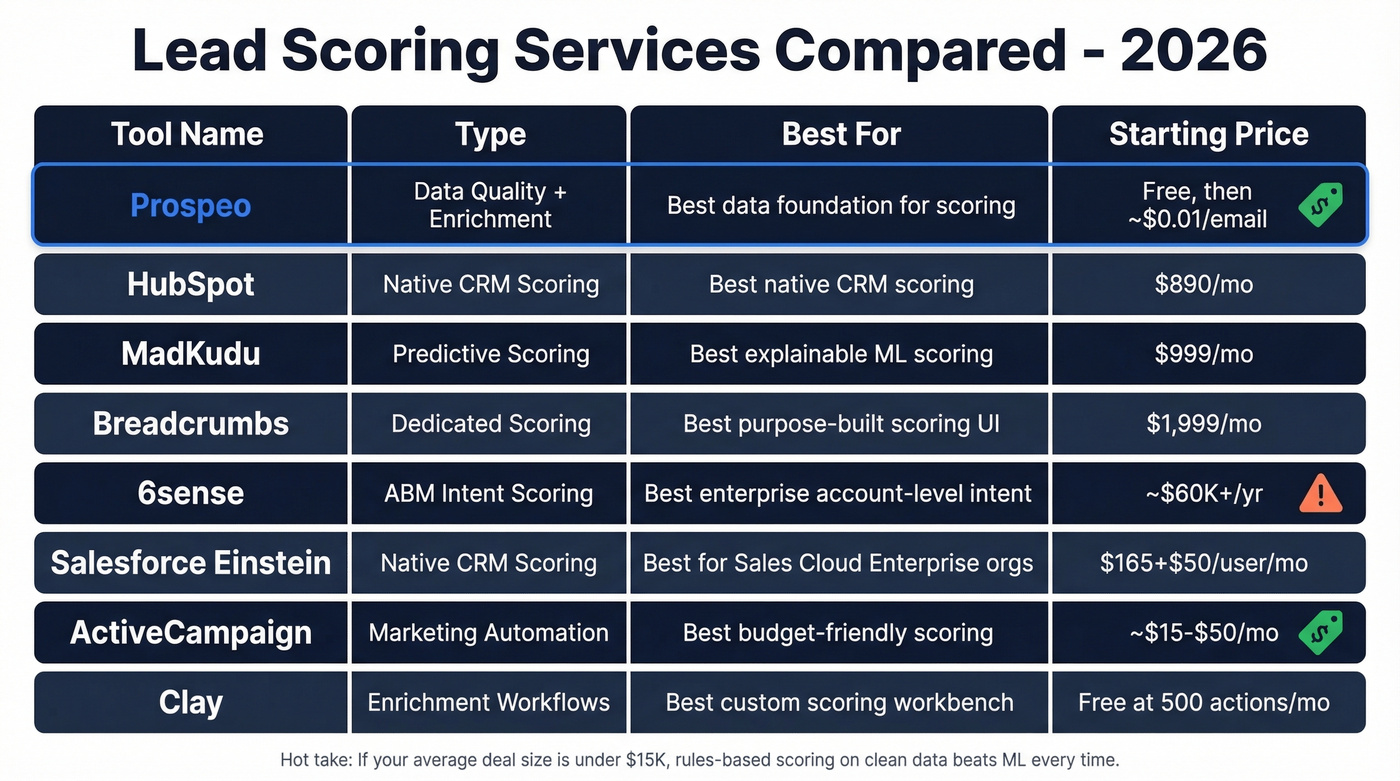
Hot take: If your average deal size is under $15K, you almost certainly don't need a predictive scoring engine. Rules-based scoring on clean data will outperform a fancy ML model trained on dirty records every single time.
Best Lead Scoring Tools in 2026
Prospeo
Your scoring model is only as good as the data it scores. If your CRM is full of bounced emails, outdated titles, and missing firmographics, even the best model produces garbage scores that reps rightfully ignore.
Prospeo solves this upstream problem. It's a B2B data platform with 300M+ professional profiles, 98% email accuracy, and a 7-day data refresh cycle - the industry average is six weeks. CRM enrichment returns 50+ data points per contact, which means your scoring fields stop being blank, stale, or inconsistent. Intent data covers 15,000 Bombora topics so you can layer buying signals directly into your scoring criteria. Native integrations with HubSpot, Salesforce, and Clay mean enriched data flows straight into whatever scoring engine you're running.
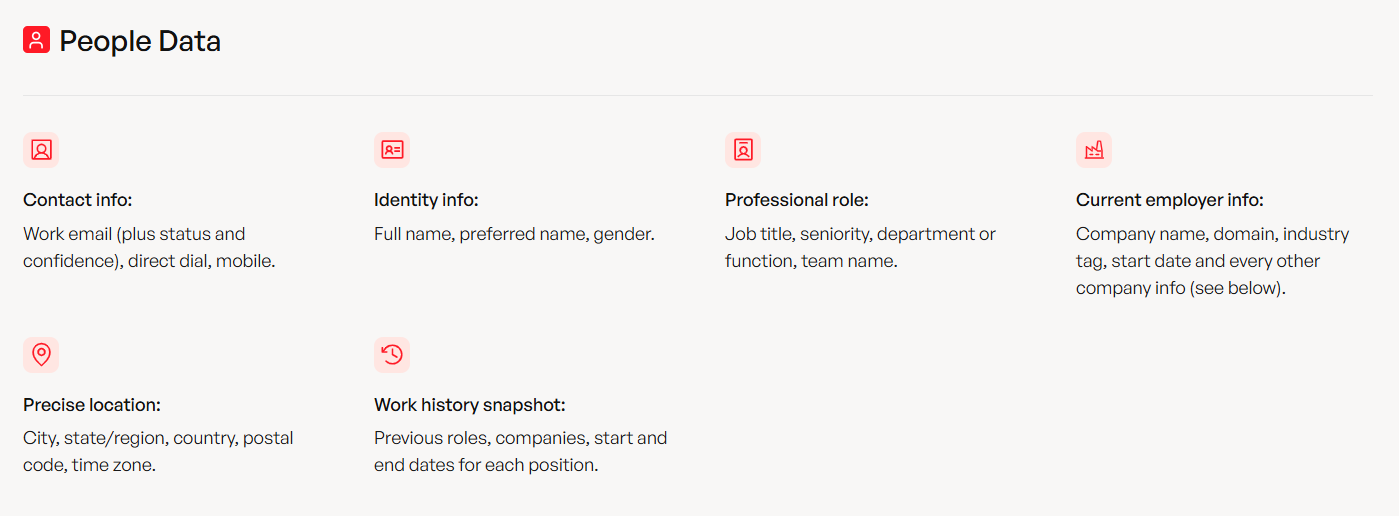
Use this if: Your sales team ignores lead scores because "the data is wrong" - stale titles, bounced emails, missing company info.
Not what you need if: You already have clean, verified CRM data and just need a scoring engine.
Pricing: Free tier with 75 emails/mo, roughly $0.01/email after that, no contracts.
HubSpot
If you're already on HubSpot CRM, native scoring is the path of least resistance. Manual scoring on Professional at $890/mo lets you build rules-based models on fit and behavior - and honestly, that's enough for most mid-market teams. Predictive scoring requires Enterprise at $3,600/mo with a 10-seat minimum plus $3,500 onboarding. Breeze Intelligence adds enrichment starting at $45/mo for 100 credits.
Use this if: You're on HubSpot already and want scoring without adding another vendor.
Skip this if: You need predictive scoring but can't justify the Enterprise jump - that's a $46.7K+ year-one commitment before you score a single lead.
Predictive scoring locked behind Enterprise is overkill for most teams. In our experience, starting with manual scoring on Professional and graduating later is the smarter play.
MadKudu
MadKudu is the best dedicated predictive scoring platform when you need models your VP of Sales can actually understand. Unlike black-box ML tools, MadKudu surfaces feature importance so you see exactly why a lead scored high or low. That explainability is what gets Sales to buy in.
Growth starts at $999/mo for 2 users, Pro runs $2,499/mo for 10 users, and the median annual spend across Vendr's dataset of 43 purchases is roughly $35,000. It carries a 4.6/5 on G2 with 110+ reviews. We've seen teams get real value here, but only after they've already cleaned up their underlying data - MadKudu amplifies whatever quality you feed it.
Use this if: You have 1,000+ converted leads and need transparent predictive scoring.
Skip this if: You're pre-scale with limited conversion data. MadKudu needs training data to shine.
Breadcrumbs
Breadcrumbs lets you create models in three clicks, and the "Copilot" feature analyzes your data to suggest a starting model in seconds. G2 reviewers praise its HubSpot and Pendo integrations, and the company reports up to 30% increased MQL-to-opportunity conversion. Pro starts at $1,999/mo with a 4.3/5 on G2 across 23 reviews.
One heads-up: setup can be challenging for new users. Plan for a learning curve, especially if you haven't built scoring models before.
6sense
Enterprise ABM intent scoring - a great fit when you're monitoring thousands of target accounts and can justify the platform cost. The median buyer pays $58,617/year across 314 Vendr purchases, and mid-market deployments typically run $60K-$100K/year. A free plan offers 50 credits/month, but credits don't roll over.
If your ABM program justifies the spend, 6sense's intent signals are best-in-class. If it doesn't, you're lighting money on fire.
ActiveCampaign vs. Clay
These two serve different ends of the DIY scoring spectrum:
| ActiveCampaign | Clay | |
|---|---|---|
| Approach | Built-in scoring inside marketing automation | Enrichment-powered custom scoring workflows |
| Starting price | ~$15-$50/mo (scoring on higher tiers) | Free at 500 actions/mo; Growth at $495/mo |
| G2 rating | - | 4.7/5 |
| Best for | SMBs running email-driven lead gen | Teams building custom scoring logic from multiple data sources |
ActiveCampaign is the pick if you want basic fit + behavior scoring without a five-figure annual commitment. Clay is the pick if you want a scoring workbench where you pull enrichment data from 100+ providers and build formulas on top.
Salesforce Einstein
If you're already on Sales Cloud Enterprise, Einstein is the path of least resistance for predictive scoring. Sales Cloud Enterprise runs $165/user/mo, plus the Einstein add-on at $50/user/mo. But the real cost is implementation - expect $50K-$500K+ depending on complexity, and the model needs roughly 1,000+ converted leads to train on.
We've seen teams underestimate that implementation timeline by months. For orgs with the data volume and Salesforce commitment, it's powerful. For everyone else, it's an expensive science project.

Every lead scoring failure in this list traces back to the same root cause: dirty data. Prospeo enriches your CRM with 50+ data points per contact, 98% email accuracy, and a 7-day refresh cycle - so your scoring model scores reality, not six-week-old ghosts.
Stop tuning models. Start fixing the data underneath them.
Outsourced vs. In-House Scoring
Not every team should build scoring in-house. Outsourced lead scoring services - typically bundled into managed RevOps or lead gen retainers - run $3K-$15K/month. They can launch in 2-4 weeks versus the 3-6 months it takes to build internally, and agencies estimate 30-40% cost savings versus hiring a full-time RevOps person.
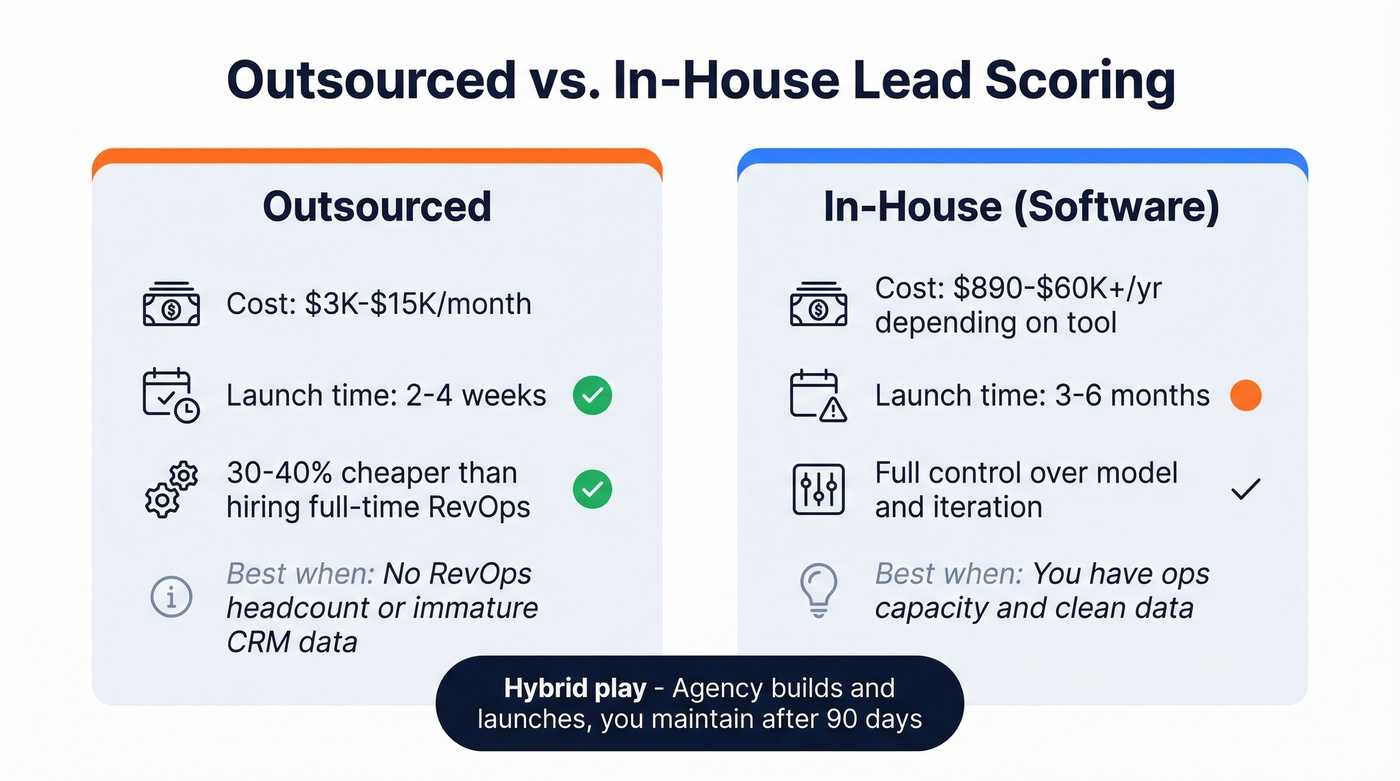
Outsource if you lack RevOps headcount or your CRM data isn't mature enough to support a model. Use software if you have ops capacity, clean data, and want full control. The hybrid play works too: hire an agency to build and launch the model, then bring maintenance in-house after 90 days.
Predictive vs. Rules-Based
| Dimension | Rules-Based | Predictive (ML) |
|---|---|---|
| Transparency | High - you set the rules | Low by default - demand explainability |
| Complexity | Low | Medium-High |
| Data needed | Minimal | ~1,000+ conversions |
| Maintenance | Manual recalibration | Auto-retrains (ideally) |
| Best for | Early-stage, <1K deals | Scaled orgs, 1K+ deals |
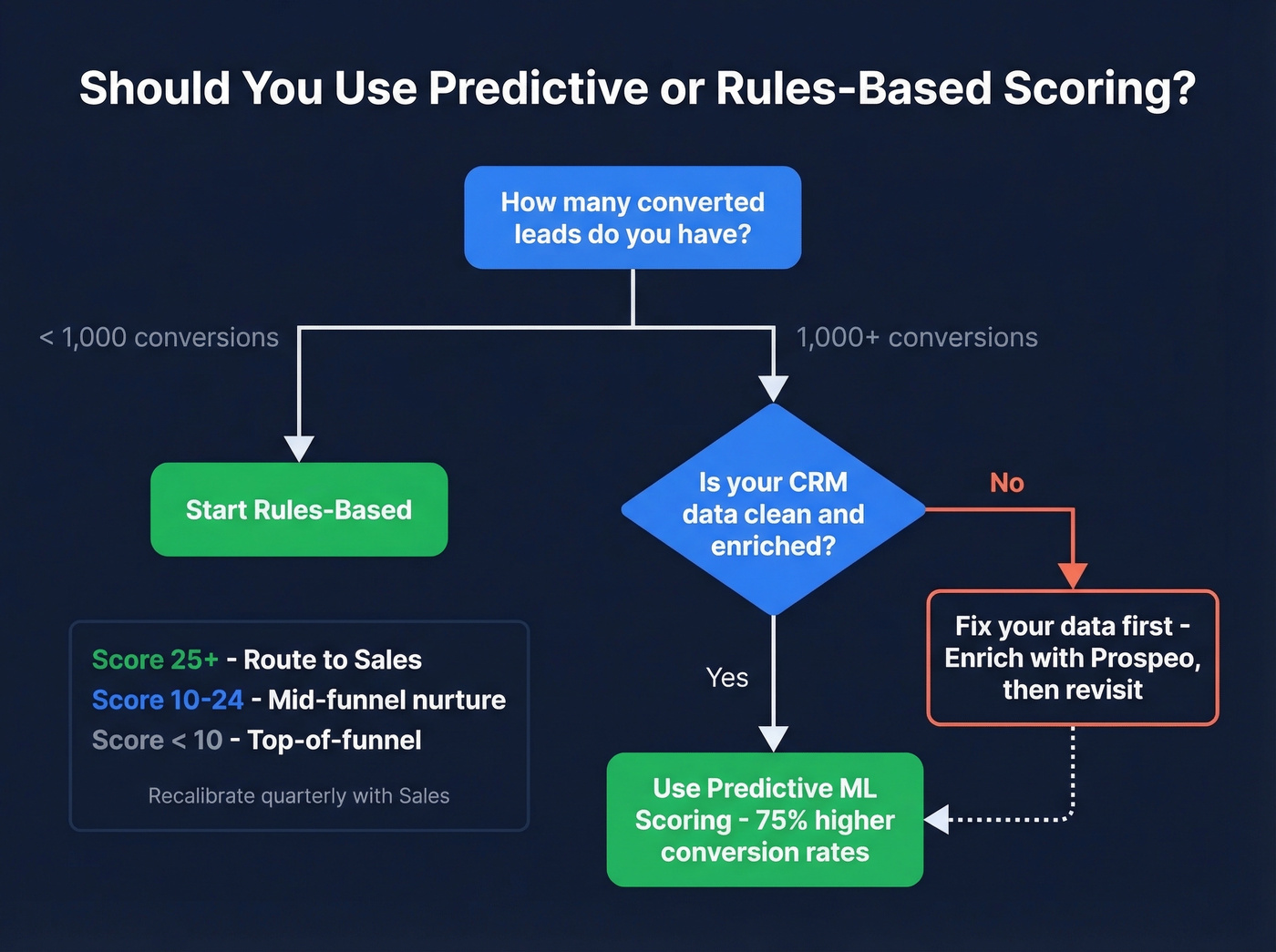
ML models deliver 75% higher conversion rates than rules-based scoring - but only with enough training data. Here's the thing: if you have fewer than 1,000 converted leads, start with rules-based. A popular framework from the r/b2bmarketing community keeps it dead simple - fit plus behavior, three thresholds. Score 25+ routes to Sales, 10-24 gets mid-funnel nurture, under 10 stays top-of-funnel. Recalibrate quarterly. ML models without enough training data just produce confident-sounding nonsense.
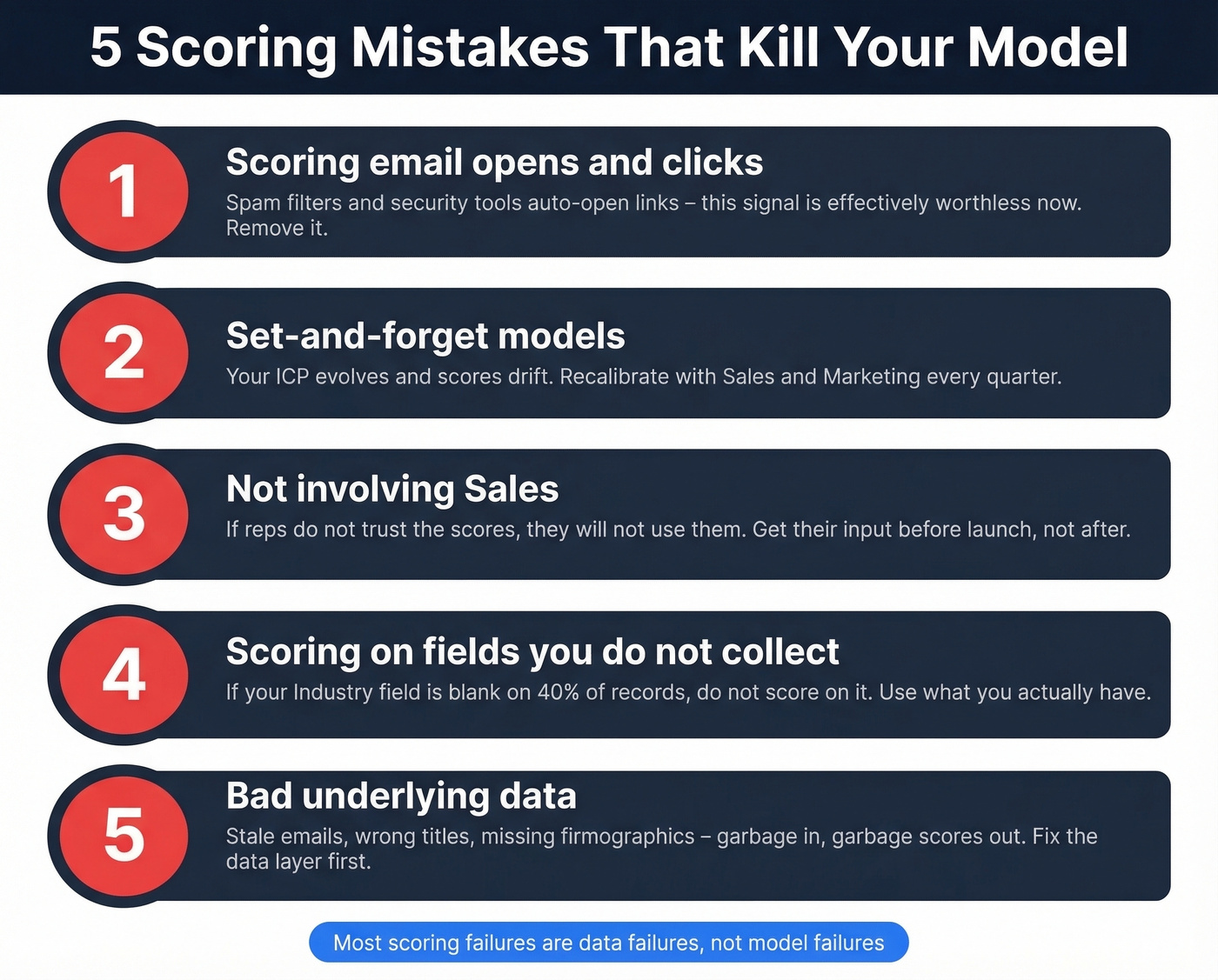
Scoring Mistakes That Kill Your Model
- Scoring email opens and clicks. Spam filters and security tools auto-open and auto-click links - this signal is effectively worthless now. Remove it.
- Set-and-forget models. Your ICP evolves and scores drift. Recalibrate with Sales and Marketing quarterly.
- Not involving Sales. If reps don't trust the scores, they won't use them. Get their input on fit criteria before launch - not after.
- Scoring on fields you don't collect. If your Industry field is blank on 40% of records, don't score on it. Use what you actually have.
- Bad underlying data. Stale emails, wrong titles, missing firmographics - garbage in, garbage scores out. Fix the data layer first. We've watched teams spend months tuning model weights when the real problem was that a third of their contact records were outdated. That's a data enrichment problem, not a scoring problem.
FAQ
What is a lead scoring service?
Either software that automates lead prioritization based on fit and behavior data, or an outsourced agency that builds and manages your scoring model end-to-end. Software handles the logic; outsourced services handle strategy, implementation, and ongoing optimization - typically for $3K-$15K/month.
How much does lead scoring software cost?
Native CRM scoring via HubSpot Professional starts at $890/mo. Dedicated platforms like MadKudu run $999-$2,499/mo. Enterprise intent platforms like 6sense average $58,617/year. Enrichment tools that feed scoring models start free at roughly $0.01/email.
Do I need predictive or rules-based scoring?
If you have fewer than 1,000 converted leads, start rules-based: fit plus behavior, three thresholds. 25+ routes to Sales, 10-24 gets mid-funnel nurture, under 10 stays top-of-funnel. Graduate to ML-based scoring once you have the conversion volume to train a model properly.
What's the best free option to improve lead scores?
Prospeo's free tier (75 emails/mo) lets you verify and enrich CRM contacts before they hit your scoring model - eliminating stale data that tanks score accuracy. Clay also offers 500 free actions/month for building custom scoring workflows from multiple enrichment sources.