

Leadfeeder vs Lead Forensics: Real Pricing, Reviews, and the Gap Neither Fills
About 97% of website visitors leave without filling a form, booking a demo, or doing anything you can route to sales. That's why this Leadfeeder vs Lead Forensics comparison keeps coming up: both tools promise to turn anonymous traffic into a list of companies you can act on.
Here's the thing, though. Company identification is only half the job.
If all you get is "Acme Corp visited your pricing page," you're still stuck doing the hard part: figuring out who inside Acme matters, finding a real email or direct dial, and reaching them before the moment's gone.
30-second verdict
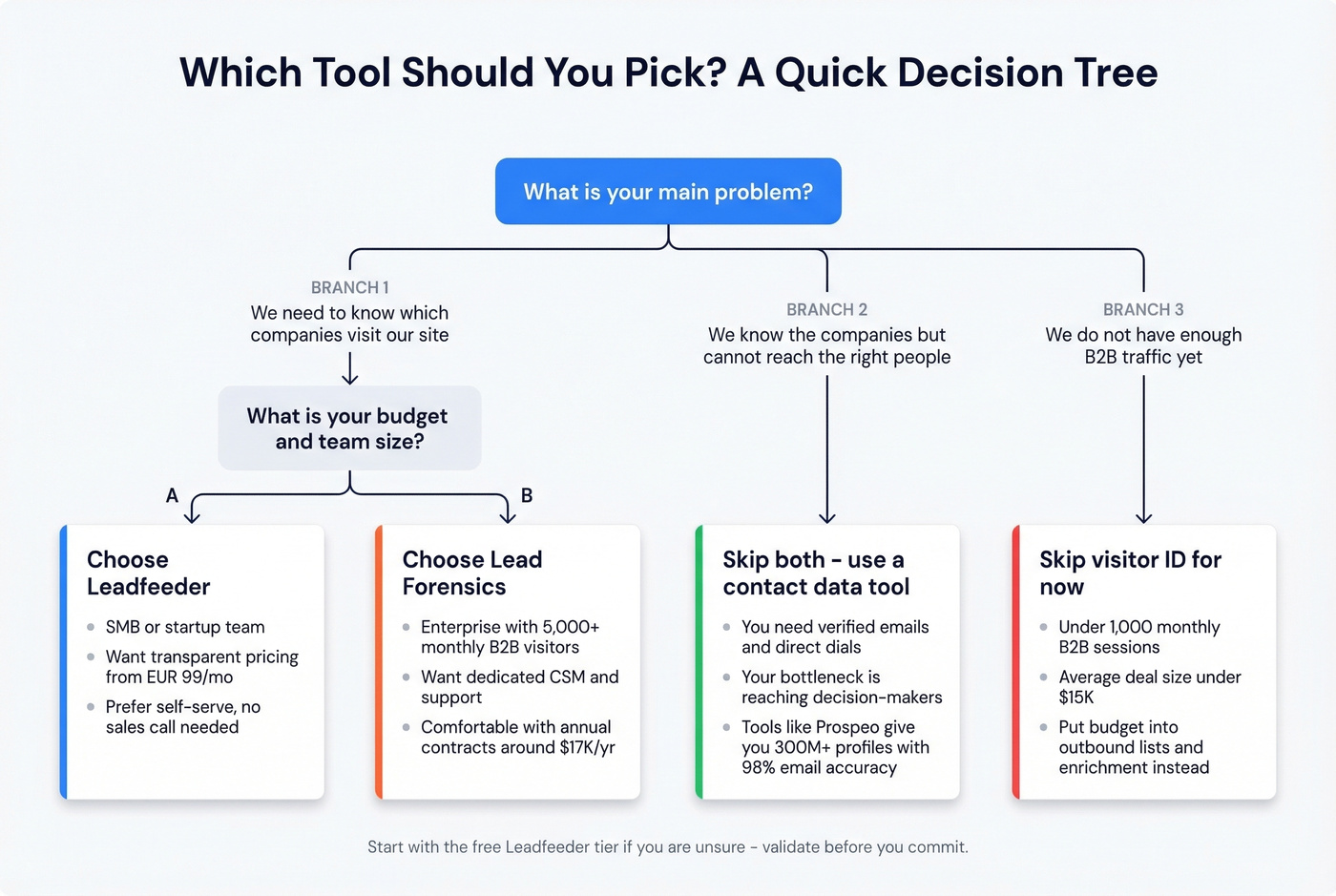
Pick Leadfeeder if you want transparent pricing, a real free tier, and a setup you can do in an afternoon without procurement. It's a strong fit for SMB and self-serve teams.
Pick Lead Forensics if you're an enterprise team with heavy B2B traffic and you value a dedicated CSM. Its support scores are consistently excellent on G2.
Skip both if your real bottleneck is contact data (verified emails and direct dials). Visitor ID won't fix that.
Feature-by-feature comparison
Both tools work the same way at the core: install a snippet, map IPs to companies, then push those companies into workflows (CRM, Slack, email alerts). The differences show up in pricing model, contract terms, and how much hand-holding you want.
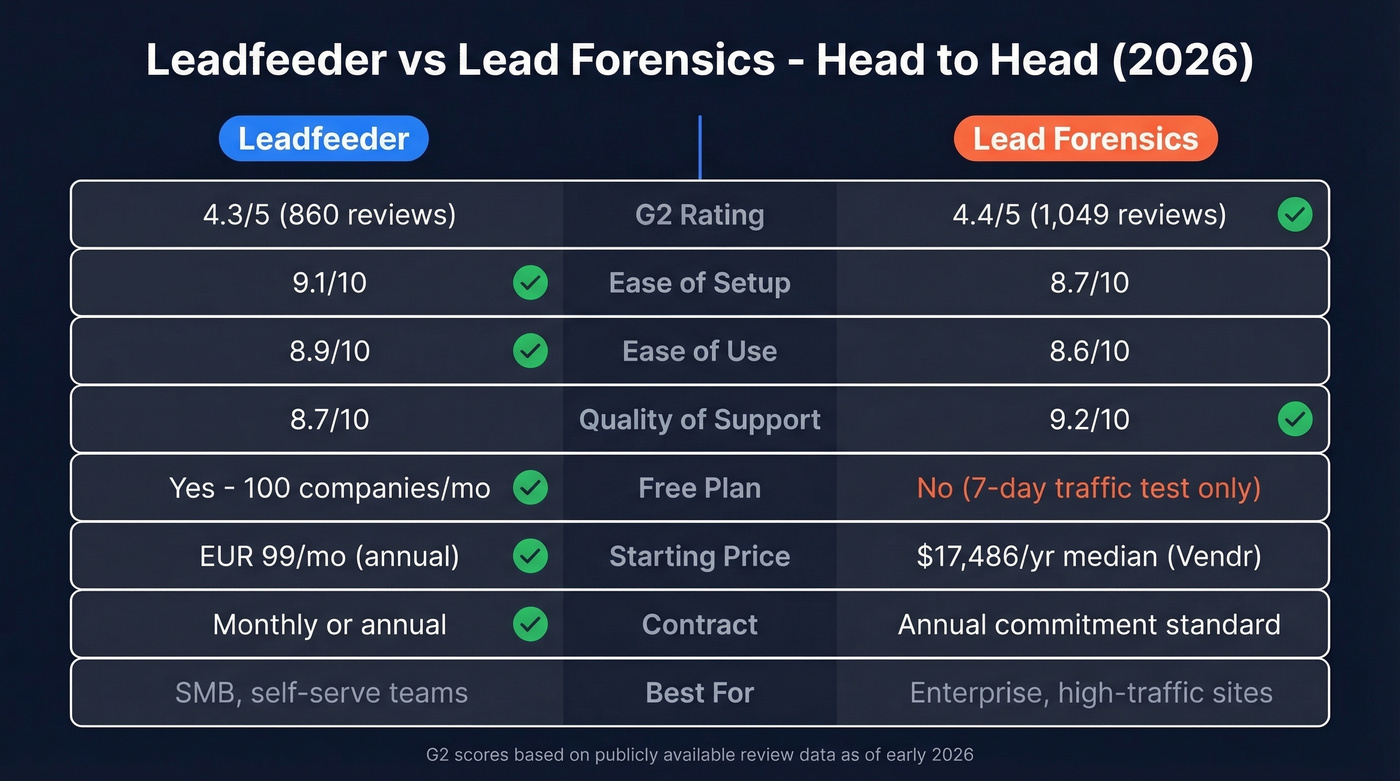
| Dimension | Leadfeeder | Lead Forensics | Edge |
|---|---|---|---|
| G2 rating | 4.3/5 (860 reviews) | 4.4/5 (1,049 reviews) | Lead Forensics |
| Ease of setup | 9.1 (277 responses) | 8.7 (469 responses) | Leadfeeder |
| Ease of use | 8.9 (499 responses) | 8.6 (783 responses) | Leadfeeder |
| Quality of support | 8.7 (407 responses) | 9.2 (758 responses) | Lead Forensics |
| Meets requirements | 8.1 (487 responses) | 8.5 (769 responses) | Lead Forensics |
| Product direction | 7.4 (459 responses) | 8.6 (721 responses) | Lead Forensics |
| Free plan | Yes - 100 companies/mo | No (7-day traffic test) | Leadfeeder |
| Starting price | EUR99/mo (annual) | $17,486/year (Vendr median) | Leadfeeder |
| Contract | Monthly or annual | Annual commitment is standard | Leadfeeder |
| GDPR / security | ISO 27001 + ISO 27701; data processed/stored in the EU | ISO 27001 (certificate valid until 31 Oct 2026) | Leadfeeder (for EU buyers) |
| Key integrations | Salesforce, HubSpot, Pipedrive, Slack, Zapier | Salesforce, HubSpot, Pipedrive, Zapier | Tie |
| Best for | SMB, self-serve teams | Enterprise, high-traffic sites | - |
Leadfeeder merged with Echobot in 2022 and relaunched under the Dealfront brand in 2023, so it now sits inside a broader GTM suite.
Lead Forensics talks publicly about investing heavily in its database and is often described as having 1.4B+ records of company IP information. Whether that matters for your site depends less on the headline number and more on your traffic mix (B2B vs B2C, remote-heavy audiences, and how much of your traffic comes from VPNs).
What you'll actually pay
Leadfeeder pricing (transparent, self-serve)
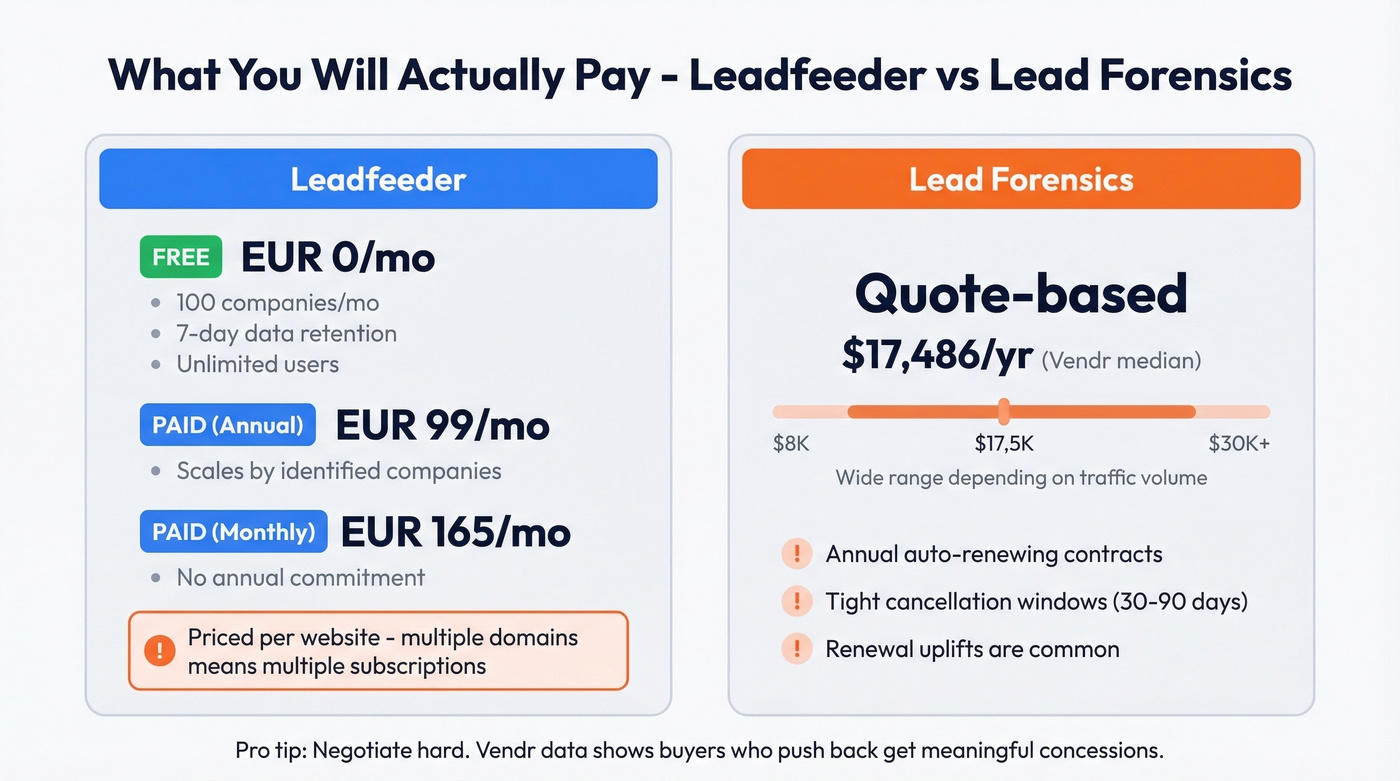
Leadfeeder has a free tier: 100 identified companies per month, 7-day data retention, and unlimited users. Paid plans start at EUR99/month billed annually (or EUR165/month billed monthly), and pricing scales by identified companies per month.
A few details that catch teams off guard:
- Pricing is per website. If you run multiple domains, you're paying multiple subscriptions.
- The free tier is useful for validation, but that 7-day retention disappears fast once you start testing workflows.
- The 14-day trial doesn't require a credit card, which makes it easy to test with real traffic.
Lead Forensics pricing (quote-based, contract-heavy)
Lead Forensics doesn't publish list pricing. You run a 7-day traffic test, then you get a quote. The Vendr benchmark puts the median buyer at $17,486/year (with a wide range).
Real talk: the contract structure is the bigger risk than the sticker price.
Annual agreements with auto-renewal are common, cancellation windows can be tight (often 30-90 days), and it's normal to see renewal uplifts. We've watched a team miss the cancellation window by a week and end up paying for a second year they didn't want. That kind of mistake is avoidable, but only if someone owns the calendar and the renewal terms from day one.
If you're going to buy Lead Forensics, negotiate like you mean it. Vendr also shows examples where buyers got meaningful concessions (price drops plus free months) by pushing back.

Both Leadfeeder and Lead Forensics stop at the company name. Your SDRs still need verified emails and direct dials to actually book meetings. Prospeo skips the guesswork - 300M+ profiles, 98% email accuracy, 125M+ verified mobiles, all refreshed every 7 days. Build lists by role, intent, and company signals, then reach out directly.
Stop paying to know who visited. Start paying to reach them.
What users actually say (reviews, not marketing)
Review sites aren't perfect, but they're still the fastest way to spot patterns that show up after month two.
Lead Forensics sits at 4.4/5 on G2 and has a strong Trustpilot presence (Trustpilot page). The consistent positives are support and account management. The consistent negatives are lead relevance and contact freshness, plus frustration about contracts.
Leadfeeder is at 4.3/5 on G2 (G2 comparison page). People like the setup and usability, and they like knowing what they'll pay before a sales call. The most common hesitation is product direction uncertainty after the Dealfront shift, which shows up in that lower "product direction" score.
Reddit threads on this exact matchup are thin, but the vibe on r/sales and RevOps communities is consistent: teams don't regret testing visitor ID tools; they regret signing long contracts before they know their match rate and downstream conversion.
The gap both tools leave (and why it matters)
Both tools are built to identify companies, not reliably identify the person behind the visit. You'll see "Acme Corp visited your pricing page three times this week," and then your SDR still has to:
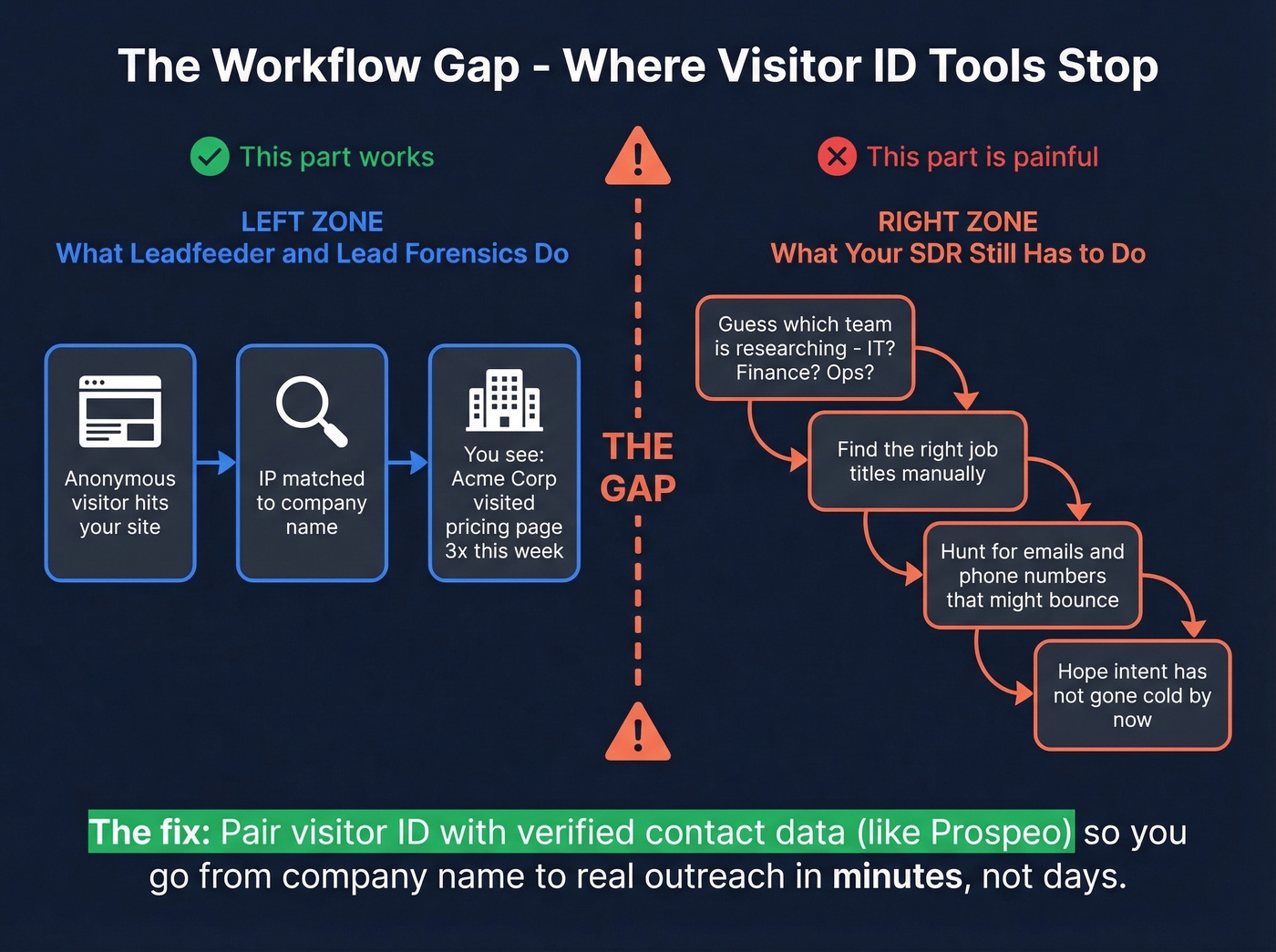
- guess which team is researching (IT? finance? ops?)
- find the right titles
- find contact details that won't bounce
- reach them before the intent cools off
And yes, the identification problem's getting worse. Remote work and VPN usage reduce IP-to-company resolution, and most sites end up with a company match rate that feels lower than you'd expect once you look at total sessions, not just the "identified" bucket.
A quick scenario we see a lot: a 12-person SaaS team installs a visitor ID tool, gets excited by the first week of logos, then realizes half the "wins" are agencies, students, competitors, or existing customers. Now they're paying for a dashboard that mostly tells them what they already knew: people are browsing.
Let's break this down into a simple decision: if your pipeline depends on reaching specific decision-makers, you need contact data that stands on its own, not a tool that waits for someone to show up on your site.
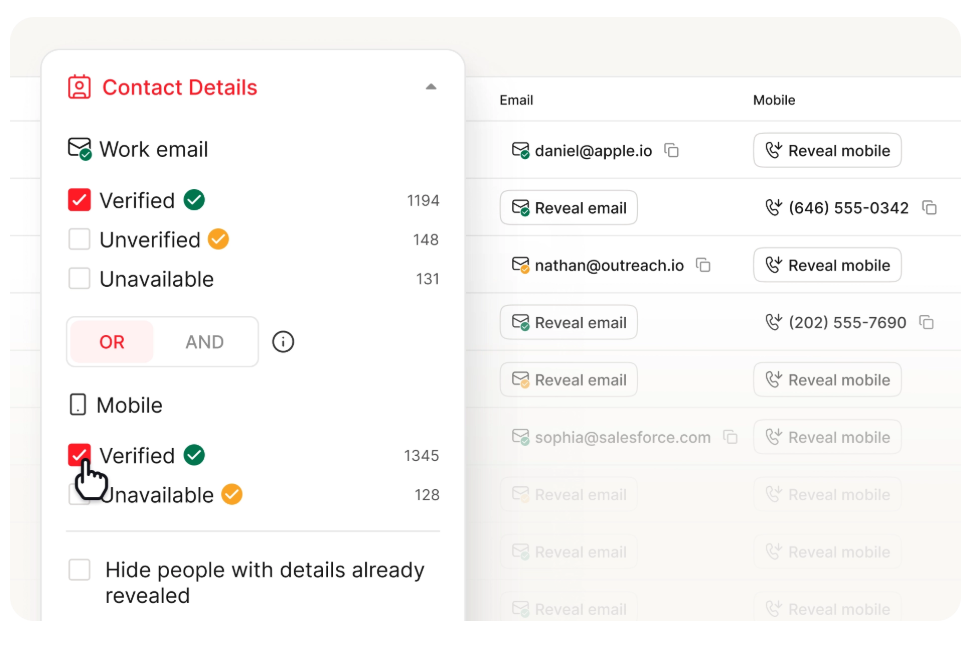
That's where tools like Prospeo fit naturally alongside (or instead of) visitor ID. Prospeo gives you 300M+ professional profiles, 143M+ verified emails, and 125M+ verified mobile numbers, refreshed every 7 days, with 98% email accuracy. You build lists by role, company, and intent topics, then reach out directly. No waiting, no guessing who the visitor was, and no "cool, but who do we email?" moment.
Who should choose what?
Choose Leadfeeder if...
You're moving fast, you don't want procurement involved, and you want to validate visitor ID before you commit. Leadfeeder's free tier is genuinely useful for a first pass, and the pricing model is easy to understand.
It's also a good fit when your sales motion is already tight: you have clear ICP filters, you know which pages matter (pricing, integrations, security), and you can route "company visited X page" into a workflow that gets acted on within hours.
Choose Lead Forensics if...
You're operating at enterprise volume and you want a vendor relationship, not just a tool. If your site gets serious B2B traffic and you have the team to work the leads, the higher support scores and the CSM model can be worth it.
Just don't treat it like a plug-and-play widget. It works best when RevOps and sales agree on routing rules, exclusions (customers, partners, job seekers), and what counts as a "sales-ready" visit.
Skip both if...
You don't have enough traffic, or you already know your problem isn't "which company visited" - it's "we can't reach the right people."
If your average deal size is under $15k, we're opinionated here: visitor identification is often a distraction. Put that budget into better outbound lists, cleaner enrichment, and verified mobiles so reps can actually connect.
FAQ
Is Lead Forensics worth the price?
For enterprise teams with high B2B traffic, it can be. The median buyer pays $17,486/year and usually signs an annual, auto-renewing contract, so the economics only work if you have enough identifiable sessions and a team that follows up fast.
Below roughly 5,000 monthly B2B visitors, many teams find the cost per useful lead gets ugly once you filter out noise, and you still need a separate source for verified contact details.
Can Leadfeeder identify individual visitors?
No. Like Lead Forensics, Leadfeeder identifies companies via reverse IP lookup, not individual people.
If you need decision-maker contact details, pair visitor ID with a contact data platform. Prospeo, for example, provides verified emails (98% accuracy) and verified mobile numbers, so you can go from "target account" to "real outreach" without guessing.
Which tool has better data accuracy?
At the company level, both can work well, but your match rate depends heavily on your audience and traffic sources. Remote-heavy traffic and VPN usage reduce resolution.
At the contact level, neither tool is designed to be your source of truth for verified emails and direct dials. Use a dedicated B2B data platform for that part of the workflow.
Visitor ID tools cost $2K-$17K/year and still leave you Googling for contact info. Prospeo delivers verified emails at $0.01 each with 98% accuracy - no annual contracts, no sales calls, no guessing which person at Acme Corp was browsing your pricing page.
Skip the visitor ID middleman and go straight to decision-makers.